
 Download PDF
Market Overview
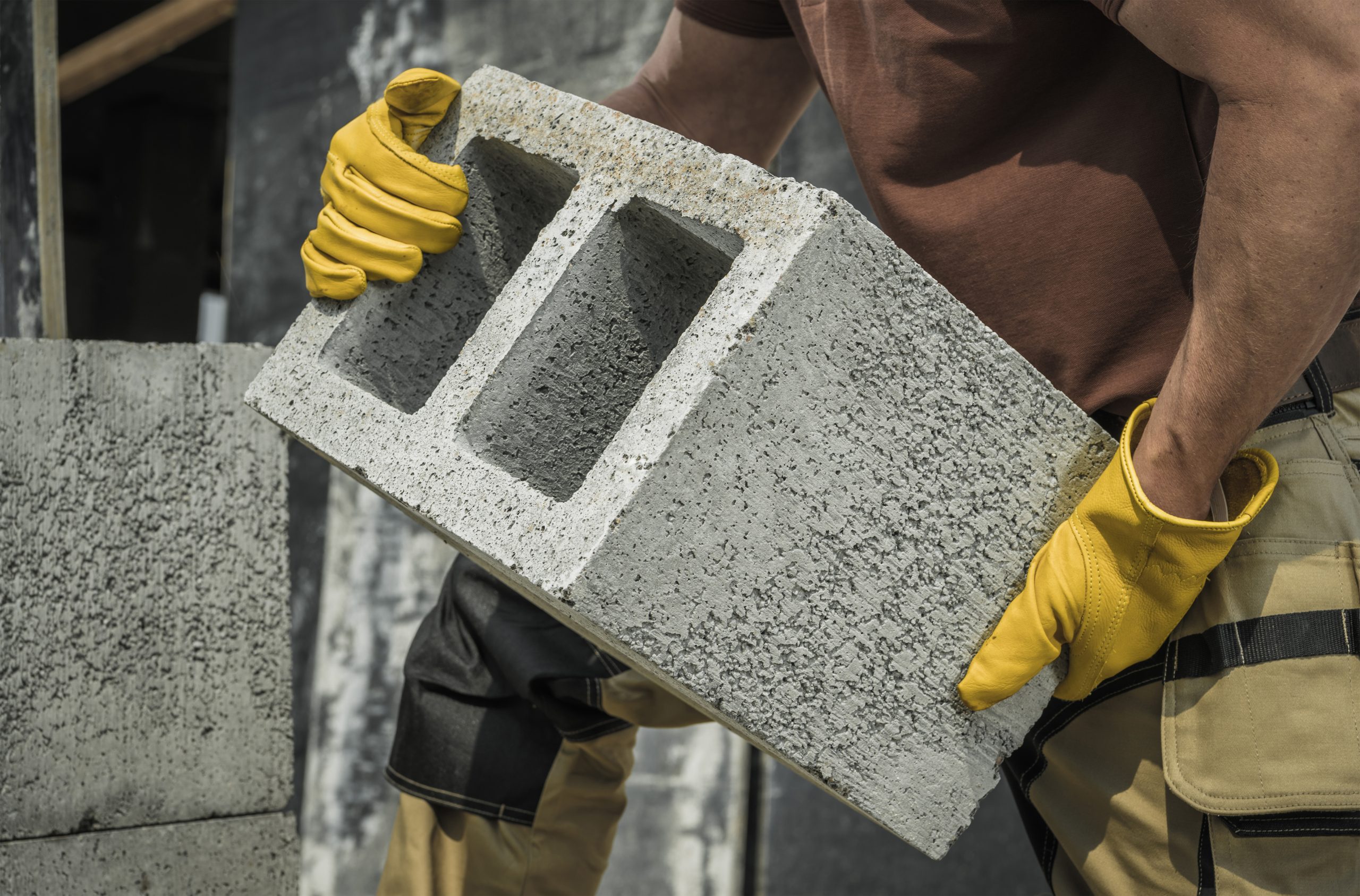
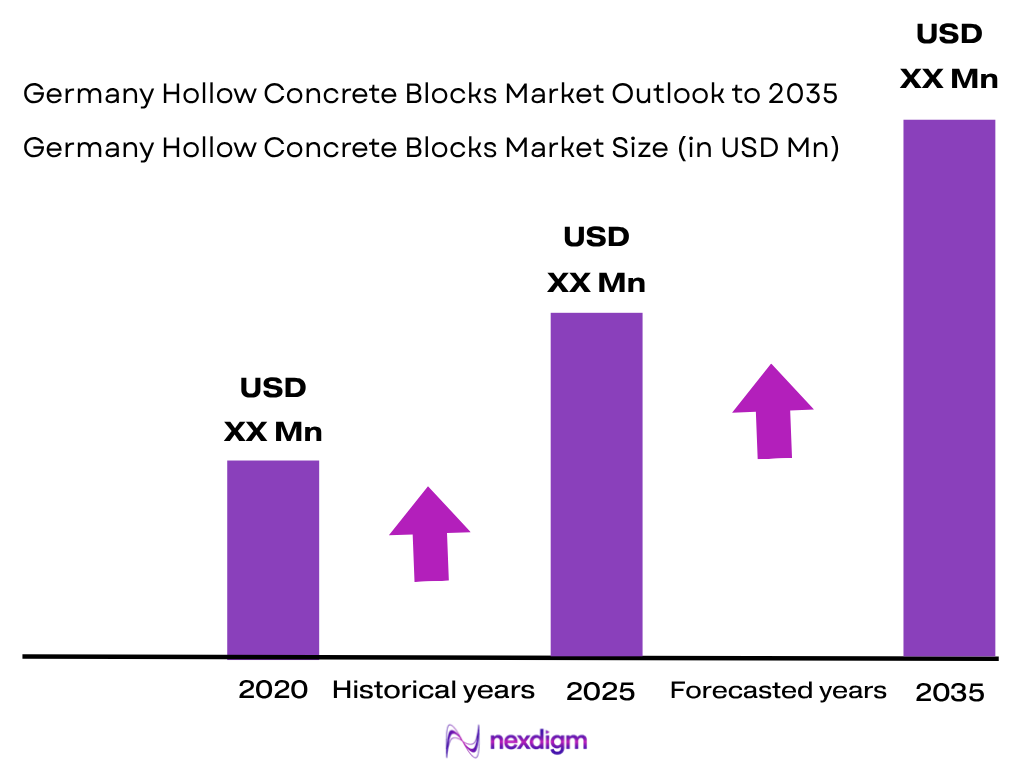
The Germany Hollow Concrete Blocks Market is valued at approximately USD ~ million, based on historical market assessment. Demand is supported by residential construction, renovation and thermally efficient masonry requirements. Germany completed 294,399 dwellings in the preceding period and 251,937 dwellings in the latest period, while completed residential floor space moved from 29.54 million square meters to 24.77 million square meters. Lightweight concrete masonry remains relevant for structural, thermal, acoustic and fire-resistant wall construction.
North Rhine-Westphalia, Bavaria, Baden-Württemberg and Rhineland-Palatinate are important demand centers for the Germany Hollow Concrete Blocks Market because of their large housing stocks, construction ecosystems and building-material manufacturing networks. Germany’s dwelling stock increased from approximately 43.52 million units to 43.76 million units, while total residential floor space exceeds 4 billion square meters. Rhineland-Palatinate additionally benefits from established natural-pumice and lightweight-concrete manufacturing clusters around the Rhine-Neuwied basin.
Market Segmentation
By Product Type
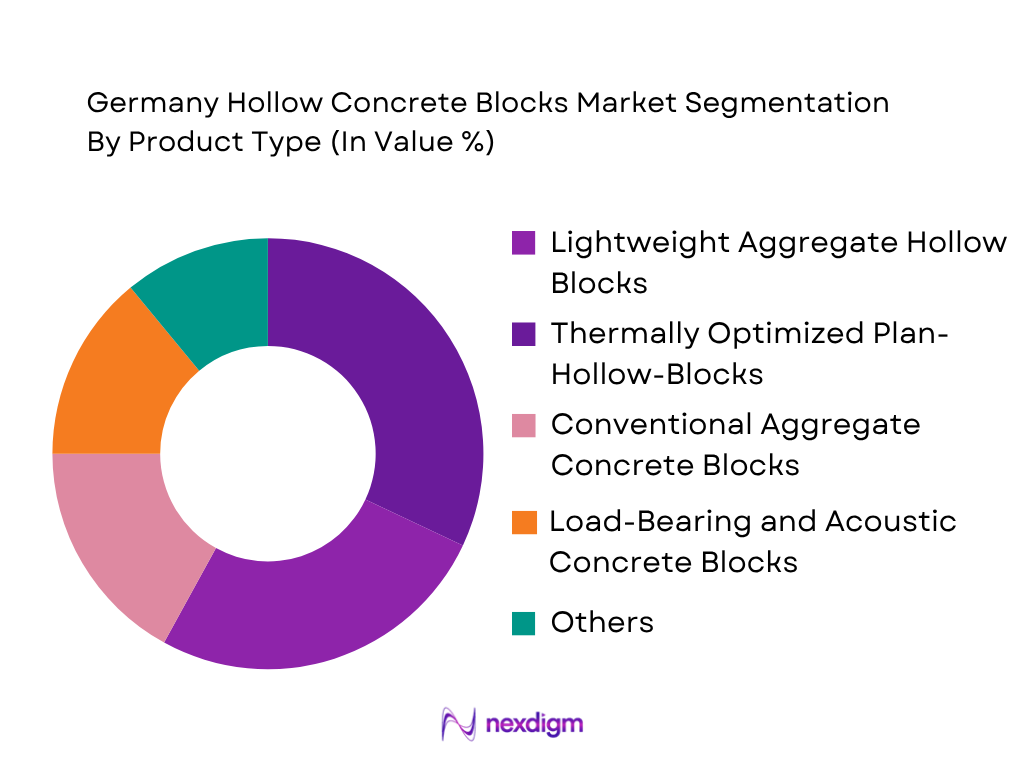
By Product Type, the Germany Hollow Concrete Blocks Market is segmented into lightweight aggregate hollow blocks, thermally optimized plan-hollow-blocks, conventional aggregate concrete blocks, load-bearing and acoustic blocks, and insulated/specialty masonry units. Lightweight aggregate hollow blocks and plan-hollow-block systems hold the dominant position because German masonry construction places substantial emphasis on combining structural performance with thermal insulation, fire resistance and acoustic characteristics. Natural-pumice-based lightweight concrete is particularly established in Rhineland-Palatinate, where specialized manufacturers have developed complete masonry systems rather than individual commodity blocks. These systems include exterior-wall blocks, internal load-bearing units, acoustic products, complementary blocks and thin-bed mortar solutions. Monolithic construction also benefits from masonry units capable of achieving thermal-envelope requirements without excessively complicated wall assemblies. Integrated-insulation blocks provide additional differentiation. Conventional dense concrete masonry remains relevant for internal walls, basements and applications prioritizing strength, while AAC, clay masonry and calcium-silicate products create strong competition across Germany’s broader masonry-material industry.
By Application
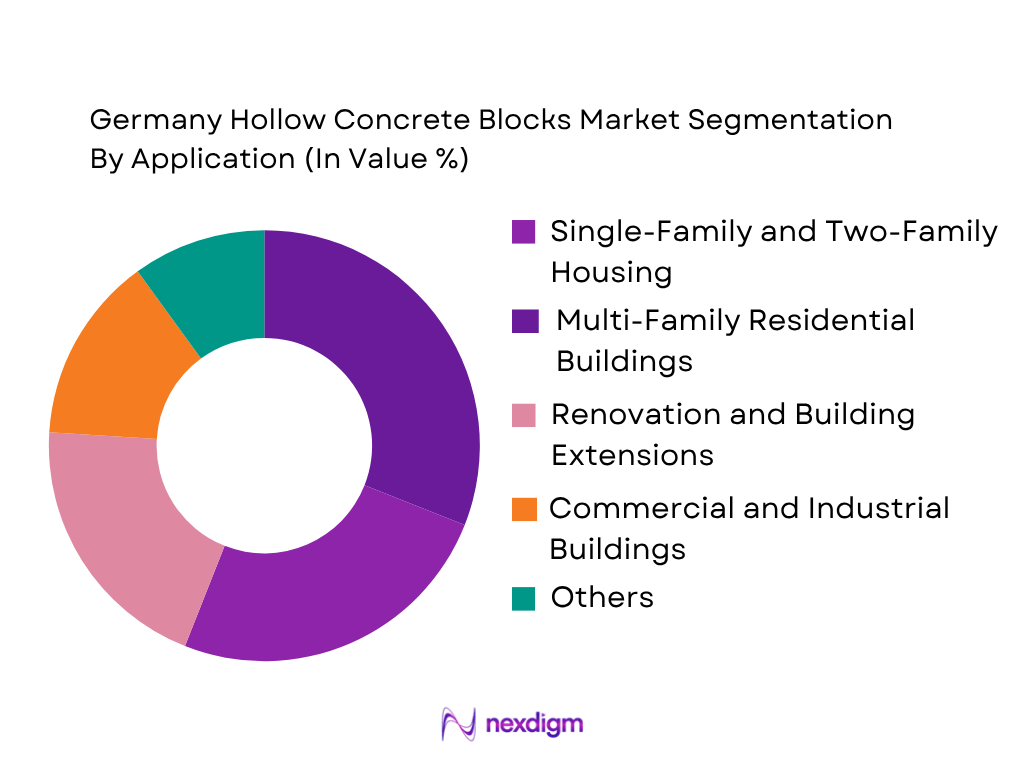
By Application, the Germany Hollow Concrete Blocks Market is segmented into single-family and two-family housing, multi-family residential buildings, renovation and building extensions, commercial and industrial buildings, and institutional/public construction. Residential construction remains the most important application because hollow and lightweight concrete masonry is suited to load-bearing external walls, internal structural walls, acoustic separation and thermally optimized building envelopes. Single-family housing has traditionally provided particularly suitable applications for monolithic lightweight-concrete construction. However, Germany’s contraction in new residential construction is increasing the strategic importance of renovation, extensions and multi-family buildings. Manufacturers are consequently developing masonry systems capable of supporting greater structural loads, improved acoustic separation and thinner wall assemblies. Germany’s large existing building stock also creates opportunities for extensions, conversions and replacement construction. Commercial and institutional applications contribute additional demand where fire protection, acoustic performance and durable mineral construction are prioritized, although concrete masonry competes with reinforced concrete, calcium-silicate blocks and other wall systems.
Competitive Landscape
The Germany Hollow Concrete Blocks Market includes specialist lightweight-concrete masonry companies, regional natural-pumice manufacturers and diversified concrete-product suppliers. KLB Klimaleichtblock, Bisotherm and JASTO represent prominent specialized masonry-system providers, particularly in lightweight concrete. Competition centers on thermal conductivity, compressive strength, density, acoustic insulation, fire performance, wall thickness and compatibility with efficient masonry installation. Regional production remains important because concrete masonry is heavy, making decentralized manufacturing and short delivery distances commercially advantageous.
| Company | Establishment Year | Headquarters | Core Masonry Technology | Thermal Masonry Capability | Structural Product Range | Natural Lightweight Aggregate Capability | Technical Compliance Focus | Distribution Model |
| KLB Klimaleichtblock GmbH | 1980s | Andernach | ~ | ~ | ~ | ~ | ~ | ~ |
| Bisotherm GmbH | 1985 | Mülheim-Kärlich | ~ | ~ | ~ | ~ | ~ | ~ |
| JASTO Baustoffwerke | 1949* | Ochtendung | ~ | ~ | ~ | ~ | ~ | ~ |
| Trasswerke Meurin | 1862 | Nickenich | ~ | ~ | ~ | ~ | ~ | ~ |
| Gebr. Zieglowski | Established Producer | Kruft | ~ | ~ | ~ | ~ | ~ | ~ |
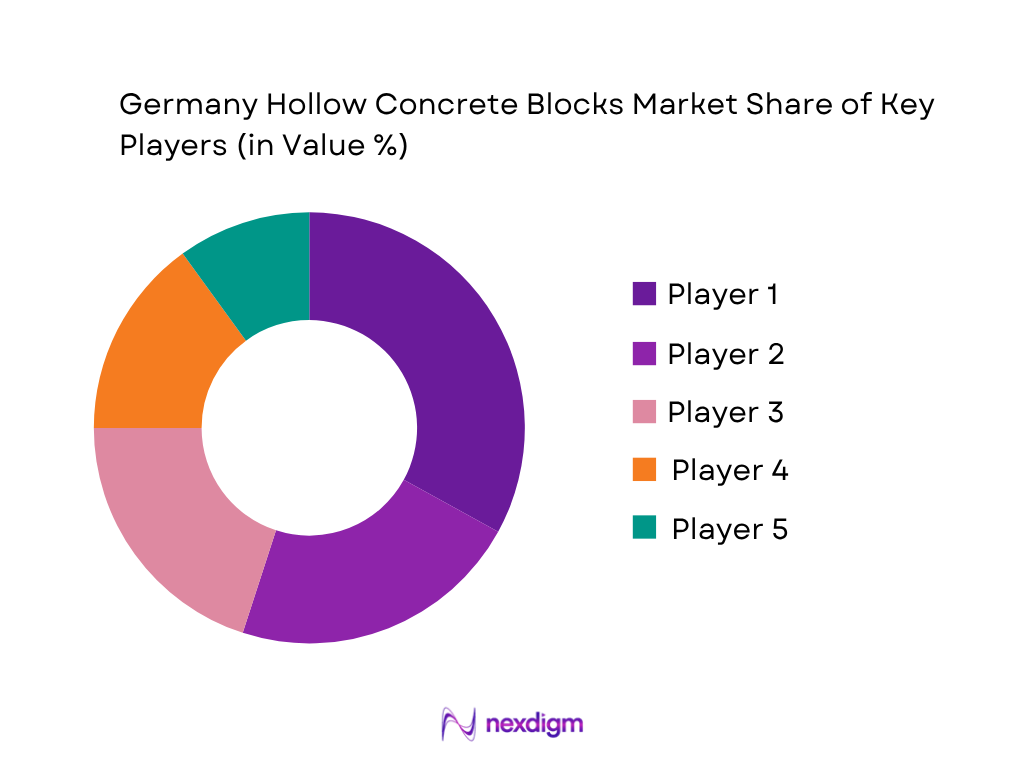
Germany Hollow Concrete Blocks Market Analysis
Growth Drivers
Housing Requirement and Large Residential Construction Backlog Supporting Concrete Masonry Demand
Germany’s continuing housing requirement provides an important demand foundation for the hollow concrete blocks market despite weakness in current construction completions. The country had 43,755,726 dwellings in 2024, increasing to 43,951,556 dwellings in 2025, while total residential floor space expanded from 4.112 billion square meters to 4.132 billion square meters. More importantly for construction-material suppliers, Germany ended 2024 with 759,700 approved but unfinished dwellings, including 330,000 units already under construction. This pipeline creates continuing requirements for load-bearing walls, external envelopes, internal partitions, acoustic separation and other masonry applications. Housing completions reached 251,937 dwellings in 2024, including 220,666 dwellings in newly constructed buildings. Germany’s macroeconomic scale also provides a substantial underlying construction economy: nominal GDP reached USD 4.69 trillion in 2024, while GDP per capita stood at USD 56,103.7. Hollow and lightweight concrete block suppliers can particularly address multi-family and energy-efficient residential construction through thermally optimized plan blocks, acoustic masonry and mineral wall systems combining structural, fire and insulation performance.
Existing Building Renovation and Conversion Expanding the Addressable Masonry Base
Germany’s exceptionally large existing building stock is increasing the strategic importance of renovation, conversion and extension activity for hollow concrete block manufacturers. The country contained 43,755,726 dwellings with 4.112 billion square meters of residential floor space in 2024, including approximately 23.5 million dwellings in 3.5 million multi-family buildings. Construction activity on existing buildings contributed 153,548 additional dwellings and 14.326 million square meters of residential floor space during 2024, demonstrating that existing structures already represent a material channel for housing creation. This remained stable in 2025, when building measures on existing properties added 154,279 dwellings and 14.217 million square meters. Germany’s USD 4.69 trillion GDP and USD 56,103.7 GDP per capita in 2024 provide the macroeconomic context for investment in a mature building stock. For the Germany Hollow Concrete Blocks Market, renovation and conversion create applications for lightweight partition walls, building extensions, replacement masonry, additional floors and reconfigured internal spaces, favoring lightweight aggregate blocks that combine lower unit weight with mineral fire protection, acoustic performance and compatibility with existing masonry structures.
Market Challenges
Residential Building Permit Contraction Reducing the Immediate New-Build Demand Pool
The sharp contraction in Germany’s residential construction pipeline represents the most direct challenge for hollow concrete block suppliers. Building approvals covered 215,289 dwellings in 2024, compared with a substantially larger construction pipeline entering the period, while approvals for newly constructed buildings accounted for only 175,950 dwellings and 16.225 million square meters of residential floor space. Completed dwellings also fell to 251,937 units in 2024 and declined further to 206,586 units in 2025; new-building completions decreased from 220,666 to 175,867 dwellings over the same period. The number of completed buildings and construction measures moved from 161,682 to 139,481. Although permits recovered to 238,063 dwellings in 2025, Germany simultaneously recorded 35,700 expired housing permits, compared with 29,000 in 2024, illustrating difficulties in converting approved projects into physical construction. The broader economy generated USD 4.69 trillion in GDP in 2024, but real GDP contracted during the year. For concrete masonry manufacturers, fewer active new-build projects intensify competition among hollow concrete, clay, AAC and calcium-silicate wall systems for a reduced pool of residential developments.
Construction-Sector Stress and Project Delays Increasing Pressure on Masonry Suppliers
Germany’s hollow concrete block manufacturers face a challenging operating environment because project delays and financial stress across the construction ecosystem can reduce order visibility and postpone material deliveries. At the end of 2024, Germany had 759,700 approved dwellings that had not been completed, with only 330,000 already under construction. The backlog remained at approximately 760,700 dwellings at the end of 2025, but the number actually under construction decreased to 307,200. Meanwhile, expired residential building permits increased from 29,000 in 2024 to 35,700 in 2025, demonstrating that a significant portion of planned construction is failing to progress within authorization periods. Construction-sector insolvencies affected 11,378 employees in 2025, further illustrating stress among building contractors and related businesses. Germany’s macroeconomic backdrop was also weak despite nominal GDP of USD 4.69 trillion and GDP per capita of USD 56,103.7 in 2024. These conditions affect hollow-block suppliers through delayed site schedules, irregular factory dispatches and lower capacity utilization, while heavy masonry products additionally require efficient regional production and logistics to avoid uneconomic long-distance transportation.
Market Opportunities
High-Performance and Energy-Efficient Concrete Masonry Positioned for Building Modernization
Germany’s transition toward more energy-efficient buildings creates an opportunity for thermally optimized plan-hollow-blocks, lightweight aggregate masonry and integrated-insulation concrete blocks. The addressable building base is substantial: Germany contained 43,755,726 dwellings and 4.112 billion square meters of residential floor space in 2024, increasing to 43,951,556 dwellings and 4.132 billion square meters in 2025. Building activity on existing properties alone generated 153,548 additional dwellings and 14.326 million square meters of residential space in 2024, followed by 154,279 dwellings and 14.217 million square meters in 2025. Federal energy-efficiency financing currently permits renovation loans of up to EUR 150,000 per residential unit, while municipal energy-efficient renovation financing can reach EUR 10 million for non-residential buildings. Germany’s economic base stood at USD 4.69 trillion in GDP and USD 56,103.7 GDP per capita in 2024. These conditions create room for hollow-block manufacturers to develop masonry systems combining lower thermal conductivity, structural capacity, acoustic insulation and mineral fire protection for extensions, conversions, replacement construction and comprehensive energy-efficiency renovation.
Multi-Family, Conversion and Lightweight Masonry Creating Diversification Opportunities
Germany’s housing structure creates an opportunity for hollow concrete block manufacturers to move beyond dependence on new single-family construction and target multi-family buildings, conversions and higher-performance internal masonry. Approximately 23.5 million dwellings were located in 3.5 million multi-family buildings in 2024, compared with 13.5 million single-family houses, making multi-storey residential construction a substantial potential application base for lightweight structural and acoustic masonry. Germany also recorded 153,548 dwellings added through construction measures on existing buildings in 2024, rising to 154,279 in 2025, while corresponding floor-space additions reached 14.326 million and 14.217 million square meters, respectively. At the same time, the construction backlog remained substantial at 759,700 approved but unfinished dwellings in 2024 and 760,700 in 2025. Germany’s nominal GDP of USD 4.69 trillion and GDP per capita of USD 56,103.7 in 2024 provide additional macroeconomic context. Manufacturers can use this installed construction base to expand plan-hollow-blocks, acoustic blocks, lightweight pumice units and prefabrication-compatible masonry systems designed for multi-family walls, extensions and adaptive-reuse projects.
Future Outlook
The Germany Hollow Concrete Blocks Market is forecast to expand at approximately ~% CAGR during 2026–2035. Near-term conditions will remain influenced by weak residential construction, but Germany’s structural housing requirement, renovation activity and energy-efficient building-envelope demand provide longer-term opportunities. Product development will increasingly focus on lightweight and thermally optimized masonry capable of combining structural strength, insulation, acoustic protection and fire resistance within a simplified wall assembly. Integrated-insulation blocks and high-performance plan blocks are expected to become strategically important.
Major Players
- KLB Klimaleichtblock GmbH
- JASTO Baustoffwerke – Jakob Stockschläder GmbH & Co. KG
- Bisotherm GmbH
- Trasswerke Meurin Produktions- und Handelsgesellschaft mbH
- Gebr. Zieglowski GmbH & Co. KG
- Rünz & Hoffend GmbH & Co. KG
- Winnen OHG Bimsbaustoffwerk
- Delfing Baustoffwerk GmbH & Co. KG
- EHL AG
- Lithonplus GmbH & Co. KG
- Rinn Beton- und Naturstein GmbH & Co. KG
- KANN GmbH Baustoffwerke
- Godelmann GmbH & Co. KG
- H+H Deutschland GmbH
- Xella Deutschland GmbH
Key Target Audience
- Hollow Concrete Block and Lightweight Concrete Masonry Manufacturers
- Cement, Pumice and Lightweight Aggregate Producers
- Residential and Multi-Family Housing Developers
- General Building and Masonry Contractors
- Building Material Wholesalers and Distributors
- Commercial, Industrial and Renovation Developers
- Investments and Venture Capitalist Firms
- Government and Regulatory Bodies (German Institute for Building Technology – DIBt, German Institute for Standardization – DIN, Federal Ministry for Housing, Urban Development and Building – BMWSB, Federal Office for Economic Affairs and Export Control – BAFA)
Research Methodology
Step 1: Identification of Key Variables
The initial phase involves developing an ecosystem map covering lightweight aggregate suppliers, cement producers, hollow-block manufacturers, licensed manufacturing plants, building-material wholesalers, masonry contractors, developers and regulatory stakeholders. Critical variables include block type, wall thickness, compressive strength, density, thermal conductivity, acoustic performance, fire resistance, manufacturing capacity and regional distribution.
Step 2: Market Analysis and Construction
Historical market information is analyzed through top-down and bottom-up methodologies using residential construction, building permits, completions, renovation activity and manufacturer-level supply capabilities. Demand is allocated across lightweight hollow blocks, thermally optimized plan blocks, conventional concrete units and specialty masonry. Alternative wall systems are assessed to establish substitution dynamics.
Step 3: Hypothesis Validation and Expert Consultation
Market hypotheses are validated through computer-assisted telephone interviews with lightweight-concrete manufacturers, building-material wholesalers, developers, architects, structural engineers and masonry contractors. Consultations assess preferred wall thicknesses, thermal requirements, strength classes, project specifications, installation productivity, delivery radius and competition from clay masonry, AAC and calcium-silicate blocks.
Step 4: Research Synthesis and Final Output
Primary findings are triangulated with construction statistics, manufacturer information, standards documentation and building-activity indicators. Bottom-up masonry-unit demand is reconciled against residential, renovation and non-residential construction. The final framework establishes market segmentation, competitive positioning, product performance requirements, structural demand drivers, risks and the long-term outlook for the Germany Hollow Concrete Blocks Market.

- Executive Summary
- Research Methodology (Market Definitions and Assumptions, Aggregate Concrete Masonry Unit Classification, Dense versus Lightweight Aggregate Block Mapping, Hollow Block versus Plan-Hollow-Block Classification, Load-Bearing and Non-Load-Bearing Masonry Mapping, Natural Pumice Lightweight Concrete Assessment, Integrated-Insulation Block Mapping, DIN EN 771-3 Product Mapping, Eurocode 6 Masonry Assessment, DIBt Approval Mapping, Manufacturing Plant Assessment, Residential and Non-Residential Construction Mapping, Renovation Demand Assessment, Top-Down Market Sizing, Bottom-Up Manufacturer Assessment, Demand-Side Assessment, Supply-Side Assessment, Manufacturer-Contractor-Building Material Dealer Interviews, Data Triangulation, Forecasting Framework)

- Definition and Scope
- Germany Hollow Concrete Block Industry Evolution and Development of Conventional Concrete Hollow Blocks, Lightweight Aggregate Hollow Blocks, Plan-Hollow-Blocks, Natural Pumice Blocks, Load-Bearing Blocks, Acoustic Masonry Blocks, Insulated Hollow Blocks and Monolithic Wall Systems
- Hollow Concrete Block Industry Value Chain Analysis
- Hollow Concrete Block Supply Chain Analysis
- Regional Lightweight Concrete and Concrete Masonry Manufacturing Cluster Assessment

- Growth Drivers (Residential Building Requirement, Housing Supply Deficit, Existing Building Renovation, Energy-Efficient Building Envelope Requirements, Multi-Family Housing Construction, Natural Pumice Lightweight Masonry Demand, Fire-Safe Mineral Construction, Acoustic Performance Requirements, Building Extension and Conversion Activity)
- Market Challenges (Residential Building Permit Contraction, Construction Financing Conditions, Cement Energy Intensity, Skilled Masonry Labor Availability, Heavy Product Transportation, Regional Manufacturing Concentration, Construction Material Decarbonization Requirements, Clay Brick Competition, Aerated Concrete Competition, Calcium-Silicate Masonry Competition)
- Market Opportunities (Highly Insulating Plan-Hollow-Blocks, Integrated-Insulation Concrete Masonry, Low-Carbon Lightweight Concrete Blocks, Recycled Aggregate Masonry Units, Multi-Storey Lightweight Concrete Masonry, Prefabricated Masonry Wall Elements, Energy-Efficiency Renovation, Circular Concrete Masonry, Acoustic Blocks, Thin-Bed Mortar Systems)
- Market Trends (Monolithic Lightweight Concrete Construction, Integrated Thermal Insulation, Thin-Bed Masonry, Lower Thermal Conductivity Blocks, Higher Compressive Strength Classes, Factory-Prepared Wall Elements, BIM-Compatible Masonry Planning, Environmental Product Declarations, Recycled Lightweight Aggregates, Lower-Clinker Cementitious Inputs)
- Government Regulations and Standards (DIN EN 771-3 Aggregate Concrete Masonry Units, DIN 20000-403 Application Rules, DIN EN 1996 Eurocode 6 Masonry Design, DIBt General Construction Technique Permits, CE Marking, Declaration of Performance, Building Energy Act Requirements, DIN 4109 Acoustic Protection, Fire Protection Requirements, Environmental Product Declaration Requirements)
- SWOT Analysis
- Porter’s Five Forces Analysis
- PESTLE Analysis

- By Market Value (2020-2025)
- By Hollow Concrete Block Consumption Volume (2020-2025)
- By Hollow Concrete Block Production Volume (2020-2025)
- By Lightweight Concrete Masonry Volume (2020-2025)
- By Conventional Aggregate Concrete Block Volume (2020-2025)
- By Load-Bearing Masonry Unit Volume (2020-2025)

- By Product Type (In Value %)
Conventional Concrete Hollow Blocks
Lightweight Aggregate Hollow Blocks
Plan-Hollow-Blocks
Insulated Plan-Hollow-Blocks
Load-Bearing Concrete Masonry Units
Acoustic and Sound-Insulation Blocks
Specialty and Complementary Masonry Units - By Wall Thickness (In Value %)
Up to 11.5 cm
17.5 cm
20–24 cm
30 cm
36.5 cm
42.5 cm and Above - By Masonry Function (In Value %)
Load-Bearing External Walls
Load-Bearing Internal Walls
Non-Load-Bearing Internal Walls
Thermally Insulated External Walls
Acoustic Separation Walls
Basement and Foundation Walls
Fire-Resistant Masonry - By Application (In Value %)
Single-Family and Two-Family Housing
Multi-Family Residential Buildings
Residential Renovation and Extensions
Commercial and Office Buildings
Industrial and Logistics Buildings
Institutional and Public Buildings
Basement and Ancillary Construction - By Building Energy Concept (In Value %)
Monolithic Lightweight Concrete Masonry
Hollow Block Masonry with External Thermal Insulation Composite System
Integrated-Insulation Hollow Block Masonry
High-Thermal-Resistance Exterior Masonry
Acoustic-Optimized Internal Masonry
Conventional Non-Insulated Internal Masonry - By Construction Type (In Value %)
New Residential Construction
New Non-Residential Construction
Building Renovation
Building Extensions
Energy-Efficiency Retrofit
Conversion and Adaptive Reuse

- Market Share of Major Players (By Sales Value, Masonry Unit Volume, Lightweight Concrete Volume, Manufacturing Capacity, Production Plant Network, Building Material Dealer Coverage, Residential Project Exposure, Non-Residential Project Exposure)
- Cross Comparison Parameters (Lightweight and Aggregate Concrete Masonry Product Breadth, Hollow Block and Plan-Hollow-Block Wall Thickness Range, Compressive Strength and Gross Dry Density Classes, Thermal Conductivity and Integrated-Insulation Capability, Acoustic and Fire-Resistance Performance, DIN EN 771-3-DIBt Compliance and Technical Approval Portfolio, Manufacturing Plant and Building Material Dealer Distribution Network, Single-Family-Multi-Family-Commercial Project Supply Portfolio)
- SWOT Analysis of Major Players (Product Breadth, Manufacturing Capability, Thermal Performance, Regional Supply Network, Sustainability Positioning, Contractor Relationships)
- Detailed Profiles of Major Companies
KLB Klimaleichtblock GmbH KLB Klimaleichtblock
JASTO Baustoffwerke – Jakob Stockschläder GmbH & Co. KG JASTO
Bisotherm GmbH Bisotherm
Trasswerke Meurin Produktions- und Handelsgesellschaft mbH KLB Klimaleichtblock
Gebr. Zieglowski GmbH & Co. KG KLB Klimaleichtblock
Rünz & Hoffend KG KLB Klimaleichtblock
Winnen OHG Bimsbaustoffwerk KLB Klimaleichtblock
Delfing Baustoffwerk GmbH & Co. KG DIBt
Ehl AG
Lithonplus GmbH & Co. KG
Rinn Beton- und Naturstein GmbH & Co. KG
Kann GmbH Baustoffwerke
Godelmann GmbH & Co. KG
H+H Deutschland GmbH
Xella Deutschland GmbH

- Single-Family Housing Developer Requirement Assessment
- Multi-Family Residential Developer Requirement Assessment
- Architect and Structural Engineer Specification Assessment
- Masonry Contractor Requirement Assessment
- Renovation Contractor Requirement Assessment
- Building Material Wholesaler Assessment
- Industrial and Commercial Developer Assessment

- By Market Value (2026-2035)
- By Hollow Concrete Block Consumption Volume (2026-2035)
- By Hollow Concrete Block Production Volume (2026-2035)
- By Lightweight Concrete Masonry Volume (2026-2035)
- By Conventional Aggregate Concrete Block Volume (2026-2035)
- By Load-Bearing Masonry Unit Volume (2026-2035)


 Request a Sample
 Ask for Customization
 Get a Quote
 Enquire Now
