
 Download PDF
Market Overview
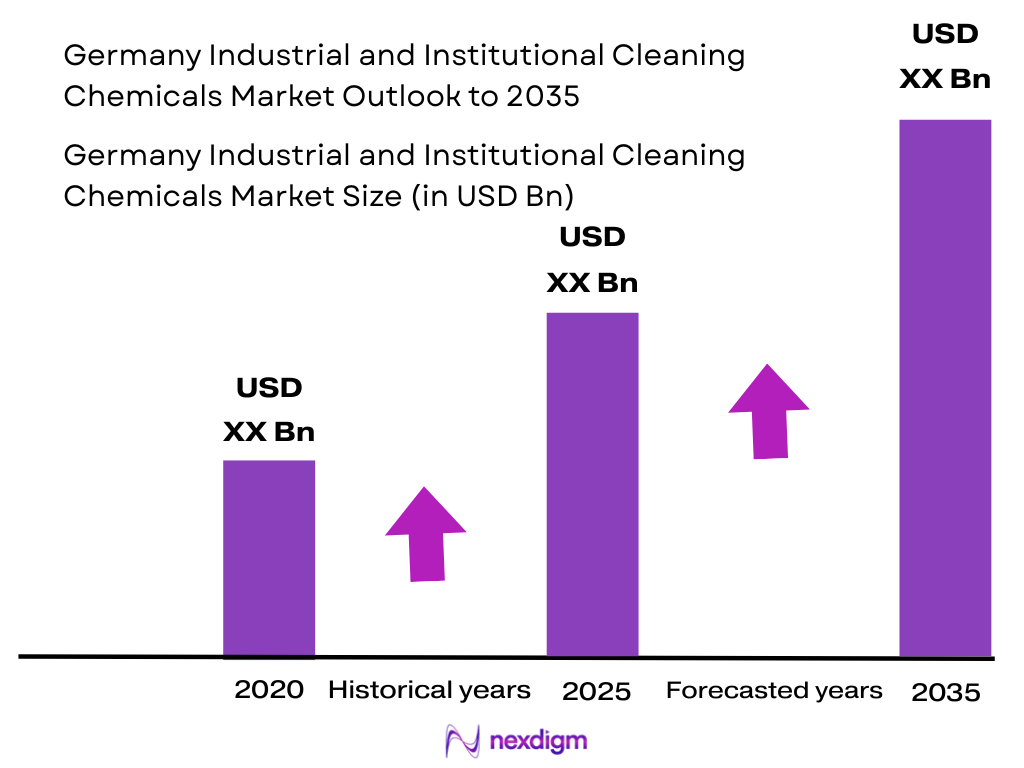
Industrial and institutional cleaning demand is anchored by Germany’s large economic and commercial base. The German economy recorded GDP of EUR 4,328.97 billion in the latest observation, compared with EUR 4,219.31 billion in the preceding year. Manufacturing comprised 209,815 legal units and 7.47 million employees, creating substantial demand for degreasers, surface cleaners, disinfectants, process cleaners and specialty formulations across production environments. Healthcare, accommodation, foodservice and facility-management operations further broaden consumption beyond industrial plants.
Demand is particularly concentrated in major industrial and population centers such as North Rhine-Westphalia, Bavaria, Baden-Württemberg, Hamburg and Hesse. North Rhine-Westphalia had approximately 18.03 million residents in the latest population observation, while Bavaria had 13.25 million and Baden-Württemberg 11.25 million. These regions combine large populations with manufacturing, healthcare, logistics, commercial property and foodservice activity. Germany also recorded 1,841 hospitals and 472,851 hospital beds, reinforcing the recurring requirement for professional cleaning and disinfection chemistry across healthcare facilities.
Market Segmentation
By Product Type
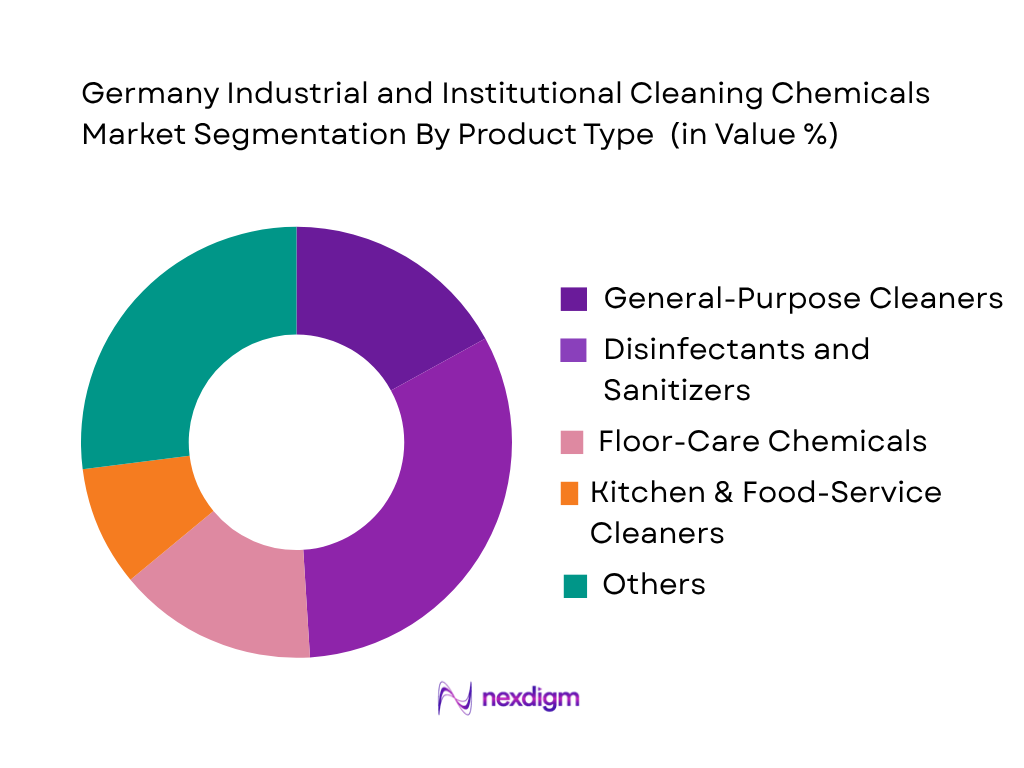
Germany Industrial and Institutional Cleaning Chemicals Market is segmented by product type into general-purpose cleaners, disinfectants and sanitizers, floor-care chemicals, kitchen and food-service cleaners, industrial degreasers, specialty cleaners, laundry chemicals and warewashing chemicals. General-purpose cleaners represent a major consumption category because they can be deployed across offices, commercial buildings, healthcare facilities, hospitality premises, retail locations and industrial workplaces. Their broad surface compatibility and frequent-use characteristics create recurring consumption compared with more application-specific formulations. Disinfectants and sanitizers remain particularly important in healthcare and food-service environments, while industrial degreasers address Germany’s extensive manufacturing and engineering base. Destatis recorded 7.47 million manufacturing employees and 209,815 manufacturing legal units in 2024, providing a large industrial customer base for cleaning chemistry.
By End-Use Industry
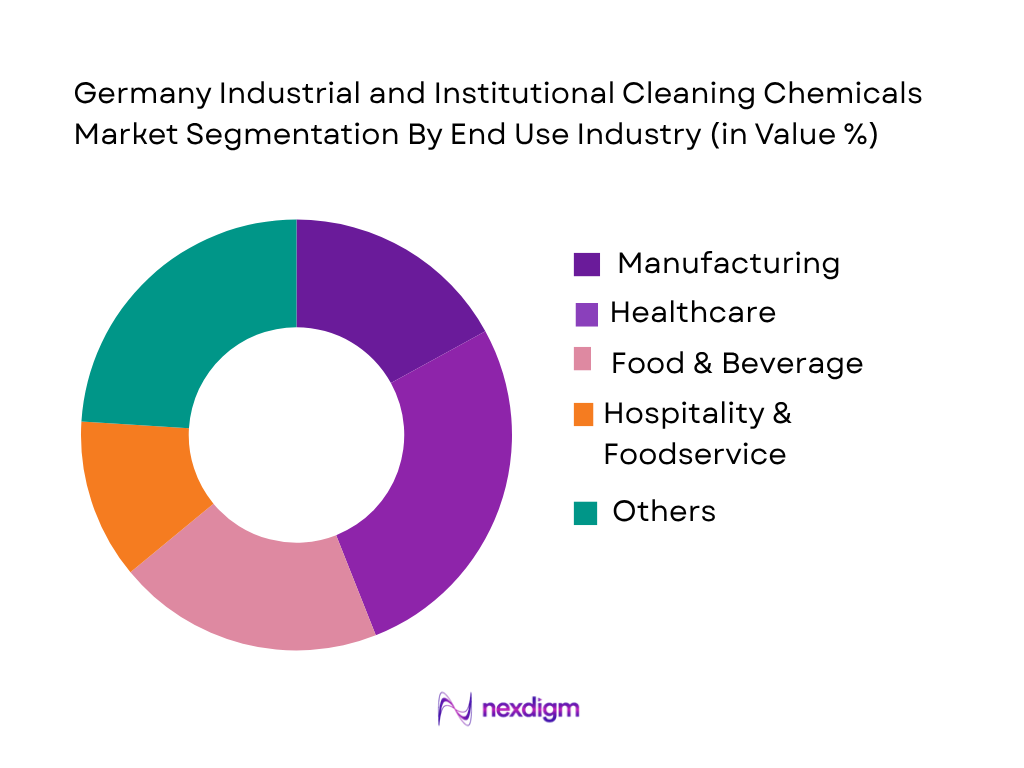
Germany Industrial and Institutional Cleaning Chemicals Market is segmented by end-use industry into manufacturing, healthcare, food and beverage, hospitality and foodservice, retail and commercial facilities, transportation and logistics, education and public institutions, and other industrial and institutional facilities. Manufacturing represents a leading demand center because cleaning chemicals are required for machinery, production areas, floors, tools, components, workshops and employee facilities. Germany’s manufacturing sector recorded EUR 2,556.83 billion in turnover and 7.47 million employees in 2024, highlighting the scale of facilities requiring routine and specialized cleaning. Healthcare is another high-intensity application, with 1,841 hospitals and 472,851 beds creating persistent demand for surface disinfection, patient-area cleaning and infection-control products.
Competitive Landscape
The Germany Industrial and Institutional Cleaning Chemicals Market is characterized by multinational chemical and hygiene companies competing alongside specialized professional-cleaning suppliers. Competition centers on formulation performance, regulatory compliance, dosing systems, sustainability credentials, technical support, distribution coverage and customer-specific cleaning programs. Major suppliers benefit from established relationships with manufacturing, healthcare, hospitality, food-processing and facility-management customers. Germany’s chemical industry also provides a strong domestic industrial ecosystem, with the German Chemical Industry Association reporting EUR 221 billion in chemical-pharmaceutical industry turnover in 2024.
| Company | Establishment | Headquarters | Key Product Focus | Industrial Applications | Institutional Applications | Distribution Reach | Sustainability Focus | Technical Service |
| Henkel | 1876 | Düsseldorf, Germany | ~ | ~ | ~ | ~ | ~ | ~ |
| BASF | 1865 | Ludwigshafen, Germany | ~ | ~ | ~ | ~ | ~ | ~ |
| Ecolab | 1923 | St. Paul, USA | ~ | ~ | ~ | ~ | ~ | ~ |
| Diversey | 1923 | Fort Mill, USA | ~ | ~ | ~ | ~ | ~ | ~ |
| Dr. Schnell | 1975 | Munich, Germany | ~ | ~ | ~ | ~ | ~ | ~ |
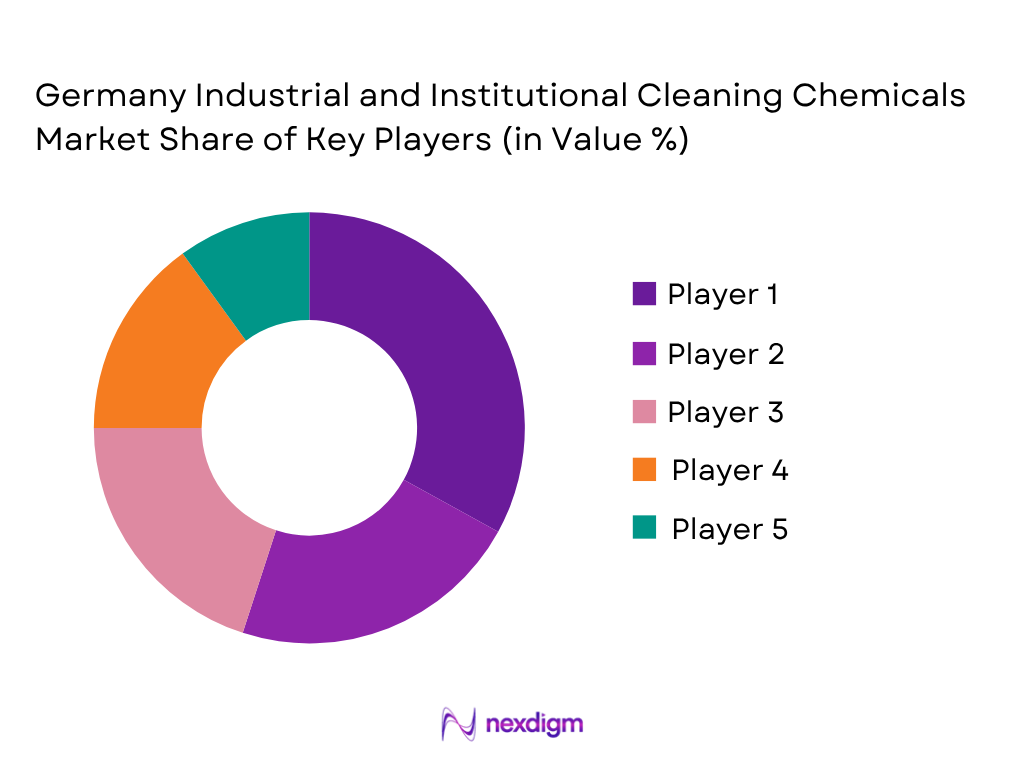
Germany Industrial and Institutional Cleaning Chemicals Market Analysis
Growth Drivers
Healthcare Hygiene Intensity
Germany’s healthcare infrastructure creates a recurring demand base for disinfectants, surface cleaners, sanitary chemicals and specialized institutional formulations. The country operated 1,841 hospitals with 472,851 beds and recorded 17,546,329 inpatient cases in 2024, according to the Federal Statistical Office (Destatis). Hospital employment also exceeded 1 million full-time-equivalent positions, increasing the number of clinical, administrative and support areas requiring controlled cleaning protocols. The breadth of healthcare activity extends beyond hospitals to medical practices, rehabilitation centers, nursing facilities and outpatient-care locations. Healthcare environments require frequent treatment of floors, patient rooms, operating areas, washrooms, high-touch surfaces and equipment, supporting recurring consumption of professional cleaning chemicals. Germany’s healthcare expenditure further demonstrates the scale of institutional activity, with hospital costs reaching EUR 149.8 billion in 2024. The combination of a large installed healthcare infrastructure, high patient throughput and stringent hygiene procedures supports demand for disinfectants, concentrated surface cleaners, instrument-cleaning chemistry and dosing systems. This demand is relatively resilient because cleaning requirements are operational rather than discretionary, while infection-control expectations sustain product usage across multiple healthcare facility types.
Food Processing Activity
Germany’s large food-manufacturing base supports continuous consumption of industrial and institutional cleaning chemicals for production equipment, processing surfaces, floors, storage areas and food-contact environments. Destatis recorded 5,476 establishments in the manufacture of food and animal feed in 2024, employing 593,876 people and generating approximately EUR 204.8 billion in turnover. Such facilities require cleaning programs covering production lines, tanks, conveyors, filling equipment, processing rooms and sanitation areas. Cleaning intensity is particularly important where production involves proteins, dairy products, beverages, bakery products and other materials that can generate organic residues and microbial-control requirements. Germany also recorded 245,555 accommodation and food-service establishments and 2.21 million employees in 2024, expanding professional demand for kitchen cleaners, degreasers, dishwashing chemicals, surface sanitizers and washroom products beyond manufacturing plants. The combination of food production and foodservice therefore creates multiple recurring consumption points. Suppliers can address these requirements through alkaline cleaners, acidic descalers, enzymatic formulations, disinfectants and automated dosing systems designed around food-industry hygiene protocols. The scale of Germany’s food-processing and foodservice infrastructure supports sustained professional chemical demand across both industrial production and downstream institutional operations.
Market Challenges
REACH Compliance Burden and Biocidal Product Authorization
Germany’s professional cleaning-chemical industry operates within a stringent European chemical-management framework, creating substantial compliance requirements for manufacturers and suppliers. Products containing substances regulated under chemical and biocidal legislation require detailed documentation, classification, labeling, safety information and, where applicable, authorization. The challenge is particularly relevant for disinfectants and antimicrobial cleaning products because formulation changes can affect regulatory status, efficacy claims and market availability. Germany’s chemical industry itself recorded EUR 221 billion in turnover in 2024, illustrating the scale and complexity of the domestic chemical ecosystem subject to European regulatory requirements. Pharmaceutical manufacturing adds another highly controlled customer environment, with Germany’s pharmaceutical companies investing EUR 10.7 billion in research and development in 2024, according to Germany Trade & Invest. Professional cleaning suppliers serving pharmaceutical plants therefore face demanding expectations around chemical compatibility, contamination control and documentation. Compliance can extend product-development timelines and require continuous monitoring of substances, formulations and regulatory classifications. For suppliers, the challenge is not limited to initial registration: maintaining compliant technical files, safety documentation and authorized uses becomes an ongoing operational requirement, particularly for companies serving multiple industrial and institutional applications.
Raw Material Dependency and Energy-Intensive Production
Cleaning-chemical manufacturers must manage exposure to fluctuations in the availability of surfactants, solvents, builders, disinfectant actives, enzymes and specialty additives, while production itself can require energy for blending, heating, purification, packaging and water treatment. Germany’s industrial base demonstrates the scale of facilities exposed to these supply considerations: manufacturing comprised 209,815 legal units, 7,471,915 employees and approximately EUR 2,556.83 billion in turnover in 2024. The chemical sector is closely integrated with this manufacturing ecosystem, meaning disruptions in upstream chemical inputs can affect downstream formulation availability. Water and wastewater management also creates operational requirements; Germany recorded 11,366 legal units and 315,288 employees in water supply, sewerage, waste management and remediation activities in 2024. For cleaning-chemical producers, this reinforces the importance of wastewater-compatible formulations and responsible handling of concentrated products. Customers increasingly expect consistent cleaning performance while reducing chemical loading, water use and waste. Suppliers therefore face the technical challenge of reformulating products without sacrificing efficacy, compatibility or regulatory compliance. This combination of upstream supply exposure, manufacturing complexity and environmental-management requirements can raise operational risks throughout the professional cleaning-chemical value chain.
Market Opportunities
Green Cleaning Chemistry and Concentrated Formulations
Germany’s extensive industrial and institutional infrastructure creates a strong application base for lower-impact cleaning chemistry, including concentrated formulations, bio-based surfactants, enzymatic cleaners and low-VOC products. Manufacturing alone represented 209,815 legal units, 7.47 million employees and EUR 2,556.83 billion in turnover in 2024, while human-health and social-work activities represented 271,527 legal units and 6.41 million employees. These large customer environments provide numerous opportunities to introduce formulations that reduce chemical volume per application while maintaining cleaning performance. Concentrated products can be integrated with controlled dosing to reduce over-application, packaging requirements and storage volumes. Enzymatic formulations can address protein, carbohydrate and lipid residues in food processing and institutional environments, while bio-based surfactants can support sustainability objectives where performance requirements allow substitution. Germany’s chemical sector provides an established industrial ecosystem for formulation development, with the chemical and pharmaceutical industry generating EUR 221 billion in turnover in 2024. The opportunity therefore extends beyond conventional green positioning toward measurable operational efficiency: lower dosage, optimized water use, reduced packaging and automated application. Suppliers able to combine environmental attributes with documented cleaning efficacy can address procurement requirements across healthcare, food processing, manufacturing, hospitality and professional facility-management operations.
Automated Dosing, Smart Dispensing and Precision Industrial Cleaning
Germany’s large-scale manufacturing, healthcare and commercial infrastructure provides a substantial installed base for automated chemical dispensing and precision-cleaning solutions. Manufacturing employed 7,471,915 people across 209,815 legal units in 2024, while Germany’s healthcare system operated 1,841 hospitals with 472,851 beds. Such environments contain numerous repeat-use cleaning points where automated dosing can improve consistency, control chemical consumption and reduce operator variability. Smart dispensing can connect chemical delivery with cleaning schedules, equipment requirements and usage monitoring, allowing facility operators to identify excessive consumption and optimize replenishment. Precision industrial cleaning also offers opportunities in pharmaceutical, food, automotive, electronics and machinery manufacturing, where residue control and surface compatibility can be critical. Germany’s pharmaceutical sector invested EUR 10.7 billion in R&D in 2024, indicating a sophisticated manufacturing environment in which specialized cleaning protocols can support high-value production. The opportunity extends to connected dispensing systems, application-specific concentrates, closed dosing equipment and digitally monitored cleaning programs. Suppliers can therefore move beyond selling individual chemicals toward integrated chemical-and-equipment solutions that generate recurring demand through consumables while strengthening customer retention through dosing hardware, technical service and application management.
Future Outlook
Over the forecast period, the Germany Industrial and Institutional Cleaning Chemicals Market is expected to benefit from continued industrial hygiene requirements, healthcare sanitation, food-processing standards and professional facility-management activity. The market is likely to move toward concentrated chemistry, automated dosing, application-specific formulations and sustainability-oriented products. Germany’s substantial manufacturing and institutional infrastructure provides a broad recurring-consumption base, while regulatory requirements are expected to continue influencing product formulation, documentation and supplier selection.
Major Players
- Henkel
- BASF
- Ecolab
- Diversey
- Dr. Schnell
- Werner & Mertz Professional
- Kiehl Group
- VERMOP
- WEPA Professional
- Kärcher
- Stockmeier Chemie
- Johannes Kiehl KG
- Vileda Professional
- Werner & Mertz
- Buzil-Werk Wagner
Key Target Audience
- Industrial manufacturing companies and plant operators
- Healthcare networks and hospital procurement departments
- Food and beverage processing companies
- Hospitality and foodservice operators
- Facility management and professional cleaning service providers
- Investments and venture capitalist firms
- Government and regulatory bodies (Federal Institute for Occupational Safety and Health, Federal Environment Agency, Federal Institute for Risk Assessment)
- Chemical distributors and professional hygiene solution providers
Research Methodology
Step 1: Identification of Key Variables
The initial phase maps Germany’s industrial and institutional cleaning ecosystem, including chemical manufacturers, distributors, facility-management companies and end-use industries. Secondary research incorporates official economic, industrial, healthcare and regulatory datasets to identify the variables influencing chemical consumption, formulation demand, purchasing patterns and end-use intensity.
Step 2: Market Analysis and Construction
Historical market information is structured across product categories, end-use industries, distribution channels and application requirements. Manufacturing, healthcare, food processing, hospitality, commercial facilities and institutional demand are evaluated to construct the addressable market using both top-down industry indicators and bottom-up consumption assessment.
Step 3: Hypothesis Validation and Expert Consultation
Market hypotheses are validated through discussions with participants across the cleaning-chemical value chain, including manufacturers, distributors, facility-management professionals, procurement personnel and industrial hygiene specialists. Inputs are used to test product adoption, application intensity, supplier selection and formulation trends.
Step 4: Research Synthesis and Final Output
The final stage triangulates secondary datasets, company information, industry indicators and primary insights. Segment-level estimates are reconciled against end-use demand and supply-side indicators to develop a consistent assessment of Germany’s industrial and institutional cleaning chemicals ecosystem and its long-term outlook.

- Executive Summary
- Research Methodology (Market Definition and Scope, Product Inclusion and Exclusion Criteria, Market Sizing Framework, Top-Down Assessment, Bottom-Up Assessment, Demand-Side Analysis, Supply-Side Analysis, Primary Research, Distributor Validation, End-User Validation, Consumption-Based Modelling, Facility-Level Demand Mapping, Data Triangulation, Forecasting Framework, Sensitivity Analysis, Assumptions and Limitations)

- Definition and Scope
- Market Evolution and Development of Professional Cleaning Chemistry
- Germany Industrial and Institutional Cleaning Chemicals Ecosystem
- Industry Value Chain
- Supply Chain Architecture
- Domestic Production and Import Dependency

- Growth Drivers (Healthcare Hygiene Intensity, Food Processing Activity, Pharmaceutical Manufacturing, Industrial Production, Hospitality Infrastructure, Facility Management Outsourcing, Commercial Real Estate, Institutional Sanitation, Professional Cleaning Standards)
- Market Challenges (REACH Compliance Burden, Biocidal Product Authorization, Hazard Classification, Raw Material Dependency, Energy-Intensive Production, Wastewater Treatment Requirements, Skilled Labour Constraints, Fragmented Customer Base)
- Market Opportunities (Green Cleaning Chemistry, Bio-Based Surfactants, Enzymatic Cleaning, Concentrated Formulations, Low-VOC Chemistry, Water-Efficient Cleaning, Automated Dosing, Smart Dispensing, Sustainable Packaging, Precision Industrial Cleaning)
- Market Trends (Sustainable Procurement, Eco-Label Adoption, Bio-Based Formulations, Concentrated Chemistry, Enzyme-Based Cleaning, Low-Residual Disinfection, Automate Dosing, Water Reduction, Refill Systems, Packaging Circularity)
- Regulatory and Compliance Framework (REACH Registration, CLP Classification and Labelling, EU Biocidal Products Regulation, German Chemicals Act, Hazardous Substances Ordinance, Occupational Safety, Wastewater Requirements, Packaging Compliance, Environmental Protection)
- SWOT Analysis
- Porter’s Five Forces Analysis
- PESTLE Analysis

- By Market Value (2020-2025)
- By Volume Consumption (2020-2025)
- By Product Category (2020-2025)
- By Chemistry Type (2020-2025)
- By Formulation Type (2020-2025)
- By Application (2020-2025)
- By End-Use Industry (2020-2025)

- By Product Type (In Value %)
General-Purpose Cleaners
Disinfectants and Sanitizers
Floor Care Chemicals
Kitchen and Food-Service Cleaners
Laundry Chemicals
Warewashing Chemicals
Industrial Degreasers
Carpet and Upholstery Cleaners
Glass and Surface Cleaners
Restroom and Washroom Cleaners
Specialty and Precision Cleaners - By Chemistry Type (In Value %)
Surfactant-Based Chemistry
Acid-Based Chemistry
Alkaline Chemistry
Solvent-Based Chemistry
Enzyme-Based Chemistry
Biocide and Antimicrobial Chemistry
Chelating-Agent-Based Chemistry - By Formulation Type (In Value %)
Ready-to-Use Liquids
Concentrated Liquids
Powders
Gels
Foams
Tablets and Solid Doses
Wipes and Pre-Moistened Formats - By End-Use Industry (In Value %)
Healthcare and Hospitals
Food and Beverage Processing
Pharmaceutical Manufacturing
Hospitality and Foodservice
Industrial and Manufacturing Facilities
Commercial Offices and Business Parks
Retail and Shopping Facilities
Education and Institutional Facilities
Transportation and Logistics
Government and Public Facilities - By Cleaning Application (In Value %)
Hard-Surface Cleaning
Floor Cleaning and Maintenance
Equipment and Machinery Cleaning
Clean-in-Place Cleaning
Manual Dishwashing
Automatic Warewashing
Industrial Degreasing
Parts and Component Cleaning
Restroom Sanitation
High-Touch Surface Disinfection
Precision Equipment Cleaning - By Distribution Channel (In Value %)
Direct Manufacturer Sales
Janitorial and Sanitation Distributors
Industrial Chemical Distributors
Wholesale Distributors
Facility Management Procurement
Specialist B2B Cleaning Suppliers
Online B2B Channels

- Market Share Analysis of Major Players (By Value, Product Category, Chemistry Type, End-Use Industry, Application, Distribution Channel)
- Cross Comparison Parameters (Product Portfolio Breadth, Professional SKU Coverage, Domestic Manufacturing Footprint, Specialty Chemistry Capability, Sustainable Chemistry Portfolio, Automated Dosing Capability, Distribution Network Reach, Facility-Management Customer Coverage)
- SWOT Analysis of Major Players
- Detailed Profiles of Major Companies
Ecolab Inc.
Diversey Holdings
Dr. Schnell GmbH & Co. KGaA
Werner & Mertz Professional
Kiehl Group
Vileda Professional
Buzil-Werk Wagner GmbH & Co. KG
Dr. Becher GmbH
Alfred Kärcher SE & Co. KG
Wetrok AG
Hagleitner Hygiene International GmbH
Christeyns NV
Reckitt Benckiser Group plc
SC Johnson Professional
Procter & Gamble Professional

- Industrial and Institutional Cleaning Chemicals Purchasing Behavior
- End-User Demand Patterns
- Enterprise Procurement Analysis
- Customer Segmentation by Facility Scale
- Industry-Specific Consumption Behavior

- By Market Value (2026-2035)
- By Volume Consumption (2026-2035)
- By Product Category (2026-2035)
- By Chemistry Type (2026-2035)
- By Formulation Type (2026-2035)
- By Application (2026-2035)
- By End-Use Industry (2026-2035)


 Request a Sample
 Ask for Customization
 Get a Quote
 Enquire Now