
 Download PDF
 Download PDF
Market Overview
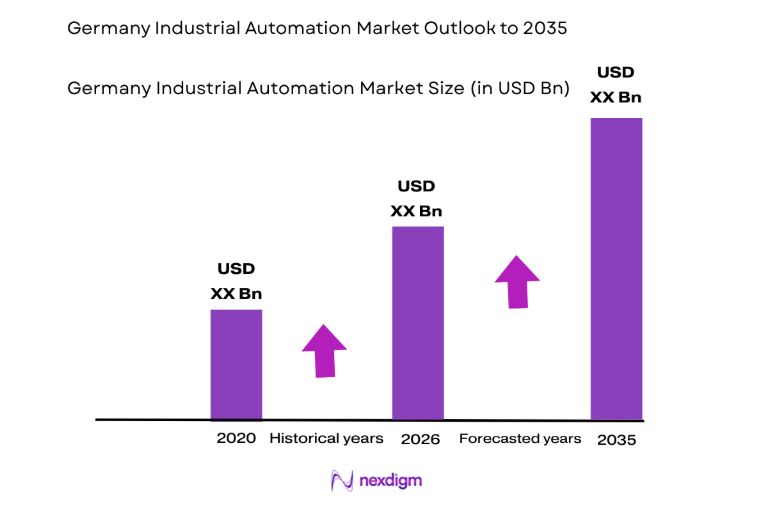
Germany’s industrial automation market reached approximately USD ~ based on a recent historical assessment compiled from national industrial statistics and reports from the German Federal Ministry for Economic Affairs and Energy. Growth is primarily driven by the increasing adoption of automation technologies in manufacturing, logistics, automotive, and energy sectors. The shift towards Industry 4.0, incorporating robotics, AI, and IoT technologies, significantly boosts demand for advanced automation solutions across industries in Germany.
The dominant cities driving the industrial automation market in Germany are Munich, Stuttgart, Frankfurt, and Dresden, which are home to major industrial players and high-tech manufacturing facilities. These regions benefit from strong infrastructure, proximity to automotive manufacturers, and highly skilled labor. Germany’s leading position in the automotive, machinery, and robotics industries continues to foster innovation and attract significant investments into automation technologies. The country’s emphasis on digitalization and smart manufacturing further supports the dominance of these cities in the industrial automation landscape.
Market Segmentation
By Product Type
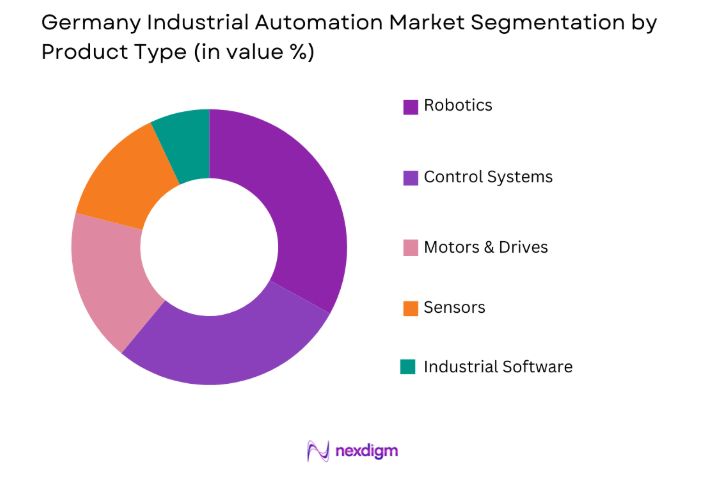
By Product Type, Germany’s industrial automation market is segmented into Robotics, Control Systems, Motors & Drives, Sensors, and Industrial Software. Recently, Robotics has a dominant market share due to factors such as demand patterns, brand presence, infrastructure availability, or consumer preference. The rise of smart factories and the need for flexible, high-performance manufacturing processes are driving this demand. Robotics plays a critical role in automating repetitive tasks, improving production efficiency, and reducing operational costs. The automotive industry, in particular, relies on robotics for assembly lines, while other industries such as electronics and food production increasingly deploy robots to streamline operations and meet the demand for higher precision and speed.
By End Use Industry
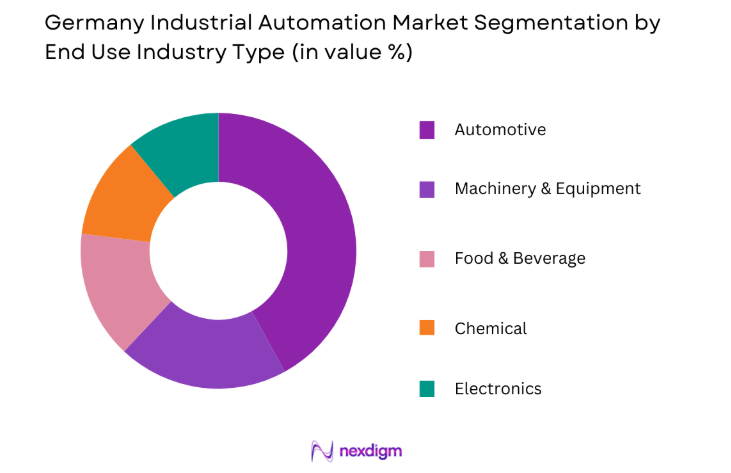
By End Use Industry, Germany’s industrial automation market is segmented into Automotive, Machinery & Equipment, Food & Beverage, Chemical, and Electronics. Recently, the Automotive sector has a dominant market share due to factors such as demand patterns, brand presence, infrastructure availability, or consumer preference. Germany’s automotive industry is one of the largest globally, and the integration of automation technologies in automotive manufacturing processes, including robotic assembly lines, has driven the demand for industrial automation systems. With a strong focus on the development of electric vehicles (EVs) and the automation of production processes, the automotive industry in Germany remains the largest consumer of industrial automation products and solutions, supporting the continued growth of the market.
Competitive Landscape
The Germany industrial automation market is competitive and consolidated, with several multinational and regional players dominating the landscape. Key market leaders are leveraging their technological expertise in robotics, AI, and industrial software to drive innovation and stay ahead in a fast-evolving market. Strategic collaborations, acquisitions, and the push for digital transformation are central to the strategies of major players. Companies are increasingly focused on developing scalable, flexible automation solutions that can cater to various industries, particularly the automotive, manufacturing, and logistics sectors.
| Company Name | Establishment Year | Headquarters | Technology Focus | Market Reach | Key Products | Revenue | Industry Focus |
| Siemens AG | 1847 | Germany | ~ | ~ | ~ | ~ | ~ |
| ABB Ltd | 1988 | Switzerland | ~ | ~ | ~ | ~ | ~ |
| Schneider Electric | 1836 | France | ~ | ~ | ~ | ~ | ~ |
| KUKA AG | 1898 | Germany | ~ | ~ | ~ | ~ | ~ |
| Rockwell Automation | 1903 | United States | ~ | ~ | ~ | ~ | ~ |
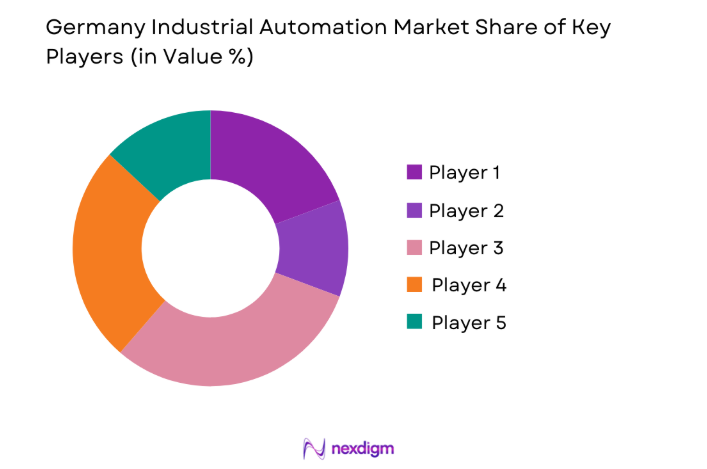
Germany Industrial Automation Market Analysis
Growth Drivers
Adoption of Industry 4.0 Technologies:
Industry 4.0 is a key growth driver in Germany’s industrial automation market. The implementation of smart factory solutions, where machines and systems are interconnected through IoT technologies, has revolutionized manufacturing processes. These advancements enable real-time monitoring, predictive maintenance, and the optimization of production workflows. The German government’s emphasis on digital transformation, through programs like “Industrie 4.0”, further accelerates the adoption of automation technologies across industries. In addition, the automotive industry in Germany is a significant driver of Industry 4.0 adoption, as manufacturers increasingly use robotics, AI, and big data to streamline production lines, improve vehicle quality, and reduce costs. The automotive industry’s move toward electric vehicle (EV) manufacturing further boosts the demand for automation systems designed for high-speed, high-precision tasks. This shift is driving demand for robotics, sensors, and AI-based industrial software that support smart manufacturing. The growing use of automation in the production of various industrial goods, from electronics to food and beverage, strengthens the role of Industry 4.0 technologies as a major growth driver.
Shift Towards Electric Vehicles (EVs) and Sustainability:
The growing shift towards electric vehicles (EVs) and sustainable manufacturing practices is fueling the demand for industrial automation in Germany. As the global automotive industry increasingly transitions to electric vehicles, the need for automation solutions in EV production has risen. Automation helps optimize battery assembly, vehicle assembly lines, and testing processes, all of which are crucial in scaling up EV production. German automotive manufacturers like Volkswagen, BMW, and Mercedes-Benz are leading the charge in adopting EV technologies, further enhancing the demand for automation solutions. Moreover, sustainability initiatives, such as reducing carbon emissions and improving energy efficiency in manufacturing processes, are contributing to the growth of automation. Industrial automation enables efficient resource use, waste reduction, and energy savings by optimizing operations. The demand for automation systems in the EV sector also extends to the supply chain, including battery production and infrastructure development, driving continuous innovation in the automation market. As EV production ramps up and sustainability becomes a central goal in industrial practices, the adoption of automation technologies will play a critical role in supporting the industry’s goals.
Market Challenges
High Initial Investment and Integration Costs:
One of the major challenges facing the German industrial automation market is the high initial cost associated with implementing automation systems. The purchase and installation of robotics, control systems, and other advanced automation technologies require significant capital investment. For smaller manufacturers, particularly those in traditional sectors, this high upfront cost may be a barrier to adopting automation. Moreover, integrating automation solutions with existing manufacturing systems can be complex and costly. Businesses must account for system compatibility issues, downtime during installation, and the training of personnel to operate the new systems. These costs can delay the adoption of automation technologies, particularly in industries where budgets are constrained, hindering market growth in the short term. While the long-term benefits of automation, such as increased productivity and cost savings, are evident, the financial burden of initial investment remains a significant challenge.
Skilled Labor Shortage in Automation Technologies:
As Germany continues to embrace industrial automation, there is an increasing demand for skilled labor capable of designing, implementing, and maintaining advanced automation systems. However, there is a shortage of qualified professionals with expertise in robotics, industrial control systems, and artificial intelligence, which are crucial to the successful deployment of automation technologies. The fast-paced evolution of automation technology exacerbates this issue, as workers need to continuously update their skills to keep pace with new advancements. Companies often struggle to find personnel with the necessary technical skills, which leads to delays in the adoption and full implementation of automation solutions. Additionally, the lack of skilled workers affects the efficiency and effectiveness of automation systems, as improper use or maintenance can lead to system malfunctions and downtime. Addressing this labor shortage is essential for sustaining the growth of the industrial automation market in Germany, as companies need to ensure a steady supply of qualified workers to manage the increasingly complex technologies being implemented.
Opportunities
Government Support and Industrial 4.0 Initiatives:
The German government’s support for Industry 4.0 initiatives presents significant growth opportunities for the industrial automation market. Through funding, subsidies, and research programs, the government is helping manufacturers transition to smart factories that leverage automation, data exchange, and digital technologies. Initiatives such as “Industrie 4.0” promote the adoption of cyber-physical systems, the Internet of Things (IoT), and artificial intelligence, which are driving innovation in automation technologies. These efforts not only enhance Germany’s competitive position in the global manufacturing sector but also create a conducive environment for automation providers to expand their market presence. The government’s commitment to supporting digitalization and technological advancement in manufacturing is expected to sustain long-term demand for industrial automation systems, fostering a cycle of innovation, research, and adoption that benefits both industry and technology providers.
Emergence of AI and Machine Learning in Industrial Automation:
The integration of artificial intelligence (AI) and machine learning (ML) technologies into industrial automation presents exciting opportunities for Germany’s market. AI-powered automation systems can enhance production efficiency by enabling machines to make decisions based on real-time data, improving accuracy and reducing the need for human intervention. Machine learning algorithms can optimize operations by analyzing large datasets and identifying patterns that humans may not be able to detect. These technologies also enable predictive maintenance, where machines can anticipate failures and automatically schedule repairs, minimizing downtime and reducing costs. The adoption of AI and ML in industrial automation will likely accelerate across various industries, including automotive, manufacturing, and logistics. As companies continue to seek ways to enhance productivity and reduce operational costs, the demand for AI-integrated automation solutions is expected to rise, providing substantial growth opportunities for technology providers.
Future Outlook
Germany’s industrial automation market is poised for significant growth over the next five years, fueled by technological advancements in robotics, AI, and IoT. The continued push towards Industry 4.0, coupled with strong government support and the increasing adoption of automation in key industries like automotive, manufacturing, and energy, will create a robust market environment. Furthermore, the growing demand for electric vehicles and sustainable manufacturing processes will further drive the need for advanced automation solutions, ensuring long-term market expansion.
Major Players
- Siemens AG
- ABB Ltd
- Rockwell Automation
- Schneider Electric
- KUKA AG
- FANUC Corporation
- Mitsubishi Electric
- Omron Corporation
- Bosch Rexroth
- Honeywell International
- Yaskawa Electric Corporation
- Emerson Electric
- Rethink Robotics
- Beckhoff Automation
- Danaher Corporation
Key Target Audience
- Manufacturing Companies
- Automotive Manufacturers
- Robotics Companies
- Industrial Automation System Integrators
- Energy and Utilities Companies
- Investments and venture capitalist firms
- Government and regulatory bodies
Research Methodology
Step 1: Identification of Key Variables
This step involves identifying the critical market drivers, such as industry trends, technological advancements, and regulatory support, to create a solid foundation for the research. Key variables are gathered from industry reports, government data, and expert interviews.
Step 2: Market Analysis and Construction
The collected data is analyzed to segment the market by product type and industry application. This step involves constructing models that predict future trends and growth areas in the market.
Step 3: Hypothesis Validation and Expert Consultation
Experts in industrial automation, technology providers, and industry analysts review and validate the initial findings to ensure that the assumptions align with real-world industry trends.
Step 4: Research Synthesis and Final Output
The final research report is synthesized, incorporating validated insights and data-driven projections. This report is structured to provide a comprehensive analysis of the current and future state of Germany’s industrial automation market.

- Executive Summary
- Research Methodology (Definitions, Scope, Industry Assumptions, Market Sizing Approach, Primary & Secondary Research Framework, Data Collection & Verification Protocol, Analytic Models & Forecast Methodology, Limitations & Research Validity Checks)

- Market Definition and Scope
- Value Chain & Stakeholder Ecosystem
- Regulatory / Certification Landscape
- Sector Dynamics Affecting Demand

- Growth Drivers
Increasing Demand for Robotics and Automation in Automotive Manufacturing
Expansion of Smart Factory Initiatives Across German Industrial Zones
Government Support for Digital Transformation and Industry 4.0 Initiatives - Market Challenges
High Initial Investment for Industrial Automation Technologies
Shortage of Skilled Engineers in Robotics and Automation
Integration Challenges with Existing Legacy Systems in Industrial Facilities - Market Opportunities
Development of Automated Logistics and Warehousing Solutions
Growth of AI and Machine Learning in Industrial Automation
Smart Manufacturing Solutions for Small and Medium-Sized Enterprises - Trends
Increasing Adoption of Collaborative Robots in Manufacturing
Rising Use of Artificial Intelligence and IoT in Industrial Automation Systems - Government Regulations
- SWOT Analysis
- Porter’s Five Forces

- By Market Value, 2020-2025
- By Installed Units, 2020-2025
- By Average System Price, 2020-2025
- By System Complexity Tier, 2020-2025

- By System Type (In Value%)
Industrial Robotics Systems
Programmable Logic Controllers
Distributed Control Systems
Supervisory Control and Data Acquisition Systems
Industrial Machine Vision Systems - By Platform Type (In Value%)
Automotive Manufacturing Automation Platforms
Electronics and Semiconductor Automation Platforms
Energy and Utilities Automation Platforms
Logistics and Warehouse Automation Platforms - By Fitment Type (In Value%)
New Industrial Automation Installations
Retrofit Automation for Existing Manufacturing Facilities
Integrated Smart Factory Automation Systems
Modular Industrial Automation Solutions - By End User Segment (In Value%)
Automotive and Industrial Manufacturing
Electronics and Semiconductor Manufacturing
Energy and Utilities Sector

- Market Share Analysis
- Cross Comparison Parameters (Automation Technology Portfolio, System Integration Capability, Industrial Application Coverage, Digital Platform Integration, Pricing Strategy, Regional Service Network, R&D Investment)
- SWOT Analysis of Key Competitors
- Pricing & Procurement Analysis
- Key Players
Siemens AG
ABB Ltd
Schneider Electric
Rockwell Automation
Mitsubishi Electric
Honeywell International
Emerson Electric
Yokogawa Electric Corporation
Bosch Rexroth
Omron Corporation
Fanuc Corporation
KUKA AG
Hitachi Industrial Equipment Systems
Delta Electronics
Keyence Corporation

- Automotive Manufacturers Deploying Robotics for Production Efficiency
- Electronics Manufacturers Increasing Automation for Precision and Speed
- Energy Infrastructure Operators Using Automation for Efficient Grid Management
- Logistics Companies Expanding Automated Material Handling and Distribution

- Forecast Market Value, 2026-2035
- Forecast Installed Units, 2026-2035
- Price Forecast by System Tier, 2026-2035
- Future Demand by Platform, 2026-2035


 Request a Sample
 Ask for Customization
 Get a Quote
 Enquire Now