

 Download PDF
Market Overview
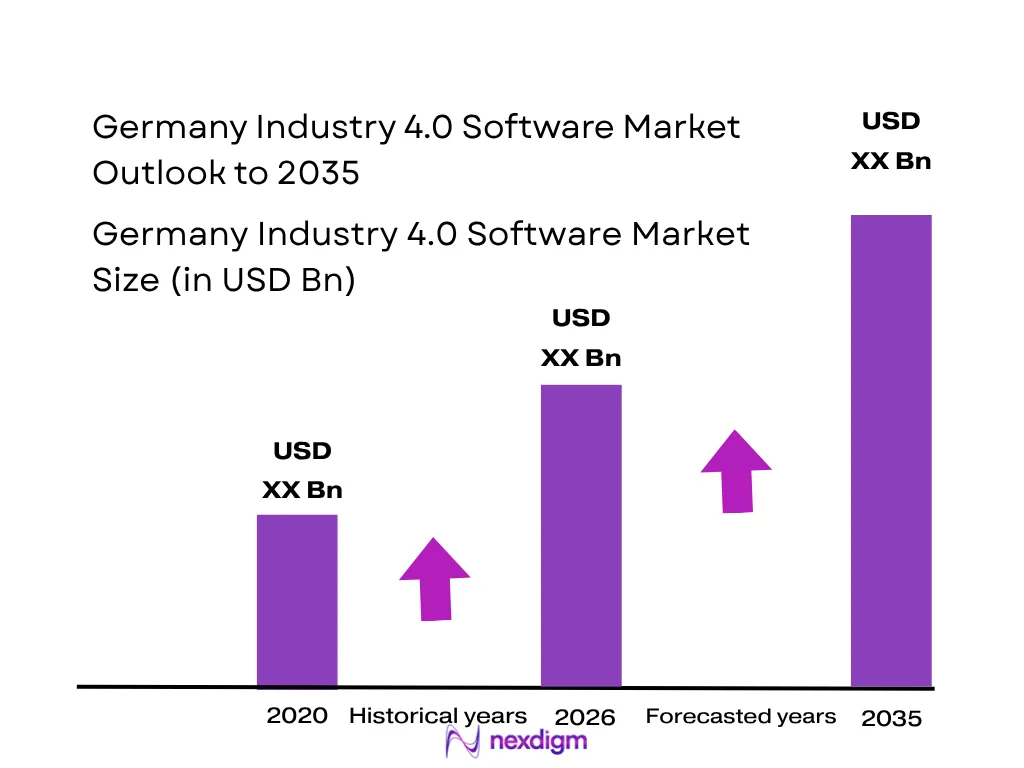
Germany’s Industry 4.0 software market is anchored in one of the world’s deepest industrial bases. Publicly accessible country-level trackers place Germany’s broader Industry 4.0 market at USD ~ billion in 2025, while another major tracker recorded USD ~ million in 2024 and identified software as the fastest-growing component. The demand base is supported by Germany’s USD 4.69 trillion GDP and USD 829.96 billion manufacturing value added in 2024, with manufacturing still accounting for 19.9% of gross value added, which keeps software spending tightly linked to plant productivity, traceability, and automation modernization.
Within Germany, Munich, Walldorf, Stuttgart, Darmstadt, Frankfurt/Rhine-Main, and the broader Bavaria, Baden-Württemberg, Hesse, and North Rhine-Westphalia corridors dominate the market because they combine industrial headquarters, automation specialists, cloud and data-center infrastructure, and strong regional Industry 4.0 ecosystems. Bavaria benefits from a major automotive cluster, Baden-Württemberg runs a dedicated Industrie 4.0 network, North Rhine-Westphalia is one of Germany’s strongest industrial and IT regions, and Frankfurt/Rhine-Main remains Germany’s leading data-center location, which strengthens industrial cloud, AI, and sovereign-data deployments for manufacturers.
Market Segmentation
By Software Layer
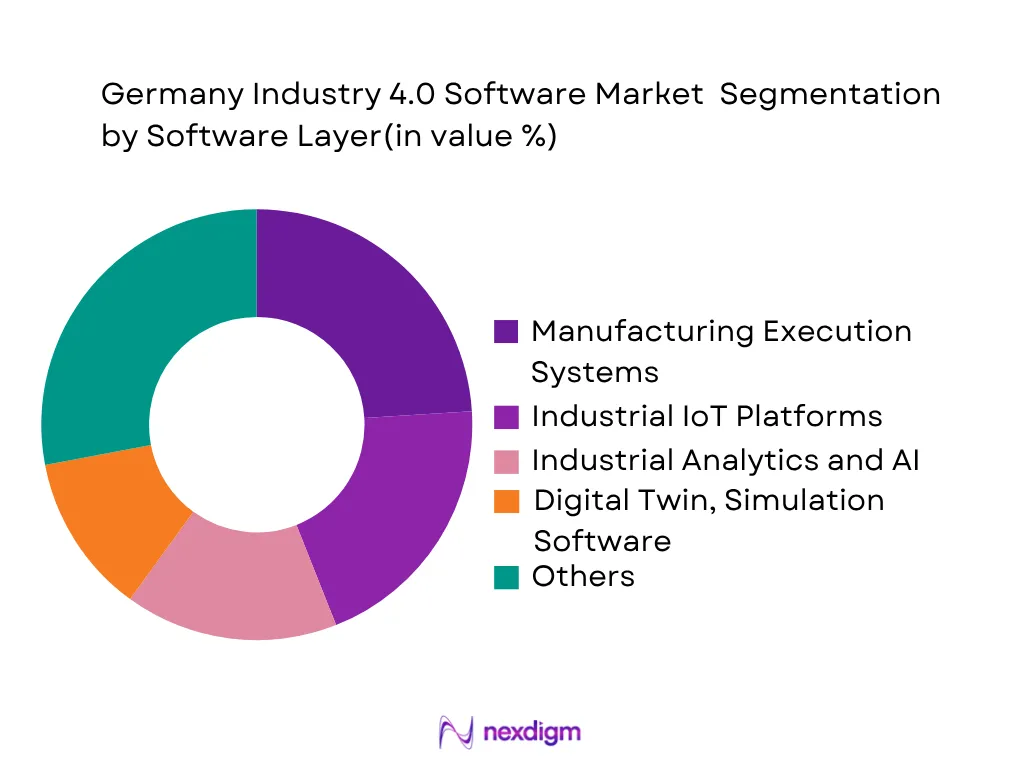
Germany Industry 4.0 software market is segmented by software layer into manufacturing execution systems, industrial IoT platforms, industrial analytics and AI, digital twin and simulation software, advanced planning and scheduling software, quality and traceability software, and SCADA/HMI software. Manufacturing execution systems currently hold the dominant share because German manufacturers continue to prioritize real-time shopfloor control, batch and serial traceability, quality capture, downtime reduction, and ERP-to-plant synchronization before scaling broader AI or digital-twin programs. Public market data already shows the Germany MES market at USD 1,089 million in 2023, supported by strong use in automotive, chemicals, and machinery. In practice, MES remains the operational backbone that turns factory data into executable workflows, which is why it stays ahead of more specialized categories such as digital twin or industrial AI.
By Deployment Model
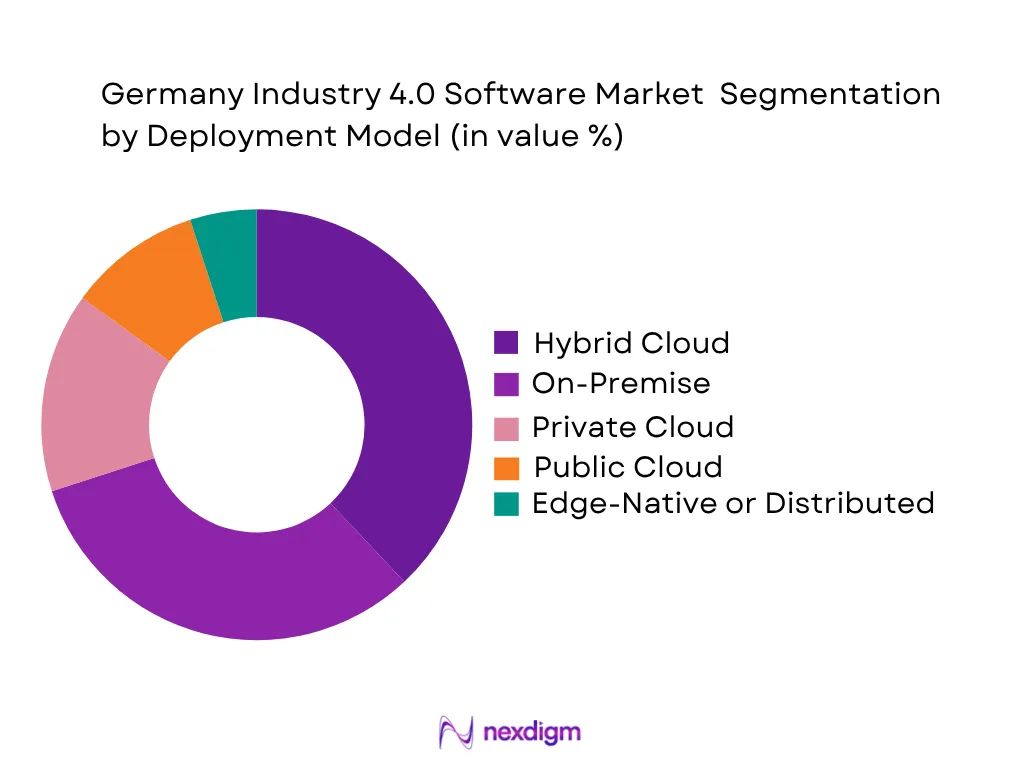
Germany Industry 4.0 software market is segmented by deployment model into hybrid cloud, on-premise, private cloud, public cloud, and edge-native or distributed deployments. Hybrid cloud holds the dominant share because German manufacturers are balancing two needs that rarely sit in the same architecture: secure local control for production-critical systems and elastic compute for analytics, AI, and multi-site visibility. Public sources show that German companies are already heavy cloud users, yet manufacturing environments still prefer local or tightly governed infrastructure for OT-connected workloads. At the same time, Frankfurt/Rhine-Main and Germany’s wider data-center base improve the attractiveness of sovereign cloud hosting. Hybrid therefore dominates by allowing firms to keep execution close to the plant while moving dashboards, historians, AI models, and collaboration layers into resilient cloud environments.
Competitive Landscape
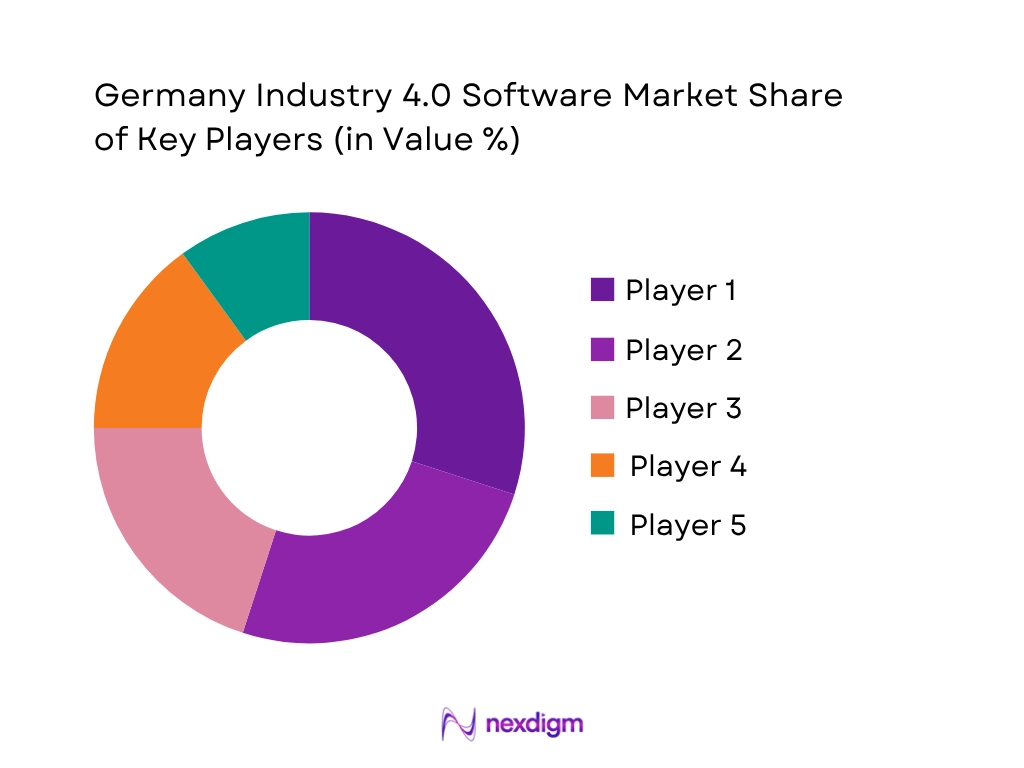
The Germany Industry 4.0 software market is led by a mix of large industrial platform vendors and specialized manufacturing software providers. The competitive center of gravity sits with companies that can combine shopfloor execution, plant connectivity, ERP/PLM integration, analytics, and cloud readiness in one stack. Siemens and SAP carry strong enterprise credibility, while MPDV, FORCAM ENISCO, and PSI Software remain important for production-centric execution, manufacturing data management, and optimization-led industrial deployments. This creates a market where breadth, interoperability, and delivery capability matter as much as pure software functionality.
| Company | Establishment Year | Headquarters | Core Industry 4.0 Software Focus | Primary Germany Industry Fit | Deployment Orientation | Key Interoperability / Integration Strength | Distinct Competitive Position |
| Siemens | 1847 | Munich, Germany | – | – | – | – | – |
| SAP | 1972 | Walldorf, Germany | – | – | – | – | – |
| MPDV | 1977 | Mosbach, Germany | – | – | – | – | – |
| FORCAM ENISCO | 2001 | Böblingen, Germany | – | – | – | – | – |
| PSI Software | 1969 | Berlin, Germany | – | – | – | – | – |
Germany Industry 4.0 Software Market Competitive Intelligence
The Germany Industry 4.0 software market is characterized by a highly structured competitive landscape where industrial-origin platform providers and enterprise IT vendors converge, creating a dual-layer competition between shopfloor execution depth and enterprise integration strength. Companies like Siemens and SAP dominate due to their ability to offer end-to-end ecosystems spanning MES, digital twin, ERP, and industrial cloud, while players such as MPDV and FORCAM ENISCO compete through deep manufacturing specialization and plant-level execution capabilities. Global vendors including PTC and Rockwell Automation are strengthening their presence via IIoT platforms and industrial AI, intensifying competition around interoperability, hybrid deployment, and time-to-value. The market increasingly favors vendors that can integrate OT-IT systems, support sovereign data frameworks like Manufacturing-X, and deliver measurable plant-level ROI, making ecosystem strength and implementation capability as critical as product functionality.
Germany Industry 4.0 Software Market Analysis
Growth Drivers
Expansion of Smart Factory Programs Across German Manufacturing
Germany’s Industry 4.0 software demand is being pulled by the sheer scale of its industrial economy and the policy-backed expansion of digital factory programs. Germany recorded USD 829.96 billion in manufacturing value added in 2024, while the IMF places nominal GDP at about USD 4.69 trillion in 2024, keeping manufacturing one of the country’s largest software-spending bases. On the policy side, Germany’s revised Digital Decade roadmap includes 50 measures backed by EUR 102.1 billion, including EUR 46.8 billion from public budgets, while the country had an estimated 652 edge nodes in 2024. These figures matter for Industry 4.0 software because smart-factory rollouts need plant connectivity, edge orchestration, MES, analytics, and industrial data layers to function at scale across automotive, machinery, chemicals, and electronics facilities.
Rising Need for Real-Time Plant Visibility and OEE Improvement
The need for real-time plant visibility in Germany is rooted in industrial volatility and the high cost of underperformance in a large export-led production system. Destatis reported that industrial production fell 2.5% month on month in September 2024, and production in industry excluding energy and construction was down 2.7% in the same month. In the same release, capital goods output fell 4.0%, underlining why German manufacturers are investing in software that tracks throughput, downtime, scrap, changeovers, and asset utilization in real time. Germany also had roughly 46.1 million persons in employment in 2024, which means even small OEE gains can have significant labor-productivity implications in a tight operating environment. Software for plant visibility becomes essential when enterprises need to stabilize lines quickly, compare site performance, and move from reactive troubleshooting to continuous operational control.
Market Challenges
Complexity of Integrating Brownfield OT Environments
Brownfield integration is a major challenge because Germany’s industrial strength rests on large installed bases of legacy machinery, proprietary PLC environments, and heterogeneous plant systems accumulated over decades. Germany generated USD 829.96 billion in manufacturing value added in 2024 and still relied heavily on mature export sectors such as motor vehicles, machinery, and industrial equipment. Destatis also reported that capital goods production fell 4.0% in September 2024, showing how exposed plants are to disruption and why operators hesitate to disturb working lines during software retrofits. In practice, Industry 4.0 projects often require MES, historians, edge gateways, quality systems, and ERP connectors to coexist with old machine interfaces and site-specific logic. The larger and older the industrial estate, the more time and technical effort are needed for protocol conversion, data normalization, and secure OT integration.
Long Enterprise Sales Cycles and Multi-Stakeholder Buying Structures
Enterprise sales cycles remain long because German manufacturers buy Industry 4.0 software through layered technical, operational, financial, and compliance review processes. In 2024, Germany’s foreign trade turnover with the United States alone reached EUR 252.8 billion, while total exports in the first half of 2024 were EUR 801.7 billion. In an economy of about USD 4.69 trillion, software decisions inside globally exposed industrial firms rarely sit with one function. CIOs, plant managers, OT teams, procurement, works councils, cybersecurity leaders, and business-unit heads all influence the decision, especially when software touches production execution or machine data. That slows adoption because vendors must prove integration feasibility, cyber resilience, operator usability, and measurable operational payback before multi-site commitments are approved. The scale of Germany’s manufacturing system increases the payoff of software adoption, but it also lengthens internal validation cycles.
Market Opportunities
Hybrid Cloud and Edge-Native Factory Software Architectures
A major opportunity lies in hybrid cloud and edge-native architectures because Germany already has the ingredients needed for this model: a large industrial base, rising enterprise cloud use, and a strong national push around edge infrastructure and sovereign digital capacity. Germany’s Digital Decade report counted 652 edge nodes in 2024 and set out 50 measures backed by EUR 102.1 billion. Eurostat’s latest published cloud statistics show 52.74% of EU enterprises using paid cloud services in 2025, while the Germany-specific databrowser view shows 60.66 for enterprise cloud use. At the macro level, Germany’s USD 829.96 billion manufacturing value added means there is a very large installed base of factories that can benefit from keeping runtime control at the edge while using the cloud for analytics, collaboration, and model training. This architecture directly fits German concerns around latency, resilience, cybersecurity, and data sovereignty.
AI-Powered Scheduling, Quality, and Maintenance Applications
AI-powered scheduling, quality, and maintenance software represents a strong forward opportunity because adoption data is already moving in the right direction while Germany’s industrial base remains large enough to absorb these tools at scale. Across the EU, 13.5% of enterprises used AI in 2024, rising to 20.0% in 2025; in manufacturing, the share of enterprises using AI rose from 7% to 11% between 2021 and 2024. Germany also remains one of Europe’s biggest industrial economies with USD 829.96 billion in manufacturing value added and about 46.1 million employed persons in 2024. These current figures support future growth in software that improves finite-capacity planning, predictive maintenance, machine vision inspection, and root-cause analytics. German factories do not need speculative future conditions for these applications to expand; the installed base, skills pressure, and digital-policy momentum already create a strong operational case today.
Future Outlook
Germany Industry 4.0 software demand is expected to stay structurally strong because the country’s manufacturing system still needs higher throughput, better labor productivity, tighter quality control, and more resilient supply networks. The next wave of spending is likely to center on hybrid architectures, industrial AI, plant-level data models, and digital-twin-enabled planning. Adoption should also widen beyond flagship automotive and machinery users into chemicals, food processing, pharma, and advanced electronics. Regional data sovereignty, Manufacturing-X participation, and interoperable plant connectivity will increasingly shape which vendors win large deployments.
Major Players
- Siemens
- SAP
- Software AG
- MPDV
- FORCAM ENISCO
- PSI Software
- Bosch Connected Industry
- Beckhoff Automation
- ifm
- PTC
- Rockwell Automation
- Schneider Electric
- ABB
- Microsoft
- Amazon Web Services
Key Target Audience
- Industrial software vendors and platform providers
- Automotive and auto-component manufacturers
- Machinery and industrial equipment manufacturers
- Chemicals and process manufacturing companies
- Plant operators, factory digitalization leaders, and OT/IT heads
- System integrators and industrial automation solution providers
- Investments and venture capitalist firms
- Government and regulatory bodies
Research Methodology
Step 1: Identification of Key Variables
The study begins by mapping the Germany Industry 4.0 software ecosystem across software vendors, industrial end users, automation providers, cloud partners, and data-infrastructure enablers. Secondary research is used to define the variables that matter most in this market, including MES intensity, hybrid deployment preference, plant connectivity needs, interoperability standards, industrial AI readiness, and software adoption by manufacturing vertical.
Step 2: Market Analysis and Construction
Historical market signals are compiled from public market trackers, official economic sources, and Germany-specific industrial statistics. This phase links software demand to the country’s manufacturing base, regional industrial clusters, cloud and data-center buildout, and factory automation depth. The objective is to build a practical market model that reflects actual buying behavior in German manufacturing rather than generic enterprise software demand.
Step 3: Hypothesis Validation and Expert Consultation
Working assumptions around dominant software layers, deployment architectures, and vendor positioning are then pressure-tested through expert interviews with software providers, system integrators, plant digitalization leaders, and manufacturing stakeholders. These discussions are designed to validate software selection criteria, pilot-to-scale friction points, and Germany-specific requirements around data sovereignty, legacy integration, and operational ROI.
Step 4: Research Synthesis and Final Output
The final phase triangulates supply-side and demand-side evidence into a single benchmarked view of the market. Company positioning, segment shares, adoption patterns, and future demand themes are consolidated into a business-ready output that supports strategy, investment screening, partnership selection, and market-entry decisions for stakeholders operating in Germany’s Industry 4.0 software environment.

- Executive Summary
- Research Methodology (Market Definitions and Scope, Research Assumptions, Abbreviations, Study Framework, Market Sizing Logic, Competitive Benchmarking Framework, Adoption Trend Assessment Framework, Demand-Side and Supply-Side Validation, Primary Interviews with Manufacturers and Technology Providers, Limitations and Data Triangulation)

- Definition and Scope
- Evolution of Germany’s Industrie 4.0 Software Landscape
- Germany Manufacturing Digitization Context
- Software Value Chain and Ecosystem Mapping
- Enterprise Architecture Stack in Smart Factories
- Role of Plattform Industrie 4.0, Manufacturing-X, Catena-X, and Industrial Data Spaces
- Software Buying Journey Across German Manufacturing Enterprises
- Typical Plant-to-Enterprise Integration Model in Germany
- Germany-Specific Adoption Maturity Curve
- Industry 4.0 Software Decision-Making Hierarchy in Enterprises

- Growth Drivers
Expansion of Smart Factory Programs Across German Manufacturing
Rising Need for Real-Time Plant Visibility and OEE Improvement
Growing Adoption of Industrial AI, Predictive Analytics, and Copilot Layers
Increasing Relevance of Digital Twin and Virtual Commissioning
Manufacturing-X and Cross-Company Data Collaboration Momentum
Cybersecurity and Compliance-Driven Software Modernization
Labor Shortages Accelerating Software-Led Operational Efficiency - Market Challenges
Complexity of Integrating Brownfield OT Environments
Long Enterprise Sales Cycles and Multi-Stakeholder Buying Structures
Data Quality, Interoperability, and Semantic Standardization Gaps
Cloud Hesitation in Mission-Critical Production Environments
Scarcity of OT-IT-Data Talent in Manufacturing Organizations
ROI Proof Requirements Before Multi-Plant Scaling
Fragmented Software Estates Across Sites and Business Units - Market Opportunities
Hybrid Cloud and Edge-Native Factory Software Architectures
AI-Powered Scheduling, Quality, and Maintenance Applications
Mittelstand-Focused Modular Software Offerings
Industrial Data Spaces and Ecosystem Interoperability Platforms
Software for Energy Efficiency, ESG Traceability, and Carbon-Aware Production
Industry-Specific Templates for Automotive, Machinery, Chemicals, and Pharma
Managed Services and Outcome-Based Deployment Models - Market Trends
Shift from Standalone MES to Composable Manufacturing Platforms
Increasing Convergence of MES, APS, Quality, and Analytics Layers
Rise of Low-Code / No-Code Industrial Workflow Extensions
Industrial AI Embedded into Core Production Software
Growing Preference for Open APIs, OPC UA, MQTT, and Interoperable Architectures
Growth in Partner-Led Implementation and Co-Innovation Models
Expansion of Factory Data Lakes and Unified Operational Data Models - Government Policy, Standards, and Regulatory Landscape
Plattform Industrie 4.0 and National Industrial Digitization Agenda
Manufacturing-X and Sectoral Data-Space Initiatives
EU Data Act Implications for Industrial Equipment Data Access
AI Governance and Trust Requirements in Industrial Software
Cybersecurity, NIS-Oriented Controls, and Secure Plant Connectivity
Interoperability Standards: OPC UA, Asset Administration Shell, IDS, and Related Frameworks - SWOT Analysis
- Porter’s Five Forces Analysis
- PESTLE Analysis
- Germany Industry 4.0 Software Stakeholder Ecosystem
- Buyer Persona Analysis
Adoption Maturity Heatmap by Industry and Enterprise Size

- By Revenue, 2020-2025
- By Number of Active Software Deployments, 2020-2025
- By Average Annual Software Spend per Manufacturing Site, 2020-2025

- By Software Layer (In Value %)
Manufacturing Execution Systems
SCADA / HMI Software
Industrial IoT Platforms and Device Connectivity Software
Industrial Analytics, AI, and Predictive Software
Digital Twin, Simulation, and Virtual Commissioning Software
Advanced Planning, Scheduling, and Production Optimization Software
Industrial Data Integration, Middleware, and Connectivity Software
Quality, Traceability, and Performance Management Software - By Deployment Model (In Value %)
On-Premise
Private Cloud
Public Cloud
Hybrid Cloud
Edge-Connected / Distributed Deployment - By Enterprise Size (In Value %)
Large Enterprises
Upper Mid-Sized Manufacturers
Mittelstand Manufacturers
Small Industrial Enterprises - By End-Use Industry (In Value %)
Automotive and Auto Components
Machinery and Industrial Equipment
Chemicals and Process Industries
Electrical and Electronics Manufacturing
Food and Beverage Processing
Pharmaceuticals and Life Sciences Manufacturing
Metals, Fabrication, and Heavy Industry
Aerospace and Defense Manufacturing - By Application / Use Case (In Value %)
Production Monitoring and OEE Improvement
Predictive Maintenance and Asset Performance
Energy Monitoring and Resource Optimization
Production Planning and Scheduling
Quality Management and Traceability
Digital Work Instructions and Connected Workforce
Supply Chain Visibility and Factory-to-Network Orchestration
Simulation, Digital Twin, and Virtual Engineering - By Region (In Value %)
Southern Germany
Western Germany
Northern Germany
Eastern Germany

- Market Positioning of Key Players by Software Layer
- Benchmarking of Players by Enterprise Segment Focus
- Benchmarking of Players by End-Use Industry Focus
- Benchmarking of Players by Deployment Strategy
- Benchmarking of Players by Germany Market Presence and Ecosystem Strength
- Cross Comparison Parameters (Core Platform Positioning, Coverage Across MES, IIoT, Analytics, Digital Twin, APS, and Quality Modules, Germany Manufacturing Vertical Focus, Deployment Model and Data Sovereignty Fit, ERP / PLM / OT Interoperability and Open-Standards Compatibility, Industrial AI, Copilot, and Predictive Capability Readiness, Partner Ecosystem, Integrator Reach, and Local Delivery Strength in Germany, Pricing Logic, Implementation Complexity, and Time-to-Value)
- Competitive Landscape Mapping
- Market Share Analysis of Major Players
- Pricing and Commercial Model Analysis
- Strategic Initiatives, Partnerships, and M&A Review
- SWOT Analysis of Major Players
- Detailed Profiles of Major Companies
Siemens
SAP
Software AG
MPDV
FORCAM ENISCO
PSI Software
Bosch Connected Industry
Beckhoff Automation
ifm
PTC
Rockwell Automation
Schneider Electric
ABB
Microsoft
Amazon Web Services

- Software Adoption Maturity by Manufacturing Vertical
- Budget Ownership and Software Procurement Structure
- Key Software Selection Criteria
- Current Pain Points in Plant Digitalization
- Preferred Deployment and Commercial Models
- Integration Priorities Across ERP, PLM, OT, and Shopfloor Systems
- Desired Outcomes: OEE, Throughput, Quality, Energy, and Downtime
- Barriers to Scale from Pilot to Multi-Site Rollout
- Vendor Evaluation Journey and Proof-of-Value Expectations

- By Revenue, 2026-2035
- By Number of Active Software Deployments, 2026-2035
- By Average Annual Software Spend per Manufacturing Site, 2026-2035


 Request a Sample
 Ask for Customization
 Get a Quote
 Enquire Now