
 Download PDF
Market Overview
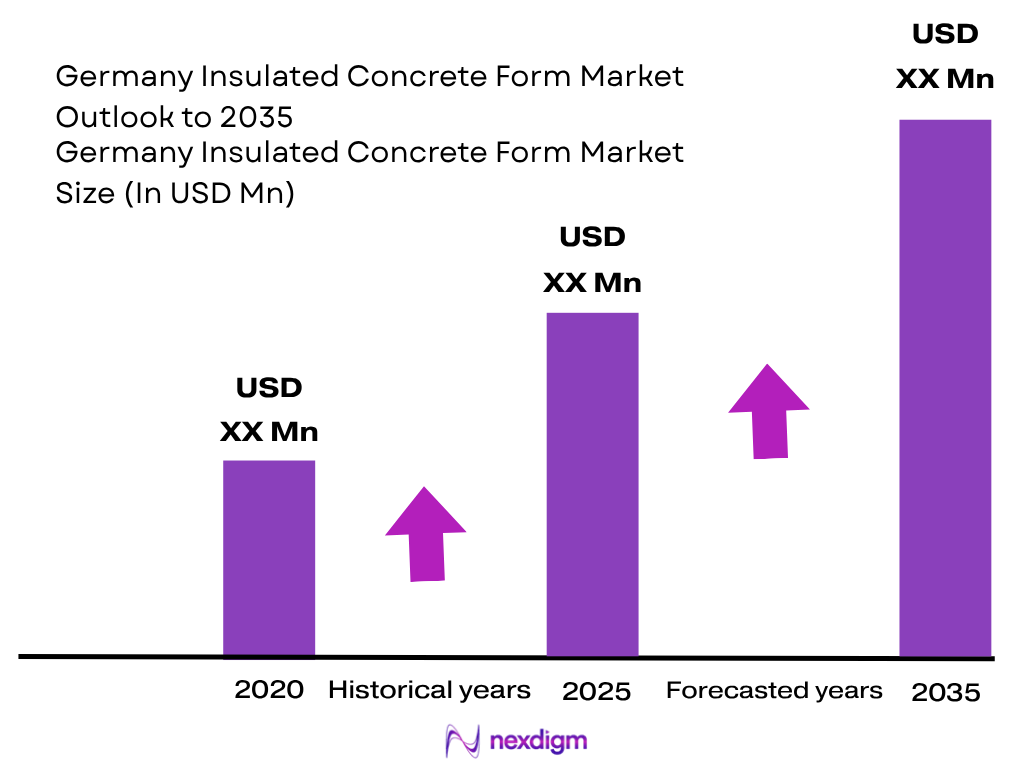
The Germany Insulated Concrete Form Market is valued at approximately USD ~XX million, based on historical ICF adoption across residential, basement and energy-efficient construction. The addressable construction base shifted from 294,399 completed dwellings and 29.554 million m² of residential floor space to 251,937 dwellings and 24.768 million m², while approved dwellings declined from 260,100 to 215,900. These volumes continue to support demand for thermally insulated reinforced-concrete wall systems.
Berlin, Hamburg, Bavaria and Baden-Württemberg represent important German ICF demand clusters because they combine residential development, stringent thermal-envelope requirements and specialist construction-system networks. Berlin’s newly constructed housing remained almost unchanged at 14,633 and 14,632 dwellings, while Hamburg completions increased from 5,999 to 8,319 dwellings and generated 569,360 m² of new residential floor area. Baden-Württemberg also recorded 3,825 newly completed prefabricated residential buildings, reinforcing demand for industrialized high-performance building methods.
Market Segmentation
By Formwork Architecture
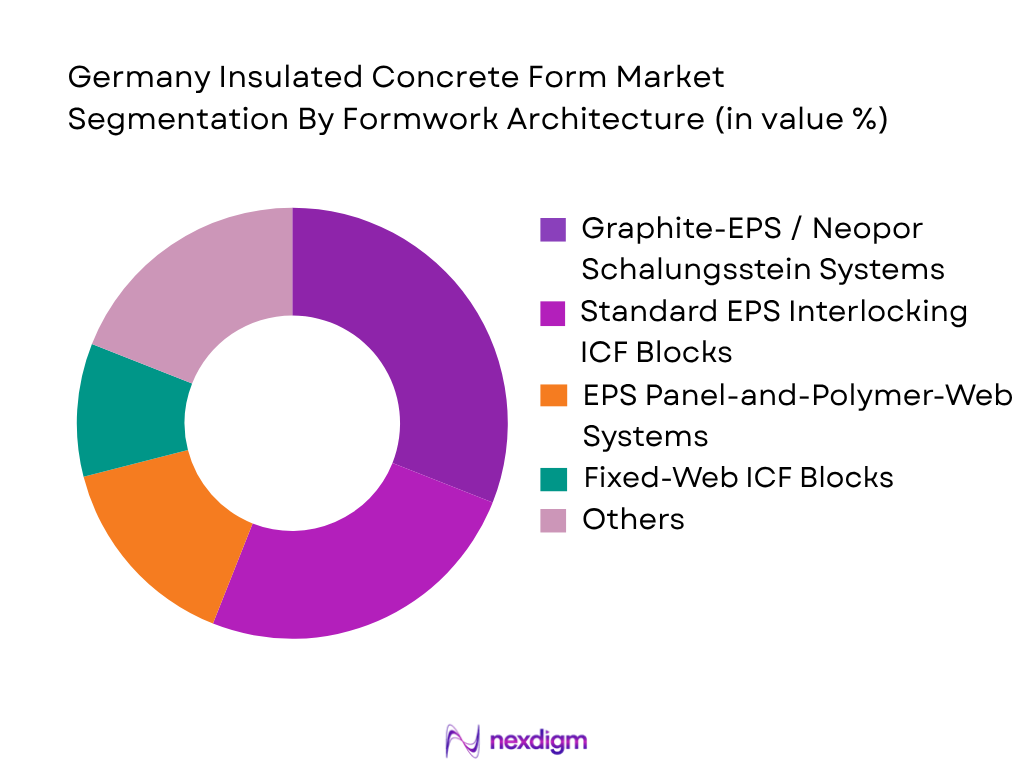
The Germany Insulated Concrete Form Market is segmented into EPS interlocking Schalungsstein systems, graphite-EPS/Neopor blocks, EPS panel-and-web systems, fixed-web ICF blocks, variable-core systems, wood-cement permanent formwork and specialty high-insulation systems. Graphite-EPS and Neopor Schalungsstein systems hold the leading report-model share because German building specifications place substantial emphasis on envelope insulation, thermal-bridge reduction and high-efficiency construction. Domestic manufacturers have developed permanent formwork systems specifically around enhanced EPS insulation. MAGU, for example, processes EPS for construction and markets Neopor-based wall-form systems, while isorast uses BASF Neopor EPS and has a European Technical Assessment for non-load-bearing permanent EPS shuttering filled with structural concrete. These systems fit detached housing, basements and high-performance houses where insulation and concrete structure can be integrated into one wall assembly. Standard EPS blocks retain a large position due to simpler material availability, while wood-cement and panel systems compete where environmental positioning, robustness or different installation practices influence specification.
By Building Type
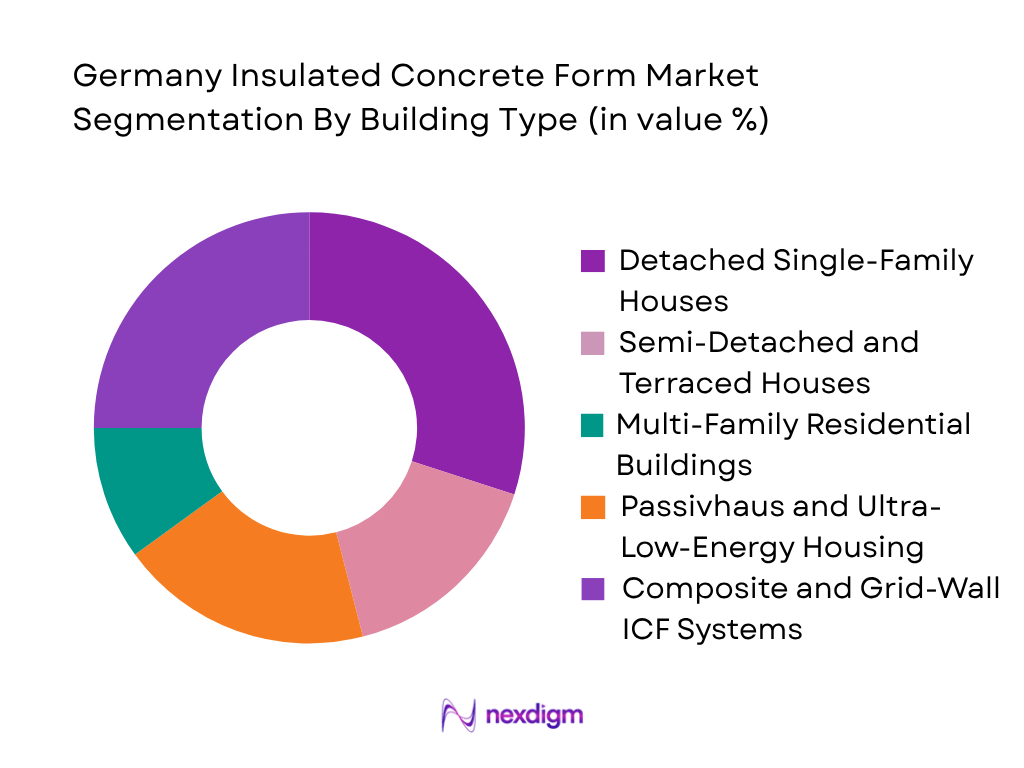
The Germany Insulated Concrete Form Market is segmented into detached single-family houses, semi-detached and terraced houses, multi-family housing, affordable housing, Passivhaus and ultra-low-energy houses, commercial buildings, institutional facilities, hospitality properties and industrial buildings. Detached single-family housing represents the leading report-model segment, as ICF is particularly compatible with customized low-rise construction, self-build projects, basements and complete insulated structural shells. Germany completed 54,500 single-family houses in 2024, alongside 17,600 dwellings in two-family buildings and 135,300 new dwellings in multi-family buildings. Although multi-family construction accounts for larger dwelling volumes, detached projects offer simpler wall geometries, lower vertical structural complexity and stronger opportunities for owner-build or turnkey ICF packages. MAGU specifically promotes complete Bausatzhaus construction using its permanent insulated formwork, while European systems such as EUROMAC2 address both single-family and collective housing. Multi-family applications remain important, particularly where concrete wall construction and stringent energy performance can be combined economically.
Competitive Landscape
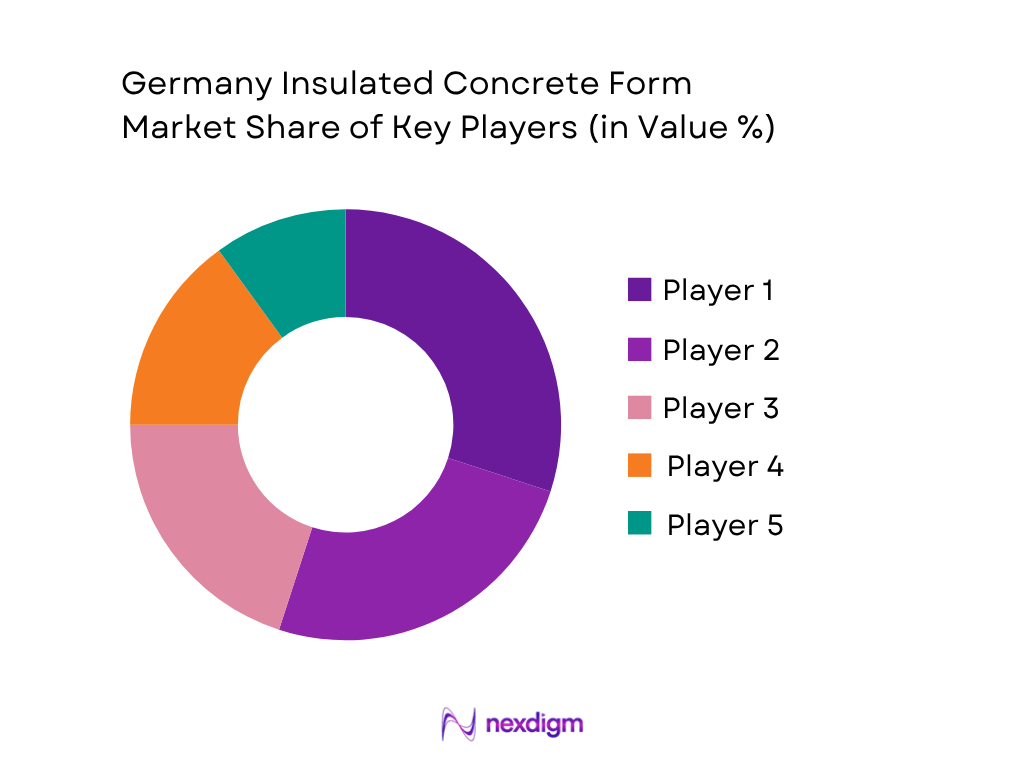
The Germany Insulated Concrete Form Market combines established domestic permanent-formwork manufacturers with broader European and international ICF technology suppliers. German specialists such as MAGU and isorast compete through graphite-EPS/Neopor insulation, thermal-envelope integration and locally adapted technical documentation. European suppliers such as BEWI and EUROMAC2 widen the competitive set through EPS construction systems and complete wall solutions, while international ICF brands provide alternative block architectures. Competitive differentiation centers on thermal performance, concrete-core flexibility, regulatory documentation, system breadth, installer support and compatibility with Effizienzhaus and Passivhaus-oriented construction.
| Major Player | Establishment Year | Headquarters | ICF / Formwork Architecture | Insulation Technology | Concrete-Core / Structural Flexibility | German Market Position | Energy-Efficient Building Capability | Technical & Installer Support |
| MAGU Bausysteme | 1968 | Hüfingen, Germany | ~ | ~ | ~ | ~ | ~ | ~ |
| isorast-Passivhaus-Produkte | Not publicly disclosed | Taunusstein, Germany | ~ | ~ | ~ | ~ | ~ | ~ |
| BEWI | 1980 | Frøya, Norway | ~ | ~ | ~ | ~ | ~ | ~ |
| EUROMAC2 | 1976 | Folschviller, France | ~ | ~ | ~ | ~ | ~ | ~ |
| Nudura | 2001 | Beachwood, Ohio, USA | ~ | ~ | ~ | ~ | ~ | ~ |
Germany Insulated Concrete Form Market Analysis
Growth Drivers
Recovery in Residential Building Approvals Strengthening the Addressable ICF Pipeline
Germany’s improving residential approval pipeline is a direct growth driver for the Germany Insulated Concrete Form Market, particularly for EPS and graphite-EPS Schalungsstein systems used in detached, semi-detached and energy-efficient residential buildings. According to the Federal Statistical Office of Germany (Destatis), 238,063 dwellings received building approval in 2025, compared with 215,289 dwellings in 2024, while permits for dwellings in newly constructed buildings reached 197,732 units in 2025 versus 175,950 units in 2024. New single-family house approvals reached 44,500 units in 2025, creating a sizeable application base for permanent insulated concrete formwork, where lightweight EPS forms, reinforcement and cast-in-place concrete can be combined within one envelope system. Destatis also recorded 83,152 newly approved buildings in 2025 compared with 76,619 in 2024. This renewed pipeline creates project opportunities for German ICF manufacturers serving low-rise housing, basements and complete structural shells. Supporting investment capacity, World Bank data place Germany’s 2024 GDP at USD 4,685.59 billion and GDP per capita at USD 56,103.7, providing a substantial macroeconomic base for higher-performance residential construction technologies.
Energy-Efficient New Construction Supporting Integrated Insulated Concrete Wall Systems
Germany’s policy emphasis on highly energy-efficient new buildings supports the Germany Insulated Concrete Form Market because ICF combines permanent insulation and reinforced concrete within a single external-wall assembly. KfW continues to support Efficiency House 40 construction under its Climate-Friendly New Construction framework, while Efficiency House 55 support was reintroduced in December 2025 and extended during 2026. KfW reported that more than 14,000 housing units received Efficiency House 55 support between the program’s reopening on 16 December 2025 and year-end, demonstrating immediate demand for energy-qualified new construction. The importance of efficient envelopes is also evident in the wider pipeline: Destatis recorded 20.080 million square metres of approved residential floor area in 2024 and 22.120 million square metres in 2025. ICF systems can participate in this activity through continuous EPS or graphite-EPS insulation, reduced wall-junction thermal bridging and concrete thermal mass, particularly in detached houses and efficiency-focused residential projects. KfW also explicitly identifies optimized external-wall insulation as a core measure for efficiency-house construction. From a macroeconomic perspective, the World Bank recorded Germany’s 2024 GDP at USD 4,685.59 billion and GDP per capita at USD 56,103.7, supporting investment in technically advanced building-envelope solutions.
Market Challenges
Contraction in Housing Completions Restricting Near-Term ICF Installation Volumes
Weak residential completions remain a major challenge for the Germany Insulated Concrete Form Market because ICF suppliers depend on actual project execution rather than building approvals alone. According to Destatis, Germany completed 251,900 dwellings in 2024, followed by only 206,600 dwellings in 2025. New single-family house completions stood at 54,500 units in 2024, a particularly important figure because detached homes represent one of the most technically straightforward applications for EPS Schalungsstein and permanent insulated concrete wall systems. The slowdown also affects project conversion: Germany ended 2025 with 760,700 approved but unfinished dwellings, of which 307,200 units were already under construction, while the corresponding backlog stood at 759,700 dwellings at the end of 2024. Additionally, 35,700 residential building permits expired in 2025 compared with 29,000 in 2024, illustrating that approved projects do not necessarily translate into material demand. This environment increases competition among ICF, masonry, timber, AAC and conventional concrete systems for fewer completed buildings. World Bank data show Germany’s 2024 GDP at USD 4,685.59 billion and GDP per capita at USD 56,103.7, indicating strong economic capacity despite the weak construction cycle.
Entrenched Conventional Building Methods Increase the Technical Threshold for ICF Adoption
The Germany Insulated Concrete Form Market faces a structural challenge from established masonry, timber, precast concrete and conventional reinforced-concrete construction ecosystems that already possess broad contractor familiarity, engineering standards and distribution networks. The scale of Germany’s construction pipeline makes specification inertia commercially important. Destatis recorded 145,010 approved buildings and construction measures in 2024, including 76,619 newly approved buildings, while the corresponding figures increased to 149,748 and 83,152 in 2025. During 2024, 215,900 dwellings were completed in newly constructed residential buildings, including 135,300 dwellings in multi-family buildings, where taller structures, dense reinforcement and floor-wall interfaces can require more specialized ICF engineering than detached housing. ICF suppliers must therefore provide documented concrete-core configurations, structural calculations, fire-performance documentation, thermal details, concrete-placement procedures and installer support to displace familiar German wall technologies. The requirement becomes more demanding for multi-storey projects than for standardized low-rise housing. This technical adoption barrier exists within a large, sophisticated economy: according to the World Bank, Germany generated USD 4,685.59 billion in GDP during 2024, with GDP per capita reaching USD 56,103.7, supporting numerous established construction-system alternatives competing for the same projects.
Market Opportunities
Large Construction Backlog Creates Opportunity for Faster Integrated Wall-System Delivery
Germany’s substantial stock of approved but unfinished housing creates a future opportunity for the Germany Insulated Concrete Form Market, particularly where developers seek wall technologies capable of integrating formwork, insulation and reinforced concrete within fewer construction interfaces. Destatis recorded 759,700 approved but unfinished dwellings at the end of 2024 and 760,700 dwellings at the end of 2025. Of the latter, 307,200 dwellings were already under construction, including 158,600 units where structural shell work had been completed. The scale of this backlog prompted the German government and KfW to reactivate Efficiency House 55 new-building support on 16 December 2025, specifically targeting previously approved construction projects. More than 14,000 housing units entered that support framework before year-end. This existing project inventory creates scope for ICF suppliers to target developers with optimized Schalungsstein logistics, pre-engineered reinforcement details, integrated insulation and installer training aimed at improving structural-envelope execution. The opportunity depends on converting approved projects into construction rather than forecasting hypothetical housing demand. Germany’s investment capacity remains substantial, with the World Bank reporting 2024 GDP of USD 4,685.59 billion and GDP per capita of USD 56,103.7, supporting investment in productivity-oriented construction technologies.
Growing Efficient-Building Pipeline Creates Scope for Graphite-EPS and High-Performance ICF Systems
High-performance insulated wall systems represent an important future opportunity for the Germany Insulated Concrete Form Market as Germany continues to channel new construction toward Efficiency House standards and increasingly optimized envelopes. KfW retained Efficiency House 40 and Efficiency House 40 QNG support while adding temporary Efficiency House 55 support, creating multiple recognized performance pathways for residential developers. During the first half of 2026, KfW’s Climate-Friendly Construction program recorded EUR 5.4 billion in new commitments, compared with EUR 1.6 billion during the corresponding 2025 period, indicating substantial current financing activity around efficient new construction. Concurrently, Destatis recorded permits for 21,775 dwellings in March 2026, 20,172 dwellings in April and 20,992 dwellings in May, representing an active project pipeline in which high-insulation wall systems can compete. Germany-based ICF technologies already employ graphite-enhanced EPS and Neopor-type insulation, providing a technical basis for wall assemblies designed around lower heat transmission, concrete thermal mass and reduced thermal bridges. This creates opportunities for manufacturers to differentiate through thinner high-performance envelopes, recycled EPS and integrated structural solutions. The World Bank reports Germany’s 2024 GDP at USD 4,685.59 billion and GDP per capita at USD 56,103.7, underpinning continued capacity for advanced construction investment.
Future Outlook
The Germany Insulated Concrete Form Market is forecast to expand at approximately ~XX% CAGR during 2026–2035, supported by demand for thermally efficient concrete envelopes, Passivhaus-oriented construction and increasingly integrated structural-insulation systems. Development will nevertheless occur against a weak near-term residential construction backdrop, increasing the importance of specialized high-performance applications. KfW climate-friendly construction programs, graphite-EPS technologies, recycled insulation materials, lower-carbon concrete and installer-oriented complete building systems should shape future competitive positioning.
Germany’s energy-efficiency financing framework creates a relevant specification environment for ICF. KfW’s Climate-Friendly New Construction program finances eligible residential buildings with loans of up to EUR 150,000 per dwelling, while the Climate-Friendly New Construction in the Low-Price Segment program provides financing of up to EUR 100,000 per unit for qualifying efficient housing. Permanent insulated concrete forms can address this environment through continuous insulation, reduced junction heat loss and integrated reinforced-concrete construction.
Major Players
- MAGU Bausysteme
- isorast-Passivhaus-Produkte
- BEWI
- EUROMAC2
- Wolf Thermo-Module
- Steinotech
- Nudura
- Amvic Building System
- Quad-Lock Building Systems
- Fox Blocks
- BuildBlock Building Systems
- SuperForm Products
- IntegraSpec
- VELOX
- Durisol / Woodcrete Systems
Key Target Audience
- Insulated Concrete Form and Permanent Formwork Manufacturers
- Residential Developers and Housebuilders
- Passivhaus and Energy-Efficient Building Developers
- General Contractors and Specialized Concrete Contractors
- EPS, Graphite-EPS, Ready-Mix Concrete and Reinforcement Manufacturers
- Architects, Structural Engineering Practices and Building-System Specifiers
- Investments and Venture Capitalist Firms
- Government and Regulatory Bodies (Federal Ministry for Housing, Urban Development and Building, KfW, German Institute for Building Technology, Federal Office for Economic Affairs and Export Control, Federal Environment Agency and State Building Authorities)
Research Methodology
Step 1: Identification of Key Variables
The initial phase involves constructing a comprehensive ecosystem map for the Germany Insulated Concrete Form Market, covering ICF manufacturers, EPS processors, concrete suppliers, reinforcement manufacturers, distributors, architects, energy-efficiency experts, contractors and developers. Desk research establishes the principal variables affecting the market, including installed ICF wall area, EPS consumption, concrete-core thickness, building typology, thermal performance, regulatory approvals, domestic production and distribution coverage.
Step 2: Market Analysis and Construction
Historical market analysis combines a top-down assessment of German residential and non-residential construction with bottom-up evaluation of ICF manufacturers and permanent-formwork suppliers. Building completions, permits, housing typology and floor-area statistics establish the addressable construction base. Supplier portfolios, system capacities, estimated wall installations, insulation configurations, project exposure and distribution networks are subsequently assessed to construct and reconcile market value and volume estimates.
Step 3: Hypothesis Validation and Expert Consultation
Market hypotheses are validated through computer-assisted telephone interviews and direct interaction with ICF producers, EPS processors, ready-mix concrete suppliers, structural engineers, energy-efficiency specialists, contractors and distributors. Consultations focus on Schalungsstein architecture, Neopor adoption, wall thicknesses, reinforcement configurations, concrete placement, Passivhaus suitability, regulatory acceptance, installation productivity and project-level substitution against masonry, timber and conventional reinforced-concrete construction.
Step 4: Research Synthesis and Final Output
The final phase triangulates Destatis construction statistics, KfW energy-efficient building information, technical approvals, manufacturer documentation and primary market inputs. Bottom-up supplier and installed-wall estimates are reconciled with the top-down addressable construction base to avoid overstating ICF penetration. The completed framework provides a validated assessment of segmentation, supplier positioning, technology development, regulatory influences, demand constraints and future opportunities in the Germany Insulated Concrete Form Market.

- Executive Summary
- Research Methodology (Market Definition and Scope, Germany Insulated Concrete Form Market Classification, EPS and Graphite-EPS ICF Demand Assessment, ICF Wall Area Consumption Mapping, Domestic ICF Manufacturing Capacity Assessment, Import Dependency Analysis, EPS and Neopor Feedstock Assessment, Formwork Architecture and Moulding Technology Mapping, Application-Level Demand Assessment, Building Type Demand Mapping, Energy-Efficient Construction Assessment, Primary Industry Interviews, Top-Down Market Sizing, Bottom-Up Company Revenue and ICF Wall Area Assessment, Trade Flow Analysis, Data Triangulation, Pricing Assessment, Forecasting Framework)

- Definition and Scope
- Germany Insulated Concrete Form Industry Evolution and Development of EPS Schalungssteine, Graphite-EPS Permanent Formwork, Reinforced Concrete Wall Systems and Energy-Efficient Building Ecosystem
- ICF Block, EPS Panel, Polymer Web, Reinforcement, Concrete Core and Integrated Insulation Industry Structure
- Germany Insulated Concrete Form Value Chain Analysis
- Germany Insulated Concrete Form Supply Chain Analysis
- EPS and Neopor Feedstock Supplier, EPS Moulder, ICF Manufacturer, Connector Supplier, Reinforcement Producer, Ready-Mix Concrete Supplier, Distributor, Structural Engineer, Energy-Efficiency Planner, Installer, Contractor, Developer and Building Owner Ecosystem Analysis
- Insulated Concrete Form Integration Across Detached Housing, Semi-Detached Housing, Multi-Family Residential Buildings, Passivhaus Projects, Effizienzhaus Buildings, Basements, Commercial Buildings, Public Buildings and Swimming Pools

- Growth Drivers (Effizienzhaus 40 and High-Efficiency New-Build Requirements, Demand for Low-Transmission-Heat-Loss Building Envelopes, KfW Climate-Friendly Construction Funding, Passivhaus Construction, Thermal-Bridge Reduction, Airtight Building Envelope Requirements, Integration of Reinforced Concrete Structure and Insulation, Skilled Construction Labour Constraints, Self-Build and Bausatzhaus Applications)
- Market Challenges (Weak New Residential Construction Pipeline, Competition from Masonry and Timber Construction, Reinforced Concrete Embodied Carbon Considerations, EPS Sustainability Requirements, Limited Specialized ICF Contractor Availability, Concrete Placement and Form Pressure Management, DIBt and European Technical Assessment Requirements, Fire Protection Compliance, Structural Engineering Requirements, Established German Masonry Supply Chain)
- Market Opportunities (Effizienzhaus 40 Housing, QNG-Compatible Construction, Passivhaus-Oriented ICF Systems, Graphite-EPS and Neopor Permanent Formwork, Low-Thermal-Bridge Concrete Walls, Multi-Family Residential ICF, Basement Construction, Domestic ICF Manufacturing, Recycled-EPS Formwork, Lower-Carbon Concrete Integration, Self-Build Housing Systems, Integrated Foundation-Wall-Roof Solutions)
- Market Trends (Graphite-EPS Adoption, Neopor Schalungssteine, Variable Concrete Core Systems, High-Insulation Wall Assemblies, Integrated Thermal and Structural Design, Blower-Door-Oriented Airtight Construction, Lifecycle Carbon Assessment, QNG Certification, Recycled Insulation Content, Factory-Optimized Form Components, Integrated Window and Shutter Details, Digital Structural and Thermal Design)
- Regulatory and Standards Landscape (Gebäudeenergiegesetz, German Building Codes, Landesbauordnungen, DIBt Technical Approvals, European Technical Assessments, Construction Products Regulation, DIN EN Concrete Requirements, DIN Thermal Protection Requirements, Fire Protection Requirements, Effizienzhaus 40 Requirements, Qualitätssiegel Nachhaltiges Gebäude, Passivhaus Performance Requirements)
- SWOT Analysis
- Porter’s Five Forces Analysis
- PESTLE Analysis
- Stakeholder Ecosystem
- Competition Ecosystem

- By Market Value (2020-2025)
- By ICF Wall Area Installed (2020-2025)
- By ICF Schalungsstein and Panel Consumption Volume (2020-2025)
- By Domestic ICF Production Value (2020-2025)
- By Domestic ICF Production Volume (2020-2025)
- By ICF System Import Value (2020-2025)
- By ICF System Import Volume (2020-2025)
- By Average Selling Price (2020-2025)

- By Formwork Architecture (In Value %)
EPS Interlocking Schalungsstein Systems
Graphite-EPS / Neopor Schalungsstein Systems
EPS Panel-and-Polymer-Web Systems
Fixed-Web ICF Blocks
Variable Concrete-Core ICF Systems
Wood-Cement Permanent Formwork Systems
High-Insulation Passivhaus ICF Systems
Hybrid and Specialty Permanent Formwork Systems - By Insulation Material (In Value %)
Standard Expanded Polystyrene
Graphite-Enhanced Expanded Polystyrene
Neopor-Based Insulated Formwork
High-Density Expanded Polystyrene
Recycled-Content Expanded Polystyrene
Wood-Cement Composite Permanent Formwork
EPS-XPS Hybrid Systems
Other High-Performance Insulated Formwork Materials - By Application Type (In Value %)
External Load-Bearing Walls
Internal Structural Walls
Basement Walls
Retaining Walls
Foundations and Stem Walls
Swimming Pool Structures
Garage and Ancillary Building Walls
Commercial Structural Walls
Public and Institutional Building Walls
Multi-Storey Reinforced Concrete Walls
Other Reinforced Concrete Applications - By Building Type (In Value %)
Detached Single-Family Houses
Semi-Detached and Terraced Houses
Multi-Family Residential Buildings
Affordable and Social Housing
Passivhaus and Ultra-Low-Energy Housing
Commercial and Mixed-Use Buildings
Educational and Public Buildings
Healthcare and Care Facilities
Hospitality and Leisure Buildings
Industrial and Agricultural Buildings - By Distribution and Project Delivery Model (In Value %)
Direct ICF Manufacturer Supply
Regional Building Material Distribution
Authorized ICF System Partners
Installer-Led Procurement
General Contractor Procurement
Developer Direct Procurement
Self-Builder and Bausatzhaus Supply
Design-Supply-Technical-Support Packages

- Market Share of Major Players (By Germany ICF Revenue, ICF Wall Area, Schalungsstein Volume, Formwork Architecture, Insulation Material, Concrete Core Configuration, Building Type, German Manufacturing and Distribution Footprint)
- Cross Comparison Parameters (Germany ICF Revenue, ICF Schalungsstein and Panel Architecture Breadth, EPS Graphite-EPS and Neopor Thermal Performance Capability, Concrete Core Width and Structural Configuration Flexibility, DIBt ETA and German Building Regulation Approval Coverage, Effizienzhaus Passivhaus and Airtight Building Capability, Germany Manufacturing Distribution and Installer Footprint, Structural Design Energy Planning Training and On-Site Technical Support Capability)
- SWOT Analysis of Major Players
- Competitive Positioning Matrix
- ICF Schalungsstein and Permanent Formwork Portfolio Benchmarking
- Pricing and ICF System Category Benchmarking
- Manufacturing, EPS Moulding and Permanent Formwork Technology Assessment
- Building Type and Customer Application Exposure Assessment
- Domestic Manufacturing Versus Imported ICF Supply Positioning
- Detailed Profiles of Major Companies
MAGU Bausysteme
isorast-Passivhaus-Produkte
BEWI
EUROMAC2
Wolf Thermo-Module
Steinotech
Nudura
Amvic Building System
Quad-Lock Building Systems
Fox Blocks
BuildBlock Building Systems
SuperForm Products
IntegraSpec
VELOX
Durisol / Woodcrete Systems

- Detached House Developer ICF Procurement Assessment
- Self-Builder and Bausatzhaus ICF Adoption Assessment
- Multi-Family Residential Developer ICF Requirement Analysis
- Affordable and Social Housing Developer ICF Assessment
- Passivhaus and Effizienzhaus Developer ICF Specification Assessment
- Architect and Energy-Efficiency Expert ICF Specification Analysis
- Structural Engineer Concrete Core and Reinforcement Assessment
- General Contractor ICF Procurement and Installation Assessment
- Basement and Specialist Concrete Contractor ICF Requirement Analysis
- Commercial and Public Building Developer ICF Assessment

- By Market Value (2026-2035)
- By ICF Wall Area Installed (2026-2035)
- By ICF Schalungsstein and Panel Consumption Volume (2026-2035)
- By Domestic ICF Production Value (2026-2035)
- By Domestic ICF Production Volume (2026-2035)
- By ICF System Import Value (2026-2035)
- By ICF System Import Volume (2026-2035)
- By Average Selling Price (2026-2035)


 Request a Sample
 Ask for Customization
 Get a Quote
 Enquire Now