
 Download PDF
Market Overview
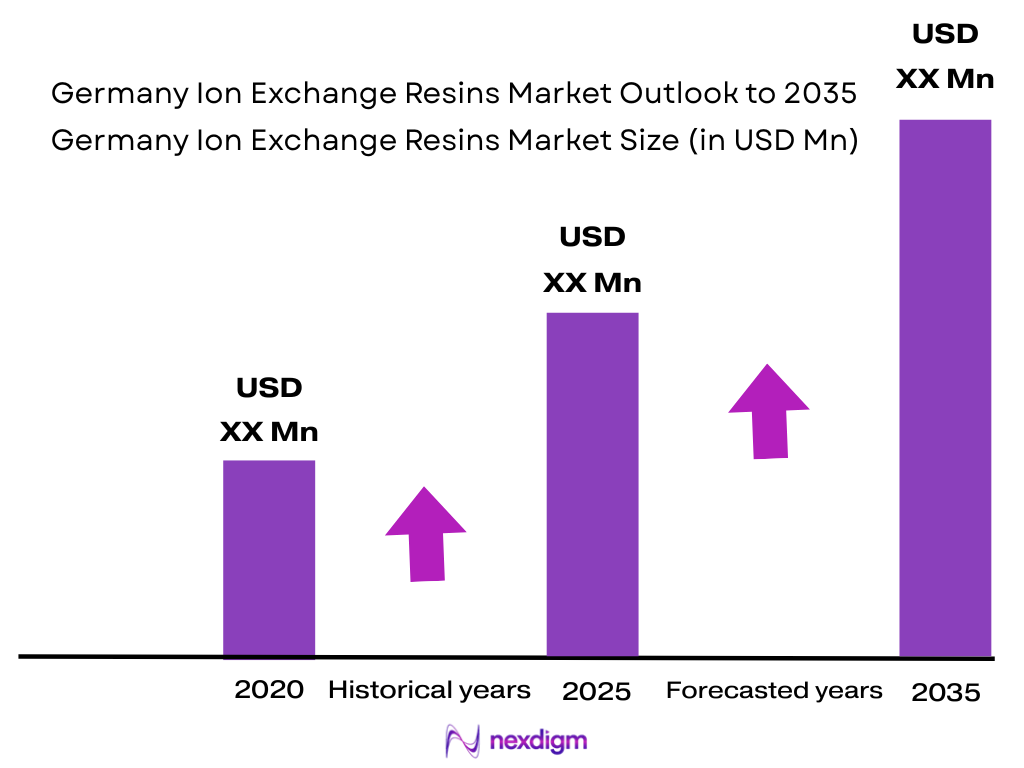
The Germany Ion Exchange Resins Market is valued at approximately USD ~400 million, compared with approximately USD ~380 million in the preceding historical observation, reflecting demand from industrial water treatment, chemical processing, pharmaceuticals, power utilities and high-purity manufacturing. A published Germany-specific industrial-water resin study places the market at approximately USD 0.4 billion, while the broader global ion exchange resin market exceeds USD 2 billion. Germany’s extensive process-industry base and recurring resin replacement requirements underpin consumption.
North Rhine-Westphalia, Saxony, Saxony-Anhalt and Bavaria represent important German demand and supply clusters. Cologne-Leverkusen benefits from LANXESS’s specialty-chemicals and Lewatit ecosystem, while Bitterfeld hosts ion-exchange resin production. Dresden is strengthening demand through semiconductor fabrication and associated ultrapure-water systems, supported by a EUR 5 billion German support measure for ESMC. Germany’s chemical-pharmaceutical sector recorded turnover moving from EUR 229.3 billion to EUR 221 billion, sustaining a large process-water treatment customer base.
Market Segmentation
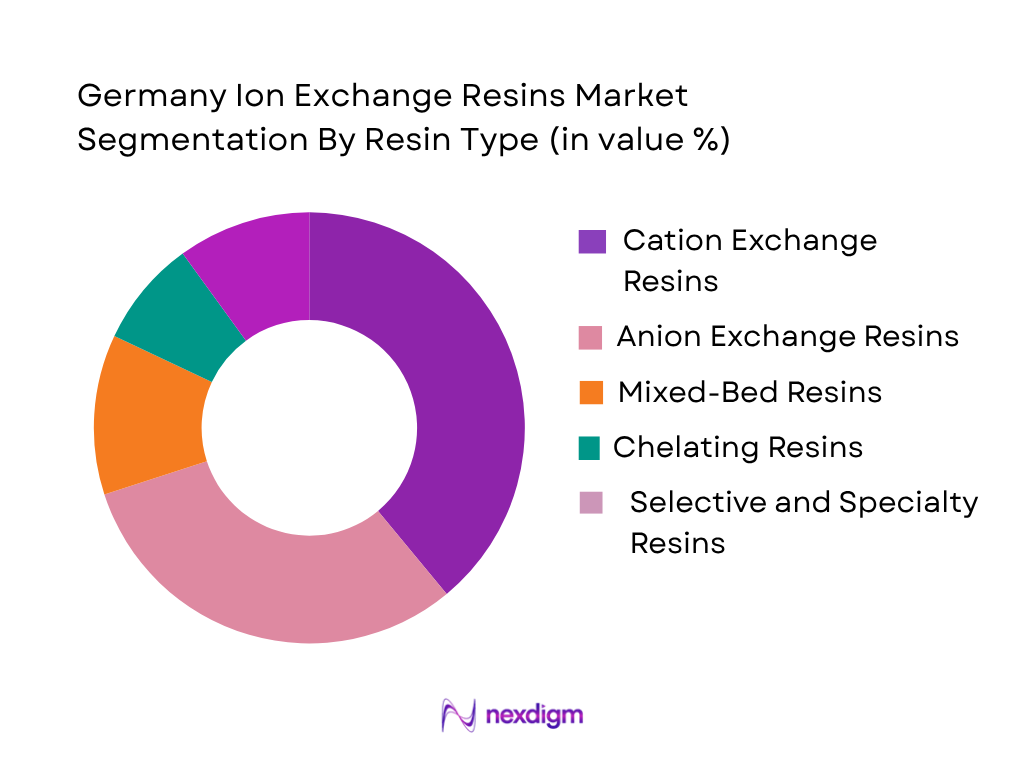
By Resin Type
Germany Ion Exchange Resins Market is segmented by resin type into cation exchange resins, anion exchange resins, mixed-bed resins, chelating resins, and selective and specialty resins. Cation exchange resins hold the dominant share under this segmentation because they are extensively consumed in hardness removal, industrial water softening, demineralization trains, boiler-feed preparation and process-water conditioning. Strong-acid cation resins have a particularly established installed base and are commonly paired with anion resins in demineralization systems. Germany’s substantial chemical, pharmaceutical, power, food-processing and advanced manufacturing industries create recurring replacement demand for these materials. Cation resins also benefit from mature operating practices, broad compatibility with conventional regeneration systems and widespread availability from leading suppliers. LANXESS continues to manufacture strong-acid cation products in Germany and has introduced lower-carbon-footprint grades for industrial and drinking-water softening applications, reinforcing the segment’s commercial relevance.
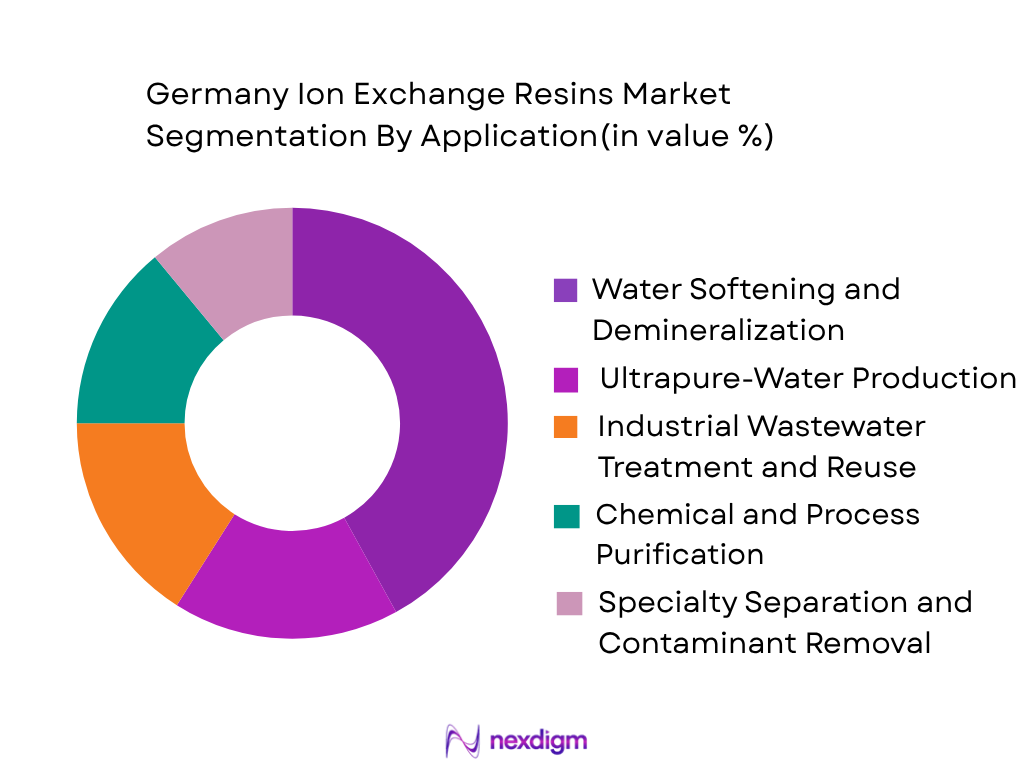
By Application
Germany Ion Exchange Resins Market is segmented by application into water softening and demineralization, ultrapure-water production, industrial wastewater treatment and reuse, chemical and process purification, and specialty separation and contaminant removal. Water softening and demineralization represent the dominant application because German industrial facilities require controlled hardness, conductivity and ionic composition for boilers, cooling systems, process streams and high-quality manufacturing water. The segment benefits from a large installed base, recurring regeneration cycles and periodic resin replacement rather than dependence solely on new treatment-system installations. Chemical and pharmaceutical plants, municipal systems and industrial utilities create diversified demand. Ion exchange also remains complementary to membrane technologies: reverse osmosis may remove bulk dissolved solids while ion exchange and mixed-bed polishing are used where tighter ionic purity is required. Germany’s established water-treatment infrastructure therefore provides a recurring consumption base for cation and anion resins.
Competitive Landscape
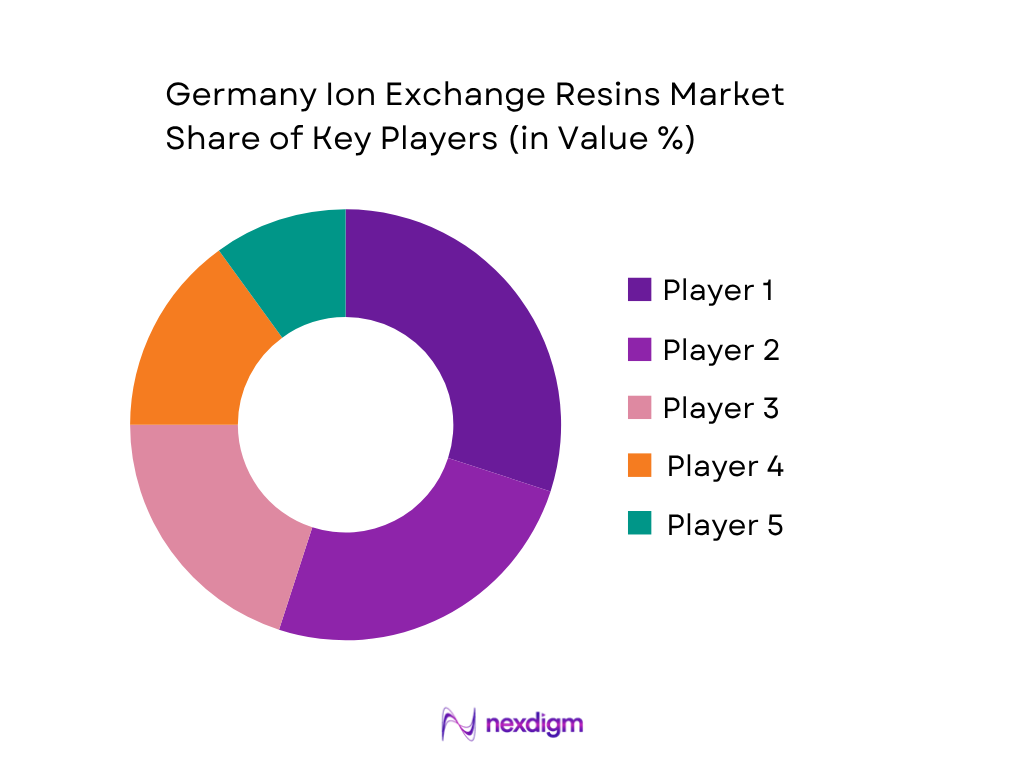
The Germany Ion Exchange Resins Market combines a strong domestic supplier with established international resin manufacturers. LANXESS has a structural advantage through the Lewatit brand, German production and technical infrastructure, while DuPont, Ecolab/Purolite, Mitsubishi Chemical and Samyang compete through broad resin chemistry, high-purity grades and international customer relationships. Competition increasingly extends beyond conventional exchange capacity toward uniform-particle technology, low-leachable grades, selective removal, sustainability, technical support and total treatment-system economics. MarketsandMarkets identifies LANXESS, DuPont, Ecolab, Mitsubishi Chemical and Samyang among important global suppliers.
| Major Player | Establishment | Headquarters | Resin Brand | Core Resin Portfolio | High-Purity / Specialty Capability | Germany / Europe Presence | Key Market Applications | Technical & Service Positioning |
| LANXESS AG | 2004 | Cologne, Germany | ~ | ~ | ~ | ~ | ~ | ~ |
| DuPont de Nemours, Inc. | 1802 heritage | Wilmington, USA | ~ | ~ | ~ | ~ | ~ | ~ |
| Ecolab Inc. / Purolite | 1923 / Purolite platform | Saint Paul, USA | ~ | ~ | ~ | ~ | ~ | ~ |
| Mitsubishi Chemical Group | 1933 heritage | Tokyo, Japan | ~ | ~ | ~ | ~ | ~ | ~ |
| Samyang Corporation | 1924 | Seoul, South Korea | ~ | ~ | ~ | ~ | ~ | ~ |
Germany Ion Exchange Resins Market Analysis
Growth Drivers
Expansion of Germany’s Chemical and Pharmaceutical Processing Base
Germany’s large chemical and pharmaceutical manufacturing ecosystem provides a substantial installed demand base for ion exchange resins used in boiler-feed demineralization, process-water purification, condensate polishing, ingredient purification and wastewater treatment. The German chemical and pharmaceutical industry generated EUR 221 billion in sales in 2024, comprising EUR 82 billion from domestic business and EUR 139 billion from foreign business, according to the German Chemical Industry Association using Federal Statistical Office data. Approximately 480,000 employees were engaged in the sector, demonstrating the scale of continuous-process manufacturing infrastructure requiring controlled water chemistry. Germany Trade & Invest reports that pharmaceutical production alone reached EUR 37.5 billion in 2024. This industrial base operates within an economy whose GDP stood at USD 4.68559 trillion and whose population reached 83,516,593 in 2024, according to the World Bank. Chemical reactors, steam systems, purification trains and pharmaceutical production facilities require removal of hardness ions, silica, nitrate, dissolved metals and other contaminants. Consequently, Germany’s existing industrial asset base creates recurring demand for strong-acid cation, strong-base anion, mixed-bed and specialty purification resins through regeneration, make-up resin consumption and periodic resin-bed replacement.
Growth of Semiconductor Manufacturing and Ultrapure-Water Infrastructure
Semiconductor investment is strengthening a technically demanding application area for the Germany Ion Exchange Resins Market because wafer fabrication requires highly purified process water with extremely low ionic contamination. In 2024, the European Commission approved EUR 5 billion of German state support for European Semiconductor Manufacturing Company’s new semiconductor fabrication facility in Dresden. ESMC brings together **4 major industrial partners—TSMC, Bosch, Infineon and NXP—**and reinforces Dresden’s importance as a high-technology manufacturing cluster. Such facilities require multistage ultrapure-water systems in which ion exchange resins are deployed for deionization, mixed-bed polishing and removal of trace ionic contaminants after upstream membrane treatment. The broader industrial platform supporting this demand is substantial: Germany recorded 209,815 manufacturing legal units and 7,471,915 manufacturing employees in 2024, according to the Federal Statistical Office. Manufacturing turnover reached EUR 2.556826 trillion during the same period. The World Bank places Germany’s 2024 GDP at USD 4.68559 trillion, demonstrating the economic scale supporting capital-intensive industrial infrastructure. The semiconductor build-out therefore supports demand not merely for conventional resins but for ultrapure, low-leachable, uniform-particle and tightly controlled mixed-bed products suited to high-specification water systems.
Market Challenges
Weak Operating Conditions in Germany’s Core Chemical Customer Base
A major challenge for the Germany Ion Exchange Resins Market is subdued operating activity among chemical and pharmaceutical plants, which are among the country’s largest industrial users of demineralization and process-purification systems. German chemical and pharmaceutical sales totaled EUR 221 billion in 2024, consisting of EUR 82 billion in domestic sales and EUR 139 billion in foreign sales, according to VCI figures based partly on Federal Statistical Office data. The industry nevertheless maintained approximately 480,000 jobs, indicating that a very large production infrastructure remains operational even under weaker demand conditions. Germany’s wider manufacturing sector contained 209,815 legal units, employed 7,471,915 people, and generated approximately EUR 2.557 trillion in turnover during 2024, according to Destatis. The World Bank reported national GDP of USD 4.68559 trillion and GDP per capita of USD 56,103.7 in 2024. For ion exchange resin suppliers, weaker utilization of chemical production assets can restrict consumption associated with process throughput, new treatment capacity and facility expansion. Resin replacement demand provides some resilience, but suppliers remain exposed to operating rates at chemical, petrochemical, polymer and specialty-chemical plants where large demineralization and boiler-water treatment trains are installed.
Complex Resin Lifecycle, Wastewater and Spent-Material Management Requirements
Germany’s extensive environmental treatment infrastructure creates demand for ion exchange technology but also raises compliance requirements around regenerants, spent resin and concentrated contaminant streams. The Federal Statistical Office recorded 8,464 biological wastewater-treatment plants in Germany in 2024, of which 4,006 facilities reported direct sewage-sludge disposal. Germany disposed of 1,666,268 tonnes of dry sewage sludge during the same period, including 1,248,265 tonnes disposed of within the originating federal state, 415,069 tonnes transferred to another German state and 2,934 tonnes sent to another country. Destatis separately recorded 381 chemical-physical waste-treatment plants processing 7,055,900 tonnes of material in 2024. These figures illustrate the scale and regulatory sophistication of Germany’s waste-management environment. Ion exchange systems generate spent regenerant solutions containing salts and removed contaminants, while exhausted specialty resins may require controlled handling depending on captured substances. Germany’s economy, valued by the World Bank at USD 4.68559 trillion in 2024, supports sophisticated treatment infrastructure, but this also creates high expectations for traceability and environmental management. Resin suppliers therefore need products that deliver stable operating life, effective regeneration and compatibility with established wastewater-management practices.
Market Opportunities
Selective Resin Solutions for PFAS and Advanced Drinking-Water Treatment
Tightening contaminant control creates a significant future opportunity for specialty ion exchange resins in Germany, particularly strongly selective anion products designed for persistent fluorinated compounds. Germany’s drinking-water regulatory framework specifies a limit of 100 nanograms per litre for the sum of 20 designated PFAS substances and establishes an additional parameter covering 4 priority PFAS compounds at 20 nanograms per litre, according to Germany’s Drinking Water Ordinance and Federal Environment Agency information. These numeric limits are directly relevant to resin selection because conventional softening resins are not designed for the same contaminant profile as dedicated selective anion-exchange media. Germany also had a population of 83,516,593 in 2024 according to the World Bank, illustrating the scale of the drinking-water system subject to contaminant-management requirements. The Federal Statistical Office recorded 8,464 biological wastewater-treatment facilities in 2024, demonstrating the depth of the national water-treatment ecosystem within which advanced polishing technologies can be integrated. These existing infrastructure and regulatory conditions create room for resin suppliers to expand into PFAS polishing, groundwater remediation, industrial discharge treatment and selective contaminant removal. Future growth is therefore likely to favor technically differentiated resins supported by application engineering rather than only conventional commodity water-softening products.
Ultrapure, High-Purity and Specialty Resin Penetration in Advanced Manufacturing
Germany’s evolving manufacturing mix creates an opportunity for higher-specification ion exchange resins in semiconductors, pharmaceuticals, biotechnology and other contamination-sensitive industries. Germany Trade & Invest reports pharmaceutical production of EUR 37.5 billion in 2024, while the Federal Statistical Office recorded 209,815 manufacturing legal units, 7,471,915 manufacturing employees and EUR 2.556826 trillion of manufacturing turnover. In parallel, the European Commission approved EUR 5 billion of German support for the new ESMC semiconductor fabrication facility in Dresden, a joint project involving 4 companies: TSMC, Bosch, Infineon and NXP. These industries require water treatment beyond basic hardness removal, including deionization, trace-ion removal, silica control and final mixed-bed polishing. Germany’s broader macroeconomic capacity supports such capital-intensive applications: World Bank data place 2024 GDP at USD 4.68559 trillion and GDP per capita at USD 56,103.7. These current indicators provide a strong foundation for future adoption of ultrapure-water-grade, low-leachable, uniform-particle, mixed-bed and specialty chelating resins. Suppliers that can meet stringent qualification requirements and provide technical support for integrated RO–ion exchange–polishing systems have a clear pathway to address higher-value German industrial applications.
Future Outlook
The Germany Ion Exchange Resins Market is expected to expand at a forecast CAGR of approximately ~6.5% during the forecast period, supported by higher requirements for water purity, contaminant removal, water reuse and advanced industrial manufacturing. Growth is likely to shift progressively toward higher-value selective, uniform-particle, low-TOC and ultrapure-water grades rather than being driven solely by conventional softening resin volumes.Semiconductor investment is particularly relevant. The European Commission approved a EUR 5 billion German measure supporting the ESMC semiconductor facility in Dresden, reinforcing Saxony’s role as an advanced electronics manufacturing cluster. Semiconductor fabrication requires highly controlled ultrapure-water systems in which ion exchange and mixed-bed polishing can provide final ionic removal. This creates an attractive market for premium resins with low extractables, tight bead-size distribution, high mechanical stability and reliable qualification documentation.
Regulatory tightening will create another demand layer. Germany’s Drinking Water Ordinance establishes a 100 ng/L limit for the sum of 20 specified PFAS compounds and a more stringent 20 ng/L limit for four priority PFAS substances at later compliance stages. Selective anion-exchange technologies are consequently positioned as part of the treatment toolkit alongside activated carbon and other adsorption technologies. LANXESS is already commercially positioning Lewatit solutions for PFAS removal, indicating that selective contaminant treatment is becoming a strategic specialty-resin opportunity.
Major Players
- LANXESS AG – Lewatit™
- DuPont de Nemours, Inc. – AmberLite™
- Ecolab Inc. / Purolite – Purolite™
- Mitsubishi Chemical Group Corporation – DIAION™
- Samyang Corporation – TRILITE™
- Thermax Limited – Tulsion™
- Ion Exchange (India) Limited – INDION™
- Sunresin New Materials Co., Ltd.
- ResinTech, Inc.
- Jacobi Carbons Group / Jacobi Resins
- CHEMRA GmbH – TREVERLITE
- Graver Technologies LLC
- Jiangsu Suqing Water Treatment Engineering Group
- Zhejiang Zhengguang Industrial Co., Ltd.
- Aldex Chemical Company Limited
Key Target Audience
- Ion Exchange Resin Manufacturers and Specialty Polymer Producers
- Industrial Water Treatment Equipment Manufacturers, EPC Contractors and System
- Integrators
- Chemical, Pharmaceutical, Semiconductor, Power, Food and Advanced Manufacturing Companies
- Ion Exchange Resin Importers, Distributors and Regeneration Service Providers
- Water Utilities and Industrial Wastewater Treatment Operators
- Investments and Venture Capitalist Firms
- Government and Regulatory Bodies
- Private Equity Firms, Strategic Investors and Specialty Chemical Acquisition Teams
Research Methodology
Step 1: Identification of Key Variables
The initial phase involves constructing an ecosystem map covering resin manufacturers, raw-material suppliers, importers, distributors, water-treatment EPC companies, regeneration providers and major German end users. Secondary research is used to identify variables such as resin chemistry, exchange capacity, pricing, import dependence, installed bed volume, replacement cycles, end-user water requirements and regional industrial concentration.
Step 2: Market Analysis and Construction
Historical Germany Ion Exchange Resins Market data is compiled using manufacturer disclosures, trade flows, industry databases, resin pricing, water-treatment installations and sector-specific consumption indicators. A top-down model evaluates Germany’s position within European resin demand, while bottom-up analysis reconstructs consumption from supplier sales, imported volumes, installed resin capacity and recurring replacement requirements across industrial applications.
Step 3: Hypothesis Validation and Expert Consultation
Initial market hypotheses are validated through CATIs and structured interviews with resin manufacturers, distributors, industrial water-treatment companies, EPC specialists, regeneration providers and procurement executives. Discussions assess average selling prices, resin volumes, replacement intervals, customer qualification requirements, competitive positioning and emerging demand from semiconductor, pharmaceutical, PFAS-treatment and industrial water-reuse applications.
Step 4: Research Synthesis and Final Output
The final stage triangulates primary findings with trade statistics, company information, regulatory developments and end-industry indicators. Supplier-level sales estimates are reconciled with application-level consumption calculations to minimize double counting. Market shares, segmentation, competitive benchmarks and forecasts are then reviewed against capacity, pricing, replacement-cycle and technology-adoption assumptions before preparation of the final Germany Ion Exchange Resins Market model.

- Executive Summary
- Research Methodology (Market Definition and Scope, Ion Exchange Resin Classification, Market Boundary Assessment, Abbreviations, Market Sizing Methodology, Top-Down Market Estimation, Bottom-Up Market Validation, Demand-Side Assessment, Supply-Side Assessment, Domestic Production Assessment, Import-Based Market Reconstruction, Distributor Sales Assessment, Installed Resin Bed Assessment, Resin Replacement Cycle Analysis)

- Definition and Scope
- Evolution of Germany Ion Exchange Resins Industry
- Ion Exchange Resin Industry Genesis and Market Development
- Germany Ion Exchange Resins Industry Ecosystem Analysis
- Germany Ion Exchange Resins Supply Chain Analysis
- Domestic Manufacturing versus Imported Resin Supply Landscape
- Installed Ion Exchange System Base Assessmen

- Market Growth Drivers (Expansion of Semiconductor and Microelectronics Manufacturing, Increasing Ultrapure Water Requirements, Growth of Chemical and Specialty Chemical Production, Rising Industrial Water Treatment Investment, Increasing Industrial Water Reuse, Expansion of Pharmaceutical and Biopharmaceutical Manufacturing)
- Market Challenges (Volatility in Styrene-Divinylbenzene and Acrylic Feedstock Prices, Energy Cost Pressure, Resin Price Volatility, Competition from Reverse Osmosis and Electrodeionization, Resin Fouling from Organic and Metal Contaminants, Regeneration Chemical Cost)
- Market Opportunities (Ultrapure Water Resins for Semiconductor Manufacturing, Semiconductor Grade Mixed Bed Resins, PFAS-Selective Anion Exchange Resins, Industrial Wastewater Recycling, Heavy Metal and Selective Chelating Resins, High-Purity Pharmaceutical Resins, Biopharmaceutical Process Water Resins)
- Market Trends (Shift from Commodity to High-Performance Resins, Adoption of Uniform Particle Size Resins, RO–Ion Exchange–EDI Hybridization, Growth of Mixed Bed Polishing, Increasing Demand for Low-Leachable and Low-TOC Resins, Semiconductor Grade Resin Qualification, Longer Resin Life Optimization)
- Regeneration Economics Analysis
- SWOT Analysis of Major Players
- Porter’s Five Forces Analysis
- PESTLE Analysis

- By Market Value (2020-2025)
- By Consumption Volume (2020-2025)
- By Average Selling Price (2020-2025)
- By Domestic Production Value (2020-2025)
- By Import Value (2020-2025)
- By Import Volume (2020-2025)
- By Installed Resin Bed Volume (2020-2025)
- By Fresh Resin Consumption versus Replacement Resin Demand (2020-2025)

- By Resin Type
Strong Acid Cation Resins
Weak Acid Cation Resins
Strong Base Anion Resins – Type I
Strong Base Anion Resins – Type II
Weak Base Anion Resins
Mixed Bed Resins
Chelating Resins
Selective Ion Exchange Resins
Adsorbent and Specialty Separation Resins
Ultrapure Water Grade Resins
Food and Pharmaceutical Grade Resins
Condensate Polishing Resins - By Polymer Matrix
Styrene-Divinylbenzene Resins
Acrylic Resins
Polystyrenic Resins
Macroporous Resins
Gel-Type Resins
Specialty Polymeric Matrices - By Application
Water Softening
Demineralization and Deionization
Condensate Polishing
Ultrapure Water Production
Boiler Feedwater Treatment
Process Water Purification
Drinking and Municipal Water Treatment
Wastewater Treatment and Water Reuse
PFAS Removal
Nitrate Removal
Heavy Metal Removal
Boron and Selective Contaminant Removal
Food and Beverage Purification
Pharmaceutical Purification and Separation
Biopharmaceutical Process Water Treatment
Chemical Processing and Catalysis
Metal Recovery and Hydrometallurgy - By Supply Source
Germany
China
South Korea
Japan
India
United States
Other European Markets
Other Asia-Pacific Markets
Domestic and Locally Repacked Supply - By Geography
North Rhine-Westphalia
Bavaria
Baden-Württemberg
Lower Saxony
Hesse
Saxony
Rhineland-Palatinate
Hamburg and Northern Germany
Central Germany Industrial Cluster
Other Industrial and Manufacturing Clusters

- Market Share Analysis of Major Players
- Cross Comparison Parameters (Product Portfolio Breadth, Ion Exchange Capacity and Resin Performance Range, Ultrapure Water and Semiconductor Grade Capability, Germany Manufacturing–Distributor and Inventory Coverage, Industrial–Chemical and Pharmaceutical Application Coverage, Resin Qualification and Technical Support Capability, Price Positioning and Total Cost of Ownership, Regeneration Efficiency and Expected Resin Service Life)
- Competitive Benchmarking Analysis (Product Innovation Capability, Pricing Strategy, Germany Market Presence, Supply Chain Efficiency, Customer Base Strength, Product Grade Coverage, Application-Specific Resin Capability, Distribution and Technical Service Strength)
- SWOT Analysis of Major Players
- Pricing Analysis (Cation Resin Pricing, Anion Resin Pricing, Mixed-Bed Resin Pricing, Chelating Resin Pricing, Ultrapure Water Grade Premium, Country-of-Origin Price Differential, Distributor Margin, Bulk Procurement Pricing)
- Major Companies
LANXESS AG – Lewatit™
DuPont de Nemours, Inc. – AmberLite™
Ecolab Inc. / Purolite – Purolite™
Mitsubishi Chemical Group Corporation – DIAION™
Samyang Corporation – TRILITE™
Thermax Limited – Tulsion™
Ion Exchange (India) Limited – INDION™
Sunresin New Materials Co., Ltd.
ResinTech, Inc.
Jacobi Carbons Group / Jacobi Resins
CHEMRA GmbH – TREVERLITE
Graver Technologies LLC
Jiangsu Suqing Water Treatment Engineering Group
Zhejiang Zhengguang Industrial Co., Ltd.
Aldex Chemical Company Limited

- End-User Industry Demand Assessment
- Application-Based Consumption Analysis
- Procurement Behavior Analysis
- Buyer Preference Assessment
- Domestic versus Imported Resin Sourcing Analysis
- Pricing Sensitivity Analysis
- Germany Ion Exchange Resins Supply-Demand Analysis
- Domestic Resin Availability and Distribution Assessment
- Import Dependency Analysis
- Domestic Consumption Assessment

- By Market Value (2026-2035)
- By Consumption Volume (2026-2035)
- By Average Selling Price (2026-2035)
- By Domestic Production Value (2026-2035)
- By Import Value (2026-2035)
- By Import Volume (2026-2035)
- By Installed Resin Bed Volume (2026-2035)
- By Fresh Resin Consumption versus Replacement Resin Demand (2026-2035)


 Request a Sample
 Ask for Customization
 Get a Quote
 Enquire Now