
 Download PDF
Market Overview
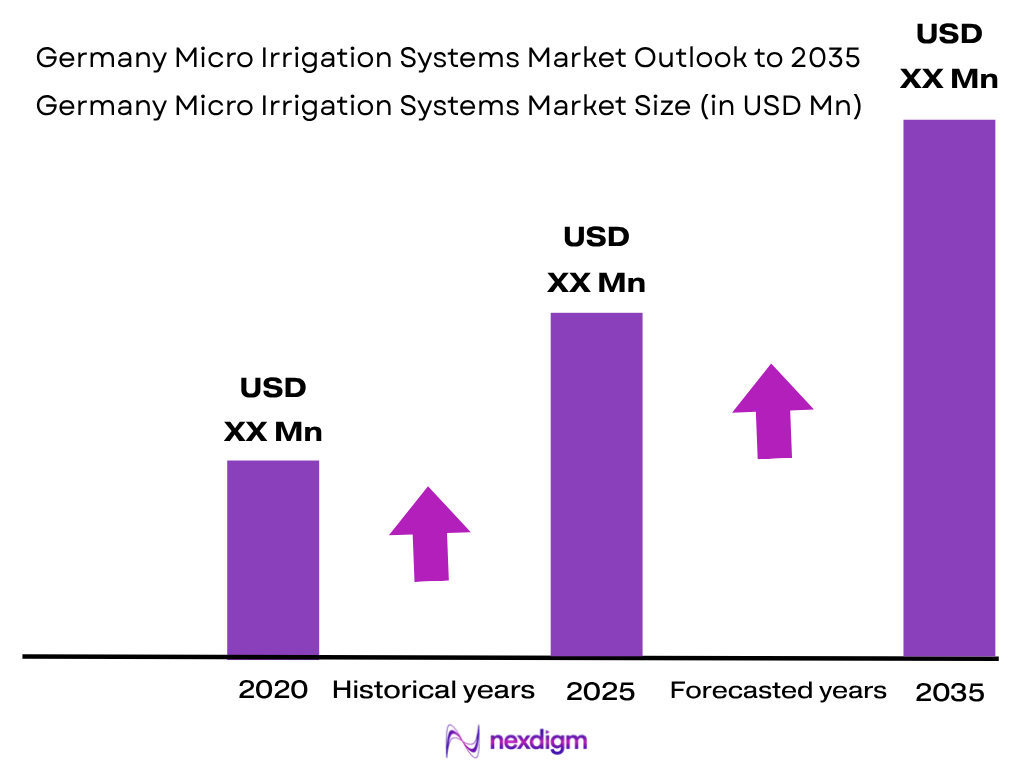
The Germany Micro Irrigation Systems Market is valued at ~USD XX billion in 2024 and is supported by increasing adoption of water-efficient agricultural technologies, greenhouse cultivation, and precision farming practices. The market expansion is driven by Germany’s requirement for sustainable agricultural water management and compliance with European environmental policies. According to the Federal Statistical Office of Germany, the country had approximately 16.6 million hectares of agricultural land in 2024, creating a significant application base for efficient irrigation solutions. Rising climate variability and increasing focus on resource optimization are encouraging farmers, horticulture operators, and greenhouse producers to adopt drip irrigation and automated irrigation systems.
Germany’s micro irrigation demand is concentrated in agricultural regions including Bavaria, Lower Saxony, North Rhine-Westphalia, Baden-Württemberg, and Rhineland-Palatinate due to their strong horticulture, vegetable cultivation, greenhouse production, and specialty crop activities. Bavaria and Lower Saxony remain important agricultural centers because of their extensive farming infrastructure, while Rhineland-Palatinate has strong vineyard cultivation requiring precise irrigation management. Germany recorded agricultural production activities across more than 260,000 agricultural holdings in 2023, according to national agricultural statistics, supporting demand for modern irrigation technologies. These regions dominate due to higher commercialization of farming, greater technology adoption, and increasing investments in sustainable agricultural practices.
Market Segmentation
By Irrigation System Type
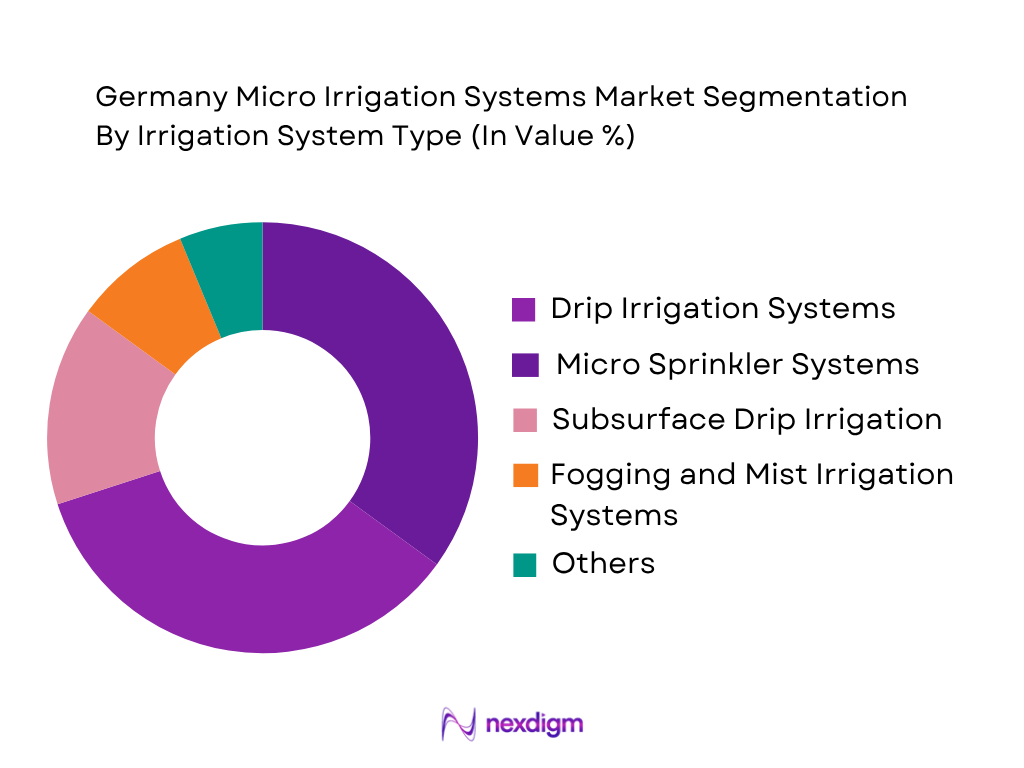
Germany Micro Irrigation Systems Market is segmented into drip irrigation systems, micro sprinklers, subsurface drip irrigation, fogging systems, and other specialized irrigation technologies. Drip irrigation systems represent the dominant segment due to their suitability for vegetable farming, vineyards, greenhouse cultivation, and horticulture applications. Germany’s increasing focus on water conservation and sustainable agricultural practices has accelerated adoption of systems that provide controlled water delivery directly to crop roots. Drip irrigation also supports integration with fertigation systems, enabling farmers to optimize fertilizer usage and improve crop productivity. The presence of advanced agricultural enterprises and greenhouse operators further supports demand for automated drip solutions. Increasing climate variability and concerns regarding efficient water utilization are encouraging commercial farms to replace conventional irrigation methods with precision-based systems.
By Application Area
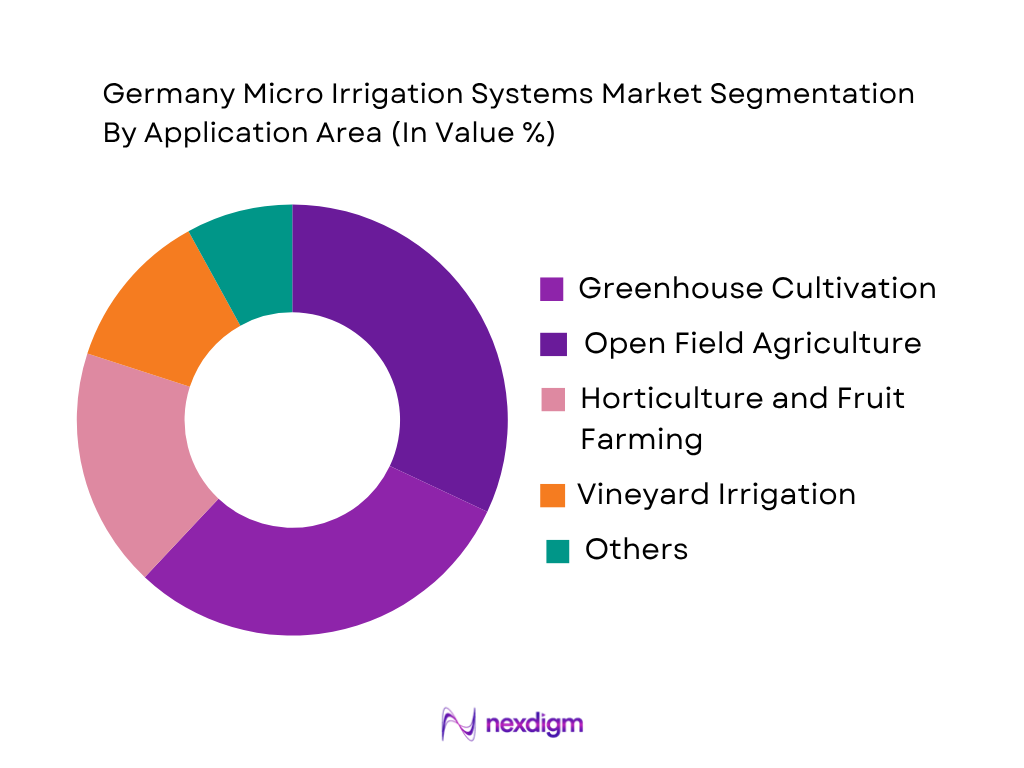
Germany Micro Irrigation Systems Market is segmented into greenhouse cultivation, open-field agriculture, horticulture, vineyards, and nursery applications. Greenhouse cultivation holds a leading position due to Germany’s developed protected agriculture sector and increasing requirement for controlled growing environments. Greenhouse operators require precise irrigation systems to maintain crop quality, reduce water wastage, and automate production processes. Germany has a strong vegetable greenhouse industry, particularly for tomatoes, cucumbers, peppers, and ornamental plants, where micro irrigation systems are widely adopted. Additionally, vineyards in regions such as Rhineland-Palatinate and Baden-Württemberg use precision irrigation technologies to manage water availability and improve grape quality. The combination of advanced farming practices, environmental regulations, and demand for sustainable food production continues to increase micro irrigation adoption across commercial agricultural applications.
Competitive Landscape
The Germany Micro Irrigation Systems Market includes global irrigation technology providers, European agricultural equipment manufacturers, and specialized irrigation solution companies. Competition is driven by product innovation, automation capabilities, precision irrigation technologies, and after-sales service networks. Major companies focus on developing smart irrigation solutions integrated with sensors, digital monitoring platforms, and fertigation technologies to address the increasing demand for sustainable agricultural water management.
| Company | Establishment Year | Headquarters | Product Portfolio | Irrigation Technology | Automation Capability | Greenhouse Solutions | Distribution Network | Sustainability Focus |
| Netafim | 1965 | Israel | ~ | ~ | ~ | ~ | ~ | ~ |
| Rivulis Irrigation | 1966 | Israel | ~ | ~ | ~ | ~ | ~ | ~ |
| Rain Bird Corporation | 1933 | USA | ~ | ~ | ~ | ~ | ~ | ~ |
| Hunter Industries | 1981 | USA | ~ | ~ | ~ | ~ | ~ | ~ |
| Gardena | 1961 | Germany | ~ | ~ | ~ | ~ | ~ | ~ |
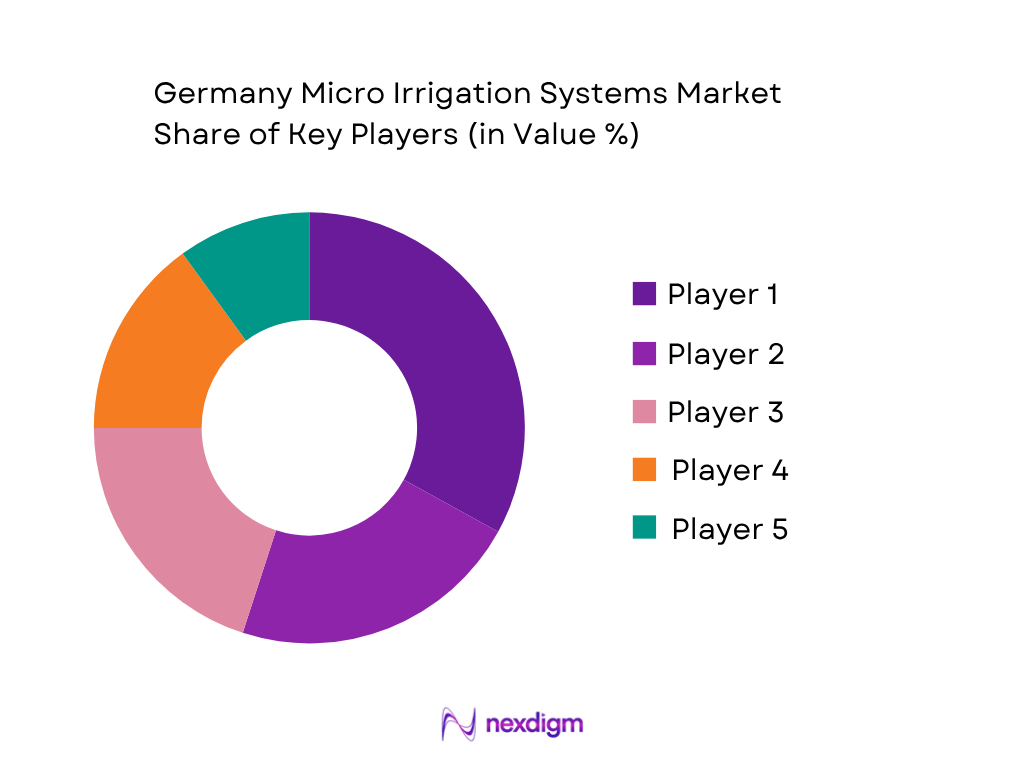
Germany Micro Irrigation Systems Market Analysis
Growth Drivers
Increasing Water Conservation Requirements
Increasing water conservation requirements are strengthening demand for micro irrigation systems in Germany as agricultural producers focus on improving water-use efficiency and adapting to changing climatic conditions. Germany has experienced increased pressure on agricultural water management due to irregular rainfall patterns, rising temperatures, and regional water availability concerns. According to the European Environment Agency, Germany recorded average annual renewable freshwater resources of approximately 188 billion cubic meters in recent assessments, highlighting the importance of sustainable water utilization across economic sectors. The Federal Statistical Office of Germany reported that agricultural land covered around 16.6 million hectares in 2024, creating a large operational base where efficient irrigation technologies can improve resource management. Micro irrigation systems, including drip irrigation and micro sprinklers, support controlled water application, reduced evaporation losses, and improved crop productivity. The increasing adoption of protected cultivation and horticulture production further increases demand for precise irrigation solutions. Germany’s agricultural sector is also influenced by European Union sustainability policies that encourage resource-efficient farming practices. These factors are encouraging commercial farms, greenhouse operators, and specialty crop producers to invest in advanced irrigation systems that support long-term water conservation objectives.
Expansion of Protected Agriculture
Expansion of protected agriculture is driving the adoption of micro irrigation systems in Germany due to the increasing requirement for controlled growing environments and precise resource management. Greenhouses and protected cultivation facilities require reliable irrigation technologies to maintain crop quality, regulate water supply, and optimize fertilizer application. Germany has a well-developed horticulture sector, with greenhouse production concentrated in vegetables, ornamental plants, and nursery crops. According to the Federal Statistical Office of Germany, the country had approximately 260,000 agricultural holdings in 2023, including specialized horticulture and commercial farming operations requiring modern production techniques. Protected agriculture enables growers to reduce dependency on external climate conditions while improving production consistency. Micro irrigation systems are widely used in these facilities because they allow accurate water delivery through drip systems, fertigation equipment, and automated controllers. The European Union’s sustainable agriculture policies have also encouraged farmers to adopt technologies that improve resource efficiency. Germany’s increasing focus on local food production, controlled environment farming, and climate adaptation strategies is supporting investment in advanced irrigation infrastructure. As greenhouse cultivation expands, demand for automated and precision-based irrigation solutions continues to increase across commercial agricultural operations.
Market Challenges
High Initial Investment Requirements
High initial investment requirements remain a significant challenge for Germany’s micro irrigation systems market because advanced irrigation installations involve substantial expenditure on equipment, design, automation systems, and installation services. Modern micro irrigation solutions require components such as drip lines, filtration systems, pumps, pressure regulators, sensors, and digital controllers, which increase upfront investment compared with conventional irrigation practices. Germany has a diverse agricultural structure, with approximately 262,000 agricultural holdings recorded in recent agricultural statistics, including many small and medium-sized farms that may face financial limitations when adopting advanced irrigation technologies. The European agricultural sector continues to emphasize modernization, but investment decisions among smaller farms are influenced by access to financing, expected productivity improvements, and operational requirements. Micro irrigation systems also require periodic maintenance, including filter cleaning, emitter replacement, and technical servicing, which adds to ownership considerations. Although large commercial farms and greenhouse operators are more likely to adopt these technologies, smaller agricultural enterprises may delay implementation due to capital constraints. Addressing affordability through financing programs, modular irrigation systems, and simplified installation solutions remains important for increasing adoption throughout Germany’s agricultural sector.
Complex Installation and System Design Requirements
Complex installation and system design requirements create challenges for wider micro irrigation adoption in Germany because efficient systems require technical planning based on crop type, soil characteristics, water quality, field structure, and irrigation requirements. Unlike conventional irrigation methods, micro irrigation systems require precise configuration of pressure levels, emitter spacing, filtration capacity, and automation controls. Germany’s agricultural landscape includes diverse production systems ranging from open-field vegetable cultivation to vineyards and greenhouse operations, each requiring customized irrigation designs. According to national agricultural statistics, Germany maintains more than 16 million hectares of agricultural land, creating significant variation in farming conditions and irrigation requirements. Technical expertise is required for system installation, maintenance, and optimization, particularly when integrating sensors, automated controllers, and fertigation systems. Smaller farms may face difficulties accessing specialized irrigation professionals and technical support services. Water quality management is another concern because mineral deposits and impurities can affect emitter performance and system efficiency. As irrigation technologies become more advanced, the need for skilled installation services and technical training becomes increasingly important. Improving farmer knowledge and expanding professional support networks can help overcome these operational challenges.
Market Opportunities
Expansion of Smart Irrigation Technologies
Expansion of smart irrigation technologies represents a major opportunity for the Germany micro irrigation systems market as agricultural producers increasingly integrate digital solutions into water management practices. Smart irrigation combines sensors, automation systems, weather data, and remote monitoring platforms to optimize irrigation decisions and improve resource efficiency. Germany has strong digital infrastructure supporting agricultural technology adoption, with the International Telecommunication Union reporting that the country had more than 79 million internet users in 2024, creating favorable conditions for connected farming solutions. Smart irrigation technologies are particularly relevant for greenhouse operators, horticulture farms, and commercial agricultural enterprises requiring precise environmental control. These systems enable real-time monitoring of soil moisture, irrigation scheduling, and water consumption, reducing manual intervention and improving operational efficiency. Germany’s focus on sustainable agriculture and climate adaptation is encouraging farmers to explore digital farming solutions. Integration of IoT-based monitoring platforms with micro irrigation systems creates opportunities for technology providers to offer complete water management solutions. As farms increasingly adopt automation and data-driven decision-making, smart irrigation technologies are expected to become a critical component of Germany’s modern agricultural infrastructure.
Precision Fertigation Adoption
Precision fertigation adoption provides significant growth opportunities for Germany’s micro irrigation systems market as farmers increasingly seek integrated solutions that combine water management with accurate nutrient delivery. Fertigation allows fertilizers to be applied directly through irrigation networks, improving nutrient efficiency and supporting higher-quality crop production. This technology is particularly valuable for greenhouse cultivation, vegetable farming, vineyards, and specialty horticulture operations where crop quality and resource optimization are critical. Germany’s agricultural sector includes approximately 16.6 million hectares of agricultural land in 2024, providing a substantial application base for advanced irrigation and nutrient management solutions. European Union agricultural policies increasingly emphasize sustainable input utilization, reducing environmental impact, and improving farming efficiency. Precision fertigation systems support these objectives by enabling controlled fertilizer application and reducing unnecessary nutrient losses. Integration with digital farm management platforms, sensors, and automated irrigation controllers further enhances system performance. Commercial growers are increasingly adopting these technologies to improve productivity while meeting sustainability requirements. The combination of micro irrigation, automation, and precision nutrient management creates opportunities for irrigation technology providers to develop advanced solutions tailored to Germany’s evolving agricultural practices.
Future Outlook
The Germany Micro Irrigation Systems Market is expected to experience continued development driven by increasing adoption of precision agriculture, sustainable farming practices, and advanced irrigation automation. Future market expansion will be supported by growing demand for greenhouse irrigation solutions, smart water management technologies, and digital agriculture platforms. Climate adaptation requirements and European sustainability initiatives are expected to encourage farmers and agricultural enterprises to invest in efficient irrigation infrastructure.
Major Players
- Netafim
- Rivulis Irrigation
- Rain Bird Corporation
- Hunter Industries
- Gardena
- Kärcher
- Jain Irrigation Systems
- Toro Company
- Lindsay Corporation
- Metzer Group
- Komet Irrigation
- T-Tape
- Irritec
- Vyrsa
- EPCO
Key Target Audience
- Agricultural Equipment Manufacturers
- Irrigation System Manufacturers
- Greenhouse Farming Companies
- Commercial Farming Enterprises
- Horticulture and Vineyard Operators
- Investments and Venture Capitalist Firms
- Government and Regulatory Bodies (Federal Ministry of Food and Agriculture, German Environment Agency)
- Agricultural Technology Solution Providers
Research Methodology
Step 1: Identification of Key Variables
The initial stage involves identifying major market variables influencing Germany’s micro irrigation ecosystem. This includes analysis of agricultural land utilization, irrigation adoption patterns, crop requirements, technology penetration, regulatory environment, and stakeholder structure. Secondary research is conducted to define market boundaries and identify demand and supply factors affecting market growth.
Step 2: Market Analysis and Construction
This stage focuses on evaluating historical market developments through demand-side and supply-side assessment. Agricultural applications, irrigation technologies, component categories, installation trends, and adoption patterns are analyzed to construct a comprehensive market framework. Market dynamics are evaluated through agricultural production trends and technology adoption indicators.
Step 3: Hypothesis Validation and Expert Consultation
Market assumptions are validated through discussions with irrigation manufacturers, agricultural technology providers, greenhouse operators, and farming professionals. Expert consultations provide insights into purchasing behavior, technology preferences, operational challenges, and future adoption trends within Germany’s agricultural irrigation sector.
Step 4: Research Synthesis and Final Output
The final stage integrates collected information from manufacturers, agricultural stakeholders, and industry sources. Data is triangulated to ensure accuracy across market segments, applications, and competitive analysis. The final report provides validated insights into market structure, growth drivers, challenges, opportunities, and future developments.

- Executive Summary
- Research Methodology (Market Definitions and Assumptions, Market Boundary Identification, Micro Irrigation System Classification, Market Sizing Framework, Top-Down Analysis, Bottom-Up Analysis, Demand-Side Assessment, Supply-Side Assessment, Agricultural Stakeholder Interviews, Data Triangulation, Forecasting Framework, Research Limitations and Future Scope)

- Definition and Scope
- Market Evolution and Development Timeline of Micro Irrigation Adoption
- Historical Development of Drip Irrigation
- Germany Agricultural Water Management Ecosystem Analysis
- Micro Irrigation Value Chain Analysis

- Growth Drivers (Increasing Water Conservation Requirements, Expansion of Protected Agriculture, Rising Adoption of Precision Farming Technologies, Increasing Climate Variability Impact on Agriculture, Growth of High-Value Horticulture Production, EU Sustainable Agriculture Initiatives, Rising Demand for Automated Irrigation Solutions, Increasing Greenhouse Farming Activities)
- Market Challenges (High Initial Investment Requirements, Complex Installation and System Design, Maintenance Requirements for Filtration Systems, Limited Adoption Among Small Farms, Dependence on Imported Irrigation Components, Technical Skill Requirements, Water Quality Management Issues, Competition from Traditional Irrigation Methods)
- Market Opportunities (Expansion of Smart Irrigation Technologies, IoT-Based Farm Water Monitoring, AI-Enabled Irrigation Optimization, Growth of Sustainable Agriculture Practices, Expansion of Greenhouse Irrigation Solutions, Precision Fertigation Adoption, Digital Farm Management Integration, Renewable Energy-Based Irrigation Systems)
- Market Trends (Smart Sensor-Based Irrigation Management, Automated Irrigation Controllers, Digital Agriculture Integration, Sustainable Water Management Practices, Climate Resilient Farming Technologies, Integration of Weather-Based Irrigation Systems, Advanced Fertigation Solutions, Robotics and Automation in Agriculture)
- Government Regulations (European Union Common Agricultural Policy Support Measures, EU Water Framework Directive Compliance, German Fertilizer Regulation Requirements, Sustainable Farming Regulations, Agricultural Water Conservation Policies, Greenhouse Production Standards, Environmental Protection Regulations)
- SWOT Analysis
- Porter’s Five Forces Analysis
- PESTLE Analysis
- Stakeholder Ecosystem Analysis

- By Market Value (2020-2025)
- By Installed Area Coverage (2020-2025)
- By Irrigation System Volume Deployment (2020-2025)
- By Equipment Category Revenue Contribution (2020-2025)
- By Agricultural Application Value Contribution (2020-2025)

- By Irrigation System Type (In Value %)
Drip Irrigation Systems
Surface Drip Irrigation
Subsurface Drip Irrigation
Micro Sprinkler Systems
Mini Sprinkler Systems
Fogging and Mist Irrigation Systems
Capillary Irrigation Systems - By Component Type (In Value %)
Emitters and Drippers
Pipes and Tubing Systems
Filters and Filtration Units
Pumps and Pressure Regulation Equipment
Valves and Control Systems
Sensors and Monitoring Devices
Fertigation Equipment - By Application Area (In Value %)
Open Field Agriculture
Greenhouse Cultivation
Nursery and Plant Propagation
Commercial Horticulture
Fruit Orchards
Vegetable Production
Viticulture and Vineyard Irrigation - By Crop Type (In Value %)
Vegetables
Fruits
Grapes and Vineyards
Cereals and Specialty Crops
Ornamental Plants
Nursery Crops - By End User Type (In Value %)
Commercial Farms
Greenhouse Operators
Agricultural Cooperatives
Nurseries and Garden Centers
Research and Demonstration Farms
Landscape and Municipal Irrigation Users - By Distribution Channel (In Value %)
Direct Manufacturer Sales
Agricultural Equipment Dealers
Specialized Irrigation Distributors
Online Agricultural Equipment Platforms
Installation and Service Providers

- Market Positioning of Major Players (By Product Portfolio, Application Coverage, Technology Integration, Distribution Reach)
- Cross Comparison Parameters (Product Portfolio Breadth, Drip Irrigation Technology Capability, Greenhouse Irrigation Solutions, Automation and Sensor Integration, Filtration System Portfolio, Fertigation Technology Availability, Installation and Service Network Strength, Sustainability-Focused Product Development)
- SWOT Analysis of Major Players
- Detailed Profiles of Major Companies
Netafim
Rivulis Irrigation
Jain Irrigation Systems
Rain Bird Corporation
Hunter Industries
Kärcher
Gardena
Komet Irrigation
Lindsay Corporation
Toro Company
EPCO
Metzer Group
T-Tape
Vyrsa

- Agricultural Adoption Assessment
- Commercial Farm Analysis
- Greenhouse Operator Analysis
- Crop-Specific Irrigation Requirement Analysis
- Purchase Decision-Making Analysis
- Technology Preference Analysis

- By Market Value (2026-2035)
- By Installed Area Coverage (2026-2035)
- By Irrigation System Volume Deployment (2026-2035)
- By Equipment Category Revenue Contribution (2026-2035)
- By Agricultural Application Value Contribution (2026-2035)


 Request a Sample
 Ask for Customization
 Get a Quote
 Enquire Now