
 Download PDF
Market Overview
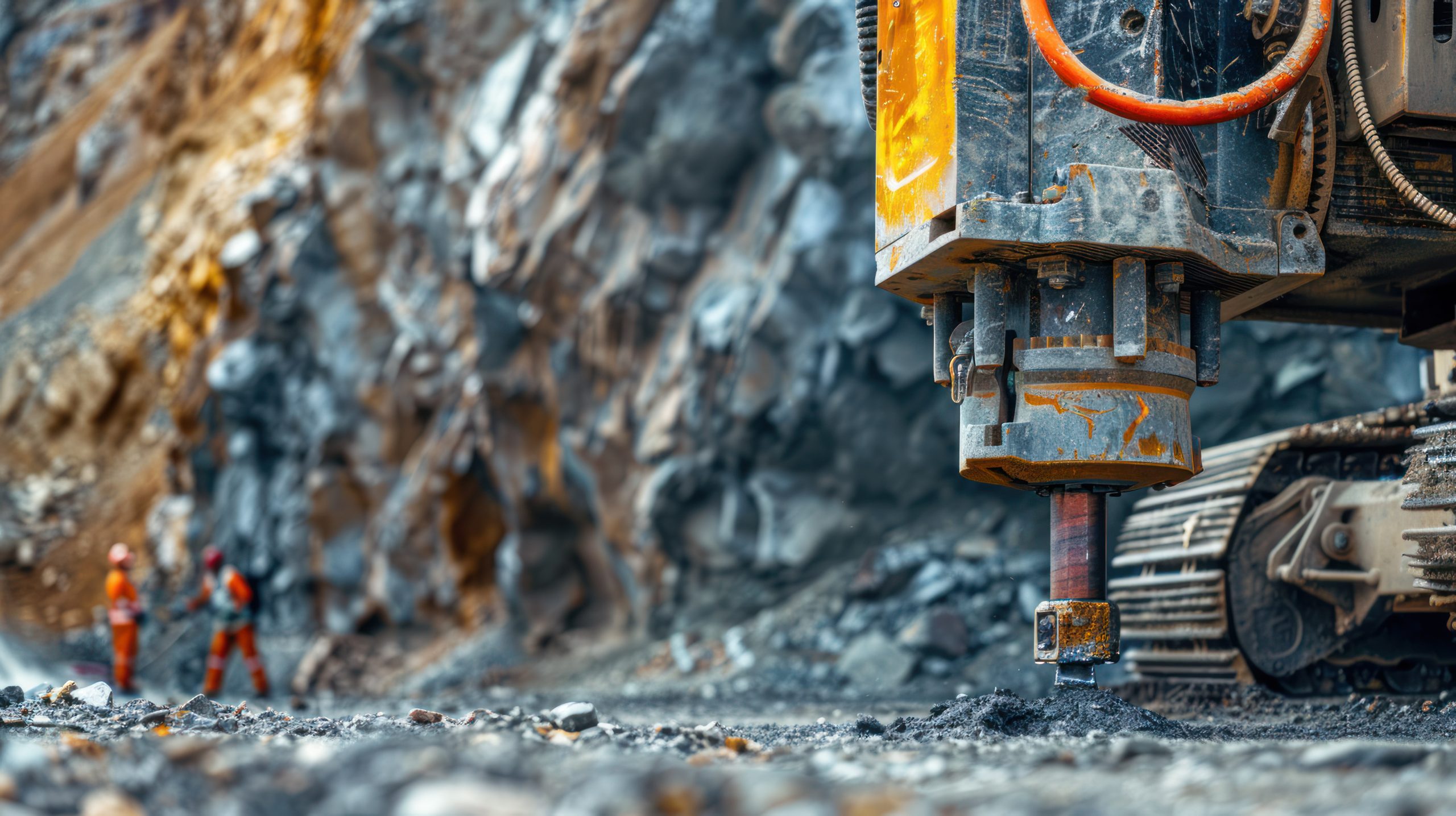
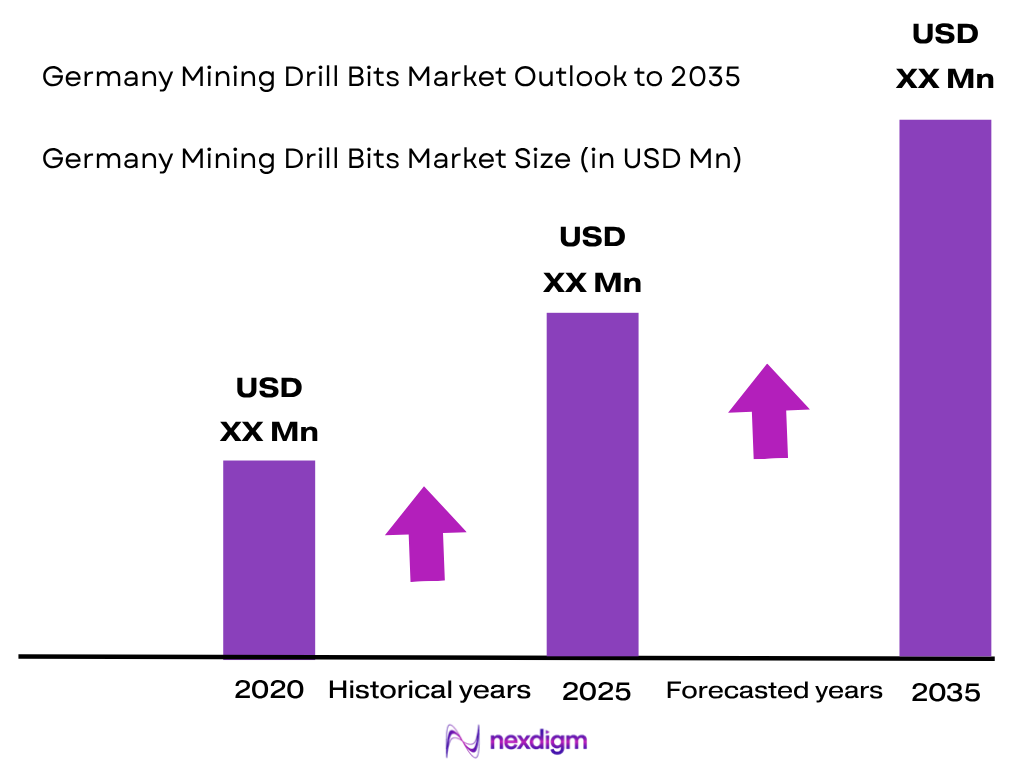
The Germany Mining Drill Bits Market is estimated at USD ~ million in the base year, supported by quarrying, industrial-mineral extraction, underground mining and geological drilling requirements. Germany remained the EU’s largest lignite producer, extracting approximately 92 million tonnes in the latest reported period, while industrial production recorded substantial activity across mining and quarrying operations. The latest annual industrial-production reading also indicates continued demand for drilling equipment associated with mineral extraction, aggregates and infrastructure-related rock excavation. Drill-bit demand is additionally supported by Germany’s advanced machinery ecosystem, replacement requirements and emphasis on automated drilling technologies.
Germany’s mining-drilling activity is concentrated around established mineral-producing and quarrying regions, particularly areas associated with lignite, potash, rock salt, aggregates, limestone and industrial minerals. Central and eastern Germany remain important for lignite-related extraction, while Lower Saxony and Thuringia have established potash and salt operations. North Rhine-Westphalia and Bavaria provide significant quarrying, aggregates and industrial-material activity. Germany’s domestic mining base is complemented by geological exploration and infrastructure excavation, creating demand for DTH, rotary, top-hammer and diamond-core tooling across different drilling conditions and equipment configurations.
Market Segmentation
By Drill Bit Type
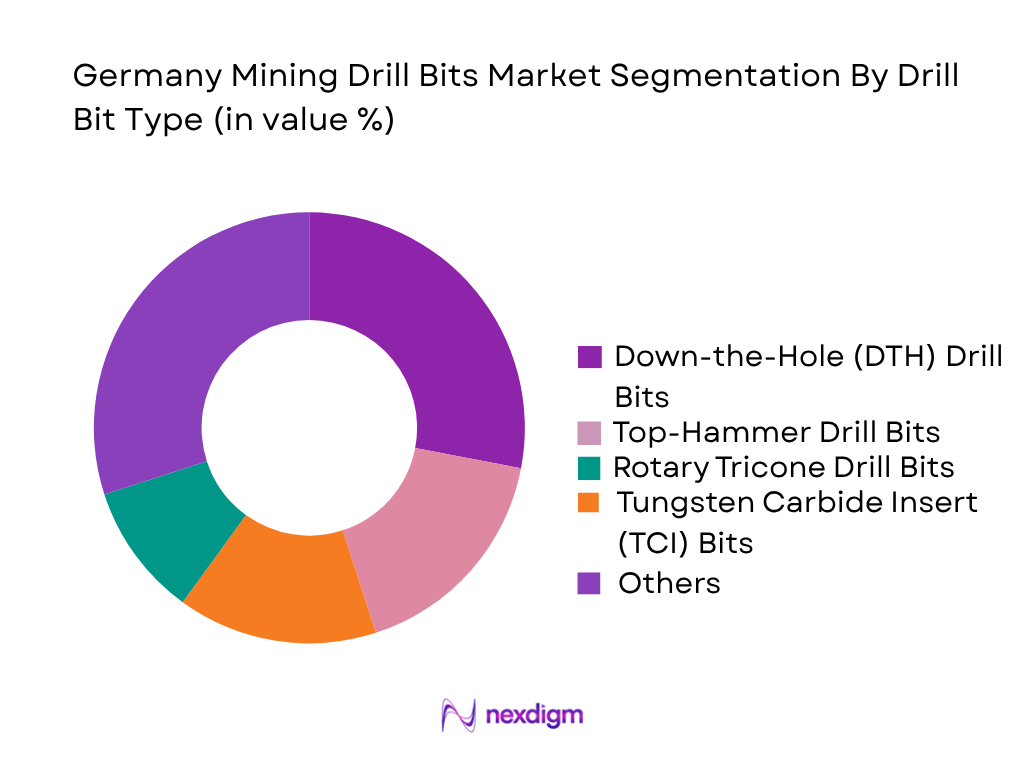
The Germany Mining Drill Bits Market is segmented by drill bit type into Down-the-Hole (DTH) drill bits, top-hammer drill bits, rotary tricone drill bits, tungsten carbide insert bits, milled-tooth bits, PDC bits, diamond core bits, drag bits, button bits and specialty rock-drilling bits. DTH drill bits are modeled as the leading category with a ~28% share, reflecting their suitability for hard-rock drilling, quarrying, blasting and surface applications. Rotary tricone and carbide-based products follow because of their applicability across larger drilling diameters and abrasive formations. Diamond-core bits retain strong relevance for exploration and geological investigation, where core recovery and formation characterization are essential. Germany’s mining environment requires different tooling according to rock hardness, hole diameter, drilling depth, penetration requirements and equipment configuration. The country’s 92 million tonnes of lignite production provides a measurable extraction base, while quarrying and industrial-mineral operations create additional requirements for rock-drilling consumables. The increasing integration of automated drilling and equipment monitoring also favors drill bits capable of delivering consistent penetration and predictable wear characteristics.
By Mining Application
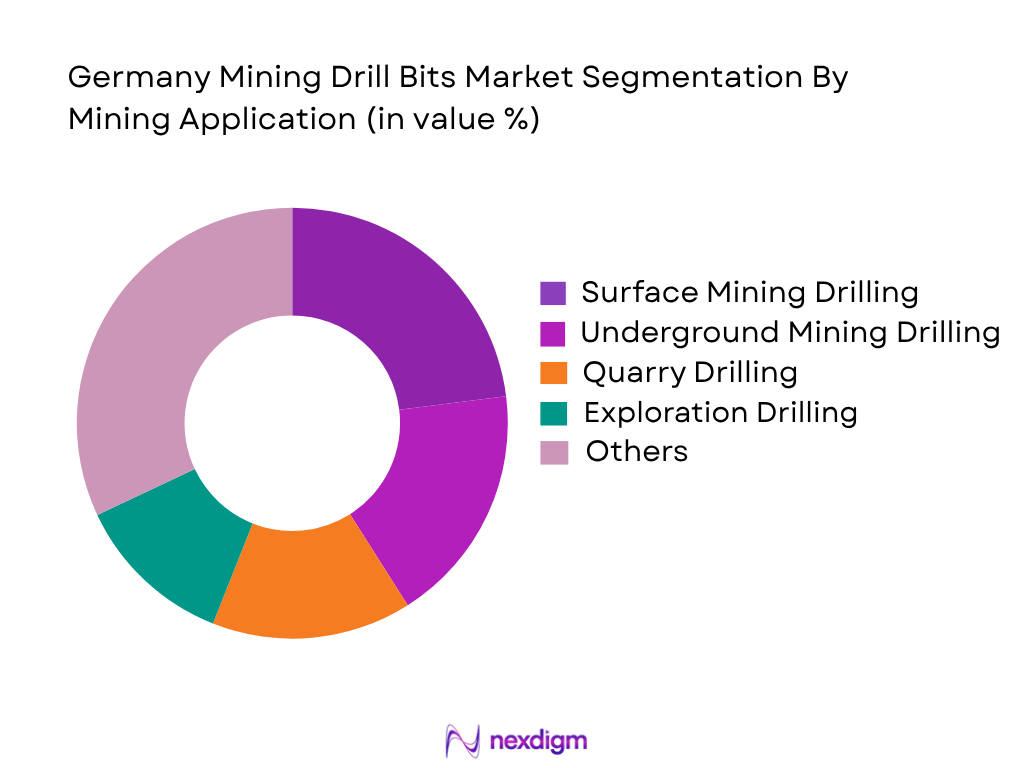
The Germany Mining Drill Bits Market is segmented by mining application into surface mining drilling, underground mining drilling, exploration drilling, production drilling, blasting drilling, grade-control drilling, resource-definition drilling, mine-development drilling, quarry drilling and geotechnical and geological drilling. Surface mining drilling is modeled as the largest application at ~23%, reflecting Germany’s substantial quarrying, aggregate, industrial-mineral and lignite extraction activities. Underground mining drilling represents ~18%, supported particularly by potash and salt operations, while quarry drilling accounts for ~15% because limestone, aggregates and construction materials require recurring rock excavation. Exploration drilling contributes ~12%, followed by production drilling and blasting drilling at ~10% and ~9%. Germany’s approximately 92 million tonnes of lignite extraction demonstrates the continuing scale of surface extraction, while the country’s industrial and infrastructure base generates additional requirements for drilling contractors and specialized tooling.
Competitive Landscape
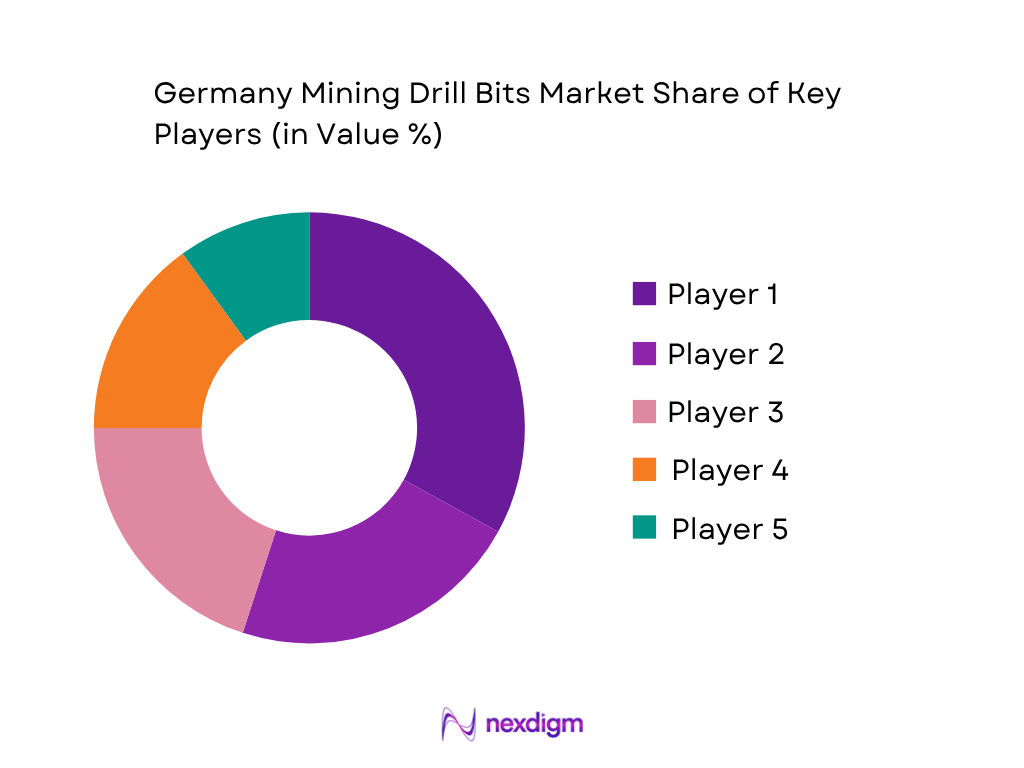
The Germany Mining Drill Bits Market includes international mining-equipment manufacturers, specialized rock-tool producers and companies supplying drilling consumables through European distribution networks. Competition is differentiated by DTH and top-hammer technology, rotary and tricone tooling, diamond-core capabilities, carbide cutting structures, equipment compatibility, aftermarket services and technical support. Germany’s sophisticated industrial environment also increases the importance of engineering quality, equipment integration and productivity optimization. Epiroc, Sandvik, Boart Longyear, Mincon and Robit represent important participants across different portions of the drilling-tool ecosystem.
| Company | Establishment Year | Headquarters | DTH Capability | Diamond-Core Capability | Carbide Technology | Aftermarket Support | Germany Presence |
| Epiroc Deutschland GmbH | 2018* | Essen, Germany | ~ | ~ | ~ | ~ | ~ |
| Sandvik Mining and Rock Solutions | 1862 | Sandviken, Sweden | ~ | ~ | ~ | ~ | ~ |
| Boart Longyear | 1890 | Salt Lake City, USA | ~ | ~ | ~ | ~ | ~ |
| Mincon Group plc | 1977 | Shannon, Ireland | ~ | ~ | ~ | ~ | ~ |
| Robit Plc | 1975 | Lempäälä, Finland | ~ | ~ | ~ | ~ | ~ |
Germany Mining Drill Bits Market Analysis
Growth Drivers
Expansion of Mineral Extraction and Quarrying Activity
The Germany Mining Drill Bits Market is supported by the country’s continuing requirement for drilling across lignite extraction, quarrying, industrial minerals, aggregates and geological applications. Germany extracted approximately 92 million tonnes of lignite in 2024, providing a substantial established base for surface drilling and associated rock-excavation activities. The broader industrial environment also remains significant: industry, including construction, contributed 25.6% of Germany’s GDP in 2024, while Germany recorded GDP of approximately USD 4.69 trillion. Although overall industrial production declined 4.5% in 2024, civil-engineering production increased 2.1%, supporting drilling requirements connected with infrastructure and ground works. The combination of mining, quarrying and civil-engineering activity sustains demand for DTH, rotary, top-hammer and carbide drill bits. Germany also remains a major consumer of mineral raw materials, with domestic production of aggregates, salt and other non-metallic materials requiring recurring drilling operations. Drill-bit demand is therefore linked not only to mine production but also to drilling intensity, rock hardness, hole diameter, equipment utilization and replacement cycles. These conditions create a continuing requirement for durable drilling consumables capable of maintaining penetration performance under abrasive geological conditions.
Rising Focus on Domestic and European Critical-Mineral Supply
The Germany Mining Drill Bits Market is receiving structural support from increased attention toward domestic mineral exploration and supply security. Germany’s federal geological authority identified domestic extraction and exploration of critical mineral resources as strategically important for strengthening industrial supply chains. This is particularly relevant because Germany is heavily dependent on imports for many metallic raw materials, creating an incentive to evaluate domestic deposits and expand geological knowledge. Germany’s economy generated approximately USD 4.69 trillion of GDP in 2024, while industry, including construction, accounted for 25.6% of GDP, demonstrating the importance of reliable material supply to the industrial economy. Exploration programs require diamond-core, reverse-circulation, DTH and other specialized drilling tools for resource definition, geological characterization and deposit evaluation. Demand can therefore extend beyond conventional operating mines into early-stage exploration and development projects. The growing requirement for critical minerals also increases the importance of drilling accuracy, core recovery, penetration efficiency and bit durability. As geological programs progress from reconnaissance toward resource definition, drilling intensity can increase and create recurring requirements for specialized consumables. This creates an important structural driver for suppliers capable of supporting different formations, drilling depths and exploration methods across Germany’s geological environment.
Market Challenges
Declining Industrial Production and Uneven Mining Activity
The Germany Mining Drill Bits Market faces demand uncertainty from weaker industrial activity and the country’s changing domestic extraction structure. German industrial production declined 4.5% in 2024, while production excluding energy and construction fell 4.9%. Capital-goods production decreased 5.6%, indicating weaker industrial investment conditions that can influence equipment procurement and drilling-related capital expenditure. Construction production also declined 3.2%, although civil engineering increased 2.1%, creating a mixed demand environment. Germany’s GDP contracted 0.5% in 2024, while consumer-price inflation remained at 2.3%, adding pressure to investment decisions and operating budgets. For drill-bit suppliers, these conditions can translate into fluctuating drilling activity, delayed equipment purchases and greater emphasis on extending existing bit life. The challenge is particularly relevant because drilling consumables depend on utilization levels at mines, quarries and exploration projects. Germany’s transition away from coal extraction also changes the long-term composition of domestic drilling demand, requiring suppliers to adapt toward quarrying, industrial minerals, underground salt and potash operations, geological exploration and infrastructure drilling. Consequently, market participants must manage demand variability while maintaining technical support and product availability across several smaller application categories.
Dependence on Imported Metallic Raw Materials and Specialized Technologies
The Germany Mining Drill Bits Market faces supply-chain exposure because drill bits require specialized steels, tungsten carbide, diamonds and other engineered materials whose production and processing are internationally distributed. Germany’s federal geological authority identifies the country as almost completely import-dependent for primary metallic raw materials, making raw-material security an important industrial consideration. The country’s industrial sector represented 25.6% of GDP in 2024, while total GDP reached approximately USD 4.69 trillion, meaning disruptions affecting industrial inputs can have broad economic implications. Drill-bit manufacturers must maintain reliable access to carbide grades, steel alloys and other wear-resistant materials to produce DTH, tricone, PDC and diamond-core tooling. International supply dependencies can expose manufacturers to transportation disruptions, geopolitical risks and availability constraints. Specialized drilling technologies also require engineering expertise for button geometry, cutting structures, flushing design and bit-to-rig compatibility. Germany’s highly developed industrial environment raises expectations for consistent technical performance and equipment integration. Suppliers consequently need robust inventory management, regional distribution and technical-service capabilities. These requirements can increase operational complexity, particularly for smaller suppliers serving specialized mining, quarrying and exploration applications where individual product configurations may vary substantially according to rock formation and drilling method.
Market Opportunities
Expansion of Critical-Mineral Exploration and Geological Drilling
The Germany Mining Drill Bits Market has an opportunity to benefit from expanding domestic exploration for critical and strategic mineral resources. Germany’s federal geological authority has specifically examined domestic extraction and exploration of critical mineral resources, highlighting the importance of improving domestic availability and strengthening raw-material supply chains. Exploration creates direct requirements for diamond-core bits, reverse-circulation tooling, DTH bits and other specialized products used during geological investigation and resource definition. Germany’s industrial economy remains substantial, with GDP of approximately USD 4.69 trillion in 2024 and industry, including construction, contributing 25.6% of GDP. This industrial base creates continuing demand for mineral inputs used in manufacturing, energy systems, construction and technology applications. The opportunity for drill-bit suppliers lies in supporting the complete exploration cycle, from initial drilling to deeper resource-definition programs. Advanced diamond-core products can address requirements for core recovery and geological interpretation, while RC and DTH systems can support faster material investigation where appropriate. Suppliers can also differentiate through application-specific carbide grades, optimized button configurations, drilling-performance monitoring and technical field support. As exploration programs become more technically demanding, suppliers with specialized geological-drilling portfolios can participate in projects beyond traditional production mining, broadening the addressable application base for Germany’s mining drill-bit industry.
Digitalization, Automation and High-Performance Drilling Solutions
Digital drilling and automation represent an opportunity for the Germany Mining Drill Bits Market because operators increasingly require greater productivity, predictable tool performance and improved resource efficiency. Germany’s industrial sector accounted for 25.6% of GDP in 2024, creating a strong industrial environment for automation, advanced machinery and data-enabled production systems. At the same time, industrial production declined 4.5% during the year, increasing the importance of productivity improvements and efficient equipment utilization. These conditions create opportunities for drill-bit suppliers to combine high-performance tooling with digital monitoring of penetration rate, vibration, torque, drilling time and bit wear. DTH and top-hammer systems can be developed with application-specific cutting structures designed around measurable drilling conditions, while diamond-core products can be optimized for consistent recovery and reduced interruptions. Condition-based replacement can also help operators replace bits according to actual wear rather than fixed intervals, potentially improving drilling continuity. Germany’s engineering-intensive industrial base provides a suitable environment for integrating sensors, automated drill controls and performance analytics with conventional drilling consumables. Suppliers that combine drill-bit engineering with technical data, equipment compatibility and field-service capabilities can therefore address the market’s increasing emphasis on productivity, reliability and optimized drilling operations without depending solely on higher drilling volumes.
Future Outlook
The Germany Mining Drill Bits Market is expected to develop through a combination of quarrying activity, underground potash and salt mining, industrial-mineral extraction, geological investigation and infrastructure-related rock drilling. The market’s technology mix is likely to increasingly emphasize longer bit life, predictable penetration, automated drilling compatibility and digital monitoring of drilling performance. Germany’s position as the EU’s largest lignite producer provides an established surface-extraction base, while its advanced industrial sector supports sophisticated equipment integration.
Future demand is also likely to be influenced by critical-mineral exploration and efforts to strengthen European raw-material supply chains. The German market therefore provides opportunities for specialized DTH tooling, diamond-core products, advanced carbide structures, condition-based replacement programs and integrated drill-rig and tooling solutions. At the same time, Germany’s environmental and regulatory framework will influence the development of mining and quarrying projects, making drilling productivity and resource efficiency increasingly important considerations.
Major Players
- Epiroc Deutschland GmbH
- Sandvik Mining and Rock Solutions Germany
- Boart Longyear
- Komatsu Germany GmbH
- Caterpillar Germany GmbH
- Furukawa Rock Drill Co., Ltd.
- Mincon Group plc
- Robit Plc
- Rockmore International
- Mitsubishi Materials Corporation
- Kennametal Inc.
- Halco Rock Tools
- DreBo Werkzeugfabrik GmbH
- BETEK GmbH & Co. KG
- MICON Drilling GmbH
Key Target Audience
- Mining and Quarrying Companies
- Potash and Salt Mining Operators
- Drilling Contractors and Rock-Excavation Service Providers
- Mining Equipment and Drill-Bit Manufacturers
- Mining Equipment Distributors and Aftermarket Service Providers
- Investments and Venture Capitalist Firms
- Government and Regulatory Bodies (Federal Ministry for Economic Affairs and Climate Action, State Mining Authorities, Federal Institute for Geosciences and Natural Resources)
- Industrial Mineral, Aggregate and Construction-Material Producers
Research Methodology
Step 1: Identification of Key Variables
The initial phase involves mapping Germany’s complete drilling-tool ecosystem, including mining operators, quarry companies, drilling contractors, equipment manufacturers and consumable suppliers. Variables include drill-bit type, drilling method, application, rock formation, drilling diameter, penetration performance, bit life, replacement frequency and equipment compatibility. Official German mining and industrial statistics are incorporated to establish the operating environment.
Step 2: Market Analysis and Construction
Historical market information is compiled through bottom-up analysis of drilling applications, mining activity, quarrying operations, exploration programs and drill-bit consumption requirements. The assessment distinguishes between DTH, rotary, top-hammer, diamond-core and carbide-based tooling. Consumption is evaluated against drilling intensity, equipment utilization, replacement cycles and application-specific requirements.
Step 3: Hypothesis Validation and Expert Consultation
Market hypotheses are validated through discussions with mining companies, quarry operators, drilling contractors, equipment distributors and rock-tool suppliers. Interviews focus on procurement practices, bit selection, drilling performance, replacement intervals, technical support and equipment compatibility. Secondary evidence is cross-checked against industry-level operating indicators and company disclosures.
Step 4: Research Synthesis and Final Output
The final research stage integrates supply-side and demand-side findings to construct the Germany Mining Drill Bits Market model. Segment-level assumptions are reviewed for consistency across drill-bit type, drilling method and application. The final analysis incorporates competitive positioning, technology benchmarking, aftermarket dynamics and future demand drivers to produce a consolidated market outlook.

- Executive Summary
- Research Methodology (Market Definition and Scope, Germany Mining Drill Bits Market Classification, Drill Bit Technology Mapping, DTH Drilling Assessment, Top-Hammer Drilling Evaluation, Rotary Drilling Technology Analysis, Carbide Button Technology Assessment, Diamond Drilling Evaluation, Drill-Rig Compatibility Mapping, Underground Mining Application Assessment, Surface Mining Application Assessment, Quarrying Application Assessment, Potash and Salt Mining Drilling Assessment, Industrial Mineral Extraction Assessment, Mineral Exploration Drilling Assessment, Drill-Bit Consumption Estimation, Demand-Side Assessment, Supply-Side Assessment, Top-Down Market Sizing, Bottom-Up Market Sizing, Primary Industry Interviews, Data Triangulation, Forecasting Framework)

- Definition and Scope
- Germany Mining and Quarrying Industry Evolution and Development of Potash and Salt Mining, Lignite Mining Operations, Industrial Mineral Extraction, Limestone and Aggregate Quarrying, Underground Mining Technology, Surface Mining Equipment Deployment, Mineral Exploration Activities, Critical Mineral Exploration, Construction Material Extraction, Automated Mining Equipment Adoption and Advanced Rock Drilling Technology Deployment
- Mining Drill Bits Value Chain Analysis
- Mining Drill Bits Supply Chain Analysis
- Drill-Bit Manufacturers, Tungsten Carbide Suppliers, Cemented Carbide Manufacturers, Diamond Tool Suppliers, Drilling Equipment Manufacturers, Drill-Rig Suppliers, Mining Equipment Distributors, Quarry Equipment Distributors, Exploration Drilling Contractors, Mining Contractors, Quarrying Companies, Industrial Mineral Producers, Potash Mining Operators and End-Use Mining Industries

- Growth Drivers (Expansion of Quarrying and Aggregate Production, Potash and Salt Mining Activity, Critical Mineral Exploration, Underground Mining Technology Development, Infrastructure Construction Requirements, Industrial Mineral Extraction, Digital Drilling Technology Adoption)
- Market Challenges (Limited Domestic Metallic Mining Base, Dependence on Imported Mineral Resources, Complex Geological Conditions, High Technical Requirements for Specialized Drill Bits, Environmental Restrictions, Underground Mining Operating Constraints, Skilled Workforce Requirements, Equipment Compatibility Challenges, High Wear in Abrasive Formations)
- Market Opportunities (Critical Mineral Exploration, Lithium and Battery-Mineral Exploration, Advanced Diamond Core Tooling, High-Performance DTH Drill Bits, Automated Drilling Systems, Digital Drill-Bit Performance Monitoring, Underground Drilling Optimization, Quarry Productivity Enhancement, Advanced Carbide Technologies, Local Technical and Aftermarket Support)
- Market Trends (Increasing Drill-Rig Automation, Digital Drilling Monitoring, Extended Bit-Life Technologies, Advanced Carbide Cutting Structures, Application-Specific Drill-Bit Development, Electrification of Mining Equipment, Condition-Based Bit Replacement, Automated Underground Drilling, Precision Rock Excavation, Integrated Drill-Rig and Tooling Systems)
- Government Regulations and Standards (Federal Mining Act Requirements, State Mining Authority Regulations, Federal Immission Control Act Requirements, Federal Nature Conservation Act Requirements, Water Resources Act Requirements, Occupational Health and Safety Regulations, Explosives and Blasting Regulations, Critical Raw Materials Act Requirements, Circular Economy Requirements, Environmental and Mine-Rehabilitation Standards)
- SWOT Analysis
- Porter’s Five Forces Analysis
- PESTLE Analysis
- Stakeholder Ecosystem
- Competition Ecosystem

- By Market Value (2020-2025)
- By Drill Bit Consumption Volume (2020-2025)
- By Average Selling Price (2020-2025)
- By DTH Drill Bit Consumption Volume (2020-2025)
- By Top-Hammer Drill Bit Consumption Volume (2020-2025)
- By Rotary Drill Bit Consumption Volume (2020-2025)
- By Diamond Core Bit Consumption Volume (2020-2025)
- By Carbide Drill Bit Consumption Volume (2020-2025)
- By Quarrying-Related Drill Bit Consumption Volume (2020-2025)

- By Drill Bit Type (In Value %)
Down-the-Hole (DTH) Drill Bits
Top-Hammer Drill Bits
Rotary Tricone Drill Bits
Tungsten Carbide Insert (TCI) Bits
Milled-Tooth Drill Bits
Polycrystalline Diamond Compact (PDC) Bits
Diamond Core Bits
Drag Bits
Button Bits
Specialty Rock and Mining Drill Bits - By Drilling Method (In Value %)
Percussive Drilling
Rotary Drilling
Rotary-Percussive Drilling
Core Drilling
Down-the-Hole Hammer Drilling
Top-Hammer Drilling
Diamond Drilling
Blast-Hole Drilling - By Application Area (In Value %)
Potash Mining
Rock Salt Mining
Lignite Mining
Limestone and Aggregate Extraction
Industrial Mineral Extraction
Quarrying and Stone Extraction
Construction Material Extraction
Underground Rock Excavation
Geotechnical Investigation
Mineral Exploration
Other Rock Drilling Applications - By Drill Bit Material and Cutting Structure (In Value %)
Tungsten Carbide Button Bits
Carbide Insert Bits
Diamond-Impregnated Bits
Polycrystalline Diamond Compact Cutting Structures
Milled-Tooth Cutting Structures
Steel-Tooth Cutting Structures
Diamond Surface-Set Bits
Hybrid Cutting Structures - By End-Use Industry (In Value %)
Potash and Salt Mining Industry
Quarrying and Aggregate Industry
Construction Materials Industry
Industrial Minerals Industry
Lignite Mining Industry
Underground Mining Industry
Geotechnical Engineering
Civil Engineering and Infrastructure
Mineral Exploration
Specialized Drilling Services - By Customer Type (In Value %)
Mining Operators
Quarry Operators
Drilling Contractors
Construction Contractors
Industrial Mineral Producers
Geotechnical Contractors
Mining Equipment Distributors
Specialized Drilling Service Providers

- Market Share of Major Players (Germany Revenue, Drill-Bit Product Coverage, DTH Product Portfolio, Top-Hammer Technology Coverage, Diamond Drilling Capability, Carbide Technology Portfolio, Drill-Rig Compatibility, Quarrying Application Coverage, Underground Mining Application Coverage, Distribution Network, Aftermarket Service Capability, Technical Support, Product Availability, European Supply Chain Reach)
- Cross Comparison Parameters (DTH Drill-Bit Portfolio Breadth, Top-Hammer Drill-Bit Capability, Carbide Cutting Structure Technology, Diamond Core Drilling Capability, Drill-Rig Compatibility Coverage, Hard-Rock Drilling Expertise, Product Customization Capability, Aftermarket and Technical Support Network)
- SWOT Analysis of Major Players
- Competitive Positioning Matrix
- Drill-Bit Technology and Performance Benchmarking
- Quarrying and Aggregate Drilling Assessment
- Underground and Industrial Mineral Drilling Assessment
- Drill-Bit Procurement and Aftermarket Assessment
- Detailed Profiles of Major Companies
Epiroc Deutschland GmbH
Sandvik Mining and Rock Solutions Germany
Boart Longyear
Komatsu Germany GmbH
Caterpillar Germany GmbH
Furukawa Rock Drill Co., Ltd.
Mincon Group plc
Robit Plc
Rockmore International
Mitsubishi Materials Corporation
Kennametal Inc.
Halco Rock Tools
DreBo Werkzeugfabrik GmbH
BETEK GmbH & Co. KG
MICON Drilling GmbH

- Potash and Salt Mining Procurement Assessment
- Quarry Operator Demand Analysis
- Aggregate Producer Requirement Assessment
- Underground Mining Drilling Requirement Analysis
- Industrial Mineral Producer Assessment
- Construction Material Producer Procurement Assessment
- Mineral Exploration Contractor Demand Analysis
- Geotechnical Contractor Requirement Analysis
- Mining Equipment Distributor Demand Assessment
- Drill-Bit Replacement and Reordering Analysis
- Product Selection Criteria Assessment
- Supplier Evaluation Assessment

- By Market Value (2026-2035)
- By Drill Bit Consumption Volume (2026-2035)
- By Average Selling Price (2026-2035)
- By DTH Drill Bit Consumption Volume (2026-2035)
- By Top-Hammer Drill Bit Consumption Volume (2026-2035)
- By Rotary Drill Bit Consumption Volume (2026-2035)
- By Diamond Core Bit Consumption Volume (2026-2035)
- By Carbide Drill Bit Consumption Volume (2026-2035)
- By Quarrying-Related Drill Bit Consumption Volume (2026-2035)
- By Underground Mining Drilling Application Volume (2026-2035)
- By Geotechnical Drilling Application Volume (2026-2035)


 Request a Sample
 Ask for Customization
 Get a Quote
 Enquire Now