
 Download PDF
Market Overview
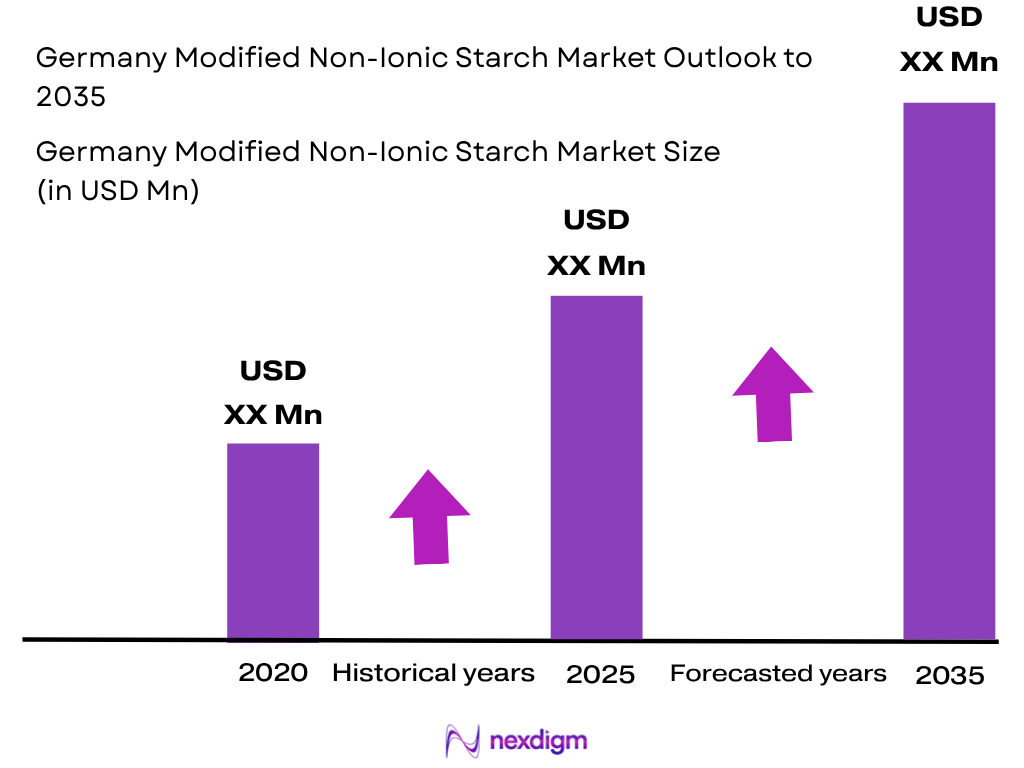
The Germany Modified Non-Ionic Starch market is valued at ~USD XX billion in 2024, based on industrial consumption analysis covering food processing, pharmaceutical excipients, and specialty applications. The market expansion is supported by Germany’s advanced food manufacturing ecosystem, which recorded approximately EUR 218 billion in food industry turnover in 2023, according to the German Food and Drink Federation. Increasing demand for processed foods, clean-label ingredients, and functional starch solutions is strengthening adoption across bakery, dairy, convenience foods, and industrial applications.
Germany represents one of the most developed modified starch markets in Europe due to its large-scale food processing industry, pharmaceutical manufacturing base, and strong demand for functional ingredients. Major industrial hubs including North Rhine-Westphalia, Bavaria, Baden-Württemberg, and Lower Saxony dominate consumption due to concentrated food manufacturing facilities, chemical processing capabilities, and established ingredient distribution networks. Germany’s food manufacturing sector employed approximately 600,000 workers in 2023, supporting demand for specialty ingredients such as modified non-ionic starch in large-scale production environments.
Market Segmentation
By Raw Material Type
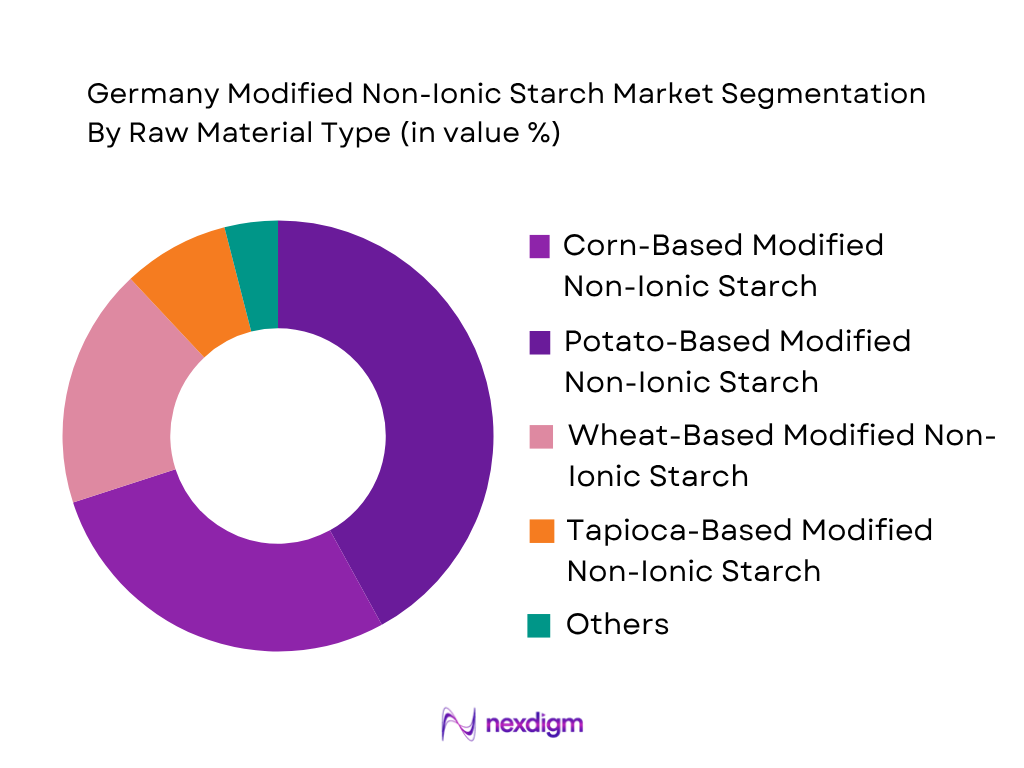
Corn-based modified non-ionic starch accounts for the dominant share within Germany’s raw material segmentation due to its extensive availability, processing compatibility, and established supply chain infrastructure. Germany processed significant quantities of cereals annually, with corn production reaching approximately 4.5 million tonnes in 2023, supporting industrial starch applications. Corn starch provides strong viscosity control, thermal stability, and improved texture properties, making it widely preferred in processed foods, sauces, bakery fillings, and industrial formulations. Potato-based starch remains an important segment due to Germany’s strong potato processing industry and consumer preference for European-origin ingredients. However, corn-based solutions maintain wider industrial acceptance because of consistent functionality across multiple applications, including convenience foods, dairy products, and pharmaceutical formulations.
By Application
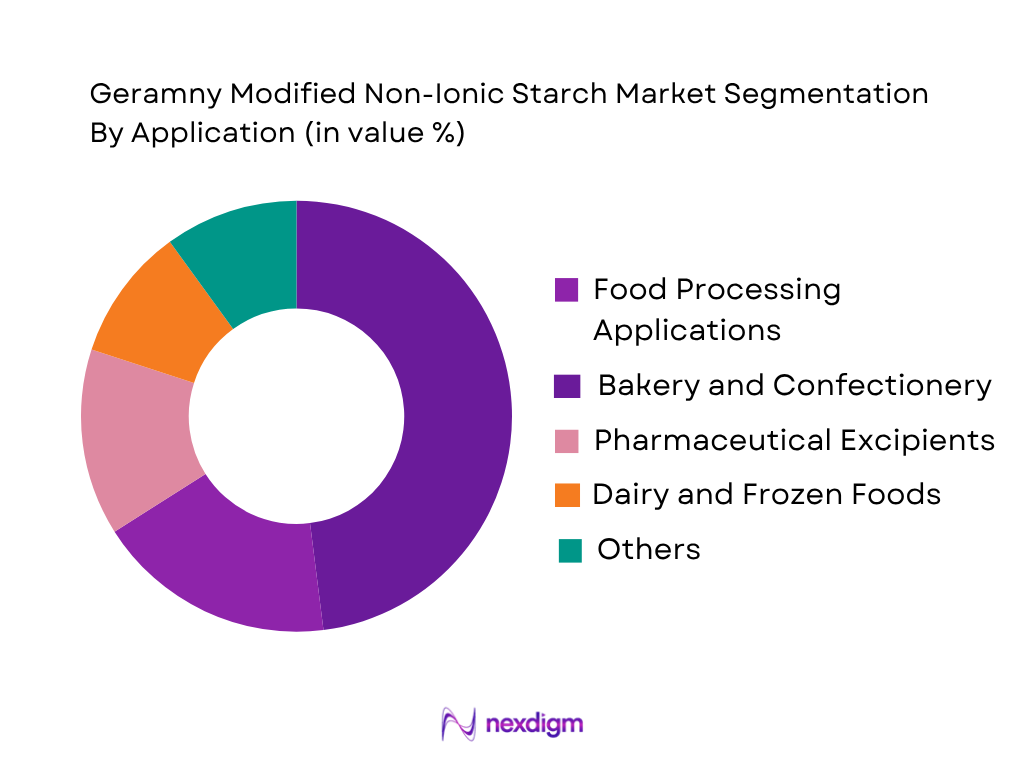
Food processing applications dominate Germany’s modified non-ionic starch market due to the country’s highly developed packaged food manufacturing ecosystem and increasing requirement for texture enhancement, stabilization, and shelf-life improvement solutions. Germany’s food processing sector generated approximately EUR 200+ billion turnover in 2023, creating strong demand for functional ingredients. Modified non-ionic starch is widely incorporated into sauces, ready meals, soups, and processed products because it improves consistency and stability during storage and processing. The growth of convenience food consumption, demand for clean-label formulations, and innovation in plant-based products further supports adoption. Pharmaceutical and industrial applications are also expanding due to starch’s compatibility, binding properties, and suitability for specialized formulations.
Competitive Landscape
The Germany Modified Non-Ionic Starch market is characterized by the presence of global ingredient manufacturers, European starch producers, and specialty chemical companies. Competition is influenced by product functionality, raw material sourcing, application expertise, regulatory compliance, and innovation capabilities. Major companies focus on developing customized starch solutions for food, pharmaceutical, and industrial applications.
| Company | Establishment Year | Headquarters | Product Portfolio | Key Raw Materials | Food Application Presence | Pharmaceutical Capability | Innovation Focus |
| Tate & Lyle | 1921 | London, UK | ~ | ~ | ~ | ~ | ~ |
| Ingredion Incorporated | 1906 | Westchester, USA | ~ | ~ | ~ | ~ | ~ |
| Cargill | 1865 | Minnesota, USA | ~ | ~ | ~ | ~ | ~ |
| Roquette | 1933 | Lestrem, France | ~ | ~ | ~ | ~ | ~ |
| AGRANA Beteiligungs-AG | 1988 | Vienna, Austria | ~ | ~ | ~ | ~ | ~ |
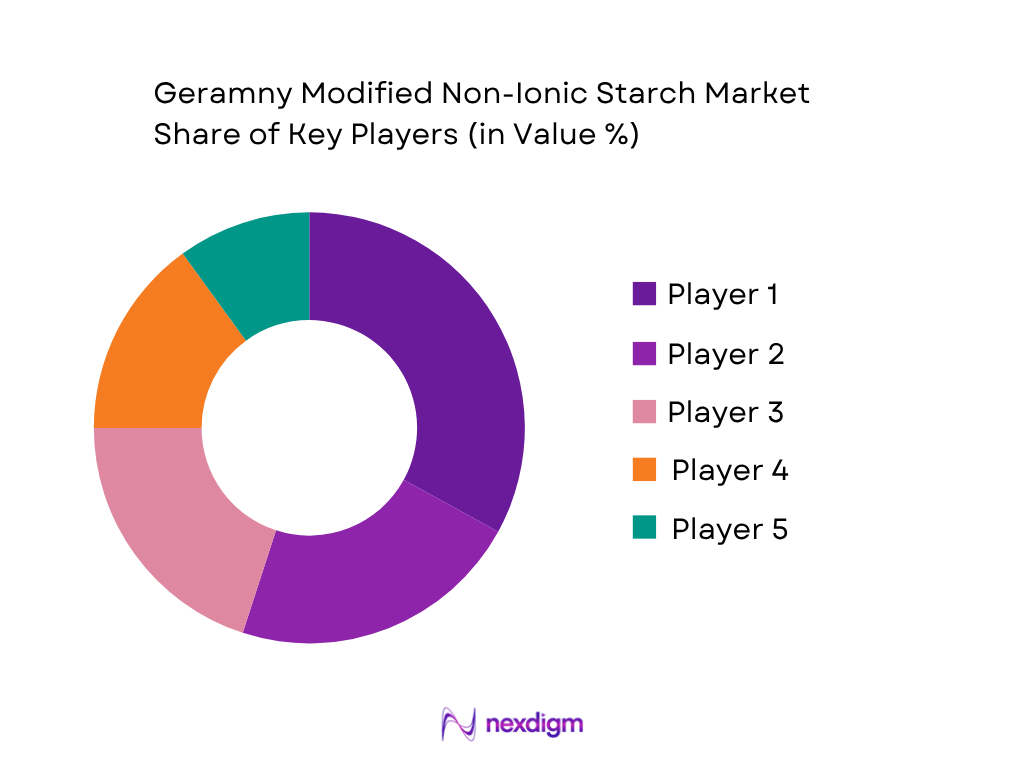
Germany Modified Non-Ionic Starch Market Analysis
Growth Drivers
Expansion of Processed Food Manufacturing
The Germany Modified Non-Ionic Starch market is supported by the continued expansion of processed food manufacturing, where modified starches are used for viscosity control, stabilization, texture improvement, and shelf-life enhancement. Germany’s food and beverage manufacturing industry remains one of Europe’s largest, with the sector generating approximately EUR 218 billion in turnover in 2023, according to the German Federal Ministry of Food and Agriculture. The country recorded around 5,600 food processing companies in 2023, creating a broad industrial base requiring functional ingredients. Increasing production of ready meals, sauces, dairy products, bakery goods, and frozen foods is strengthening demand for specialized starch solutions. Germany’s processed food industry also benefits from strong export activity, with food and agricultural exports exceeding EUR 90 billion in 2023, supporting demand for ingredients that maintain quality during transportation and storage. Modified non-ionic starches are increasingly preferred because they provide stability under heat, freezing, and acidic conditions, allowing manufacturers to meet consumer expectations for consistent product quality. The continued development of convenience food categories and industrial-scale food production is expected to sustain demand for advanced starch modification technologies.
Increasing Demand for Clean Label Ingredients
The Germany Modified Non-Ionic Starch market is gaining momentum from the rising focus on clean-label and naturally derived functional ingredients within the food manufacturing sector. German consumers and manufacturers are increasingly prioritizing transparency, ingredient functionality, and plant-based solutions. According to Germany’s Federal Statistical Office, household expenditure on food and non-alcoholic beverages reached approximately EUR 245 billion in 2023, reflecting strong consumption activity across packaged and processed food categories. The European food industry has also increased investments in reformulation strategies to replace synthetic additives with naturally derived alternatives. Modified starches derived from corn, potato, and wheat are being adopted because they improve texture and stability while supporting reduced additive formulations. Germany produced approximately 4.5 million tonnes of maize in 2023, supporting availability of starch-based raw materials for industrial applications. The growth of organic food sales, which exceeded EUR 16 billion in Germany in 2023, is encouraging manufacturers to develop ingredient solutions compatible with natural and sustainable product positioning. This shift is increasing opportunities for specialized modified starch products designed for clean-label food applications.
Market Challenges
Strict European Food Regulations
The Germany Modified Non-Ionic Starch market faces challenges due to strict European regulatory requirements governing food additives, processing methods, and ingredient labeling. Modified starch manufacturers must comply with extensive safety assessments, documentation requirements, and quality standards established under European food legislation. The European Union maintains a regulatory framework covering more than 300 approved food additives and processing aids, requiring manufacturers to ensure compliance throughout production and distribution processes. Germany’s food safety system involves monitoring through federal authorities and regional agencies, increasing compliance responsibilities for ingredient suppliers. Companies operating in the modified starch sector must maintain detailed traceability systems, quality certifications, and technical documentation for different applications. The complexity increases when starch ingredients are supplied for pharmaceutical and specialized food applications, where additional quality standards apply. Germany’s manufacturing sector consumed approximately 2,500 petajoules of industrial energy in 2023, highlighting the importance of efficient production systems while maintaining regulatory standards. These requirements increase operational complexity for manufacturers developing customized starch solutions and can slow product approvals for innovative formulations.
Competition from Alternative Hydrocolloids
The Germany Modified Non-Ionic Starch market experiences competition from alternative functional ingredients, particularly hydrocolloids such as gums and other texture-modifying agents. Food manufacturers often evaluate multiple ingredient options based on application requirements, processing conditions, and desired product characteristics. Germany’s food manufacturing industry includes approximately 6,000 medium and large food processing enterprises, creating demand for diverse functional ingredient solutions. Alternative ingredients including xanthan gum, guar gum, and carrageenan are used in applications requiring thickening, stabilization, and emulsification properties. The European market has also witnessed increased interest in plant-derived specialty ingredients, increasing competition among suppliers. Modified starch producers must differentiate through improved functionality, application expertise, and compatibility with clean-label requirements. Additionally, Germany imported approximately 7 million tonnes of agricultural products in 2023, indicating dependence on international agricultural supply chains for several ingredient categories. Fluctuations in raw material availability and changing formulation preferences among manufacturers create competitive pressure for modified starch suppliers. Companies need continuous innovation to maintain relevance across food, pharmaceutical, and industrial applications.
Market Opportunities
Clean Label Modified Starch Development
The Germany Modified Non-Ionic Starch market presents opportunities through the development of clean-label starch solutions designed for food manufacturers seeking functional alternatives with improved consumer acceptance. The demand is supported by Germany’s expanding organic and sustainable food sector, which generated approximately EUR 16 billion in sales in 2023 according to industry statistics. Food producers are increasingly reformulating products to reduce artificial additives while maintaining texture, stability, and processing performance. Modified starches derived from renewable agricultural sources such as potatoes, corn, and wheat provide opportunities for manufacturers developing natural ingredient systems. Germany harvested approximately 10.6 million tonnes of potatoes in 2023, supporting availability of potato-based starch resources for specialty applications. Clean-label modified starch technologies can support applications in sauces, dairy products, bakery items, and plant-based foods by improving consistency and product quality. Increasing consumer interest in transparent ingredient lists and sustainable food production methods is encouraging manufacturers to invest in advanced starch modification processes. These developments create opportunities for suppliers offering application-specific solutions aligned with European food formulation trends.
Pharmaceutical Excipient Expansion
The Germany Modified Non-Ionic Starch market has growth opportunities from increasing pharmaceutical applications where modified starches are used as binders, disintegrants, and stabilizing agents in drug formulations. Germany remains one of Europe’s largest pharmaceutical manufacturing centers, with pharmaceutical production facilities distributed across major industrial regions. According to Germany’s Federal Statistical Office, pharmaceutical manufacturing generated approximately EUR 65 billion in industry revenue in 2023, reflecting a strong production base requiring specialized excipients. Modified starch ingredients provide advantages such as compatibility, controlled functionality, and plant-based origin, making them suitable for pharmaceutical formulations. Germany exported pharmaceutical products worth more than EUR 120 billion in 2023, demonstrating the scale of its pharmaceutical supply ecosystem and the need for reliable ingredient inputs. Increasing demand for generic medicines, advanced drug delivery systems, and regulated pharmaceutical production is creating opportunities for specialty starch suppliers. Manufacturers capable of providing high-purity modified starch solutions with consistent quality standards are positioned to benefit from expanding pharmaceutical formulation requirements across Germany and wider European markets.
Future Outlook
Over the next decade, the Germany Modified Non-Ionic Starch market is expected to demonstrate steady expansion driven by increasing demand for functional food ingredients, pharmaceutical formulation requirements, and sustainable ingredient solutions. Growth will be supported by advancements in starch modification technologies, rising adoption of plant-based products, and increasing regulatory emphasis on clean-label formulations. The market is expected to witness stronger demand from food manufacturers seeking improved texture, stability, and processing efficiency.
Major Players
- Ingredion Incorporated
- Tate & Lyle
- Cargill
- Roquette
- AGRANA Beteiligungs-AG
- BASF
- KMC
- Avebe
- Emsland Group
- Tereos
- ADM
- Louis Dreyfus Company
- Beneo
- HLR Starch Products
- FMC Corporation
Key Target Audience
- Food processing manufacturers and ingredient procurement heads
- Bakery, confectionery, and convenience food manufacturers
- Pharmaceutical formulation companies and excipient procurement teams
- Dairy and frozen food manufacturers
- Specialty ingredient distributors and importers
- Investments and venture capitalist firms (food technology funds, ingredient innovation funds, industrial biotechnology investors)
- Government and regulatory bodies (Federal Ministry of Food and Agriculture (BMEL), German Federal Institute for Risk Assessment (BfR), European Food Safety Authority (EFSA))
- Industrial adhesive and specialty chemical manufacturers
Research Methodology
Step 1: Identification of Key Variables
The initial phase involves developing an ecosystem map covering major stakeholders operating across the Germany Modified Non-Ionic Starch market, including starch manufacturers, food processors, pharmaceutical companies, distributors, and industrial users. Extensive secondary research is conducted through industry databases, government publications, trade statistics, and regulatory documents to identify major market variables affecting demand, supply, and application trends.
Step 2: Market Analysis and Construction
This stage focuses on analyzing historical market developments, production patterns, application penetration, and consumption trends across major end-use industries. A combination of supply-side assessment and demand-side evaluation is performed to understand production capacities, import dependency, application adoption, and revenue contribution from different segments.
Step 3: Hypothesis Validation and Expert Consultation
Market assumptions are validated through discussions with industry participants, including starch producers, food manufacturers, pharmaceutical companies, and application specialists. These consultations provide operational insights regarding product development trends, formulation requirements, regulatory challenges, and future adoption patterns within Germany.
Step 4: Research Synthesis and Final Output
The final phase integrates primary and secondary research findings to develop a comprehensive analysis of the Germany Modified Non-Ionic Starch market. Information gathered from manufacturers, distributors, and end users is evaluated to validate market trends, competitive positioning, segmentation analysis, and future growth opportunities.

- Executive Summary
- Research Methodology (Market Definitions and Scope, Market Classification Framework, Market Sizing Methodology, Top-Down Analysis, Bottom-Up Analysis, Demand-Side Evaluation, Supply-Side Assessment, Primary Industry Interviews, Trade Flow Analysis, Value Chain Mapping, Data Triangulation, Forecasting Model, Research Limitations and Assumptions)

- Definition and Scope
- Market Evolution and Development Timeline of Modified Starch Industry
- Historical Development of Germany Starch Processing Sector
- Major Industry Developments and Technology Advancements
- Germany Modified Starch Industry Ecosystem
- Modified Non-Ionic Starch Value Chain Analysis

- Growth Drivers (Expansion of Processed Food Manufacturing, Increasing Demand for Clean Label Ingredients, Growth of Functional Food Applications, Rising Bakery and Convenience Food Production, Expansion of Pharmaceutical Manufacturing, Increasing Demand for Plant-Based Ingredients, Growth of Sustainable Food Processing, Rising Specialty Starch Applications, Increasing Industrial Adhesive Consumption)
- Market Challenges (Strict European Food Regulations, High Production Compliance Requirements, Competition from Alternative Hydrocolloids, Dependence on Imported Specialty Starch Technologies, Raw Material Availability Constraints, High Processing Standards, Energy Cost Pressure on Manufacturing, Limited Consumer Awareness Regarding Modified Starch Applications)
- Market Opportunities (Clean Label Modified Starch Development, Plant-Based Ingredient Innovation, Gluten-Free Food Applications, Pharmaceutical Excipient Expansion, Sustainable Starch Processing Technologies, Functional Beverage Applications, Specialty Bakery Ingredient Demand, Bio-Based Industrial Adhesive Development, Export-Oriented Specialty Starch Production)
- Market Trends (Rising Demand for Natural Functional Ingredients, Clean Label Product Development, Plant-Based Food Formulations, Sustainable Processing Practices, Advanced Texture Engineering, Customized Starch Solutions, Reduced Additive Food Manufacturing, Specialty Pharmaceutical Excipients)
- Government Regulations (European Food Safety Authority Regulations, EU Food Additive Regulations, Novel Food Requirements, German Food Safety Standards, REACH Chemical Compliance, Packaging Sustainability Regulations, Pharmaceutical Excipient Standards, Organic Food Certification Requirements)
- SWOT Analysis
- Porter’s Five Forces Analysis
- PESTLE Analysis

- By Market Value (2020-2025)
- By Consumption Volume (2020-2025)
- By Domestic Production Volume (2020-2025)
- By Import Volume (2020-2025)
- By Export Volume (2020-2025)

- By Raw Material Source (In Value %)
Potato-Based Modified Starch
Wheat-Based Modified Starch
Corn-Based Modified Starch
Tapioca-Based Modified Starch
Rice-Based Modified Starch
Other Agricultural Feedstock-Based Modified Starch - By Modification Process (In Value %)
Hydroxypropylation
Acetylation
Cross-Linking
Oxidation
Pregelatinization
Dual Modification
Other Specialty Modification Processes - By Application Industry (In Value %)
Food and Beverage Processing
Bakery and Confectionery Products
Dairy and Frozen Food Applications
Sauces, Dressings and Processed Foods
Convenience Food Manufacturing
Pharmaceutical Applications
Paper and Packaging Industry
Industrial Adhesives - By Functional Property (In Value %)
Thickening and Viscosity Control
Texture Enhancement
Stabilization
Binding and Encapsulation
Moisture Retention
Film Formation
Emulsion Stabilization - By Distribution Channel (In Value %)
Direct Industrial Procurement
Food Ingredient Distributors
Pharmaceutical Ingredient Suppliers
Industrial Chemical Distributors
Online B2B Platforms

- Market Share Analysis of Major Players (By Revenue, Product Category, Application Industry, Customer Segment, Distribution Channel)
- Cross Comparison Parameters (Product Portfolio Breadth, Modified Starch Product Range, Raw Material Processing Capability, Production Capacity, Application-Specific Solutions, Food Grade Certification Portfolio, Research and Development Capability, Customer Industry Coverage)
- SWOT Analysis of Major Players
- Detailed Profiles of Major Companies
Ingredion Incorporated
Cargill Incorporated
Roquette
Tate & Lyle PLC
Archer Daniels Midland Company
Tereos
Emsland Group
Avebe
AGRANA Beteiligungs-AG
Crespel & Deiters
KMC Ingredients
Loryma GmbH
Südstärke GmbH
Royal Cosun
Beneo GmbH

- Food Processing Industry Assessment
- Bakery and Confectionery Industry Analysis
- Dairy and Frozen Food Industry Assessment
- Pharmaceutical Industry Analysis
- Industrial Application Assessment
- Consumer Product Trend Analysis
- Procurement Behaviour Assessment

- By Market Value (2026-2035)
- By Consumption Volume (2026-2035)
- By Domestic Production Volume (2026-2035)
- By Import Volume (2026-2035)
- By Export Volume (2026-2035)


 Request a Sample
 Ask for Customization
 Get a Quote
 Enquire Now