
 Download PDF
Market Overview
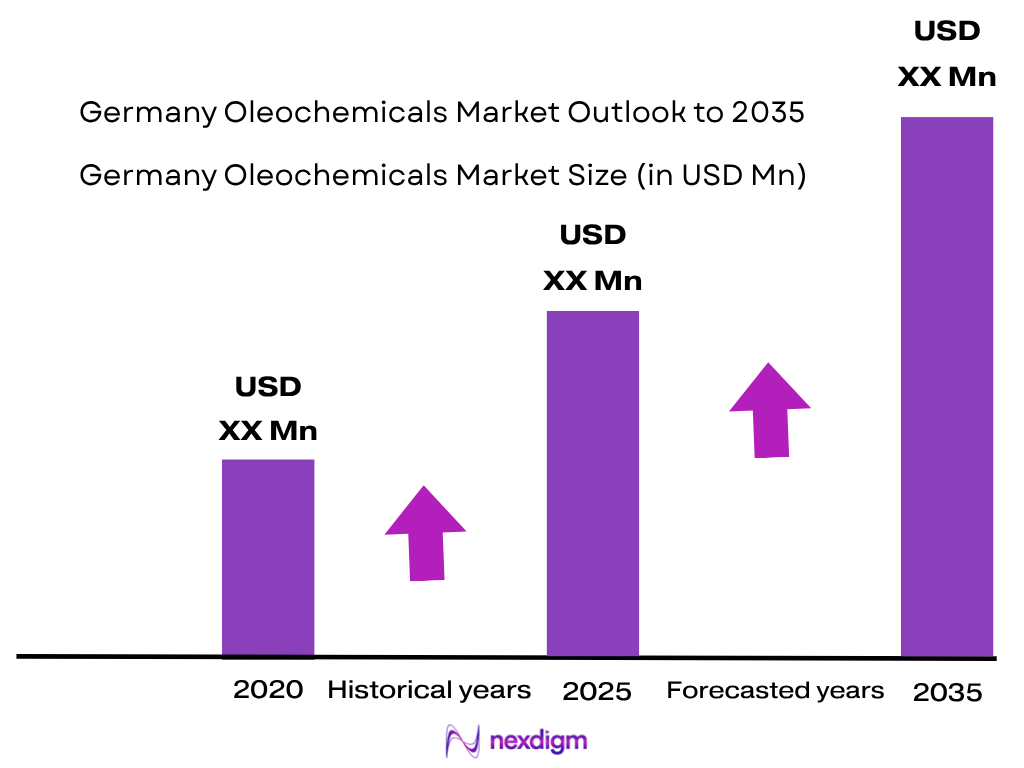
The Germany Oleochemicals Market is valued at approximately USD 2.10 billion, with the published benchmark from Reed Intelligence placing market revenue at USD 2,103.31 million. Germany’s broader chemical-pharmaceutical industry recorded sales of EUR 229.3 billion in the preceding full-year period and approximately EUR 240 billion in the following full-year period, supporting substantial downstream consumption of fatty acids, glycerine, esters and other oleochemical intermediates. Demand is driven by personal care, detergents, pharmaceuticals, lubricants and specialty chemical applications.
Emmerich am Rhein, Hamburg, Witten, Wittenberge, Ludwigshafen and Essen form important centers of Germany’s oleochemical and downstream specialty-chemical ecosystem. Emmerich hosts KLK EMMERICH, which identifies itself as Europe’s leading oleochemical manufacturer, while IOI Oleo operates from Hamburg with more than 330 employees and production plants in Witten and Wittenberge. Ludwigshafen contains BASF’s integrated chemical complex with 125 production plants, while Essen anchors Evonik’s specialty-chemicals operations, creating dense feedstock, application-development, infrastructure and customer networks.
Market Segmentation
By Product Type
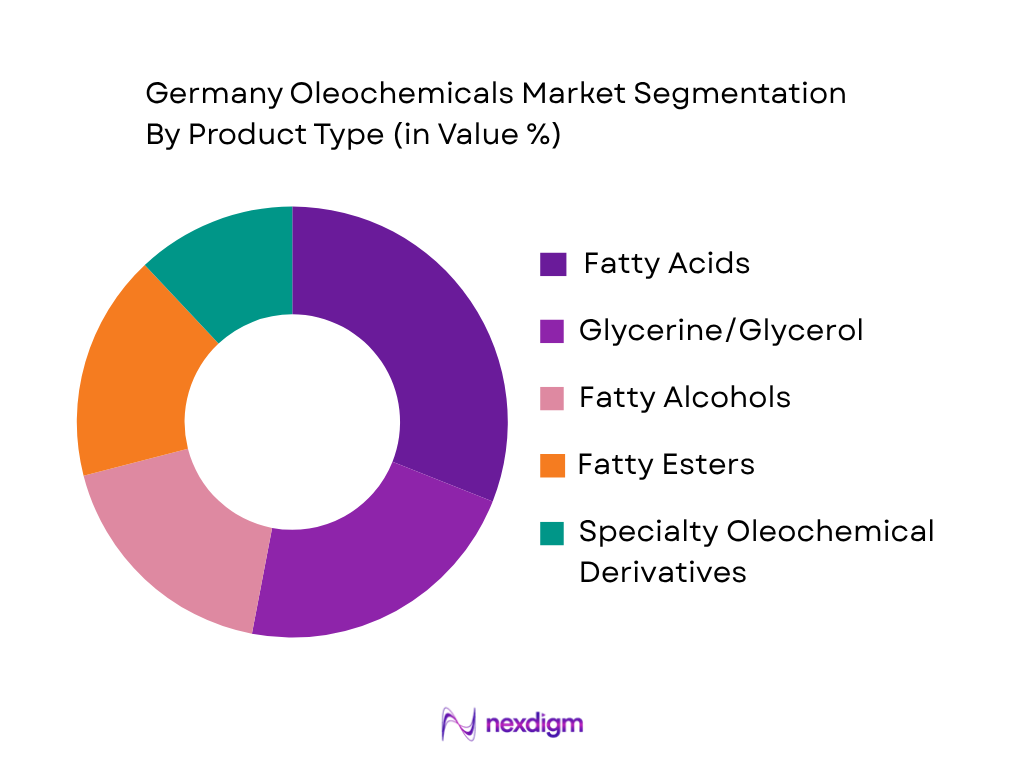
The Germany Oleochemicals Market is segmented by product type into fatty acids, glycerine/glycerol, fatty alcohols, fatty esters and specialty oleochemical derivatives. Fatty acids hold the dominant position within this segmentation. Their leadership reflects their extensive role as primary intermediates for soaps, detergents, cosmetics, lubricants, coatings, plastics, rubber processing and industrial formulations. ECHA identifies fatty acids as major oleochemicals derived from vegetable and animal oils and fats, supporting their central position within oleochemical conversion chains. Germany additionally benefits from established fatty-acid production at major manufacturing locations such as Emmerich, where KLK produces distilled, hydrogenated and fractionated fatty acids alongside refined glycerine and specialty derivatives. The segment is further supported by demand for stearic, oleic, palmitic, lauric and specialty fatty acids from Germany’s sizable chemical and consumer-product manufacturing base.
By End-Use Industry
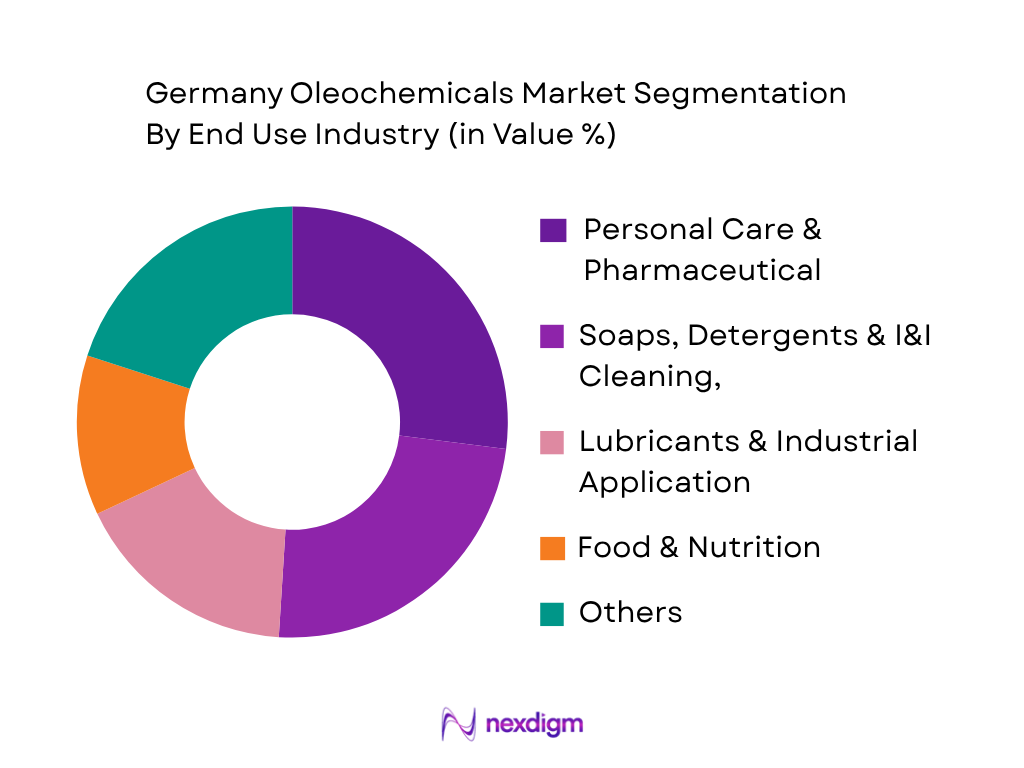
The Germany Oleochemicals Market is segmented by end-use industry into personal care and pharmaceuticals, soaps and detergents, lubricants and industrial applications, food and nutrition, polymers and coatings, and other applications. Personal care and pharmaceuticals represent the leading end-use segment because Germany has an extensive formulation, specialty-ingredient and life-sciences manufacturing ecosystem requiring high-purity esters, glycerine, fatty alcohols, emulsifiers, emollients and lipid-based excipients. IOI Oleo’s German operations illustrate this downstream specialization through pharmaceutical active ingredients and excipients, cosmetic emollients, emulsifiers, texturizers and multifunctional ingredients. EU cosmetic-product legislation imposes formal ingredient-safety and product-safety requirements, strengthening demand for traceable, controlled-quality inputs from established suppliers. Higher-margin specialty formulations also encourage German producers to move beyond basic oleochemicals toward customized functional derivatives.
Competitive Landscape
The Germany Oleochemicals Market combines large integrated chemical groups, dedicated oleochemical manufacturers and specialty-ingredient producers. KLK EMMERICH has a particularly strong position in basic oleochemicals such as fatty acids and glycerine, while IOI Oleo is strongly positioned in esters, MCTs, personal care, pharmaceutical and technical applications. BASF and Evonik compete through downstream specialty chemistry and formulation capabilities, while Oleon participates across renewable fatty-acid derivatives, esters and specialty applications. Competition increasingly centers on feedstock flexibility, application expertise, purity, sustainability certification and renewable-carbon credentials rather than scale alone.
| Company | Establishment | Headquarters | Core Oleochemical Exposure | Key Product Families | Germany Manufacturing Footprint | Feedstock Positioning | Key End Uses | Sustainability/Competitive Capability |
| KLK OLEO | 1991 | Petaling Jaya, Malaysia | ~ | ~ | ~ | ~ | ~ | ~ |
| BASF SE | 1865 | Ludwigshafen, Germany | ~ | ~ | ~ | ~ | ~ | ~ |
| IOI Oleo GmbH | 2016 | Hamburg, Germany | ~ | ~ | ~ | ~ | ~ | ~ |
| Evonik Industries AG | 2007 | Essen, Germany | ~ | ~ | ~ | ~ | ~ | ~ |
| Oleon | 1957 roots / Oleon name from 2000 | Ertvelde, Belgium | ~ | ~ | ~ | ~ | ~ | ~ |
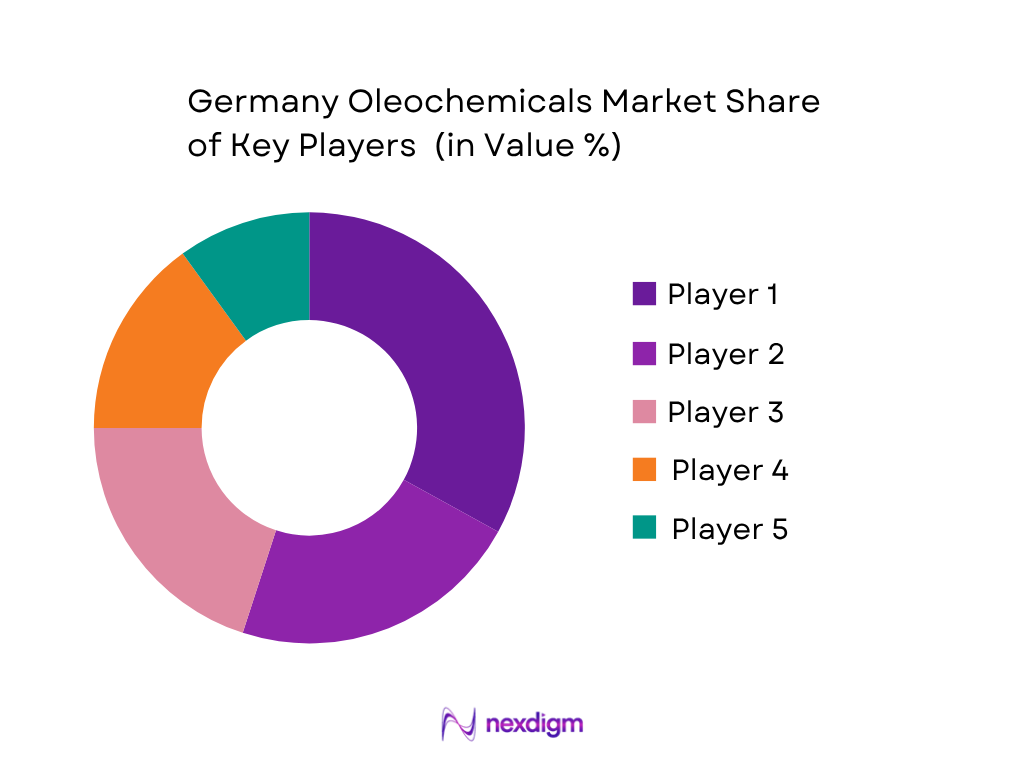
Germany Oleochemicals Market Analysis
Growth Drivers
Renewable Carbon Adoption and Fossil-to-Bio Substitution
Germany’s transition toward renewable carbon is strengthening the structural case for oleochemicals across surfactants, lubricants, personal-care ingredients, polymer additives, coatings and other chemical applications where fatty acids, fatty alcohols, glycerine and esters can replace or complement fossil-derived intermediates. Germany generated 431.7 TWh of electricity in 2024, of which 254.9 TWh came from renewable sources, according to the Federal Network Agency. The German Environment Agency separately recorded 284 TWh of renewable electricity generation using its broader accounting methodology and 197.2 TWh of renewable heat.
The broader macroeconomic base remains substantial: World Bank data place German GDP at USD 4.6856 trillion in 2024, GDP per capita at USD 56,103.7, and population at 83,516,593, providing a large industrial and consumer economy capable of supporting higher-specification bio-based materials. Germany’s chemical-manufacturing infrastructure further reinforces this demand pathway. Federal Statistical Office data show 1,710 establishments and 346,685 employees in chemical manufacturing in 2024, demonstrating the scale of the downstream conversion ecosystem into which oleochemical intermediates can be integrated.
Personal Care, Detergent and Surfactant Ingredient Demand
Germany’s large personal-care and household-cleaning industries provide a direct demand base for oleochemical feedstocks including fatty alcohols, fatty acids, glycerine, esters, emulsifiers and surfactant intermediates. In 2024, German beauty-care products generated EUR 16.9 billion in domestic retail sales, while home-care products generated EUR 5.7 billion, according to the German Cosmetic, Toiletry, Perfumery and Detergent Association. Combined domestic beauty and home-care sales reached EUR 22.6 billion, while total domestic and export industry sales reached EUR 34.6 billion. Hair-care products remained the largest beauty-care revenue category, while detergents remained central to household-care demand, directly supporting fatty alcohol ethoxylates, sulfates, soaps and other oleochemical-derived formulations. The industry operates within a large macroeconomic consumption base: World Bank data record Germany’s population at 83,516,593 in 2024, GDP per capita at USD 56,103.7, and total GDP at USD 4.6856 trillion. These indicators support a substantial consumer-products manufacturing and consumption platform despite weak aggregate GDP growth. On the supply side, Germany’s chemical sector contained 1,710 establishments and 346,685 employees in 2024, while total manufacturing employment at establishments with at least 50 employees stood at approximately 5.5 million people at year-end. This industrial scale enables domestic formulators to source, modify and incorporate oleochemicals into higher-value consumer-care products.
Market Challenges
Palm Feedstock Dependency, Traceability and Regulatory Compliance
Germany’s oleochemical industry remains exposed to imported lipid feedstocks, particularly palm- and palm-kernel-derived materials used in lauric fatty acids, fatty alcohols, surfactants, emulsifiers and specialty esters. This creates a structural challenge because oleochemical manufacturers must increasingly demonstrate exactly where agricultural feedstocks originate and whether they comply with European environmental requirements. The EU Deforestation Regulation places oil palm among the regulated commodities and extends due-diligence obligations across relevant products entering or leaving the European market. The compliance framework requires geolocation and supply-chain information that is substantially more demanding than conventional supplier declarations, making traceability systems a core operational requirement for Germany-based processors using palm-derived oleochemical inputs.
Germany’s exposure is significant because its chemical industry contained 1,710 establishments employing 346,685 people in 2024, according to the Federal Statistical Office. The scale of this industrial base means compliance requirements affect a large network of formulators, importers and downstream processors rather than only a handful of primary oleochemical manufacturers. Germany’s broader economy also recorded USD 4.6856 trillion in GDP and a population of 83,516,593 in 2024 according to the World Bank, illustrating why interruption of chemical-feedstock availability can propagate through a large manufacturing and consumer economy. Regulatory compliance is also occurring while Germany seeks broader environmental transformation: renewable electricity generation reached 254.9 TWh under Federal Network Agency accounting in 2024, demonstrating that environmental performance is becoming embedded across industrial policy rather than restricted to individual product regulations.
Energy-Intensive Manufacturing and Pressure on European Chemical Competitiveness
Germany’s oleochemical manufacturers operate inside an industrial environment where energy intensity and weakened manufacturing momentum create substantial challenges for commodity and semi-specialty production. Oleochemical processing involves fat splitting, distillation, fractionation, hydrogenation, esterification, purification, drying and heated storage, all of which require reliable electricity, steam, thermal energy or hydrogen inputs. German electricity generation totaled 431.7 TWh in 2024, according to the Federal Network Agency, while the country’s industrial base remained under pressure. Federal Statistical Office data show that approximately 5.5 million people were employed in manufacturing establishments with at least 50 employees at the end of 2024, 68,000 fewer employees than a year earlier.
Chemical-industry employment stood at approximately 326,000 people under the same establishment-size measure, while broader annual industrial statistics recorded 346,685 employees across 1,710 chemical establishments. Germany’s macroeconomic performance further illustrates the difficult industrial environment. World Bank data show German GDP at USD 4.6856 trillion in 2024, but real GDP growth was -0.5, indicating contraction despite the economy’s large absolute scale. GDP per capita remained USD 56,103.7, reflecting high productivity and purchasing power, but manufacturers still faced weak industrial demand and restructuring pressure. Federal Statistical Office figures show 1,725 chemical establishments in 2023 compared with 1,710 in 2024, while chemical-sector employment remained broadly flat at 346,685.
Market Opportunities
Specialty Esters, Pharmaceutical Glycerine and Bio-Based Emollients
Germany presents a strong forward opportunity for oleochemical producers that move downstream from basic fatty acids and glycerine into specialty esters, pharmaceutical-grade glycerine, MCTs, emollients, emulsifiers and high-purity functional lipids. Current downstream data support this opportunity. Germany’s beauty-care industry generated EUR 16.9 billion in domestic sales in 2024, while total beauty and household-care domestic sales reached EUR 22.6 billion. These industries consume precisely the types of high-purity oleochemical derivatives used to formulate skin care, hair care, oral care, cleansing products, creams, lotions and specialty emulsions. Germany also possesses a substantial pharmaceutical manufacturing platform.
The macroeconomic environment reinforces the addressable downstream base: World Bank data report USD 4.6856 trillion in German GDP, GDP per capita of USD 56,103.7, and a population of 83,516,593 in 2024. These indicators matter for specialty oleochemicals because higher-value formulations are supported by developed pharmaceutical, cosmetic and technical industries rather than dependence on bulk commodity consumption alone. Specialty esters provide multiple avenues for growth because molecular structure can be modified for spreadability, polarity, viscosity, lubricity, oxidative behavior and skin feel, enabling suppliers to differentiate products for cosmetics, pharmaceuticals, food processing, lubricants and polymer applications.
Circular Feedstocks, Sustainable Surfactants and Low-Carbon Oleochemicals
Circular lipid feedstocks and low-carbon oleochemical derivatives represent a significant development opportunity as Germany combines renewable-energy expansion, resource-efficiency policy and industrial decarbonization. German renewable electricity generation reached 254.9 TWh in 2024 according to the Federal Network Agency, while the German Environment Agency recorded 197.2 TWh of renewable heat and total renewable electricity generation of 284 TWh under its broader methodology. Renewable installed generation capacity increased by almost 20 GW during 2024. These indicators are relevant to oleochemicals because lower-carbon manufacturing requires both renewable molecular feedstocks and progressively cleaner process energy.
Germany already operates an extensive bio-based energy and recycling infrastructure, giving processors experience with the collection, certification and movement of secondary lipid streams. The German Environment Agency recorded 32.7 TWh of biofuels consumed in transport during 2024, illustrating the existing scale of renewable liquid-feedstock handling in Germany even though not all such material is technically or economically interchangeable with oleochemical feedstocks. This infrastructure is relevant because competition for waste lipids creates incentives for oleochemical producers to improve purification, feedstock flexibility and value realization rather than rely exclusively on virgin agricultural oils. Sustainable surfactants represent another opportunity.
Future Outlook
The Germany Oleochemicals Market is expected to expand at a forecast CAGR of approximately 7.94% during the forecast period, supported by substitution of fossil-derived intermediates with renewable-carbon chemicals, increased specialty-esters consumption, growth in high-purity pharmaceutical and personal-care ingredients, and greater use of biodegradable lubricants and surfactants. Competitive advantage will increasingly depend on sustainable feedstock procurement, energy efficiency, technical differentiation and downstream integration. Future development will increasingly favor specialty over commodity oleochemicals.
Sustainability will also alter procurement economics. Oleochemicals can originate from vegetable oils, animal fats and other lipid feedstocks, while German purchasers increasingly require documented feedstock origin, renewable-carbon content and credible supply-chain controls. The European Commission’s evolving deforestation regulation specifically addresses oil-palm commodities and certain derivatives, increasing the strategic value of traceability and compliant sourcing systems. Regulatory sophistication creates both barriers and opportunities.
Major Players
- BASF SE
- KLK EMMERICH GmbH / KLK OLEO
- IOI Oleo GmbH / IOI Oleochemical
- Evonik Industries AG
- Oleon NV / Avril Group
- Emery Oleochemicals
- Croda International Plc
- Cargill
- Wilmar International / Wilmar Europe
- Musim Mas Group
- Kao Chemicals Europe
- Vantage Specialty Chemicals
- Peter Greven GmbH & Co. KG
- Berg + Schmidt GmbH & Co. KG
- Temix Oleo / KLK Temix
Key Target Audience
- Oleochemical Manufacturers and Specialty Derivative Producers
- Personal Care, Cosmetics and Home-Care Ingredient Manufacturers
- Pharmaceutical, Nutrition and High-Purity Lipid Companies
- Lubricant, Polymer, Coating and Industrial Formulation Manufacturers
- Vegetable Oil, Animal Fat and Sustainable Lipid Feedstock Suppliers
- Chemical Distributors, Importers and Industrial Supply-Chain Companies
- Investments and Venture Capitalist Firms
- Government and Regulatory Bodies (European Chemicals Agency, European Commission Directorate-General for Environment, German Federal Ministry for the Environment, Climate Action, Nature Conservation and Nuclear Safety, German Environment Agency)
Research Methodology
Step 1: Identification of Key Variables
The research process begins by constructing a Germany-specific oleochemicals ecosystem covering feedstock suppliers, fatty-acid splitters, glycerine refiners, ester manufacturers, specialty formulators, distributors and end users. Secondary research identifies critical variables such as product volumes, feedstock mix, pricing, installed capacity, imports, exports, end-use demand, purity requirements and sustainability certification.
Step 2: Market Analysis and Construction
Historical market development is evaluated through producer disclosures, German external-trade statistics, European chemical-industry information and application-market indicators. The top-down approach assesses downstream chemical, personal-care, detergent, pharmaceutical and industrial consumption, while bottom-up construction analyzes manufacturer portfolios, production sites, trade flows, capacity utilization and realizable selling prices.
Step 3: Hypothesis Validation and Expert Consultation
Initial hypotheses are validated through structured interviews and CATIs with oleochemical producers, distributors, procurement managers, technical formulators and downstream industrial users. Discussions focus on fatty-acid and glycerine demand, contract pricing, feedstock substitution, customer qualification, certification premiums, application growth and competitive positioning to reconcile differences observed in secondary sources.
Step 4: Research Synthesis and Final Output
The final stage triangulates supply-side production, apparent consumption, imports and exports with end-use demand and company-level intelligence. Conflicting observations are reconciled through product-level checks and expert validation. The resulting model establishes market size, segment distribution, competition, demand drivers and the forecast framework for the Germany Oleochemicals Market.

- Executive Summary
- Research Methodology (Market Definitions and Product Boundaries, Basic vs Specialty Oleochemicals Classification, Feedstock Mapping, HS/CN Code Mapping, Primary and Secondary Research Framework, Top-Down Market Sizing, Bottom-Up Producer Capacity Assessment, Plant-Level Production Estimation, Apparent Consumption Analysis, Import–Export Reconciliation, Demand-Side End-Use Assessment, Supply-Side Manufacturer Assessment, Capacity Utilization Analysis, Price–Volume–Mix Assessment, Primary Interviews with Oleochemical Producers/Distributors/End Users, Trade Data Validation, Data Triangulation, Forecasting Framework, Scenario Modelling, Limitations and Future Conclusions)

- Definition and Scope
- Oleochemicals Industry Evolution and Market Development
- Germany’s Position in the European Oleochemicals Value Chain
- Feedstock-to-Derivative Conversion Map
- Key Demand Centers and Downstream Manufacturing Linkages

- Growth Drivers (Renewable Carbon Adoption, Personal Care Ingredient Demand, Detergent and Surfactant Demand, Bio-Lubricant Adoption, Fossil-to-Bio Substitution, Sustainable Chemistry Targets, Specialty Ester Demand, Circular Feedstock Utilization)
- Market Challenges (Palm Feedstock Dependency, Feedstock Price Volatility, Energy Costs, EUDR Traceability Burden, REACH Compliance, European Chemical Manufacturing Costs, Asian Import Competition, Capacity Rationalization)
- Market Opportunities (Specialty Esters, Sustainable Surfactants, Pharmaceutical Glycerin, Bio-Based Emollients, Low-Carbon Oleochemicals, Circular Feedstocks, High-Purity Fatty Acids, Polymer Additives)
- Market Trends (Premiumization, Feedstock Diversification, RSPO Uptake, Mass-Balance and Segregated Supply, Decarbonization, Specialty Derivatization, Renewable Carbon Accounting, Portfolio Rationalization)
- Germany Oleochemicals Regulatory and Policy Landscape (EU REACH, CLP Regulation, EUDR, EU Chemicals Strategy for Sustainability, Renewable Energy Framework, German Chemicals Regulation, Food/Feed Standards, Cosmetics Regulation, Pharmaceutical GMP, Sustainability Certification)
- SWOT Analysis
- Porter’s Five Forces Analysis
- PESTLE Analysis

- By Market Value (2020-2025)
- By Domestic Consumption Volume (2020-2025)
- By Domestic Production Volume (2020-2025)
- By Import Volume (2020-2025)
- By Export Volume (2020-2025)
- By Average Realized Selling Price (2020-2025)
- By Basic Oleochemicals Revenue (2020-2025)
- By Specialty Oleochemicals Revenue (2020-2025)

- By Product Type (in value%)
Fatty Acids
Stearic Acid
Oleic Acid
Lauric Acid
Palmitic Acid
Caprylic/Capric Acids
Isostearic Acid
Dimer and Trimer Fatty Acids - By Feedstock (in value %)
Palm and Palm-Kernel-Based Oleochemicals
Coconut-Based Oleochemicals
Rapeseed-Based Oleochemicals
Sunflower-Based Oleochemicals
Soy-Based Oleochemicals
Tallow-Based Oleochemicals
Waste and Circular Lipid Feedstocks
Multi-Feedstock Oleochemical Production - By Feedstock Origin (in value %)
Domestic and EU-Sourced Feedstocks
Imported Tropical Oils
Certified Sustainable Feedstocks
Circular/Recycled Feedstocks
Conventional Non-Certified Feedstocks - By Oleochemical Grade (in value %)
Technical and Industrial Grade
Personal Care and Cosmetic Grade
Food and Nutrition Grade
Feed Grade
Pharmaceutical/Pharmacopoeia Grade
High-Purity Specialty Grade - By End-Use Industry (in value %)
Beauty and Personal Care
Home Care and Detergents
Industrial and Institutional Cleaning
Food and Nutrition
Pharmaceutical and Life Sciences
Lubricants and Metalworking Fluids
Plastics, Polymer Additives and Compounding
Paints, Coatings and Printing Inks
Rubber and Tire Manufacturing
Agrochemicals
Construction Chemicals
Candles and Waxes
Pulp and Paper
Textile and Leather Chemicals - By Customer Type (in value %)
Large Strategic Accounts
Mid-Sized Industrial Customers
Specialty Formulators
Small and Medium Enterprises

- Market Share of Major Players (Revenue, Domestic Sales Volume, Installed Capacity, Product Family, End-Use Exposure, Production Footprint, Merchant Sales)
- Cross Comparison Parameters (Germany/European Oleochemical Production Capacity, Basic-to-Specialty Product Mix, Fatty Acid and Glycerin Portfolio Breadth, Feedstock Integration and Flexibility, RSPO/ISCC and Traceability Coverage, Downstream Ester/Surfactant/Emollient Capability, German Manufacturing and Logistics Footprint, End-Use Industry Diversification)
- Pricing Benchmarking (Commodity Oleochemical Pricing, Specialty Premium, Contract Structure, Sustainability Premium)
- SWOT Analysis of Major Players (Portfolio Strength, Feedstock Integration, Manufacturing Cost Position, Innovation Capability, Customer Access, Regulatory Exposure)
- Detailed Profiles of Major Companies
BASF SE
KLK EMMERICH GmbH / KLK OLEO
IOI Oleo GmbH / IOI Oleochemical
Evonik Industries AG
Oleon NV / Avril Group
Emery Oleochemicals
Croda International Plc
Cargill
Wilmar International / Wilmar Europe
Musim Mas Group
Kao Chemicals Europe
Vantage Specialty Chemicals
Peter Greven GmbH & Co. KG
Berg + Schmidt GmbH & Co. KG
Temix Oleo

- Personal Care and Cosmetics
- Home Care, Detergents and Industrial & Institutional Cleaning
- Pharmaceuticals and Healthcare
- Lubricants and Metalworking Fluids
- Food and Nutritions
- Plastics, Polymers and Rubber
- Paints, Coatings, Adhesives and Inks
- Other Industrial Applications

- By Market Value (2026-2035)
- By Domestic Consumption Volume (2026-2035)
- By Domestic Production Volume (2026-2035)
- By Import Volume (2026-2035)
- By Export Volume (2026-2035)
- By Average Realized Selling Price (2026-2035)
- By Basic Oleochemicals Revenue (2026-2035)
- By Specialty Oleochemicals Revenue (2026-2035)


 Request a Sample
 Ask for Customization
 Get a Quote
 Enquire Now