
 Download PDF
Market Overview
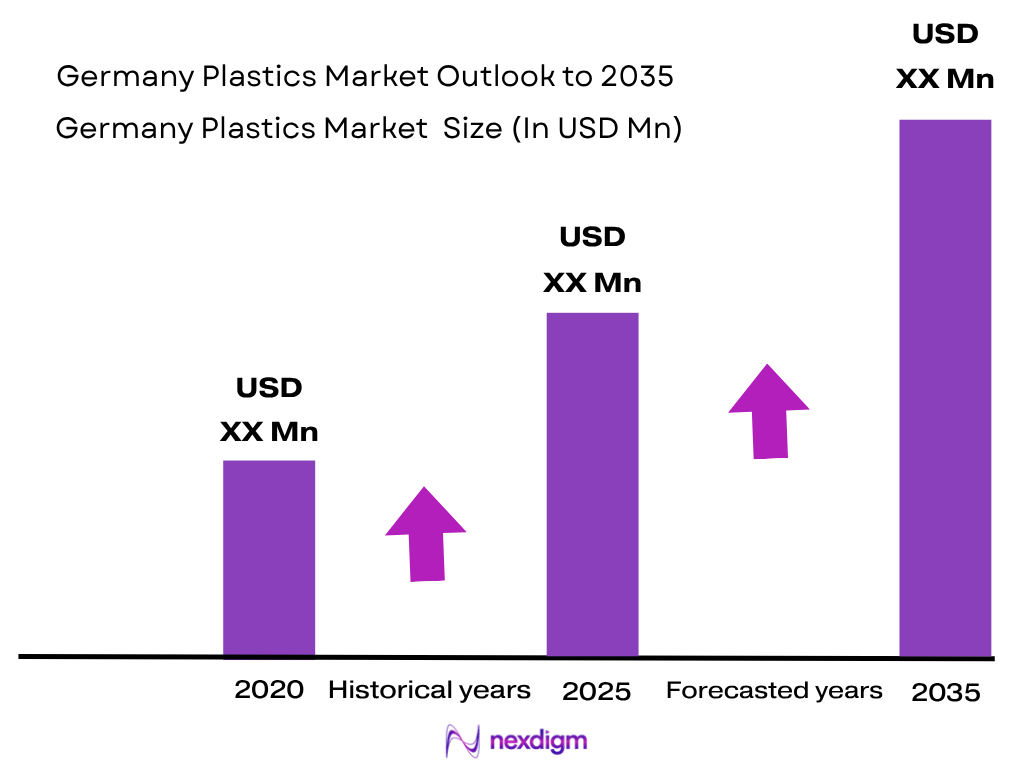
The Germany Plastics Market is valued at approximately USD ~ billion, based on a five-year historical analysis, supported by packaging, automotive, construction, electronics and technical plastic applications. Germany’s plastics-converting industry generates approximately EUR 68.2 billion in annual turnover, employs more than 307,000 people and comprises around 2,906 enterprises. The broader economic base increased from approximately USD 4.56 trillion to USD 4.69 trillion, reinforcing Germany’s position as Europe’s largest industrial economy and a major consumer of polymers and converted plastic products.
Ludwigshafen, Leverkusen, Dormagen, Krefeld, Essen, Darmstadt and major industrial centers across North Rhine-Westphalia dominate Germany’s plastics ecosystem because they combine petrochemical production, specialty polymer development, automotive suppliers, compounders and downstream converters. Ludwigshafen hosts the world’s largest integrated chemical complex, spanning approximately 10 square kilometres with 125 production plants, while Leverkusen combines polymer production, research and corporate functions. North Rhine-Westphalia also contains the interconnected Leverkusen, Dormagen and Krefeld-Uerdingen material-production network, strengthening access to polycarbonate, polyurethane and technical plastics.
Market Segmentation
By Polymer Type
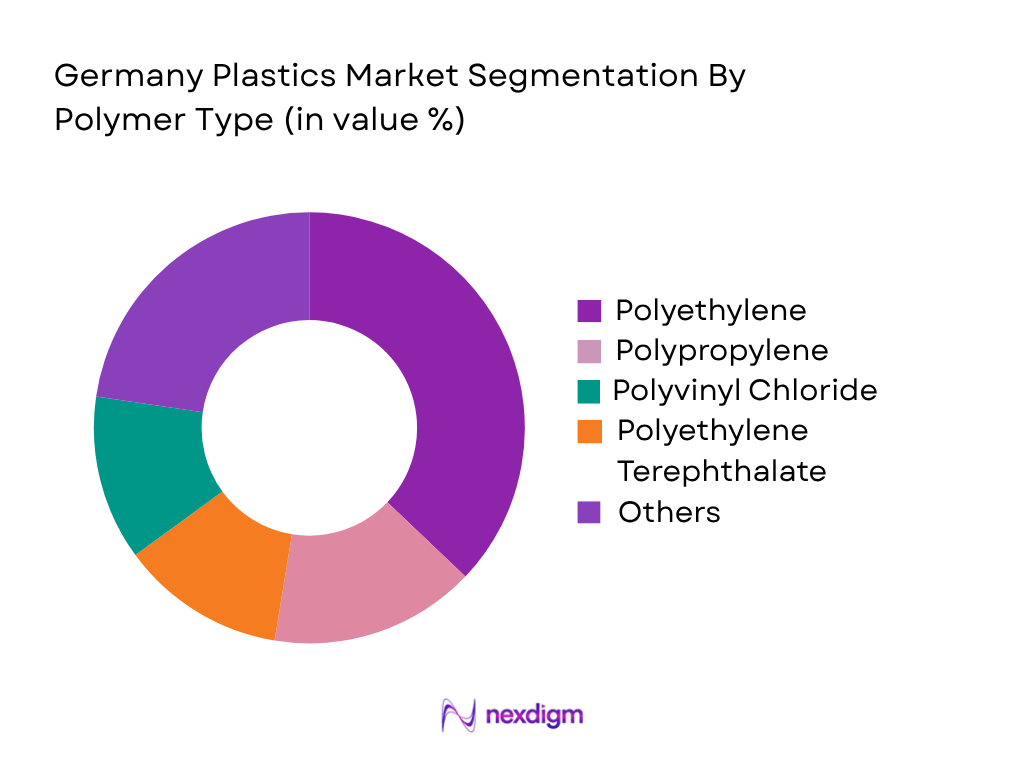
The Germany Plastics Market is segmented into polyethylene, polypropylene, polyvinyl chloride, polyethylene terephthalate, polystyrene, polyurethane, polycarbonate, polyamide, PMMA and other engineering and specialty plastics. Polyethylene holds the dominant position because it serves a broad range of high-volume applications including flexible films, rigid packaging, industrial liners, containers, pipes and transport packaging. Germany’s large converter base creates consistent demand for both HDPE and LDPE/LLDPE grades, while packaging remains one of the principal end markets for polymer consumption. Polyethylene additionally benefits from established European petrochemical supply chains and its compatibility with mechanical recycling technologies. Recycled polyethylene is becoming increasingly relevant as brand owners and converters restructure packaging formats around circularity and recycled-content requirements. Germany’s industrial structure also supports specialized grades for blow molding, film extrusion and pipe extrusion. Its dominance is therefore linked to application breadth, converter familiarity, processing versatility and compatibility with Germany’s expanding circular-plastics ecosystem rather than dependence on one individual consuming industry.
By End-Use Industry
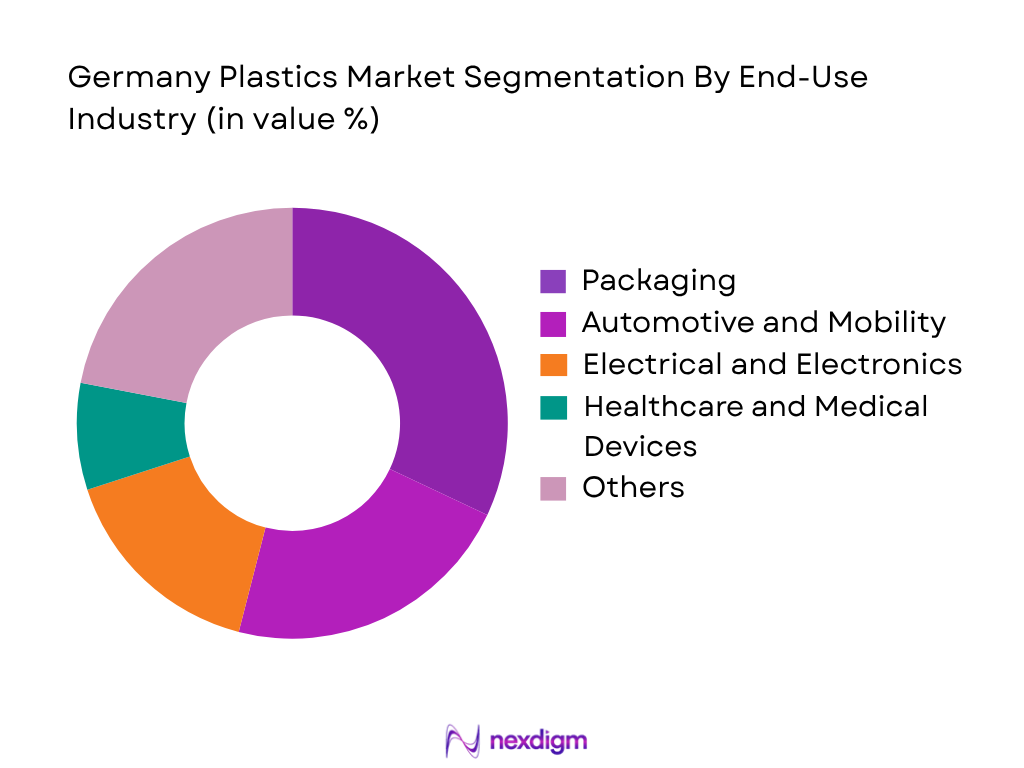
The Germany Plastics Market is segmented into packaging, automotive and mobility, building and construction, electrical and electronics, healthcare, household products, industrial equipment and agriculture. Packaging represents the dominant end-use segment because Germany has a substantial food, beverage, consumer-goods and industrial-packaging infrastructure requiring films, bottles, containers, caps, closures, trays and transport packaging. Germany’s packaging collection system also illustrates the scale of material flows: approximately 8.828 million tonnes of packaging materials were collected or taken back through relevant systems, including around 2.654 million tonnes of lightweight packaging materials. Packaging additionally leads circular-economy investments because converters must increasingly optimize structures for recyclability, lightweighting and recycled content. Demand spans flexible polyethylene films, polypropylene containers, PET bottles, barrier structures and reusable industrial packaging. Germany’s dense modern-retail network, packaged-goods manufacturing base, export industries and sophisticated recycling ecosystem therefore create a stronger and more continuous polymer requirement in packaging than in more cyclical applications such as automotive production or construction activity.
Competitive Landscape
The Germany Plastics Market combines globally integrated polymer producers with highly specialized engineering-plastics manufacturers, compounders and downstream converters. BASF and Covestro have substantial material-production and technology platforms, while Evonik and Röhm maintain strong positions in specialty and high-performance polymers. Röchling represents the downstream engineering-plastics segment with extensive exposure to industrial, automotive and medical applications. Competition is shaped by polymer technology, customer qualification, German production footprint, circular-material capability, technical performance and ability to support automotive, packaging and industrial customers through material substitution and sustainability transitions.
| Company | Establishment Year | Headquarters | Core Plastics Portfolio | Key Processing / Technology Capability | Major End-Use Exposure | German Manufacturing Presence | Circularity Capability | Specialty Material Position |
| BASF SE | 1865 | Ludwigshafen, Germany | ~ | ~ | ~ | ~ | ~ | ~ |
| Covestro AG | 2015 | Leverkusen, Germany | ~ | ~ | ~ | ~ | ~ | ~ |
| Evonik Industries AG | 2007 | Essen, Germany | ~ | ~ | ~ | ~ | ~ | ~ |
| Röhm GmbH | 2019 | Darmstadt, Germany | ~ | ~ | ~ | ~ | ~ | ~ |
| Röchling SE & Co. KG | 1822 | Mannheim, Germany | ~ | ~ | ~ | ~ | ~ | ~ |
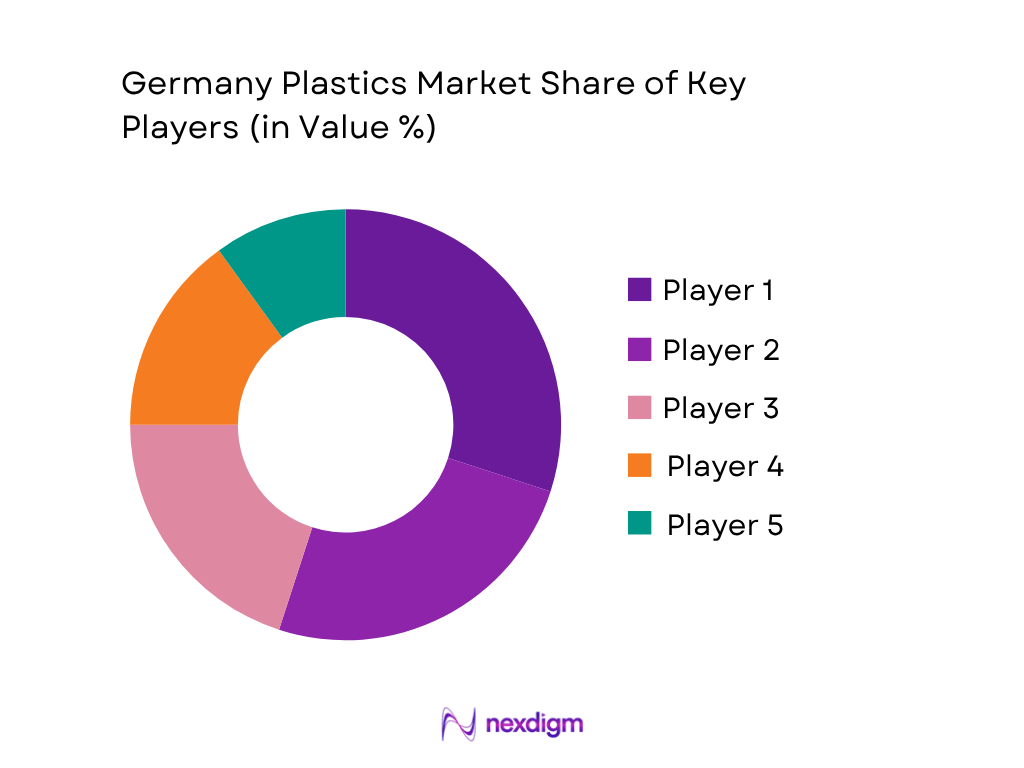
Germany Plastics Market Analysis
Growth Drivers
Strong Automotive and Technical Plastics Demand
Germany’s plastics market is supported by the country’s large automotive and advanced-manufacturing base, where polyamides, polypropylene compounds, polycarbonate, polyurethane, thermoplastic elastomers and reinforced polymers are used in interior parts, structural components, electrical systems, battery assemblies and thermal-management applications. Germany recorded approximately 2.82 million new passenger-car registrations in 2024, maintaining a substantial domestic platform for plastic components and engineering materials. The country’s manufacturing sector employed about 5.5 million people at the end of 2024, including approximately 948,000 employees in mechanical engineering and 326,000 in the chemical industry, strengthening the industrial customer base for technical polymers, compounds and semi-finished plastics. Germany’s GDP stood at approximately USD 4.686 trillion in 2024, GDP per capita reached approximately USD 56,103.7, and population stood at 83,516,593. Although overall automotive production faced pressure, the established OEM and supplier ecosystem continues to generate requirements for lightweight, heat-resistant, flame-retardant and electrically insulating plastics, particularly as vehicle architectures become more electronics-intensive and electrified.
Large Packaging Collection and Plastics Processing Ecosystem
Packaging remains a major structural driver for the Germany Plastics Market because food, beverages, consumer products, industrial logistics and e-commerce require films, bottles, containers, trays, closures and reusable transport packaging. Germany recorded 8.828 million tonnes of packaging materials collected or taken back in 2024, including 2.654 million tonnes of lightweight packaging, a material stream heavily associated with plastic and composite packaging. Separately, 1.152 million tonnes of plastic packaging entered documented disposal routes, of which 636,354 tonnes were delivered to recycling facilities within Germany. These substantial material flows support demand not only for virgin polyethylene, polypropylene and PET but also for increasingly sophisticated recycled-polymer grades. Germany’s population stood at 83,516,593, providing a substantial consumer base, while GDP reached approximately USD 4.686 trillion and GDP per capita approximately USD 56,103.7 in 2024, underpinning packaged-goods consumption and industrial activity. The coexistence of extensive collection infrastructure, sophisticated conversion capabilities and a large consumer economy therefore sustains demand for flexible, rigid, reusable and circular plastic packaging solutions.
Market Challenges
High Energy Exposure Across Polymer and Chemical Production
Energy intensity remains a major challenge for the Germany Plastics Market because polymerization, compounding, extrusion, injection molding and recycling rely heavily on electricity, natural gas and petrochemical feedstocks. German industry consumed approximately 3,343 petajoules of energy in 2024, while energy-intensive industries accounted for around 2,738 petajoules. The chemical industry, which supplies polymer resins, additives and intermediates to plastics converters, remained the country’s largest industrial energy-consuming segment. Germany’s industrial system also used approximately 351 petajoules of energy carriers as raw materials for products including chemicals and plastics. Structural pressure remained evident into 2026, with energy-intensive industrial production continuing below levels recorded during the earlier part of the decade and employment across energy-intensive industries declining by approximately 53,200 workers over the relevant comparison period. These pressures operate within an economy that generated approximately USD 4.686 trillion in GDP in 2024. For German plastics producers, elevated energy exposure influences polymer plant utilization, conversion economics, capacity decisions and competitiveness against materials supplied from manufacturing regions with different feedstock and energy conditions.
Weakness Across Key Plastics-Consuming Industrial Sectors
The Germany Plastics Market faces demand-side pressure because several major plastics-consuming industries experienced weaker production conditions during 2024. Automotive manufacturing, mechanical engineering, electrical equipment and building construction are important consumers of engineering compounds, pipes, insulation materials, cable polymers, vehicle components, profiles and technical molded products. Germany’s mechanical-engineering sector employed approximately 948,000 people at the end of 2024, representing around 55,000 fewer employees than its earlier peak, illustrating the pressure affecting one of the country’s major industrial customer groups. The chemical industry employed approximately 326,000 people, while the broader manufacturing sector accounted for about 5.5 million employees. Germany simultaneously generated approximately USD 4.686 trillion in GDP in 2024, with GDP per capita of approximately USD 56,103.7 and a population of 83,516,593. Nevertheless, contraction across major manufacturing activities can reduce capacity utilization among plastics converters and delay customer investment in automotive, construction and capital-goods applications, creating a challenging operating environment for suppliers heavily exposed to cyclical industrial demand.
Market Opportunities
Expansion of Recycled Plastics and Closed-Loop Material Systems
Germany’s established waste-management infrastructure provides a substantial foundation for future expansion of recycled polyethylene, polypropylene, PET and other secondary polymers. Approximately 1.152 million tonnes of plastic packaging entered documented disposal channels in 2024, with 636,354 tonnes supplied to recycling facilities within Germany and another 126,166 tonnes transferred for recycling elsewhere in the European Union. Germany also collected approximately 2.654 million tonnes of lightweight packaging, providing a substantial feedstock pool for sorting, washing, regranulation and recompounding operations. Across the wider German waste system, approximately 362.719 million tonnes of waste were generated, of which around 249.857 million tonnes were directed toward material recovery. These existing material flows create future opportunities to expand higher-quality post-consumer resins for packaging, automotive, construction and industrial applications. Germany’s population of 83,516,593 and GDP of approximately USD 4.686 trillion in 2024 further underpin substantial material consumption and recoverable waste generation. Future market development can therefore center on advanced sorting, improved polymer separation, consistent recyclate quality, traceability and closed-loop partnerships between recyclers, converters and end users.
Higher-Value Engineering Plastics for Electrification and Advanced Manufacturing
Future opportunities in the Germany Plastics Market are increasingly concentrated in engineering polymers and technically differentiated compounds used by automotive, electronics, electrical equipment and advanced industrial manufacturers. Germany’s industrial base included approximately 326,000 chemical-industry employees, 319,000 employees in computer, electronic and optical equipment manufacturing, and 948,000 mechanical-engineering employees at the end of 2024. These industries require polyamides, polycarbonate, PBT, PMMA, thermoplastic elastomers and reinforced compounds for connectors, housings, sensors, electrical insulation, thermal-management systems, battery-related components and precision industrial parts. Germany also recorded approximately 2.82 million new passenger-car registrations in 2024, maintaining a large domestic platform for increasingly electronics-intensive and electrified vehicle systems. The country generated approximately USD 4.686 trillion in GDP, supported by a population of 83,516,593 and GDP per capita of approximately USD 56,103.7. These industrial fundamentals create future opportunities for flame-retardant grades, lightweight reinforced compounds, recycled engineering plastics and specialized materials designed for electric mobility, electronics and high-performance industrial applications.
Future Outlook
The Germany Plastics Market is forecast to expand at approximately ~XX% CAGR during 2026-2035, with the industry gradually shifting from a predominantly virgin-polymer model toward higher recycled content, circular feedstocks and specialized engineering materials. Automotive electrification, packaging redesign, building renovation and medical applications are expected to create new technical requirements. At the same time, energy efficiency and European petrochemical competitiveness will remain central to future investment decisions.
Circular packaging will be one of the most important development areas. Germany already processes substantial packaging material flows through established collection and recovery systems, creating a feedstock base for mechanical recycling. Increased use of recycled polyethylene, polypropylene and PET will encourage investments in sorting, washing, regranulation and recompounding technologies. Converters capable of supplying consistent technical properties, traceability and food-contact compliant materials will be better positioned as brands redesign packaging around recyclability and recycled-content objectives.
Major Players
- BASF SE
- Covestro AG
- Evonik Industries AG
- Röhm GmbH
- Röchling SE & Co. KG
- ALPLA Germany
- REHAU Industries SE & Co. KG
- Ensinger GmbH
- Pöppelmann GmbH & Co. KG
- Gerresheimer AG
- Wirthwein SE
- Jokey SE
- Interzero
- PreZero
- LyondellBasell Germany
Key Target Audience
- Polymer and Petrochemical Producers
- Plastics Converters and Compounders
- Packaging Manufacturers and Brand Owners
- Automotive OEMs and Tier-1/Tier-2 Component Suppliers
- Plastics Recycling and Circular Material Companies
- Industrial Machinery and Plastics Processing Equipment Manufacturers
- Investments and Venture Capitalist Firms
- Government and Regulatory Bodies (Federal Ministry for the Environment, Climate Action, Nature Conservation and Nuclear Safety, German Environment Agency, Central Agency Packaging Register, Federal Institute for Occupational Safety and Health, Federal Ministry for Economic Affairs and Energy)
Research Methodology
Step 1: Identification of Key Variables
The initial phase involves constructing a detailed ecosystem map of the Germany Plastics Market, covering polymer producers, compounders, converters, packaging manufacturers, automotive suppliers, recyclers, machinery manufacturers and major end-use industries. Desk research is used to identify variables such as polymer production, conversion output, recycled-material availability, end-use consumption, plant capacity, import dependence and regulatory requirements. These variables define the framework for subsequent demand- and supply-side analysis.
Step 2: Market Analysis and Construction
Historical information is consolidated using a combination of top-down and bottom-up market construction. The top-down assessment evaluates polymer production, trade flows, conversion-industry output and major application sectors, while the bottom-up analysis evaluates material consumption across packaging, automotive, construction, electronics, medical and industrial users. Production and consumption flows are reconciled to prevent double counting between resin sales, compounds and finished converted plastic products.
Step 3: Hypothesis Validation and Expert Consultation
Market hypotheses are validated through computer-assisted telephone interviews and structured interactions with polymer producers, converters, distributors, recyclers, machinery suppliers and procurement professionals. These discussions assess resin specifications, capacity utilization, material substitution, recycled-content requirements, supplier qualification and end-use trends. Operational insights are triangulated against company reporting, industry statistics, trade datasets and regulatory documentation to strengthen confidence in segment-level conclusions.
Step 4: Research Synthesis and Final Output
The final phase integrates polymer production, downstream conversion, end-use consumption, competitive positioning, recycling and regulatory developments into a unified market model. Bottom-up findings are cross-checked against industry-level production and trade indicators, while company-level information is used to validate technology capabilities and application exposure. Forecast assumptions incorporate automotive electrification, packaging circularity, building renovation, recycled-polymer adoption, industrial energy conditions and evolving European plastics regulation.

- Executive Summary
- Research Methodology (Market Definition and Scope, Germany Plastics Market Classification, Polymer Production Assessment, Plastic Conversion Capacity Evaluation, Virgin and Recycled Polymer Analysis, Plastic Processing Technology Assessment, End-Use Industry Mapping, Circular Plastics Ecosystem Evaluation, Mechanical Recycling Assessment, Chemical Recycling Assessment, Polymer Trade and Supply Chain Analysis)

- Definition and Scope
- Germany Plastics Industry Evolution and Development of Polymer Manufacturing and Circular Plastics Ecosystem
- Petrochemical Feedstock, Polymer Production, Compounding and Plastic Conversion Structure
- Germany Plastics Market Value Chain Analysis
- Germany Plastics Market Supply Chain Analysis
- Polyethylene, Polypropylene, PVC, PET, Engineering Plastics, Recyclates, Compounds and Masterbatch Ecosystem Analysis
- Plastic Material Integration Assessment Across Packaging, Automotive, Construction, Electrical and Electronics, Healthcare and Industrial Applications

- Growth Drivers (Strong Automotive and Engineering Plastics Demand, Established Packaging Conversion Base, Advanced Plastic Processing Machinery Ecosystem, Expansion of Circular Polymer Adoption, High-Performance Polymer Applications, Building Renovation and Infrastructure Demand)
- Market Challenges (High Industrial Energy Requirements, European Petrochemical Competitiveness Pressure, Polymer Production Rationalization, Automotive Manufacturing Volatility, Recyclate Quality Constraints, Complex Circular Economy Compliance Requirements)
- Market Opportunities (Expansion of High-Quality Recycled Polyolefins, Growth of Food-Grade Recycled Plastics, Development of Chemical Recycling, Increasing Electric Vehicle Engineering Plastic Applications, Expansion of Circular Automotive Components, Growth of Design-for-Recycling Packaging)
- Market Trends (Post-Consumer Recycled Content Integration, Mono-Material Packaging Development, Mass-Balance Circular Polymer Adoption, Automotive Lightweighting, Closed-Loop Plastic Recycling, Advanced Sorting Technology, Energy-Efficient Plastic Processing)
- Regulatory and Standards Landscape (German Packaging Act, EU Packaging and Packaging Waste Regulation, German Circular Economy Act, EU Waste Framework Directive, REACH Compliance, Food-Contact Plastic Regulations, Recycled Content Requirements, End-of-Life Vehicle Regulations)
- SWOT Analysis
- Porter’s Five Forces Analysis
- PESTLE Analysis
- Stakeholder Ecosystem
- Competition Ecosystem

- By Market Value (2020-2025)
- By Plastics Production Volume (2020-2025)
- By Plastics Conversion Volume (2020-2025)
- By Domestic Polymer Consumption Volume (2020-2025)
- By Virgin Plastics Consumption Volume (2020-2025)
- By Recycled Plastics Consumption Volume (2020-2025)
- By Finished Plastic Product Output Volume (2020-2025)

- By Polymer Type (In Value %)
Polyethylene
High-Density Polyethylene
Low-Density Polyethylene
Linear Low-Density Polyethylene
Polypropylene
Polyvinyl Chloride
Polyethylene Terephthalate
Polystyrene
Polyurethane
Polycarbonate
Polyamide
PMMA
Engineering and Specialty Plastics
Recycled Polymers - By End-Use Industry (In Value %)
Packaging
Food and Beverage Packaging
Industrial Packaging
Automotive and Mobility
Building and Construction
Electrical and Electronics
Healthcare and Medical Devices
Household and Consumer Products
Agriculture and Horticulture
Machinery and Industrial Equipment
Renewable Energy Applications
Logistics and Material Handling - By Circularity Type (In Value %)
Fossil-Based Virgin Plastics
Mechanically Recycled Post-Consumer Plastics
Mechanically Recycled Pre-Consumer Plastics
Chemically Recycled Plastics
Mass-Balance Circular Polymers
Bio-Based Plastics
Bio-Attributed Plastics
Closed-Loop Recyclates
Open-Loop Recyclates - By Customer Type (In Value %)
Large Plastic Converters
Packaging Manufacturers
Automotive Tier-1 and Tier-2 Suppliers
Construction Product Manufacturers
Electrical and Electronics Manufacturers
Medical Device Manufacturers
Industrial Component Manufacturers
Compounders and Masterbatch Manufacturers
Brand Owners
Recyclers and Recompounders
Polymer Distributors - By Region (In Value %)
North Rhine-Westphalia
Bavaria
Baden-Württemberg
Lower Saxony
Hesse
Rhineland-Palatinate
Saxony
Saxony-Anhalt
Brandenburg and Berlin
Northern Germany

- Market Share of Major Players (By Revenue, Polymer Production Capacity, Plastic Conversion Capability, Product Category, End-Use Industry, Manufacturing Footprint, Circular Polymer Portfolio, Customer Segment Distribution)
- Cross Comparison Parameters (Polymer and Specialty Material Portfolio Breadth, German Production and Conversion Capacity, Engineering Plastics Technology Capability, Automotive and Packaging Customer Integration, Recycled and Circular Polymer Portfolio, German Manufacturing and Distribution Footprint, Mechanical and Chemical Recycling Capability, Low-Carbon and Bio-Based Material Development)
- SWOT Analysis of Major Players
- Competitive Positioning Matrix
- Product and Technology Portfolio Benchmarking
- Pricing and Polymer Category Benchmarking
- Manufacturing and Processing Technology Assessment
- End-Use Industry and Customer Integration Assessment
- Detailed Profiles of Major Companies
BASF SE
Covestro AG
Evonik Industries AG
Röhm GmbH
Röchling SE & Co. KG
ALPLA Germany
REHAU Industries SE & Co. KG
Ensinger GmbH
Pöppelmann GmbH & Co. KG
Gerresheimer AG
Wirthwein SE
Jokey SE
Interzero
PreZero
LyondellBasell Germany

- Packaging Converter Polymer Procurement Assessment
- Automotive Tier-1 and Tier-2 Supplier Polymer Requirement Analysis
- Construction Plastic Product Manufacturer Assessment
- Electrical and Electronics Material Selection Analysis
- Medical Plastic Manufacturer Requirement Assessment
- Industrial Plastic Component Buyer Analysis
- Brand Owner Packaging Material Assessment
- Recycled Polymer Buyer Qualification Analysis
- Virgin versus Recycled Polymer Procurement Assessment

- By Market Value (2026-2035)
- By Plastics Production Volume (2026-2035)
- By Plastics Conversion Volume (2026-2035)
- By Domestic Polymer Consumption Volume (2026-2035)
- By Virgin Polymer Demand Volume (2026-2035)
- By Recycled Polymer Demand Volume (2026-2035)
- By Circular and Bio-Based Polymer Demand Volume (2026-2035)
- By Engineering Plastics Demand Volume (2026-2035)


 Request a Sample
 Ask for Customization
 Get a Quote
 Enquire Now