

 Download PDF
Market Overview
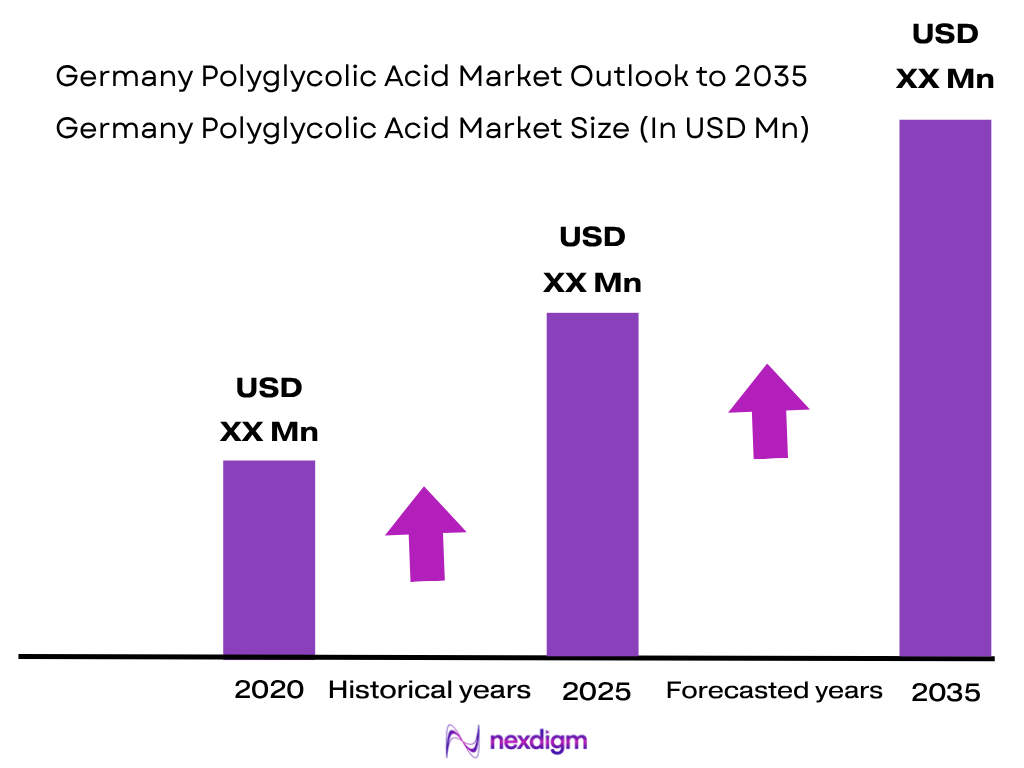
The Germany Polyglycolic Acid Market is valued at approximately USD ~XX million, with demand concentrated in absorbable sutures, resorbable medical components and emerging barrier applications. The supporting German healthcare system recorded EUR 500.27 billion in expenditure in the preceding period and EUR 538.21 billion in the latest period. Hospital expenditure simultaneously increased from EUR 121.06 billion to EUR 131.56 billion, strengthening the application environment for surgical biomaterials such as PGA.
Baden-Württemberg, Bavaria and North Rhine-Westphalia form the dominant German commercial regions for PGA-related medical applications because these states are the country’s largest MedTech locations. Germany recorded 1,508 MedTech manufacturers with more than 20 employees and 212,100 MedTech workers in the latest reporting period. The country also had 1,841 hospitals, 472,851 installed hospital beds and approximately 17.55 million hospital cases, creating a substantial downstream environment for absorbable surgical materials.
Market Segmentation
By Grade Type
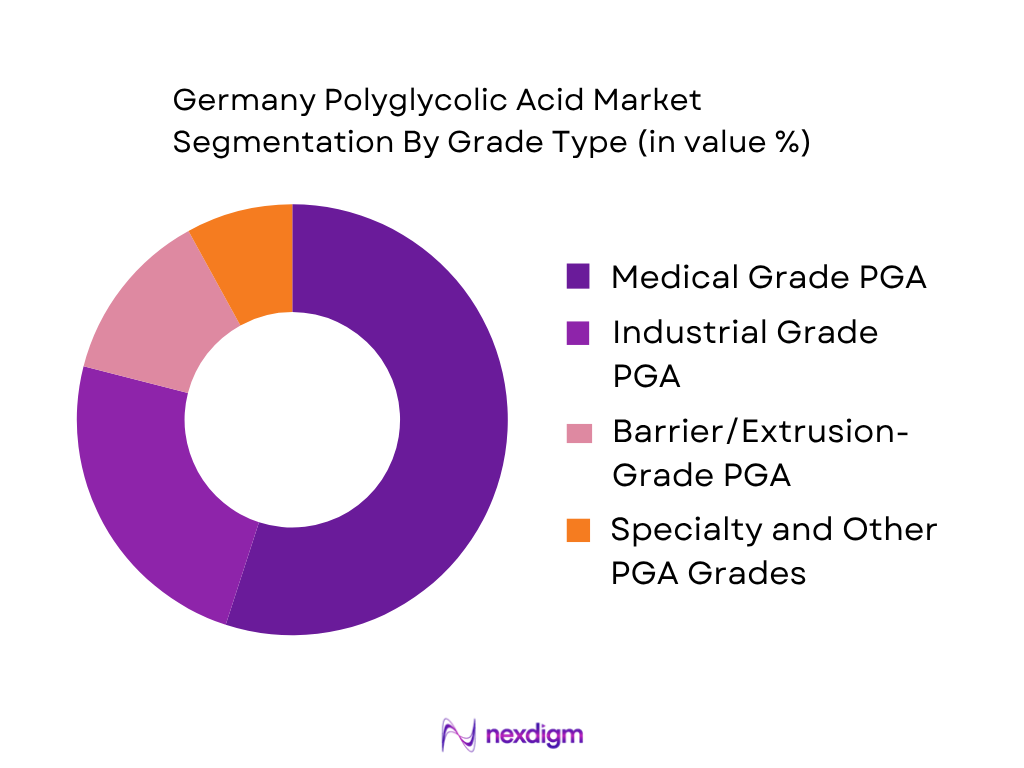
The Germany Polyglycolic Acid Market is segmented by grade into medical-grade PGA, industrial-grade PGA, barrier/extrusion-grade PGA and specialty grades. Medical-grade PGA is considered the dominant segment because Germany has a large medical-device manufacturing and surgical-care ecosystem that provides established commercialization channels for bioresorbable polymers. PGA is commercially used in absorbable sutures; German manufacturer SERAG-WIESSNER, for example, markets a polyglycolic-acid braided multifilament suture for gynecology, pediatric surgery, oral and maxillofacial surgery, plastic surgery and urology. Its PGA product retains at least half of its tensile strength after five days and completes absorption after approximately 42 days. Germany’s medical-device manufacturing base contains more than 1,500 sizeable manufacturers and supports over 210,000 workers. Medical-grade polymer suppliers also offer dedicated polyglycolide grades for implantable and bioresorbable applications, reinforcing the established commercial position of medical-grade PGA relative to less-developed industrial applications.
By Application Type
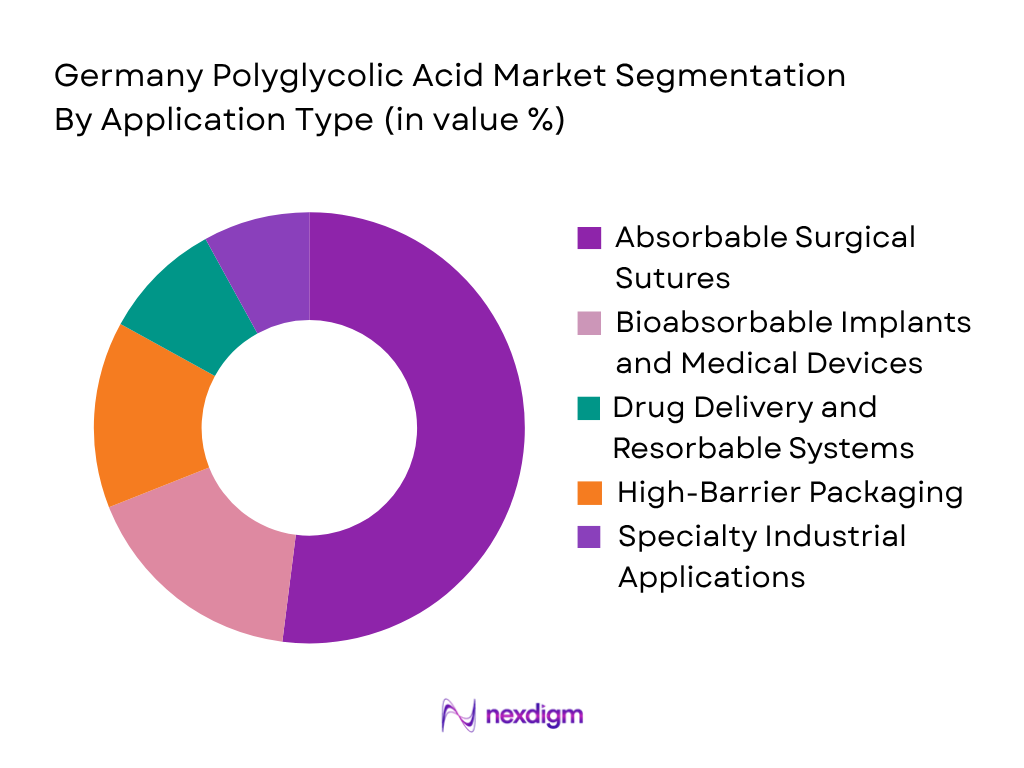
The Germany Polyglycolic Acid Market is segmented by application into absorbable surgical sutures, bioabsorbable implants and devices, drug-delivery systems, high-barrier packaging and specialty industrial uses. Absorbable surgical sutures represent the principal established application because PGA combines tensile strength with predictable hydrolytic absorption and has an existing commercial medical-device pathway. Germany recorded 16,310,526 coded hospital operations in the latest reporting period, while approximately 17.55 million inpatient cases were handled across the hospital system. This large surgical infrastructure provides a substantial addressable application environment for absorbable wound-closure materials. Commercial PGA sutures are already available from German manufacturers, including products covering thread sizes from USP 6/0 to 1 and EP 0.7 to 4. Packaging remains a longer-term diversification route because PGA offers strong gas-barrier characteristics, but its commercial penetration remains less established than its use in absorbable medical products.
Competitive Landscape
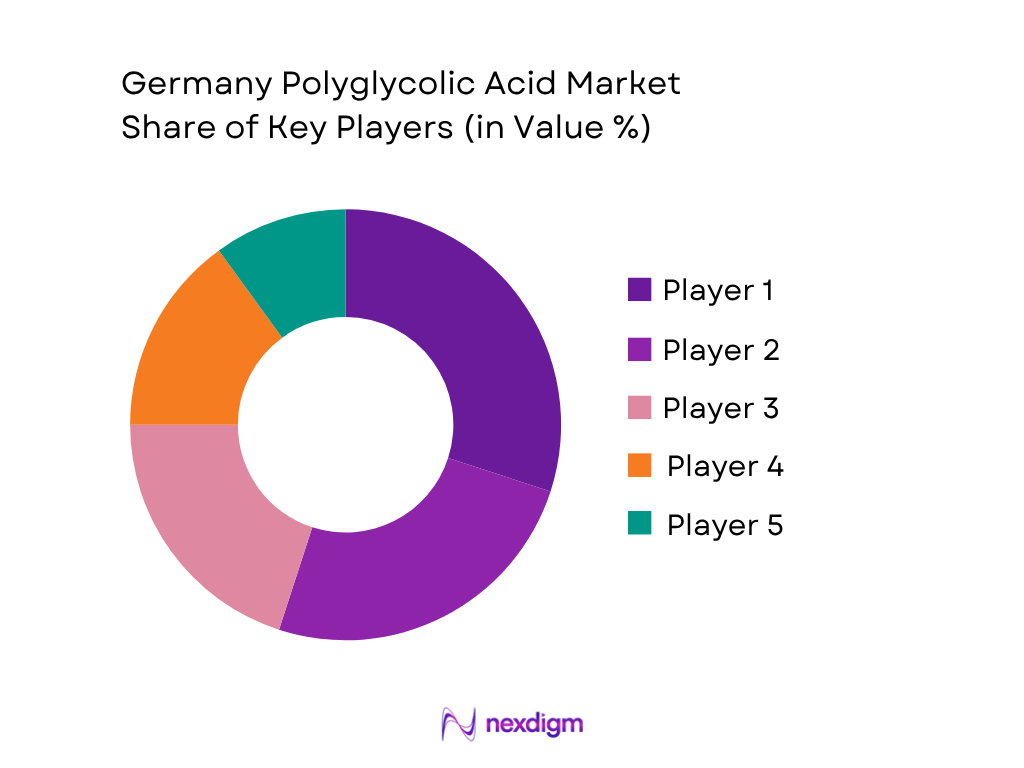
The Germany Polyglycolic Acid Market operates through a specialized international supply chain rather than a broad commodity-polymer structure. Competition spans upstream PGA and bioresorbable-polymer suppliers such as Kureha and Corbion and downstream German medical-device companies such as B. Braun, SERAG-WIESSNER and RESORBA. Competitive positioning depends on medical-grade purity, controlled degradation, polymer molecular characteristics, suture-processing expertise, regulatory documentation and access to German medical-device OEMs. PGA also competes with other resorbable polymers, making application qualification and clinical performance important barriers to entry.
| Company | Establishment Year | Headquarters | Germany-Relevant PGA Position | Primary PGA/Application Focus | Medical-Grade Capability | Processing Capability | Degradation/Performance Focus | Germany/European Market Position |
| Kureha Corporation | 1944 | Tokyo, Japan | ~ | ~ | ~ | ~ | ~ | ~ |
| Corbion N.V. | 1919 | Amsterdam, Netherlands | ~ | ~ | ~ | ~ | ~ | ~ |
| B. Braun SE | 1839 | Melsungen, Germany | ~ | ~ | ~ | ~ | ~ | ~ |
| SERAG-WIESSNER GmbH & Co. KG | 1866 | Naila, Germany | ~ | ~ | ~ | ~ | ~ | ~ |
| RESORBA Medical GmbH | 1931 | Nuremberg, Germany | ~ | ~ | ~ | ~ | ~ | ~ |
Germany Polyglycolic Acid Market Analysis
Growth Drivers
Strong Surgical Procedure Base Supporting PGA Absorbable Suture Demand
Germany’s extensive surgical-care infrastructure creates a strong demand foundation for polyglycolic acid, particularly for absorbable surgical sutures and wound-closure applications. German hospitals recorded 16,310,526 inpatient operations in 2024, including 381,456 intestinal procedures, 251,033 Caesarean-section procedures, 216,374 surgical wound-debridement procedures and 174,338 procedures involving restoration of skin and subcutaneous-tissue continuity. Germany also operated 1,841 hospitals with 472,851 installed beds and 25,956 intensive-care beds, while approximately 17.55 million inpatient cases were handled through the hospital system. These volumes create recurring requirements for wound-closure materials across general surgery, gynecology, urology, pediatric surgery and oral and maxillofacial procedures. PGA is particularly relevant because commercially available German PGA sutures cover sizes from USP 6/0 to USP 1 and EP 0.7 to EP 4, retain at least half of their tensile strength after approximately 5 days, and undergo substantial absorption after around 42 days. The underlying macroeconomic environment also supports sophisticated healthcare procurement. World Bank data recorded Germany’s GDP at approximately USD 4.69 trillion in 2024, with GDP per capita of approximately USD 56,104 and a population of 83.52 million. This combination of millions of surgical procedures, extensive hospital infrastructure and established commercial PGA products directly supports medical-grade PGA demand across resin supply, fiber spinning, suture braiding, coating and finished surgical-device manufacturing.
Strong Medical-Technology Manufacturing Ecosystem Supporting PGA Commercialization
Germany’s highly developed medical-technology manufacturing ecosystem supports PGA commercialization because medical-grade polyglycolide requires specialized polymer processing, sterilization compatibility, quality control, regulatory documentation and controlled degradation performance. Germany had 1,508 medical-technology manufacturers with more than 20 employees in 2024, while approximately 212,100 people were employed across the broader MedTech sector. Larger medical-device manufacturers accounted for approximately 166,000 employees, while around 9,500 smaller medical-technology enterprises operated across the country, creating a substantial network of device developers, contract manufacturers, material specialists and component suppliers. Healthcare-related research expenditure reached EUR 7,488 million, supporting continued development of advanced biomaterials and resorbable medical devices. Commercial biomedical-polymer portfolios already include dedicated polyglycolide with intrinsic viscosity of 1.3–1.9 dl/g, alongside glycolide-containing polymers extending to approximately 3.5 dl/g, illustrating the technical specialization of the material. Germany’s macroeconomic foundation further strengthens this ecosystem, with World Bank data showing approximately USD 4.69 trillion of GDP, USD 56,104 GDP per capita and 83.52 million residents in 2024. For PGA suppliers, this combination of medical-device manufacturers, skilled workers, healthcare R&D and clinical infrastructure provides a strong commercialization platform for absorbable sutures, bioresorbable components, fibers and other temporary implantable products requiring precisely controlled polymer characteristics.
Market Challenges
Complex Medical Device Qualification and Regulatory Requirements
Medical-device regulation represents a significant challenge for Germany’s polyglycolic acid market because PGA’s principal commercial applications include absorbable sutures and resorbable medical devices that require extensive conformity assessment. European regulatory data recorded 28,069 MDR certificate applications and 10,554 MDR certificates issued through October 2024. The regulatory pipeline subsequently reached 32,898 certificate applications and 18,010 issued certificates by February 2026, while Europe had 52 MDR-designated notified bodies in June 2026. PGA-based products require validated biocompatibility, degradation behavior, sterilization compatibility, mechanical performance and manufacturing traceability before commercialization. Current German PGA sutures illustrate these tightly controlled specifications, with commercially available products spanning USP 6/0 to USP 1, maintaining at least half their tensile strength after approximately 5 days and achieving substantial absorption after around 42 days. Any change in molecular weight, coating, filament structure or processing conditions can therefore require additional technical validation. Germany’s macroeconomic scale remains supportive, with World Bank data recording approximately USD 4.69 trillion of GDP, USD 56,104 GDP per capita and 83.52 million people in 2024, but regulatory complexity can still extend commercialization timelines. PGA suppliers seeking entry into Germany must consequently combine polymer-production capability with medical-grade quality systems, validated processing, regulatory documentation and consistent material performance.
Processing Sensitivity and Competition from Alternative Resorbable Polymers
PGA faces a technical challenge because the hydrolytic behavior that enables bioresorption also makes moisture control, storage and thermal processing particularly important. Commercial German PGA sutures can retain at least half their tensile strength after approximately 5 days and substantially absorb after around 42 days, whereas competing absorbable materials can maintain significant mechanical support for 14 days or 28 days and require approximately 90 days or 180–220 days for dissolution. These differences allow medical-device manufacturers to choose alternative polymers according to the required tissue-healing period. Biomedical-material portfolios therefore include PGA alongside PLA, PLGA, PCL, PDO and other resorbable materials. Dedicated medical polyglycolide is commercially available at intrinsic viscosity of approximately 1.3–1.9 dl/g, while glycolide-containing materials extend to approximately 3.5 dl/g, providing developers with multiple degradation and processing options. Germany’s sophisticated customer base increases competitive pressure: the country had 1,508 sizeable medical-technology manufacturers and approximately 212,100 MedTech employees in 2024. World Bank data simultaneously recorded approximately USD 4.69 trillion of GDP and USD 56,104 GDP per capita. PGA suppliers must therefore compete through controlled degradation, consistent molecular properties and application-specific performance while managing resin drying, melt stability, sterilization and moisture-resistant storage throughout the manufacturing chain.
Market Opportunities
Expansion into Resorbable Fixation and Implantable Medical Components
Germany provides an attractive future opportunity for PGA suppliers to move beyond conventional sutures into resorbable fixation systems and temporary implantable components. German hospitals recorded 16,310,526 inpatient operations in 2024, including 242,449 open reductions of multi-fragment fractures, 172,697 closed fracture or epiphyseal reductions involving osteosynthesis, 168,523 open joint operations and 163,240 dynamic spinal-stabilization procedures. These procedures do not represent current PGA consumption, but they demonstrate the scale of Germany’s orthopedic and surgical ecosystem in which bioresorbable materials can be developed and qualified. Germany also recorded 281,086 hip endoprosthesis implantations and 249,248 knee endoprosthesis implantations, supporting an extensive network of orthopedic specialists, hospitals and medical-device manufacturers. Healthcare research expenditure reached EUR 7,488 million, while Germany’s MedTech sector employed approximately 212,100 people across a broad manufacturing ecosystem. World Bank data recorded approximately USD 4.69 trillion of GDP, USD 56,104 GDP per capita and 83.52 million residents in 2024. This current industrial and clinical foundation creates opportunities for PGA-based temporary pins, clips, meshes, anchors and tissue-fixation components where controlled degradation following healing can reduce the requirement for permanent polymer retention or subsequent removal procedures.
High-Barrier Packaging Films and Coatings as an Industrial Diversification Route
High-barrier packaging provides a future diversification opportunity for Germany’s PGA market because the country already has a substantial plastic packaging production and recycling ecosystem. Official statistics recorded 1,151.522 thousand tonnes of plastic lightweight packaging disposed of in 2024, including 636.354 thousand tonnes transferred to recycling within Germany and 126.166 thousand tonnes transferred for recycling elsewhere in the European Union. German plastic packaging and packaging-film production reached approximately 3,850 thousand tonnes, comprising 1,443 thousand tonnes of packaging films, 712 thousand tonnes of containers and related products, 586 thousand tonnes of bottles, 411 thousand tonnes of PET bottles and 375 thousand tonnes of pouches, carrier bags and sacks. These volumes provide an established converter base for evaluating PGA as a specialized oxygen- and carbon-dioxide-barrier layer rather than as a bulk replacement for PE, PP or PET. Germany’s economic base also supports advanced packaging development, with World Bank data recording approximately USD 4.69 trillion of GDP, USD 56,104 GDP per capita and 83.52 million residents in 2024. Future opportunities are therefore concentrated in thin PGA coatings, PET/PGA structures and specialty barrier films capable of improving product protection while maintaining compatibility with Germany’s large packaging-recycling infrastructure.
Future Outlook
The Germany Polyglycolic Acid Market is expected to expand at approximately ~X.X% CAGR during 2026–2035, supported primarily by advanced medical applications rather than commodity-plastic consumption. Germany’s extensive surgical-care infrastructure, medical-device manufacturing base and bioresorbable-material expertise provide a strong commercialization environment for PGA. Medical applications are expected to remain central, particularly absorbable sutures, tissue fixation and specialized implantable components. PGA’s hydrolytic degradation characteristics and mechanical performance make it relevant where temporary structural support is required without permanent polymer retention.
Barrier packaging represents an additional development pathway, although commercial adoption will depend on processing economics, compatibility with existing packaging structures and increasingly strict European recyclability requirements. Medical-grade qualification will remain a stronger near-term competitive moat than general industrial PGA conversion.
Major Players
- Kureha Corporation
- Corbion N.V.
- BMG Co., Ltd.
- Shanghai Pujing Chemical Technology Co., Ltd.
- CHN Energy Yulin Chemical Co., Ltd.
- Shanghai DODGEN Chemical Technology Co., Ltd.
- B. Braun SE / Aesculap
- SERAG-WIESSNER GmbH & Co. KG
- RESORBA Medical GmbH
- TROGE Medical GmbH
- Healthium Medtech Limited
- DemeTECH Corporation
- Johnson & Johnson MedTech / Ethicon
- Alpek Polyester
- Kuraray Europe GmbH
Key Target Audience
- PGA Resin and Glycolide Manufacturers
- Bioresorbable Medical Polymer Manufacturers
- Surgical Suture and Wound-Closure Manufacturers
- Medical Device and Bioabsorbable Implant Manufacturers
- High-Barrier Packaging Manufacturers and Converters
- Specialty Polymer Distributors and Medical Material Suppliers
- Investments and Venture Capitalist Firms
- Government and Regulatory Bodies (Federal Institute for Drugs and Medical Devices – BfArM, Federal Ministry of Health – BMG, Federal Environment Agency – UBA, Federal Institute for Risk Assessment – BfR)
Research Methodology
Step 1: Identification of Key Variables
The initial phase involves constructing an ecosystem map covering PGA resin producers, glycolide suppliers, biomedical-polymer companies, German suture manufacturers, implantable-device manufacturers and barrier-packaging developers. Critical variables include medical-grade purity, resin availability, molecular characteristics, degradation profile, application qualification and downstream processing. Secondary research is used to establish Germany-specific healthcare, surgical, medical-device and packaging indicators.
Step 2: Market Analysis and Construction
Historical Germany Polyglycolic Acid Market demand is constructed using both top-down and bottom-up approaches. The top-down framework evaluates the German medical-device, surgical and specialty-polymer ecosystem, while the bottom-up framework assesses PGA consumption across sutures, bioresorbable devices, drug-delivery systems and barrier applications. Supplier portfolios, product availability and application-level polymer intensity are reconciled to prevent double counting.
Step 3: Hypothesis Validation and Expert Consultation
Market hypotheses are validated through computer-assisted telephone interviews with biomedical-polymer suppliers, medical-device manufacturers, surgical-suture producers, specialty distributors and packaging developers. Interviews focus on PGA qualification requirements, grade preferences, procurement structures, degradation specifications and substitution by PLA, PLGA, PDO and other resorbable polymers. Primary responses are triangulated against published company portfolios and German healthcare and medical-device statistics.
Step 4: Research Synthesis and Final Output
The final stage combines supplier-side and application-side findings to establish a validated Germany Polyglycolic Acid Market framework. Medical PGA consumption is reconciled against surgical applications and manufacturer activity, while industrial PGA demand is assessed through barrier packaging and specialty applications. Forecast scenarios incorporate medical-device innovation, regulatory qualification, material substitution, imported PGA availability and downstream processing capability to develop the long-term market outlook.

- Executive Summary
- Research Methodology (Market Definition and Scope, Germany Polyglycolic Acid Market Classification, Medical-Grade and Industrial-Grade PGA Assessment, Glycolide and Glycolic Acid Feedstock Mapping, PGA Polymerization Technology Evaluation, Medical Biomaterial Application Assessment, Absorbable Suture Application Mapping, High-Barrier Packaging Application Evaluation, PGA Import and Distribution Ecosystem Analysis, PGA Processing and Conversion Technology Assessment)

- Definition and Scope
- Germany Polyglycolic Acid Industry Evolution and Development of Resorbable Biomaterials and High-Barrier Polymer Ecosystem
- PGA Resin Production, Import, Distribution, Processing and Application Structure
- Germany Polyglycolic Acid Value Chain Analysis
- Germany Polyglycolic Acid Supply Chain Analysis
- Glycolic Acid, Glycolide, PGA Resin, Medical-Grade Polymer, Absorbable Suture and Barrier Packaging Ecosystem Analysis
- PGA Material Integration Assessment Across Medical Devices, Surgical Sutures, Pharmaceutical Applications and High-Barrier Packaging

- Growth Drivers (Expansion of Germany Medical Technology Manufacturing Base, Increasing Adoption of Absorbable Surgical Sutures, Growth of Resorbable Biomaterial Applications, Demand for High-Strength Biodegradable Polymers, Development of High-Gas-Barrier Packaging, Increasing Medical Polymer Innovation)
- Market Challenges (Limited Global PGA Production Base, Dependence on Imported PGA Resin, High Moisture Sensitivity During Processing, Hydrolytic Degradation During Storage, Medical-Grade Qualification Complexity, Competition from PLA and PLGA, Limited Packaging Converter Familiarity)
- Market Opportunities (High-Purity Medical PGA Development, Bioabsorbable Implant Applications, Advanced Wound-Closure Products, High-Barrier Mono-Material Packaging, PET Barrier Enhancement, Specialty PGA Coatings, Controlled-Degradation Components, Medical Polymer Compounding)
- Market Trends (Medical-Grade PGA Specialization, Resorbable Medical Device Development, High-Barrier Polymer Innovation, PGA/PET Multilayer Development, Controlled Hydrolysis Engineering, Medical Polymer Traceability, Lightweight Barrier Structures)
- Regulatory and Standards Landscape (EU Medical Device Regulation, German Medical Device Implementation Framework, ISO 10993 Biocompatibility Requirements, REACH Compliance, EU Packaging and Packaging Waste Regulation, Food-Contact Material Requirements, German Packaging Compliance Framework)
- SWOT Analysis
- Porter’s Five Forces Analysis
- PESTLE Analysis
- Stakeholder Ecosystem
- Competition Ecosystem

- By Market Value (2020-2025)
- By PGA Consumption Volume (2020-2025)
- By Medical-Grade PGA Consumption Volume (2020-2025)
- By Industrial-Grade PGA Consumption Volume (2020-2025)
- By Absorbable Suture PGA Consumption Volume (2020-2025)
- By High-Barrier Packaging PGA Consumption Volume (2020-2025)
- By Imported PGA Resin Volume (2020-2025)

- By Grade Type (In Value %)
Medical-Grade PGA
High-Purity Implantable PGA
Suture-Grade PGA
Industrial-Grade PGA
Extrusion-Grade PGA
Injection-Moulding-Grade PGA
Fiber-Spinning-Grade PGA
Barrier-Coating-Grade PGA - By Application Type (In Value %)
Absorbable Surgical Sutures
General Surgery Sutures
Dental and Oral Surgery Sutures
Orthopedic and Tissue-Fixation Devices
Bioabsorbable Medical Implants
Drug-Delivery and Resorbable Medical Systems
High-Barrier Packaging Films
PET/PGA Multilayer Packaging
Specialty Fibers and Filaments
Controlled-Degradation Industrial Components - By End-Use Industry (In Value %)
Medical Device Manufacturing
Hospitals and Surgical Care
Orthopedic and Dental Devices
Pharmaceutical and Drug Delivery
Food Packaging
Beverage Packaging
Specialty Polymer Processing
Industrial Applications - By Physical Form (In Value %)
PGA Resin Pellets
High-Purity Polymer Granules
Multifilament Fibers
Braided PGA Sutures
Monofilaments
Barrier Films
Barrier Coatings
Extruded PGA Components - By Region (In Value %)
North Rhine-Westphalia
Bavaria
Baden-Württemberg
Hesse
Lower Saxony
Northern Germany
Eastern Germany

- Market Share of Major Players (By Revenue, PGA Grade Type, Medical Application Segment, Industrial Application Segment, Absorbable Suture Presence, Barrier Packaging Application, Germany Distribution Presence, Customer Segment Distribution)
- Cross Comparison Parameters (PGA Production and Supply Capability, Medical-Grade Polymer Purity, Molecular Weight and Grade Portfolio, Hydrolysis and Degradation Control Capability, Gas-Barrier Performance Capability, Germany Medical Device Customer Reach, Packaging Application Development Capability, EU Regulatory and Technical Support Readiness)
- SWOT Analysis of Major Players g
- Pricing and Grade Category Benchmarking
- Detailed Profiles of Major Companies
Kureha Corporation – Kuredux PGA Resin, High-Strength and High-Barrier Industrial PGA
Corbion N.V. – PURASORB Medical-Grade Polyglycolide and Resorbable Biomaterials
BMG Co., Ltd. – Medical-Grade Polyglycolide and Bioabsorbable Polymer Materials
Shanghai Pujing Chemical Technology Co., Ltd. – Medical, Industrial and Degradable PGA Materials
CHN Energy Yulin Chemical Co., Ltd. – Large-Scale PGA and Glycolic-Acid-Chain Production
Shanghai DODGEN Chemical Technology Co., Ltd. – PGA Process Technology and Industrial PGA Materials
B. Braun SE / Aesculap – Safil Pure PGA Absorbable Surgical Sutures
SERAG-WIESSNER GmbH & Co. KG – SERAPID PGA Absorbable Surgical Sutures
RESORBA Medical GmbH – PGA RESORBA and PGA RESOQUICK Surgical Sutures
TROGE Medical GmbH – TRO-PGA and TRO-PGA Rapid Absorbable Surgical Sutures
Healthium Medtech Limited – PGA-Based Absorbable Surgical Suture Solutions
DemeTECH Corporation – PGA Surgical Sutures and Wound-Closure Products
Johnson & Johnson MedTech / Ethicon – Glycolide-Based Absorbable Wound-Closure Solutions
Alpek Polyester – PGA-Enabled PET High-Barrier Packaging Development
Kuraray Europe GmbH – High-Barrier Polymer Materials and Sustainable Packaging Solutions

- Medical Device Manufacturer PGA Adoption Assessment
- Absorbable Suture Manufacturer Material Requirements Analysis
- Hospital and Surgical Application Assessment
- Orthopedic and Dental Device Manufacturer Analysis
- Pharmaceutical and Drug-Delivery Application Assessment
- Food and Beverage Packaging Converter Analysis
- Medical Polymer Distributor Ecosystem Assessment
- High-Barrier Packaging Developer Assessment
- PGA Material Attribute Preference Analysis

- By Market Value (2026-2035)
- By PGA Consumption Volume (2026-2035)
- By Medical-Grade PGA Consumption Volume (2026-2035)
- By Industrial-Grade PGA Consumption Volume (2026-2035)
- By Absorbable Suture PGA Consumption Volume (2026-2035)
- By High-Barrier Packaging PGA Consumption Volume (2026-2035)
- By Imported PGA Resin Volume (2026-2035)


 Request a Sample
 Ask for Customization
 Get a Quote
 Enquire Now