
 Download PDF
Market Overview
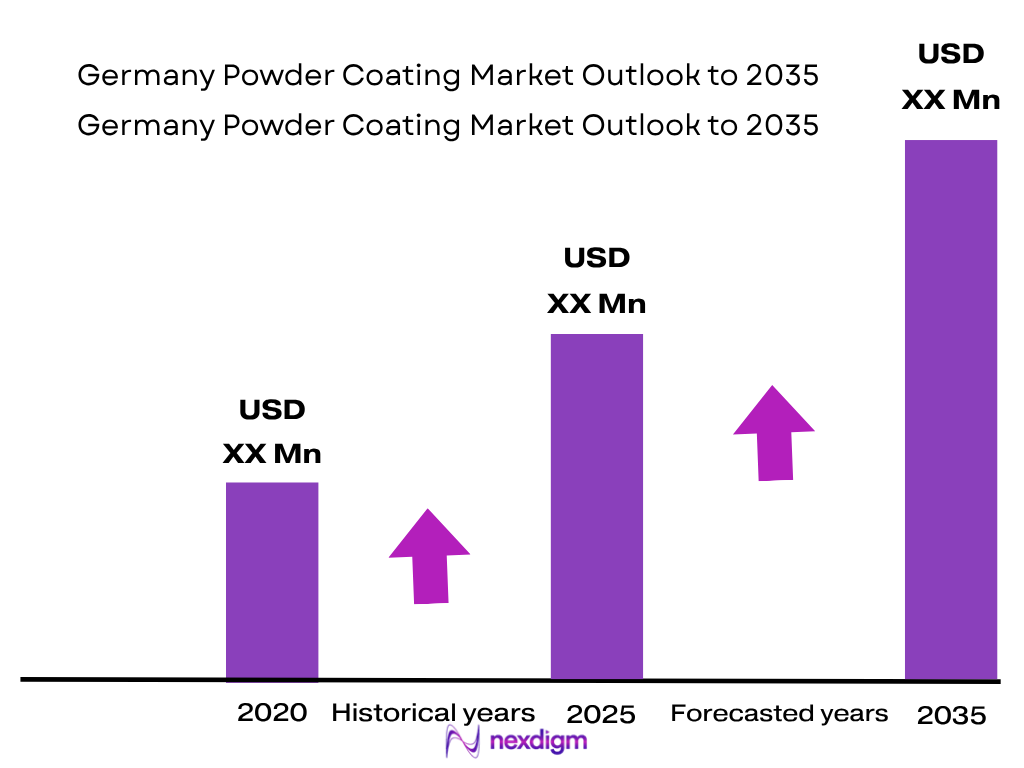
The Germany Powder Coating Market is represented at USD ~million, supported by automotive components, architectural aluminium, machinery, metal products and electrical equipment. Across the two latest required annual observations, German prepared powder-coating production moved from 61,373 tonnes worth €393.278 million to 57,327 tonnes worth €353.205 million. The decline reflects weaker industrial activity rather than structural technology displacement, while solvent-free application, powder recovery, corrosion protection and lower-energy curing continue supporting adoption.
Stuttgart and wider Baden-Württemberg, Munich and Bavaria, and the Rhine-Ruhr industrial belt remain major powder-coating demand centres because they concentrate automotive production, machinery, metalworking, component suppliers and industrial coating operations. Germany produced about 4.1 million passenger cars in each of the two latest required annual observations, creating a substantial finishing requirement for wheels, chassis parts, metal components and supplier assemblies. National industrial-coatings sales additionally reached 358,000 tonnes worth €2.6 billion in the latest observation.
Market Segmentation
By Resin Chemistry
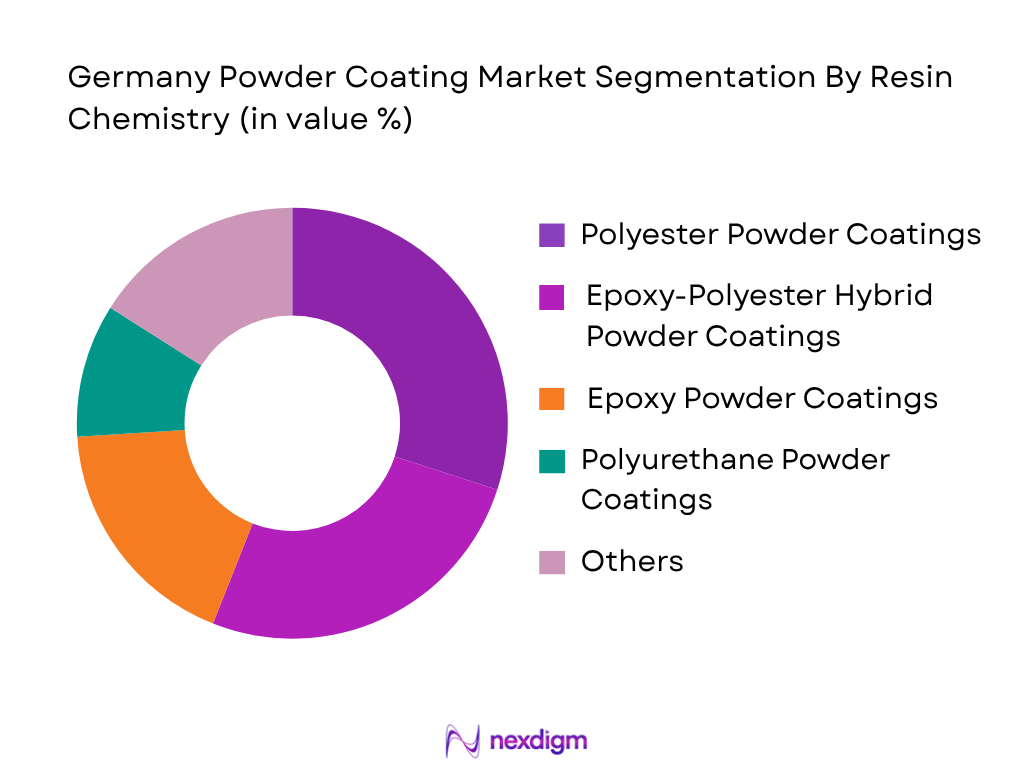
The Germany Powder Coating Market is segmented by resin chemistry into polyester, epoxy-polyester hybrid, epoxy, polyurethane, acrylic, and thermoplastic and other specialty powder coatings. Polyester powder coatings dominate the resin segment, particularly because Germany has significant architectural aluminium, transportation, machinery and outdoor metal-product demand. Polyester systems provide an attractive combination of weatherability, UV stability, mechanical performance, colour retention and cost efficiency. Super-durable and TGIC-free polyester systems are also increasingly relevant for façades, windows, doors, railings and exterior fabricated products. Germany’s strong qualification-driven architectural finishing industry further supports polyester consumption, with GSB and QUALICOAT requirements influencing product selection. Grand View Research independently identifies polyester as Germany’s largest revenue-generating powder-coating resin category. Epoxy-polyester hybrids remain important for indoor industrial products because they combine epoxy chemical performance with polyester appearance and application economics.
By End-Use Industry
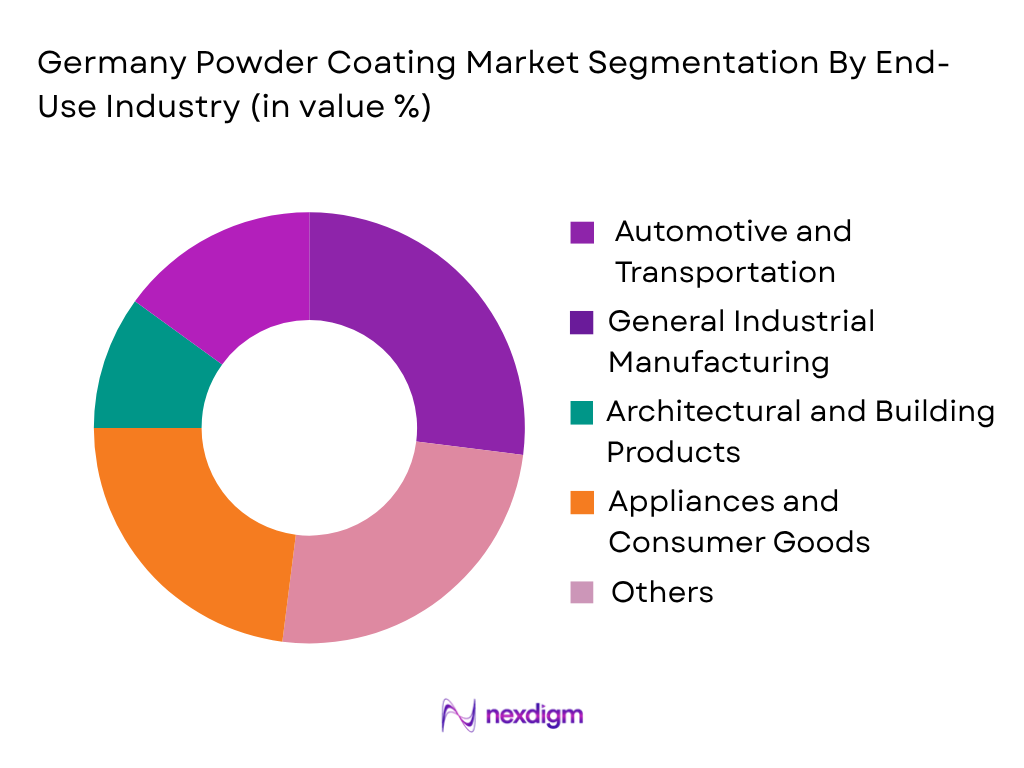
The Germany Powder Coating Market is segmented by end-use industry into automotive and transportation, architectural and building products, general industrial manufacturing, appliances and consumer goods, furniture, and other industrial applications. Automotive and transportation represents the leading individual demand segment, supported by Germany’s position as Europe’s largest passenger-car production base and its extensive network of OEMs, Tier-1 suppliers, wheel producers, chassis-component manufacturers and commercial-vehicle suppliers. Powder coatings are applied to wheels, suspension parts, seat structures, underbody components, springs, brackets, battery-related assemblies and numerous fabricated components requiring corrosion resistance and repeatable automated finishing. Germany produced about 4.1 million passenger cars in both of the latest two relevant annual periods. VdL further reports that automotive-supplier/transport applications combined with building applications account for around half of German powder-coating demand, underlining their central role in market consumption.
Competitive Landscape
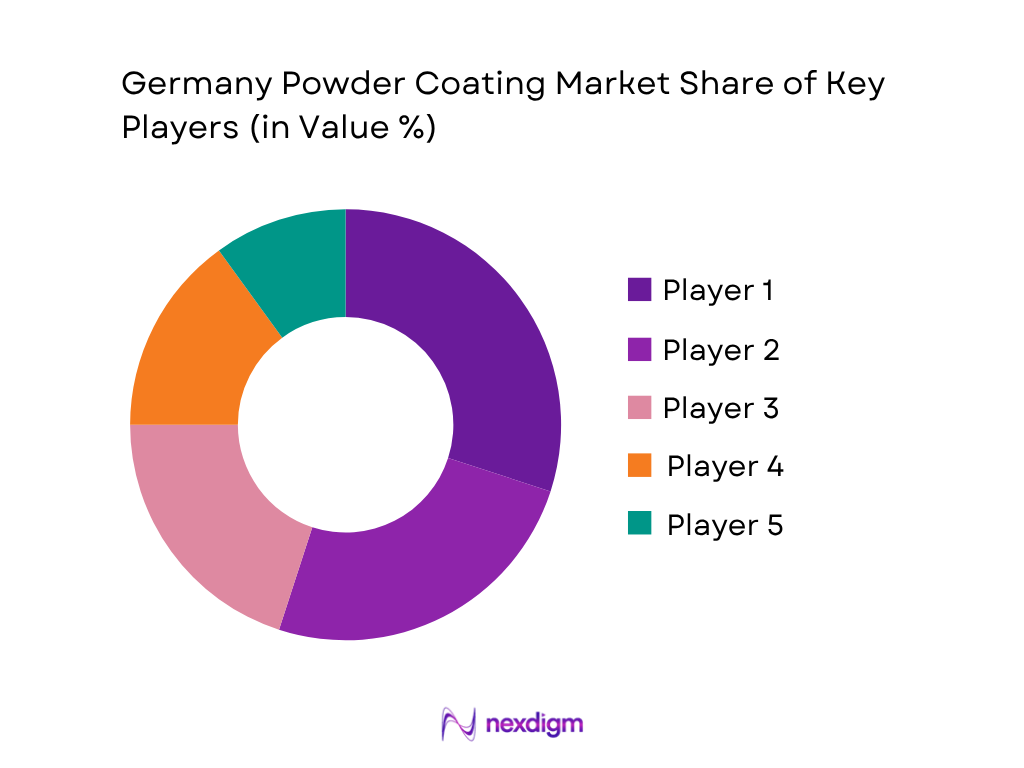
The Germany Powder Coating Market has a combination of global coatings groups and specialised European and German powder manufacturers. AkzoNobel, Axalta, TIGER Coatings, FreiLacke and PPG/Wörwag hold particularly strong strategic positions through established customer relationships, broad resin portfolios, architectural and industrial qualifications, technical service and customised colour capabilities. Competition increasingly extends beyond powder price toward cost per coated square metre, curing energy, application efficiency, overspray recovery, durability, OEM approvals, corrosion protection and technical support.
| Company | Establishment Year | Headquarters | Key Powder Brand / Portfolio | Germany Presence | Major End Uses | Low-Cure / Advanced Technology | Architectural / Industrial Capability | Sustainability & Technical Position |
| AkzoNobel | 1792 heritage | Amsterdam, Netherlands | ~ | ~ | ~ | ~ | ~ | ~ |
| Axalta Coating Systems | 1866 heritage | Philadelphia, USA | ~ | ~ | ~ | ~ | ~ | ~ |
| TIGER Coatings | 1930 | Wels, Austria | ~ | ~ | ~ | ~ | ~ | ~ |
| FreiLacke | 1926 | Bräunlingen-Döggingen, Germany | ~ | ~ | ~ | ~ | ~ | ~ |
| PPG / Wörwag | 1883 / Wörwag 1918 | Pittsburgh, USA / Stuttgart legacy | ~ | ~ | ~ | ~ | ~ | ~ |
Germany Powder Coating Market Analysis
Growth Drivers
Automotive and Transportation Manufacturing Base
Germany’s automotive and transportation manufacturing ecosystem is a core demand driver for powder coatings because large volumes of wheels, suspension parts, seat structures, brackets, chassis components, battery housings, commercial-vehicle components and fabricated metal assemblies require durable factory-applied finishes. German plants produced 4,069,222 passenger cars in 2024, while domestic production reached 4,148,836 vehicles in 2025, demonstrating the continuing scale of the country’s automotive manufacturing platform. Within the 2024 production base, German factories manufactured 1,797,852 SUVs and off-road vehicles, 908,075 compact vehicles, 470,715 medium-class cars, 469,575 upper-medium-class vehicles and 163,465 luxury vehicles, creating a broad component-finishing requirement extending beyond vehicle body coatings. Export intensity strengthens this industrial ecosystem: Germany shipped approximately 3.4 million newly manufactured passenger cars abroad in 2024, including 881,000 battery-electric cars, while total exports of motor vehicles and automotive components reached €262.8 billion. These volumes matter for powder-coating suppliers because automotive component finishing is highly specification-driven and requires corrosion resistance, abrasion resistance, consistent film build, automated application compatibility and repeatable curing performance. The broader macroeconomic foundation is also substantial. World Bank data place German GDP at approximately US$4.69 trillion in 2024, while German manufacturing generated approximately US$829.96 billion of value added, demonstrating the unusually large industrial base within which surface-treatment technologies operate. Destatis additionally recorded 209,815 manufacturing legal units and 7,471,915 employees in German manufacturing during 2024, indicating a deep network of OEMs, Tier suppliers and metal-component manufacturers that can consume powder coatings either directly or through job coaters.
Large Industrial, Machinery and Metal-Processing Ecosystem
Germany’s broad manufacturing and engineering base provides powder-coating demand well beyond automotive applications, particularly across machinery, electrical cabinets, industrial equipment, fabricated steel products, storage systems, material-handling equipment, HVAC housings and metal furniture. The German Federal Statistical Office recorded 209,815 manufacturing legal units in 2024, employing 7,471,915 people and generating approximately €2.557 trillion in manufacturing turnover. This extensive industrial network creates a large installed base of captive coating lines and independent job coaters that finish steel, galvanized steel and aluminium components. Germany’s machinery industry is especially relevant because machinery exports reached approximately €217.4 billion in 2024, making machinery the country’s second-largest merchandise export category after vehicles and automotive components. Electrical and electronic manufacturing provides another sizeable application pool: Germany imported approximately €104.0 billion of electrical equipment and €134.3 billion of data-processing, electrical and optical products during 2024, reflecting the scale of equipment circulating through industrial supply chains. Powder coatings are particularly suitable for control cabinets, switchgear housings, server and telecom enclosures, pumps, compressors, machine frames, shelving, industrial doors and fabricated assemblies because automated electrostatic application can provide durable finishes with recoverable overspray. The macroeconomic scale reinforces this addressable industrial demand. World Bank data show approximately US$829.96 billion in German manufacturing value added in 2024, within a national economy of roughly US$4.69 trillion.
Market Challenges
Weakness in Industrial and Construction Activity
The principal near-term challenge for Germany’s powder-coating industry is weak activity across several powder-intensive manufacturing and construction sectors. German industrial production entered 2024 under substantial pressure, and the Federal Statistical Office reported particularly weak conditions in machinery, automotive manufacturing and construction. The impact is visible in physical demand indicators rather than only sentiment measures. Germany issued permits for 215,900 dwellings in 2024, representing 43,700 fewer approvals than in the preceding period and the lowest absolute number since 2010. New multifamily-building approvals accounted for 114,200 dwellings, while the approved enclosed volume of non-residential buildings—covering factories, warehouses, offices and agricultural buildings—fell to 193.0 million cubic metres. This is important for powder coatings because construction weakness directly reduces the project pipeline for coated aluminium window profiles, façade systems, doors, railings, steel structures, warehouse components, HVAC equipment and architectural hardware. Industrial weakness simultaneously affects machinery frames, fabricated metal components and job-coating throughput. Germany nevertheless remains a very large industrial economy: World Bank data record US$4.69 trillion of GDP and approximately US$829.96 billion of manufacturing value added in 2024, while Destatis records 7,471,915 manufacturing employees. The challenge is therefore not absence of an industrial base but insufficient utilization of that base. IMF analysis published in 2026 described Germany as having experienced several years of negative or very low growth following energy-price shocks, tighter financial conditions and increasing competition in export markets.
Energy-Intensive Curing and Pressure on German Manufacturing Competitiveness
Powder coating eliminates conventional solvent use and enables overspray recovery, but the technology generally requires ovens to heat coated components sufficiently for crosslinking, making energy availability and industrial competitiveness important operating considerations for German applicators. Germany’s electricity system generated and fed approximately 431.5 billion kilowatt-hours into the grid in 2024. Of this amount, around 256.4 billion kilowatt-hours came from renewable sources and approximately 175.1 billion kilowatt-hours from conventional sources. Industrial coating lines are exposed not only to electricity requirements for booths, compressors, ventilation and material handling, but also to thermal-energy requirements associated with pretreatment drying and curing ovens. These requirements are significant for high-mass steel components because the substrate itself must reach the specified metal temperature before curing can be completed. The competitive pressure becomes more material when viewed against Germany’s industrial scale: Destatis recorded approximately €2.557 trillion of manufacturing turnover, 209,815 manufacturing legal units and 7,471,915 manufacturing employees in 2024, while World Bank data place manufacturing value added at approximately US$829.96 billion. Germany therefore has a very large installed manufacturing system whose coating economics can be affected by energy and utilization conditions. The IMF’s 2026 assessment of Germany specifically identifies the earlier energy-price shock and weak underlying productivity as structural constraints affecting the broader economy, making energy-efficient manufacturing investment especially relevant.
Market Opportunities
Renewable Energy, Grid Equipment and Energy Infrastructure Coatings
Germany’s continuing build-out of renewable-generation and associated electrical infrastructure creates a significant future opportunity for powder coatings used on fabricated metal structures, electrical cabinets, inverter housings, mounting systems, battery-storage enclosures and corrosion-exposed equipment. The opportunity is supported by an already substantial physical asset base rather than speculative future projections. Germany ended 2024 with approximately 190 GW of installed renewable-electricity capacity. Solar installations alone added 16.2 GW during 2024, taking total installed solar capacity to 99.3 GW. Approximately 435,000 new plug-in balcony photovoltaic systems were registered during the same period, accounting for roughly 0.4 GW of capacity. Onshore wind capacity reached 63.5 GW, while offshore wind capacity reached approximately 9.2 GW following the commissioning of 73 additional offshore turbines during 2024. A large battery-storage facility with 174 MW of capacity also entered operation in Hamm. Each element of this energy infrastructure creates downstream requirements for coated steel and aluminium components, including outdoor cabinets, frames, mounting structures, fencing, electrical housings, ancillary equipment and corrosion-protection systems. Powder coatings are particularly relevant where manufacturers require repeatable factory finishing, high material utilization, durable exterior performance and resistance to moisture, UV exposure and mechanical damage. The macroeconomic capacity supporting such industrial investment remains substantial: the World Bank records German GDP at approximately US$4.69 trillion in 2024, while manufacturing value added reached around US$829.96 billion.
Heat Pumps, HVAC, Electrical Equipment and Building-Energy Modernization
Germany’s transition toward electrified building systems creates an opportunity for powder coatings across heat-pump cabinets, HVAC housings, radiators, ventilation units, control cabinets, switchgear and related fabricated metal equipment. The opportunity is supported by significant existing equipment and building activity. The German Federal Statistical Office reported that approximately 76,100 residential buildings were completed in 2024, with heat pumps increasingly specified as the principal heating technology in new construction. German manufacturers produced approximately 162,400 heat pumps during 2024, showing that even after a sharp cyclical correction the domestic manufacturing base remained substantial. This equipment requires coated sheet-metal housings and components capable of handling outdoor exposure, condensation, scratches during installation, temperature variation and extended product lifetimes. The opportunity also extends to the electrical infrastructure required to operate increasingly electrified buildings. Germany’s business register recorded 74,485 legal units in electricity, gas, steam and air-conditioning supply and 11,366 legal units in water, sewerage, waste-management and remediation activities during 2024, indicating a large infrastructure and service ecosystem. Construction itself comprised 388,229 legal units and 2,255,825 employees, reinforcing the scale of potential downstream installation channels for coated equipment. World Bank macroeconomic data place Germany’s economy at approximately US$4.69 trillion in 2024, with a population of 83,516,593, providing a large installed building and household base requiring heating, cooling and electrical infrastructure. The opportunity for powder-coating suppliers is therefore broader than new residential construction alone. Replacement HVAC equipment, heat-pump modernization, electrical distribution systems, energy-management cabinets, commercial-building equipment and industrial HVAC installations can all require coated metal housings.
Future Outlook
The Germany Powder Coating Market is expected to move from cyclical weakness toward technology-led growth over the long term, with a projected ~6.0% CAGR during 2026–2035 for report-modelling purposes. Growth is expected to be concentrated in high-performance rather than commodity formulations. Low-temperature curing, energy-efficient powder lines, EV components, electrical infrastructure, super-durable architectural coatings, corrosion-resistant systems and functional powders are likely to shape supplier investment.
Energy efficiency will become one of the most important competitive variables. Conventional powder coating requires thermal curing, which is material to operating costs for German applicators facing high industrial energy expenses. Technologies that reduce metal temperature, shorten oven dwell time or increase line speed therefore offer both sustainability and productivity benefits. AkzoNobel’s Low-E systems demonstrate the direction of product development, with certain architectural powders curing at 150°C and providing reduced energy consumption compared with traditional systems.
Major Players
- Akzo Nobel Powder Coatings GmbH – Interpon
- Axalta Coating Systems Germany GmbH & Co. KG – Alesta / Teodur
- TIGER Coatings GmbH & Co. KG
- Emil Frei GmbH & Co. KG – FreiLacke
- CWS Powder Coatings GmbH
- PPG Wörwag Coatings GmbH & Co. KG
- The Sherwin-Williams Company – Inver
- KANSAI HELIOS Germany GmbH
- Ganzlin Beschichtungspulver GmbH
- Bubenhofer AG Farbenfabrik
- IGP Pulvertechnik AG
- Brillux GmbH & Co. KG Industrielack
- Teknos Group
- Jotun
- Protech Group / Oxyplast
Key Target Audience
- Powder Coating Manufacturers
- Automotive OEMs and Tier-1 Component Manufacturers
- Architectural Aluminium Extruders, Fabricators and Job Coaters
- Industrial Machinery, Electrical Equipment and Metal Product Manufacturers
- Resin, Pigment, Additive and Surface Pretreatment Suppliers
- Powder Application Equipment, Booth, Recovery System and Cure-Oven Manufacturers
- Investments and Venture Capitalist Firms
- Government and Regulatory Bodies (German Federal Environment Agency – UBA, Federal Institute for Occupational Safety and Health – BAuA, Federal Ministry for the Environment, Climate Action, Nature Conservation and Nuclear Safety – BMUKN, European Chemicals Agency – ECHA)
Research Methodology
Step 1: Identification of Key Variables
The initial research phase involves constructing the complete Germany Powder Coating Market ecosystem, covering resin producers, pigment and additive suppliers, powder formulators, distributors, application-equipment providers, job coaters and industrial OEMs. Secondary research is conducted using VdL publications, Destatis classifications, company disclosures, certification bodies and industry databases. Key variables include production volume, domestic consumption, import penetration, resin mix, end-use demand and average selling price.
Step 2: Market Analysis and Construction
Historical powder-coating production, value, trade flows and industrial end-use indicators are compiled and reconciled. The bottom-up model assesses individual manufacturer sales, German manufacturing footprints, distributor throughput and major applicator consumption, while the top-down model evaluates Germany’s industrial-coatings market, powder penetration and end-use manufacturing activity. Automotive production, architectural aluminium, general industry, machinery and metal-fabrication indicators are used as demand-side validation variables.
Step 3: Hypothesis Validation and Expert Consultation
Initial market hypotheses are validated through computer-assisted telephone interviews and structured discussions with powder formulators, distributors, application-equipment suppliers, job coaters, OEM procurement teams and coating-line managers. Interviews examine product mix, resin chemistry, powder usage per coated area, film thickness, transfer efficiency, curing temperature, reclaim rates, pricing and supplier-selection criteria. Feedback is used to challenge assumptions and refine market segmentation.
Step 4: Research Synthesis and Final Output
The final phase triangulates supplier-side sales information with demand-side powder consumption and macro-industrial indicators. Manufacturer information is cross-checked against job-coater throughput, OEM coating practices, production statistics and trade patterns. Resin and end-use segmentation are validated independently before consolidation. The resulting dataset is reviewed for consistency between market value, consumption volume, average selling price, company shares and forecast assumptions to produce the final Germany Powder Coating Market model.

- Executive Summary
- Research Methodology (Market Definition and Scope, Germany Powder Coating Taxonomy, Thermoset and Thermoplastic Powder Classification, Resin Chemistry Mapping, Decorative and Functional Powder Classification, Substrate Mapping, Surface Pretreatment Assessment, Electrostatic Application Technology Assessment, Cure Technology Assessment, Film Thickness Assessment, Powder Recovery and Reclaim Assessment, Market Sizing Framework) a

- Definition and Scope
- Germany Powder Coating Industry Evolution and Technology Development
- Powder Coating Manufacturing and Formulation Process
- Powder Coating Value Chain Analysis
- Germany Powder Coating Supply Chain Analysis
- Resin, Pigment, Additive and Filler Ecosystem Analysis
- Germany Powder Coating Domestic Manufacturing and Import Dependency Assessment
- OEM Powder Coating Application Architecture and Job-Coater Solution Framework

- Growth Drivers (Automotive and Tier Supplier Manufacturing Base, Machinery and Industrial Equipment Production, Architectural Aluminum Finishing Demand, Appliance and White Goods Manufacturing, Renewable Energy Equipment Growth, Liquid-to-Powder Conversion, Low-VOC Industrial Finishing Adoption, High Powder Recovery and Material Utilization)
- Market Challenges (High Industrial Energy Costs, Weakness in Domestic Manufacturing Cycles, Resin and Pigment Price Volatility, Imported Powder Competition, Stringent OEM Qualification Requirements, Combustible Dust Safety Compliance, Frequent Small-Batch Color Changes, Skilled Applicator Constraints)
- Market Opportunities (Low-Temperature Cure Powders, EV Battery and Charging Infrastructure Coatings, Super-Durable Architectural Systems, Heavy-Duty Corrosion-Protection Powders, Functional Electrical and Dielectric Coatings, Powder Coating for Heat-Sensitive Substrates, Automated Powder Application Systems, Import Substitution and Localized Technical Supply)
- Market Trends (Low-Bake Fast-Cure Systems, Super-Durable Architectural Powders, Functional Powder Coatings, Fine-Texture and Matt Finishes, Bonded Metallic Powders, Robotic Powder Application, Dense-Phase Powder Delivery, Sustainable Solvent-Free Finishing)
- Regulatory and Standards Landscape (EU REACH Requirements, CLP Classification and Labelling Requirements, German Workplace Safety Requirements, Industrial Emissions Requirements, Combustible Dust and Explosion Protection Requirements, QUALICOAT Architectural Performance Requirements, GSB International Requirements, Qualisteelcoat Requirements, ISO 12944 Corrosion Protection Standards, ASTM and ISO Powder Coating Test Standards)
- SWOT Analysis
- Porter’s Five Forces Analysis
- PESTLE Analysis
- Stakeholder Ecosystem
- Competition Ecosystem

- By Market Value (2020-2025)
- By Powder Coating Consumption Volume (2020-2025)
- By Coated Surface Area (2020-2025)
- By Domestic Production Volume (2020-2025)
- By Import Volume (2020-2025)
- By Export Volume (2020-2025)
- By Average Selling Price (2020-2025)
- By Thermoset Powder Consumption (2020-2025)
- By Thermoplastic Powder Consumption (2020-2025)

- By Resin Chemistry (In Value %)
Pure Polyester Powder Coatings
TGIC Polyester Powder Coatings
TGIC-Free Polyester Powder Coatings
Super-Durable Polyester Powder Coatings
Hyper-Durable Polyester Powder Coatings
Epoxy Powder Coatings
Epoxy-Polyester Hybrid Powder Coatings
Polyurethane Powder Coatings
Acrylic Powder Coatings
Fluoropolymer Powder Coatings
Silicone Polyester Powder Coatings
Nylon Powder Coatings
Polyethylene Powder Coatings - By Coating Technology (In Value %)
Thermosetting Powder Coatings
Thermoplastic Powder Coatings
Low-Temperature Cure Powder Coatings
Low-Bake Fast-Cure Powder Coatings
Ultra-Low-Bake Powder Coatings
UV-Curable Powder Coatings
Thin-Film Powder Coatings
High-Temperature Resistant Powder Coatings - By Functional Performance (In Value %)
Decorative Powder Coatings
Corrosion-Resistant Powder Coatings
Super-Durable Architectural Powders
Hyper-Durable Architectural Powders
High-Temperature Powder Coatings
Electrical Insulation and Dielectric Powders
Thermally Conductive Powder Coatings
Antimicrobial Powder Coatings
Anti-Graffiti Powder Coatings
Scratch-Resistant Powder Coatings
Chemical-Resistant Powder Coatings
Heavy-Duty Corrosion-Protection Powders
Fire-Retardant Powder Coatings
Electrostatic Dissipative Powder Coatings
Zinc-Rich and Zinc-Free Powder Primers - By End-Use Industry (In Value %)
Automotive and Transportation Components
Automotive OEM and Tier Supplier Components
Architectural Aluminum and Building Products
General Industrial Manufacturing
Machinery and Equipment Manufacturing
Electrical Equipment and Control Panels
Appliances and White Goods
Agricultural and Construction Equipment
HVAC and Heating Equipment
Furniture and Commercial Fixtures
Renewable Energy Equipment
Railway and Transportation Equipment
Bicycles and E-Mobility Components
Metal Fabrication and Engineering Products
Industrial Storage and Material Handling Equipment
Energy and Infrastructure Equipment - By Distribution Channel (In Value %)
Direct Powder Manufacturer-to-OEM Sales
Direct Manufacturer-to-Applicator Sales
Authorized Powder Coating Distributors
Industrial Coatings Distributors
European Regional Supply Hubs
Local Stocking Warehouses
Dealer and Reseller Networks
Equipment and Powder Bundled Distribution
Project-Specific Supply Contracts
Custom Color and Small-Batch Channels - By Region (In Value %)
North Rhine-Westphalia
Bavaria
Baden-Württemberg
Lower Saxony
Hesse
Saxony
Thuringia
Brandenburg
Berlin
Hamburg
Schleswig-Holstein
Remaining Germany

- Market Share of Major Players (By Revenue, Volume, Resin Chemistry, Powder Technology, End-Use Industry, Application Type, Market Type, Distribution Channel)
- Cross Comparison Parameters (Resin Chemistry and Powder Technology Breadth, Germany and European Manufacturing and Supply Footprint, Low-Temperature and Fast-Cure Technology Capability, Super-Durable Architectural Powder Portfolio Strength, Automotive and Functional Powder Capability, Heavy-Duty Corrosion Protection Capability, Custom Color Matching and Technical Application Support, Sustainable and TGIC-Free Low-Energy Powder Portfolio)
- SWOT Analysis of Major Players
- Competitive Positioning Matrix
- Pricing and Distribution Network Benchmarking
- Detailed Profiles of Major Companies
Akzo Nobel Powder Coatings GmbH – Interpon
Axalta Coating Systems Germany GmbH & Co. KG – Alesta / Teodur
TIGER Coatings GmbH & Co. KG
Emil Frei GmbH & Co. KG – FreiLacke
CWS Powder Coatings GmbH
PPG Wörwag Coatings GmbH & Co. KG
The Sherwin-Williams Company – Inver
KANSAI HELIOS Germany GmbH
Ganzlin Beschichtungspulver GmbH
Bubenhofer AG Farbenfabrik
IGP Pulvertechnik AG
Brillux GmbH & Co. KG Industrielack
Teknos Group
Jotun
Protech Group / Oxyplast

- Buyer Segmentation
- OEM Procurement Behaviour
- Supplier Selection Criteria
- Buyer Pain Points
- Technology Adoption Assessment
- Replacement and Repurchase Behaviour

- By Market Value (2026-2035)
- By Powder Coating Consumption Volume (2026-2035)
- By Coated Surface Area (2026-2035)
- By Domestic Production Volume (2026-2035)
- By Import Volume (2026-2035)
- By Export Volume (2026-2035)
- By Average Selling Price (2026-2035)
- By Thermoset Powder Consumption (2026-2035)
- By Thermoplastic Powder Consumption (2026-2035)


 Request a Sample
 Ask for Customization
 Get a Quote
 Enquire Now