
 Download PDF
Market Overview
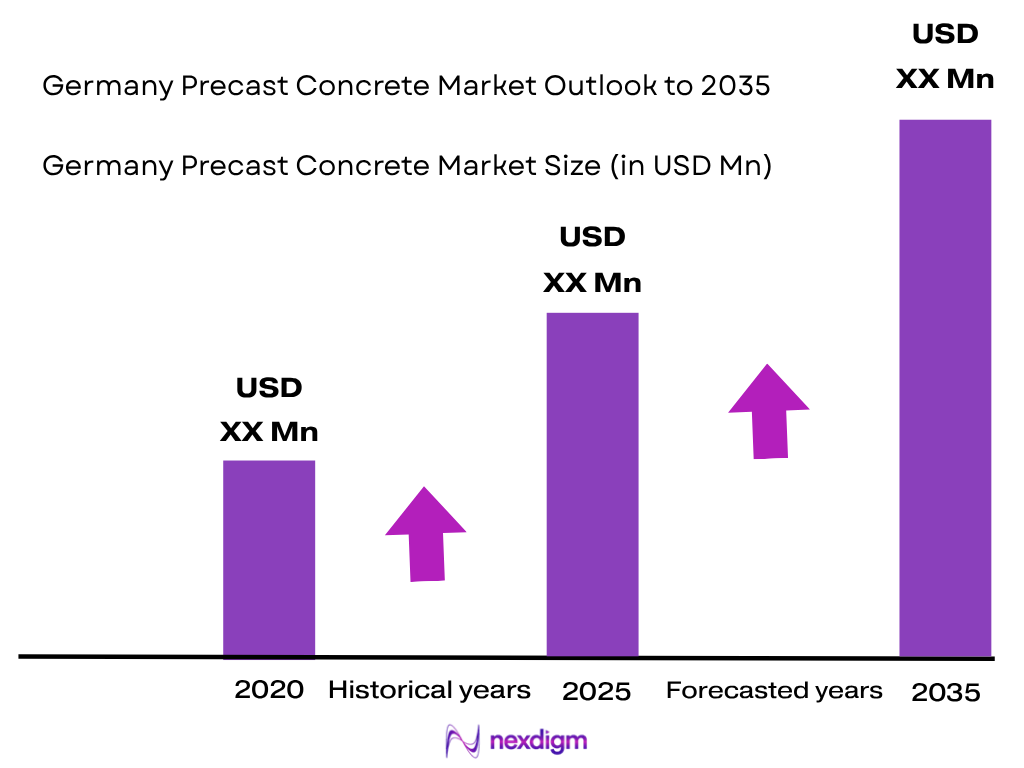
The Germany Precast Concrete Market is valued at approximately USD ~ billion, based on historical industry assessment. Underlying construction activity recorded 251,937 completed dwellings, compared with 294,399 in the preceding annual period, while completed building/construction measures reached 161,682, compared with 183,665 previously. Despite residential weakness, industrialized construction, infrastructure rehabilitation, prestressed systems and factory-controlled construction continue supporting precast demand across buildings, bridges, utilities and transportation infrastructure.
North Rhine-Westphalia, Bavaria and Baden-Württemberg are major German demand centers because they combine large populations, industrial construction bases, logistics corridors and extensive building stocks. Their populations stand at approximately 18.03 million, 13.25 million and 11.25 million, respectively. North Rhine-Westphalia contains 1,046 km² of industrial and commercial land, Bavaria 1,009 km², and Baden-Württemberg 761 km², supporting warehouses, factories, commercial buildings and infrastructure applications suitable for precast construction.
Market Segmentation
By Product Type
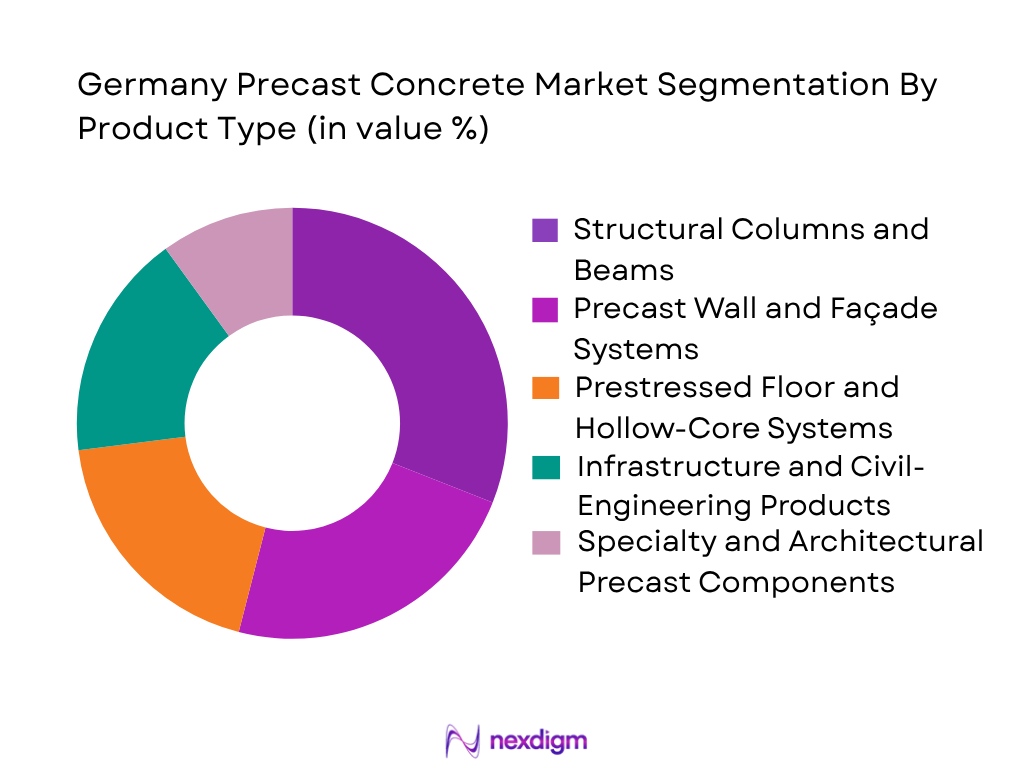
The Germany Precast Concrete Market is segmented into structural columns and beams, precast wall and façade systems, prestressed floor and hollow-core systems, infrastructure and civil-engineering products, and specialty precast components. Structural columns and beams hold the dominant market share, supported by Germany’s established industrialized building practices and extensive application of factory-produced structural systems in logistics buildings, factories, commercial properties and parking structures. German manufacturers operate sophisticated precasting facilities capable of integrating reinforcement fabrication, concrete batching, prestressing and component finishing. The segment also benefits from system construction, where columns, beams and floor elements are engineered as coordinated structural packages. Large domestic manufacturers increasingly combine structural design, factory production, transportation and erection, making structural precast attractive for projects requiring predictable installation sequences and reduced on-site formwork. Prestressed flooring and wall systems constitute additional significant categories, while civil-engineering products serve transportation, utility, water and environmental infrastructure.
By Application
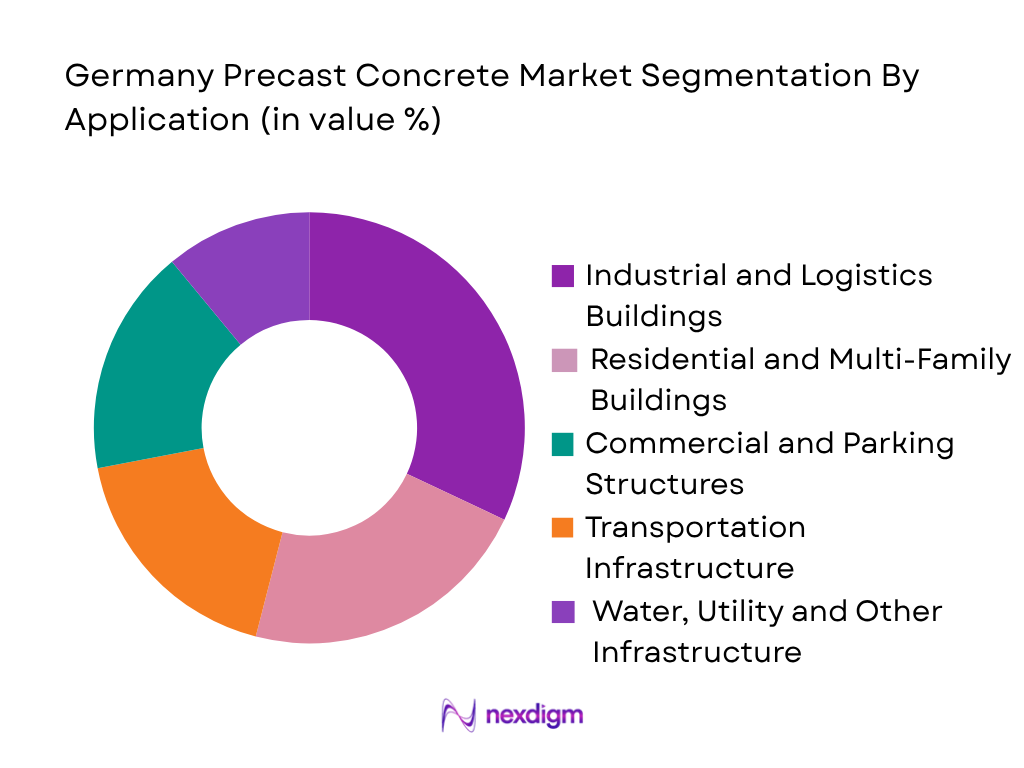
The Germany Precast Concrete Market is segmented into industrial and logistics buildings, residential and multi-family buildings, commercial and parking structures, transportation infrastructure, and water, utility and other infrastructure. Industrial and logistics buildings hold the dominant market share because Germany has a mature system-building industry in which repetitive structural grids, large spans and schedule-sensitive construction favor factory-produced columns, beams, walls and floor elements. Companies such as GOLDBECK industrially manufacture essential building elements in their own factories before assembling them on construction sites, illustrating the established role of prefabrication in German commercial construction. Logistics centers and manufacturing facilities particularly benefit from long-span prestressed components and standardized structural systems. Residential construction provides additional opportunities through serial and modular building approaches, while bridges, railway infrastructure and utility projects create demand for highly engineered precast elements. Parking structures are another established application because repetitive bays and standardized components suit industrial production and rapid assembly.
Competitive Landscape
The Germany Precast Concrete Market has a broad domestic manufacturing base comprising integrated construction groups, structural precast specialists, prestressed concrete manufacturers and infrastructure-product companies. Competition centers on production capacity, plant proximity, long-span prestressing capability, structural engineering, BIM integration, automated production, transport and erection services, and increasingly the carbon intensity of concrete products. Max Bögl and GOLDBECK have particularly integrated models combining industrial production with construction delivery, while BREMER, KLEBL and FUCHS maintain substantial capabilities across structural or infrastructure-oriented precast systems.
| Major Player | Establishment Year | Headquarters / Main Base | Core Precast Capability | Prestressed Capability | Manufacturing Footprint | BIM / Engineering Integration | Infrastructure Exposure | Project Delivery Capability |
| Max Bögl | 1929 | Sengenthal | ~ | ~ | ~ | ~ | ~ | ~ |
| GOLDBECK | 1969 | Bielefeld | ~ | ~ | ~ | ~ | ~ | ~ |
| BREMER | 1947 | Paderborn | ~ | ~ | ~ | ~ | ~ | ~ |
| KLEBL | 1890 | Neumarkt i.d.OPf. | ~ | ~ | ~ | ~ | ~ | ~ |
| FUCHS Fertigteilwerke | 1949 | Berching | ~ | ~ | ~ | ~ | ~ | ~ |
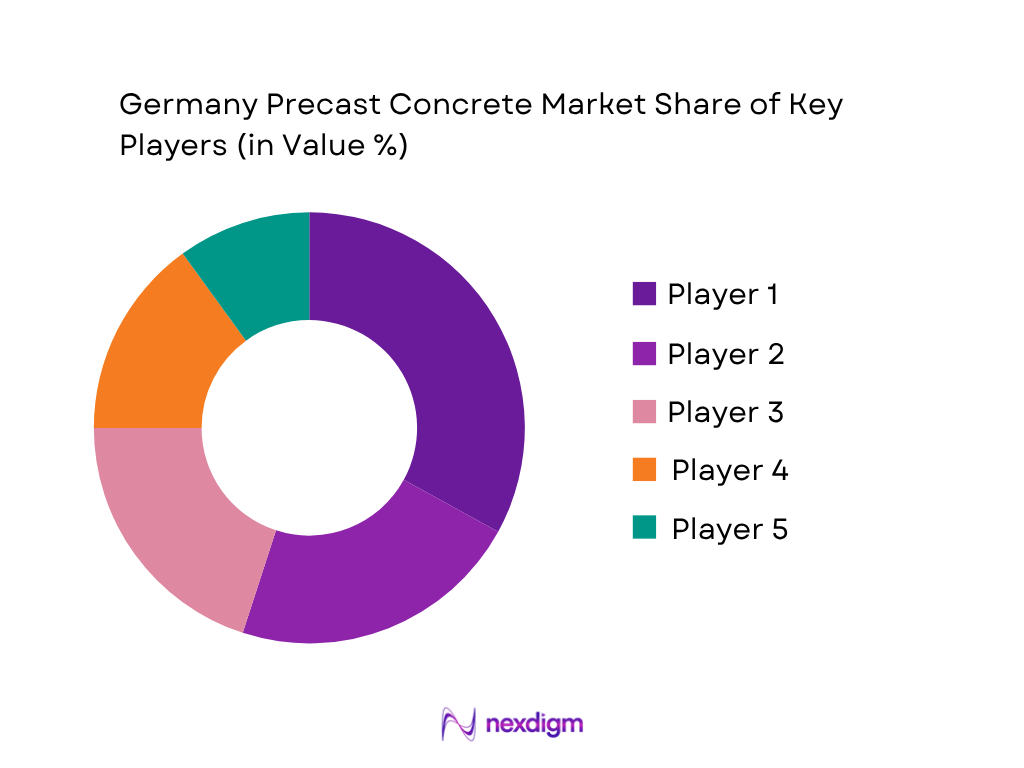
Germany Precast Concrete Market Analysis
Growth Drivers
Expansion of Industrialized, Prefabricated and Serial Construction
Germany’s established use of factory-produced construction systems provides a structural demand driver for precast concrete columns, beams, walls, façades, floor slabs and prestressed elements. Destatis recorded 24,106 newly completed buildings using prefabricated construction in 2024, representing 108.179 million cubic meters of enclosed volume and 12.028 million square meters of usable floor area. Within residential construction, 16,855 prefabricated residential buildings were completed, including approximately 14,300 single-family prefabricated houses. Importantly for the Germany Precast Concrete Market, factory-based construction displayed greater resilience than conventional construction during the wider building downturn: approximately 59,200 conventionally constructed residential buildings were completed compared with around 16,900 prefabricated residential buildings. The pipeline also contains a large volume of projects that could benefit from faster, industrialized delivery. Germany had 759,700 permitted but unfinished dwellings at the end of 2024, including approximately 330,000 dwellings already under construction. The pipeline remained substantial at the end of 2025, with 760,700 permitted but unfinished dwellings, including 307,200 already under construction. Meanwhile, total dwelling permits increased from 215,289 in 2024 to 238,063 in 2025, and permitted residential floor area increased from 20.080 million square meters to 22.120 million square meters. New-building dwelling permits similarly moved from 175,950 to 197,732. These indicators provide a sizeable physical project base for manufacturers of precast walls, element slabs, stairs, balconies, structural frames and prestressed flooring. The macroeconomic context remains large despite weak economic momentum: World Bank data place Germany’s 2024 GDP at USD 4,685.6 billion and GDP per capita at USD 56,103.7, while the IMF subsequently recorded EUR 4,329.0 billion of nominal GDP for 2024. The combination of a large construction economy, a substantial unfinished-building pipeline and established prefabrication capabilities supports further deployment of industrialized concrete construction where standardization, factory quality control and parallel site-and-factory workflows can improve project execution.
Bridge, Rail and Transport Infrastructure Modernization Supporting Engineered Precast Demand
Germany’s transport infrastructure renewal program provides a market-specific demand driver for prestressed bridge girders, bridge deck elements, noise barriers, railway components, platform elements, drainage structures and specialized civil-engineering precast products. The federal transport network contains approximately 40,000 bridges across motorways and federal roads, and around 55 out of every 100 bridge structures were constructed before 1985. Within the federal motorway network alone, approximately 28,000 bridge substructures require continuous inspection and lifecycle management. The Autobahn GmbH modernization program identifies around 4,000 bridge structures requiring modernization across approximately 7,000 kilometers of heavily used transit routes. This existing physical asset base creates a long-duration replacement and rehabilitation requirement rather than demand dependent solely on new road construction. Rail infrastructure provides an additional construction pipeline. Germany’s 2024 federal transport budget made approximately EUR 26.4 billion available for the relevant transport and digital infrastructure portfolio, compared with approximately EUR 18.9 billion in 2023. The federal government also provided EUR 5.5 billion in 2024 through an equity increase for Deutsche Bahn, forming part of EUR 20 billion planned through 2029, while the transport ministry identified corridor renovation, replacement and maintenance as core investment priorities. This is directly relevant to precast manufacturers because railway modernization can require platform systems, cable troughs, retaining components, sleepers, drainage products and specialized structural elements, while bridge replacement can use prestressed girders and factory-manufactured structural components to reduce work performed within traffic corridors. Germany’s broader macroeconomic capacity supports these infrastructure programs: World Bank data record USD 4,685.6 billion of GDP and USD 56,103.7 of GDP per capita in 2024. The IMF records 2024 general-government expenditure of EUR 2,139.7 billion, illustrating the scale of the public-sector economic base supporting infrastructure delivery. For precast suppliers, the opportunity is therefore linked to a measurable installed infrastructure base requiring renewal, particularly products that combine structural strength, durability, standardized production and accelerated installation at sites where minimizing road or railway closures is operationally important.
Market Challenges
Residential Construction Contraction Reducing Near-Term Structural Precast Order Volumes
Germany’s weak residential construction cycle creates a direct challenge for manufacturers supplying precast walls, floors, stairs, balconies, structural frames and residential prefabrication systems. Destatis recorded 251,937 completed dwellings in 2024, down from 294,399 in 2023, while the number of completed buildings and construction measures declined from 183,665 to 161,682. New-building completions were particularly weak: completed dwellings in new buildings decreased from 262,859 to 220,666, while completed new buildings fell from 118,369 to 97,279. The downturn intensified in 2025, when Germany completed only 206,586 dwellings, including 175,867 dwellings in newly constructed buildings. Completed residential floor area fell from 24.768 million square meters in 2024 to 20.056 million square meters in 2025, while new-building residential floor area declined from 21.237 million to 16.747 million square meters. Factory construction was not insulated from the contraction. Destatis recorded 24,106 prefabricated residential and non-residential buildings in 2024, compared with 27,355 in 2023, before the number fell further to 20,258 in 2025. Prefabricated residential buildings decreased from 19,942 in 2023 to 16,855 in 2024, showing that industrialized building methods can outperform conventional construction relatively while still experiencing lower absolute volumes. Macroeconomic conditions help explain the subdued construction environment. World Bank data show Germany generated USD 4,685.6 billion of GDP in 2024 but real economic output contracted by 0.5 percentage points on the Bank’s annual-growth measure; the IMF likewise records weak output and notes that Germany experienced negative growth during 2023–2024. The challenge for precast manufacturers is therefore utilization rather than merely long-term market relevance. Plants carry fixed infrastructure such as batching systems, reinforcement-processing lines, prestressing beds, molds, cranes and storage yards. When building completions contract from 294,399 dwellings to 251,937 and subsequently 206,586, suppliers exposed heavily to residential construction face lower throughput, greater competition for available projects and more difficulty maintaining efficient factory-loading schedules.
Heavy-Component Logistics and Long Project Cycles Constraining Precast Manufacturing Efficiency
The physical characteristics of precast concrete create a structural challenge in Germany because long prestressed girders, wall panels, columns, floor elements and bridge components require specialized transportation, lifting and carefully sequenced erection. This challenge becomes more significant when construction projects are delayed after permits have already been issued. Germany recorded 759,700 permitted but unfinished dwellings at the end of 2024, of which approximately 330,000 were already under construction. By the end of 2025, the backlog stood at 760,700 dwellings, with 307,200 already under construction. Destatis also reports that the average interval between building approval and completion has lengthened substantially since 2020. For precast manufacturers, extended project schedules can alter production slots, mold utilization, component-storage requirements and delivery sequencing because finished elements cannot always be transported until foundations, cranes and site access are ready. Transport complexity is amplified by Germany’s extensive aging bridge network. Around 40,000 bridges are located on federal motorways and federal roads, approximately 55 out of every 100 were built before 1985, and roughly 4,000 bridge structures within the 7,000-kilometer modernization network have been identified as requiring modernization. Heavy precast loads therefore operate within an infrastructure system that itself requires substantial rehabilitation. Factory production also depends on sufficiently consistent project throughput. Destatis recorded 24,106 completed prefabricated buildings in 2024, with 108.179 million cubic meters of enclosed volume, but this declined to 20,258 buildings and 99.805 million cubic meters in 2025. The wider economy offered limited cyclical support: World Bank data put 2024 GDP at USD 4,685.6 billion and GDP per capita at USD 56,103.7, while the IMF recorded a 0.5-point contraction in real GDP for 2024 in its latest assessment. These conditions increase the importance of regional plant coverage, because reducing haul distances can improve the economics and reliability of precast delivery. Manufacturers must coordinate plant capacity, component dimensions, specialized trailers, lifting equipment, temporary storage and erection schedules, making logistics and project timing integral parts of competitive capability rather than secondary distribution functions.
Market Opportunities
Serial and Prefabricated Construction Creates Scope for Greater Precast Penetration
Germany’s existing adoption of prefabricated construction provides a measurable base from which structural and architectural precast systems can expand as the building pipeline recovers. Destatis recorded approximately 16,900 completed prefabricated residential buildings in 2024, including around 14,300 single-family prefabricated houses. Across residential and non-residential construction together, 24,106 prefabricated buildings were completed, representing 108.179 million cubic meters of enclosed volume, 12.028 million square meters of usable floor area and 28,825 completed dwellings. The future opportunity is supported by improving current permitting indicators rather than speculative future construction statistics. Germany approved 238,063 dwellings in 2025, compared with 215,289 in 2024. Permitted residential floor area increased from 20.080 million square meters to 22.120 million square meters, while permits specifically for new buildings increased from 76,619 buildings to 83,152. New-building dwelling permits moved from 175,950 to 197,732, and associated floor area increased from 16.225 million to 17.996 million square meters. This pipeline is relevant to precast suppliers because serial residential schemes, multi-family buildings, public buildings and standardized commercial projects can use repeatable wall, floor, stair, balcony and structural-frame designs. A large backlog provides another potential deployment base: 760,700 permitted dwellings remained unfinished at the end of 2025, including 307,200 already under construction. Precast and semi-precast construction can support project acceleration by allowing factory production to proceed alongside site preparation and foundation work. The opportunity exists within a large national economy: World Bank data place German GDP at USD 4,685.6 billion and GDP per capita at USD 56,103.7 in 2024, while the IMF records nominal GDP of EUR 4,329.0 billion. These current indicators justify future growth potential without relying on future market-size projections. Suppliers able to integrate standardized engineering, BIM-to-production workflows, automated reinforcement fabrication, factory quality control and coordinated erection can position precast as a practical response to Germany’s large permitted-building pipeline and need for more industrialized construction delivery.
Bridge and Railway Renewal Creates Long-Term Opportunity for Infrastructure Precast Products
Germany’s existing road and railway asset base creates a significant future opportunity for manufacturers of prestressed girders, bridge elements, retaining structures, noise barriers, railway components, drainage products and specialized precast civil-engineering systems. The opportunity is supported by current infrastructure conditions rather than future market forecasts. Approximately 40,000 bridges are located across Germany’s federal motorway and federal-road network, with roughly 55 out of every 100 bridge structures built before 1985. The federal motorway network contains around 28,000 bridge substructures, while approximately 4,000 bridges across 7,000 kilometers of heavily trafficked transit corridors have been identified as requiring modernization. These assets create a substantial replacement and rehabilitation pipeline in which prefabricated bridge components can reduce on-site construction duration and enable factory-controlled production. Railway investment provides a parallel demand channel. The federal transport budget provided approximately EUR 26.4 billion in 2024, compared with EUR 18.9 billion in 2023, with rail identified as an investment priority. Germany also provided EUR 5.5 billion in Deutsche Bahn equity funding during 2024 as part of the broader rail infrastructure financing framework. These current commitments support corridor renovation, replacement and maintenance projects that can require railway platforms, sleepers, cable troughs, retaining systems, culverts, structural components and other standardized concrete products. The opportunity is strengthened by Germany’s macroeconomic capacity: World Bank data record USD 4,685.6 billion of GDP and USD 56,103.7 of GDP per capita in 2024, while IMF data show EUR 2,139.7 billion of general-government expenditure in the same year. For Germany’s precast industry, infrastructure renewal is strategically important because it diversifies demand away from the weaker residential cycle and rewards technical capabilities in prestressing, high-strength concrete, exposure-class durability, dimensional control and factory production. Manufacturers able to design components for accelerated installation can address projects where minimizing motorway or railway closures is critical, creating a future growth route grounded in Germany’s currently documented infrastructure-renewal requirements.
Future Outlook
The Germany Precast Concrete Market is forecast to expand at approximately ~% CAGR during 2026–2035, with growth increasingly shaped by industrialized construction rather than conventional volume expansion alone. Serial construction, infrastructure modernization, data centers, logistics buildings, bridge rehabilitation and low-carbon construction are expected to create opportunities for technologically advanced precast manufacturers.
The market is likely to shift further toward integrated design-to-production processes. BIM-based detailing, automated reinforcement processing, digitally controlled casting and standardized connections can allow manufacturers to move directly from structural engineering models into factory production. This favors companies that combine engineering expertise with modern manufacturing capacity.
Major Players
- Max Bögl Fertigteilwerke GmbH & Co. KG
- GOLDBECK Betonelemente
- BREMER SE / BREMER Betonfertigteile
- KLEBL GmbH / KLEBL Fertigteil GmbH
- FUCHS Fertigteilwerke GmbH
- Heidelberg Materials Betonelemente DE GmbH & Co. KG
- Rekers Betonwerk GmbH & Co. KG
- CONSOLIS DW SYSTEMBAU GmbH
- OTTO QUAST Fertigbau
- Brüninghoff Beton Fertigteil Werk GmbH & Co. KG
- Lupp Fertigteile GmbH
- GP Papenburg Betonfertigteilwerk GmbH
- RAILBETON HAAS GmbH
- Hering Bau GmbH & Co. KG
- Beton-Fertigteilbau Erfurt GmbH
Key Target Audience
- Precast and Prestressed Concrete Manufacturers
- Industrial and Commercial Construction Companies
- Residential Developers and Housing Companies
- Infrastructure, Railway and Bridge Contractors
- Cement, Aggregate, Reinforcing Steel and Prestressing Steel Suppliers
- Construction Technology and Precast Manufacturing Equipment Providers
- Investments and Venture Capitalist Firms
- Government and Regulatory Bodies (Federal Ministry for Housing, Urban Development and Building, Federal Ministry of Transport, German Institute for Building Technology, Federal Highway Authority)
Research Methodology
Step 1: Identification of Key Variables
The initial phase involves mapping the Germany Precast Concrete Market ecosystem across precast manufacturers, construction groups, material suppliers, developers, infrastructure authorities and engineering companies. Key variables include production capacity, plant locations, prestressing capability, product mix, transport radius, structural applications, project pipeline, construction-system adoption and manufacturing technology.
Step 2: Market Analysis and Construction
Historical market information is analyzed through top-down and bottom-up approaches covering construction completions, permits, building floor space, infrastructure development and manufacturer production capabilities. Demand is assessed across industrial, logistics, residential, commercial and infrastructure applications and reconciled with structural precast, prestressed concrete, wall, floor and civil-engineering product requirements.
Step 3: Hypothesis Validation and Expert Consultation
Market hypotheses are validated through computer-assisted telephone interviews with precast manufacturers, structural engineers, contractors, developers, equipment suppliers and construction-material companies. These consultations evaluate production utilization, specification trends, procurement criteria, transport constraints, erection requirements, competitive positioning and adoption of serial, modular and low-carbon precast construction.
Step 4: Research Synthesis and Final Output
Primary findings are triangulated with official construction statistics, manufacturer disclosures, infrastructure information and production indicators. Bottom-up manufacturer assessments are reconciled against top-down construction demand to establish the market structure, segmentation, competitive environment and future outlook. The resulting framework provides a validated assessment of Germany’s structural, prestressed and infrastructure precast ecosystem.

- Executive Summary
- Research Methodology (Market Definitions and Assumptions, Germany Precast Concrete Market Classification, Precast and Prestressed Concrete Scope, Product Mapping, Structural Component Mapping, Infrastructure Product Mapping, Prestressed Concrete Assessment, Wall and Façade Element Assessment, Hollow-Core and Floor Slab Assessment, Concrete Pipe and Manhole Assessment, Bridge Component Assessment, Railway Precast Component Assessment, Modular and Serial Construction Assessment, Manufacturing Plant Mapping, Production Capacity Assessment, Plant Utilization Assessment, Regional Production Cluster Mapping, Supply-Side Assessment, Demand-Side Assessment, Top-Down Market Sizing, Bottom-Up Market Sizing, Primary Industry Interviews, Construction and Infrastructure Project Pipeline Assessment, Data Triangulation, Forecasting Framework)

- Definition and Scope
- Germany Precast Concrete Industry Evolution and Development of Structural Precast Systems, Prestressed Concrete Systems, Industrial and Logistics Building Systems, Precast Wall and Façade Elements, Hollow-Core and Prestressed Floor Slabs, Beams and Columns, Concrete Pipes and Manholes, Bridge Components, Railway Components, Modular Concrete Systems, Architectural Concrete, High-Performance Concrete, Automated Precast Manufacturing, Low-Carbon Precast Concrete
- Precast Concrete Value Chain Analysis
- Precast Concrete Supply Chain Analysis
- Cement and Binder Producers, Aggregate Suppliers, Reinforcing Steel Suppliers, Prestressing Steel Suppliers, Admixture Suppliers, Formwork and Mold Providers, Connection-System Suppliers, Precast Manufacturing Plants, Prestressing Facilities, Engineering and Structural Design Companies, BIM and Production Software Providers, Heavy-Haul Transport Providers, Crane and Erection Contractors, General Contractors, Industrial Developers, Residential Developers, Deutsche Bahn Contractors, Federal and State Road Authorities, Municipalities, Utility Operators

- Growth Drivers (Serial and Modular Construction Adoption, Industrial and Logistics Building Development, Housing Construction Requirements, Bridge Replacement and Rehabilitation, Railway Infrastructure Modernization, Data Center Construction, Labor Productivity Requirements, Faster Construction Schedules, Factory-Controlled Construction Quality, Building Standardization and Prefabrication)
- Market Challenges (Weakness in New Residential Construction, High Cement and Energy Requirements, Heavy Precast Component Transportation Constraints, Oversized Load Logistics, Crane and Erection Requirements, Skilled Plant Labor Availability, Capital-Intensive Production Plants, Project-Specific Mold Requirements, Construction Cycle Volatility, Structural Connection Complexity)
- Market Opportunities (Serial Residential Construction, Data Center Structural Systems, Bridge Replacement Components, Railway Infrastructure Precast, Industrial and Logistics Building Systems, Modular Concrete Buildings, Hybrid Timber-Concrete Systems, Low-Carbon Precast Concrete, Recycled-Aggregate Precast Products, Automated Precast Manufacturing, Digital Design-to-Production Integration)
- Market Trends (BIM-to-Production Integration, Automated Reinforcement Processing, Robotic Production, Serial Construction, Design for Manufacture and Assembly, Hybrid Structural Systems, Material-Efficient Precast Design, Clinker-Reduced Concrete, Recycled Concrete Aggregates, Digital Quality Control, Just-in-Time Production and Delivery)
- Government Regulations and Standards (DIN EN 13369 Common Rules for Precast Concrete Products, DIN EN 206 Concrete Requirements, DIN 1045 Concrete Structures, Eurocode 2 Structural Concrete Design, Product-Specific DIN EN Precast Standards, Factory Production Control, CE Marking Requirements, Construction Product Regulation Requirements, Exposure and Durability Classes, Fire Protection Requirements, Environmental Product Declaration Requirements)
- SWOT Analysis
- Porter’s Five Forces Analysis
- PESTLE Analysis
- Stakeholder Ecosystem
- Precast Concrete Manufacturing and Construction Ecosystem

- By Market Value (2020-2025)
- By Precast Concrete Production Volume (2020-2025)
- By Structural Precast Production Volume (2020-2025)
- By Prestressed Concrete Production Volume (2020-2025)
- By Precast Wall and Façade Element Production Volume (2020-2025)
- By Floor and Ceiling Element Production Volume (2020-2025)
- By Concrete Pipe and Manhole Production Volume (2020-2025)
- By Bridge and Civil Engineering Component Production Volume (2020-2025)
- By Railway Precast Component Production Volume (2020-2025)
- By Installed Precast Manufacturing Capacity (2020-2025)
- By Production Capacity Utilization (2020-2025)

- By Product Type (In Value %)
Structural Columns and Beams
Prestressed Beams and Girders
Precast Wall Elements
Sandwich and Façade Elements
Element and Semi-Precast Floor Slabs
Prestressed Hollow-Core Slabs
Precast Stairs and Balconies
Concrete Pipes
Manholes and Utility Chambers
Box Culverts and Drainage Components
Bridge Components
Railway Precast Components
Foundations and Special Structural Components
Architectural Concrete Elements - By Construction System (In Value %)
Reinforced Structural Precast Systems
Prestressed Precast Systems
Full Precast Building Systems
Semi-Precast Systems
Hybrid Precast-Steel Systems
Hybrid Precast-Timber Systems
Modular and Serial Concrete Systems
Architectural Precast Systems - By Application (In Value %)
Industrial and Manufacturing Buildings
Warehouses and Logistics Facilities
Commercial Buildings
Residential and Multi-Family Buildings
Data Centers
Parking Structures
Bridges and Road Infrastructure
Railway Infrastructure
Water and Wastewater Infrastructure
Energy Infrastructure
Public and Institutional Buildings
Agricultural Buildings - By Manufacturing Technology (In Value %)
Stationary Mold Production
Carousel Production Systems
Long-Line Prestressing
Battery Mold Production
Automated Wall and Floor Element Production
Self-Compacting Concrete Precasting
High-Performance Concrete Precasting
Robotic and Digitally Controlled Production
Low-Carbon Precast Manufacturing - By Concrete and Material Technology (In Value %)
Conventional Reinforced Concrete
Prestressed Concrete
Self-Compacting Concrete
High-Strength Concrete
Fiber-Reinforced Concrete
Recycled-Aggregate Concrete
Clinker-Reduced Concrete
CO₂-Reduced Precast Concrete
Ultra-High-Performance Concrete - By Region (In Value %)
North Rhine-Westphalia
Bavaria
Baden-Württemberg
Lower Saxony
Hesse
Saxony
Brandenburg and Berlin
Schleswig-Holstein and Hamburg
Other German Federal States

- Market Share of Major Players (By Germany Revenue, Precast Production Capacity, Number of Manufacturing Plants, Structural Precast Capacity, Prestressed Concrete Capacity, Wall and Floor Element Capacity, Infrastructure Product Portfolio, Railway Product Capability, Geographic Manufacturing Coverage, Engineering and BIM Capability, Heavy-Haul Logistics Capability, Erection Capability, Low-Carbon Concrete Capability, Major Project Portfolio)
- Cross Comparison Parameters (Annual Precast Concrete Production Capacity, Germany Precast Manufacturing Plant Network, Structural and Prestressed Product Breadth, Maximum Prestressed Component Span and Heavy-Element Capability, BIM-to-Fabrication and Automated Production Capability, DIN-EN Factory Production Control and Sustainability Certification Portfolio, Heavy-Haul Transport and On-Site Erection Capability, Industrial-Residential-Bridge-Rail Infrastructure Project Portfolio)
- SWOT Analysis of Major Players
- Competitive Positioning Matrix
- Major Companies
Max Bögl Fertigteilwerke GmbH & Co. KG
GOLDBECK Betonelemente
BREMER SE / BREMER Betonfertigteile
KLEBL GmbH / KLEBL Fertigteil GmbH
FUCHS Fertigteilwerke GmbH
Heidelberg Materials Betonelemente DE GmbH & Co. KG
Rekers Betonwerk GmbH & Co. KG
CONSOLIS DW SYSTEMBAU GmbH
OTTO QUAST Fertigbau
Brüninghoff Beton Fertigteil Werk GmbH & Co. KG
Lupp Fertigteile GmbH
GP Papenburg Betonfertigteilwerk GmbH
RAILBETON HAAS GmbH
Hering Bau GmbH & Co. KG
Beton-Fertigteilbau Erfurt GmbH

- Industrial Developer Precast Requirement Assessment
- Logistics Developer Structural System Assessment
- General Contractor Procurement Assessment
- Housing Company Serial Construction Requirement Assessment
- Data Center Developer Structural Requirement Assessment
- Road and Bridge Contractor Precast Requirement Assessment
- Railway Contractor Precast Requirement Assessment
- Water and Wastewater Utility Procurement Assessment
- Structural Engineer Specification Assessment
- Precast Performance Requirement Assessment (Compressive Strength, Prestressing Capability, Span Capability, Fire Resistance, Acoustic Performance, Thermal Performance, Dimensional Tolerance, Exposure-Class Compliance, Durability, Surface Quality, Installation Speed, Service Life)

- By Market Value (2026-2035)
- By Precast Concrete Production Volume (2026-2035)
- By Structural Precast Production Volume (2026-2035)
- By Prestressed Concrete Production Volume (2026-2035)
- By Wall and Floor Element Demand (2026-2035)
- By Industrial and Logistics Precast Demand (2026-2035)
- By Residential and Serial Construction Precast Demand (2026-2035)
- By Bridge and Road Infrastructure Precast Demand (2026-2035)
- By Railway Infrastructure Precast Demand (2026-2035)
- By Water and Wastewater Precast Demand (2026-2035)
- By Data Center Precast Demand (2026-2035)
- By Modular and Hybrid Precast System Demand (2026-2035)
- By Low-Carbon Precast Concrete Demand (2026-2035)


 Request a Sample
 Ask for Customization
 Get a Quote
 Enquire Now
