
 Download PDF
Market Overview
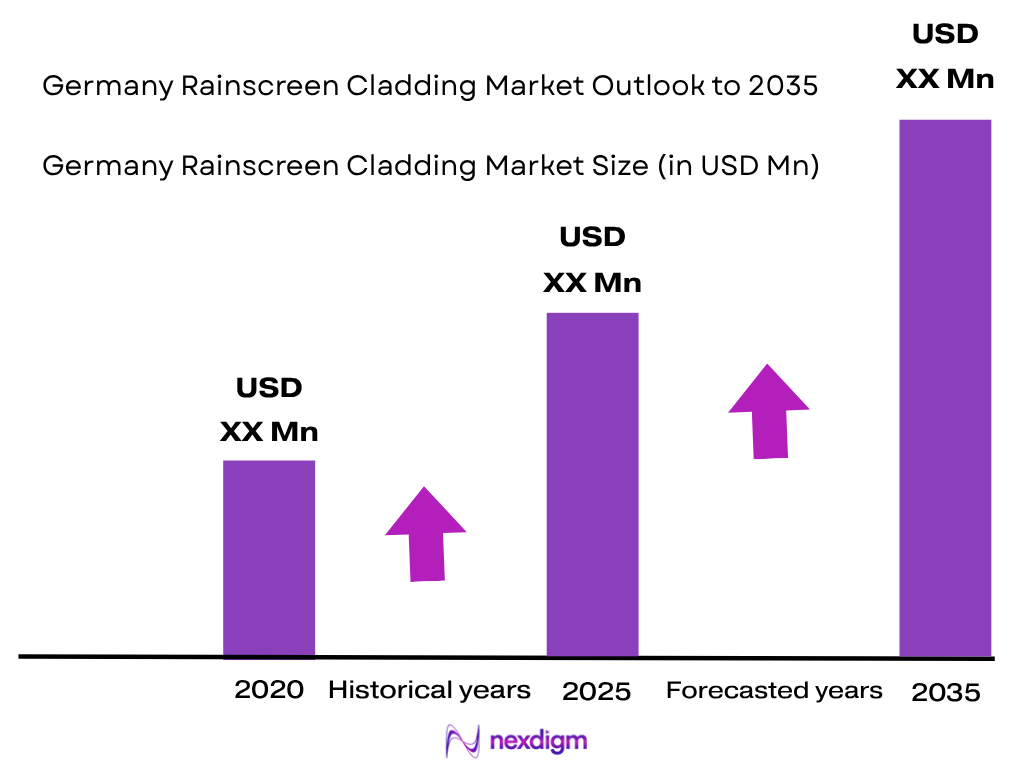
The Germany Rainscreen Cladding Market is valued at approximately ~USD XX million, supported by one of Europe’s largest construction and building-renovation ecosystems. Construction investment moved from EUR 453.01 billion in the preceding annual observation to EUR 450.66 billion in the latest observation, comprising EUR 270.48 billion in residential construction and EUR 180.18 billion in non-residential construction. This substantial addressable building base supports demand for ventilated façades, insulation-integrated cladding, fiber cement, ceramic and architectural metal systems.
Berlin and Hamburg are among the important urban demand centers for Germany Rainscreen Cladding Market because dense multi-family housing, commercial property and existing-building renovation create significant façade requirements. Berlin’s housing stock increased from 2,043,583 units to 2,058,666 units, including 14,474 dwellings added through new buildings. Hamburg recorded 8,319 completed dwellings, compared with 5,999 previously, and generated 569,360 square meters of new residential floor space, strengthening opportunities for ventilated façades and energy-oriented exterior-wall upgrades.
Market Segmentation
By Cladding Material Type
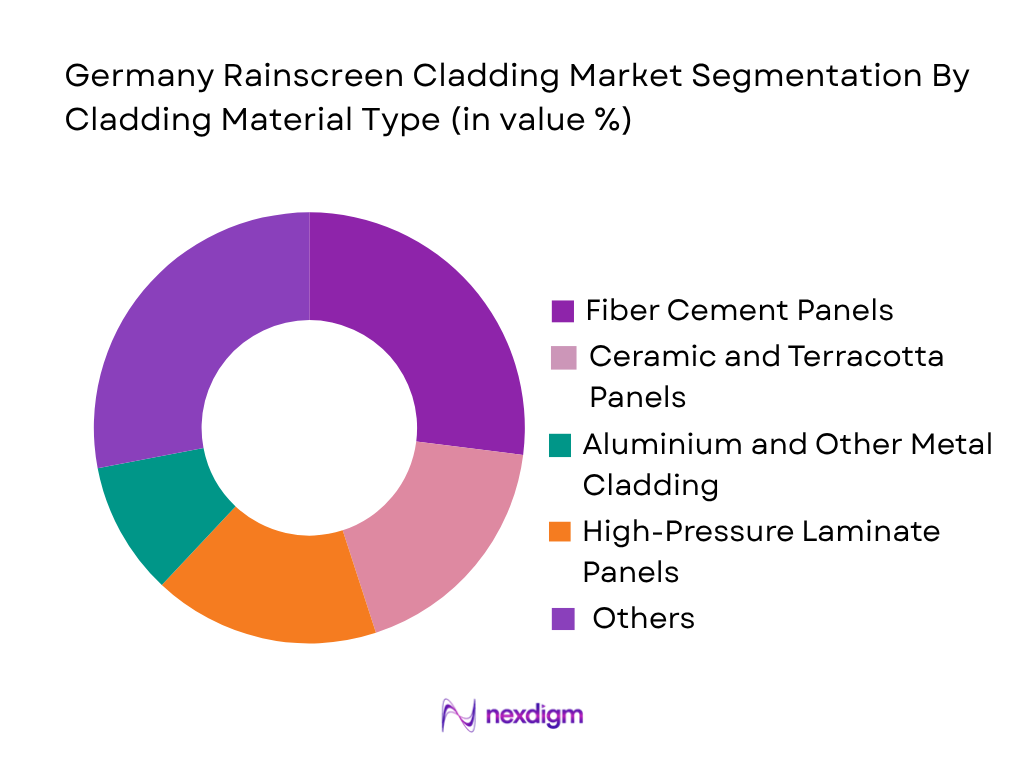
Germany Rainscreen Cladding Market is segmented into fiber cement panels, ceramic and terracotta panels, aluminium and metal panels, HPL panels, natural stone, brick-slip and clinker systems, timber façades, and other architectural materials. Fiber cement panels hold the dominant modeled market share under this segmentation because they align effectively with Germany’s established VHF construction approach, combining dimensional stability, weather resistance, non-combustible product options and compatibility with mineral-wool insulation. Fiber cement is particularly suitable for multi-family residential renovation, schools, public buildings, offices and large-scale façade refurbishment where architects require durable large-format panels and documented environmental performance. Swisspearl and EQUITONE maintain dedicated fiber-cement façade offerings within Germany, reinforcing installer and specification familiarity. Energy renovation also supports this segment because German requirements for modified external walls can impose a maximum thermal transmittance of 0.24 W/(m²·K) for heated residential and relevant non-residential zones, making insulated rainscreen assemblies well suited to retrofit applications.
By Application
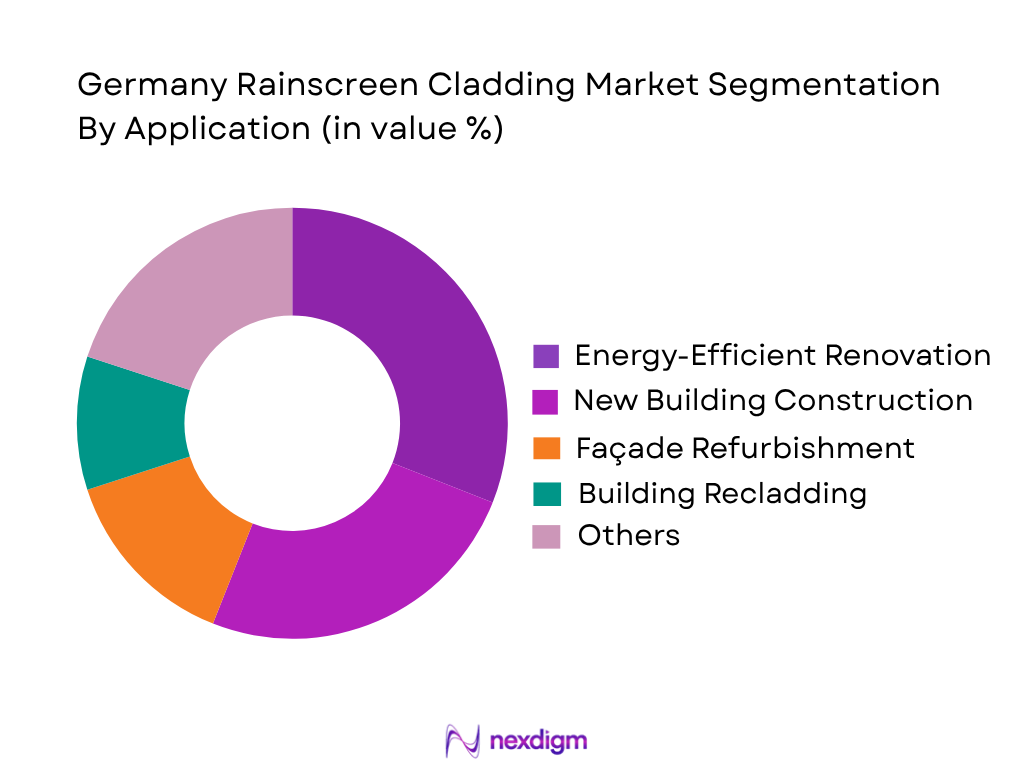
Germany Rainscreen Cladding Market is segmented into new building construction, energy-efficient renovation, façade refurbishment, building recladding, thermal-insulation upgrades, fire-safety remediation, moisture-damage rehabilitation and photovoltaic façade upgrades. Energy-efficient renovation is the dominant modeled application segment, reflecting Germany’s large established building stock and stringent requirements governing thermal upgrades to exterior walls. When external cladding, panel-type coverings or insulation layers are added to qualifying existing walls, the regulatory framework specifies a maximum U-value of 0.24 W/(m²·K) for heated residential buildings and qualifying non-residential zones. Germany’s broader construction environment also increasingly favors renovation because completed new buildings decreased from 118,369 to 97,279, while completed dwellings declined from 294,399 to 251,937 between the latest comparable annual observations. This combination of weaker new-build volumes and a substantial installed building stock increases the strategic importance of recladding, insulation upgrades and refurbishment-oriented VHF solutions for suppliers and specialist façade contractors.
Competitive Landscape
The Germany Rainscreen Cladding Market has a diversified competitive structure comprising specialist façade manufacturers, fiber-cement producers, ceramic façade companies, architectural metal suppliers, insulation groups and integrated building-envelope providers. Competition extends beyond cladding panels to system testing, fire classification, thermal-bridge optimization, environmental documentation, substructure compatibility, project engineering and architect specification support. German and wider European companies benefit from established VHF expertise, while sustainability documentation and renovation-specific systems are becoming increasingly important differentiators.
| Major Player | Establishment Year | Headquarters | Primary Material | Rainscreen/VHF Offering | Fire-Performance Positioning | Renovation Capability | Sustainability Capability | Technical/Specification Support |
| Sto SE & Co. KGaA | 1954 | Stühlingen, Germany | ~ | ~ | ~ | ~ | ~ | ~ |
| EQUITONE / Etex | 1905 | Zaventem, Belgium | ~ | ~ | ~ | ~ | ~ | ~ |
| Swisspearl | 1903* | Niederurnen, Switzerland | ~ | ~ | ~ | ~ | ~ | ~ |
| Rockpanel / ROCKWOOL Group | 1937 | Hedehusene, Denmark | ~ | ~ | ~ | ~ | ~ | ~ |
| PREFA | 1946 | Marktl, Austria | ~ | ~ | ~ | ~ | ~ | ~ |
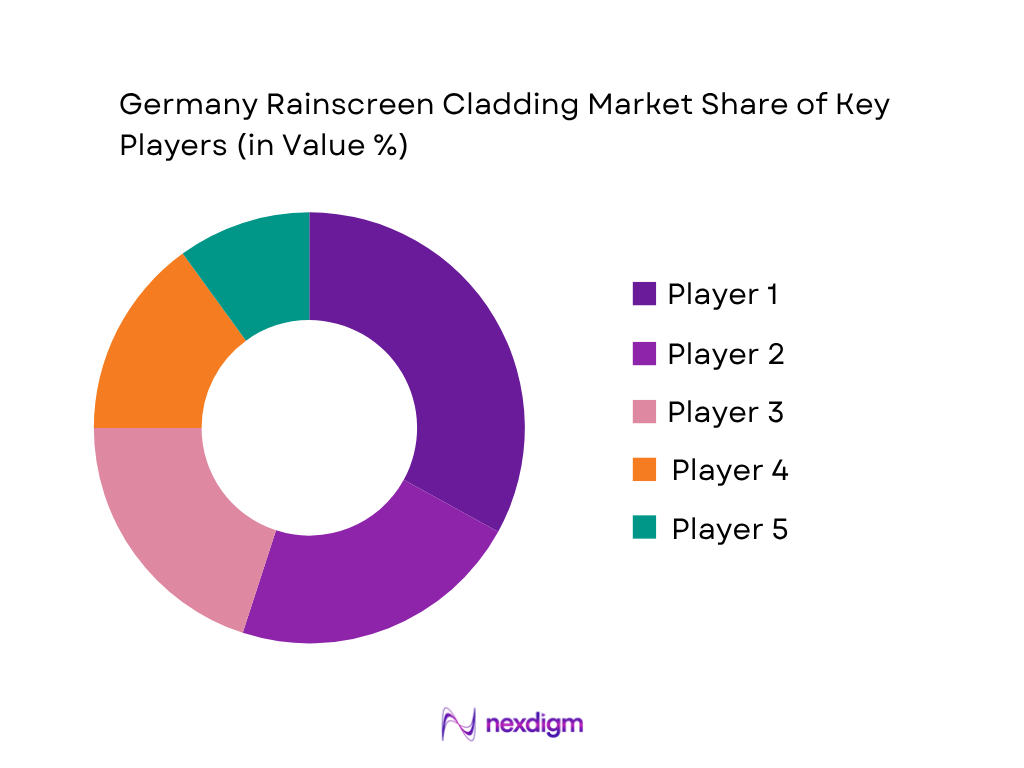
Germany Rainscreen Cladding Market Analysis
Growth Drivers
Energy-Efficient Renovation of Germany’s Large Existing Building Stock
Germany’s large installed building base is a structural driver for rainscreen cladding because ventilated façade systems can combine exterior-wall renewal, insulation, moisture management and architectural modernization within one retrofit intervention. Destatis reported approximately 43.8 million dwellings in Germany at the end of 2024, including 23.5 million dwellings in 3.5 million multi-family buildings. Total residential floor area reached around 4.1 billion square metres, creating a substantial installed envelope requiring periodic maintenance and energy upgrades. BAFA recorded 180,462 applications under the Federal Funding for Efficient Buildings individual-measures programme in 2024, including 167,365 measures associated with the building envelope and 141,361 measures for specialist planning and construction supervision. These figures directly support opportunities for ventilated rainscreen systems incorporating fiber cement, ceramic, aluminium, HPL, mineral-wool insulation and thermally optimized substructures. From a macroeconomic perspective, World Bank data place Germany’s 2024 GDP at USD 4.686 trillion, with GDP per capita at USD 56,103.7 and a population of 83,516,593. The combination of a very large building stock, substantial household economic capacity and active federally supported building-envelope renovation creates sustained specification potential for German VHF systems.
Large Construction Investment Base Supporting Façade Specification
Germany continues to provide a substantial construction base for rainscreen cladding despite weakness in selected new-build segments. Destatis records EUR 450.66 billion of construction investment in 2024, comprising EUR 270.48 billion in residential construction and EUR 180.18 billion in non-residential construction. In 2025, total construction investment increased to EUR 460.75 billion, while non-residential construction reached EUR 188.43 billion. This scale supports façade demand across multi-family housing, offices, hospitals, schools, municipal buildings, logistics assets, manufacturing facilities and mixed-use projects where rainscreen assemblies compete on thermal performance, durability and architectural flexibility. Germany also completed 161,682 buildings and construction measures in 2024, including 97,279 newly constructed buildings, while completed residential floor space reached 24.768 million square metres. The World Bank reports Germany’s nominal GDP at USD 4.686 trillion in 2024 and USD 5.051 trillion in 2025, confirming the scale of the underlying economy supporting construction procurement and capital investment. For rainscreen suppliers, this means demand is not dependent on a single building category; VHF systems can address both residential and non-residential projects through differentiated materials, substructures, insulation configurations and fixing technologies.
Market Challenges
Contraction in New-Build Completions Reducing Immediate Façade Installation Volume
Germany’s weakening new-build pipeline creates a direct challenge for rainscreen cladding manufacturers and installers that depend heavily on newly constructed residential façades. Destatis recorded 251,937 completed dwellings in 2024, compared with 294,399 dwellings in 2023, representing an absolute reduction of 42,462 units. The deterioration continued in 2025, when completed dwellings fell to 206,586 units, while completed residential floor space declined from 24.768 million square metres in 2024 to 20.056 million square metres. Newly constructed buildings decreased from 97,279 units in 2024 to 78,182 units in 2025, reducing the number of projects entering the addressable façade-installation pool. Building-permit data show 145,010 buildings or construction measures approved in 2024, while 149,748 were approved in 2025, indicating some stabilization but not yet restoration of previous new-building volumes. This matters specifically to VHF suppliers because large-format fiber cement, ceramic panels, metal cassette systems and engineered substructures are frequently specified early in design and procurement. World Bank data nevertheless show a 2024 economy of USD 4.686 trillion, meaning the challenge is primarily construction-cycle allocation rather than lack of overall economic scale. Destatis
Large Construction Backlog and Longer Project Conversion Cycles
The German rainscreen cladding market also faces project-conversion risk because approved residential development does not immediately translate into installed façade area. Destatis reported a construction backlog of 759,700 approved but unfinished dwellings at the end of 2024, including approximately 330,000 dwellings already under construction. By the end of 2025, the backlog remained at 760,700 dwellings, while 307,200 units were under construction and 158,600 had reached the shell-completion stage. In addition, 35,700 residential building permits expired in 2025, compared with 29,000 permits in 2024, demonstrating that a notable portion of planned construction may be delayed, redesigned or cancelled before façade procurement. For rainscreen suppliers, such delays can affect specification conversion, fabrication planning, ceramic-panel production schedules, aluminium-sheet allocation, substructure ordering and specialist installer utilization. The issue is amplified because VHF packages are typically installed after structural and enclosure milestones and therefore occur relatively late in the construction programme. Germany’s World Bank population figure of 83,516,593 and GDP of USD 4.686 trillion in 2024 confirm a large underlying market, but conversion from approved building projects into executed façade packages remains uneven and requires careful pipeline management. Destatis
Market Opportunities
Expansion of Building-Envelope Renovation and Recladding Applications
Existing-building modernization represents one of the clearest future opportunities for Germany’s rainscreen cladding industry because the installed building stock is considerably larger than the annual new-build pipeline. Destatis counted approximately 43.8 million dwellings at the end of 2024, of which 42.9 million were located in residential buildings and 23.5 million were contained within multi-family buildings. Total residential floor area reached about 4.1 billion square metres, creating a very large stock of exterior walls that can progressively require insulation improvement, recladding, moisture remediation or architectural renewal. BAFA recorded 167,365 requested building-envelope measures through the Federal Funding for Efficient Buildings individual-measures programme during 2024, alongside 141,361 specialist planning and construction-supervision measures. These current activity levels create a strong pipeline for future use of ventilated fiber cement, ceramic, aluminium, zinc and HPL systems where an existing exterior wall can be upgraded while retaining or improving weather protection. New construction alone produced only 21.237 million square metres of residential floor space in 2024, emphasizing the strategic importance of the much larger existing stock. Germany’s 2024 GDP of USD 4.686 trillion, according to the World Bank, provides a substantial economic base supporting sustained building modernization.
Recovery in Building Permits Creates a Forward Pipeline for Ventilated Façades
A rebound in residential building approvals provides a forward opportunity for rainscreen cladding manufacturers even though current completions remain subdued. Destatis recorded 238,063 approved dwellings in 2025, up from 215,289 approvals in 2024, an absolute increase of 22,774 units. Permits for dwellings in newly constructed buildings increased from 175,950 units to 197,732 units, while approved residential floor area expanded from 20.080 million square metres to 22.120 million square metres. Total approved buildings and construction measures also increased from 145,010 to 149,748. These indicators matter for rainscreen suppliers because façade materials are commonly evaluated during architectural design, detailed planning and tendering well before installation. The increase therefore expands the pool of projects that can potentially specify fiber cement, terracotta, aluminium cassette, zinc, HPL, mineral-wool insulation and thermally broken substructure systems. The opportunity is reinforced by Germany’s substantial macroeconomic base: World Bank data record GDP at USD 4.686 trillion in 2024 and USD 5.051 trillion in 2025, while population stood at 83,516,593 in 2024. Suppliers establishing specification positions during the approval-to-construction phase are therefore positioned to capture the improving project pipeline as projects advance toward façade procurement.
Future Outlook
The Germany Rainscreen Cladding Market is forecast to expand at approximately ~X.X% CAGR during 2026–2035, with growth increasingly shifting toward renovation rather than dependence on conventional new construction. Energy upgrades to existing exterior walls, replacement of aging building envelopes, stricter thermal-performance expectations and greater use of mineral-wool-compatible ventilated façades will underpin demand. Building owners are also placing greater emphasis on durability, disassembly, environmental product declarations and lifecycle performance, supporting higher-value VHF solutions.
Germany’s construction base remains substantial despite weakness in new residential completions. Construction investment amounted to EUR 450.66 billion, including EUR 180.18 billion in non-residential construction, providing a broad platform covering offices, schools, healthcare facilities, industrial properties, public buildings and infrastructure-related assets. The decrease in newly completed buildings strengthens the strategic rationale for suppliers to target existing-building renovation, where exterior insulation and façade replacement can be combined within one VHF intervention.
Major Players
- Sto SE & Co. KGaA
- EQUITONE / Etex Germany Exteriors GmbH
- Swisspearl Deutschland GmbH
- Rockpanel / ROCKWOOL Group
- Moeding Keramikfassaden GmbH
- Argeton / Wienerberger GmbH
- Fundermax GmbH
- Trespa International B.V.
- Rieder Group
- RHEINZINK GmbH & Co. KG
- Kalzip GmbH
- PREFA GmbH
- SFS Group Germany
- Hilti Deutschland AG
- Schüco International KG
Key Target Audience
- Rainscreen Cladding and Ventilated Façade Manufacturers
- Fiber Cement, Ceramic, Metal and HPL Cladding Manufacturers
- VHF Contractors, Façade Fabricators and Building-Envelope Installers
- Property Developers, Housing Companies and Commercial Building Owners
- General Contractors and Construction Companies
- Architectural, Façade Engineering and Building-Envelope Design Firms
- Investments and Venture Capitalist Firms
- Government and Regulatory Bodies (Federal Ministry for Housing, Urban Development and Building, Federal Ministry for Economic Affairs and Energy, German Institute for Building Technology, Federal Office for Economic Affairs and Export Control, State Building Authorities)
Research Methodology
Step 1: Identification of Key Variables
The initial phase involves creating an ecosystem map for the Germany Rainscreen Cladding Market covering manufacturers, VHF contractors, insulation suppliers, substructure companies, architects, housing companies and building owners. Desk research identifies critical variables including installed façade area, material penetration, renovation intensity, building type, insulation requirements, fire classification, thermal bridges, federal-state demand and specification patterns.
Step 2: Market Analysis and Construction
Historical demand is constructed through simultaneous top-down and bottom-up approaches. Top-down analysis evaluates German construction investment, residential and non-residential building activity, renovation demand and existing building stock, while bottom-up analysis converts representative projects and building categories into addressable façade areas. Material consumption, VHF penetration and supplier participation are then mapped by application and building type.
Step 3: Hypothesis Validation and Expert Consultation
Market hypotheses are validated through computer-assisted telephone interviews and direct engagement with VHF contractors, façade manufacturers, architects, planners, distributors, insulation companies and technical specialists. Interviews are designed to validate material preferences, renovation penetration, specification processes, installation practices, fire-performance requirements, substructure selection and competitive positioning across German residential and non-residential projects.
Step 4: Research Synthesis and Final Output
The final phase triangulates official construction indicators, company disclosures, building regulations, project databases and primary interviews. Supplier-level information is reconciled with project-level façade-area calculations and top-down construction indicators. Market segmentation, competitive positioning and forecast assumptions are subsequently cross-validated to produce a coherent assessment of new-build, renovation, recladding and energy-efficiency-driven rainscreen demand.

- Executive Summary
- Research Methodology (Market Definitions and Assumptions, Germany Rainscreen Cladding Market Classification, Building-Envelope Scope, Ventilated Rainscreen Facade Mapping, VHF System Assessment, Open-Joint Rainscreen Assessment, Closed-Joint Rainscreen Assessment, Fiber Cement Cladding Assessment, Ceramic and Terracotta Cladding Assessment, Aluminium Cladding Assessment, Zinc and Copper Cladding Assessment, High-Pressure Laminate Assessment, Natural Stone Rainscreen Assessment, Brick-Slip and Clinker Facade Assessment, Timber Cladding Assessment, Photovoltaic Facade Assessment, Substructure and Bracket Assessment, Fastener and Anchor Assessment, Thermal Insulation Assessment, Thermal-Bridge Assessment, Fire Performance Assessment, Wind-Load Assessment, Driving-Rain Resistance Assessment, Moisture Management Assessment, GEG Compliance Assessment, DIN 18516-1 Assessment, VOB/C DIN 18351 Assessment, Supply-Side Assessment, Demand-Side Assessment, Top-Down Market Sizing, Bottom-Up Market Sizing, Primary Industry Interviews, Building Renovation Pipeline Assessment, Data Triangulation, Forecasting Framework)

- Definition and Scope
- Germany Rainscreen Cladding Industry Evolution and Development of Vorgehängte Hinterlüftete Fassaden, Ventilated Rainscreen Systems, Fiber Cement Facades, Ceramic and Terracotta Facades, Aluminium Sheet and Cassette Facades, Zinc and Copper Facades, High-Pressure Laminate Facades, Natural Stone Rainscreens, Brick-Slip and Clinker Systems, Glass Rainscreens, Timber Cladding, Rendered Carrier-Board Facades, Thermally Optimized Substructures, Passive-House-Compatible Facades, Prefabricated Facade Systems, Building-Integrated Photovoltaic Facades, Circular and Demountable Facade Systems
- Rainscreen Cladding Value Chain Analysis
- Rainscreen Cladding Supply Chain Analysis
- Fiber Cement Manufacturers, Ceramic and Terracotta Manufacturers, Aluminium Sheet Suppliers, Zinc and Copper Suppliers, High-Pressure Laminate Manufacturers, Natural Stone Suppliers, Timber Cladding Suppliers, Mineral Wool Manufacturers, Aluminium and Stainless-Steel Substructure Suppliers, Bracket Manufacturers, Fastener and Anchor Suppliers, Membrane Suppliers, Rainscreen System Providers, Facade Engineering Companies, VHF Contractors, Panel Fabricators, Installation Contractors, General Contractors, Architects, Facade Planners, Housing Companies, Property Developers, Public-Sector Building Owners, Building Material Distributors, Testing and Certification Providers

- Growth Drivers (Energy Renovation of Existing Buildings, GEG-Compliant Exterior-Wall Upgrades, Multi-Family Housing Renovation, Non-Residential Building Modernisation, Demand for Thermally Decoupled Substructures, Long-Life Facade Systems, Moisture-Managed Wall Assemblies, Public-Building Refurbishment, Architectural Material Diversity, Circular Construction)
- Market Challenges (Weak New-Build Construction Cycles, Skilled Facade Installer Shortage, High Technical Documentation Requirements, Complex Building Regulations, Thermal-Bridge Compliance, Fire-Barrier Detailing, Substructure Engineering Complexity, Long Planning Cycles, Existing-Building Substrate Variability, Material and Installation Coordination)
- Market Opportunities (Deep Energy Renovation, Existing-Building Recladding, Non-Combustible VHF Systems, Passive-House-Compatible Substructures, Building-Integrated Photovoltaic Facades, Recyclable Aluminium and Metal Facades, Low-Carbon Fiber Cement Systems, Circular and Demountable Facades, Public-Sector Building Renovation, Prefabricated Facade Modules, Digital Facade Planning)
- Market Trends (VHF Adoption in Renovation, Thermally Optimized Brackets, Mineral-Wool-Based Wall Assemblies, Large-Format Panels, Concealed Fixings, Prefabrication, BIM-Based Facade Engineering, Building-Integrated Photovoltaics, Material Passports, Reusable Facade Components, Low-Carbon Materials, EPD-Based Specification, Passive-House-Compatible Facades, Timber-Clad VHF Systems)
- Government Regulations and Standards (DIN 18516-1 Ventilated External Wall Cladding Requirements, VOB/C ATV DIN 18351 Facade Works Requirements, DIN 4108-3 Moisture Protection Requirements, DIN EN 13501-1 Fire Classification, Musterbauordnung Requirements, Landesbauordnungen, Muster-Verwaltungsvorschrift Technische Baubestimmungen, Gebäudeenergiegesetz Requirements, Exterior-Wall U-Value Requirements, Fire-Barrier Requirements, Wind-Load Requirements, Driving-Rain Protection Requirements, DIBt Approval Requirements)
- SWOT Analysis
- Porter’s Five Forces Analysis
- PESTLE Analysis
- Stakeholder Ecosystem

- By Market Value (2020-2025)
- By Installed Rainscreen Cladding Area (2020-2025)
- By Installed Ventilated Facade Area (2020-2025)
- By Fiber Cement Rainscreen Installation Area (2020-2025)
- By Ceramic and Terracotta Rainscreen Installation Area (2020-2025)
- By Metal Rainscreen Installation Area (2020-2025)
- By New-Build VHF Installation Area (2020-2025)
- By Renovation and Refurbishment VHF Installation Area (2020-2025)
- By Residential VHF Installation Area (2020-2025)
- By Non-Residential VHF Installation Area (2020-2025)
- By Public-Building VHF Installation Area (2020-2025)
- By Industrial and Logistics VHF Installation Area (2020-2025)

- By Cladding Material Type (In Value %)
Fiber Cement Panels
Ceramic and Terracotta Panels
Aluminium Sheets and Cassettes
Aluminium Composite Panels
Zinc Cladding
Copper Cladding
Steel and Stainless-Steel Cladding
High-Pressure Laminate Panels
Natural Stone Panels
Brick-Slip and Clinker Systems
Glass Facade Panels
Rendered Carrier-Board Systems
Timber Facade Cladding
Photovoltaic Facade Panels
Other Architectural Rainscreen Materials - By Rainscreen System Type (In Value %)
Open-Joint Ventilated Facades
Closed-Joint Ventilated Facades
Drained and Back-Ventilated Facades
Pressure-Moderated Rainscreen Systems
Cassette and Tray Panel Systems
Plank and Lap-Cladding Systems
Large-Format Panel Systems
Carrier-Board Rainscreen Systems
Integrated Photovoltaic VHF Systems
Thermally Optimized Rainscreen Systems - By Application (In Value %)
New Building Construction
Energy-Efficient Renovation
Facade Refurbishment
Building Recladding
Thermal Insulation Upgrades
Fire-Safety Facade Remediation
Moisture-Damage Rehabilitation
Building Extension and Vertical Addition
Heritage-Sensitive Facade Renovation
Building-Integrated Photovoltaic Facade Upgrades - By Building Type (In Value %)
Multi-Family Residential Buildings
Single and Two-Family Residential Buildings
Office and Administrative Buildings
Retail and Commercial Buildings
Hotels and Hospitality Buildings
Healthcare and Care Facilities
Schools and Educational Buildings
Government and Municipal Buildings
Industrial and Manufacturing Buildings
Warehouses and Logistics Buildings
Data Centres
Transportation and Infrastructure Buildings
Mixed-Use Developments - By Federal State (In Value %)
North Rhine-Westphalia
Bavaria
Baden-Württemberg
Lower Saxony
Hesse
Berlin
Hamburg
Saxony
Rhineland-Palatinate
Schleswig-Holstein
Brandenburg
Saxony-Anhalt
Thuringia
Mecklenburg-Western Pomerania
Saarland
Bremen

- Market Share of Major Players (By Germany Revenue, Rainscreen Project Value, Installed VHF Area, Fiber Cement Portfolio, Ceramic and Terracotta Portfolio, Metal Cladding Portfolio, Thermally Optimized Substructure Capability, Renovation Project Portfolio, DIN 18516-1 System Compatibility, Fire-Safe System Capability, Building-Integrated Photovoltaic Capability, Germany-Wide Project Coverage, Sustainability Documentation, Facade Engineering Capability, Technical Support and Installer Network)
- Cross Comparison Parameters (VHF Cladding Material Portfolio Breadth, DIN 18516-1 System Compatibility, Non-Combustible and Fire-Safe System Capability, Thermally Optimized Substructure Capability, Renovation and Existing-Building System Capability, EPD and Circularity Documentation Strength, Building-Integrated Photovoltaic Facade Capability, Germany-Wide Contractor and Technical Support Network)
- SWOT Analysis of Major Players
- Competitive Positioning Matrix
- Major Companies
Sto SE & Co. KGaA
EQUITONE / Etex Germany Exteriors GmbH
Swisspearl Deutschland GmbH
Rockpanel / ROCKWOOL Group
Moeding Keramikfassaden GmbH
Argeton / Wienerberger GmbH
Fundermax GmbH
Trespa International B.V.
Rieder Group
RHEINZINK GmbH & Co. KG
Kalzip GmbH
PREFA GmbH
SFS Group Germany
Hilti Deutschland AG
Schüco International KG

- Housing Company Facade Requirement Assessment
- Property Developer Facade Requirement Assessment
- General Contractor Procurement Assessment
- VHF Contractor Project Requirement Analysis
- Architect and Design Specification Assessment
- Facade Planner System Selection Assessment
- Multi-Family Housing Facade Requirement Assessment
- Commercial Building Facade Requirement Assessment
- Public-Building Renovation Requirement Assessment
- Healthcare and Educational Building Facade Assessment
- Industrial and Logistics Building Facade Assessment
- Energy-Renovation Facade Requirement Assessment

- By Market Value (2026-2035)
- By Installed Rainscreen Cladding Area (2026-2035)
- By Installed Ventilated Facade Area (2026-2035)
- By Fiber Cement Rainscreen Installation Area (2026-2035)
- By Ceramic and Terracotta Rainscreen Installation Area (2026-2035)
- By Metal Rainscreen Installation Area (2026-2035)
- By New-Build VHF Installation Area (2026-2035)
- By Renovation and Refurbishment VHF Installation Area (2026-2035)
- By Residential VHF Installation Area (2026-2035)
- By Non-Residential VHF Installation Area (2026-2035)
- By Public-Building VHF Installation Area (2026-2035)
- By Industrial and Logistics VHF Installation Area (2026-2035)


 Request a Sample
 Ask for Customization
 Get a Quote
 Enquire Now