
 Download PDF
Market Overview
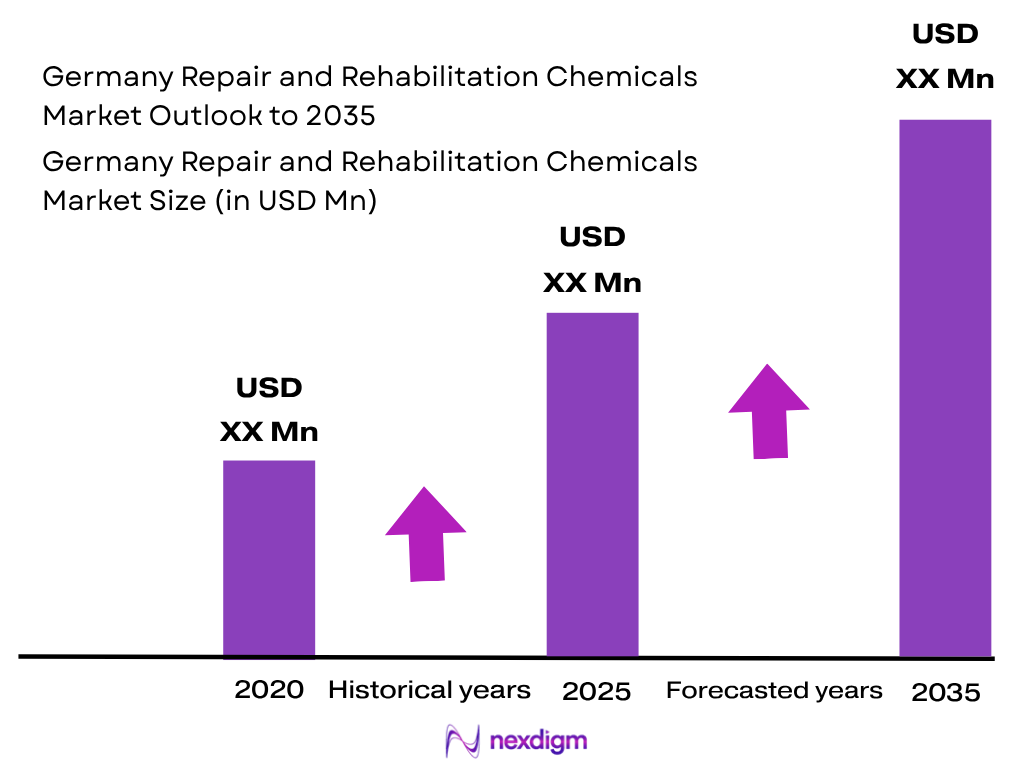
The Germany Repair and Rehabilitation Chemicals Market is valued at approximately USD ~XX million, supported by the country’s extensive stock of ageing residential, commercial and infrastructure assets. Germany’s dwelling inventory increased from 43.517 million to 43.756 million units, while total construction investment moved from EUR 453.01 billion to EUR 450.66 billion across consecutive annual observations. This large installed base sustains demand for PCC/SPCC mortars, injection resins, corrosion protection, surface coatings and structural strengthening systems.
North Rhine-Westphalia, Bavaria and Baden-Württemberg dominate the Germany Repair and Rehabilitation Chemicals Market because they combine Germany’s largest population concentrations with dense building, industrial and transport infrastructure. Destatis records Baden-Württemberg’s population increasing from 11,230,740 to 11,245,898, while the latest corresponding figures place North Rhine-Westphalia at 18,034,454 residents and Bavaria at 13,248,928. These regions contain extensive bridges, parking structures, residential buildings and industrial concrete assets requiring recurring rehabilitation and durability enhancement.
Market Segmentation
By Product Type
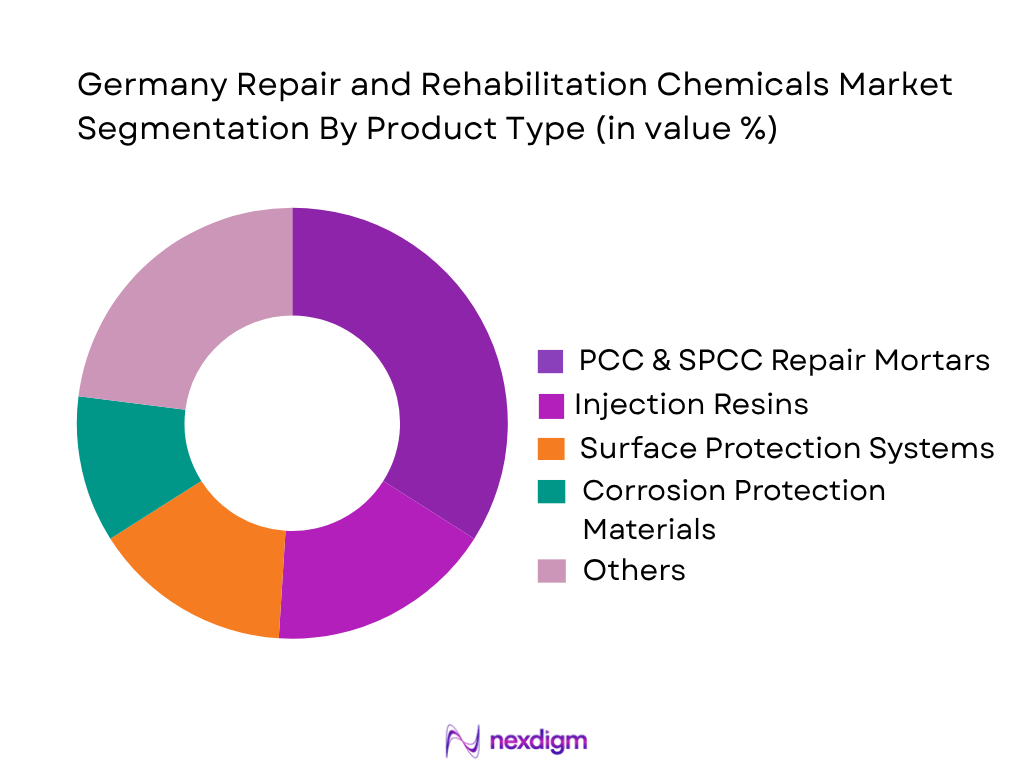
The Germany Repair and Rehabilitation Chemicals Market is segmented into PCC and SPCC repair mortars, injection resins, surface protection systems, corrosion protection materials, structural strengthening systems, waterproof rehabilitation products and other specialty chemicals. PCC and SPCC repair mortars hold the dominant position because concrete reinstatement remains fundamental to bridge, parking structure, balcony, façade, tunnel and industrial rehabilitation. Germany’s technical framework places substantial emphasis on compatible concrete replacement systems with controlled mechanical properties and exposure resistance. Remmers, for example, markets PCC and SPCC systems covering R3 and R4 structural repair, manual placement, wet spraying and dry spraying, with products designed for frost and de-icing salt exposure. Such versatility allows repair mortars to address local patching as well as larger structural sections. The prevalence of reinforced-concrete infrastructure and recurring carbonation, chloride and freeze-thaw deterioration reinforces the importance of cementitious repair systems as the base layer of comprehensive rehabilitation specifications.
By Structure Type
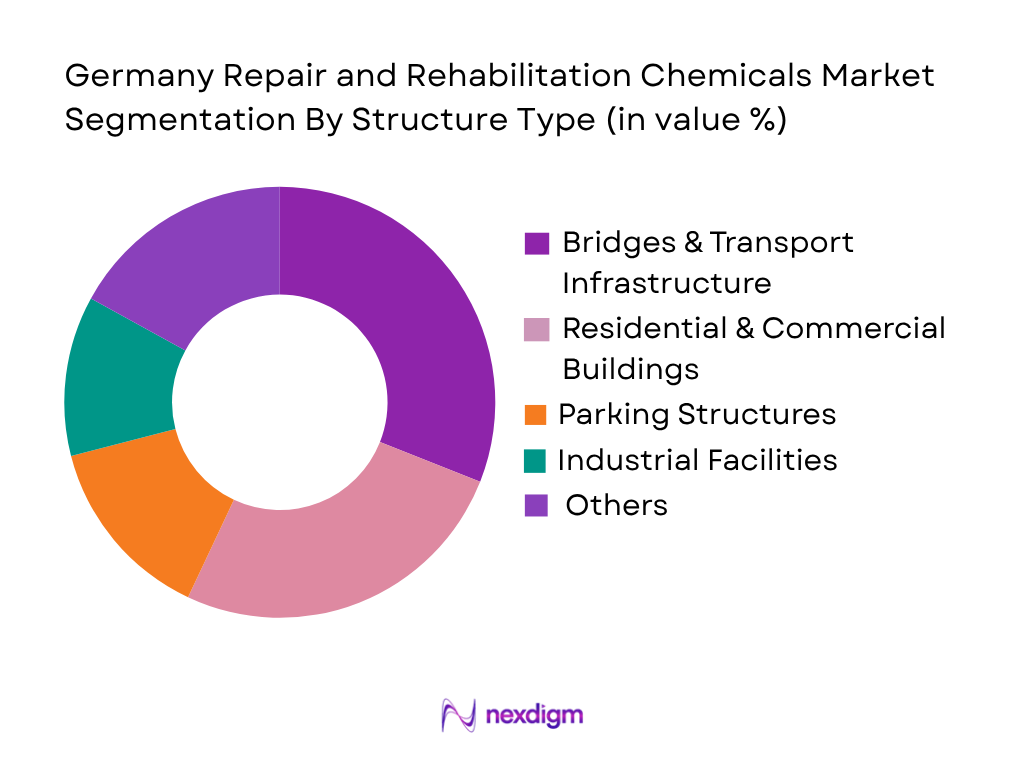
The Germany Repair and Rehabilitation Chemicals Market is segmented into bridges and transport infrastructure, residential and commercial buildings, parking structures, industrial facilities, water and wastewater infrastructure, tunnels and other concrete structures. Bridges and transport infrastructure represent the dominant segment because Germany operates a large ageing federal bridge stock exposed to traffic loading, de-icing salts, carbonation and freeze-thaw cycles. Autobahn GmbH reports around 28,000 bridge substructures on the motorway network and approximately 40,000 bridges across federal trunk roads, with around 4,000 bridge structures identified for modernization on priority motorway corridors. Repair programs commonly require concrete replacement mortars, corrosion-control systems, injection materials, waterproofing and surface protection before complete replacement becomes necessary. More than half of Germany’s bridge structures were constructed before 1985, reinforcing the requirement for systematic condition assessment and rehabilitation. The scale and technical intensity of bridge interventions therefore support transport infrastructure’s leading position within Germany’s rehabilitation-chemicals demand structure.
Competitive Landscape
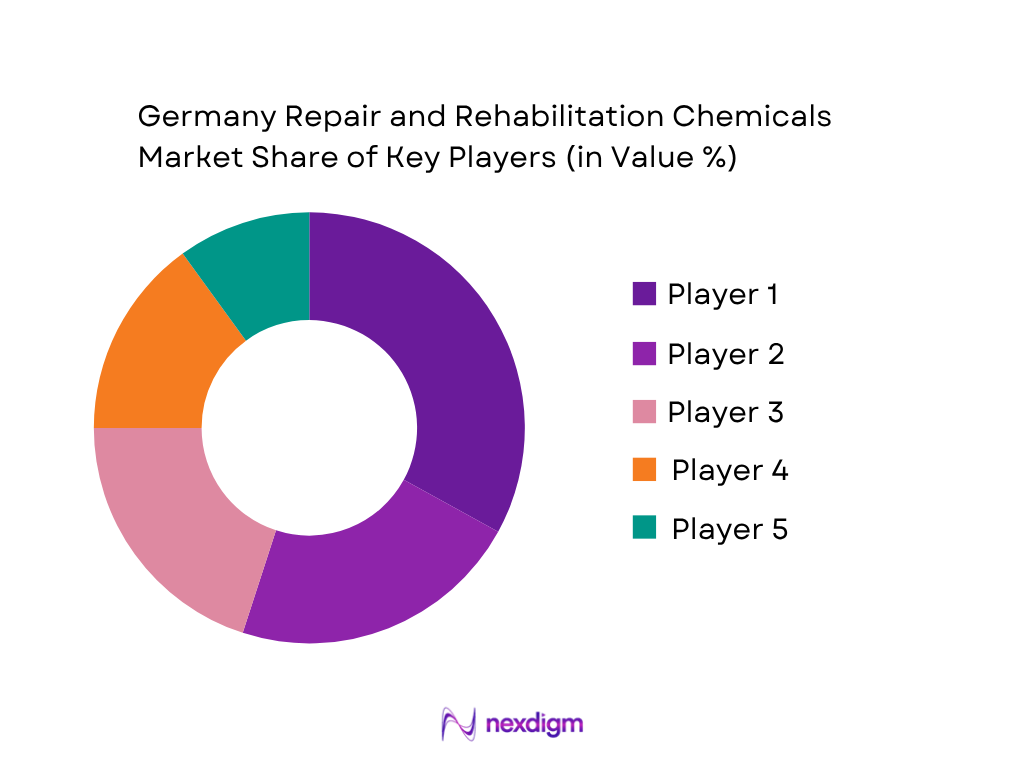
The Germany Repair and Rehabilitation Chemicals Market includes established domestic construction-chemical manufacturers and major European suppliers with broad technical portfolios. MC-Bauchemie, Sika, Remmers, Sto and MAPEI compete across concrete replacement mortars, crack injection, reinforcement corrosion protection, surface protection and structural strengthening. Competitive advantage is driven by EN 1504 compliance, compatibility with German repair rules, technical laboratory support, specification capability, specialist-contractor relationships and the ability to provide complete system solutions rather than individual products. Sika, for example, explicitly aligns its German concrete-repair portfolio with EN 1504 and national DAfStb repair requirements.
| Company | Established | Headquarters | Core Repair Systems | Injection Capability | Corrosion Protection Capability | Surface Protection Capability | Structural Strengthening Capability | Germany Market Positioning |
| MC-Bauchemie | 1961 | Bottrop, Germany | ~ | ~ | ~ | ~ | ~ | ~ |
| Sika AG | 1910 | Baar, Switzerland | ~ | ~ | ~ | ~ | ~ | ~ |
| Remmers GmbH | 1949 | Löningen, Germany | ~ | ~ | ~ | ~ | ~ | ~ |
| Sto SE & Co. KGaA | 1955 | Stühlingen, Germany | ~ | ~ | ~ | ~ | ~ | ~ |
| MAPEI Group | 1937 | Milan, Italy | ~ | ~ | ~ | ~ | ~ | ~ |
Germany Repair and Rehabilitation Chemicals Market Analysis
Growth Drivers
Accelerating Bridge and Transport Infrastructure Rehabilitation
Germany’s ageing road-bridge network is creating sustained demand for PCC/SPCC repair mortars, injection resins, reinforcement-corrosion protection, hydrophobic treatments and protective coatings. Autobahn GmbH manages around 28,000 motorway bridge substructures, while the federal trunk-road network contains approximately 40,000 bridges; about 4,000 bridge structures on priority motorway corridors have been identified for accelerated modernization. Active projects demonstrate the rehabilitation intensity: the 830-metre Fellertal Bridge entered major repair in 2024, with nearly 28,000 square metres of bridge area scheduled for rehabilitation, including waterproofing, deck components and expansion joints. In 2025, the federal government additionally authorized approximately EUR 1.1 billion for urgent rehabilitation of bridges, tunnels and motorway surfaces. These programs directly create applications for structural mortars, crack treatment, concrete replacement and corrosion-control chemistry. The macroeconomic base remains substantial despite weak economic momentum: the World Bank recorded German GDP at US$4,685.59 billion and GDP per capita at US$56,103.7 in 2024. Germany’s combination of high-value infrastructure and ageing concrete assets therefore makes transport rehabilitation a central volume driver for specialized repair chemicals.
Large Existing Building Stock Supporting Recurring Rehabilitation
Germany’s mature building inventory creates a broad recurring application base for concrete-repair mortars, injection systems, balcony rehabilitation, parking-garage protection and façade restoration. Destatis recorded approximately 43.8 million dwellings at the end of 2024, representing an increase of 238,500 dwellings from 2023. Around 23.5 million dwellings were located in approximately 3.5 million multifamily buildings, where common concrete elements include balconies, basements, underground parking areas, stair structures and façade components. Germany’s total residential floor area reached roughly 4.1 billion square metres, illustrating the physical scale of assets requiring long-term maintenance rather than one-time construction activity. This existing stock becomes particularly important as new construction weakens: only 215,900 dwellings received construction approval in 2024, 43,700 fewer than the previous year. Repair and refurbishment can consequently provide a more resilient demand channel than new-build construction for rehabilitation-chemical suppliers. At the macroeconomic level, the World Bank reported Germany’s 2024 GDP at US$4,685.59 billion and GDP per capita at US$56,103.7, supporting substantial household, institutional and property-owner capacity to maintain high-value real-estate assets.
Market Challenges
Shortage of Skilled Construction and Specialist Rehabilitation Labour
The Germany Repair and Rehabilitation Chemicals Market faces a significant execution challenge because concrete rehabilitation requires trained personnel for condition assessment, substrate preparation, reinforcement treatment, injection, spray-mortar placement and controlled curing. Destatis reported approximately 2.6 million construction workers in 2024, representing a decline of 28,000 employees from the previous year and ending the sector’s long-running employment expansion. This is particularly relevant to technically demanding rehabilitation projects because repair-system failure can result from inadequate concrete removal, improper moisture conditioning, incorrect injection pressure or insufficient corrosion treatment even where premium chemicals are specified. The Federal Employment Agency also identifies widespread demand for qualified labour across more than 160 shortage occupations, reinforcing the broader constraint on technically skilled personnel. Rehabilitation workloads are simultaneously increasing: Autobahn GmbH’s bridge-modernization program addresses about 4,000 priority bridge structures, requiring specialist contractors and engineers alongside materials. The constraint operates within an economy of considerable scale; the World Bank recorded German GDP of US$4,685.59 billion in 2024, while national employment reached approximately 46.1 million persons. Repair-chemical suppliers therefore increasingly need contractor training, application supervision and system-specific technical support to reduce workmanship-related project risk.
Complex Asset Conditions and Traffic-Sensitive Repair Execution
Germany’s rehabilitation market is technically challenging because ageing structures often remain operational while repairs are undertaken, requiring products that combine structural performance with rapid application and limited service disruption. The Wiehltal Bridge is approximately 700 metres long and entered intensive monitoring following structural-capacity deficiencies identified during the 2024/2025 inspection cycle, resulting in lane restrictions and limitations on heavy transport. The Ringbahn Bridge, originally designed for around 25,000 vehicles per day, was exposed to approximately 230,000 daily vehicles in 2025 at the Funkturm interchange before structural deterioration triggered closure. Such conditions complicate concrete repair because contractors must work around continuous traffic, vibration, restricted access and narrow possession windows while ensuring adequate bond development, curing and reinforcement protection. Product selection must also reflect carbonation, chloride ingress, freeze-thaw action and de-icing salt exposure rather than compressive strength alone. Germany’s US$4,685.59 billion GDP in 2024, reported by the World Bank, indicates the economic importance of keeping transport assets operational. Consequently, manufacturers face demanding requirements for rapid-setting mortars, low-viscosity injection resins, spray-applied systems and technically validated rehabilitation packages capable of minimizing downtime while extending asset life.
Market Opportunities
Infrastructure Modernization Funding Creates a Larger Rehabilitation Pipeline
Germany’s current public-infrastructure funding framework creates a strong forward opportunity for suppliers of structural repair mortars, injection products, corrosion-control systems and concrete-protection materials. The Federal Ministry of Finance established the Infrastructure and Climate Neutrality Special Fund in 2025 with EUR 500 billion available for additional investment over a 12-year implementation framework. During 2025 alone, approximately EUR 24 billion was already disbursed from the fund, while Autobahn GmbH received around EUR 1.1 billion in additional resources specifically for urgent rehabilitation of bridges, tunnels and road surfaces. These current allocations expand the financial capacity for rehabilitation projects whose technical scopes typically include crack injection, concrete replacement, waterproofing, corrosion treatment and structural strengthening. The existing bridge base reinforces the addressable opportunity: around 4,000 motorway bridge structures have been identified for priority modernization. Germany also remains one of the world’s largest economies, with the World Bank recording GDP of US$4,685.59 billion and GDP per capita of US$56,103.7 in 2024. Suppliers with EN 1504-compliant systems, established contractor networks and technical specification capabilities are therefore positioned to participate in a substantially enlarged infrastructure-renewal program.
Repair-over-Replacement and High-Performance Rehabilitation Systems
Germany’s large stock of existing buildings and transport assets creates an opportunity for repair technologies that extend structural life without complete demolition or replacement. Destatis recorded approximately 43.8 million dwellings in 2024, including 23.5 million apartments in 3.5 million multifamily buildings, while total residential floor area reached approximately 4.1 billion square metres. Simultaneously, weaker new-build activity increased the strategic relevance of maintaining existing assets, with only 215,900 dwellings approved in 2024, compared with 259,600 approximately one year earlier. Infrastructure projects demonstrate the same lifecycle logic. The Fellertal Bridge rehabilitation covers nearly 28,000 square metres of bridge area, while the Ahrtal Bridge rehabilitation completed in 2024 involved renewed waterproofing, drainage and roadway components rather than full structural replacement. This environment favours higher-value PCC/SPCC mortars, hydrophobic impregnation, anti-carbonation coatings, epoxy injection and CFRP strengthening systems that allow targeted extension of service life. The World Bank’s US$4,685.59 billion German GDP figure for 2024 provides the macroeconomic foundation for continued investment in existing assets. Suppliers capable of offering complete diagnosis-to-protection systems can therefore capture increasing rehabilitation demand across buildings, parking structures and infrastructure.
Future Outlook
The Germany Repair and Rehabilitation Chemicals Market is forecast to expand at approximately ~X.X% CAGR during 2026–2035. Growth is expected to be increasingly driven by rehabilitation of existing assets rather than dependence on new construction alone. Germany’s ageing bridges, parking structures, residential stock, wastewater infrastructure and industrial facilities create long-duration requirements for concrete repair, injection, corrosion mitigation and surface protection. Greater emphasis on lifecycle extension and avoiding premature demolition is also expected to favour technically advanced rehabilitation systems.
Bridge modernization represents one of the clearest demand pools. Autobahn GmbH identifies approximately 4,000 motorway bridge structures requiring modernization on a priority network of around 7,000 kilometres. Repair solutions are required both to maintain structures until replacement and to extend the life of bridges where full reconstruction is unnecessary.
Major Players
- MC-Bauchemie Müller GmbH & Co. KG
- Sika Deutschland CH AG & Co KG
- Remmers GmbH
- Sto SE & Co. KGaA
- MAPEI GmbH
- PCI Augsburg GmbH
- SCHOMBURG GmbH & Co. KG
- PAGEL Spezial-Beton GmbH & Co. KG
- KÖSTER BAUCHEMIE AG
- Master Builders Solutions Deutschland GmbH
- Saint-Gobain Weber GmbH
- ARDEX GmbH
- Tremco CPG Germany GmbH
- Fosroc Germany / Fosroc Europe
- Sopro Bauchemie GmbH
Key Target Audience
- Repair and Rehabilitation Chemical Manufacturers
- Construction Chemical Distributors and Baustoff-Fachhandel
- Specialist Concrete Repair and Structural Strengthening Contractors
- Bridge, Tunnel and Transport Infrastructure Operators
- Residential, Commercial and Industrial Asset Owners
- Water and Wastewater Infrastructure Operators
- Investments and Venture Capitalist Firms
- Government and Regulatory Bodies (Federal Ministry of Transport, Federal Highway Research Institute, German Institute for Building Technology, Federal Highway Company)
Research Methodology
Step 1: Identification of Key Variables
The initial phase involves constructing an ecosystem map encompassing manufacturers, distributors, specialist repair contractors, engineering offices, infrastructure operators and asset owners within the Germany Repair and Rehabilitation Chemicals Market. Secondary research is used to identify critical variables including repair chemistry, deterioration mechanism, asset type, application method, technical standards and regional rehabilitation intensity.
Step 2: Market Analysis and Construction
Historical demand is analyzed through combined top-down and bottom-up techniques. The top-down assessment evaluates Germany’s building stock, bridge network, infrastructure maintenance and construction investment, while the bottom-up model assesses product consumption across PCC/SPCC repair, injection, corrosion protection, coatings and strengthening applications to construct the Germany Repair and Rehabilitation Chemicals Market framework.
Step 3: Hypothesis Validation and Expert Consultation
Market hypotheses are validated through computer-assisted telephone interviews and structured discussions with manufacturers, Baustoff-Fachhandel participants, specialist concrete repair contractors, engineers and asset managers. These interactions help validate repair-system selection, EN 1504 compliance, PCC and SPCC usage, injection technologies, procurement structures and competitive positioning across the Germany Repair and Rehabilitation Chemicals Market.
Step 4: Research Synthesis and Final Output
Primary findings are triangulated with Destatis statistics, federal infrastructure information, technical regulations, company product portfolios and project-level rehabilitation evidence. Top-down estimates are reconciled with bottom-up product consumption calculations before finalizing segmentation, competition and future demand. This process produces a comprehensive and internally consistent assessment of the Germany Repair and Rehabilitation Chemicals Market.

- Executive Summary
- Research Methodology (Market Definitions and Assumptions, Germany Repair and Rehabilitation Chemicals Market Classification, PCC Repair Mortar Assessment, SPCC Repair Mortar Assessment, Structural Repair Mortar Scope, Non-Structural Repair Mortar Assessment, Microconcrete Assessment, Cementitious Grout Assessment, Epoxy Grout Assessment, Epoxy Crack Injection Assessment, Polyurethane Injection Assessment, Cementitious Injection Assessment, Structural Epoxy Bonding Assessment, Reinforcement Corrosion Protection Assessment, Corrosion Inhibitor Assessment, Surface Protection System Assessment, Hydrophobic Impregnation Assessment, Anti-Carbonation Coating Assessment, Waterproofing Rehabilitation Assessment, CFRP Structural Strengthening Assessment, Joint Rehabilitation Assessment, Bridge Rehabilitation Assessment, Tunnel Rehabilitation Assessment, Parking Structure Rehabilitation Assessment, Water and Wastewater Structure Repair Assessment, EN 1504 Repair Principle Mapping, TR Instandhaltung Assessment, ZTV-ING Infrastructure Repair Assessment, ZTV-W Water Structure Assessment, Carbonation Depth Assessment, Chloride Exposure Assessment, Freeze-Thaw Exposure Assessment, Crack Width Assessment, Repair Depth Assessment, Substrate Condition Assessment)

- Definition and Scope
- Germany Repair and Rehabilitation Chemicals Industry Evolution and Development of Conventional Cementitious Concrete Repair, PCC Polymer-Modified Repair Mortars, SPCC Spray Mortars, R1 Repair Mortars, R2 Repair Mortars, R3 Structural Repair Mortars, R4 Structural Repair Mortars, Microconcrete, Cementitious Grouts, Epoxy Grouts, Low-Viscosity Epoxy Injection Resins, Polyurethane Injection Systems, Cementitious Injection Materials, Structural Epoxy Bonding Agents, Reinforcement Corrosion Protection Systems, Corrosion Inhibitors, Anti-Carbonation Coatings, Hydrophobic Impregnation, Crack-Bridging Surface Protection Systems, Waterproof Rehabilitation Materials, CFRP Strengthening Systems, Joint Rehabilitation Materials, Rapid-Setting Repair Materials and Integrated Repair-and-Protection Systems
- Repair and Rehabilitation Chemicals Value Chain Analysis
- Repair and Rehabilitation Chemicals Supply Chain Analysis
- Cement and Specialty Binder Suppliers, Redispersible Polymer Powder Suppliers, Epoxy Resin Suppliers, Polyurethane Raw Material Suppliers, Fibre Suppliers, Corrosion Inhibitor Suppliers, Silane and Siloxane Suppliers, Mineral Filler Suppliers, Specialty Additive Suppliers, Repair Chemical Manufacturers, Domestic Construction Chemical Producers, Importers, Baustoff-Fachhandel, Construction Chemical Distributors

- Growth Drivers (Aging Reinforced Concrete Infrastructure, Bridge Rehabilitation, Parking Structure Refurbishment, Residential Building Renovation, Balcony and Façade Repair, Tunnel Maintenance, Water and Wastewater Infrastructure Rehabilitation, De-Icing Salt Damage, Carbonation-Induced Reinforcement Corrosion, Chloride Exposure, Structural Safety Upgrading, Lifecycle Extension of Existing Concrete Assets)
- Market Challenges (Incomplete Concrete Condition Assessment, Hidden Reinforcement Corrosion, Chloride Contamination, Carbonation Depth, Freeze-Thaw Damage, High Substrate Moisture, Crack Recurrence, Incorrect Repair Material Selection, Weak Surface Preparation, Repair Mortar Debonding, Skilled Specialist Contractor Availability, Structural Shutdown Constraints, EN 1504 Compliance Complexity, TR Instandhaltung Compliance, Quality Control of Site Application)
- Market Opportunities (R3 and R4 Structural Repair Mortars, PCC and SPCC Repair Systems, High-Early-Strength Rapid Repair, Epoxy Crack Injection, PU Leakage Injection, Corrosion Protection Systems, Anti-Carbonation Coatings, Hydrophobic Impregnation, CFRP Strengthening, Parking Structure Rehabilitation, Bridge Deck Repair, Wastewater Chemical-Resistant Repair, Rapid Infrastructure Repair, Preventive Concrete Protection, Low-Carbon Repair Systems)
- Market Trends (Pre-Bagged Polymer-Modified Repair Mortars, PCC and SPCC Repair Systems, EN 1504-Based Specification, R3 and R4 Performance Classification, Low-Shrinkage Repair Mortars, Spray-Applied Structural Repair, Low-Viscosity Epoxy Injection, Fast-Curing PU Injection, Integrated Repair-and-Protection Systems, Corrosion Management, CFRP Strengthening, Low-Carbon Repair Mortars, Rapid Return-to-Service Materials, Preventive Rehabilitation, Asset-Life Extension)
- Government Regulations and Standards (EN 1504 Concrete Protection and Repair Requirements, EN 1504-3 Structural and Non-Structural Repair Products, EN 1504-5 Concrete Injection Requirements, EN 1504-7 Reinforcement Corrosion Protection, EN 1504-9 Repair Principles, TR Instandhaltung Requirements, ZTV-ING Infrastructure Repair Specifications, ZTV-W Water Structure Requirements, DAfStb Technical Rules, DIN Test Standards, CE Marking, Declaration of Performance Requirements, REACH Requirements, CLP Chemical Classification Requirements)
SWOT Analysis - Porter’s Five Forces Analysis
- PESTLE Analysis
- Stakeholder Ecosystem
- Repair Chemical Manufacturing Contractor and Asset Rehabilitation Ecosystem

- By Market Value (2020-2025)
- By Repair Chemical Consumption Volume (2020-2025)
- By PCC Repair Mortar Consumption (2020-2025)
- By SPCC Repair Mortar Consumption (2020-2025)
- By Structural Repair Mortar Consumption (2020-2025)
- By Microconcrete Consumption (2020-2025)
- By Epoxy Injection Consumption (2020-2025)
- By Polyurethane Injection Consumption (2020-2025)
- By Cementitious Grout Consumption (2020-2025)
- By Epoxy Grout Consumption (2020-2025)
- By Corrosion Protection Material Consumption (2020-2025)
- By Surface Protection System Consumption (2020-2025)
- By Structural Strengthening Chemical Consumption (2020-2025)
- By Building Rehabilitation Chemical Consumption (2020-2025)
- By Bridge and Infrastructure Repair Chemical Consumption (2020-2025)

- By Product Type (In Value %)
PCC Repair Mortars
SPCC Spray Mortars
Structural Repair Mortars
Non-Structural Repair Mortars
Microconcrete and Flowable Repair Materials
Cementitious Grouts
Epoxy Grouts
Epoxy Injection Resins
Polyurethane Injection Resins
Cementitious Injection Materials
Structural Epoxy Bonding Agents
Reinforcement Corrosion Protection Materials
Corrosion Inhibitors
Surface Protection Systems
Hydrophobic Impregnation Systems
Anti-Carbonation Coatings
CFRP Strengthening Resins and Adhesives
Joint Rehabilitation Materials
Rapid-Setting Repair Materials
Specialty Rehabilitation Chemicals - By Repair Chemistry (In Value %)
Polymer-Modified Cementitious Systems
Epoxy Resin Systems
Polyurethane Systems
Acrylic Systems
Silane and Siloxane Systems
Corrosion-Inhibiting Chemistries
CFRP and Composite Resin Systems
Hybrid Polymer-Cement Systems
Mineral Repair Systems
Other Specialty Chemistries - By Application (In Value %)
Concrete Spall Repair
Crack Injection
Water Leakage Injection
Reinforcement Corrosion Repair
Carbonation-Damaged Concrete Repair
Chloride-Damaged Concrete Repair
Freeze-Thaw Damage Repair
Structural Section Restoration
Beam and Column Repair
Slab and Deck Repair
Bridge Deck Rehabilitation
Pier and Abutment Repair
Tunnel Lining Repair
Parking Structure Repair
Balcony and Façade Repair
Industrial Concrete Repair
Water and Wastewater Structure Rehabilitation
Joint Rehabilitation - By Performance Requirement (In Value %)
High Compressive Strength
High Bond Strength
Low Shrinkage
High Early Strength
Rapid Return-to-Service
High Flexural Strength
High Tensile Strength
Spray Application Capability
High Build Thickness
Freeze-Thaw Resistance
Chloride Resistance
Carbonation Resistance
Chemical Resistance
Water Immersion Resistance
Crack Bridging
Corrosion Protection
Low Permeability
Structural Load Transfer - By Structure Type (In Value %)
Bridges and Flyovers
Tunnels
Parking Garages and Underground Car Parks
Residential Buildings
Commercial Buildings
Industrial Facilities
Power Plants
Water Treatment Plants
Wastewater Treatment Plants
Drinking Water Structures
Rail Infrastructure
Precast Concrete Structures
Balconies and Façades
Retaining Structures
Municipal Infrastructure - By Region (In Value %)
North Rhine-Westphalia
Bavaria
Baden-Württemberg
Lower Saxony
Hesse
Berlin
Hamburg
Saxony
Rhineland-Palatinate
Schleswig-Holstein
Brandenburg
Saxony-Anhalt
Thuringia
Mecklenburg-Vorpommern
Saarland
Bremen

- Market Share of Major Players (By Germany Revenue, Repair Chemical Consumption Volume, PCC Repair Mortar Portfolio, SPCC Repair Mortar Portfolio, Epoxy Injection Portfolio, Polyurethane Injection Portfolio, Grout Portfolio, Corrosion Protection Capability, Surface Protection Capability, Waterproofing Rehabilitation Exposure, CFRP Strengthening Exposure, Bridge and Infrastructure Project Exposure, Germany Manufacturing Capacity, Baustoff-Fachhandel Network, Technical Laboratory Capability)
- Cross Comparison Parameters (PCC SPCC R3 and R4 Structural Repair Portfolio Breadth, Epoxy Polyurethane and Cementitious Crack Injection Capability, Reinforcement Corrosion Protection and Surface Durability Technology Capability, CFRP Structural Strengthening Bonding and Anchoring Capability, Bridge Parking Tunnel and Water Infrastructure Rehabilitation Project Reference Base, Rapid-Setting High-Early-Strength and Traffic-Sensitive Repair Capability, Germany Manufacturing Warehousing Baustoff-Fachhandel and Distribution Reach, Condition Assessment Specification Support Contractor Training and Project-Site Technical Service Capability)
- SWOT Analysis of Major Players
- Competitive Positioning Matrix
- Major Companies
MC-Bauchemie Müller GmbH & Co. KG
Sika Deutschland CH AG & Co KG
Remmers GmbH
Sto SE & Co. KGaA
MAPEI GmbH
PCI Augsburg GmbH
SCHOMBURG GmbH & Co. KG
PAGEL Spezial-Beton GmbH & Co. KG
KÖSTER BAUCHEMIE AG
Master Builders Solutions Deutschland GmbH
Saint-Gobain Weber GmbH
ARDEX GmbH
Tremco CPG Germany GmbH
Fosroc Germany / Fosroc Europe
Sopro Bauchemie GmbH

- Structural Repair Contractor Requirement Assessment
- Infrastructure Contractor Requirement Assessment
- Bridge Rehabilitation Contractor Requirement Assessment
- Injection Contractor Requirement Assessment
- Parking Structure Repair Contractor Requirement Assessment
- Structural Strengthening Contractor Requirement Assessment
- Property Owner Rehabilitation Requirement Assessment
- Housing Company Rehabilitation Requirement Assessment
- Industrial Asset Owner Requirement Assessment
- Municipal Infrastructure Requirement Assessment
- Water and Wastewater Operator Requirement Assessment
- Engineering Office Specification Assessment
- Technical Laboratory and Site Support Requirement Assessment

- By Market Value (2026-2035)
- By Repair Chemical Consumption Volume (2026-2035)
- By PCC Repair Mortar Consumption (2026-2035)
- By SPCC Repair Mortar Consumption (2026-2035)
- By Structural Repair Mortar Consumption (2026-2035)
- By Microconcrete Consumption (2026-2035)
- By Epoxy Injection Consumption (2026-2035)
- By Polyurethane Injection Consumption (2026-2035)
- By Cementitious Grout Consumption (2026-2035)
- By Epoxy Grout Consumption (2026-2035)
- By Corrosion Protection Material Consumption (2026-2035)
- By Surface Protection System Consumption (2026-2035)
- By Structural Strengthening Chemical Consumption (2026-2035)
- By Building Rehabilitation Chemical Consumption (2026-2035)
- By Bridge and Infrastructure Repair Chemical Consumption (2026-2035)


 Request a Sample
 Ask for Customization
 Get a Quote
 Enquire Now