
 Download PDF
Market Overview
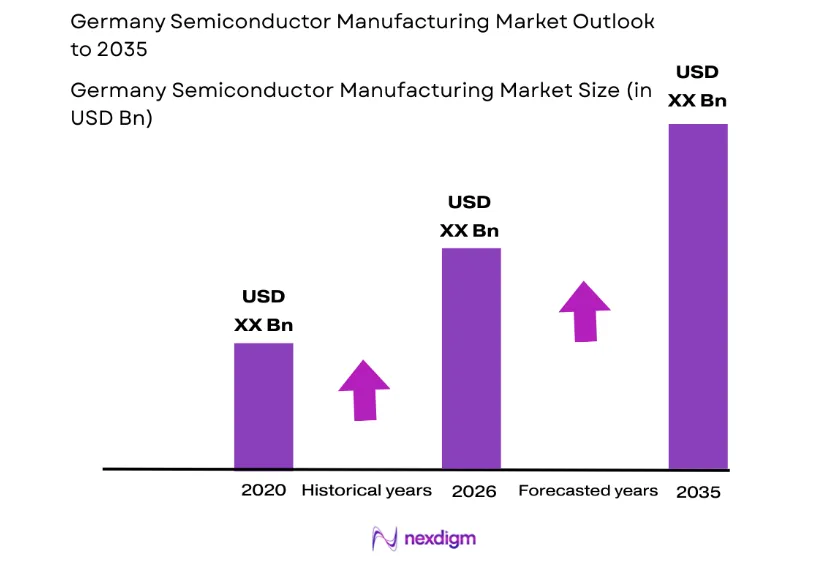
Germany’s semiconductor manufacturing market reached approximately USD ~ based on a recent historical assessment compiled from industry reports and government trade statistics, including data from the German Ministry of Economic Affairs and International Trade and semiconductor associations. Growth is driven by the rising demand for semiconductors in automotive applications, industrial automation, consumer electronics, and renewable energy systems. Semiconductor foundries in Germany, as part of the EU’s digitalization agenda, are increasing production capacity and advancing research into next-generation chips.
Germany’s semiconductor manufacturing hub is concentrated primarily in cities such as Dresden, Munich, and Nuremberg, which house the country’s leading chip production facilities and R&D centers. These cities benefit from robust industrial infrastructure, highly skilled labor, and strong collaboration between private semiconductor companies and public sector initiatives, including the government’s support for the semiconductor industry within Europe. These regions are dominant in high-tech development, particularly for automotive, telecommunications, and industrial applications.
Market Segmentation
By Product Type
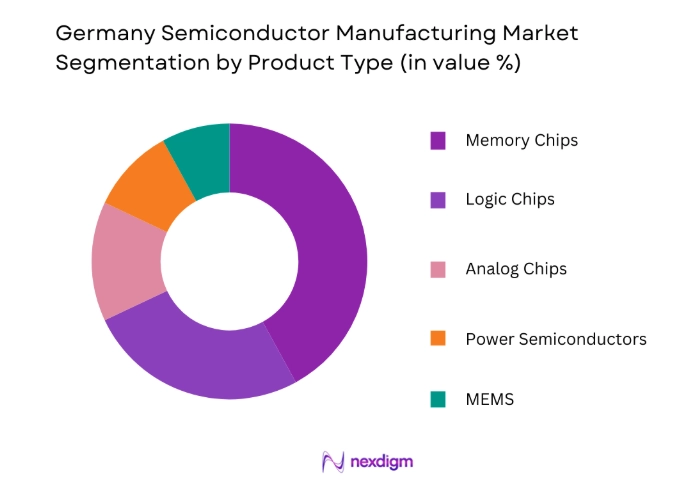
By Product Type, Germany’s semiconductor manufacturing market is segmented by product type into Memory Chips, Logic Chips, Analog Chips, Power Semiconductors, and Microelectromechanical Systems (MEMS). Recently, Memory Chips have a dominant market share due to factors such as demand patterns, brand presence, infrastructure availability, or consumer preference. Memory chips, including DRAM and NAND flash, are essential for consumer electronics, automotive, and industrial applications, fueling demand from leading sectors in Germany. The automotive sector, with its growing reliance on in-vehicle electronics and data storage, drives significant demand for high-performance memory chips. As more devices become connected and data-driven, the need for memory chips with higher density and faster access speeds continues to grow, reinforcing their market dominance.
By End Use Industry
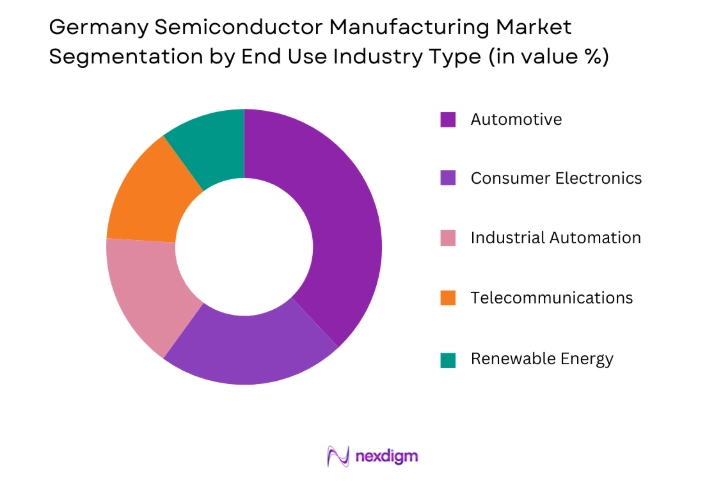
By End Use Industry, Germany’s semiconductor manufacturing market is segmented by product type into Automotive, Consumer Electronics, Industrial Automation, Telecommunications, and Renewable Energy. Recently, Automotive has a dominant market share due to factors such as demand patterns, brand presence, infrastructure availability, or consumer preference. The automotive industry in Germany is a significant consumer of semiconductors, particularly as the industry increasingly relies on advanced driver assistance systems (ADAS), autonomous driving technologies, and electric vehicles (EVs). The shift toward electric mobility and connected cars has led to a surge in demand for power semiconductors, sensors, and memory chips. Germany, being home to some of the world’s largest automotive manufacturers, continues to drive semiconductor demand in this sector, which supports long-term growth prospects for the semiconductor market.
Competitive Landscape
Germany’s semiconductor manufacturing market is competitive, with major global players establishing or expanding their presence in the region. The market is consolidated, with large semiconductor companies operating both manufacturing plants and R&D centers. The government has actively supported the industry through funding and incentives, enabling the expansion of local foundries and technological capabilities. Despite the dominance of global players, regional innovation and the presence of strong industrial and academic partnerships ensure continued growth.
| Company Name | Establishment Year | Headquarters | Technology Focus | Market Reach | Key Products | Revenue | Technology Partnerships |
| Intel Corporation | 1968 | United States | ~ | ~ | ~ | ~ | ~ |
| Samsung Electronics | 1938 | South Korea | ~ | ~ | ~ | ~ | ~ |
| TSMC | 1987 | Taiwan | ~ | ~ | ~ | ~ | ~ |
| Infineon Technologies | 1999 | Germany | ~ | ~ | ~ | ~ | ~ |
| NXP Semiconductors | 2006 | Netherlands | ~ | ~ | ~ | ~ | ~ |
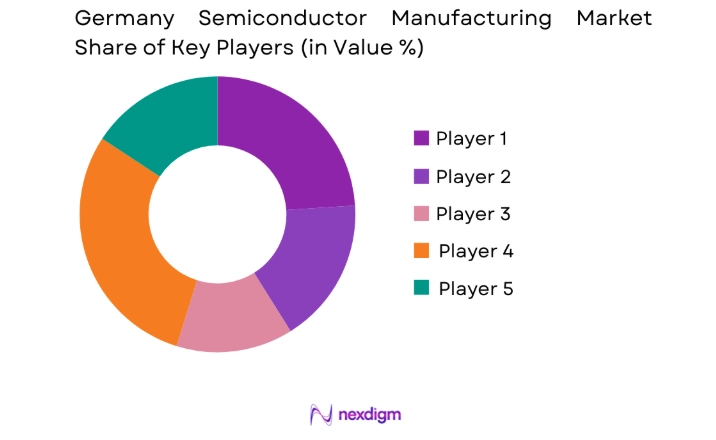
Germany Semiconductor Manufacturing Market Analysis
Growth Drivers
Technological Advancements in Automotive Electronics:
The growing reliance on electronic systems in vehicles is a key driver of semiconductor demand in Germany. The automotive sector increasingly incorporates advanced driver assistance systems (ADAS), electric vehicles (EVs), and autonomous driving technologies, all of which require advanced semiconductor components. Power semiconductors, sensors, memory chips, and microcontrollers are crucial for the operation of electric vehicles, which need efficient power management systems, fast data processing, and vehicle-to-vehicle communication. The shift towards electric mobility in Germany, with local automotive giants such as Volkswagen, BMW, and Mercedes-Benz leading the charge, has led to an increased need for advanced semiconductors. Additionally, autonomous driving technologies are expected to grow in the coming years, further driving the demand for specialized chips. As automotive electronics become more sophisticated, the demand for high-performance semiconductors will only continue to rise, supporting long-term market growth.
Growth in Industrial Automation and Smart Manufacturing:
The continued digital transformation of industrial sectors in Germany is driving significant demand for semiconductors. As Industry 4.0 technologies become more integrated into manufacturing processes, the need for sensors, microcontrollers, and memory chips has increased. Industrial automation systems, which rely on robots, machine learning, and IoT-enabled devices, require advanced semiconductors to operate efficiently. These systems help manufacturers optimize production, reduce operational costs, and enhance product quality. As German industries increasingly adopt smart manufacturing technologies, the demand for semiconductors in industrial automation will continue to grow, contributing to the overall expansion of the market. Moreover, the integration of advanced AI and machine learning into production systems will require powerful chips capable of supporting complex calculations, further bolstering the demand for high-performance semiconductors.
Market Challenges
Supply Chain Disruptions and Semiconductor Shortages:
The semiconductor manufacturing sector in Germany faces challenges due to ongoing global supply chain disruptions. The COVID-19 pandemic highlighted the vulnerabilities in the semiconductor supply chain, which has been further exacerbated by geopolitical tensions and trade restrictions. For example, shortages of essential raw materials, including silicon and rare earth metals, have caused delays in semiconductor production and led to price fluctuations. Additionally, disruptions in global logistics, including transportation delays and port congestion, have impacted the timely delivery of semiconductors. These challenges have especially affected industries such as automotive manufacturing, where just-in-time production systems rely heavily on the timely availability of semiconductors. Consequently, manufacturers have been forced to adapt by adjusting production schedules and implementing new strategies to secure semiconductor supplies, but the uncertainty in the supply chain remains a significant challenge for the industry.
High Capital Investment and R&D Costs:
The semiconductor manufacturing industry in Germany requires high capital investment in advanced manufacturing facilities, R&D, and cutting-edge equipment to remain competitive. Establishing state-of-the-art fabrication plants, known as foundries, demands billions of dollars in capital, as the production of semiconductors involves complex, high-precision equipment. The development of advanced technologies such as 5G chips, autonomous vehicle components, and AI-based semiconductors requires continuous investment in research and development. Additionally, the high cost of maintaining manufacturing facilities capable of producing the latest semiconductor technologies presents a significant barrier to entry for new players and requires established companies to constantly innovate and upgrade their infrastructure. These high investment costs can lead to economic inefficiencies and make the sector more vulnerable to fluctuations in demand.
Opportunities
EU-Supported Semiconductor Manufacturing Initiatives:
The European Union’s investment in semiconductor manufacturing presents significant opportunities for the German semiconductor sector. The EU has announced plans to invest heavily in the development of semiconductor production capabilities within Europe, aiming to increase domestic chip production capacity and reduce reliance on non-European suppliers. Germany stands to benefit greatly from these initiatives, as the country already has a strong semiconductor manufacturing base and infrastructure. The German government has committed to supporting the growth of its semiconductor industry through strategic funding, tax incentives, and partnerships with international players. As the EU focuses on strengthening its semiconductor supply chain, Germany can capitalize on these investments, expand its production capacity, and enhance its global competitiveness in the semiconductor market.
Growth of Semiconductor Applications in Renewable Energy and Electric Vehicles:
As Germany transitions toward greener energy solutions and accelerates the adoption of electric vehicles, the demand for specialized semiconductors continues to grow. Renewable energy technologies, such as solar, wind, and energy storage, require semiconductor components to optimize energy production and management. Semiconductor technologies are also integral to electric vehicle (EV) infrastructure, including charging stations, energy storage systems, and battery management systems. The shift toward electric mobility and the broader adoption of clean energy technologies provide ample opportunities for semiconductor manufacturers in Germany to expand their product offerings, cater to new applications, and strengthen their presence in the global market for sustainable technologies. As both the renewable energy and EV sectors expand, the demand for power semiconductors, sensors, and memory chips will continue to rise.
Future Outlook
The future outlook for Germany’s semiconductor manufacturing market is strong, driven by expanding demand in automotive, industrial automation, telecommunications, and renewable energy applications. Technological advancements, including those in electric vehicles and renewable energy infrastructure, will continue to fuel semiconductor growth. Additionally, EU-driven initiatives to boost domestic chip production and reduce reliance on imports will provide further support for the sector. The continued evolution of AI, 5G, and autonomous systems will further increase demand for advanced chips, driving innovation in semiconductor manufacturing.
Major Players
- Intel Corporation
- Samsung Electronics
- TSMC
- Infineon Technologies
- NXP Semiconductors
- STMicroelectronics
- Micron Technology
- ASML
- GlobalFoundries
- Texas Instruments
- Qualcomm
- Analog Devices
- Broadcom
- AMD
- Renesas Electronics
Key Target Audience
- Semiconductor Manufacturers
- Automotive Manufacturers
- Electronics Manufacturers
- Industrial Automation Companies
- Telecommunications Firms
- Investments and venture capitalist firms
- Government and regulatory bodies
Research Methodology
Step 1: Identification of Key Variables
The research process begins with identifying key factors such as semiconductor technology trends, demand across end-use industries, and regulatory environments shaping the market. Data is collected from industry reports, government statistics, and supplier insights.
Step 2: Market Analysis and Construction
Data collected from global semiconductor production, sales, and end-use industries are analyzed to develop an accurate representation of the market. Trends, growth drivers, and emerging technologies are mapped to understand market dynamics.
Step 3: Hypothesis Validation and Expert Consultation
Industry experts, market analysts, and technology leaders are consulted to validate assumptions, refine the research model, and ensure accurate representation of the current and future semiconductor manufacturing landscape in Germany.
Step 4: Research Synthesis and Final Output
The insights gathered through validation are synthesized to produce a comprehensive market report, detailing segmentation, growth drivers, challenges, opportunities, and competitive analysis for Germany’s semiconductor manufacturing market.

- Executive Summary
- Research Methodology (Definitions, Scope, Industry Assumptions, Market Sizing Approach, Primary & Secondary Research Framework, Data Collection & Verification Protocol, Analytic Models & Forecast Methodology, Limitations & Research Validity Checks)

- Market Definition and Scope
- Value Chain & Stakeholder Ecosystem
- Regulatory / Certification Landscape
- Sector Dynamics Affecting Demand

- Growth Drivers
Expansion of Electronics and Automotive Manufacturing in Germany
Government Initiatives Supporting Semiconductor R&D and Innovation
Growing Demand for Advanced Semiconductor Chips in Telecommunications and Data Centers - Market Challenges
High Capital Investment for Semiconductor Fabrication Facilities
Supply Chain Disruptions and Global Semiconductor Shortages
Complexities in Integration with Legacy Semiconductor Manufacturing Systems - Market Opportunities
Development of Semiconductor Packaging and Testing Hubs
Strategic Partnerships with Global Semiconductor Foundries
Increasing Demand for Semiconductor Chips in AI, IoT, and 5G Applications - Trends
Rising Investment in Semiconductor Packaging Technologies
Growing Demand for Advanced Chips Supporting Artificial Intelligence and Autonomous Vehicles - Government Regulations
- SWOT Analysis
- Porter’s Five Forces

- By Market Value, 2020-2025
- By Installed Units, 2020-2025
- By Average System Price, 2020-2025
- By System Complexity Tier, 2020-2025

- By System Type (In Value%)
Semiconductor Wafer Fabrication Systems
Semiconductor Assembly and Packaging Systems
Semiconductor Testing Systems
Semiconductor Manufacturing Equipment
Semiconductor Materials and Specialty Chemicals - By Platform Type (In Value%)
Consumer Electronics Manufacturing
Automotive Electronics Manufacturing
Telecommunications Infrastructure Manufacturing
Industrial Electronics Manufacturing - By Fitment Type (In Value%)
Front End Semiconductor Fabrication
Back End Assembly and Packaging
Integrated Semiconductor Manufacturing Facilities
Outsourced Semiconductor Manufacturing Services - By End User Segment (In Value%)
Electronics and Consumer Device Manufacturers
Telecommunications Infrastructure Providers
Automotive and Industrial Electronics Manufacturers

- Market Share Analysis
- Cross Comparison Parameters (Technology Node Capability, Fabrication Capacity, Packaging Technology, Equipment Integration, Supply Chain Partnerships, Pricing Structure, Innovation Capability)
- SWOT Analysis of Key Competitors
- Pricing & Procurement Analysis
- Key Players
Intel Corporation
Taiwan Semiconductor Manufacturing Company
Samsung Electronics
GlobalFoundries
United Microelectronics Corporation
STMicroelectronics
Infineon Technologies
Texas Instruments
ASE Technology Holding
Amkor Technology
Applied Materials
ASML Holding
KLA Corporation
Lam Research
Siltronic AG

- Electronics Manufacturers Driving Demand for Integrated Circuit Production
- Telecommunications Companies Expanding Semiconductor Usage for 5G Infrastructure
- Automotive Electronics Producers Requiring Semiconductor Components for Electric Vehicles
- Industrial Equipment Manufacturers Utilizing Semiconductor Devices in Automation

- Forecast Market Value, 2026-2035
- Forecast Installed Units, 2026-2035
- Price Forecast by System Tier, 2026-2035
- Future Demand by Platform, 2026-2035


 Request a Sample
 Ask for Customization
 Get a Quote
 Enquire Now