
 Download PDF
Market Overview
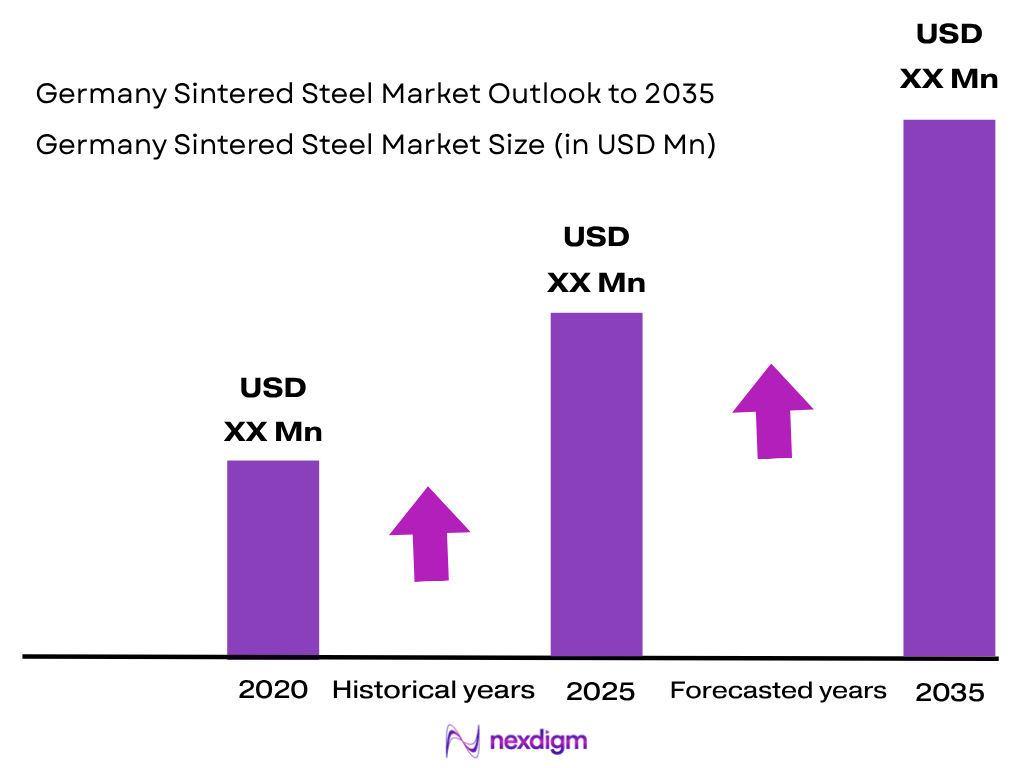
The Germany Sintered Steel Market is estimated at ~USD XX million in the current market model, with a forecast CAGR of ~X.X% during the forecast period. The market is closely linked to Germany’s large automotive, machinery, electrical-equipment and precision-manufacturing base. Germany’s GDP was USD 4.69 trillion and GDP per capita was USD 56,103.7 in the latest World Bank data, while manufacturing represented 19.9% of gross value added. Germany also produced 4,069,222 passenger cars domestically, creating a substantial addressable base for gears, bearings, bushings, synchronizer components, pump parts and other sintered steel applications.
Germany’s most important geographic clusters for the Sintered Steel Market are Bavaria, Baden-Württemberg, Lower Saxony and North Rhine-Westphalia, reflecting the concentration of automotive OEMs, Tier-1 suppliers, machinery producers and specialist component manufacturers. Stuttgart and Munich provide major automotive engineering ecosystems, while Wolfsburg and surrounding Lower Saxony support large-scale vehicle manufacturing. Baden-Württemberg additionally combines automotive, industrial machinery and precision-engineering capabilities. Germany’s manufacturing sector generated 19.9% of national gross value added, materially expanding the industrial customer base for sintered components. The country’s 4,069,222 passenger-car production volume further reinforces the importance of these manufacturing clusters.
Market Segmentation
By Product Type
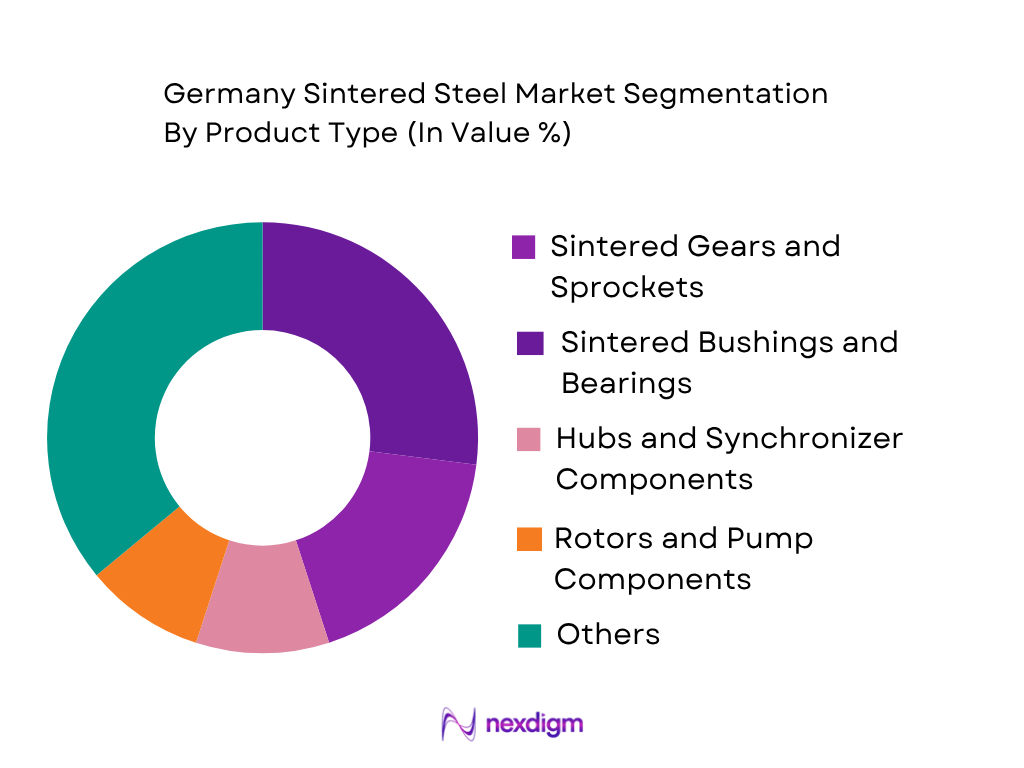
The Germany Sintered Steel Market is segmented by product type into sintered steel gears, bushings and bearings, sprockets, hubs and synchronizer components, rotors and pump components, structural components, flanges and collars, shafts and cams, magnetic components, and other precision components. Sintered steel gears are positioned as the leading product category in the market model because automotive transmissions, actuators, pumps, industrial drives and robotic systems require repeatable geometries and high-volume production. Miba identifies sintered gears for passenger cars, trucks, motorcycles, off-highway vehicles, robotics and industrial applications, including planetary, spur and helical gearing. GKN Powder Metallurgy similarly identifies transmission components such as planetary carriers, parking gears and clutch-related components. Germany’s domestic production of 4,069,222 passenger cars provides a significant recurring application base, while the country’s manufacturing sector accounts for 19.9% of gross value added. The broad application range allows sintered steel gears to serve both mobility and industrial equipment demand.
By End-Use Industry
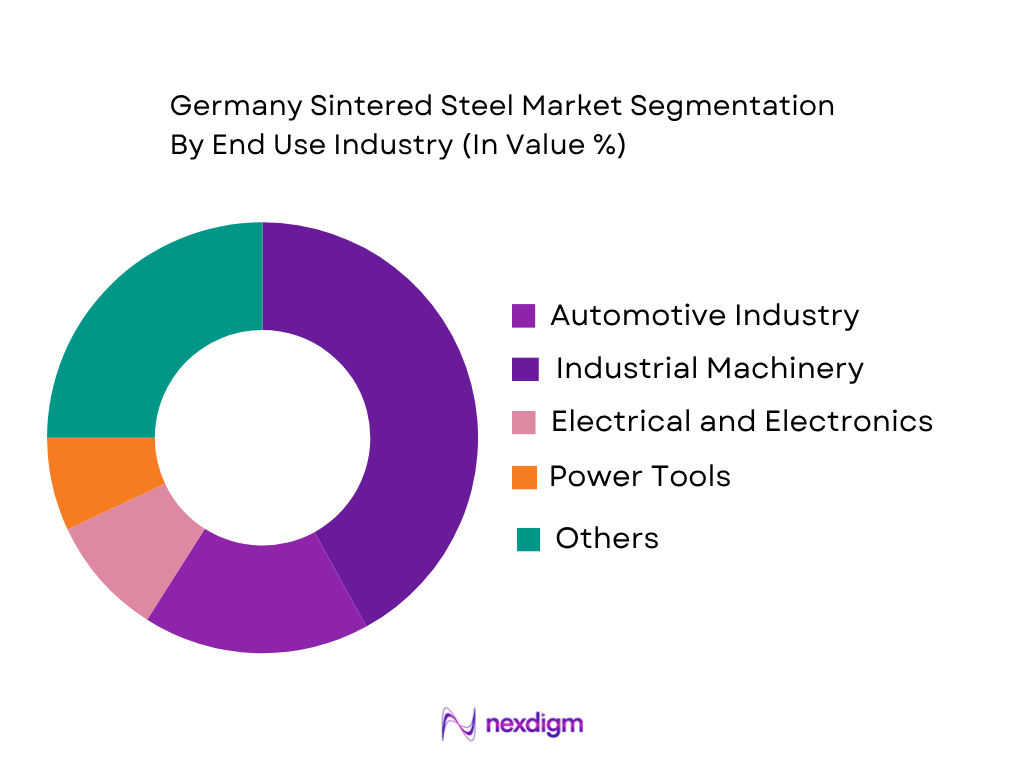
The Germany Sintered Steel Market is segmented by end-use industry into automotive, industrial machinery, electrical and electronics, power tools, medical technology, energy and power equipment, agriculture and construction equipment, consumer appliances, e-mobility and electric powertrain, and hydraulic and fluid-control equipment. Automotive represents the leading segment in the market model because Germany maintains a dense ecosystem of vehicle manufacturers and component suppliers requiring gears, pump parts, synchronizer components, bearings, bushings and structural components. Domestic passenger-car production reached 4,069,222 units, while automotive-industry revenue reached EUR 269.5 billion in the first half of the latest reported year. Industrial applications provide additional demand through robotics, compressors, conveyor systems, hydraulic equipment and automated machinery. Miba specifically identifies automotive, robotics, compressors, e-bikes, medical technology and industrial applications for sintered components.
Competitive Landscape
The Germany Sintered Steel Market includes international powder-metallurgy groups, specialist sintered-component manufacturers, metal-powder producers and diversified industrial-material companies. Competition is shaped by component engineering capability, powder formulation, compaction technology, sintering control, tooling expertise, density achievement and automotive qualification. GKN Powder Metallurgy operates multiple German locations, including facilities in Bad Brückenau, Bad Langensalza, Bonn and Radevormwald. Miba also maintains a broad sintered-component portfolio covering automotive and industrial applications.
| Company | Establishment | Headquarters | Sintered Component Portfolio | Automotive Capability | EV Capability | Powder Metallurgy Technology | Industrial Applications | Engineering Capability |
| GKN Powder Metallurgy | 1934 | Bonn, Germany | ~ | ~ | ~ | ~ | ~ | ~ |
| Miba Sinter Group | 1927 | Laakirchen, Austria | ~ | ~ | ~ | ~ | ~ | ~ |
| PMG Holding | 1961 | Germany | ~ | ~ | ~ | ~ | ~ | ~ |
| SCHUNK Group | 1945 | Heuchelheim, Germany | ~ | ~ | ~ | ~ | ~ | ~ |
| Höganäs | 1797 | Höganäs, Sweden | ~ | ~ | ~ | ~ | ~ | ~ |
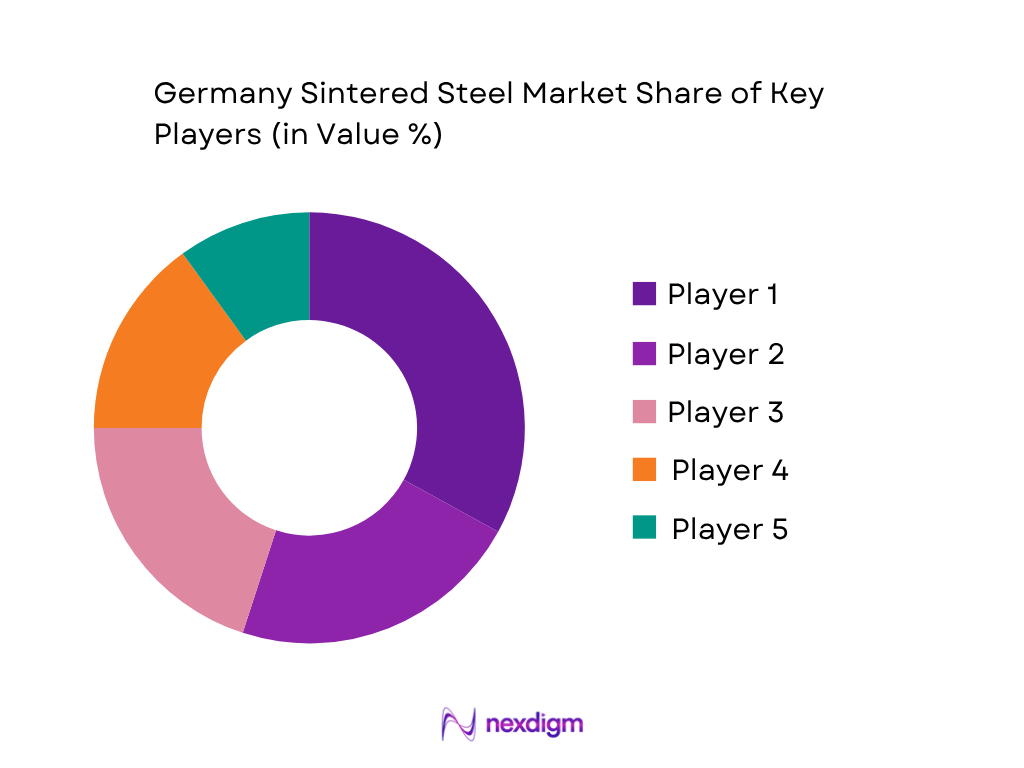
Germany Sintered Steel Market Analysis
Growth Drivers
Automotive Component Localization
Germany’s large automotive manufacturing ecosystem provides a substantial downstream base for sintered-steel gears, synchronizer components, bushings, rotors, sprockets and other precision parts. According to the VDA, 4,069,222 passenger cars were produced domestically, while German manufacturers produced 13,594,137 passenger cars across domestic and overseas facilities in 2024. The country also exported 3,173,500 vehicles from domestic production, demonstrating the scale of automotive component requirements. The automotive industry’s continued shift toward electrified drivetrains creates additional requirements for precision components with controlled dimensional accuracy and material efficiency. Sintered-steel manufacturing is particularly relevant where complex geometries, repeatability and near-net-shape production can reduce secondary machining requirements. Germany’s manufacturing base therefore supports demand for powder-metallurgy components across transmission systems, electric motors, thermal-management assemblies and auxiliary systems. The driver is reinforced by the concentration of automotive suppliers and component manufacturers around established industrial clusters, where localized production enables shorter supply chains and closer coordination between vehicle manufacturers and Tier-1 and Tier-2 suppliers.
High-Volume Precision Manufacturing
Germany’s established machinery and industrial-equipment base creates demand for manufacturing technologies capable of producing repeatable components at industrial volumes. Destatis reported that German manufacturing gross value added declined 3.0% in 2024, while industrial production declined 4.5%, reflecting pressure across machinery, automotive and other manufacturing industries. At the same time, the industrial sector consumed 3,343 petajoules of energy, with natural gas accounting for 29.2%, electricity for 21.1%, mineral oils and products for 16.5%, and coal for 14.5%. These conditions increase the importance of material-efficient production routes that can minimize machining allowances and material waste. Powder metallurgy supports this requirement through controlled powder utilization, automated pressing and sintering, and near-net-shape manufacturing. Sintered-steel components can therefore serve applications requiring dimensional consistency, controlled porosity, wear resistance and integrated geometries. The technology is relevant to gears, bearings, bushings, pump components and structural parts used in industrial machinery and automation equipment.
Market Challenges
Automotive Production Volatility
Germany’s dependence on automotive manufacturing creates exposure to fluctuations in vehicle production, model cycles and supplier demand. Domestic passenger-car production reached 4,069,222 units in 2024, compared with 4,109,371 units in 2023, while the domestic market registered 2,817,300 new passenger vehicles. At the broader industrial level, Destatis recorded a 4.5% decline in industrial production and a 5.6% decline in capital-goods production during 2024. Manufacturing gross value added also decreased 3.0%, with machinery and automotive production specifically identified among the weaker areas. These conditions can affect utilization rates at powder-metallurgy component plants, particularly those heavily concentrated on automotive drivetrain applications. Sintered-steel producers supplying high-volume automotive programs must manage production schedules around vehicle-platform changes, inventory adjustments and changes in component specifications. Demand can also vary according to the pace of internal-combustion, hybrid and battery-electric vehicle programs because component architectures differ significantly. This creates a requirement for diversified application portfolios covering automotive, industrial machinery, electrical equipment and other end uses rather than dependence on one vehicle technology or customer category.
Energy-Intensive Sintering Operations
Energy requirements represent an important operating consideration for German sintered-steel manufacturers because pressing, controlled-atmosphere sintering, heat treatment and associated production equipment require continuous industrial energy input. Destatis recorded total industrial energy consumption of 3,343 petajoules in 2024, with natural gas representing 29.2% and electricity 21.1% of industrial energy use. Energy-intensive industrial sectors had already experienced production reductions following earlier energy-price increases, and Destatis reported that the energy-intensive branches included chemical and metal-processing industries. For sintered-steel producers, energy exposure can influence furnace utilization, production scheduling and the economics of high-temperature processing. The challenge becomes more significant for manufacturers producing high-density components that require additional sinter-hardening, heat treatment or controlled-atmosphere processing. Companies therefore need to improve furnace loading, thermal-cycle control, equipment utilization and energy management while maintaining metallurgical consistency. The issue is particularly relevant in Germany because manufacturing competitiveness is closely connected with industrial energy availability and efficiency.
Market Opportunities
EV Reduction Gears
Germany’s established automotive manufacturing infrastructure creates an application opportunity for sintered-steel components used in electric-vehicle reduction gears, differential systems, motor assemblies and other compact drivetrain architectures. The VDA recorded 4,069,222 domestic passenger cars produced in 2024, while 572,700 electric cars were newly registered in Germany during the same period. Domestic production also included a record monthly output of 155,700 electric passenger cars in November 2024. Although total electric-vehicle registrations declined during the year, the production infrastructure demonstrates that electrified vehicle programs remain integrated into German manufacturing operations. Electric drivetrains place specific requirements on gears and rotating components, including dimensional precision, surface durability, noise characteristics and weight optimization. Powder metallurgy can address these requirements through near-net-shape production and controlled material distribution. The opportunity therefore extends beyond conventional transmission components toward reduction gears, differential components, motor-related parts and other compact precision assemblies. German automotive suppliers with existing pressing, sintering, sizing and heat-treatment capabilities can adapt these processes to electrified powertrain applications while maintaining production integration with established vehicle and component manufacturing clusters.
Industrial Automation Components
Germany’s industrial machinery and automation ecosystem creates an opportunity for sintered-steel gears, bearings, bushings, magnetic components, pump parts and structural components used in automated equipment. Destatis reported that industrial production declined 4.5% in 2024 and that capital-goods production declined 5.6%, illustrating the near-term pressure on machinery demand while also highlighting the scale of the industrial equipment base that powder-metallurgy suppliers can serve. Sintered-steel manufacturing is suited to automation applications where repeatable geometries, controlled tolerances, wear resistance and high-volume production are required. Components can be designed to combine multiple functions into a single compact geometry, reducing assembly requirements and secondary operations. The opportunity is particularly relevant to robotic mechanisms, actuator systems, gearboxes, material-handling equipment, pumps and precision industrial drives. Germany’s existing concentration of machinery manufacturers and industrial automation suppliers provides a developed customer ecosystem for specialized powder-metallurgy components. Producers can therefore expand beyond automotive applications by developing application-specific alloys, high-density components and sinter-hardened parts for industrial automation, helping diversify demand while leveraging existing German manufacturing capabilities.
Future Outlook
Over the forecast period, the Germany Sintered Steel Market is expected to be influenced by the transformation of the automotive manufacturing base, increasing electrification, industrial automation and continued demand for precision components. Germany’s domestic passenger-car production provides a substantial installed manufacturing ecosystem, while sintered components are already used in drivetrain, e-drivetrain, pump, actuator and industrial applications. The technology’s ability to create complex geometries, reduce secondary machining and maintain production consistency supports its continued use in high-volume applications.
Major Players
- GKN Powder Metallurgy
- Miba Sinter Group
- PMG Holding GmbH
- SCHUNK Group
- Höganäs AB
- Sumitomo Electric Sintered Alloy
- Sinterwerke Grenchen
- Fine Sinter Co., Ltd.
- Mitsubishi Materials Corporation
- Kennametal Inc.
- Hitachi Metals
- Federal-Mogul Powertrain
- Porite Europe
- Sintertechnik GmbH
- Burgmann Industries
Key Target Audience
- Automotive OEMs and Powertrain Manufacturers
- Automotive Tier-1 and Tier-2 Component Suppliers
- Industrial Machinery and Automation Manufacturers
- Powder Metallurgy and Metal-Powder Producers
- Investments and Venture Capitalist Firms (Industrial Technology, Advanced Manufacturing and Mobility Funds)
- Government and Regulatory Bodies (Federal Ministry for Economic Affairs and Energy, Federal Ministry for the Environment, Nature Conservation, Nuclear Safety and Consumer Protection)
- Electric-Mobility and Powertrain Component Manufacturers
- Industrial Equipment and Precision-Component Procurement Organizations
Research Methodology
Step 1: Identification of Key Variables
The initial phase involves mapping Germany’s sintered-steel ecosystem, including metal-powder suppliers, tooling companies, sintering-component manufacturers, automotive OEMs, Tier-1 suppliers and industrial customers. Variables include component production, powder consumption, manufacturing capacity, application penetration, density requirements and technology adoption.
Step 2: Market Analysis and Construction
Historical production, automotive manufacturing, machinery output and industrial-demand indicators are analyzed alongside component-level requirements. A bottom-up framework evaluates sintered steel consumption across automotive, industrial machinery, e-mobility, electrical and other application segments, while a top-down assessment validates the overall market structure.
Step 3: Hypothesis Validation and Expert Consultation
Market hypotheses are validated through interviews with powder-metallurgy manufacturers, component suppliers, automotive procurement professionals, machinery manufacturers and technical specialists. Discussions focus on component qualification, material grades, production volumes, application conversion, technology selection and customer procurement criteria.
Step 4: Research Synthesis and Final Output
The final stage triangulates secondary statistics, company information, manufacturing indicators and industry interviews. The resulting analysis establishes the market structure, segmentation, competitive environment, technology trends and future demand framework while separating publicly reported information from model-derived estimates.

- Executive Summary
- Research Methodology (Market Definition and Scope, Sintered Steel Classification, Powder Metallurgy Process Mapping, Market Sizing Framework, Top-Down Market Estimation, Bottom-Up Component Demand Modeling, Automotive Production Assessment, Industrial Manufacturing Assessment, Powder Feedstock Analysis, Sintering Capacity Assessment, Primary Industry Interviews, Demand-Side Validation, Supply-Side Validation, Data Triangulation, Forecasting Framework, Assumptions and Limitations)

- Definition and Scope
- Germany Sintered Steel Industry Evolution
- Sintered Steel Manufacturing Process Analysis
- Sintered Steel Value Chain Analysis
- Sintered Steel Supply Chain Analysis

- Growth Drivers (Automotive Component Localization, High-Volume Precision Manufacturing, Advanced Powder Metallurgy Adoption, EV Powertrain Component Development, Industrial Automation Expansion, Demand for Lightweight Components, Near-Net-Shape Manufacturing, Material Efficiency Requirements, Advanced Gear Manufacturing, German Automotive Supplier Base)
- Market Challenges (Automotive Production Volatility, Energy-Intensive Sintering Operations, High Tooling Investment, Specialty Powder Supply Exposure, Complex Material Qualification, High-Density Component Requirements, Skilled Workforce Requirements, Competition from Machining, Casting and Forging, Strict Quality Requirements, European Manufacturing Cost Pressures)
- Market Opportunities (EV Reduction Gears, Electric-Motor Components, High-Density Sintered Gears, Sintered Stainless-Steel Components, Industrial Automation Components, Precision Bearings and Bushings, Advanced Magnetic Components, Metal Injection Molding, Sinter-Hardening Applications, Lightweight Automotive Components, Hydrogen and Energy-System Components)
- Market Trends (Electrification of Powertrains, Sinter-Hardening Adoption, High-Density Compaction, Digital Process Monitoring, Automated Powder Handling, Advanced Alloy Powder Development, Near-Net-Shape Component Design, Lightweight Component Engineering, Additive Manufacturing Integration, Circular Powder Metallurgy, Industry 4.0 Sintering Operations)
- Government Regulations and Standards (European Union Machinery Requirements, REACH Chemical Compliance, RoHS Requirements, EU Ecodesign Requirements, German Environmental Protection Requirements, Industrial Emissions Requirements, Occupational Health and Safety Requirements, Automotive Quality Management Requirements, Material Traceability Requirements, Recycling and Circular-Economy Requirements)
- SWOT Analysis
- Porter’s Five Forces Analysis
- PESTLE Analysis
- Stakeholder Ecosystem
- Competition Ecosystem

- By Market Value (2020-2025)
- By Production Volume (2020-2025)
- By Sintered Component Volume (2020-2025)
- By Metal Powder Consumption (2020-2025)
- By Sintering Production Capacity (2020-2025)
- By Average Component Weight (2020-2025)
- By Automotive Sintered Component Consumption (2020-2025)
- By Industrial Sintered Component Consumption (2020-2025)

- By Product Type (In Value %)
Sintered Steel Gears
Sintered Steel Bushings and Bearings
Sintered Steel Sprockets
Sintered Steel Hubs and Synchronizer Components
Sintered Steel Rotors and Pump Components
Sintered Steel Structural Components
Sintered Steel Flanges and Collars
Sintered Steel Shafts and Cams
Sintered Steel Magnetic Components
Other Precision Sintered Steel Components - By Material Grade (In Value %)
Iron-Based Sintered Steel
Low-Alloy Sintered Steel
High-Alloy Sintered Steel
Stainless Sintered Steel
Nickel-Alloy Sintered Steel
Copper-Alloy Sintered Steel
Pre-Alloyed Steel Powder Components
Diffusion-Alloyed Steel Powder Components - By Manufacturing Process (In Value %)
Press-and-Sinter
Sinter-Hardening
Warm Compaction
High-Velocity Compaction
Metal Injection Molding
Powder Forging
Hot Isostatic Pressing
Secondary Machining and Sizing - By End-Use Industry (In Value %)
Automotive
Industrial Machinery
Electrical and Electronics
Power Tools
Medical Technology
Energy and Power Equipment
Agriculture and Construction Equipment
Consumer Appliances
E-Mobility and Electric Powertrain
Hydraulic and Fluid-Control Equipment - By Component Application (In Value %)
Transmission and Gearbox Components
Engine Components
Electric-Motor Components
Fuel-System Components
Oil-Pump and Water-Pump Components
Shock-Absorber Components
Steering and Braking Components
Actuator and Control Components
Bearing and Bushing Applications
Industrial Drive and Motion Components - By Density Level (In Value %)
Low-Density Sintered Components
Medium-Density Sintered Components
High-Density Sintered Components
Ultra-High-Density Sintered Components - By Customer Type (In Value %)
Automotive OEMs
Automotive Tier-1 Suppliers
Automotive Tier-2 and Tier-3 Suppliers
Industrial Component Manufacturers
Powder Metallurgy Component Specialists
Electrical and Electronics Manufacturers
Power-Tool Manufacturers
Medical Device Manufacturers
Industrial Equipment Manufacturers - By Region (In Value %)
Bavaria
Baden-Württemberg
North Rhine-Westphalia
Lower Saxony
Hesse
Saxony
Rhineland-Palatinate
Saarland
Thuringia
Other German Regions

- Market Share of Major Players (Germany Revenue Contribution, Sintered Component Portfolio, Automotive Component Coverage, Industrial Component Coverage, Production Capacity, Powder Metallurgy Technology Coverage, EV Component Capability, Geographic Manufacturing Presence, Customer Base, Engineering Capability, Tooling Capability, Aftermarket Coverage)
- Cross Comparison Parameters (Sintered Component Portfolio Breadth, Powder Metallurgy Process Capability, High-Density Component Capability, Automotive OEM and Tier-1 Coverage, EV and E-Mobility Component Capability, Material and Alloy Development Capability, Production Automation and Digitalization, Engineering and Tooling Capability)
- SWOT Analysis of Major Players
- Detailed Profiles of Major Companies
GKN Powder Metallurgy
PMG Holding GmbH
Miba Sinter Group
SCHUNK Sintermetalltechnik GmbH
Burgmann Industries GmbH & Co. KG
Höganäs AB
Sumitomo Electric Sintered Alloy Germany GmbH
Sinterwerke Grenchen AG
Federal-Mogul Powertrain
Mitsubishi Materials Corporation
Kennametal Inc.
Hitachi Metals
Fine Sinter Co., Ltd.
Sintertechnik GmbH
Porite Europe

- Automotive OEM Component Requirement Assessment
- Automotive Tier-1 Supplier Demand Analysis
- EV Component Requirement Analysis
- Industrial Machinery Demand Assessment
- Power Tool Component Demand Assessment
- Electrical and Electronics Component Demand Analysis

- By Market Value (2026-2035)
- By Production Volume (2026-2035)
- By Sintered Component Volume (2026-2035)
- By Metal Powder Consumption (2026-2035)
- By Sintering Production Capacity (2026-2035)
- By Average Component Weight (2026-2035)
- By Automotive Sintered Component Consumption (2026-2035)
- By Industrial Sintered Component Consumption (2026-2035)


 Request a Sample
 Ask for Customization
 Get a Quote
 Enquire Now