

 Download PDF
Market Overview
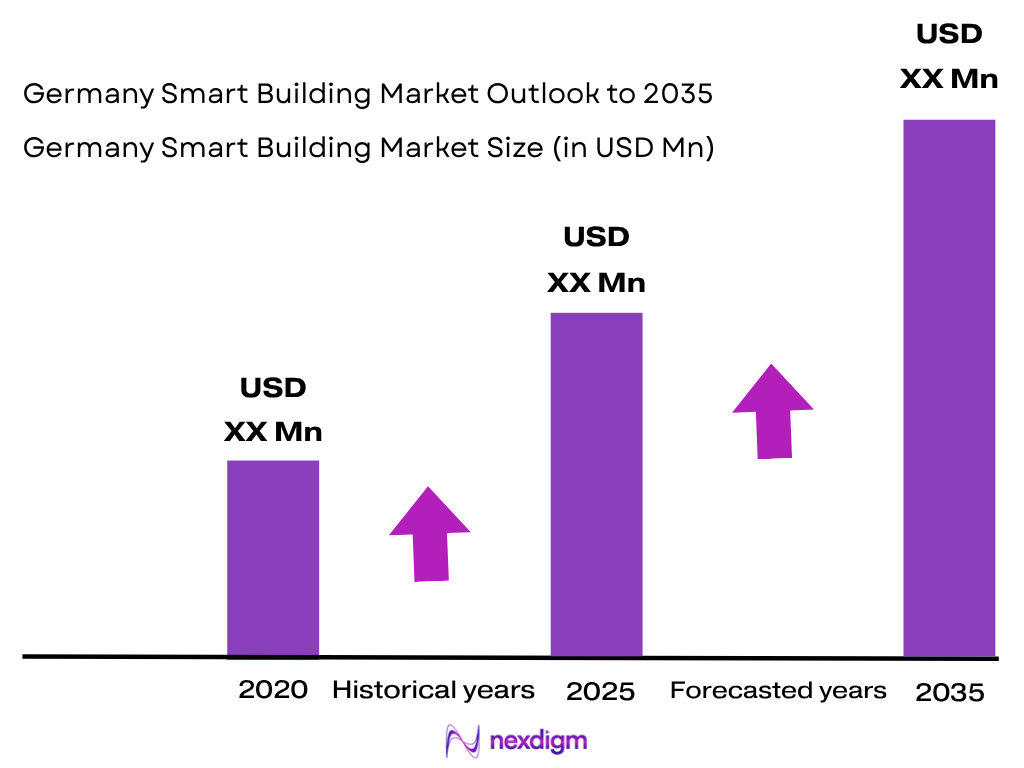
The Germany Smart Building Market is estimated at ~USD XX billion in 2024, with the market supported by building-energy modernization, automation adoption, connected HVAC systems, digital facility management, and demand for lower operational energy consumption. Germany has an extensive building stock requiring modernization, creating a substantial retrofit opportunity alongside new construction. Official statistics recorded 43.76 million dwellings in 2024, compared with 43.52 million in 2023, while Germany completed 251,900 dwellings in 2024. The energy-modernization requirement is particularly relevant because around 60% of building energy consumption is associated with heating, according to the German Federal Government.
Germany’s smart-building activity is concentrated around major metropolitan and industrial centers including Berlin, Munich, Frankfurt, Hamburg, Stuttgart, Düsseldorf, Cologne and the Rhine-Ruhr region, where large commercial property portfolios, technology-intensive facilities, industrial buildings and institutional assets create demand for automation and energy-management systems. Frankfurt is particularly important for data-center infrastructure and financial-sector buildings, while Munich and Stuttgart have strong corporate and technology ecosystems. Berlin combines government, commercial and technology facilities. Germany’s building modernization agenda further supports demand across existing properties, with federal policy identifying existing-building transformation as central to achieving climate-neutral building operations by 2045.
Market Segmentation
By Solution Type
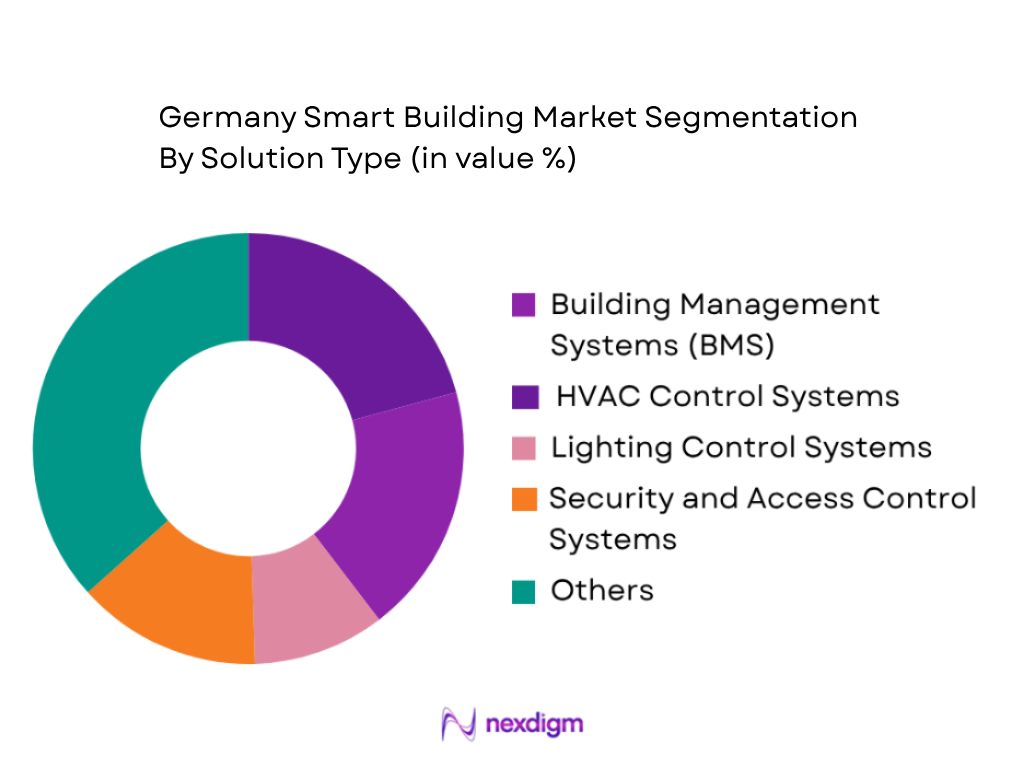
The Germany Smart Building Market is segmented by solution type into building automation systems, building management systems, smart HVAC and climate control, smart lighting controls, building energy management systems, access control and security systems, fire and life-safety systems, and occupancy and indoor-environment monitoring systems. Building automation and management systems hold the dominant share because they function as the central operating layer connecting HVAC equipment, room controllers, lighting, meters, sensors, alarms and building services. Germany’s extensive stock of commercial, industrial and institutional properties creates substantial scope for integrated control platforms rather than isolated smart devices. Building owners increasingly require systems capable of monitoring operating conditions, coordinating equipment and supporting energy-performance management. Germany’s strong KNX, BACnet and industrial-control ecosystem also supports deployment across both newly constructed and retrofitted properties. Smart HVAC represents another important segment because heating, ventilation and cooling controls can be integrated with occupancy sensing, room automation, heat pumps and building energy-management platforms.
By Building Type
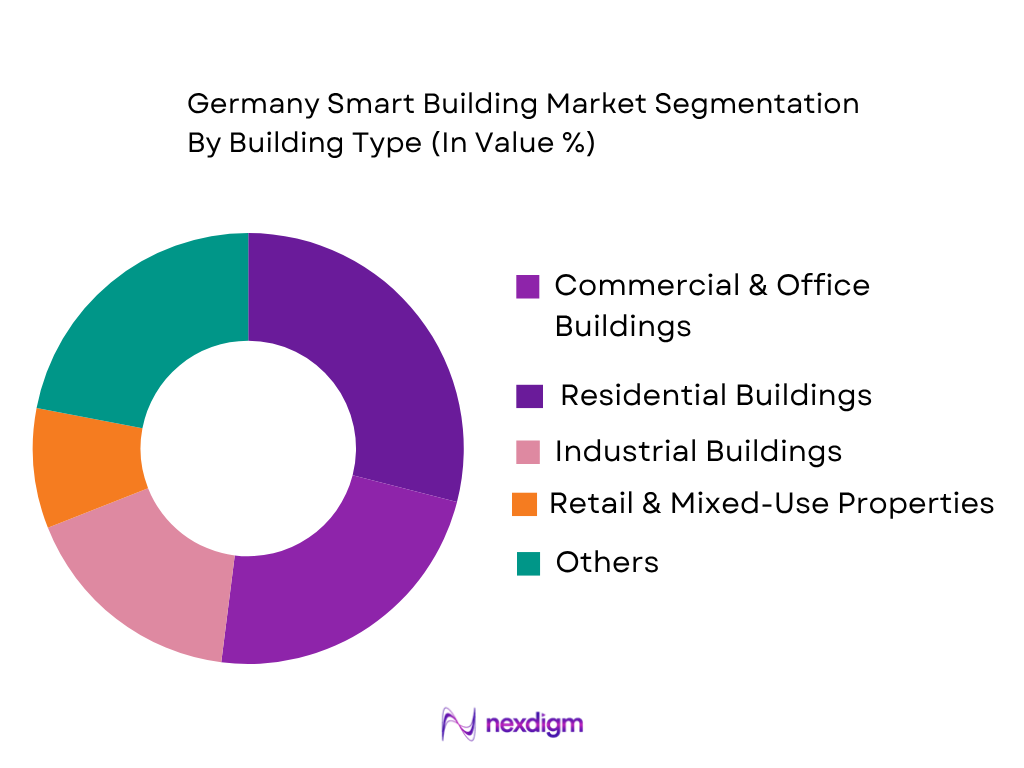
The Germany Smart Building Market is segmented by building type into office buildings, residential buildings, industrial buildings, retail properties, healthcare facilities, hospitality buildings, educational buildings, logistics facilities, government buildings and data centers. Commercial and office buildings represent the dominant segment because sophisticated office properties typically combine building management, HVAC automation, access control, occupancy monitoring, automated lighting and energy-management functions within one operating environment. Germany’s large corporate and institutional property base provides considerable retrofit potential because many existing buildings require modernization of controls and energy infrastructure rather than complete replacement. Office landlords also have stronger incentives to monitor energy consumption, indoor environmental conditions, space utilization and equipment performance across their portfolios. Industrial facilities constitute another strategically important application because German manufacturing properties require integrated energy monitoring, ventilation, utility control and operational automation. Residential adoption is increasingly connected with heat pumps, photovoltaic generation, battery storage, smart meters, EV charging and home energy-management systems.
Competitive Landscape
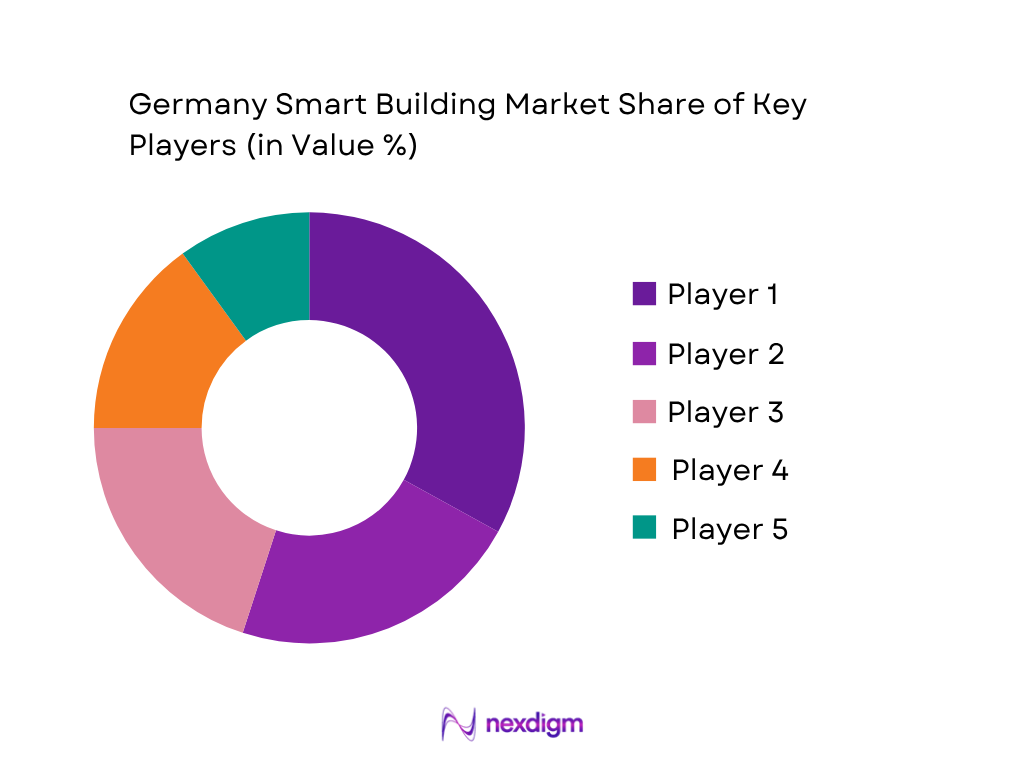
The Germany Smart Building Market includes established building-automation, electrical-equipment, HVAC-control, industrial-automation and digital-platform providers. Competition spans integrated building-management platforms, HVAC controls, energy-management systems, IoT connectivity, security, analytics and professional services. German-headquartered companies have a strong domestic engineering and automation ecosystem, while international providers compete through broad technology portfolios and established European distribution networks.
| Company | Establishment Year | Headquarters | Core Smart Building Offering | HVAC & Energy Management | BMS / Automation | IoT & Analytics | Germany Presence | Services |
| Siemens AG | 1847 | Munich, Germany | ||||||
| Schneider Electric SE | 1836 | Rueil-Malmaison, France | ||||||
| Honeywell International Inc. | 1906 | Charlotte, USA | ||||||
| Johnson Controls International plc | 1885 | Cork, Ireland | ||||||
| ABB Ltd. | 1988 | Zurich, Switzerland |
Germany Smart Building Market Analysis
Growth Drivers
Building Energy Efficiency Requirements and Building Modernization Demand
Germany’s building-efficiency agenda is creating a structural requirement for technologies that can measure, control and optimize energy use across existing and new properties. The Federal Ministry for Economic Affairs and Climate Action states that Germany is targeting climate neutrality by 2045, requiring accelerated transformation of the building stock through renovation and greater use of renewable energy. The scale of the installed stock supports the retrofit case: Destatis records 43.76 million dwellings in 2024, compared with 43.52 million in 2023. At the same time, Germany completed 251,937 dwellings in 2024, while 145,010 building or construction projects received permits across building construction. These conditions create demand for building-management systems, smart meters, connected HVAC controls, energy-management platforms and automated monitoring because modernization increasingly involves operational controls rather than structural renovation alone. The opportunity is particularly relevant to commercial and institutional buildings where multiple systems need centralized supervision. Destatis also recorded 193.0 million cubic meters of approved non-residential building volume in 2024, demonstrating the scale of the non-residential asset base entering construction and modernization workflows.
Expansion of Commercial Real Estate, Smart HVAC Adoption and Data Center Development
Commercial and technology-intensive buildings are strengthening demand for connected building infrastructure because HVAC, electricity, security and facility operations increasingly require continuous monitoring and automated control. Germany’s electricity system handled 431.7 TWh of generation in 2024, including 254.9 TWh from renewable sources, according to the Federal Network Agency, increasing the importance of intelligent energy-management systems capable of coordinating building loads with a changing electricity mix. Building activity also provides a substantial addressable base: 177.7 million cubic meters of non-residential building volume were completed in 2024, while the dwelling stock reached 43.76 million units. For smart HVAC specifically, Germany’s transition toward electric heating is significant: 69.4% of approximately 76,100 residential buildings completed in 2024 used heat pumps as their primary heating system, compared with 64.6% of approximately 96,800 buildings in 2023. This technology shift increases the need for digital controls, load management, temperature monitoring and automated optimization. Data-intensive facilities add another demand layer because uninterrupted cooling, power management and environmental monitoring require integrated automation.
Market Challenges
High System Integration Complexity, Legacy Building-System Interoperability and Multi-Vendor Integration
Germany’s large installed building base creates technical challenges because smart-building deployments frequently need to connect modern IoT devices and cloud platforms with legacy HVAC, lighting, access-control and building-management equipment. Destatis reports 43.76 million dwellings in 2024, highlighting the scale of the existing asset base that can require modernization rather than complete replacement. At the same time, only 145,010 building or construction projects received permits in 2024, indicating that a large portion of smart-building demand must come from existing properties rather than new construction alone. Non-residential construction also declined in several important categories, with approved non-residential building volume reaching 193.0 million cubic meters in 2024. Integration therefore needs to accommodate buildings with different equipment generations, communication protocols, control architectures and documentation standards. Retrofit projects can require gateways, protocol conversion, centralized supervisory controls and additional sensors before advanced analytics can function reliably. Multi-vendor environments further increase commissioning and interoperability requirements, while property owners must maintain existing building operations during installation. These factors can lengthen deployment cycles and increase engineering requirements, particularly for hospitals, offices, industrial facilities, hotels and large mixed-use properties.
Cybersecurity Requirements, Specialized Engineering Skills and Long Building Equipment Replacement Cycles
Increasing connectivity across HVAC, lighting, access control, energy meters and facility-management platforms creates cybersecurity and operational-resilience requirements alongside conventional engineering challenges. Germany’s building stock contains 43.76 million dwellings, while 251,937 dwellings were completed in 2024, demonstrating that smart-building technologies must operate across both legacy and newly constructed assets. The replacement challenge is reinforced by Germany’s construction pipeline: 759,700 approved but unfinished dwellings remained at the end of 2024, including 330,000 already under construction, according to Destatis. Such projects can involve different equipment specifications and installation timelines, complicating the standardization of building automation. The building sector also faces a broader modernization requirement because Germany’s climate-neutrality objective is set for 2045, meaning building owners must increasingly integrate energy controls and digital monitoring into long-term asset strategies. Cybersecurity becomes particularly important when building systems are connected to enterprise networks or remote-management platforms, while specialized engineers are required to configure controllers, communication protocols, HVAC logic and analytics layers. Long replacement cycles can delay full-system upgrades and encourage phased modernization, increasing the importance of interoperable architecture.
Market Opportunities
Smart Building Retrofit Programs, AI-Based Energy Optimization and Smart HVAC Optimization
Germany’s existing building stock provides a substantial foundation for retrofit-oriented smart-building solutions. Destatis records 43.76 million dwellings in 2024, compared with 43.52 million in 2023, while the Federal Ministry for Economic Affairs and Climate Action identifies accelerated renovation of the building stock as necessary for Germany’s climate-neutrality objective for 2045. This creates an opportunity for AI-enabled energy optimization, connected HVAC controls, automated fault detection and building-energy-management platforms that can improve operation without requiring complete rebuilding. Heating is a particularly important application because building energy consumption is strongly linked to thermal management. The technology transition in new buildings also supports the need for advanced controls: 69.4% of approximately 76,100 residential buildings completed in 2024 used heat pumps as their primary heating technology, up from 64.6% of approximately 96,800 in 2023. Smart controls can coordinate heat pumps, ventilation, temperature sensors, occupancy information and electricity consumption. Retrofit providers can therefore target individual systems first and progressively integrate them into broader building-management platforms, creating opportunities across offices, residential portfolios, hotels, industrial buildings and public properties.
Digital Twin Deployment, Predictive Maintenance, Integrated Energy Management and Net-Zero Building Management
The increasing digitalization of Germany’s building infrastructure creates opportunities for platforms that combine sensor data, equipment models, energy information and operational analytics. Germany generated 431.7 TWh of electricity in 2024, with 254.9 TWh generated from renewable sources, according to the Federal Network Agency. This changing electricity mix increases the relevance of intelligent building controls that can monitor consumption and coordinate flexible loads. The opportunity extends across commercial and non-residential assets, with 177.7 million cubic meters of non-residential building volume completed in 2024. Digital twins can provide continuously updated representations of HVAC, electrical, lighting and occupancy systems, while predictive-maintenance platforms can identify abnormal equipment behavior before failures disrupt building operations. Energy-management platforms can also integrate renewable electricity, heating equipment and building loads into one operating environment. The scale of Germany’s building modernization requirement provides a long-term application base: the federal government is targeting climate neutrality by 2045 and explicitly links this objective with accelerated transformation of the building stock. These conditions support solutions combining digital twins, predictive analytics, cybersecurity, energy management and automated HVAC optimization.
Future Outlook
Over the forecast period, the Germany Smart Building Market is expected to develop around building modernization, energy optimization, connected HVAC, automation and digital facility management. Existing buildings will remain an important deployment environment because Germany has a large installed building base requiring energy and technology upgrades. AI-enabled analytics, digital twins, predictive maintenance and integrated building-management platforms are expected to expand the functionality of smart-building systems. Demand will also be influenced by the continuing transition toward more efficient heating technologies and increasingly connected building infrastructure.
Major Players
- Siemens AG
- Schneider Electric SE
- Honeywell International Inc.
- Johnson Controls International plc
- ABB Ltd.
- Robert Bosch GmbH
- Legrand SA
- Trane Technologies plc
- Eaton Corporation plc
- Kieback&Peter GmbH & Co. KG
- Sauter Building Control International GmbH
- Beckhoff Automation GmbH & Co. KG
- WAGO GmbH & Co. KG
- Phoenix Contact GmbH & Co. KG
- GEZE GmbH
Key Target Audience
- Commercial Real Estate Developers and Property Owners
- Building Automation and HVAC Technology Manufacturers
- Facility Management and Building Services Operators
- Data Center Infrastructure Developers and Operators
- Investments and Venture Capitalist Firms
- Government and Regulatory Bodies (Federal Ministry for Economic Affairs and Energy, Federal Ministry for Housing, Urban Development and Building, German Energy Agency)
- Building Technology System Integrators and Engineering Contractors
- Energy-Service Companies and Building Energy Management Providers
Research Methodology
Step 1: Identification of Key Variables
The initial phase involves mapping the Germany Smart Building ecosystem across building owners, developers, automation manufacturers, HVAC suppliers, system integrators, facility managers and technology providers. Variables include installed automation systems, building age, retrofit requirements, HVAC controls, energy-management adoption, IoT connectivity and digital-platform deployment.
Step 2: Market Analysis and Construction
Historical market information is compiled using building-stock statistics, construction activity, technology deployment indicators, company disclosures and regulatory information. The analysis separates hardware, software and services while measuring demand across commercial, residential, industrial, institutional, hospitality and data-center buildings.
Step 3: Hypothesis Validation and Expert Consultation
Market hypotheses are validated through consultations with building-automation manufacturers, HVAC specialists, system integrators, facility-management providers and building developers. Interviews focus on technology adoption, retrofit requirements, procurement practices, integration complexity, project pipelines and changing customer requirements.
Step 4: Research Synthesis and Final Output
The final analysis triangulates demand-side and supply-side information with official German statistics, regulatory developments, company information and technology assessments. Market estimates are structured by component, building technology, building type, deployment mode, application and region to provide a consolidated view of the Germany Smart Building Market.

- Executive Summary
- Research Methodology (Market Definitions and Scope, Smart Building Ecosystem Mapping, Market Sizing Framework, Top-Down Analysis, Bottom-Up Market Reconstruction, Building Stock Assessment, Technology Penetration Analysis, Demand-Side Assessment, Supply-Side Assessment, Primary Industry Interviews, Secondary Data Validation, Data Triangulation, Forecasting Framework, Scenario Development, Research Limitations)

- Definition and Scope
- Smart Building Industry Evolution and Technology Development
- Germany Building Automation Ecosystem Analysis
- Smart Building Value Chain Analysis
- Smart Building Technology Supply Chain Analysis
- Building Digitalization and Automation Adoption Assessment
- New-Build versus Existing-Building Smart Technology Deployment
- Energy-Efficiency and Building-Decarbonization Context

- Growth Drivers (Building Energy Efficiency Requirements, Building Modernization Demand, Expansion of Commercial Real Estate, Smart HVAC Adoption, Energy Management Requirements, Building Automation Standards, Digitalization of Facility Management, Decarbonization of Building Operations, Government Energy-Efficiency Programs, Data Center Development)
- Market Challenges (High System Integration Complexity, Legacy Building-System Interoperability, Cybersecurity Requirements, Fragmented Communication Protocols, High Retrofit Complexity, Specialized Engineering Requirements, Long Building Equipment Replacement Cycles, Multi-Vendor Integration, Data Governance Requirements, High Dependence on HVAC and Building Energy Optimization)
- Market Opportunities (Smart Building Retrofit Programs, AI-Based Energy Optimization, Digital Twin Deployment, Predictive Maintenance, Smart HVAC Optimization, Integrated Energy Management Platforms, Connected Commercial Buildings, Data Center Automation, Smart Building Cybersecurity, IoT-Based Occupancy Analytics, Intelligent Water Management, Smart Building-as-a-Service, Net-Zero Building Management)
- Market Trends (AI-Enabled Building Operations, Cloud-Based Building Management, Digital Twins, Predictive Building Maintenance, Integrated HVAC and Energy Controls, Occupancy-Based Automation, Edge Computing for Buildings, Connected Building Platforms, Smart Meter Integration, Automated Demand Response)
- Government Regulations and Standards (Building Energy Act Requirements, Federal Funding for Efficient Buildings, EU Energy Performance of Buildings Requirements, DIN EN ISO 16484, DIN V 18599, KNX Standards, BACnet Standards, Cybersecurity Requirements, Fire Safety Requirements, Data Protection Requirements)
- Porter’s Five Forces Analysis
- PESTLE Analysis
- SWOT Analysis
- Stakeholder Ecosystem
- Competition Ecosystem

- By Market Value (2020-2025)
- By Installed Smart Building Systems (2020-2025)
- By Connected Building Devices (2020-2025)
- By Smart Building Software Deployments (2020-2025)
- By Building Automation Installations (2020-2025)

- By Component (In Value %)
Sensors
Controllers
Actuators
Smart Meters
Gateways and Edge Devices
Building Management Software
Energy Management Software
IoT Platforms
Cloud Building Platforms
Analytics and AI Software
Communication Infrastructure
Integration and Managed Services - By Building Technology (In Value %)
Building Management Systems and Building Automation
HVAC and Smart Climate Control
Energy Management and Building Energy Management Systems
Security and Access Control Systems
Smart Lighting and Lighting Controls
Fire and Life Safety Systems
IoT Sensors and Environmental Monitoring
Digital Twin and Building Analytics Platforms - By Building Type (In Value %)
Commercial Offices
Retail and Shopping Centers
Hotels and Hospitality Buildings
Healthcare Facilities
Educational Buildings
Government and Civic Buildings
Industrial and Manufacturing Facilities
Data Centers
Transportation Facilities
Residential Buildings - By Deployment Mode (In Value %)
New Construction
Existing Building Retrofit
Building Modernization
Major Renovation Projects
Smart Building Upgrade Projects - By Building Automation Level (In Value %)
Basic Building Automation
Integrated Building Management
Advanced Connected Building
AI-Enabled Smart Building
Autonomous Building Operations - By Application (In Value %)
Energy Management
HVAC Optimization
Occupancy and Space Management
Security and Access Management
Lighting Automation
Indoor Environmental Quality Monitoring
Predictive Maintenance
Facility Management
Fire and Life Safety
Asset and Equipment Monitoring

- Market Share of Major Players (By Germany Revenue, Component Portfolio, Building Technology Coverage, Building Type Coverage, Project Scale, New-Build Deployment, Retrofit Deployment, Software and Services Capability)
- Cross Comparison Parameters (Building Automation Portfolio Breadth, HVAC and Energy Management Capability, BMS Platform Functionality, KNX and BACnet Interoperability, IoT and Sensor Integration Capability, AI and Predictive Analytics Capability, Cybersecurity and Data Management Capability, Germany-Based Installation and Technical Support Network)
- SWOT Analysis of Major Players
- Detailed Profiles of Major Companies
Siemens AG
Schneider Electric SE
Honeywell International Inc.
Johnson Controls International plc
ABB Ltd.
Robert Bosch GmbH
Legrand SA
Trane Technologies plc
Eaton Corporation plc
Kieback&Peter GmbH & Co. KG
Sauter Building Control International GmbH
Beckhoff Automation GmbH & Co. KG
WAGO GmbH & Co. KG
Phoenix Contact GmbH & Co. KG
GEZE GmbH

- Commercial Building Requirement Assessment
- Existing Building Retrofit Demand Analysis
- Corporate Real Estate Technology Assessment
- Facility Management Requirement Analysis
- Hospitality Smart Building Requirement Assessment

- By Market Value (2026-2035)
- By Installed Smart Building Systems (2026-2035)
- By Connected Building Devices (2026-2035)
- By Smart Building Software Deployments (2026-2035)
- By Building Automation Installations (2026-2035)


 Request a Sample
 Ask for Customization
 Get a Quote
 Enquire Now
