
 Download PDF
Market Overview
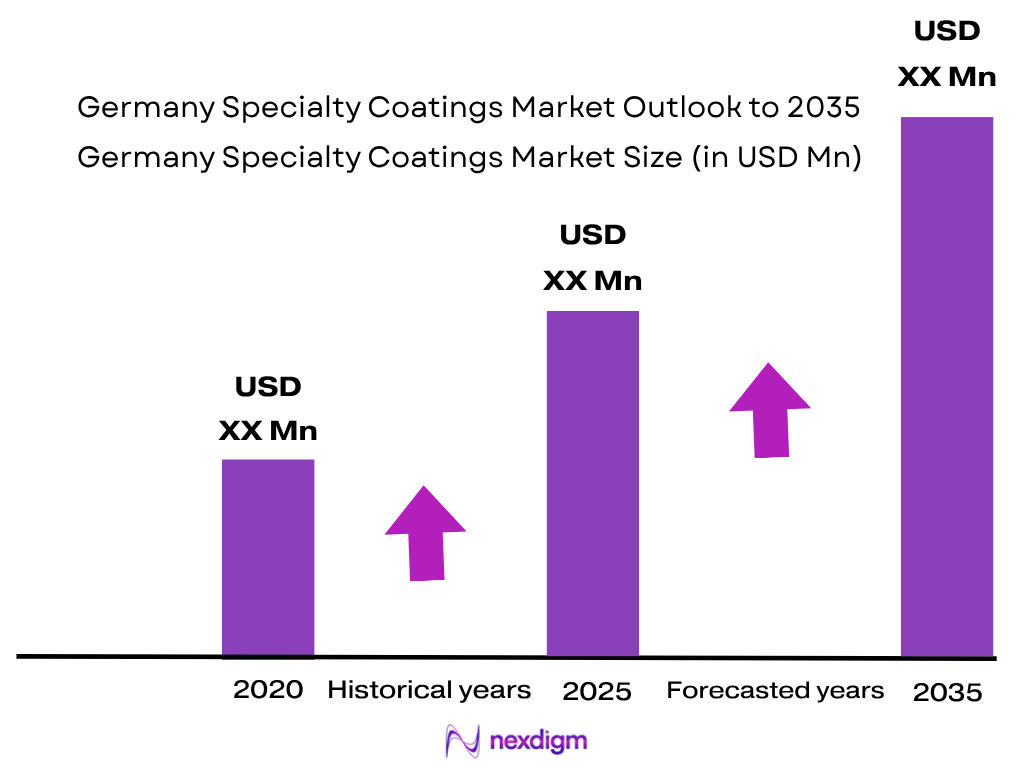
The Germany Specialty Coatings Market is valued at ~USD XX billion, compared with ~USD XX billion in the preceding annual period, supported by demand for automotive OEM, protective, powder, aerospace, machinery and high-performance industrial coatings. Germany’s wider industrial coatings market generated USD 8.73 billion in the latest reported base period, while domestic paints, coatings and printing-ink sales reached EUR 5.9 billion on 1.4 million tonnes.
Germany’s specialty-coatings demand is concentrated around Münster, Hamburg, Stuttgart, Munich, Wolfsburg and major Rhine-Ruhr industrial centres, reflecting dense automotive, machinery, chemical, aerospace and coating-production clusters. German plants produced around 4.1 million passenger cars in each of the two latest annual observations, sustaining OEM coating demand. Münster is particularly important because BASF Coatings operates a roughly 427,000 m² site with about 2,450 employees, integrating production, R&D, sales and marketing.
Market Segmentation
By Coating Type
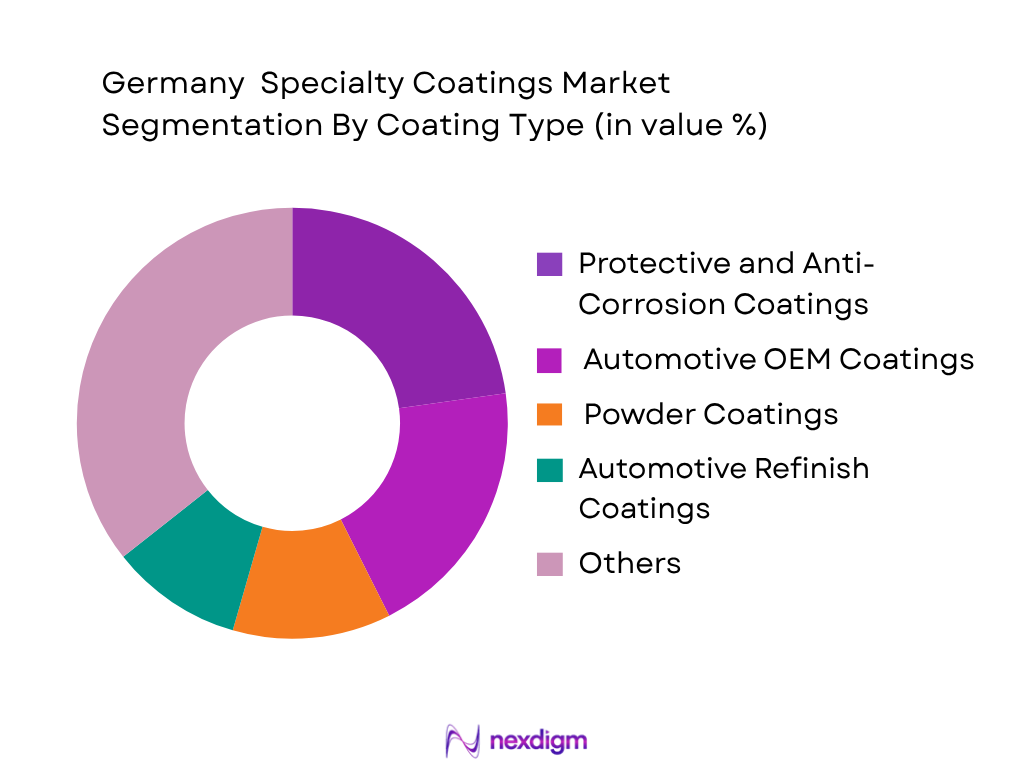
Germany Specialty Coatings Market is segmented by coating type into protective and anti-corrosion coatings, automotive OEM coatings, automotive refinish coatings, marine and offshore coatings, powder coatings, aerospace coatings, coil coatings, industrial wood coatings, industrial floor coatings, and fire-protective and intumescent coatings. Protective and anti-corrosion coatings hold the dominant market share owing to Germany’s extensive manufacturing assets, steel structures, chemical plants, energy installations, machinery and transport infrastructure. High-value assets require corrosion protection capable of extending maintenance intervals and reducing lifecycle costs. Demand is reinforced by stringent specifications for durability, chemical resistance and harsh-environment performance. Germany’s large industrial base also creates recurring maintenance and recoating requirements independent of new equipment production. Automotive OEM and powder coatings remain major categories because of the country’s vehicle manufacturing ecosystem, while marine, offshore wind and infrastructure applications support increasing use of high-solids, zinc-rich, epoxy and polyurethane protective systems.
By Resin Type
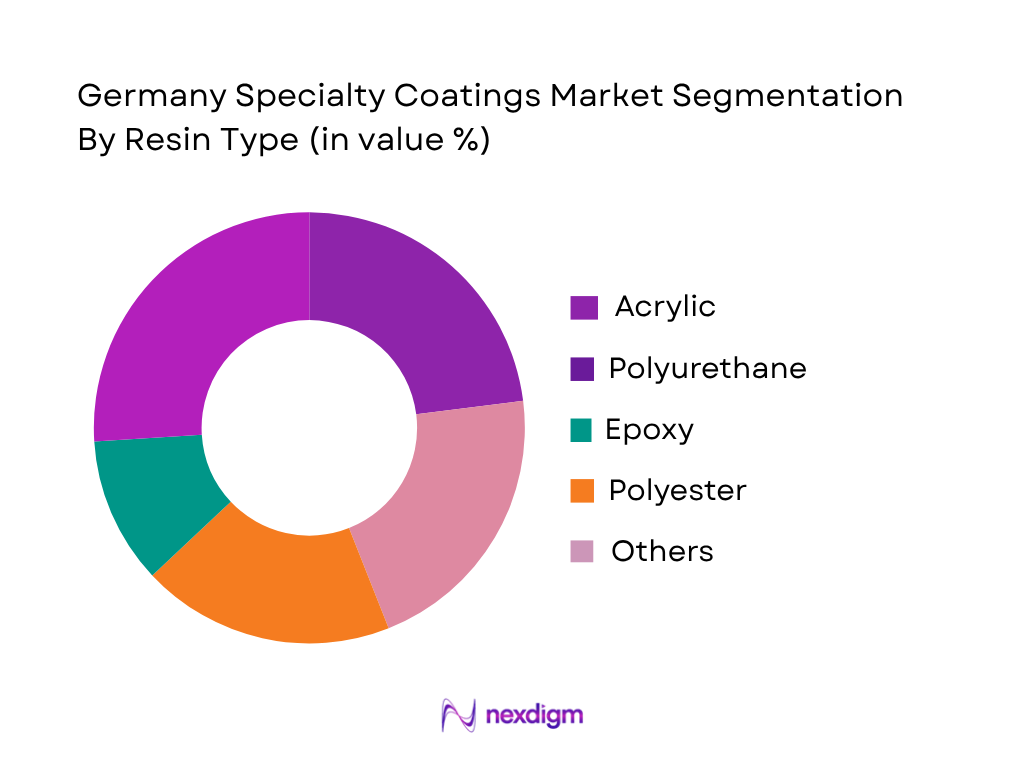
Germany Specialty Coatings Market is segmented by resin type into acrylic, polyurethane, epoxy, polyester, alkyd, fluoropolymer and PVDF, silicone, vinyl and vinyl ester, epoxy-polyester hybrid, and other high-performance resin systems. Acrylic coatings represent a leading resin category, supported by their versatility, weatherability, colour retention, UV resistance and compatibility with waterborne technologies. Public industrial-coatings research also identifies acrylic as Germany’s largest revenue-generating resin category. Acrylic systems are widely applicable across general industrial, transportation and durable-finish applications, while increasingly stringent environmental requirements favour lower-VOC formulation platforms. Polyurethane and epoxy systems nevertheless command substantial specialty demand because polyurethane provides strong finish quality and abrasion resistance, while epoxy coatings are critical for corrosion protection, flooring, industrial equipment and chemically aggressive environments. Higher-performance fluoropolymer and silicone systems remain smaller but strategically important where exceptional weatherability or heat resistance is required.
Competitive Landscape
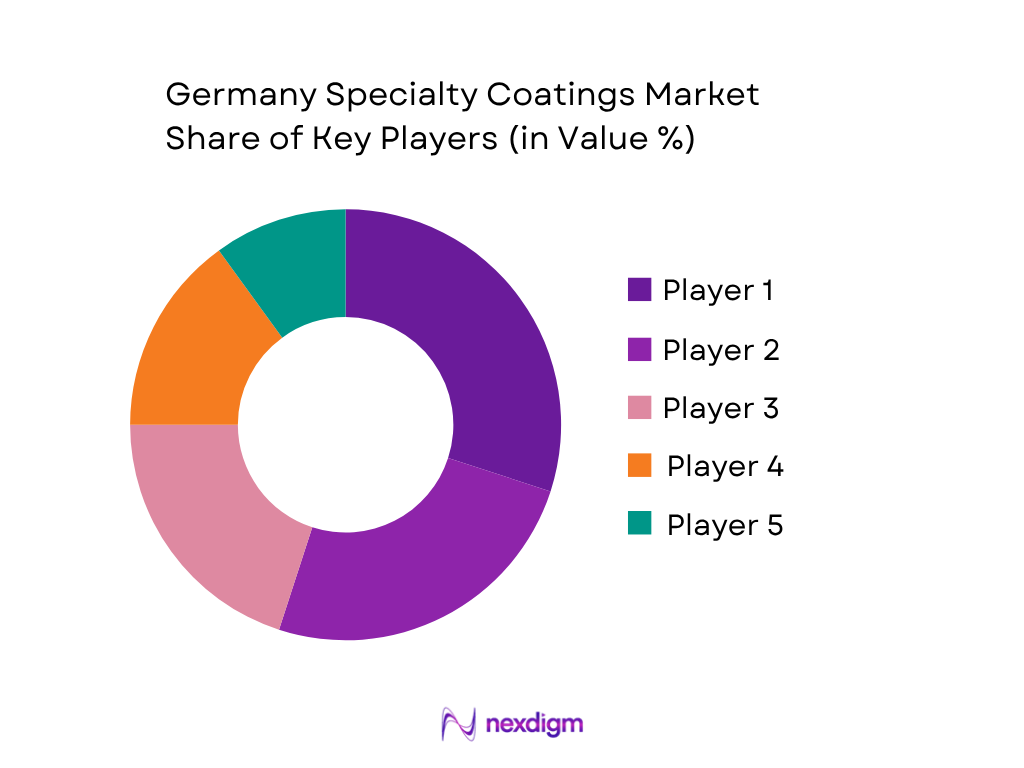
The Germany Specialty Coatings Market features a mix of global coating majors and technically specialized domestic suppliers. BASF Coatings, AkzoNobel, PPG, Axalta and Mankiewicz compete across automotive, industrial, protective, transportation and specialty applications, with differentiation increasingly based on OEM approvals, formulation technology, sustainability, application engineering and local technical support. BASF Coatings has a particularly substantial German footprint through Münster, while Hamburg-based Mankiewicz has strong positions in machinery, automotive, aviation, rail, commercial vehicles and wind-energy coatings.
| Company | Establishment Year | Headquarters | Core Specialty Coating Exposure | Key Resin/Technology Platforms | Major German End Uses | Sustainability/Low-VOC Capability | Technical & R&D Positioning | Germany Market Presence |
| BASF Coatings | 1865* | Münster/Ludwigshafen, Germany | ~ | ~ | ~ | ~ | ~ | ~ |
| AkzoNobel | 1994 | Amsterdam, Netherlands | ~ | ~ | ~ | ~ | ~ | ~ |
| PPG Industries | 1883 | Pittsburgh, United States | ~ | ~ | ~ | ~ | ~ | ~ |
| Axalta Coating Systems | 1866* | Philadelphia, United States | ~ | ~ | ~ | ~ | ~ | ~ |
| Mankiewicz | 1895 | Hamburg, Germany | ~ | ~ | ~ | ~ |
Germany Specialty Coatings Market Analysis
Growth Drivers
Automotive and Electric Vehicle Manufacturing Base
Germany’s large automotive manufacturing base is a major structural driver for specialty coatings used in OEM body finishing, primers, clearcoats, corrosion protection, plastics, battery systems and electrical insulation. According to the German Association of the Automotive Industry, German plants manufactured 4,069,222 passenger cars in 2024, including 908,075 compact vehicles, 470,715 medium-class vehicles, 469,575 upper-medium vehicles and 1,797,852 SUVs and off-road vehicles. Production increased to 4,148,836 passenger cars in 2025, providing a substantial recurring application base for automotive coating suppliers. Electric-vehicle manufacturing is particularly relevant for dielectric, thermal-management, fire-protection and battery-component coatings; German factories manufactured a record 155,700 electric passenger cars in November 2024 alone, according to VDA. The underlying macroeconomic scale also supports sophisticated domestic coating demand: World Bank data place Germany’s 2024 GDP at USD 4.685593 trillion and GDP per capita at USD 56,103.7. Germany additionally recorded EUR 779.505 billion of manufacturing value added in 2024, according to World Bank data sourced from national statistical systems. This combination of vehicle output and manufacturing depth supports sustained demand for technically qualified specialty coating systems.
Renewable Energy and Industrial Asset Protection Requirements
Germany’s expanding renewable-energy infrastructure creates a significant demand base for corrosion-resistant, weather-resistant, erosion-resistant, protective and functional specialty coatings. The Federal Network Agency reported 63.5 GW of installed onshore wind capacity at the end of 2024, while approximately 2.5 GW of net onshore wind capacity was added during the year. Germany also had 9.2 GW of offshore wind capacity, following the commissioning of 0.7 GW of additional offshore capacity and 73 new offshore wind turbines. Solar installations reached 99.3 GW, adding another large asset base requiring coated structural components, electrical enclosures and supporting infrastructure. The Federal Network Agency additionally issued approvals covering nearly 15 GW of onshore wind capacity, indicating a sizeable pipeline for towers, nacelles, fabricated steel and associated coating applications. Germany’s broader industrial capacity reinforces this demand. World Bank data show EUR 779.505 billion of manufacturing value added in 2024, while national GDP stood at USD 4.685593 trillion. Specialty-coating suppliers therefore address both newly installed renewable assets and Germany’s extensive existing base of machinery, steel structures, power equipment and industrial facilities requiring recurring corrosion control and lifecycle-extension treatments.
Market Challenges
Weak Industrial Conditions and Pressure on Coating-Intensive Manufacturing
Germany’s specialty coatings market faces pressure from weaker activity across several coating-intensive manufacturing industries, which can delay machinery orders, plant expansion, component production and maintenance projects. World Bank data place Germany’s economy at USD 4.685593 trillion in 2024, while manufacturing generated EUR 779.505 billion of value added, illustrating the considerable industrial base on which coating consumption depends. However, the chemical and pharmaceutical industry, one of the country’s important consumers of protective coatings for process equipment, storage systems, steel structures and maintenance applications, reported approximately EUR 221 billion in sales during 2024, according to the German Chemical Industry Association. Automotive production also remained below earlier peak operating levels despite its large absolute scale, with 4,069,222 passenger cars manufactured domestically in 2024. In 2025, output reached 4,148,836 units, indicating only a modest expansion in physical production. The IMF reported Germany’s population at approximately 83.501 million in 2026, highlighting a mature domestic economy in which specialty-coatings growth increasingly depends on industrial investment, technology replacement and value-added applications rather than rapid expansion of the underlying customer base. This environment raises the importance of diversification across end-use sectors.
Regulatory Reformulation and Complex Technical Qualification Requirements
Specialty coating manufacturers in Germany operate within a demanding regulatory and technical environment where product reformulation must be achieved without sacrificing corrosion resistance, adhesion, weatherability, chemical resistance or OEM-approved application performance. The scale of Germany’s manufacturing ecosystem intensifies this issue: World Bank statistics show EUR 779.505 billion of manufacturing value added in 2024, while Germany produced 4,069,222 passenger cars during the same period according to VDA. Automotive suppliers consequently need coating systems capable of repeated high-volume application while satisfying OEM specifications and European chemical-management requirements. Regulatory change is especially relevant to polyurethane, fluorinated, anti-corrosion and functional coating technologies because suppliers must continuously evaluate substance restrictions, workplace-exposure requirements and alternative raw materials. Germany’s renewable-energy asset base adds another qualification challenge: 63.5 GW of onshore wind capacity and 9.2 GW of offshore wind capacity were installed at the end of 2024, according to the Federal Network Agency, requiring coatings that withstand prolonged mechanical and environmental stress. The wider macroeconomic environment also leaves limited room for inefficient product transitions, with World Bank reporting USD 4.685593 trillion of GDP and USD 56,103.7 GDP per capita in 2024. Reformulation therefore requires extensive technical validation before industrial customers can switch established systems.
Market Opportunities
Advanced Coatings for Wind, Solar and Emerging Energy Infrastructure
Germany’s renewable-energy infrastructure provides a strong future opportunity for suppliers of anti-corrosion, erosion-resistant, weather-resistant, electrically insulating and long-life protective coatings. Current installations already create a significant maintenance and replacement base. The Federal Network Agency recorded 63.5 GW of onshore wind capacity, 9.2 GW of offshore wind capacity and 99.3 GW of solar capacity at the end of 2024. During the same year, 73 offshore wind turbines entered operation and approximately 0.7 GW of offshore capacity was commissioned. More importantly for future specialty-coating demand, regulatory authorities issued approvals for nearly 15 GW of additional onshore wind capacity, creating opportunities across turbine towers, fasteners, nacelles, fabricated components and supporting infrastructure. These assets operate under UV exposure, moisture, saltwater, temperature fluctuations and mechanical abrasion, making coating durability a technically important procurement factor. Germany’s ability to finance and industrialize advanced coating solutions is supported by an economy valued at USD 4.685593 trillion in 2024, according to the World Bank, alongside EUR 779.505 billion of manufacturing value added. Suppliers with high-solids, low-emission, fast-curing and long-service-life systems can therefore target both new installations and lifecycle maintenance requirements.
Electric Mobility and High-Performance Functional Coating Applications
Germany’s transition toward electrified transportation creates future opportunities that extend beyond conventional automotive body coatings into battery protection, electrical insulation, thermal management, fire resistance, lightweight components and specialized surface treatments. Domestic plants manufactured 4,069,222 passenger cars in 2024 and 4,148,836 units in 2025, according to VDA, providing specialty-coating suppliers with one of Europe’s largest concentrated automotive production ecosystems. Electric-vehicle manufacturing is becoming increasingly relevant to the product mix: German manufacturers produced 155,700 electric passenger cars in November 2024, the highest monthly output reported at that point. The German automotive sector also supported approximately 773,000 employees in the latest VDA industry assessment, demonstrating the depth of engineering, component and manufacturing capabilities surrounding vehicle production. This industrial foundation is reinforced by Germany’s EUR 779.505 billion of manufacturing value added in 2024, according to World Bank data, and an economy valued at USD 4.685593 trillion. These conditions support development and qualification of higher-value functional coatings for battery housings, busbars, electrical components, composite parts and lightweight substrates, allowing suppliers to move beyond conventional decorative finishes toward coatings that deliver measurable technical functions.
Future Outlook
The Germany Specialty Coatings Market is forecast to expand at a ~XX% CAGR during 2026-2035, driven by higher-value functional coatings rather than volume growth alone. Demand is expected to shift toward low-VOC, waterborne, high-solids and powder technologies alongside advanced corrosion protection, EV functional coatings, renewable-energy coatings and longer-life industrial systems. Regulatory reformulation and manufacturing productivity will increasingly determine supplier competitiveness. Automotive transformation will remain central to the market. Electric vehicles require coatings beyond traditional body finishes, including dielectric insulation, thermal-management protection, battery-pack fire protection, corrosion barriers and coatings for lightweight polymer and composite components. Germany’s continuing position as a major European vehicle-production centre provides an established customer base for suppliers capable of meeting strict automotive OEM specifications.
Protective coatings will benefit from lifecycle-extension requirements across industrial plants, bridges, energy assets, chemical facilities and transport infrastructure. Offshore and onshore wind installations will create opportunities for anti-corrosion and erosion-resistant systems exposed to moisture, UV radiation and aggressive environments. Hydrogen equipment could create another niche for specialized barrier and corrosion-resistant coating solutions.
Major Players
- BASF Coatings GmbH
- Akzo Nobel N.V.
- PPG Industries
- Axalta Coating Systems
- The Sherwin-Williams Company
- Mankiewicz Gebr. & Co.
- FreiLacke – Emil Frei GmbH & Co. KG
- Peter-Lacke GmbH
- Hempel A/S
- Jotun A/S
- Sika AG
- Beckers Group
- Kansai Helios
- Nippon Paint Holdings
- RPM International Inc.
Key Target Audience
- Specialty Coatings Manufacturers and Formulators
- Automotive, EV, Aerospace and Industrial OEMs
- Resin, Pigment, Additive and Specialty Chemical Suppliers
- Industrial Coating Applicators, Job Coaters and Surface-Treatment Companies
- Marine, Wind-Energy, Infrastructure and Industrial Asset Owners
- Specialty Coatings Distributors and Technical Wholesalers
- Investments and Venture Capitalist Firms
- Government and Regulatory Bodies (Federal Institute for Occupational Safety and Health – BAuA, German Environment Agency – UBA, Federal Ministry for the Environment, Climate Action, Nature Conservation and Nuclear Safety – BMUKN, Federal Institute for Materials Research and Testing – BAM)
Research Methodology
Step 1: Identification of Key Variables
The initial phase involves developing a complete ecosystem map of the Germany Specialty Coatings Market covering resin suppliers, pigment and additive suppliers, formulators, OEMs, applicators, distributors and industrial users. Secondary research incorporates industry associations, company disclosures, trade statistics and government manufacturing datasets. Critical variables include coating consumption, resin mix, technology adoption, end-use demand, selling prices, imports, domestic production and application intensity.
Step 2: Market Analysis and Construction
Historical specialty-coatings demand is constructed through both top-down and bottom-up models. The top-down approach evaluates Germany’s paints and industrial-coatings industry before isolating specialty applications, while the bottom-up model maps automotive production, machinery output, industrial assets, aerospace activity, marine demand and renewable-energy applications to coating consumption. Resin usage, technology mix, average selling prices and trade flows are cross-checked to establish consistency.
Step 3: Hypothesis Validation and Expert Consultation
Initial hypotheses are validated through computer-assisted telephone interviews and structured discussions with coating manufacturers, resin and additive suppliers, industrial applicators, distributors, OEM procurement teams and technical specialists. Interviews test assumptions relating to coating consumption per application, customer qualification cycles, pricing, resin substitution, waterborne conversion, powder adoption, competitive positioning and regulatory reformulation. Conflicting responses are reconciled through additional secondary-data triangulation.
Step 4: Research Synthesis and Final Output
The final stage combines demand-side and supply-side findings into a unified Germany Specialty Coatings Market model. Company-level revenues, product portfolios, manufacturing presence, import-export patterns, OEM activity and application demand are compared against the bottom-up estimates. Forecast assumptions incorporate industrial output, automotive transformation, renewable-energy investment, regulatory changes, coating technology substitution and pricing dynamics to develop base, upside and downside market scenarios.

- Executive Summary
- Research Methodology (Market Definition and Scope, Germany Specialty Coatings Taxonomy, Coating Chemistry Classification, Functional Performance Mapping, Market Sizing Framework, Top-Down Analysis, Bottom-Up Analysis, Domestic Production Assessment, Import-Export Assessment, Demand-Side Assessment, Supply-Side Assessment, End-Use Application Mapping, Industrial Consumption Assessment, Primary Industry Interviews, Trade-Flow Validation, Data Triangulation, Forecasting Framework, Scenario Analysis, Assumptions and Limitations)

- Definition and Scope
- Germany Specialty Coatings Industry Evolution and Technology Development
- Specialty Coatings Manufacturing and Formulation Process
- Specialty Coatings Value Chain Analysis
- Germany Specialty Coatings Supply Chain Analysis

- Growth Drivers (Automotive and Electric Vehicle Manufacturing Base, Machinery and Industrial Equipment Production, Offshore and Onshore Wind Expansion, Aging Infrastructure Corrosion Protection Requirements, Chemical and Process Industry Maintenance Demand, Aerospace Manufacturing and MRO Activity, Premium High-Performance Coating Adoption, Low-VOC and Energy-Efficient Coating Transition)
- Market Challenges (High Energy and Manufacturing Costs, Epoxy and Polyurethane Feedstock Volatility, REACH Compliance Costs, PFAS Reformulation Exposure, Diisocyanate Handling Requirements, Automotive and Aerospace OEM Qualification Barriers, Skilled Coating Applicator Constraints, Weakness in Energy-Intensive Industrial Production)
- Market Opportunities (Offshore Wind Protective Coatings, EV Battery Functional Coatings, Hydrogen Infrastructure Barrier Coatings, PFAS-Free High-Performance Coatings, Chrome-Free Corrosion Protection Systems, Low-Temperature-Cure Powder Coatings, High-Solids and Solvent-Free Systems, Self-Healing and Smart Coatings, Infrastructure Rehabilitation Coatings)
- Market Trends (Waterborne Conversion, Powder Coating Penetration, High-Solids Technology Adoption, Low-Temperature Curing, PFAS-Free Formulation Development, Chrome-Free Primer Adoption, Functional Nano-Coatings, Digital and Robotic Coating Application)
- Regulatory and Standards Landscape (EU REACH Requirements, CLP Regulation, VOC Emission Requirements, PFAS Restriction Developments, Diisocyanate Training Requirements, Chromium VI Restrictions, Biocidal Products Regulation, ISO 12944 Corrosion Protection Standards, Hazardous Waste Management, Worker Exposure and Occupational Safety Requirements)
- SWOT Analysis
- Porter’s Five Forces Analysis
- PESTLE Analysis

- By Market Value (2020-2025)
- By Coating Consumption Volume (2020-2025)
- By Domestic Production Volume (2020-2025)
- By Import Volume (2020-2025)
- By Export Volume (2020-2025)
- By Industrial Coatings Consumption Volume (2020-2025)
- By Specialty Coatings Production Capacity (2020-2025)
- By Average Realized Selling Price (2020-2025)
- By Application Revenue (2020-2025)

- By Coating Type (In Value %)
Protective and Anti-Corrosion Coatings
Automotive OEM Coatings
Automotive Refinish Coatings
Marine and Offshore Coatings
Powder Coatings
Aerospace and Aviation Coatings
Coil Coatings
Industrial Wood Coatings
Industrial Floor Coatings
Fire-Protective and Intumescent Coatings - By Resin Type (In Value %)
Epoxy
Polyurethane
Acrylic
Polyester
Alkyd
Fluoropolymer and PVDF
Silicone
Vinyl and Vinyl Ester
Epoxy-Polyester Hybrid
Other High-Performance Resin Systems - By Technology (In Value %)
Waterborne Coatings
Solvent-Borne Coatings
Powder Coatings
High-Solids Coatings
UV-Cured Coatings
Two-Component Coatings
Moisture-Cured Coatings
Advanced Functional and Nano-Coatings - By End-Use Industry (In Value %)
Automotive and Electric Vehicle Manufacturing
Machinery and General Industrial Manufacturing
Aerospace and Aviation
Chemical and Petrochemical Processing
Marine, Shipbuilding and Offshore Infrastructure
Wind and Renewable Energy
Steel and Metal Fabrication
Building and Infrastructure
Rail and Transportation Equipment
Electronics and Electrical Equipment - By Substrate (In Value %)
Carbon Steel
Galvanized Steel
Aluminium
Stainless Steel
Concrete
Wood and Engineered Wood
Plastics and Engineering Polymers
Composite Materials
Electronic Components and Housings - By Sales Channel (In Value %)
Direct-to-OEM Sales
Direct Industrial Project Sales
Specialty Coating Distributors
Protective and Marine Coating Distributors
Automotive Refinish Distributors
Industrial Applicators and Job Coaters
EPC and Specification Sales
Technical Wholesalers and Specialist Dealer Networks

- Market Share of Major Players (By Revenue, Volume, Coating Type, Resin Type, Technology, Application, End-Use Industry, Distribution Channel)
- Cross Comparison Parameters (Specialty Functional Coatings Portfolio Breadth, Germany Manufacturing and R&D Footprint, Resin and Technology Platform Coverage, Automotive and Industrial OEM Approval Depth, Corrosion and Extreme-Environment Performance Capability, Automotive-EV-Aerospace-Wind End-Use Penetration, PFAS-Free and Low-VOC Reformulation Readiness, Technical Service and Application Engineering Coverage)
- SWOT Analysis of Major Players
- Detailed Profiles of Major Companies
BASF Coatings GmbH
Akzo Nobel N.V.
PPG Industries
Axalta Coating Systems
The Sherwin-Williams Company
Mankiewicz Gebr. & Co.
FreiLacke – Emil Frei GmbH & Co. KG
Peter-Lacke GmbH
Hempel A/S
Jotun A/S
Sika AG
Beckers Group
Kansai Helios
Nippon Paint Holdings
RPM International Inc.

- Buyer Segmentation
- Procurement Behaviour
- Supplier Selection Criteria
- Buyer Pain Points
- Technology Adoption Assessment
- Replacement and Repurchase Behaviour

- By Market Value (2026-2035)
- By Coating Consumption Volume (2026-2035)
- By Domestic Production Volume (2026-2035)
- By Import Volume (2026-2035)
- By Export Volume (2026-2035)
- By Industrial Coatings Consumption Volume (2026-2035)
- By Specialty Coatings Production Capacity (2026-2035)
- By Average Realized Selling Price (2026-2035)
- By Application Revenue (2026-2035)


 Request a Sample
 Ask for Customization
 Get a Quote
 Enquire Now