
 Download PDF
Market Overview
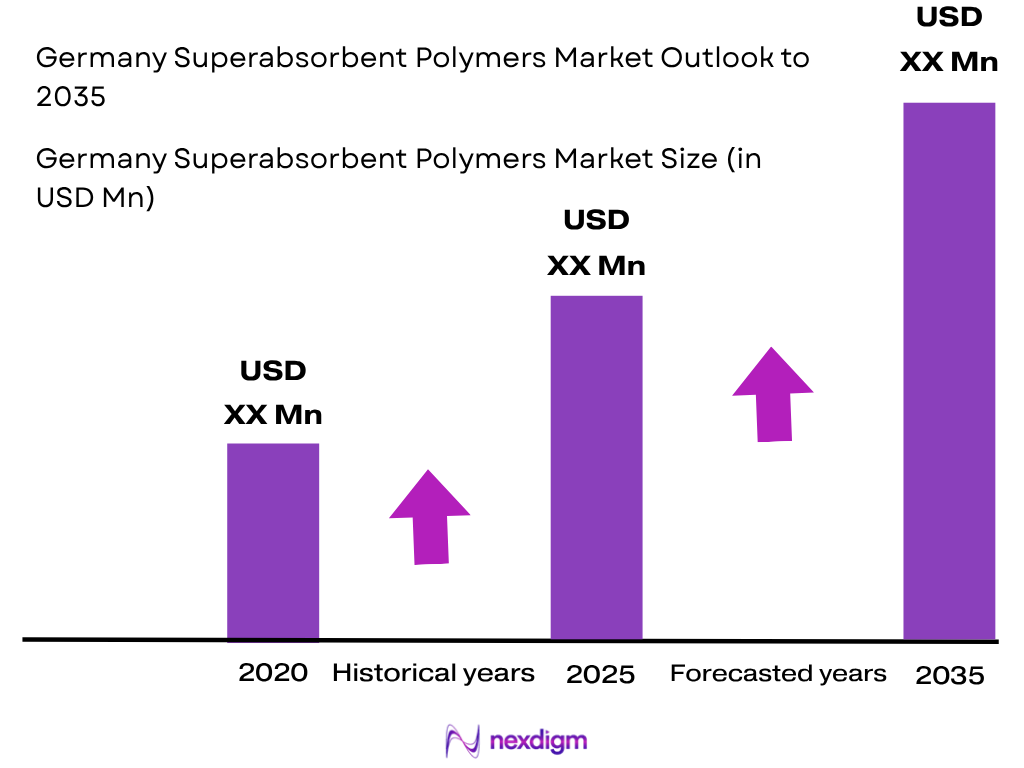
The Germany Superabsorbent Polymers Market is estimated at ~USD XX.X million in 2024, supported by demand from disposable diapers, adult incontinence products, feminine hygiene, medical absorbents and selected industrial applications. Germany’s mature hygiene-product manufacturing ecosystem, advanced chemical industry, strong healthcare infrastructure and aging population provide a diversified demand base for SAP. The market is also influenced by requirements for thinner absorbent cores, higher liquid-retention performance, improved absorption under pressure and increasing interest in sustainable polymer technologies. The country’s position within the European manufacturing network further supports SAP procurement across downstream hygiene applications.
Germany’s SAP demand is concentrated around major industrial and manufacturing regions, particularly North Rhine-Westphalia, Bavaria, Baden-Württemberg, Hesse and Lower Saxony, where chemical production, consumer-goods manufacturing, healthcare industries and logistics infrastructure are well established. Cities and industrial clusters such as Frankfurt, Düsseldorf, Cologne, Munich, Stuttgart and Hamburg provide access to chemical suppliers, converting facilities, distribution infrastructure and major consumer markets. Germany’s integration with the wider European Union also allows SAP suppliers to serve multinational hygiene manufacturers and downstream converters from established logistics and chemical-industry hubs.
Market Segmentation
By Product Type
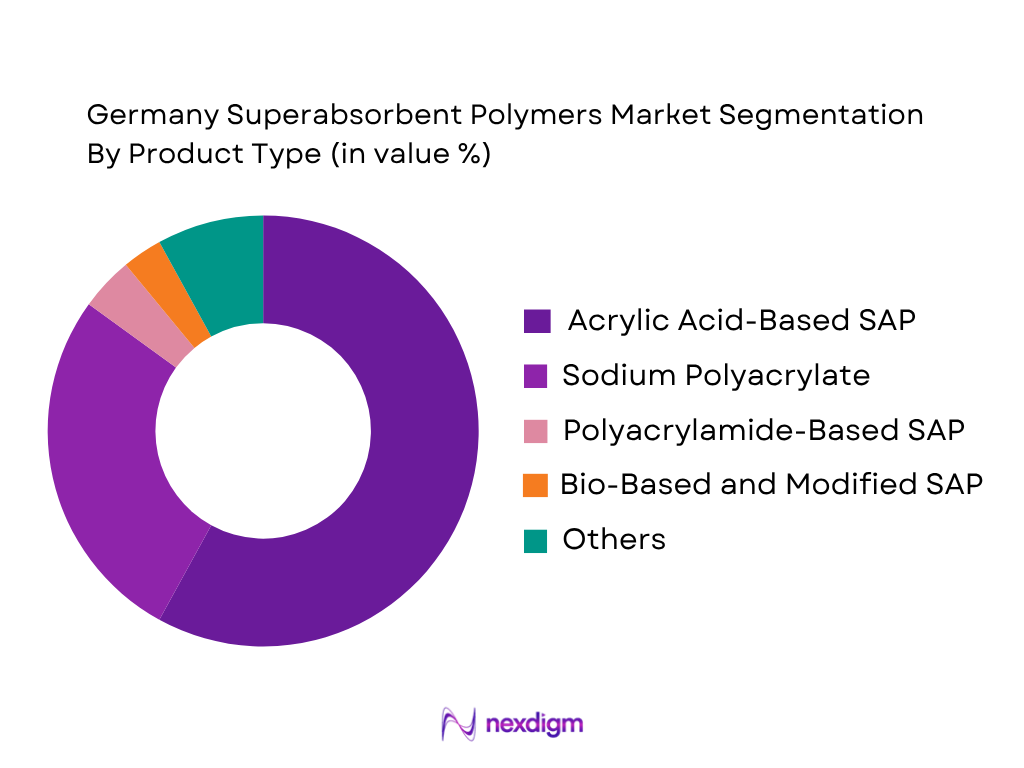
The Germany Superabsorbent Polymers Market is segmented by product type into acrylic acid-based SAP, sodium polyacrylate, polyacrylate/polyacrylamide copolymers, polyacrylamide-based SAP, bio-based and modified SAP, and other specialty SAP grades. Acrylic acid-based SAP is expected to represent the dominant product category because conventional hygiene applications require high absorption capacity, strong centrifuge retention and reliable liquid-locking performance. Baby diapers and adult incontinence products generally require established SAP grades with predictable swelling characteristics and compatibility with high-speed absorbent-core manufacturing. Sodium polyacrylate-based materials remain particularly relevant because of their established technical performance and broad commercial availability. At the same time, surface modification and crosslinking technologies allow producers to tailor absorption under pressure, permeability and gel strength. Germany’s technically sophisticated hygiene and chemical industries also create demand for differentiated grades rather than a single commodity specification. Bio-based and modified SAP products represent an emerging product class as manufacturers investigate reduced fossil-feedstock dependence and improved sustainability characteristics. Specialty grades can additionally serve medical and industrial applications where absorption performance, particle-size control and application-specific formulation requirements differ from conventional diaper-grade SAP.
By Application
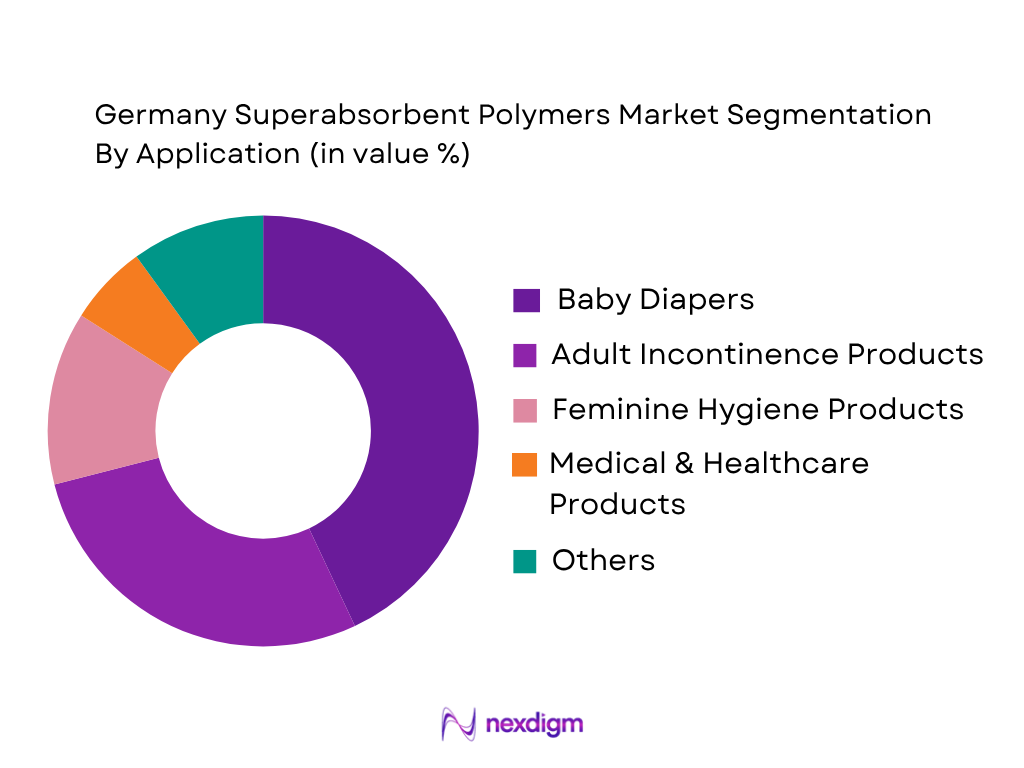
The Germany Superabsorbent Polymers Market is segmented by application into baby diapers, adult incontinence products, feminine hygiene products, medical absorbent products, agriculture and horticulture, industrial absorbent applications and other specialty applications. Baby diapers represent the principal application because SAP is an established component of modern absorbent-core structures and enables manufacturers to achieve high liquid retention while controlling product thickness. Germany’s mature disposable hygiene market provides a stable base for SAP consumption, while the country’s aging demographic profile creates additional relevance for adult incontinence products. Feminine hygiene products require rapid liquid uptake and controlled retention, supporting demand for application-specific SAP grades. Medical absorbent products provide a higher-specification niche where absorption, cleanliness and material consistency are important. Agriculture and horticulture applications use SAP to improve water retention around plant roots and potentially reduce irrigation requirements, although this represents a smaller application base than hygiene. Industrial applications can include spill-control materials, packaging protection and selected water-management products. Overall, application diversification allows SAP suppliers to address both high-volume hygiene demand and technically specialized applications requiring modified absorption characteristics.
Competitive Landscape
The Germany Superabsorbent Polymers Market comprises global specialty-chemical and polymer manufacturers supplying hygiene-grade and specialty SAP materials to German and wider European customers. Competition is shaped by product-performance consistency, production scale, technical qualification, supply reliability, sustainability credentials and the ability to support multinational hygiene manufacturers. Suppliers with established European manufacturing or distribution infrastructure can provide advantages in customer qualification, technical support and logistics, while Asian producers compete through broader capacity and international supply networks.
| Company | Establishment Year | Headquarters | SAP Portfolio | Key Application Focus | Manufacturing Footprint | Product Differentiation | Technical Capability |
| BASF SE | 1865 | Ludwigshafen, Germany | ~ | ~ | ~ | ~ | ~ |
| Evonik Industries AG | 2007 | Essen, Germany | ~ | ~ | ~ | ~ | ~ |
| Nippon Shokubai Co., Ltd. | 1941 | Osaka, Japan | ~ | ~ | ~ | ~ | ~ |
| Sumitomo Seika Chemicals Co., Ltd. | 1944 | Osaka, Japan | ~ | ~ | ~ | ~ | ~ |
| LG Chem Ltd. | 1947 | Seoul, South Korea | ~ | ~ | ~ | ~ | ~ |
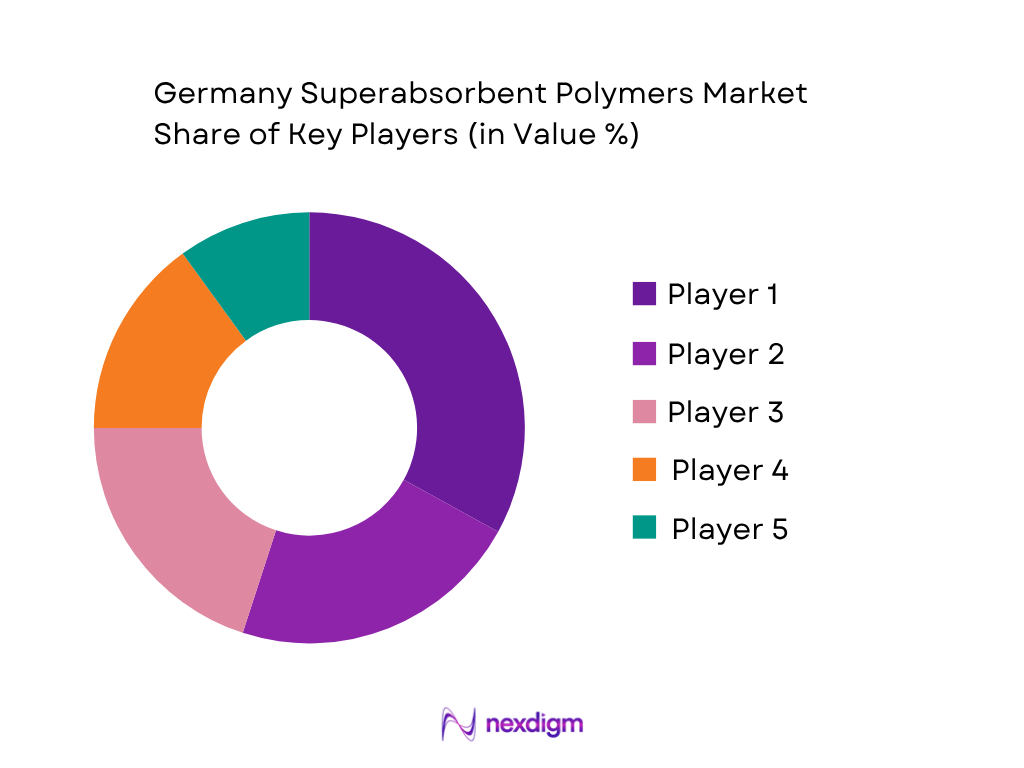
Germany Superabsorbent Polymers Market Analysis
Growth Drivers
Advanced Disposable Hygiene Manufacturing
Germany’s advanced disposable hygiene manufacturing base supports demand for superabsorbent polymers through baby diapers, adult incontinence products and feminine hygiene applications. The demographic and industrial backdrop remains relevant: Germany had 83,577,140 people in 2024, including 19,429,128 people aged 60–79 and 6,036,938 aged 80–99, according to the Federal Statistical Office. The country recorded 677,117 live births during the same year, maintaining a substantial recurring requirement for infant hygiene products. Germany also generated USD 4.69 trillion of GDP and USD 56,104 GDP per capita in 2024, according to the World Bank, supporting a high-income consumer environment for technologically advanced hygiene products. (Destatis) SAP is particularly important in modern absorbent cores because it enables manufacturers to retain substantial quantities of liquid while reducing the bulk of the absorbent structure. German manufacturers are therefore positioned to support demand for conventional acrylic-acid-based SAP as well as surface-crosslinked and high-retention grades. The country’s strong manufacturing ecosystem and European distribution connectivity further support procurement of technically consistent SAP for high-speed hygiene-product production. This combination of demographic demand, established manufacturing capability and advanced product requirements sustains SAP consumption across Germany’s hygiene industry.
Aging Population and Adult Incontinence Demand
Germany’s demographic structure creates a strong application pathway for SAP through adult incontinence products, including adult diapers, protective underwear and absorbent pads. The Federal Statistical Office reports 25,466,967 people aged 60 and above in 2024, comprising the 60–79 and 80–99 age groups together, while 17,901 people were aged 100 or more. Germany also recorded 1,007,758 deaths in 2024 against 677,117 births, producing a natural population deficit of 330,641 people. (Destatis) These demographic conditions increase the relevance of healthcare and personal-care products designed for older consumers, particularly where mobility limitations or age-related continence requirements increase reliance on disposable absorbent products. SAP enables adult-care manufacturers to combine liquid uptake, retention and product thinness, making it a core functional material in many modern absorbent structures. Germany’s healthcare expenditure and industrial capabilities further support development of specialized absorbent products requiring controlled swelling and high absorption under pressure. The country’s population totaled 83,516,593 according to the World Bank’s 2024 data, providing a large established consumer and healthcare base. (World Bank Open Data) Consequently, demographic aging is relevant not only to SAP volume demand but also to the development of higher-performance grades tailored to adult-care applications.
Market Challenges
Closure of Domestic SAP Production Capacity
Germany’s SAP industry faces a structural challenge from changes in domestic production capacity and greater reliance on European and international supply networks. This issue is particularly important because SAP is a technically qualified input: hygiene manufacturers cannot necessarily substitute one grade for another without validating absorption capacity, centrifuge retention, absorption under load, particle-size distribution, permeability and gel strength. Germany’s broader industrial environment also remains under pressure. The Federal Statistical Office reported that manufacturing gross value added declined by 3.0 in 2024, while the country’s construction industry gross value added declined by 3.8, illustrating the difficult industrial conditions surrounding chemical and manufacturing operations. (Destatis) Germany’s merchandise trade remains extensive, with the IMF reporting goods exports equivalent to 36.9 of GDP and goods imports equivalent to 31.0 of GDP in its 2024 assessment. (IMF) This international integration supports access to imported SAP but simultaneously exposes German buyers to external production interruptions, logistics constraints and supplier allocation decisions. The challenge therefore extends beyond physical availability: customers must maintain qualified supply alternatives while ensuring that imported SAP grades meet existing hygiene-product formulations and manufacturing-line requirements.
High Energy Intensity of Chemical Manufacturing
Energy requirements create a significant structural challenge for SAP and upstream chemical manufacturing in Germany because polymer production depends on industrial heat, electricity and chemical feedstocks. The Federal Statistical Office reports that German industry consumed 3,343 petajoules of energy in 2024, while energy-intensive industries consumed approximately 2,738 petajoules. The chemical industry alone accounted for 27.9 of industrial energy consumption, making it the largest industrial energy-consuming sector. Energy used as feedstock for chemical products increased to 13.3 above the previous year’s level, highlighting the importance of energy and feedstock conditions to chemical production economics. (Destatis) Although energy prices moderated during the period, Destatis recorded an annual-average decline of 6.2 in industrial energy prices and 13.3 in natural-gas prices in 2024 compared with the previous year, demonstrating how strongly energy conditions had affected the preceding industrial environment. (Destatis) For SAP manufacturers, the challenge is compounded by Germany’s stringent environmental requirements and the need to maintain reliable polymer quality. Producers therefore face pressure to improve energy efficiency, secure competitive feedstock supplies and reduce the carbon intensity of manufacturing without compromising absorption performance or hygiene-grade specifications.
Market Opportunities
High-Performance Hygiene-Grade SAP
Germany offers opportunities for high-performance SAP grades because its mature hygiene market increasingly requires materials capable of delivering strong absorption and retention within thinner absorbent structures. The demographic base is particularly relevant: the Federal Statistical Office recorded 25,466,967 residents aged 60 or older in 2024, while Germany had 677,117 births during the year, creating simultaneous demand channels for adult-care and infant-hygiene products. (Destatis) The country’s industrial and technological base also supports specialized polymer development. Germany recorded USD 4.69 trillion GDP in 2024, while GDP per capita reached USD 56,103.7, according to the World Bank. (World Bank Open Data) These conditions provide a substantial industrial and consumer environment for premium hygiene products where absorbent-core performance is a critical product attribute. High-performance SAP can be engineered around absorption under load, centrifuge retention capacity, absorption speed, permeability and gel strength, enabling manufacturers to optimize absorbent-core thickness and liquid distribution. Surface-crosslinked and modified SAP grades can also address different requirements across baby diapers, adult incontinence products and feminine hygiene products. The opportunity consequently extends beyond additional polymer consumption toward higher-value technical specifications, supplier qualification and application-specific SAP formulations for German and wider European hygiene-product manufacturing.
Sustainable and Bio-Based SAP
Sustainable and bio-based SAP development represents an opportunity to address environmental requirements while leveraging Germany’s established chemical and industrial innovation ecosystem. Germany’s industrial sector consumed 3,343 petajoules of energy in 2024, while the chemical industry accounted for 27.9 of industrial energy consumption, according to the Federal Statistical Office, highlighting the scale of the industrial base involved in the transition toward more resource-efficient chemical production. (Destatis) Germany also recorded USD 4.69 trillion GDP and USD 56,104 GDP per capita in 2024, according to the World Bank, providing a substantial economic base for investment in advanced materials and sustainable manufacturing technologies. (World Bank Open Data) For SAP, the opportunity includes bio-based or partially bio-derived feedstocks, biomass-balanced production routes, modified polymer structures and lower-material-use absorbent cores. Sustainable SAP can also support hygiene manufacturers seeking to reduce dependence on conventional fossil-based inputs while retaining critical absorption and retention characteristics. Circular approaches are another potential development pathway, particularly through improved separation and recycling technologies for SAP-containing absorbent products. Germany’s position within European chemical and hygiene supply chains further allows sustainable SAP technologies developed for the domestic market to address customers across neighboring European markets, creating an opportunity for specialized grades rather than commodity-only polymer supply.
Future Outlook
The Germany Superabsorbent Polymers Market is expected to evolve toward higher-performance and more application-specific absorbent materials. Demand from adult incontinence products is expected to remain strategically important alongside established baby-hygiene applications. Product development is likely to focus on surface-crosslinked polymers, improved absorption under pressure, stronger gel structures and thinner absorbent cores. Sustainability considerations are also expected to influence procurement, encouraging bio-based feedstocks, lower-carbon production routes and improved end-of-life solutions for SAP-containing hygiene products. Germany’s advanced chemical ecosystem and proximity to major European hygiene manufacturers provide a foundation for specialty SAP development and regional supply.
Major Players
- BASF SE
- Evonik Industries AG
- Nippon Shokubai Co., Ltd.
- Sumitomo Seika Chemicals Co., Ltd.
- LG Chem Ltd.
- Sanyo Chemical Industries, Ltd.
- Kao Corporation
- Mitsui Chemicals, Inc.
- Formosa Plastics Corporation
- San-Dia Polymers, Ltd.
- Yixing Danson Technology Co., Ltd.
- Shandong Nuoer Biological Technology Co., Ltd.
- Wanhua Chemical Group Co., Ltd.
- Zhejiang Weilong Polymer Material Co., Ltd.
- Songwon Industrial Co., Ltd.
Key Target Audience
- Disposable Diaper Manufacturers and Absorbent-Core Converters
- Adult Incontinence Product Manufacturers
- Feminine Hygiene Product Manufacturers
- Medical Absorbent Product Manufacturers
- Specialty Chemical and Polymer Distributors
- Investments and Venture Capitalist Firms
- Government and Regulatory Bodies (Federal Ministry for Economic Affairs and Climate Action, Federal Ministry for the Environment, Nature Conservation, Nuclear Safety and Consumer Protection, Federal Environment Agency)
- Industrial Chemical Procurement and Strategic Sourcing Departments
Research Methodology
Step 1: Identification of Key Variables
The initial phase involves constructing a Germany Superabsorbent Polymers Market ecosystem covering SAP producers, acrylic-acid suppliers, hygiene manufacturers, converters, distributors and end-use industries. Secondary research is used to identify product specifications, application requirements, manufacturing locations, trade flows and demand variables. The analysis distinguishes hygiene-grade SAP from specialty industrial and agricultural applications.
Step 2: Market Analysis and Construction
Historical market information is compiled across product type, application, grade, performance specification, end-use industry and regional demand. Domestic production, imports, exports and apparent consumption are assessed to establish the market supply structure. Bottom-up calculations are cross-checked against demand indicators from diaper, adult-care, feminine-hygiene and medical-product manufacturing.
Step 3: Hypothesis Validation and Expert Consultation
Market hypotheses are validated through consultations with SAP manufacturers, hygiene-product producers, chemical distributors, procurement professionals and application specialists. Discussions focus on qualification requirements, absorption specifications, supplier switching, product performance, procurement practices and emerging sustainable-material requirements. These insights are used to validate assumptions derived from secondary research.
Step 4: Research Synthesis and Final Output
The final stage integrates demand-side, supply-side and competitive intelligence into a consolidated Germany SAP market framework. Company-level analysis evaluates product portfolios, manufacturing capabilities, technical expertise, application coverage and European distribution reach. Findings are triangulated across multiple evidence sources to produce the market segmentation, competitive assessment and future outlook.

- Executive Summary
- Research Methodology (Market Definition and Scope, Germany SAP Classification, Product Specification Framework, Grade Mapping, Domestic Production Assessment, Import and Export Assessment, Manufacturing Footprint Mapping, Acrylic Acid and Upstream Feedstock Analysis, Hygiene Demand Assessment, Application-Level Demand Mapping, End-Use Industry Assessment, Supply Chain Mapping, Import Dependency Assessment, Capacity Utilization Assessment, Procurement and Qualification Analysis, Primary Industry Interviews, Data Triangulation, Market Sizing Approach, Top-Down Analysis, Bottom-Up Analysis, Forecasting Framework, Limitations and Future Conclusions)

- Definition and Scope
- Germany Superabsorbent Polymers Industry Evolution
- Germany Superabsorbent Polymers Value Chain Analysis
- Germany Superabsorbent Polymers Supply Chain Analysis
- Germany SAP Manufacturing and Production Footprint
- Germany Acrylic Acid–SAP Integration and Feedstock Ecosystem

- Growth Drivers (Advanced Disposable Hygiene Manufacturing, Aging Population and Adult Incontinence Demand, Established Chemical Manufacturing Infrastructure, Premium Hygiene Product Adoption, Demand for High-Performance Absorbent Materials, Healthcare Product Manufacturing, Advanced Polymer R&D Capabilities, Strong European Hygiene Supply Chains)
- Market Challenges (Closure of Domestic SAP Production Capacity, Dependence on European and International SAP Supply, Acrylic Acid Feedstock Exposure, High Energy Intensity of Chemical Manufacturing, Strict Environmental Compliance, Product Qualification Requirements, End-of-Life Management of SAP-Containing Hygiene Products, Recycling Constraints, Competition from Asian SAP Producers)
- Market Opportunities (High-Performance Hygiene-Grade SAP, Surface-Crosslinked SAP Development, Sustainable and Bio-Based SAP, Adult Incontinence Applications, Medical Absorbent Materials, Circular Solutions for Absorbent Hygiene Products, Specialty Industrial Absorbents, Advanced Polymer Research, European Regional Supply Development, Low-Carbon SAP Solutions)
- Market Trends (Zero-Carbon-Footprint SAP, Biomass-Balance SAP, High-Retention Polymer Development, Fluff-Free Absorbent Cores, Thin-Core Diaper Technology, Sustainable Hygiene Materials, Circular Diaper Recycling, Performance Optimization Under Pressure, Specialty SAP Formulations)
- Government Regulations (EU REACH Requirements, EU CLP Classification and Labelling, German Chemicals Act Requirements, German Hazardous Substances Ordinance, German Circular Economy Act, German Packaging Act, EU Waste Framework Directive, EU Industrial Emissions Requirements, Product Safety and Chemical Handling Requirements, Environmental Reporting and Sustainability Requirements)
- SWOT Analysis
- Porter’s Five Forces Analysis
- PESTLE Analysis
- Stakeholder Ecosystem

- By Market Value (2020-2025)
- By SAP Consumption Volume (2020-2025)
- By Domestic Production Volume (2020-2025)
- By Import Volume (2020-2025)
- By Export Volume (2020-2025)

- By Product Type (In Value %)
Acrylic Acid-Based SAP
Sodium Polyacrylate
Polyacrylate / Polyacrylamide Copolymers
Bio-Based and Modified SAP
Other Specialty SAP Grades - By Application (In Value %)
Baby Diapers
Adult Incontinence Products
Feminine Hygiene Products
Medical Absorbent Products
Agriculture and Horticulture
Industrial Absorbent Applications
Other Specialty Applications - By Performance Specification (In Value %)
Absorption Capacity
Centrifuge Retention Capacity
Absorption Against Pressure
Absorption Speed
Permeability
Gel Strength - By Product Form (In Value %)
Granular SAP
Fine-Particle SAP
Core-Shell and Modified SAP
High-Retention SAP
Bio-Based SAP - By End-Use Industry (In Value %)
Baby Hygiene Manufacturing
Adult Incontinence Manufacturing
Feminine Hygiene Manufacturing
Medical and Healthcare Products
Agriculture and Horticulture
Industrial Manufacturing
Waste Management and Environmental Applications - By Distribution Channel (In Value %)
Direct Import Supply
Specialty Chemical Distributors
Polymer and Performance Material Distributors
Hygiene Raw Material Suppliers
Industrial Chemical Distributors
Technical Sales and Application Partners

- Market Share of Major Players (By Germany Revenue, SAP Sales Volume, Product Type, Application, Grade Portfolio, Production Footprint, Import Supply, Customer Coverage, Hygiene Application Coverage, Regional Distribution)
- Cross Comparison Parameters (SAP Production Capacity, Product Portfolio Breadth, Hygiene-Grade SAP Coverage, Absorption Performance Portfolio, Surface-Crosslinked SAP Capability, Sustainable SAP Portfolio, European Manufacturing Footprint, Technical Service and Customer Qualification Capability)
- SWOT Analysis of Major Player
- Detailed Profiles of Major Companies
BASF SE
Evonik Industries AG / ICIG Superabsorber Business
Nippon Shokubai Co., Ltd.
Sumitomo Seika Chemicals Co., Ltd.
LG Chem Ltd.
Formosa Plastics Corporation
Sanyo Chemical Industries, Ltd.
Kao Corporation
Mitsui Chemicals, Inc.
Yixing Danson Technology Co., Ltd.
Songwon Industrial Co., Ltd.
San-Dia Polymers, Ltd.
Zhejiang Weilong Polymer Material Co., Ltd.
Shandong Nuoer Biological Technology Co., Ltd.

- Baby Diaper Manufacturer SAP Procurement Assessment
- Adult Incontinence Product Manufacturer SAP Requirement Analysis
- Feminine Hygiene Manufacturer Absorbency Specification Assessment
- Medical Absorbent Product Manufacturer Requirement Analysis
- SAP Distributor and Chemical Trader Assessment

- By Market Value (2026-2035)
- By SAP Consumption Volume (2026-2035)
- By Domestic Production Volume (2026-2035)
- By Import Volume (2026-2035)
- By Export Volume (2026-2035)


 Request a Sample
 Ask for Customization
 Get a Quote
 Enquire Now