
 Download PDF
Market Overview
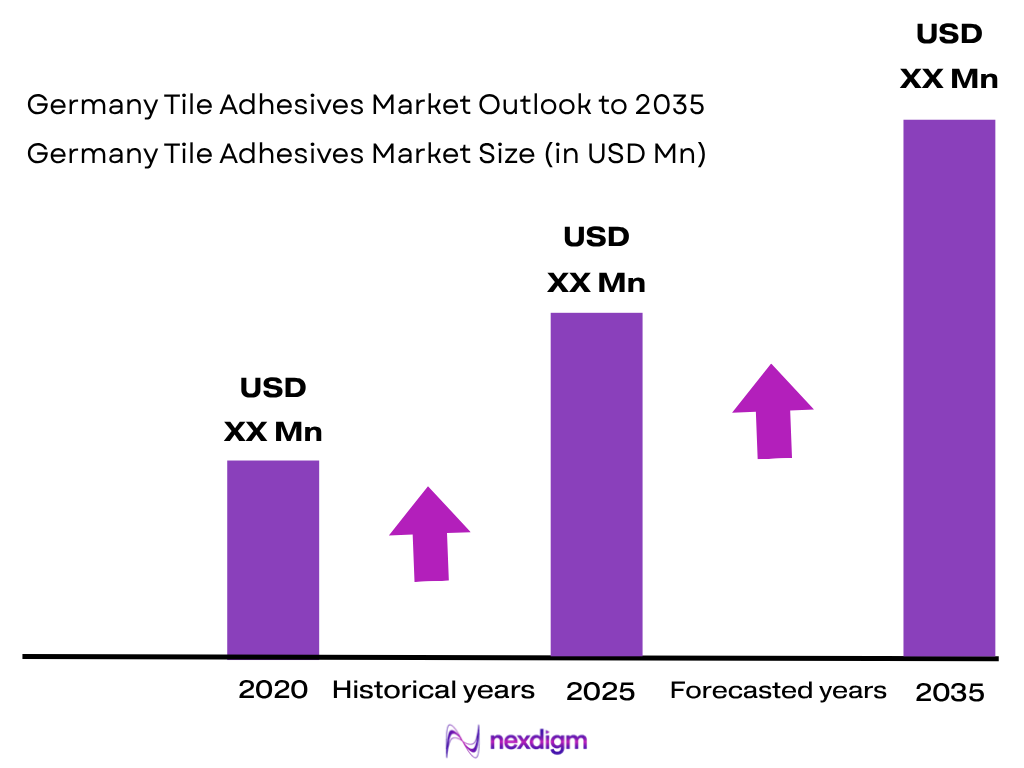
The Germany Tile Adhesives Market is valued at approximately ~USD XX million, supported by ceramic tile installation, residential renovation, bathrooms, terraces and commercial refurbishment. Construction investment moved from EUR 453.01 billion to EUR 450.66 billion, while housing construction investment moved from EUR 277.53 billion to EUR 270.48 billion across the latest two annual observations. Tile sales simultaneously moved from 93.8 million square metres to 89.4 million square metres, sustaining a substantial adhesive installation base.
North Rhine-Westphalia, Bavaria and Baden-Württemberg are major Germany Tile Adhesives Market demand centres because they combine large housing stocks, renovation activity, professional installer networks and substantial commercial construction. Baden-Württemberg alone recorded 43,559 completed dwellings followed by 36,379, including 5,128 and 4,663 dwellings created through work on existing buildings. Germany’s dwelling stock also expanded from 43.52 million to 43.76 million units, creating a very large installed base for bathroom, kitchen and floor refurbishment.
Market Segmentation
By Performance Classification
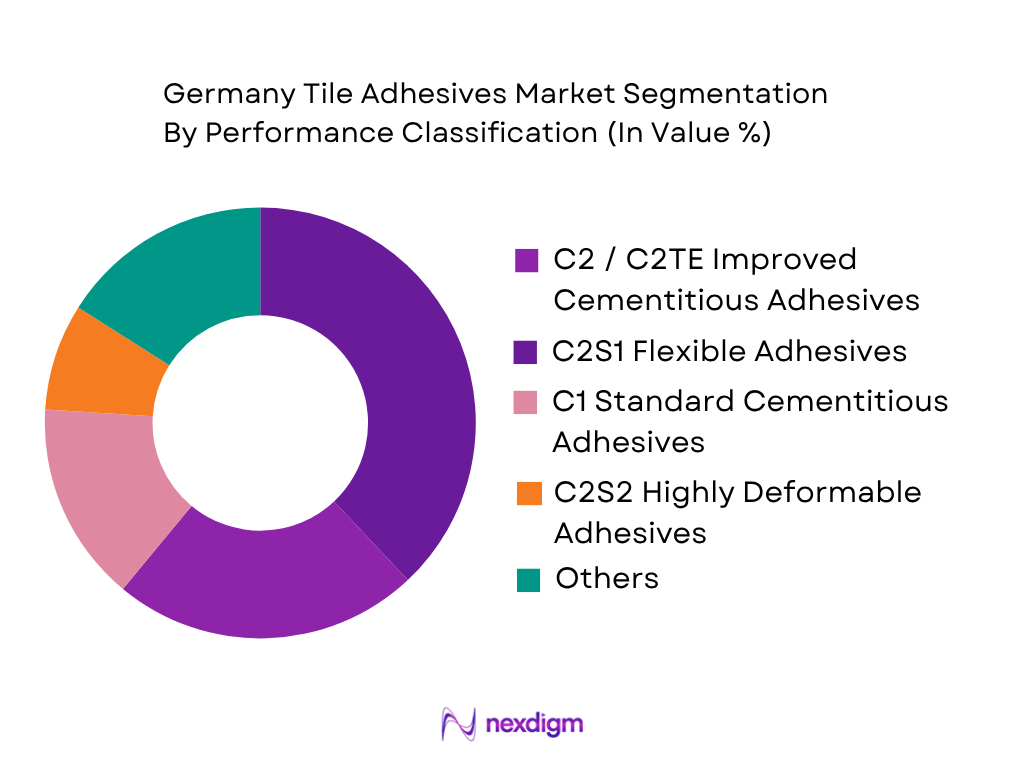
The Germany Tile Adhesives Market is segmented into C1 standard cementitious adhesives, C2 improved cementitious adhesives, C2TE products, C2S1 flexible adhesives, C2S2 highly deformable adhesives, dispersion adhesives and reactive resin systems. C2 and C2TE improved cementitious adhesives hold the dominant modeled share because German installation practice increasingly involves low-absorption porcelain stoneware, heated screeds, renovation substrates and larger tile formats that require stronger adhesion and more reliable open-time performance than basic C1 products. Professional installers also tend to prefer polymer-modified products that can cover multiple job-site conditions, reducing the need to stock numerous highly specialized mortars. The importance of renovation further reinforces flexible cementitious products because existing screeds, old tile coverings and mixed substrates create greater movement and adhesion demands. DIN EN 12004 classification, ZDB guidance and manufacturer system warranties also support migration toward clearly classified, higher-performance mortars rather than unclassified site-mixed solutions.
By Application
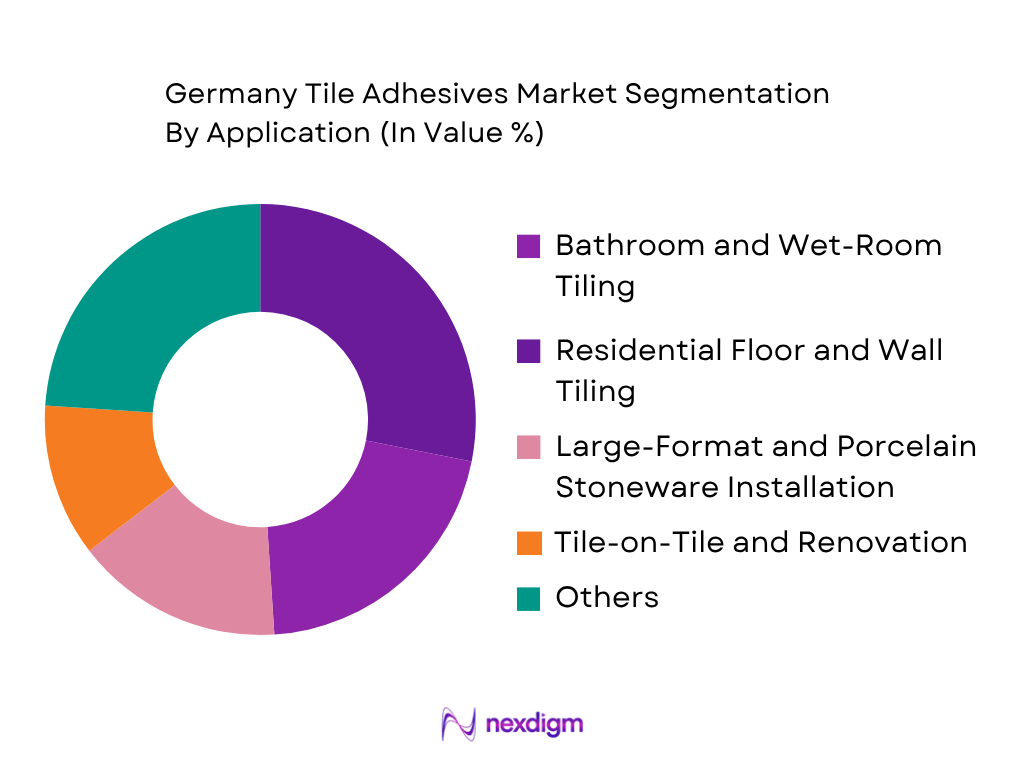
The Germany Tile Adhesives Market is segmented into bathrooms and wet rooms, residential floors and walls, large-format porcelain installation, balconies and terraces, commercial areas, natural stone, heated floors, tile-on-tile renovation and specialty industrial applications. Bathroom and wet-room tiling holds the dominant modeled share because Germany has a very large installed housing stock and bathrooms are among the most tile-intensive areas in both new construction and refurbishment. The dwelling stock reached 43.76 million units, giving adhesive suppliers a substantial recurring renovation base independent of new-home construction. Wet-room installations also require complete systems involving primers, waterproofing membranes, flexible adhesives and grouts, increasing adhesive value intensity per project. Heated-floor compatibility further strengthens demand for deformable C2S1 and C2S2 mortars because thermal cycling creates movement between the substrate and tile. Renovation demand is therefore particularly important as new dwelling completions declined from 294,399 to 251,937, making refurbishment a larger strategic focus for suppliers.
Competitive Landscape
The Germany Tile Adhesives Market has a technically mature competitive landscape led by domestic and European construction-chemical manufacturers with strong dry-mix production, professional installer relationships and application laboratories. Sopro, PCI, ARDEX, MAPEI and Saint-Gobain Weber are prominent participants across C2, C2TE, S1/S2 flexible systems, large-format tiles, natural stone and wet-room installations. Competitive differentiation depends on formulation technology, installer training, specialist-trade distribution, low-emission credentials and the ability to provide complete tiling systems rather than single adhesive products.
| Major Player | Establishment Year | Headquarters | C2 / C2TE Portfolio | S1 / S2 Flexible Capability | Large-Format / Porcelain Capability | Germany Manufacturing / R&D | Specialist Trade Reach | Technical / Installer Support |
| Sopro Bauchemie | 1985* | Wiesbaden, Germany | ~ | ~ | ~ | ~ | ~ | ~ |
| PCI Augsburg | 1950 | Augsburg, Germany | ~ | ~ | ~ | ~ | ~ | ~ |
| ARDEX | 1949 | Witten, Germany | ~ | ~ | ~ | ~ | ~ | ~ |
| MAPEI | 1937 | Milan, Italy | ~ | ~ | ~ | ~ | ~ | ~ |
| Saint-Gobain Weber | 1900s heritage | Düsseldorf, Germany | ~ | ~ | ~ | ~ | ~ | ~ |
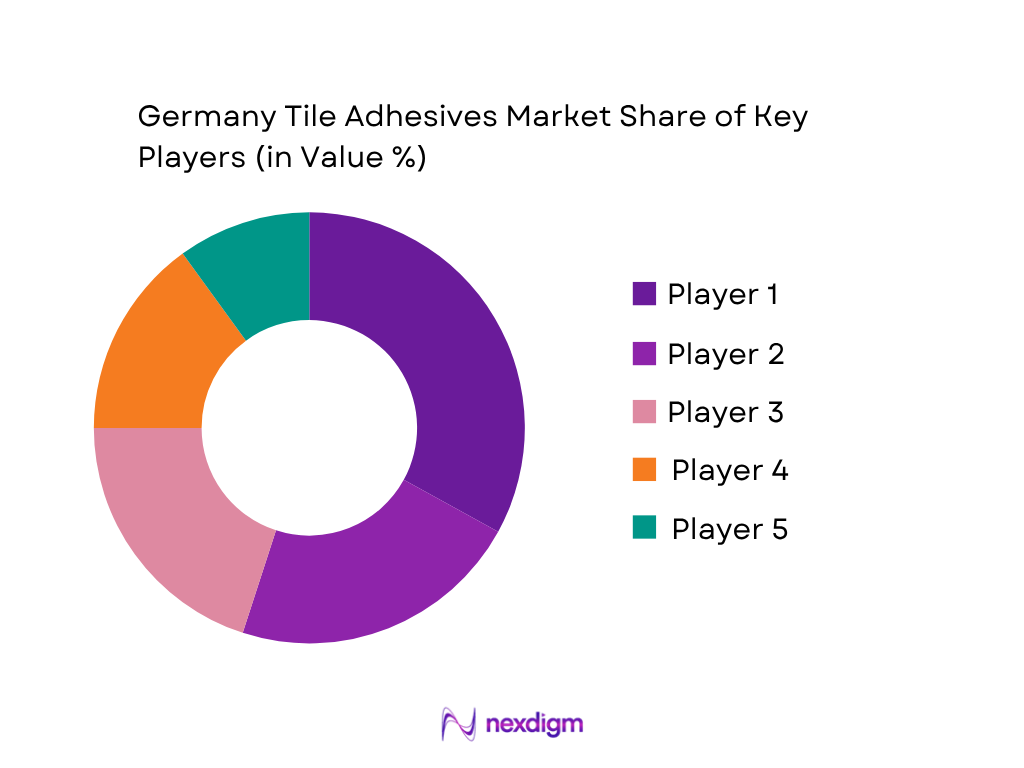
Germany Tile Adhesives Market Analysis
Growth Drivers
Large Existing Housing Stock and Renovation Activity Support Flexible Adhesive Demand
Germany’s extensive installed housing base is a structural demand driver for tile adhesives because refurbishment of bathrooms, kitchens, balconies and heated floors creates recurring installation activity independent of new construction. Destatis recorded 43.76 million dwellings at the end of 2024, up from 43.52 million one year earlier, while the total residential floor area reached around 4.1 billion square metres. More than 23.5 million dwellings were located in 3.5 million multifamily buildings, concentrating substantial renovation potential in professionally managed housing stock. Even with weaker new construction, Germany completed 251,937 dwellings in 2024 and still had a construction backlog of 759,700 approved but unfinished dwellings, including 330,000 already under construction. Renovation conditions favor C2TE and S1 flexible mortars because installers frequently work over existing screeds, old ceramic coverings, heated floors and mixed substrates requiring stronger adhesion and deformation capability than standard C1 products. Germany’s broader economic capacity supports this high-value refurbishment market: World Bank data place 2024 GDP at USD 4,685.59 billion and GDP per capita at USD 56,103.7, while construction investment totaled EUR 450.66 billion. These figures provide a substantial economic and physical asset base for recurring tile adhesive consumption.
Large-Format Porcelain and Professional Installation Increase Adhesive Performance Intensity
Germany’s ceramic tile market is increasingly important to adhesive suppliers through product complexity rather than simple volume expansion. The Bundesverband Keramische Fliesen reported domestic tile sales of 89.4 million square metres in 2024, following 93.8 million square metres in 2023. Although total tile volume contracted, the installed area remains large enough to support substantial adhesive consumption, while professional applications increasingly involve porcelain stoneware, large-format tiles, heated screeds, wet rooms and exterior installations. These applications typically require polymer-modified C2, C2TE, S1 or S2 products with improved adhesion, extended open time and deformation capability. Germany also exported 17.6 million square metres of ceramic tiles in 2024, showing that the domestic tile and installation ecosystem remains technically developed despite weaker construction conditions. The opportunity for adhesive manufacturers therefore lies in increasing performance intensity per square metre through flexible mortars, full-bed products and rapid-setting systems. Macroeconomic conditions remain supportive of premium building-material adoption: the World Bank recorded 2024 GDP of USD 4,685.59 billion and GDP per capita of USD 56,103.7, while German non-residential construction investment reached EUR 180.18 billion in 2024. This combination supports higher-specification adhesive use in residential renovation, hospitality, healthcare, retail and commercial tiling.
Market Challenges
Weak New Residential Construction Constrains Volume Growth for Standard Tile Adhesives
Germany’s weak new-build environment is a direct challenge for standard cementitious tile adhesive volumes because newly completed homes and floor area are important sources of first-time bathroom, kitchen and floor tiling. Destatis recorded 251,937 completed dwellings in 2024, falling further to 206,586 dwellings in 2025. Newly constructed dwellings declined from 220,666 to 175,867, while completed new buildings fell from 97,279 to 78,182 over the same period. Residential floor area delivered declined from 24.77 million square metres to 20.06 million square metres, reducing the addressable surface base for first-installation tile products. Building permits also remained subdued: Germany approved 215,289 dwellings in 2024 and 238,063 in 2025, still below earlier construction levels, while 35,700 housing permits expired in 2025. This environment limits straightforward volume expansion for C1 and mainstream C2 adhesives and forces suppliers to rely more heavily on renovation and premium applications. Macroeconomic conditions provide limited support for rapid recovery: World Bank data show 2024 GDP of USD 4,685.59 billion, GDP per capita of USD 56,103.7 and GDP growth of -0.5, while residential construction investment was EUR 270.48 billion.
Declining Tile Sales and Production Pressure Intensify Competition Across the Adhesive Supply Chain
The Germany Tile Adhesives Market also faces pressure from weaker ceramic tile sales and challenging conditions in domestic building-material production. Industry data show tile sales declining from 93.8 million square metres in 2023 to 89.4 million square metres in 2024 after a much larger contraction from 132.9 million square metres in the preceding cycle. German ceramic tile exports reached 17.6 million square metres in 2024, while imports remained significant, with Italy accounting for almost half of imported tile supply and Poland, Spain and Türkiye remaining major sources. This market structure creates pricing and specification pressure for domestic adhesive suppliers because lower tile throughput reduces the number of square metres available for conventional adhesive consumption while imported tile formats may require different installation systems. At the same time, construction work completed across Germany fell from 161,682 buildings and construction measures in 2024 to 139,481 in 2025, narrowing the flow of fresh installation projects. Manufacturers must therefore increase value through S1/S2, rapid-setting, natural-stone and system-based solutions. Germany’s 2024 macroeconomic base remained large at USD 4,685.59 billion of GDP and USD 56,103.7 GDP per capita, but GDP growth was -0.5, underscoring the competitive pressure in a mature, slow-growth construction economy.
Market Opportunities
C2TE, S1 and S2 Flexible Adhesives Can Capture Value from Renovation and Complex Substrates
Germany’s large existing building stock creates a strong future opportunity for higher-performance C2TE, S1 and S2 tile adhesives because refurbishment frequently involves critical substrates, heated screeds, old tiles and moisture-sensitive construction layers. The country contained 43.76 million dwellings at the end of 2024, including 23.5 million dwellings in multifamily buildings, creating a very large installed base for bathroom, kitchen and floor modernization. At the same time, the new-build slowdown increases the strategic relevance of refurbishment: only 206,586 dwellings were completed in 2025, while 760,700 approved dwellings remained unfinished at year-end. The combination of mature building stock and slower new supply favors products designed for tile-on-tile renovation, decoupling systems, fast-setting repairs and flexible heated-floor applications rather than only standard new-build mortars. Current construction investment also supports continued expenditure on technically demanding building work: Germany recorded EUR 450.66 billion in construction investment in 2024 and EUR 460.75 billion in 2025. The opportunity is reinforced by a macroeconomic base of USD 4,685.59 billion in 2024 GDP and USD 56,103.7 GDP per capita, indicating significant capacity for professional refurbishment and higher-value installation systems.
Large-Format, Wet-Room and Low-Emission Systems Offer a Premium Technology Route
Germany’s tile adhesive market offers future growth through technically demanding applications where adhesive performance matters more than basic mortar volume. The current ceramic tile base remains substantial at 89.4 million square metres of domestic sales in 2024, while Germany also completed 251,937 dwellings and maintained 759,700 approved but unfinished dwellings at year-end. This creates a broad platform for large-format porcelain, bathrooms, balconies, terraces and heated-floor installations requiring C2TE, S1 and S2 mortars, full-bed coverage and carefully coordinated waterproofing systems. Non-residential construction strengthens this opportunity: investment reached EUR 180.18 billion in 2024 and increased to EUR 188.43 billion in 2025, supporting healthcare, hospitality, public buildings, retail and industrial facilities where low-emission and system-certified products are increasingly relevant. Large-format tiles also require more controlled adhesive-bed thickness and better deformation capability, allowing suppliers to increase technical value per installed square metre. Germany’s macroeconomic capacity supports this premiumization pathway, with World Bank data recording 2024 GDP of USD 4,685.59 billion and GDP per capita of USD 56,103.7. The opportunity therefore lies in combining flexible adhesives with waterproofing, primers, grouts and decoupling systems rather than competing solely on commodity cementitious products.
Future Outlook
The Germany Tile Adhesives Market is forecast to expand at approximately ~X.X% CAGR during 2026–2035. Future growth is expected to be increasingly driven by renovation, higher-performance flexible adhesives, large-format tile installation, heated-floor systems and low-emission formulations rather than straightforward expansion of new residential construction. Suppliers that combine C2TE, S1/S2 performance with complete waterproofing and substrate-preparation systems are likely to be better positioned. Germany’s new-build environment remains challenging. Completed dwellings declined from 294,399 in 2023 to 251,937 in 2024, while completed buildings and construction measures declined from 183,665 to 161,682. New-building completions fell from 118,369 buildings to 97,279. This shifts strategic emphasis toward renovation and refurbishment, where tile adhesives can benefit from existing residential stock rather than depend solely on new project starts.
Major Players
- Sopro Bauchemie GmbH
- PCI Augsburg GmbH
- ARDEX GmbH
- MAPEI GmbH
- Saint-Gobain Weber GmbH
- BOTAMENT GmbH
- SCHOMBURG GmbH & Co. KG
- Kiesel Bauchemie GmbH & Co. KG
- codex / Uzin Utz SE
- Sika Deutschland CH AG & Co KG / Schönox
- Sievert SE / quick-mix
- Knauf Bauprodukte GmbH & Co. KG
- SAKRET Trockenbaustoffe Europa GmbH & Co. KG
- Baumit GmbH
- Bostik GmbH
Key Target Audience
- Tile Adhesive and Dry-Mix Mortar Manufacturers
- Ceramic and Porcelain Tile Manufacturers
- Building Material and Specialist Tile Distributors
- Professional Tile Installers and Tiling Contractors
- Housing Companies and Property Developers
- Renovation and Building Refurbishment Contractors
- Investments and Venture Capitalist Firms
- Government and Regulatory Bodies (German Institute for Standardization, German Institute for Building Technology, Federal Ministry for Housing, Urban Development and Building, Federal Environment Agency)
Research Methodology
Step 1: Identification of Key Variables
The initial phase involves constructing an ecosystem map covering cement suppliers, polymer producers, dry-mix manufacturers, tile producers, specialist distributors, installers and housing companies. Desk research identifies the variables that influence Germany Tile Adhesives Market demand, including tile sales, housing stock, new-building completions, renovation activity, adhesive performance classes and regional construction concentration.
Step 2: Market Analysis and Construction
Historical demand is analyzed through top-down and bottom-up approaches. Top-down assessment uses construction investment, completed dwellings, tile consumption and building stock, while bottom-up analysis estimates adhesive consumption from installed tile area, application thickness, typical coverage, performance-class penetration and product mix across residential, commercial and renovation applications.
Step 3: Hypothesis Validation and Expert Consultation
Market hypotheses are validated through computer-assisted telephone interviews with tile adhesive manufacturers, specialist dealers, tiling contractors and professional installers. These discussions validate C1 versus C2 demand, S1 and S2 penetration, large-format tile trends, heated-floor applications, renovation product usage, specialist trade preferences and technical-performance requirements.
Step 4: Research Synthesis and Final Output
The final phase triangulates official construction statistics, ceramic-tile industry data, company disclosures, technical standards and primary research. Bottom-up consumption estimates are reconciled with top-down construction indicators to determine product segmentation, application structure, competitive positioning and future opportunities across the Germany Tile Adhesives Market.

- Executive Summary
- Research Methodology (Market Definitions and Assumptions, Germany Tile Adhesives Market Boundary, Tile Adhesive Classification, Cementitious Adhesive Assessment, Dispersion Adhesive Assessment, Reactive Resin Adhesive Assessment, C1 Adhesive Assessment, C2 Adhesive Assessment, C2TE Adhesive Assessment, S1 Flexible Adhesive Assessment, S2 Highly Deformable Adhesive Assessment, Fast-Setting Adhesive Assessment, Large-Format Tile Adhesive Assessment, Porcelain Stoneware Adhesive Assessment, Natural Stone Adhesive Assessment, Mosaic Adhesive Assessment, Balcony and Terrace Adhesive Assessment, Wet-Room Adhesive Assessment, Swimming Pool Adhesive Assessment, Heated-Floor Adhesive Assessment, Renovation and Tile-on-Tile Assessment, DIN EN 12004 Assessment, DIN 18157 Assessment, DIN EN 14891 Assessment, ZDB Guidance Assessment, EMICODE Assessment, Supply-Side Assessment, Demand-Side Assessment, Top-Down Market Sizing, Bottom-Up Market Sizing, Primary Industry Interviews, Tile Consumption Mapping, Renovation Pipeline Assessment, Data Triangulation, Forecasting Framework)

- Definition and Scope
- Germany Tile Adhesives Industry Evolution and Development of Conventional Cementitious Thin-Bed Mortars, Polymer-Modified Flexible Mortars, C1 Standard Adhesives, C2 Improved Adhesives, C2TE Extended-Open-Time Slip-Resistant Adhesives, S1 Flexible Adhesives, S2 Highly Deformable Adhesives, Flow-Bed Mortars, Medium-Bed Mortars, Rapid-Setting Adhesives, Dispersion Adhesives, Reactive Resin Adhesives, Epoxy Adhesives, Porcelain Stoneware Adhesives, Large-Format Tile Adhesives, Natural Stone Adhesives, Mosaic Adhesives, Balcony and Terrace Systems, Under-Tile Waterproofing Systems, Decoupling Systems, Heated-Floor Adhesives, Low-Emission EMICODE Products, Reduced-CO2 and Cement-Reduced Tile Adhesive Technologies
- Tile Adhesives Value Chain Analysis
- Tile Adhesives Supply Chain Analysis
- Cement Suppliers, White Cement Suppliers, Redispersible Polymer Powder Suppliers, Cellulose Ether Suppliers, Acrylic Polymer Suppliers, EVA Polymer Suppliers, Epoxy Resin Suppliers, Specialty Additive Suppliers, Silica Sand and Mineral Filler Suppliers, Dry-Mix Mortar Manufacturers, Tile Adhesive Manufacturers, Construction Chemical Producers, Regional Warehouses, Building Material Wholesalers, Tile Specialist Dealers, Professional Trade Distributors, Tiling Contractors, Tile Installers, Renovation Contractors, Property Owners, Housing Companies, Architects, Planners, Testing Institutes

- Growth Drivers (Residential Renovation, Bathroom Modernization, Existing Building Stock, Porcelain Stoneware Adoption, Large-Format Tile Installation, Heated-Floor Installation, Wet-Room Renovation, Balcony and Terrace Refurbishment, Commercial Refurbishment, Professional Thin-Bed Installation, Flexible Adhesive Penetration, Building Modernization)
- Market Challenges (Weak New Residential Construction, Declining Ceramic Tile Sales, Installer Shortages, Substrate Moisture Problems, Large-Format Installation Complexity, Calcium Sulphate Screed Sensitivity, Incorrect Adhesive Bed Coverage, Tile Debonding, Imported Tile Competition, High Energy Costs in Ceramic Industry, Cement and Polymer Raw Material Volatility, Product-System Compatibility, Increasing Technical Specification Complexity)
- Market Opportunities (C2TE High-Performance Adhesives, C2S1 Flexible Mortars, C2S2 Highly Deformable Adhesives, Large-Format Tile Adhesives, Rapid-Setting Renovation Adhesives, Tile-on-Tile Systems, Heated-Floor Adhesives, Natural Stone Adhesives, Wet-Room Systems, Balcony and Terrace Systems, Decoupling Systems, Low-Emission EMICODE Products, Reduced-CO2 Adhesives, Cement-Reduced Adhesives, Complete Tile Installation Systems)
- Market Trends (C2TE Flexible Adhesives, Large-Format and XXL Tile Systems, Porcelain Stoneware Installation, Buttering-Floating Application, Highly Deformable S2 Mortars, Rapid-Setting Systems, Low-Dust Formulations, Low-Emission EC1 PLUS Products, Cement-Reduced Adhesives, Alternative Binder Technologies, Decoupling Mats, Under-Tile Waterproofing, System-Based Installation, High-Yield Lightweight Adhesives)
- Government Regulations and Standards (DIN EN 12004-1 Tile Adhesive Classification and Performance, DIN EN 12004-2 Test Methods, DIN 18157 Thin-Bed Installation Requirements, DIN EN 14891 Under-Tile Waterproofing Requirements, DIN EN 14411 Ceramic Tile Requirements, DIN EN 13888 Grout Requirements, DIN EN ISO 6076 Trowel Notch Specifications, ZDB Technical Guidance, EMICODE Emission Classification, DGNB Requirements, QNG Requirements, Construction Products Regulation, REACH and CLP Chemical Compliance)
- SWOT Analysis
- Porter’s Five Forces Analysis
- PESTLE Analysis

- By Market Value (2020-2025)
- By Tile Adhesive Consumption Volume (2020-2025)
- By Cementitious Adhesive Consumption (2020-2025)
- By Polymer-Modified Adhesive Consumption (2020-2025)
- By C1 Adhesive Consumption (2020-2025)
- By C2 Adhesive Consumption (2020-2025)
- By C2TE Adhesive Consumption (2020-2025)
- By S1 Flexible Adhesive Consumption (2020-2025)

- By Adhesive Technology (In Value %)
Cementitious Tile Adhesives
Polymer-Modified Cementitious Adhesives
Flexible Cementitious Adhesives
Dispersion Adhesives
Reactive Resin Adhesives
Epoxy Adhesives
Rapid-Setting Cementitious Adhesives
Flow-Bed Adhesives
Medium-Bed Adhesives
Cement-Reduced and Alternative-Binder Adhesives - By Performance Classification (In Value %)
C1 Standard Cementitious Adhesives
C1T Slip-Resistant Adhesives
C1E Extended Open-Time Adhesives
C2 Improved Cementitious Adhesives
C2T Improved Slip-Resistant Adhesives
C2E Extended Open-Time Improved Adhesives
C2TE Improved Extended-Open-Time Slip-Resistant Adhesives
C2F Fast-Setting Improved Adhesives
C2S1 Flexible Adhesives
C2S2 Highly Deformable Adhesives
D-Class Dispersion Adhesives
R-Class Reactive Resin Adhesives - By Tile and Covering Type (In Value %)
Ceramic Wall Tiles
Stoneware Tiles
Porcelain Stoneware / Feinsteinzeug
Large-Format Porcelain Tiles
Large Ceramic Slabs
Natural Stone
Marble
Granite
Glass Mosaic
Porcelain Mosaic
Terracotta and Cotto
Clinker Tiles - By Application (In Value %)
Bathroom and Wet-Room Tiling
Kitchen Tiling
Residential Floor Tiling
Residential Wall Tiling
Commercial Floor Tiling
Balcony and Terrace Tiling
Exterior Wall and Façade Tiling
Swimming Pool and Wellness Tiling
Tile-on-Tile Renovation
Large-Format Tile Installation
Natural Stone Installation
Industrial and Commercial Kitchen Tiling
Heated-Floor Tiling - By Building Type (In Value %)
Single-Family Housing
Multi-Family Housing
Apartment Buildings
Residential Renovation
Commercial Offices
Retail and Shopping Centres
Hotels
Hospitals and Healthcare Facilities
Schools and Public Buildings
Industrial Buildings
Food Processing Facilities
Leisure and Wellness Facilities
Transport Buildings - By Construction Activity (In Value %)
New Residential Construction
New Non-Residential Construction
Bathroom Renovation
Residential Refurbishment
Commercial Refurbishment
Tile Replacement
Tile-on-Tile Installation
Energy-Efficient Building Renovation
Balcony and Terrace Rehabilitation
Wet-Room Modernization
Public Building Renovation

- Market Share of Major Players (By Germany Revenue, Tile Adhesive Consumption Volume, Cementitious Adhesive Volume, C1 Portfolio, C2 Portfolio, C2TE Portfolio, S1 and S2 Portfolio, Large-Format Tile Adhesive Portfolio, Natural Stone Adhesive Portfolio, Reactive Resin Adhesive Portfolio, Domestic Manufacturing Capacity, Specialist Trade Distribution, Technical Laboratory Capability, Installer Training Coverage, Low-Emission Product Portfolio)
- Cross Comparison Parameters (C1 C2 C2TE S1 and S2 Performance-Class Portfolio Breadth, Large-Format XXL and Porcelain Stoneware Adhesive Capability, Natural Stone Wet-Room Balcony and Terrace System Capability, Rapid-Setting Tile-on-Tile and Renovation Adhesive Capability, Germany Dry-Mix Manufacturing R&D and Formulation Footprint, Specialist Tile Trade Building-Material Wholesale and Installer Network Reach, DIN EN 12004 DIN 18157 DIN EN 14891 and ZDB Compliance Capability, EMICODE Low-Emission Technical Training Laboratory and Site-Support Capability)
- SWOT Analysis of Major Players (Product Breadth, German Manufacturing, Installer Relationships, Specialist Trade Coverage, Sustainability Capability)
- Major Companies
Sopro Bauchemie GmbH
PCI Augsburg GmbH
ARDEX GmbH
MAPEI GmbH
Saint-Gobain Weber GmbH
BOTAMENT GmbH
SCHOMBURG GmbH & Co. KG
Kiesel Bauchemie GmbH & Co. KG
codex / Uzin Utz SE
Sika Deutschland CH AG & Co KG / Schönox
Sievert SE / quick-mix
Knauf Bauprodukte GmbH & Co. KG
SAKRET Trockenbaustoffe Europa GmbH & Co. KG
Baumit GmbH
Bostik GmbH

- Professional Tile Installer Requirement Assessment
- Tiling Contractor Requirement Assessment
- Residential Renovation Contractor Requirement Assessment
- Housing Company Requirement Assessment
- Architect and Planner Specification Assessment
- Bathroom Renovation Requirement Assessment
- Large-Format Tile Installer Requirement Assessment
- Natural Stone Installer Requirement Assessment
- Commercial Contractor Requirement Assessment

- By Market Value (2026-2035)
- By Tile Adhesive Consumption Volume (2026-2035)
- By Cementitious Adhesive Consumption (2026-2035)
- By Polymer-Modified Adhesive Consumption (2026-2035)
- By C1 Adhesive Consumption (2026-2035)
- By C2 Adhesive Consumption (2026-2035)
- By C2TE Adhesive Consumption (2026-2035)
- By S1 Flexible Adhesive Consumption (2026-2035)


 Request a Sample
 Ask for Customization
 Get a Quote
 Enquire Now
