
 Download PDF
Market Overview
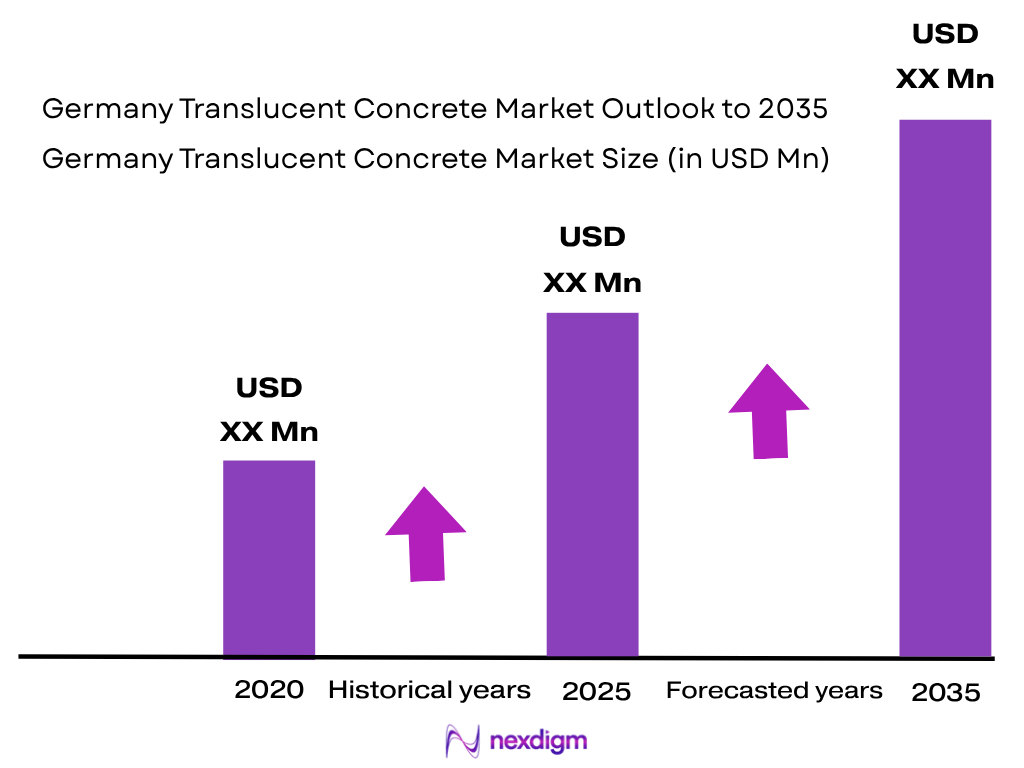
The Germany Translucent Concrete Market is valued at approximately USD ~XX million, based on historical market analysis. Demand is supported by architectural façades, interior feature walls, transport-infrastructure refurbishment and integrated lighting applications. Germany recorded 163,906 building permits/construction measures with €112.99 billion in estimated construction costs, followed by 145,010 measures representing €104.06 billion. Domestic technological capability also supports adoption, with German specialist LUCEM reporting more than 600 completed projects worldwide.
Berlin, Hamburg, Munich, Frankfurt, Aachen and major North Rhine-Westphalian commercial centers represent important demand locations for Germany Translucent Concrete Market applications because they concentrate premium commercial buildings, transportation infrastructure, corporate properties and architecturally differentiated refurbishment projects. German reference installations include façades in Berlin, Munich Airport, offices in Frankfurt and Hamburg, corporate buildings in Essen and Aachen, while Hamburg Central Station incorporated translucent-concrete panels across 25 existing concrete columns, demonstrating applicability to large public-infrastructure renovation.
Market Segmentation
By Light-Transmitting Technology
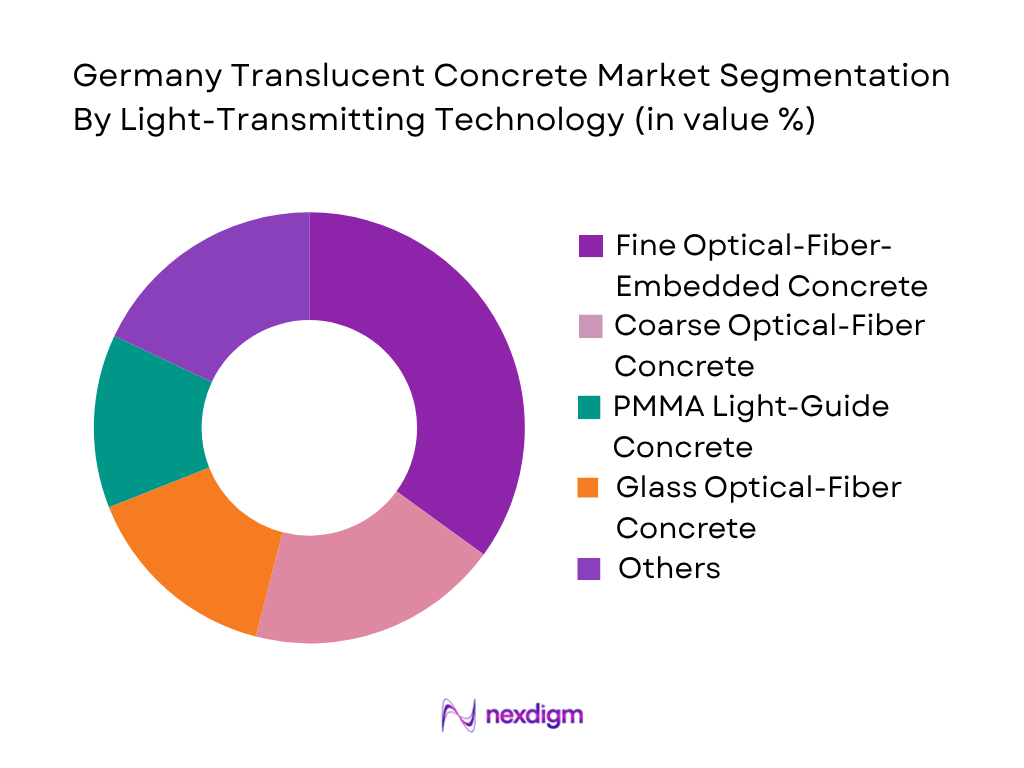
Germany Translucent Concrete Market is segmented into fine optical-fiber-embedded concrete, coarse optical-fiber concrete, PMMA light-guide concrete, glass optical-fiber concrete, custom-pattern fiber concrete and integrated LED/digital concrete. Fine optical-fiber-embedded concrete holds the dominant placeholder share because it delivers the uniform illuminated appearance required for premium wall panels, façades and interior surfaces while maintaining the visual character of concrete when illumination is inactive. German commercial technology demonstrates the technical maturity of this configuration: LUCEM LUCCON incorporates 0.5 mm optical fibers and its current portfolio can achieve fiber densities of up to 300,000 fibers per square meter. Commercial panels can combine light transmission with structural material performance, including a C70/85 concrete strength class and density of approximately 2,400 kg/m³. Fine fiber distribution is particularly suited to high-value architectural applications requiring controlled shadows, silhouettes and homogeneous illumination rather than isolated points of light. Coarser fibers remain relevant where designers require stronger point-source illumination, lettering, signage or distinctive starlight effects.
By Application
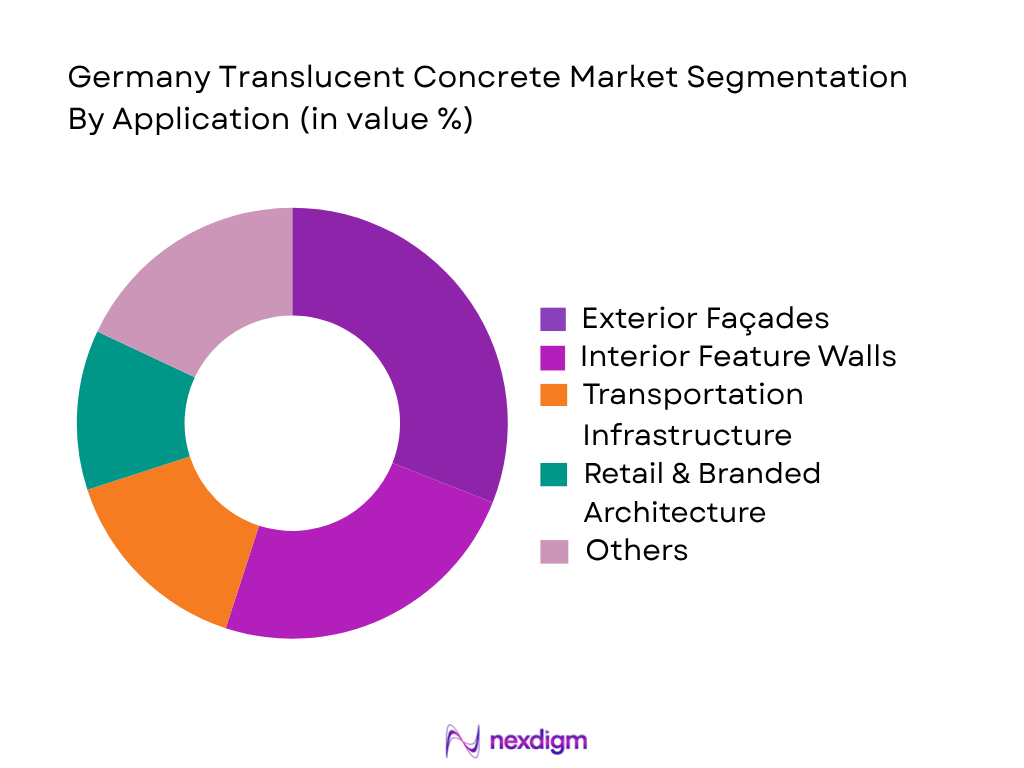
Germany Translucent Concrete Market is segmented into exterior façades, interior feature walls, partitions, transportation infrastructure, retail and branded architecture, flooring and public-realm applications. Exterior façades hold the dominant placeholder share, supported by the ability of translucent concrete to function simultaneously as an architectural concrete surface and an illuminated building-envelope element. Light-transmitting fibers extend through the panel and make natural or artificial light visible on the exposed surface without converting the concrete itself into a transparent material. Germany already has documented façade installations in Berlin and other locations, while contemporary systems coordinate panel dimensions, fixings and lighting technology as an integrated architectural solution. Renovation provides an additional route to adoption. Germany recorded 145,010 building permits and construction measures with €104.06 billion of estimated construction costs, providing a substantial project base in which specialist façade products can be specified. Interior feature walls remain another significant application because installation conditions are less exposed to weather and can accommodate custom backlighting, logos, silhouettes and decorative surfaces.
Competitive Landscape
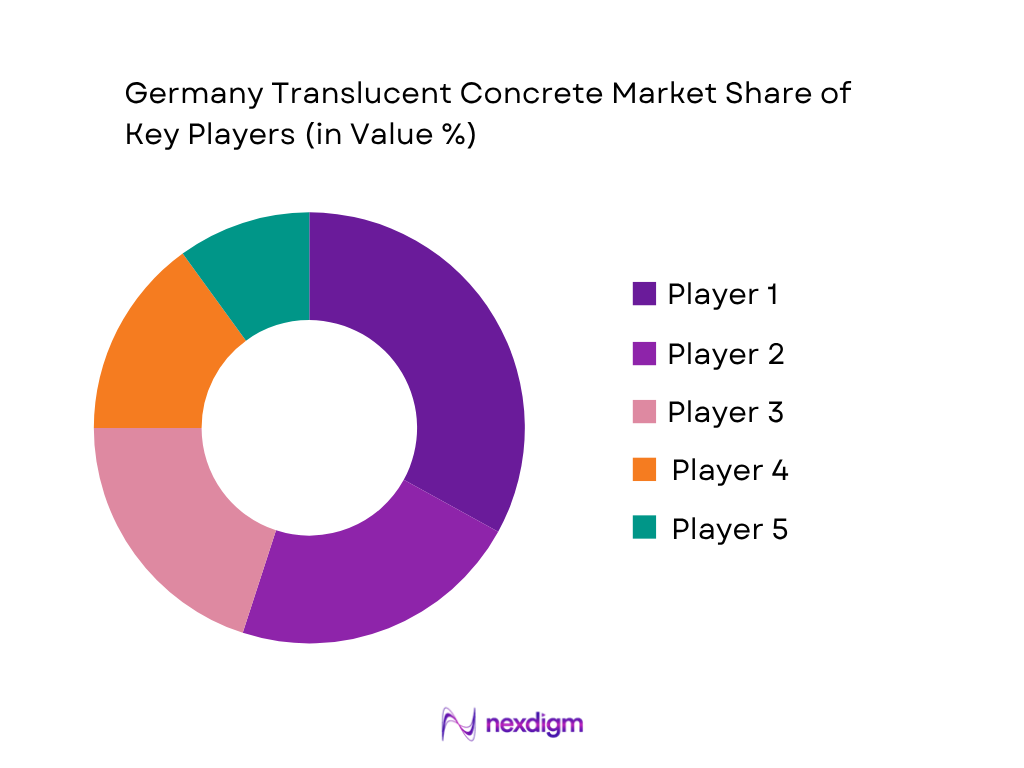
The Germany Translucent Concrete Market is characterized by specialist translucent-concrete technology providers, architectural-concrete fabricators and international light-transmitting concrete developers. Germany has a notable domestic technology position through LUCEM, founded as an RWTH Aachen spin-off in 2007, alongside fabrication and research capabilities involving specialist concrete companies. Competition is technology-led rather than volume-led, with suppliers differentiated by fiber density, panel dimensions, structural performance, custom fiber placement, façade integration and LED/digital-lighting capability.
| Major Player | Establishment Year | Headquarters | Core Technology | Panel/Fabrication Capability | Exterior Façade Capability | Custom Fiber Pattern Capability | Integrated Lighting Capability | Germany Market Relevance |
| LUCEM / Paradigm DH GmbH | 2007 | Aachen, Germany | ~ | ~ | ~ | ~ | ~ | ~ |
| LiTraCon | 2001 | Csongrád, Hungary | ~ | ~ | ~ | ~ | ~ | ~ |
| Gravelli / LiCrete | 2012 | Prague, Czech Republic | ~ | ~ | ~ | ~ | ~ | ~ |
| LCT GesmbH | 2010s | Austria | ~ | ~ | ~ | ~ | ~ | ~ |
| Heidelberg Materials / Italcementi | 1874 / Italcementi 1864 | Heidelberg, Germany | ~ | ~ | ~ | ~ | ~ | ~ |
Germany Translucent Concrete Market Analysis
Growth Drivers
Building Renovation, Infrastructure Modernization and Architectural Upgrading
Germany’s large construction and infrastructure investment base supports specification opportunities for translucent concrete across railway stations, public buildings, commercial refurbishments, façade modernization and illuminated interior surfaces. Destatis records €450.66 billion of construction fixed-capital formation in 2024, including €180.18 billion in non-residential construction, against nominal German GDP of €4,305.3 billion. The infrastructure component is particularly relevant because Deutsche Bahn reports approximately €20.1 billion spent during 2024 on expansion, renewal and maintenance of rail networks, stations and energy systems. DB InfraGO separately reported approximately €16.9 billion available for infrastructure measures, with 870 stations modernized during the period. This level of infrastructure activity expands the addressable project pipeline for specialist architectural materials capable of combining concrete durability, controlled illumination, architectural identity and wayfinding functionality. Translucent concrete is especially relevant to modernization projects because panels can be incorporated into existing structures rather than requiring replacement of the primary structural system. The market-specific applicability is demonstrated at Hamburg Central Station, where refurbishment incorporated light-transmitting concrete across 25 existing columns. Custom STARLIGHT elements incorporated hundreds of 1 mm optical glass fibers, enabling illuminated station lettering while retaining the appearance and durability of architectural concrete. Such reference installations can support wider specification across railway stations, airports, metro infrastructure, civic facilities and high-footfall public buildings where durable materials must simultaneously deliver visual communication and architectural differentiation.
Strong Construction Capital Base and Advanced Domestic Material Technology
Germany provides a substantial economic, construction and engineering platform for premium architectural materials despite weakness in conventional residential construction. Destatis records total gross fixed-capital formation of €885.72 billion in 2024, of which construction accounted for €450.66 billion, housing construction for €270.48 billion, and other construction for €180.18 billion. Nominal GDP reached €4,305.3 billion, while approximately 46.081 million people were employed, supporting a deep ecosystem of architects, façade engineers, precast manufacturers, lighting specialists, contractors and advanced-material suppliers. This industrial depth is important for translucent concrete because projects require coordination across concrete production, optical-fiber placement, panel fabrication, structural fixing and illumination systems. Germany also possesses domestic technological capabilities that reduce dependence on translucent concrete being treated solely as an imported architectural novelty. Commercial German-developed systems incorporate optical fibers as small as 0.5 mm, while high-density configurations can contain as many as 300,000 fibers per square meter. LUCCON systems combine light-transmitting functionality with C70/85 concrete, approximately 2,400 kg/m³ density and standard panel dimensions reaching 1,200 × 600 mm. These technical characteristics make translucent concrete relevant for engineered architectural applications rather than only decorative installations. Germany’s established precast, façade and lighting industries can therefore support greater integration of translucent concrete into commercial façades, corporate interiors, transport buildings, branded architecture, cultural facilities and premium refurbishment projects requiring concrete surfaces with integrated illumination.
Market Challenges
Contraction in New Construction and Reduced Immediate Specification Pipeline
Germany’s weakening new-construction pipeline creates a direct challenge for translucent concrete because specialist architectural materials are commonly specified during early design, façade engineering and interior-material selection. Destatis records 145,010 building permits and construction measures in 2024, compared with 163,906 in the preceding period. New-building permits numbered 76,619, while permitted residential floor area stood at approximately 20.08 million square meters, including 16.225 million square meters associated with new buildings. Construction completion indicators also demonstrate weaker project throughput. Germany completed 161,682 buildings and construction works and 251,937 dwellings during 2024, while completed new buildings numbered 97,279. Estimated construction costs associated with completed buildings and other structures totaled approximately €95.399 billion. Germany’s nominal GDP nevertheless remained substantial at €4,305.3 billion, indicating that the principal challenge is not the absence of economic capacity but weaker construction initiation and execution. For translucent concrete manufacturers, fewer newly initiated buildings translate into fewer opportunities for early-stage specification of optical-fiber façades, illuminated partitions, feature walls and digital concrete surfaces. This is particularly important because translucent concrete typically requires coordination among architects, lighting designers, façade engineers and manufacturers before construction reaches the installation stage. Suppliers therefore need greater exposure to refurbishment, transportation infrastructure, public buildings and commercial modernization projects. Developing modular panels, standardized mounting systems and retrofit-compatible illuminated surfaces can reduce dependence on greenfield construction and improve access to Germany’s much larger existing-building stock.
Specialized Fabrication Requirements Against a Cost-Pressured Construction Environment
Translucent concrete remains technically more demanding to manufacture and install than conventional architectural precast because optical fibers or light guides must pass through the cementitious matrix while maintaining dimensional accuracy, surface quality, fiber alignment and controlled light distribution. This complexity occurs within a German construction environment already facing investment and execution pressure. Destatis records construction fixed-capital formation of €450.66 billion in 2024, compared with €453.01 billion in the preceding period, while housing construction investment moved from approximately €277.53 billion to €270.48 billion. The number of completed buildings and construction measures stood at 161,682, compared with 183,665 previously, while completed new buildings declined from 118,369 to 97,279. Germany additionally had approximately 759,700 permitted but unfinished dwellings at the end of 2024, including around 330,000 units already under construction, illustrating substantial execution bottlenecks within the broader construction ecosystem. These conditions are especially relevant to translucent concrete because specialist panels require coordination among precast manufacturers, optical-component suppliers, façade engineers, lighting designers, electrical contractors and installers. Customized lettering, programmed lighting, specialized anchorage and individually arranged fibers add manufacturing and installation stages beyond those required for standard concrete panels. Complex project interfaces can extend lead times and increase scheduling risks when construction projects are already delayed. Greater automation of fiber placement, standardized panel dimensions, modular lighting assemblies and factory-integrated fixing systems will therefore be important for reducing fabrication complexity and making translucent concrete easier to specify across larger German construction projects.
Market Opportunities
Railway Stations and Public-Infrastructure Refurbishment
Germany’s active railway-modernization program creates a significant application opportunity for translucent concrete across station interiors, illuminated columns, passenger wayfinding, entrance features, platform environments and public-area refurbishment. Current infrastructure activity provides concrete evidence for this opportunity without relying on future projections. Deutsche Bahn reports approximately €20.1 billion spent during 2024 on expansion, renewal and maintenance of railway networks, stations and energy facilities. DB InfraGO had approximately €16.9 billion available for infrastructure works and modernized 870 stations, renewed 1,850 switches, worked on approximately 40,000 square meters of bridge area, and replaced 3,740 signalling-unit components. Germany’s nominal GDP of €4,305.3 billion and construction fixed-capital formation of €450.66 billion provide the broader macroeconomic foundation supporting large infrastructure programs. Translucent concrete already has a direct German transport reference within this environment. Hamburg Central Station incorporated customized light-transmitting panels around 25 existing concrete columns on the S1/S3 platform area, with illuminated station lettering formed using hundreds of 1 mm optical glass fibers. This installation demonstrates that translucent concrete can perform more than a decorative role: the material can simultaneously provide a robust concrete surface, architectural identity and illuminated communication. Similar functionality creates opportunities across railway stations, metro facilities, airports, passenger terminals and public buildings where high pedestrian volumes increase the importance of durable materials, recognizable wayfinding and integrated illumination. Modularized systems could further simplify deployment across repeated infrastructure refurbishment programs.
Building Modernization and High-Value Architectural Retrofit
Existing-building modernization represents an important expansion pathway because translucent concrete can be introduced through non-structural cladding, feature walls, illuminated columns and architectural surfaces without requiring complete replacement of the existing structural system. Germany recorded 145,010 building permits and construction measures in 2024, while 76,619 related specifically to new buildings, indicating that a substantial portion of permitting activity was connected with the wider existing-building and construction-measure ecosystem. Total construction fixed-capital formation reached €450.66 billion, including approximately €180.18 billion associated with non-residential construction. Public financing also supported the building environment, with more than €10 billion earmarked in the federal budget for KfW-supported construction and housing programs. Germany’s existing project backlog remained substantial, with approximately 759,700 approved but unfinished dwellings, including around 330,000 already under construction. These indicators provide a current economic base from which translucent-concrete suppliers can target commercial-property repositioning, corporate offices, hotels, transport facilities, civic buildings and façade renewal projects. The technology is particularly suited to refurbishment where owners want visible architectural differentiation without fundamentally changing the building structure. Optical fibers can form logos, lettering, pictograms and decorative patterns, while LED backlighting can transform otherwise mineral-looking surfaces after dark. Manufacturers that combine standardized retrofit panels, integrated lighting, prefabricated mounting systems and customized digital designs can therefore extend translucent concrete beyond isolated landmark projects into repeatable modernization applications across Germany’s commercial and public building stock.
Future Outlook
The Germany Translucent Concrete Market is forecast to expand at approximately ~XX% CAGR during 2026-2035, retained as a placeholder pending primary-research validation. Future development is expected to be linked less to mass concrete consumption and more to higher-value architectural applications, renovation projects, transportation infrastructure, digitally controlled façades and customized building surfaces.
Building renovation is particularly relevant because translucent concrete can be installed as cladding without requiring the existing structural element itself to become light-transmitting. Hamburg Central Station demonstrates this pathway: 25 existing concrete columns were clad with custom STARLIGHT panels, with one side of every column incorporating illuminated “HAUPTBAHNHOF” lettering through hundreds of 1 mm optical glass fibers. Such installations indicate opportunities in railway stations, airports, civic buildings and other high-traffic infrastructure where architecture, lighting and wayfinding can be combined.
Major Players
- LUCEM / Paradigm DH GmbH
- efecto GmbH
- Florack Bauunternehmung GmbH
- LBM EFO
- LiTraCon / Litracon
- Luccon Lichtbeton GmbH
- Gravelli / LiCrete
- Beton Brož / DITON
- LCT GesmbH Light & Concrete Technology
- CRE Panel GmbH
- Fapinex LLC
- FİBROBETON
- Heidelberg Materials / Italcementi
- Glass Block Technology Ltd.
- Pan-United Corporation Ltd.
Key Target Audience
- Translucent Concrete and Architectural Concrete Manufacturers
- Precast Concrete and Façade Panel Manufacturers
- Building Developers and Commercial Real Estate Owners
- Architects, Façade Engineering and Architectural Lighting Companies
- Construction Contractors and Specialty Façade Installers
- Building Material and Optical Fiber Suppliers
- Investments and Venture Capitalist Firms
- Government and Regulatory Bodies (Federal Ministry for Housing, Urban Development and Building; Federal Ministry for Economic Affairs and Energy; German Institute for Building Technology; State Building Authorities)
Research Methodology
Step 1: Identification of Key Variables
The initial phase involves constructing an ecosystem map covering translucent-concrete manufacturers, optical-fiber suppliers, precast fabricators, façade contractors, lighting-system providers, architects, developers and building owners. Secondary and proprietary databases are used to identify market variables including installed area, panel thickness, fiber density, application type, building category, project size, lighting configuration and domestic versus imported supply.
Step 2: Market Analysis and Construction
Historical Germany Translucent Concrete Market demand is constructed through top-down analysis of construction, renovation, façade and architectural-concrete activity and bottom-up analysis of identifiable translucent-concrete projects. Installed panel area, average project size, product type, application, optical-fiber configuration and project-level realization values are assessed to derive demand while avoiding double counting across manufacturer and contractor revenues.
Step 3: Hypothesis Validation and Expert Consultation
Market hypotheses are validated through computer-assisted telephone interviews and structured discussions with translucent-concrete manufacturers, architects, façade specialists, precast companies, lighting designers, contractors and material distributors. Interviews test assumptions concerning specification frequency, installed area, project conversion, fiber density, panel dimensions, manufacturing lead times, architectural preferences, competing materials and technical requirements.
Step 4: Research Synthesis and Final Output
The final stage triangulates construction statistics, project databases, manufacturer information, architectural specifications and primary interviews. Bottom-up project calculations are reconciled with top-down construction and specialty-material indicators. Technology, application and regional segmentation are then incorporated into the forecasting framework to generate a validated assessment of Germany Translucent Concrete Market demand, competitive positioning and long-term opportunities.

- Executive Summary
- Research Methodology (Market Definition and Scope, Germany Translucent Concrete Market Classification, Light-Transmitting Concrete Technology Mapping, Optical-Fiber-Embedded Concrete Assessment, PMMA Optical Fiber Concrete Evaluation, Glass and Transparent-Element Concrete Analysis, Precast Translucent Concrete Panel Evaluation, Translucent Concrete Block and Tile Assessment, Light Transmission Efficiency Analysis, Optical Fiber Density Analysis, Compressive Strength Assessment, Flexural Strength Evaluation, Panel Thickness and Dimension Assessment, Surface Finish Evaluation, Façade Application Mapping, Interior Application Assessment, Building Renovation Demand Assessment, Façade Modernization Assessment, Precast Manufacturing Capability Assessment, Architectural Specification Analysis, Domestic Manufacturing Capability Assessment, Import Dependency Assessment, Supply-Side Assessment, Demand-Side Assessment)

- Definition and Scope
- Germany Translucent Concrete Industry Evolution and Development of Optical-Fiber-Embedded Concrete, Light-Transmitting Cementitious Materials, Precast Translucent Concrete Panels, Architectural Façade Systems, Interior Feature-Wall Applications, Daylighting Solutions, High-Performance Concrete Matrices, PMMA Optical Fiber Integration, Glass Light-Guide Technologies, Customized Architectural Elements, Digital Concrete Surfaces, LED-Integrated Concrete, Low-Carbon Cementitious Matrices, Textile-Reinforced Translucent Concrete, Digital Fabrication and Advanced Precast Manufacturing
- Translucent Concrete Value Chain Analysis
- Translucent Concrete Supply Chain Analysis
- Cement and Low-Carbon Binder Suppliers, Fine Aggregate Suppliers, Optical Fiber Manufacturers, PMMA Light-Guide Suppliers, Glass Optical Fiber Suppliers, Textile Reinforcement Suppliers, Chemical Admixture Manufacturers, Translucent Concrete Technology Developers, Precast Concrete Manufacturers, Architectural Panel Fabricators, Façade System Suppliers, Lighting Technology Providers, Construction Material Distributors, Architects, Façade Planners, Lighting Designers, General Contractors, Specialty Installers, Property Developers and Building Owners

- Growth Drivers (Building Renovation Activity, Premium Architectural Design, Transportation Infrastructure Modernization, Demand for Integrated Architectural Lighting, Domestic Translucent Concrete Manufacturing, High-Performance Precast Capability, Commercial Building Refurbishment, Corporate Branding Applications, Digital Façade Development, Demand for Daylighting Solutions)
- Market Challenges (Weak New-Build Construction Environment, High Manufacturing Complexity, Labor-Intensive Fiber Placement, Specialist Installation Requirements, Competition from Architectural Glass and LED Media Façades, Custom Fabrication Lead Times, Limited Mass-Market Applications, Complex Lighting Integration, Premium Material Positioning, Optical Fiber Supply Requirements)
- Market Opportunities (Existing Building Modernization, Railway Station Refurbishment, Digital Media Façades, Custom Corporate Architecture, LED-Integrated Concrete, Three-Dimensional Load-Bearing Translucent Concrete, Automated Fiber Placement, Circular Translucent Concrete Panels, Architectural Wayfinding, Modular Façade Systems, Low-Carbon Concrete Matrices, Smart Building Surfaces)
- Market Trends (Higher Optical Fiber Density, Digitally Controlled Illumination, Custom Fiber Patterns, Logos and Lettering, Integrated Lighting and Fixing Systems, Three-Dimensional Elements, Recyclable Panel Systems, Coordinated Translucent and Non-Translucent Panels, Anti-Graffiti Surfaces, Programmable Media Concrete)
- Government Regulations and Standards (DIN 18516 Façade Requirements, DIN EN 1341 Dimensional Tolerances, Building Material Fire Classification, State Building Codes, Building Energy Requirements, Product Safety Requirements, Façade Anchorage Requirements, Structural Concrete Requirements, Environmental Requirements, Circularity Requirements)
- SWOT Analysis
- Porter’s Five Forces Analysis
- PESTLE Analysis
- Stakeholder Ecosystem
- Competition Ecosystem

- By Market Value (2020-2025)
- By Installed Volume (2020-2025)
- By Installed Surface Area (2020-2025)
- By Average Selling Price per Square Meter (2020-2025)
- By Precast Translucent Concrete Panel Consumption Volume (2020-2025)
- By Optical-Fiber-Embedded Concrete Consumption Volume (2020-2025)
- By Exterior Façade Application Volume (2020-2025)
- By Interior Architectural Application Volume (2020-2025)
- By Digital and LED-Integrated Concrete Application Volume (2020-2025)

- By Light-Transmitting Technology (In Value %)
Fine Optical-Fiber-Embedded Concrete
Coarse Optical-Fiber Concrete
PMMA Light-Guide Concrete
Glass Optical-Fiber Concrete
Custom Patterned Fiber Concrete
Hybrid Optical-Element Concrete Systems
Integrated LED Translucent Concrete
Digitally Controlled Light-Transmitting Concrete - By Product Form (In Value %)
Precast Translucent Concrete Panels
Façade Cladding Panels
Interior Wall Panels
Translucent Concrete Slabs
Translucent Concrete Blocks and Tiles
Flooring and Paving Elements
Custom Three-Dimensional Components
Furniture and Interior Elements
Signage and Branded Architectural Elements - By Application (In Value %)
Exterior Building Façades
Ventilated Façade Systems
Interior Feature Walls
Partitions and Space Dividers
Flooring and Pavements
Columns and Structural Enclosures
Transportation Infrastructure
Retail and Branded Architecture
Wayfinding and Signage
Furniture and Interior Elements
Public-Realm Installations
Digital Media Façades - By End-Use Building Type (In Value %)
Commercial Offices
Retail Buildings and Shopping Centers
Hotels and Hospitality Buildings
Transportation Stations and Infrastructure
Museums and Cultural Buildings
Government and Civic Buildings
Corporate Headquarters
Premium Residential Buildings
Educational Buildings
Healthcare Buildings
Automotive Showrooms
Entertainment and Leisure Facilities
Industrial and Corporate Campuses - By Construction Activity (In Value %)
New Construction
Existing Building Renovation
Façade Modernization
Interior Refurbishment
Transportation Infrastructure Renovation
Commercial Building Repositioning
Historic Building Modernization
Public Building Refurbishment - By Region (In Value %)
North Rhine-Westphalia
Bavaria
Baden-Württemberg
Hesse
Berlin
Hamburg
Lower Saxony
Saxony
Rest of Germany

- Market Share of Major Players (By Germany Revenue, Translucent Concrete Product Portfolio, Optical-Fiber Technology Capability, Precast Panel Portfolio, Light Transmission Performance, Panel Size and Thickness Range, Exterior Façade Capability, Interior Application Coverage, Customization Capability, Integrated Lighting Capability, Manufacturing Scalability, Germany and European Distribution Presence, Architectural Specification Reach, Project Portfolio, Technical Support Capability)
- Cross Comparison Parameters (Optical Fiber Density and Light Transmission Uniformity, Compressive and Flexural Strength Performance, Panel Size and Thickness Range, Fire UV and Frost Performance, Façade Anchorage and DIN Compliance, Custom Pattern Logo and 3D Fabrication Capability, Integrated LED and Digital Lighting Capability, Germany Manufacturing Project Reference and Technical Support)
- SWOT Analysis of Major Player
- Competitive Positioning Matrix
- Translucent Concrete Technology and Architectural Application Benchmarking
- Exterior Weathering and Durability Capability Assessment
- Germany Distribution Architectural Specification and Technical Support Assessment
- Detailed Profiles of Major Companies
LUCEM / Paradigm DH GmbH
efecto GmbH
Florack Bauunternehmung GmbH
LBM EFO
LiTraCon / Litracon
Luccon Lichtbeton GmbH
Gravelli / LiCrete
Beton Brož / DITON
LCT GesmbH Light & Concrete Technology
CRE Panel GmbH
Fapinex LLC
FİBROBETON
Heidelberg Materials / Italcementi
Glass Block Technology Ltd.
Pan-United Corporation Ltd.

- Architectural Façade Requirement Assessment
- Exterior Wall Cladding Demand Analysis
- Interior Feature-Wall Requirement Assessment
- Building Renovation and Modernization Requirement Analysis
- Commercial Office Application Assessment
- Transportation Station Application Assessment
- Luxury Hotel and Hospitality Application Analysis
- Retail and Shopping Center Application Assessment

- By Market Value (2026-2035)
- By Installed Volume (2026-2035)
- By Installed Surface Area (2026-2035)
- By Average Selling Price per Square Meter (2026-2035)
- By Precast Translucent Concrete Panel Consumption Volume (2026-2035)
- By Optical-Fiber-Embedded Concrete Consumption Volume (2026-2035)
- By Exterior Façade Application Volume (2026-2035)
- By Interior Architectural Application Volume (2026-2035)
- By Digital and LED-Integrated Concrete Application Volume (2026-2035)


 Request a Sample
 Ask for Customization
 Get a Quote
 Enquire Now