
 Download PDF
Market Overview
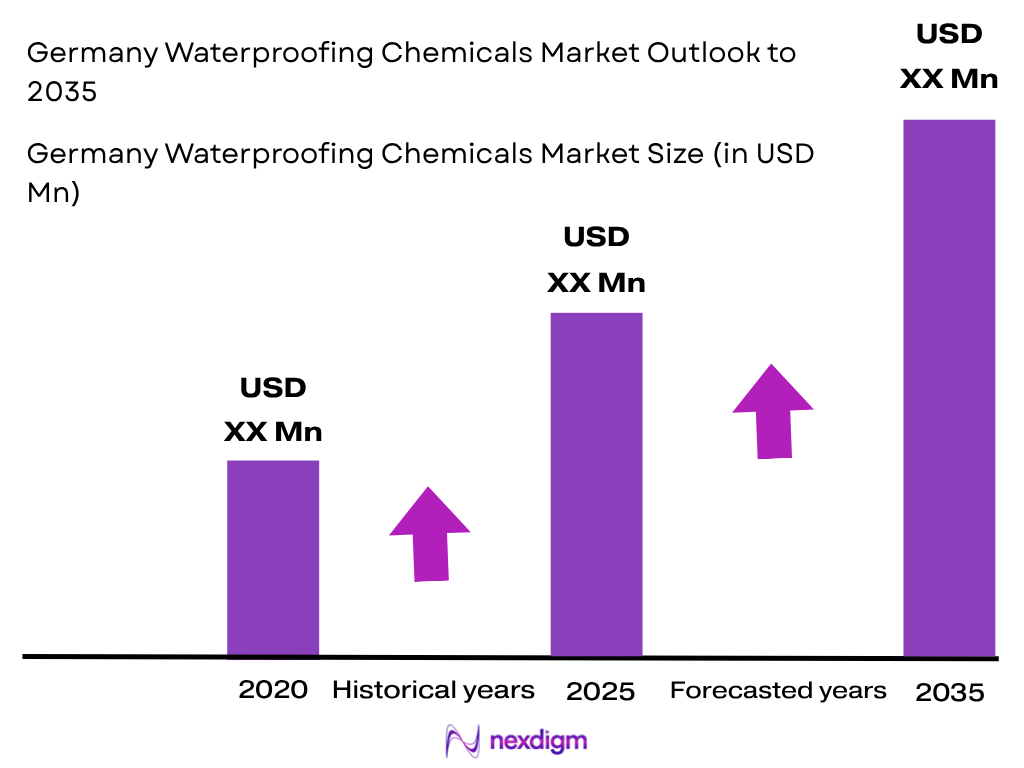
The Germany Waterproofing Chemicals Market is estimated at ~USD ~ billion in 2024, with growth supported by the country’s large construction, renovation and infrastructure base. Germany recorded EUR 450.66 billion in construction investment in 2024, compared with EUR 453.01 billion in 2023, while construction investment in non-residential structures increased to EUR 180.18 billion from EUR 175.48 billion. The market is therefore supported not only by new construction but also by waterproofing requirements across commercial, industrial, infrastructure and refurbishment projects.
The Germany Waterproofing Chemicals Market is concentrated around major construction, industrial and metropolitan centers including Berlin, Munich, Hamburg, Frankfurt, Stuttgart, Cologne and Düsseldorf, where commercial buildings, infrastructure, industrial facilities and renovation projects generate recurring waterproofing requirements. The concentration of non-residential construction and economic activity in major metropolitan regions supports demand for below-grade systems, parking structures, roofs, terraces, wet areas and concrete protection. Germany’s extensive transport infrastructure additionally creates demand for specialized waterproofing during bridge, tunnel and underground-structure rehabilitation.
Market Segmentation
By Chemistry Type
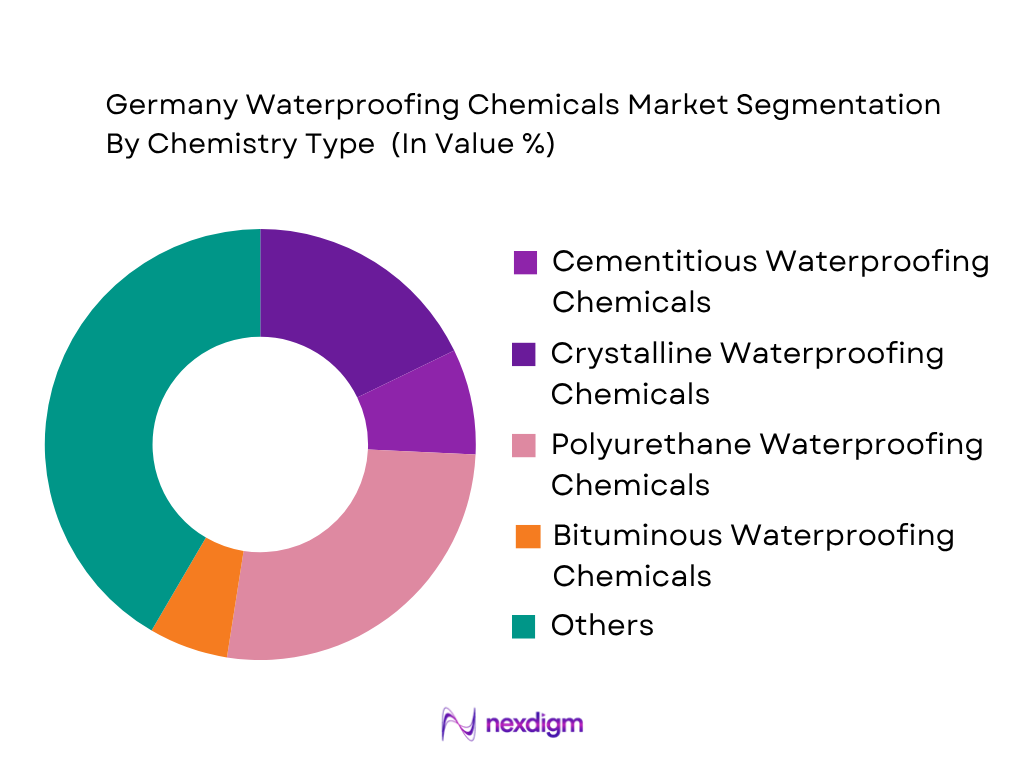
The Germany Waterproofing Chemicals Market is segmented by chemistry type into polyurethane waterproofing chemicals, polyurea waterproofing chemicals, cementitious waterproofing chemicals, acrylic and polymer-modified waterproofing chemicals, epoxy-based systems, crystalline waterproofing chemicals, silane and siloxane treatments, bituminous polymer-modified systems, and injection resins. Polyurethane waterproofing chemicals are expected to represent the dominant segment at ~XX% of 2024 market value because of their suitability for demanding construction and refurbishment applications. Their flexibility, crack-bridging characteristics and ability to form continuous protective layers make them applicable across roofs, balconies, podiums, foundations, basements and concrete structures. Polyurethane systems can also address irregular substrates where rigid protection systems may be less suitable. Demand is supported by Germany’s substantial renovation requirement and by waterproofing specifications that emphasize durability and reliable performance under variable substrate conditions. Polyurea and crystalline systems provide important alternatives for rapid-curing and concrete-integrated applications, while cementitious technologies remain relevant for wet areas and mineral substrates. The chemistry mix therefore reflects a technically differentiated market rather than a commodity-only waterproofing environment.
By Application
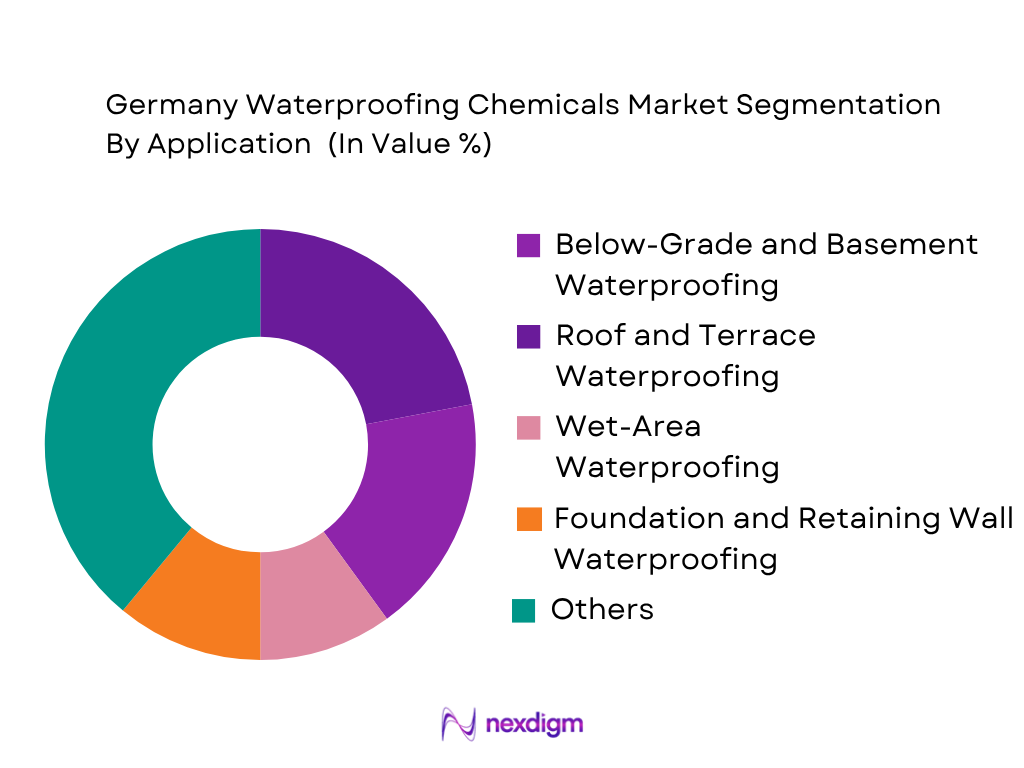
The Germany Waterproofing Chemicals Market is segmented by application into below-grade and basement waterproofing, roof and terrace waterproofing, wet-area waterproofing, foundation and retaining-wall waterproofing, concrete-structure waterproofing, balcony and podium waterproofing, parking structures, tunnels and underground structures, bridges and infrastructure, and water-retaining structures. Below-grade and basement waterproofing is expected to hold the leading position at ~XX% in 2024 because German buildings and infrastructure require effective protection against ground moisture, hydrostatic pressure and water ingress. The application is particularly relevant to refurbishment projects where existing leakage must be remediated without completely replacing structural components. Chemical waterproofing technologies provide advantages in complex geometries, joints, cracks and inaccessible areas, while injection systems can target localized leakage. The significant scale of Germany’s commercial, industrial and infrastructure stock further expands the addressable base. Infrastructure rehabilitation also increases demand for waterproofing in tunnels, underground structures and concrete assets. Consequently, below-grade applications provide a broad intersection between new construction, renovation, structural remediation and infrastructure maintenance, supporting their leading position within the application landscape.
Competitive Landscape
The Germany Waterproofing Chemicals Market is characterized by established construction-chemical manufacturers with broad product portfolios spanning polyurethane, cementitious, crystalline, injection and protective-coating technologies. Competition is influenced by technical certification, specification relationships, contractor networks, application expertise and the ability to provide complete waterproofing systems rather than individual chemical products. Major suppliers compete across new construction, refurbishment, infrastructure rehabilitation and specialist concrete-protection applications.
| Company | Established | Headquarters | Core Waterproofing Chemistry | Key Application Strength | Distribution Model | Technical Differentiator | Germany Market Position |
| Sika | 1910 | Baar, Switzerland | ~ | ~ | ~ | ~ | ~ |
| MC-Bauchemie | 1961 | Bottrop, Germany | ~ | ~ | ~ | ~ | ~ |
| Remmers | 1949 | Löningen, Germany | ~ | ~ | ~ | ~ | ~ |
| KÖSTER | 1982 | Aurich, Germany | ~ | ~ | ~ | ~ | ~ |
| Mapei | 1937 | Milan, Italy | ~ | ~ | ~ | ~ | ~ |
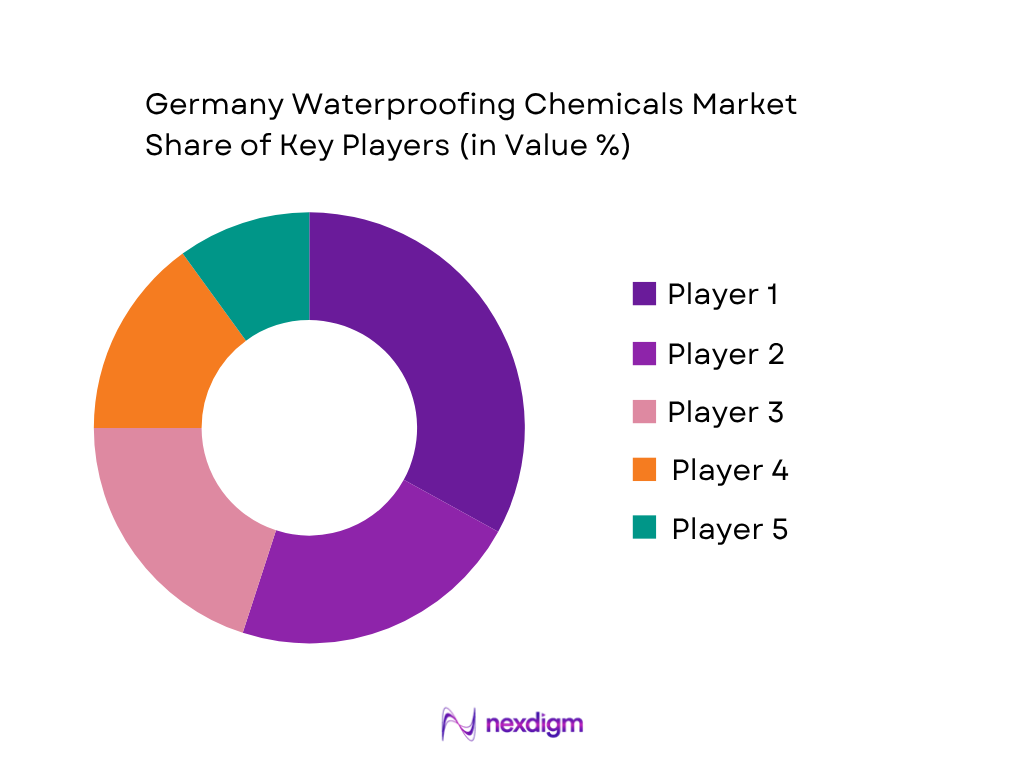
Germany Waterproofing Chemicals Market Analysis
Growth Drivers
Building Renovation and Refurbishment Activity
Germany’s extensive existing building stock creates a structural requirement for renovation, refurbishment and moisture-protection solutions, supporting demand for waterproofing chemicals across basements, façades, roofs, balconies, wet areas and concrete structures. Destatis recorded 161,682 completed buildings in 2024, including 97,279 newly constructed buildings, leaving a substantial installed base requiring maintenance and refurbishment rather than replacement. Construction investment reached EUR 450.66 billion in 2024, compared with EUR 453.01 billion in 2023, while investment in non-residential construction increased from EUR 175.48 billion to EUR 180.18 billion. The renovation opportunity is particularly relevant because waterproofing failures can deteriorate concrete, masonry and building envelopes over time, requiring chemical repair and protective treatments during refurbishment cycles. Germany’s building modernization requirements are also closely connected with energy-efficiency improvements, where roof, basement, façade and envelope interventions frequently require complementary moisture-management measures. Destatis reported that 69.4% of approximately 76,100 residential buildings completed in 2024 used heat pumps as their primary heating system, illustrating the broader modernization of the building stock and the increasing technical complexity of renovation projects. The combination of a large existing asset base, continued non-residential investment and building-modernization activity supports recurring demand for polyurethane, cementitious, crystalline, injection and polymer-modified waterproofing systems. The demand is therefore increasingly linked to lifecycle maintenance and refurbishment rather than depending solely on new residential construction.
Infrastructure Rehabilitation
Infrastructure rehabilitation is becoming an important demand channel for waterproofing chemicals because Germany’s transport and utility assets require ongoing protection against moisture penetration, corrosion-related deterioration, freeze-thaw exposure and concrete degradation. Construction-sector order intake reached EUR 103.5 billion in 2024, while civil-engineering orders reached EUR 56.3 billion, with Destatis identifying highway, bridge and tunnel rehabilitation and electricity-grid expansion among the major contributors. This creates direct application opportunities for waterproofing and concrete-protection technologies in bridge decks, tunnels, underground structures, drainage systems, retaining structures and other civil assets. Germany’s overall construction investment remained at EUR 450.66 billion in 2024, while non-residential construction investment reached EUR 180.18 billion, demonstrating the scale of capital deployed into structures outside residential buildings. Civil-engineering activity is particularly relevant to chemical waterproofing because rehabilitation projects often involve irregular substrates, cracks, joints, penetrations and difficult-to-access areas where liquid-applied, injection or crystalline systems can complement conventional protection methods. Destatis also reported that civil-engineering activity benefited from modernization and new construction of roads, railway lines and pipelines during 2024, despite the wider contraction in Germany’s construction industry. Germany’s real GDP contracted by 0.2% in 2024, while construction gross value added declined by 3.8%, making the relative resilience of infrastructure-related activity particularly important for suppliers. The rehabilitation requirement extends beyond transport to electricity, water, wastewater and municipal infrastructure, creating recurring demand for waterproofing systems capable of extending structural service life.
Market Challenges
Weak Residential New-Build Activity
Weak residential construction activity represents a significant challenge for the Germany Waterproofing Chemicals Market because new-build projects provide multiple high-volume applications for foundations, basements, roofs, wet rooms, balconies and other building components. Germany completed 161,682 buildings in 2024, compared with 183,665 buildings in 2023, while the number of newly constructed buildings fell from 118,369 to 97,279. Completed dwellings declined from 294,399 to 251,937, and newly constructed dwellings declined from 262,859 to 220,666. Construction investment in housing also decreased from EUR 277.53 billion in 2023 to EUR 270.48 billion in 2024. Destatis reported that price-adjusted construction investment declined by 3.5% during the year, with residential construction recording the largest contraction. Germany’s overall real GDP also declined by 0.2%, while construction-sector gross value added decreased by 3.8%, indicating a difficult macroeconomic environment for new building activity. For waterproofing chemical suppliers, lower residential project starts can reduce the number of new foundations, basement structures, terraces and wet-area installations entering the market. The pressure can be partially offset by renovation and infrastructure demand, but these segments may have different procurement cycles, product specifications and application requirements. Suppliers therefore face a need to shift sales exposure toward refurbishment, civil engineering, commercial properties and specialized industrial applications rather than relying heavily on residential new construction.
High Application Quality Requirements
High application-quality requirements create a challenge because waterproofing chemicals are performance-sensitive construction products whose effectiveness depends on substrate preparation, moisture conditions, application thickness, curing conditions, joint detailing and compatibility with adjacent materials. Germany’s construction environment involves significant technical and regulatory requirements, while the scale of ongoing construction activity means application failures can create substantial remediation requirements. Construction investment totaled EUR 450.66 billion in 2024, while construction-industry order intake reached EUR 103.5 billion, indicating a large volume of projects in which waterproofing performance forms part of broader structural and building-envelope specifications. Civil-engineering orders reached EUR 56.3 billion, including substantial activity in bridges and tunnels, where waterproofing failures can have consequences extending beyond localized building damage. Construction-sector gross value added declined by 3.8% in 2024, increasing pressure on contractors to execute projects efficiently while maintaining technical performance. At the same time, construction prices and financing conditions remained important constraints, according to Destatis, contributing to reduced construction investment. Waterproofing chemical suppliers and applicators must therefore manage technically demanding installation conditions without compromising quality or accelerating application beyond product requirements. Complex refurbishment projects are particularly challenging because existing concrete and masonry may contain cracks, residual moisture, contaminated surfaces or incompatible legacy coatings. The need for skilled preparation and controlled application can increase execution complexity and make contractor capability an important determinant of product performance. This creates a competitive disadvantage for suppliers whose products require extensive specialist installation support without offering corresponding technical-service infrastructure.
Market Opportunities
Building Renovation and Refurbishment
Building renovation and refurbishment offers an expanding opportunity for waterproofing chemical suppliers because the German construction environment is shifting toward maintaining and upgrading existing assets while residential new construction remains under pressure. Germany recorded 161,682 completed buildings in 2024, compared with 183,665 in 2023, while construction investment remained at EUR 450.66 billion. Importantly, non-residential construction investment increased from EUR 175.48 billion in 2023 to EUR 180.18 billion in 2024, indicating continued capital deployment into commercial, industrial, institutional and other non-residential structures. Waterproofing chemicals can participate in these projects through basement rehabilitation, roof restoration, balcony protection, wet-area refurbishment, concrete crack injection, façade moisture management and below-grade remediation. The modernization of energy systems also creates complementary renovation activity. Destatis reported that 69.4% of approximately 76,100 residential buildings completed in 2024 used heat pumps as their primary heating system, reflecting the technical modernization occurring across Germany’s building environment. Waterproofing suppliers can leverage this modernization cycle by integrating moisture protection with broader building-envelope and concrete-repair solutions. Renovation projects also tend to require specialized solutions because existing substrates cannot always be accessed or replaced as easily as components in new construction. This supports demand for injection resins, crystalline systems, polyurethane coatings and other chemical technologies capable of treating cracks, joints and difficult substrates. The opportunity therefore extends beyond standalone waterproofing and toward integrated building-rehabilitation systems combining repair, protection and moisture control.
Infrastructure Rehabilitation
Infrastructure rehabilitation represents a significant future opportunity for the Germany Waterproofing Chemicals Market because the country is directing substantial construction activity toward roads, bridges, tunnels, rail infrastructure, pipelines and electricity networks. Germany’s construction-sector order intake reached EUR 103.5 billion in 2024, including EUR 56.3 billion in civil-engineering orders. Destatis specifically attributed the strong civil-engineering order environment to major projects involving highway, bridge and tunnel rehabilitation as well as electricity-grid expansion. These activities create technically demanding applications for waterproofing chemicals because infrastructure structures are exposed to water, groundwater, precipitation, de-icing agents and repeated environmental stresses. Chemical waterproofing can be deployed alongside concrete repair, crack injection, joint sealing and protective coatings, enabling suppliers to participate in broader rehabilitation packages. Germany’s total construction investment reached EUR 450.66 billion in 2024, while non-residential construction investment reached EUR 180.18 billion, reinforcing the importance of infrastructure and non-residential assets within the construction economy. Although real GDP declined by 0.2% and construction-sector gross value added contracted by 3.8%, civil-engineering modernization remained an area of comparatively strong activity. This creates an opportunity for suppliers to reduce dependence on residential construction by developing infrastructure-specific systems for tunnels, bridges, underground structures, drainage assets and utility infrastructure. Products offering rapid curing, strong adhesion, crack-bridging performance, hydrostatic-pressure resistance and compatibility with existing concrete can be positioned for rehabilitation projects where complete structural replacement is impractical.
Future Outlook
The Germany Waterproofing Chemicals Market is expected to expand through increasing emphasis on building rehabilitation, infrastructure modernization and concrete lifecycle protection. Demand will increasingly shift toward high-performance systems capable of addressing existing-structure leakage, difficult substrates and demanding below-grade conditions. Polyurethane, polyurea, crystalline and injection technologies are positioned to benefit from technically complex renovation projects. The market should also see greater integration of waterproofing with concrete repair, structural protection and building-envelope solutions.
Major Players
- Sika Deutschland GmbH
- Remmers GmbH
- MC-Bauchemie Müller GmbH & Co. KG
- PCI Augsburg GmbH
- SCHOMBURG GmbH & Co. KG
- KÖSTER BAUCHEMIE AG
- Saint-Gobain Weber GmbH
- Triflex GmbH & Co. KG
- Sto SE & Co. KGaA
- Mapei GmbH
- ARDEX GmbH
- BOTAMENT Systembaustoffe GmbH & Co. KG
- KEMPER SYSTEM GmbH & Co. KG
- Sievert Baustoffe SE & Co. KG
- ISOTEC GmbH
Key Target Audience
- Construction Chemical Manufacturers and Product Developers
- Waterproofing Contractors and Specialist Applicators
- Commercial Property Developers and Building Owners
- Infrastructure Developers and Civil-Engineering Contractors
- Architects, Structural Engineers and Building-Specification Professionals
- Investments and Venture Capitalist Firms
- Government and Regulatory Bodies (Federal Ministry for Housing, Urban Development and Building; Federal Ministry for Digital and Transport)
- Construction Material Distributors and Building-System Suppliers
Research Methodology
Step 1: Identification of Key Variables
The initial phase establishes the Germany Waterproofing Chemicals Market ecosystem by mapping manufacturers, raw-material suppliers, distributors, applicators, contractors, architects, engineers, developers and infrastructure owners. Product variables include chemistry, application method, waterproofing function, substrate compatibility, curing characteristics, crack-bridging capability and project type. Secondary research is used to define the market boundaries and key demand-side and supply-side variables.
Step 2: Market Analysis and Construction
Historical market information is compiled across construction activity, renovation, infrastructure rehabilitation and waterproofing applications. The analysis evaluates construction investment, building activity, non-residential development, infrastructure projects and waterproofed construction applications to construct market estimates. A bottom-up assessment considers manufacturer portfolios, application volumes, project deployment and distribution structures, while top-down analysis validates the overall market framework.
Step 3: Hypothesis Validation and Expert Consultation
Market hypotheses are validated through discussions with manufacturers, waterproofing contractors, applicators, distributors, architects and construction professionals. Expert consultations focus on chemistry adoption, application preferences, specification practices, project demand, technical requirements and competitive positioning. These inputs are used to challenge preliminary estimates and identify differences between stated product capability and actual market deployment.
Step 4: Research Synthesis and Final Output
The final research stage triangulates manufacturer information, construction indicators, infrastructure activity, product-level evidence and expert inputs. Competitive benchmarking is conducted across chemistry portfolio, application coverage, technical performance, distribution reach and specification influence. The resulting framework provides a consolidated assessment of current market structure, competitive dynamics, demand drivers, challenges, opportunities and long-term development potential.

- Executive Summary
- Research Methodology (Market Definition and Scope, Waterproofing Chemicals Classification Framework, Product Mapping, Chemistry-Based Market Assessment, Application-Level Demand Mapping, End-Use Construction Assessment, Supply-Side Analysis, Demand-Side Analysis, Top-Down Market Sizing, Bottom-Up Market Sizing, Primary Industry Interviews, Manufacturer and Distributor Validation, Project Pipeline Assessment, Data Triangulation, Forecasting Framework, Market Limitations and Assumptions)

- Definition and Scope
- Germany Waterproofing Chemicals Industry Evolution and Development of Construction Waterproofing Technologies, Liquid-Applied Systems, Cementitious Waterproofing, Polyurethane Waterproofing, Polyurea Systems, Acrylic and Polymer-Modified Coatings, Crystalline Waterproofing, Injection Resin Technologies, Bituminous Chemical Systems, Concrete Protection Technologies and Integrated Repair-Waterproofing Solutions
- Waterproofing Chemicals Value Chain Analysis
- Waterproofing Chemicals Supply Chain Analysis
- Cement and Mineral Binder Suppliers, Polymer and Resin Manufacturers, Polyurethane Raw Material Suppliers, Acrylic Polymer Suppliers, Epoxy and Resin Suppliers, Chemical Additive Manufacturers, Crystalline Technology Providers, Waterproofing Chemical Manufacturers, Construction Chemical Formulators, System Solution Providers, Waterproofing Applicators, Specialist Remediation Contractors, Construction Material Distributors, Building Material Wholesalers, Architects, Structural Engineers, Waterproofing Consultants, General Contractors, Property Developers and Building Owners

- Growth Drivers (Building Renovation and Refurbishment Activity, Infrastructure Rehabilitation, Demand for Below-Grade Waterproofing, Concrete Durability Requirements, Commercial Property Modernization, Industrial and Logistics Construction, Expansion of Data Center Infrastructure, Energy-Efficient Building Upgrades, Increasing Building Envelope Performance Requirements, Long-Life Construction Protection)
- Market Challenges (Weak Residential New-Build Activity, High Application Quality Requirements, Skilled Applicator Shortages, Substrate Preparation Complexity, Moisture and Temperature Constraints, Specialty Raw Material Dependence, Stringent Product Compliance Requirements, Compatibility with Existing Waterproofing Systems, Complex Remediation Conditions, Competition from Sheet Membranes and Preformed Waterproofing Systems)
- Market Opportunities (Building Renovation and Refurbishment, Below-Grade Waterproofing Modernization, Infrastructure Rehabilitation, Data Center Waterproofing, Industrial Facility Waterproofing, Low-Emission Waterproofing Formulations, Polyurea Spray Applications, High-Performance Polyurethane Systems, Crystalline Concrete Waterproofing, Injection-Based Remediation, Integrated Concrete Repair and Waterproofing, Long-Life Bridge and Tunnel Protection)
- Market Trends (Low-VOC and Low-Emission Formulations, Higher Crack-Bridging Performance, Faster-Curing Systems, Integrated Waterproofing and Concrete Repair, Solvent-Free Technologies, High-Performance Polyurethane Adoption, Polyurea Spray Technology, Crystalline Concrete Protection, Prefabricated and System-Based Waterproofing Solutions, Digital Project Specification)
- Government Regulations and Standards (DIN 18533 Requirements for Ground-Contacting Waterproofing, DIN 18534 Interior Waterproofing, DIN 18535 Waterproofing of Tanks and Pools, WU Concrete Guidelines, European Construction Product Requirements, REACH Chemical Compliance, VOC and Emission Requirements, Building Material Fire Performance, Water-Hazardous Substance Requirements, Environmental and Circularity Requirements)
- SWOT Analysis
- Porter’s Five Forces Analysis
- PESTLE Analysis
- Stakeholder Ecosystem
- Competition Ecosystem

- By Market Value (2020-2025)
- By Consumption Volume (2020-2025)
- By Waterproofing Chemical Consumption by Chemistry (2020-2025)
- By Waterproofed Construction Area (2020-2025)
- By Average Consumption per Square Meter (2020-2025)

- By Chemistry Type (In Value %)
Polyurethane Waterproofing Chemicals
Polyurea Waterproofing Chemicals
Cementitious Waterproofing Chemicals
Acrylic and Polymer-Modified Waterproofing Chemicals
Epoxy-Based Waterproofing Systems
Crystalline Waterproofing Chemicals
Silane and Siloxane-Based Waterproofing Treatments
Bituminous Polymer-Modified Liquid Waterproofing Systems
Injection Resins and Leak-Sealing Chemicals - By Application (In Value %)
Below-Grade and Basement Waterproofing
Roof and Terrace Waterproofing
Wet-Area Waterproofing
Foundation and Retaining Wall Waterproofing
Concrete Structure Waterproofing
Balcony and Podium Waterproofing
Parking Structure Waterproofing
Tunnel and Underground Structure Waterproofing
Bridge and Infrastructure Waterproofing
Water-Retaining Structure Waterproofing - By Construction Activity (In Value %)
New Residential Construction
New Commercial Construction
Industrial and Logistics Construction
Infrastructure Construction
Building Renovation and Refurbishment
Historic Building Renovation
Concrete Repair and Rehabilitation
Roof Restoration and Replacement - By End-Use Sector (In Value %)
Residential Buildings
Commercial Offices
Retail and Shopping Centers
Hotels and Hospitality Buildings
Industrial and Manufacturing Facilities
Warehouses and Logistics Facilities
Transportation Infrastructure
Water and Wastewater Infrastructure
Public and Institutional Buildings - By Waterproofing System Type (In Value %)
Liquid-Applied Waterproofing Systems
Cementitious Waterproofing Systems
Crystalline Waterproofing Systems
Injection Waterproofing Systems
Elastomeric Waterproofing Coatings
Protective Concrete Coatings
Joint and Crack Sealing Systems
Integrated Repair and Waterproofing Systems

- Market Share of Major Players (By Germany Revenue, Chemistry Portfolio, Waterproofing System Portfolio, Application Coverage, Construction Activity, End-Use Sector, Distribution Reach, Specification Influence)
- Cross Comparison Parameters (Polyurethane and Polyurea Technology Capability, Cementitious and Crystalline Waterproofing Portfolio, Crack-Bridging and Elasticity Performance, Chemical and Hydrostatic Resistance, Application Thickness and Curing Performance, Substrate and Moisture Tolerance, DIN 18533-18535 and WU Compliance Capability, German Distribution and Technical-Service Network)
- SWOT Analysis of Major Players
- Detailed Profiles of Major Companies
Sika Deutschland GmbH
Remmers GmbH
MC-Bauchemie Müller GmbH & Co. KG
PCI Augsburg GmbH
SCHOMBURG GmbH & Co. KG
KÖSTER BAUCHEMIE AG
Saint-Gobain Weber GmbH
Triflex GmbH & Co. KG
Sto SE & Co. KGaA
Mapei GmbH
ARDEX GmbH
BOTAMENT Systembaustoffe GmbH & Co. KG
KEMPER SYSTEM GmbH & Co. KG
Sievert Baustoffe SE & Co. KG
ISOTEC GmbH

- Waterproofing Specification Requirement Assessment
- Architect and Structural Engineer Specification Analysis
- Contractor and Applicator Requirement Assessment
- Building Owner Waterproofing Priority Analysis
- Renovation and Remediation Demand Assessment
- Below-Grade Waterproofing Requirement Analysis
- Roof and Terrace Waterproofing Requirement Assessment

- By Market Value (2026-2035)
- By Consumption Volume (2026-2035)
- By Waterproofing Chemical Consumption by Chemistry (2026-2035)
- By Waterproofed Construction Area (2026-2035)
- By Average Consumption per Square Meter (2026-2035)


 Request a Sample
 Ask for Customization
 Get a Quote
 Enquire Now