

 Download PDF
Market Overview
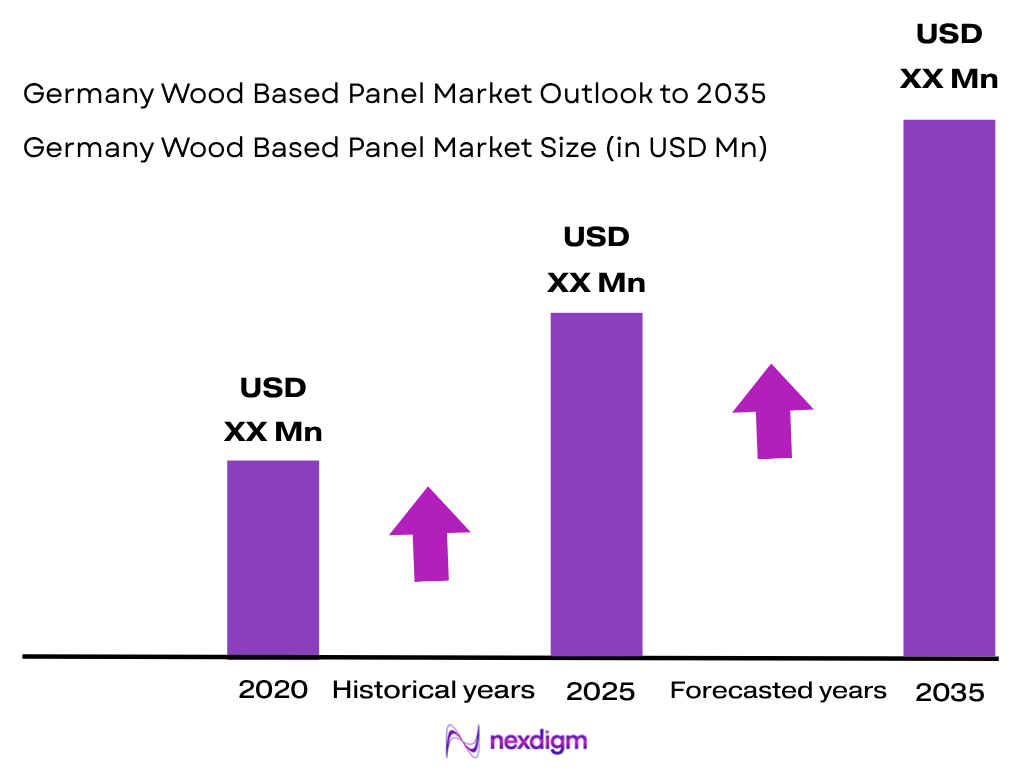
The Germany Wood Based Panel Market is valued at approximately USD ~ billion, based on the report framework. Demand is anchored in furniture, kitchens, flooring, interior fit-outs and timber construction. German furniture-industry revenue moved from EUR 17.7 billion to EUR 16.3 billion, while residential completions moved from approximately 294,000 units to 251,900 units. Germany’s established particleboard, MDF and OSB manufacturing infrastructure and circular wood utilization provide the market’s industrial foundation.
Bavaria, North Rhine-Westphalia, Baden-Württemberg, Lower Saxony and other industrial states are important to the Germany Wood Based Panel Market because of their forestry resources, furniture production, wood-processing infrastructure and construction demand. German timber harvesting moved from 70.6 million cubic meters to 61.2 million cubic meters, with Bavaria alone accounting for 20.7 million cubic meters and Baden-Württemberg 10.0 million cubic meters in the latest period, supporting major wood-processing clusters.
Market Segmentation
By Product Type
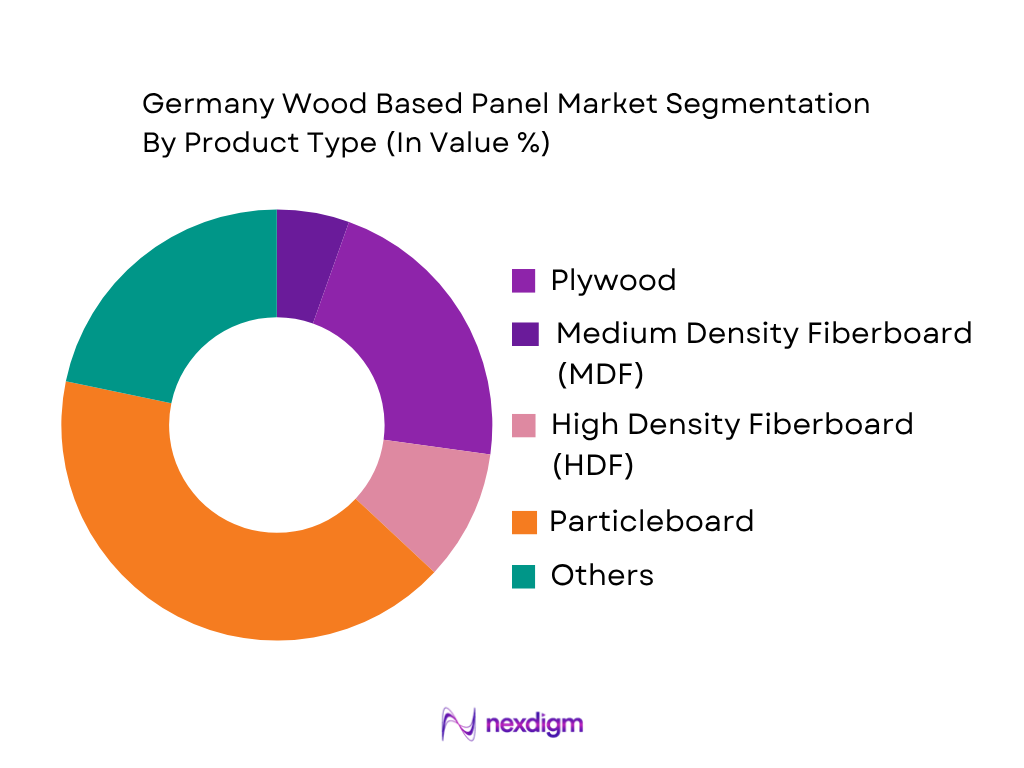
The Germany Wood Based Panel Market is segmented into particleboard, MDF, HDF, OSB, plywood, wood fibreboard and decorative engineered panels. Recently, particleboard has a dominant market share in Germany under product-type segmentation in this report framework, supported by extensive use in furniture, kitchens, shelving, interior fit-outs and laminated components. Germany also has a highly developed recovered-wood infrastructure, making particleboard particularly suitable for circular material utilization. Major manufacturers increasingly combine sawmill residues, recycled wood and forestry material instead of depending entirely on virgin industrial wood. Particleboard additionally provides a versatile substrate for melamine surfaces, laminates and decorative finishes, supporting Germany’s large furniture and interior-products ecosystem. MDF remains important for furniture fronts and precision-machined components, while OSB benefits from structural timber construction. Germany’s wood-panel manufacturing base includes companies producing particleboard, MDF, laminates, flooring substrates and construction products across multiple domestic manufacturing locations.
By Application
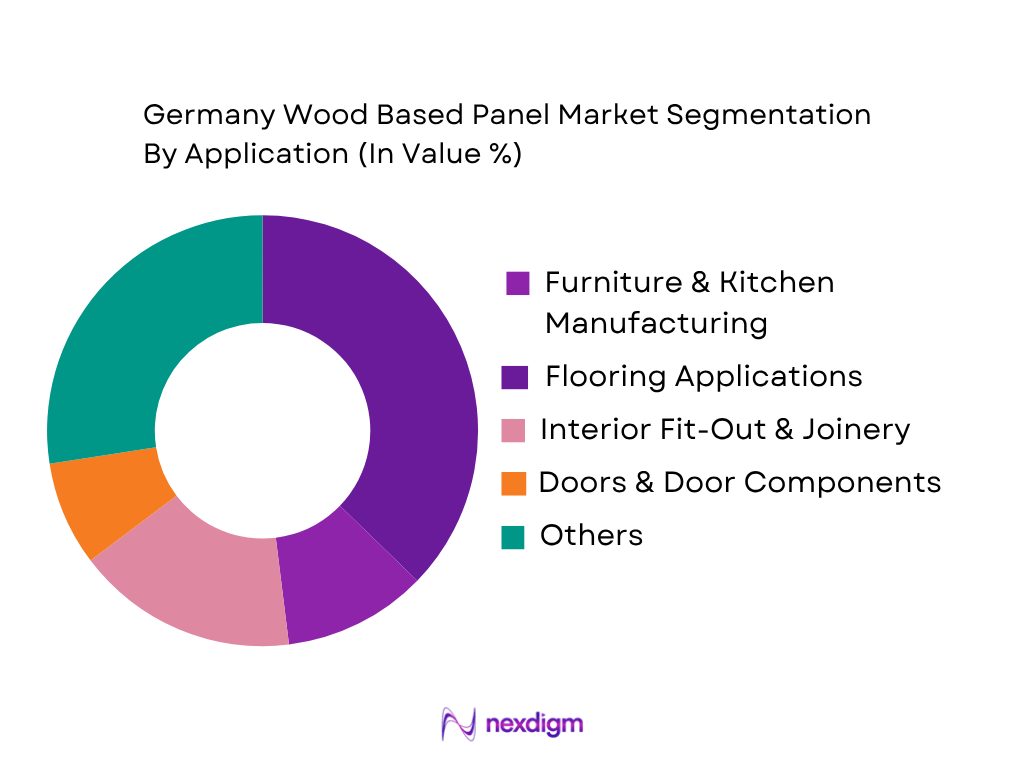
The Germany Wood Based Panel Market is segmented by application into furniture manufacturing, kitchen and cabinet manufacturing, interior fit-out, timber construction, flooring, doors, prefabricated buildings and other industrial applications. Recently, furniture and kitchen manufacturing has a dominant market share in Germany under application segmentation in this report framework because particleboard and MDF are extensively suited to carcasses, shelves, worktops, doors, fronts and storage systems. Germany possesses a mature furniture-production ecosystem alongside major panel producers offering decorative surfaces specifically for furniture and interior applications. Domestic furniture-industry turnover nevertheless moved from EUR 17.7 billion to EUR 16.3 billion, indicating cyclical pressure on this downstream channel. Structural applications are becoming strategically important as OSB and other engineered boards are incorporated into timber-frame walls, roofs, prefabricated buildings and modular systems. Low-emission boards, moisture-resistant grades and recycled-content panels further broaden wood-based panels’ suitability for Germany’s specification-driven building and furniture sectors.
Competitive Landscape
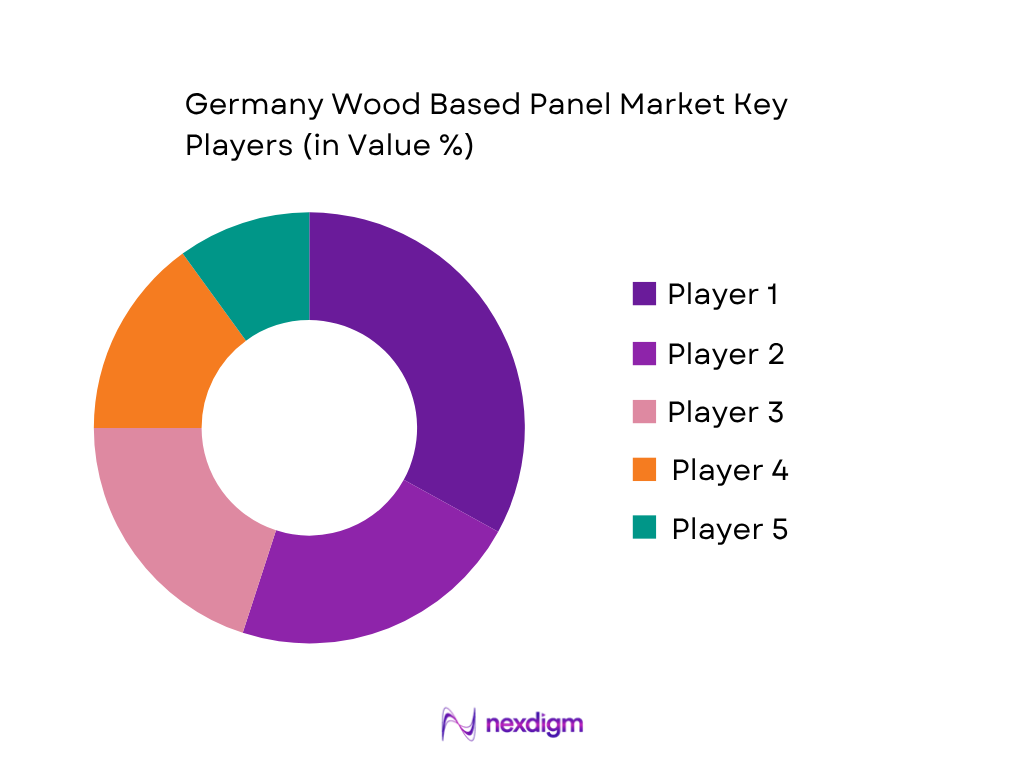
The Germany Wood Based Panel Market combines major domestic producers with large European wood-panel groups. Competition centers on particleboard and MDF production scale, recovered-wood utilization, E1 E05 emissions compliance, decorative surfaces, structural panels and sustainability credentials. EGGER operates 7 German production locations, while Pfleiderer reports a wood mix containing 85% wood residues and recycled wood, illustrating how manufacturing footprint and circular feedstock capabilities increasingly differentiate competitors.
| Major Player | Establishment Year | Headquarters | Core Panel Portfolio | Recycled-Wood Capability | Low-Emission Capability | Decorative Surfaces | Structural/Specialty Panels |
| Pfleiderer Group | 1894 | Neumarkt, Germany | ~ | ~ | ~ | ~ | ~ |
| EGGER Group | 1961 | St. Johann, Austria | ~ | ~ | ~ | ~ | ~ |
| Kronospan | 1897 | Salzburg, Austria | ~ | ~ | ~ | ~ | ~ |
| Sonae Arauco | 1959* | Maia, Portugal | ~ | ~ | ~ | ~ | ~ |
| SWISS KRONO Group | 1966 | Lucerne, Switzerland | ~ | ~ | ~ | ~ | ~ |
Germany Wood Based Panel Market Analysis
Growth Drivers
Large Furniture Manufacturing Base and Established Panel Processing Ecosystem
Germany’s large furniture and interior-products manufacturing base remains a structural demand driver for particleboard, MDF, HDF and decorative wood-based panels because these materials are extensively used in kitchen carcasses, wardrobes, shelving, office furniture, shopfitting, worktops and laminated furniture components. German furniture manufacturers generated EUR 16.3 billion in revenue in 2024, including nearly EUR 11.0 billion from domestic business and EUR 5.4 billion from foreign business. The sector comprised approximately 400 establishments with 50 or more employees and around 69,000 employees, providing wood-panel suppliers with a substantial industrial customer network. In 2025, furniture-industry revenue remained approximately EUR 15.8 billion, including around EUR 10.4 billion domestically and EUR 5.4 billion internationally, demonstrating that a sizeable processing base persisted despite weak consumer conditions. VDM Kitchen furniture is particularly relevant because Germany’s furniture association identifies it as the industry’s largest individual segment, directly supporting demand for coated particleboard, MDF, moisture-resistant boards and decorative surfaces. Germany’s wider macroeconomic scale reinforces this industrial ecosystem: World Bank data place nominal GDP at USD 4.686 trillion in 2024 and GDP per capita at USD 56,103.7, while industry including construction remained one of the country’s major economic pillars. World Bank Open Data Wood-based panel producers consequently operate close to a sophisticated downstream manufacturing system rather than relying principally on raw-panel exports. The breadth of German furniture production also supports value-added panel demand because manufacturers require multiple board thicknesses, density specifications, edge-processing characteristics and surface designs. Particleboard is particularly suitable for furniture carcasses and shelving, while MDF supports profiled fronts, painted surfaces and precision-machined components. HDF has additional relevance in flooring and thin-panel applications. Decorative-panel producers can capture further value through melamine surfaces, synchronous-pore textures, anti-fingerprint finishes and high-pressure laminates. The presence of furniture-production clusters in North Rhine-Westphalia, Bavaria, Baden-Württemberg, Lower Saxony, Hesse and Saxony creates geographically concentrated B2B demand and supports integrated relationships between panel producers, furniture OEMs, component processors and distributors. VDM This industrial depth makes furniture and interior manufacturing a durable demand foundation for Germany’s wood-based panel sector even during periods of cyclical weakness.
Timber Construction, Prefabrication and Circular Wood Utilization
Timber construction and Germany’s increasingly circular approach to wood resources create a second structural driver for wood-based panels, particularly OSB, load-bearing particleboard, structural fibreboard and wood-fibre insulation. Germany’s construction sector completed 251,937 dwellings in 2024, including 220,666 dwellings in newly constructed buildings, while completed residential floor area reached 24.768 million square meters. Destatis Although total construction weakened, timber construction performed comparatively better: industry data show the nationwide timber-construction rate reached 24.1% in 2024, while timber construction’s decline in residential building permits was materially smaller than the contraction across residential construction overall. The timber-construction rate for permitted non-residential buildings also moved above 25%, creating applications for OSB sheathing, structural boards, fibreboard and insulation products. Holzbau Deutschland The macroeconomic base supporting these applications remains substantial, with World Bank data recording German GDP at USD 4.686 trillion in 2024. World Bank Data Catalog Wood-based panel manufacturers additionally benefit from Germany’s circular material infrastructure. Virgin wood availability is finite: German forests supplied 61.183 million cubic meters of harvested timber in 2024, including 37.746 million cubic meters of spruce, fir, Douglas fir and other coniferous wood, 12.042 million cubic meters of pine and larch, 9.671 million cubic meters of beech and other deciduous wood and 1.725 million cubic meters of oak. Destatis This resource profile encourages cascading utilization, where sawmill residues, industrial wood residues and suitable recovered wood are retained in material applications before final energy recovery. Particleboard is particularly compatible with this system because recovered wood can be cleaned, sorted and reprocessed into new panels. Timber-frame and prefabricated construction complement circularity by creating applications for structural OSB, sheathing and insulation while factory-based manufacturing favors dimensionally standardized panels. Germany entered 2025 with a construction backlog of 759,700 approved but unfinished dwellings, of which 330,000 were already under construction, maintaining an underlying pipeline of potential panel-consuming activity. Destatis Together, timber construction, prefabrication and cascading wood use broaden demand beyond traditional furniture panels and strengthen the strategic role of engineered panels in Germany’s resource-efficient building economy.
Market Challenges
Declining Timber Harvest and Competition Between Material and Energy Wood Uses
Feedstock security has become a material challenge for Germany’s wood-based panel manufacturers because the domestic timber harvest has contracted while panel mills, sawmills, pulp producers and energy users compete for overlapping portions of the available wood resource. Destatis recorded 61.183 million cubic meters of timber harvesting in 2024, compared with 70.6 million cubic meters in 2023. The downward movement continued in 2025, when harvesting decreased further to 57.3 million cubic meters. Destatis This means Germany’s material-processing industries entered the middle of the decade with a smaller domestic harvest from which industrial wood, sawmill feedstock and subsequent residues could be generated. The species composition also matters for panel manufacturing and associated sawmill-residue availability. Of the 2024 harvest, 37.746 million cubic meters consisted of spruce, fir, Douglas fir and other conifers, while pine and larch contributed 12.042 million cubic meters, beech and other deciduous wood 9.671 million cubic meters, and oak 1.725 million cubic meters. Bavaria supplied 20.652 million cubic meters, Baden-Württemberg 9.988 million cubic meters and Brandenburg 4.636 million cubic meters, illustrating the geographic concentration of raw-material availability. Destatis The reduction in damaged timber is environmentally preferable but removes a feedstock stream that had temporarily increased wood availability. Damaged timber harvesting amounted to 27.3 million cubic meters in 2024 and declined to 12.7 million cubic meters in 2025. Destatis Destatis additionally reported that energy wood exceeded industrial wood harvesting for the first time in its series in 2024, underscoring competition between material and energetic utilization. Destatis For particleboard and MDF manufacturers, this environment makes recovered wood, sawmill residues and fibre recovery strategically important. However, recovered material cannot automatically substitute for virgin feedstock: contamination, coatings, metals and chemical treatment must be managed before recycling, while MDF requires suitable fibre characteristics for stable mechanical and surface properties. The macroeconomic context also remains demanding: World Bank data recorded German GDP growth of -0.5% in 2024, meaning manufacturers were simultaneously managing constrained raw-material conditions and weak economic activity. World Bank Open Data Feedstock competition therefore affects procurement security, plant utilization, product formulation and Germany’s ability to maintain high-volume domestic panel production.
Construction Weakness and Furniture Demand Cyclicality
Weakness in Germany’s construction and furniture sectors represents a significant demand-side challenge because these industries collectively absorb substantial volumes of particleboard, MDF, OSB, HDF, fibreboard and decorative panels. Destatis recorded only 251,937 completed dwellings in 2024, down from 294,399 in 2023, while the number fell further to 206,586 in 2025. Newly constructed buildings accounted for 220,666 completed dwellings in 2024 but only 175,867 in 2025, demonstrating the contraction in precisely the activity that generates demand for structural panels, flooring substrates, doors, built-in furniture and interior boards. Destatis Building permits also fell to approximately 215,300 dwellings in 2024, while only 76,619 new buildings were authorized and approved new-building residential floor space amounted to 16.225 million square meters. Destatis Furniture demand weakened simultaneously. German furniture manufacturers generated EUR 16.3 billion in revenue in 2024, while revenue fell further to approximately EUR 15.8 billion in 2025. Domestic furniture revenue in 2025 stood at around EUR 10.4 billion, while foreign revenue was approximately EUR 5.4 billion. VDM This matters directly to wood-panel producers because kitchens, wardrobes, office furniture, shelving and household furniture are major applications for decorative particleboard and MDF. Germany’s macroeconomic backdrop compounded these pressures: World Bank data recorded GDP of USD 4.686 trillion in 2024, but real GDP growth was -0.5%, limiting momentum in investment-sensitive manufacturing and household discretionary expenditure. World Bank Open Data There are early signs of construction stabilization rather than an immediate return to previous activity levels. Germany issued 238,500 dwelling permits in 2025, an increase of 23,200 permits from 2024, including 198,100 permits for new dwellings. Destatis Nevertheless, the year-end construction backlog stood at 760,700 dwellings in 2025, while only 307,200 were actually under construction. Destatis For wood-panel producers, this combination produces uneven order visibility: furniture demand remains subdued, completions are falling, and a large approved pipeline is converting into physical construction only gradually. This can create pressure on capacity utilization and intensify competition for higher-value furniture, refurbishment and structural applications.
Market Opportunities
High-Recycled-Content Particleboard and Circular Furniture Panels
Germany has a strong future opportunity to expand high-recycled-content particleboard and circular furniture panels because declining domestic timber availability increases the economic importance of keeping usable wood in material circulation for longer. Germany harvested 61.183 million cubic meters of timber in 2024, followed by only 57.3 million cubic meters in 2025, while damaged timber availability dropped from 27.3 million cubic meters to 12.7 million cubic meters over the same period. Destatis These current resource conditions provide a clear rationale for improving collection, sorting and processing of post-consumer furniture, production offcuts and other suitable recovered wood. Particleboard is particularly well positioned because its manufacturing process can incorporate processed secondary wood while still supplying standardized boards for furniture, kitchens, shelving and interior fit-outs. The downstream addressable base remains substantial despite its cyclical contraction: German furniture manufacturing generated EUR 16.3 billion in revenue in 2024, with domestic revenue close to EUR 11.0 billion and international revenue of EUR 5.4 billion. VDM Approximately 400 larger furniture establishments employing around 69,000 people remained active within the industry, providing a sizeable group of potential customers for circular panel products. VDM Germany’s macroeconomic scale strengthens the potential for industrialized circular-material systems, with World Bank data placing GDP at USD 4.686 trillion in 2024 and GDP per capita at USD 56,103.7. World Bank Open Data Future growth can therefore come from improving material productivity rather than requiring a corresponding increase in fresh timber extraction. Panel manufacturers can develop boards designed for repeated recycling, improve removal of metal and contaminants from recovered furniture wood, establish closed-loop arrangements with furniture producers and increase traceability of secondary feedstock. Decorative particleboard is especially suitable for circular furniture concepts because the substrate can be engineered around recycled content while melamine, laminate and other surfaces provide the aesthetics demanded by kitchen and furniture customers. The opportunity extends to design-for-disassembly, separable fittings and panel specifications that facilitate future recovery. Germany’s established furniture-production clusters and recovered-wood collection infrastructure give manufacturers the industrial conditions needed to move circular particleboard from a resource-management measure toward a differentiated commercial product category.
Structural OSB, Timber Modular Construction and Wood Fibre Insulation
Structural wood-based panels and fibre insulation represent a future-oriented opportunity as Germany seeks more industrialized building methods and timber construction continues gaining relevance even against a weak overall construction backdrop. Germany completed 251,937 dwellings in 2024, including 220,666 units in newly constructed buildings, while completed residential floor space totaled 24.768 million square meters. Destatis More importantly for forward demand, the construction pipeline remained substantial: 759,700 approved dwellings were unfinished at the end of 2024, including 330,000 already under construction. Destatis In 2025, dwelling permits recovered to 238,500, an increase of 23,200 permits, with 198,100 new dwellings approved. Destatis Current timber-building indicators demonstrate that wood construction is gaining structural relevance within this pipeline. The nationwide timber-construction rate reached 24.1% in 2024, while timber construction accounted for more than 25% of permitted non-residential buildings; industrial buildings recorded particularly strong timber penetration. Holzbau Deutschland These conditions provide a platform for OSB sheathing, structural particleboard, wood fibre insulation and specialty panels used in timber-frame walls, roofs, floors and prefabricated building elements. Germany’s macroeconomic capacity also remains substantial, with GDP of USD 4.686 trillion in 2024 and GDP per capita of USD 56,103.7, supporting a sophisticated construction-products market capable of adopting higher-performance engineered materials. World Bank Open Data The opportunity is particularly relevant for factory-based modular and prefabricated construction, where standardized board dimensions, predictable structural performance and rapid assembly are valuable. Wood fibre insulation can complement structural OSB by supplying thermal and acoustic functions within wall and roof systems, while moisture-resistant and fire-performance panels can broaden applications in multifamily, commercial and institutional buildings. Manufacturers can further differentiate these products through EPD documentation, certified wood sourcing, recycled or residue-derived feedstock and verified product carbon footprints. Rather than depending on a broad rebound across conventional construction, Germany’s panel industry can use the existing timber-building trajectory to expand its role per building through integrated structural, sheathing, insulation and interior panel systems.
Future Outlook
The Germany Wood Based Panel Market is projected to expand at approximately ~% CAGR during 2026–2035, based on the report framework. Future development will increasingly depend on circular raw-material utilization, recovered-wood processing, low-emission panels, timber construction and higher-value decorative surfaces. Manufacturers are expected to focus on extracting more value from constrained wood resources rather than depending solely on production-volume expansion. Product carbon footprints, EPDs and traceable wood sourcing should become increasingly important competitive attributes. Raw-material efficiency will be central to this outlook. Germany harvested 61.2 million cubic meters of timber in 2024, compared with 70.6 million cubic meters in 2023. Spruce, fir, Douglas fir and other coniferous harvesting accounted for 37.7 million cubic meters, while pine and larch contributed 12.0 million cubic meters. Reduced harvesting reinforces the commercial importance of sawmill residues, recycled furniture wood and other secondary feedstocks.
Major Players
- Pfleiderer Group
- EGGER Group
- Kronospan
- SWISS KRONO Group
- Sonae Arauco
- Pfeifer Group
- HOMANIT
- Westag
- WERZALIT
- elka-Holzwerke
- STEICO
- GUTEX
- best wood SCHNEIDER
- Kosche Holzwerkstoffe
- NOVO-TECH
Key Target Audience
- Wood Based Panel Manufacturers
- Furniture and Kitchen Manufacturers
- Timber Construction and Prefabricated Building Companies
- Wood Panel Distributors and Building Material Wholesalers
- Forestry, Sawmill and Recovered-Wood Suppliers
- Interior Fit-Out and Renovation Companies
- Investments and Venture Capitalist Firms
- Government and Regulatory Bodies (Federal Ministry of Agriculture, Food and Regional Identity, Federal Environment Agency, Federal Institute for Materials Research and Testing, German Institute for Building Technology)
Research Methodology
Step 1: Identification of Key Variables
The initial phase involves constructing an ecosystem map covering German forest owners, sawmills, recovered-wood processors, panel manufacturers, furniture producers, timber construction companies and distributors. Critical variables include particleboard, MDF and OSB capacity, industrial wood availability, recycled feedstock, panel grades, formaldehyde emissions, decorative surfaces, certifications and downstream applications.
Step 2: Market Analysis and Construction
Historical Germany Wood Based Panel Market data are analyzed through a combination of production, timber harvesting, construction, furniture activity, foreign trade and downstream consumption indicators. Top-down analysis evaluates Germany’s forestry, furniture and building ecosystems, while bottom-up analysis assesses manufacturers, production facilities, panel categories, distribution channels and end-use demand to establish the market structure.
Step 3: Hypothesis Validation and Expert Consultation
Market hypotheses are validated through CATIs and structured interviews with panel manufacturers, recovered-wood processors, furniture OEMs, distributors, timber builders and procurement specialists. Consultations evaluate plant utilization, raw-material sourcing, recycled content, product specifications, E1 E05 compliance, decorative requirements and customer purchasing behavior to corroborate assumptions developed through secondary research.
Step 4: Research Synthesis and Final Output
The final phase triangulates manufacturer information, official forestry statistics, construction indicators, furniture activity and trade data with primary research. Bottom-up findings are reconciled against top-down demand indicators to validate the Germany Wood Based Panel Market framework. Forecast assumptions incorporate recovered-wood utilization, timber construction, low-emission boards, decorative surfaces, circularity, certification and product-carbon-footprint requirements.

- Executive Summary
- Research Methodology (Market Definitions and Assumptions, Wood Based Panel Classification, HS Code Mapping, Particleboard Assessment, MDF and HDF Assessment, OSB Assessment, Plywood Assessment, Hardboard and Softboard Assessment, Wood Fibre Insulation Board Assessment, Decorative Panel Assessment, Raw Wood and Industrial Wood Assessment, Sawmill Residue Assessment, Recovered Wood Assessment, Resin and Binder Assessment, Panel Density and Thickness Mapping, Formaldehyde Emission Classification, Production Capacity Assessment, Capacity Utilization Assessment, Domestic Consumption Assessment, Import-Export Assessment, Furniture Demand Assessment, Timber Construction Demand Assessment, Supply-Side Assessment, Demand-Side Assessment, Top-Down Market Sizing, Bottom-Up Market Sizing, Primary Industry Interviews, Data Triangulation, Forecasting Framework)

- Definition and Scope
- Germany Wood Based Panel Industry Evolution and Development of Particleboard, MDF, HDF, OSB, Plywood, Hardboard, Softboard, Wood Fibre Insulation Boards, Melamine-Faced Panels, Laminated Boards, Worktops, Flooring Substrates, Structural Panels, Low-Emission Boards and Recycled-Wood Panels
- Wood Based Panel Industry Value Chain Analysis
- Wood Based Panel Supply Chain Analysis

- Growth Drivers (Large Furniture Manufacturing Base, Established Particleboard and MDF Production, Timber Construction Adoption, Prefabricated Building Demand, Renovation and Interior Refurbishment, Kitchen Manufacturing, Recovered-Wood Utilization, Circular Material Adoption, OSB Structural Applications, Wood Fibre Insulation Demand)
- Market Challenges (Industrial Wood Availability, Declining Timber Harvest, Competition Between Material and Energy Wood Use, Recovered Wood Quality Constraints, Resin and Binder Requirements, Energy-Intensive Drying and Pressing, Formaldehyde Emission Compliance, Construction Market Weakness, Furniture Demand Cyclicality, EU Regulatory Compliance)
- Market Opportunities (High-Recycled-Content Particleboard, Low-Carbon Wood Panels, Formaldehyde-Reduced Boards, Bio-Based Binder Systems, Structural OSB, Timber Modular Construction, Wood Fibre Insulation, Circular Furniture Panels, Design-for-Recycling Boards, Lightweight Panels, Fire-Retardant Boards, High-Performance Decorative Surfaces)
- Market Trends (Cascading Wood Utilization, Recovered-Wood Integration, Low-Carbon Panel Production, E1 E05 Panels, Fossil-Free Resin Development, Digital Surface Printing, Synchronous Decorative Surfaces, Mass Timber Hybrid Systems, Prefabricated Wood Construction, Material Traceability, Product Carbon Footprints, Environmental Product Declarations)
- Government Regulations and Standards (German Chemicals Prohibition Ordinance, E1 E05 Formaldehyde Requirements, EN 312 Particleboard Requirements, EN 622 Fibreboard Requirements, EN 300 OSB Requirements, Construction Products Regulation, CE Marking, German Waste Wood Ordinance, EUDR Due-Diligence Requirements, FSC Chain-of-Custody, PEFC Certification, Blue Angel Requirements, EU Taxonomy Considerations, Environmental Product Declaration Requirements)
- SWOT Analysis (Domestic Manufacturing Base, European Market Access, Recovered-Wood Infrastructure, Furniture Industry Integration, Raw Material Competition, Construction Cyclicality, Circular Economy Opportunity, Regulatory Intensity)
- Porter’s Five Forces Analysis (Industrial Wood Supplier Bargaining Power, Furniture OEM Buyer Bargaining Power, European Import Competition, Substitute Material Threat, Domestic Manufacturer Rivalry)
- PESTLE Analysis (German Construction Policy, Industrial Conditions, Furniture Consumption, Panel Manufacturing Automation, EU Environmental Regulation, Circular Wood Utilization)
- Stakeholder Ecosystem (Forest Owners, Sawmills, Recyclers, Panel Manufacturers, Furniture OEMs, Timber Builders, Distributors, Certification Bodies, Regulators)

- By Market Value (2020-2025)
- By Domestic Consumption Volume (2020-2025)
- By Total Production Volume (2020-2025)
- By Installed Production Capacity (2020-2025)
- By Capacity Utilization (2020-2025)
- By Domestic Sales Volume (2020-2025)

- By Product Type (In Value %)
Particleboard
Medium Density Fibreboard (MDF)
High Density Fibreboard (HDF)
Oriented Strand Board (OSB)
Plywood
Hardboard
Softboard
Wood Fibre Insulation Boards
Melamine-Faced Particleboard
Melamine-Faced MDF
Decorative and Specialty Wood Panels - By Raw Material Source (In Value %)
Industrial Roundwood
Sawmill Residues
Wood Chips and Wood Particles
Recovered and Post-Consumer Wood
Recycled Particleboard Feedstock
Recycled Wood Fibre
Forest Residues
Mixed Virgin and Recycled Wood
Other Lignocellulosic Feedstock - By Panel Grade (In Value %)
P1 General-Purpose Boards
P2 Interior Furniture Boards
P3 Moisture-Resistant Non-Load-Bearing Boards
P4 Load-Bearing Dry-Condition Boards
P5 Load-Bearing Moisture-Resistant Boards
P6 Heavy-Duty Load-Bearing Boards
P7 Heavy-Duty Moisture-Resistant Boards
E1 E05 Low-Emission Panels
Fire-Retardant Panels
Structural OSB Grades
Moisture-Resistant MDF
Exterior-Use Panels - By Surface and Finish Type (In Value %)
Raw Panels
Melamine-Faced Panels
High-Pressure Laminate Bonded Panels
Natural Veneer-Faced Panels
Lacquered Panels
Primed Panels
Acrylic-Faced Panels
PET-Faced Panels
Wood-Grain Decorative Panels
Synchronous-Pore Surfaces
Matt and Super-Matt Panels
Specialty Functional Surfaces - By Application (In Value %)
Furniture Manufacturing
Kitchen and Cabinet Manufacturing
Interior Fit-Out
Timber Construction
Prefabricated Housing
Modular Construction
Flooring Substrates
Doors and Door Components
Wall and Ceiling Systems
Roof and Structural SheathingWorktops
Retail and Commercial Interiors
Packaging and Industrial Applications - By End User (In Value %)
Residential Furniture Manufacturers
Kitchen Furniture Manufacturers
Office Furniture Manufacturers
Interior Fit-Out Companies
Timber Construction Companies
Prefabricated Building Manufacturers
Flooring Manufacturers
Door Manufacturers
Residential Construction
Commercial Construction
Renovation and Refurbishment
Building Material Processors

- Market Share of Major Players (By Germany Revenue, Production Volume, Installed Capacity, Particleboard Capacity, MDF Capacity, HDF Capacity, OSB Capacity, Decorative Panel Capacity, Furniture Industry Sales, Construction Industry Sales, Recycled Wood Utilization, Export Presence)
- Cross Comparison Parameters (Particleboard, MDF and OSB Production Capacity, Recovered-Wood and Recycled-Fibre Utilization, E1 E05 and Ultra-Low-Emission Panel Capability, Structural and Moisture-Resistant Panel Portfolio, Decorative Surface and Value-Added Board Capability, Product Carbon Footprint and EPD Coverage, FSC/PEFC and Blue Angel Certification Coverage, Furniture and Timber Construction Customer Penetration)
- SWOT Analysis of Major Players (Production Scale, Product Portfolio, Recycled Feedstock Access, Carbon Positioning, Customer Integration, Distribution Network)
- Competitive Positioning Matrix (Manufacturing Scale, Circularity, Technical
- Detailed Profiles of Major Companies
Pfleiderer Group
EGGER Group
Kronospan
SWISS KRONO Group
Sonae Arauco
Pfeifer Group
HOMANIT
Westag
WERZALIT
elka-Holzwerke
STEICO
GUTEX
best wood SCHNEIDER
Kosche Holzwerkstoffe
NOVO-TECH

- Furniture Manufacturer Panel Requirement Assessment
- Kitchen Manufacturer Requirement Assessment
- Timber Construction Requirement Assessment
- Prefabricated Housing Panel Requirement Assessment
- Interior Fit-Out Requirement Assessment
- Door Manufacturer Requirement Assessment

- By Market Value (2026-2035)
- By Domestic Consumption Volume (2026-2035)
- By Total Production Volume (2026-2035)
- By Installed Production Capacity (2026-2035)
- By Capacity Utilization (2026-2035)
- By Domestic Sales Volume (2026-2035)


 Request a Sample
 Ask for Customization
 Get a Quote
 Enquire Now