

 Download PDF
Market Overview
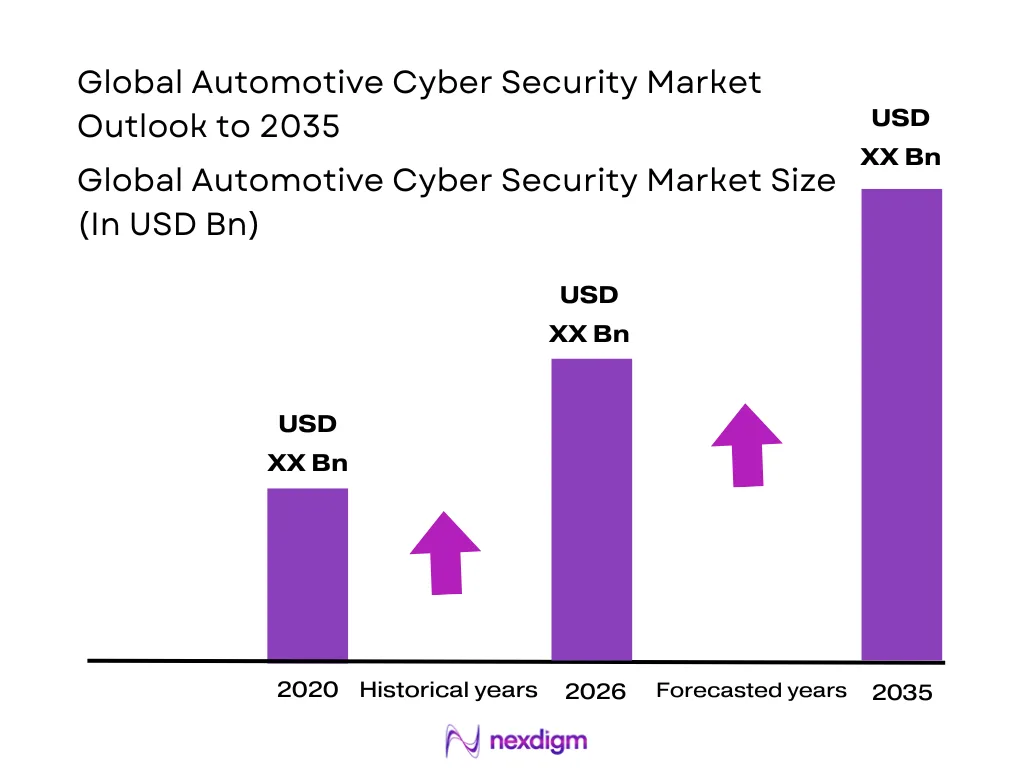
The Global Automotive Cyber Security market current size stands at around USD ~ million, shaped by rising software-defined vehicle adoption, broader telematics integration, and stronger cyber resilience mandates across connected mobility ecosystems. Demand is concentrated around embedded software hardening, secure gateway deployment, OTA protection, and cloud-linked vehicle defense capabilities. The market is increasingly characterized by design-stage security integration, lifecycle monitoring, and compliance-led procurement from OEMs and Tier suppliers. Growth is also supported by the expanding digital attack surface across connected passenger vehicles, electric platforms, and increasingly centralized E/E architectures.
Europe remains a dominant region due to early regulatory enforcement, mature automotive engineering clusters, and strong OEM-led cyber compliance programs. Germany, France, and the UK benefit from advanced vehicle software ecosystems and embedded electronics supply chains. North America follows with strong demand from connected fleet platforms, EV innovators, and digital mobility operators. Asia-Pacific, led by China, Japan, and South Korea, is emerging rapidly because of high vehicle electrification, semiconductor integration, and local innovation in telematics, cockpit systems, and intelligent transport infrastructure supporting secure connected vehicle deployment.
Market Segmentation
By Offering
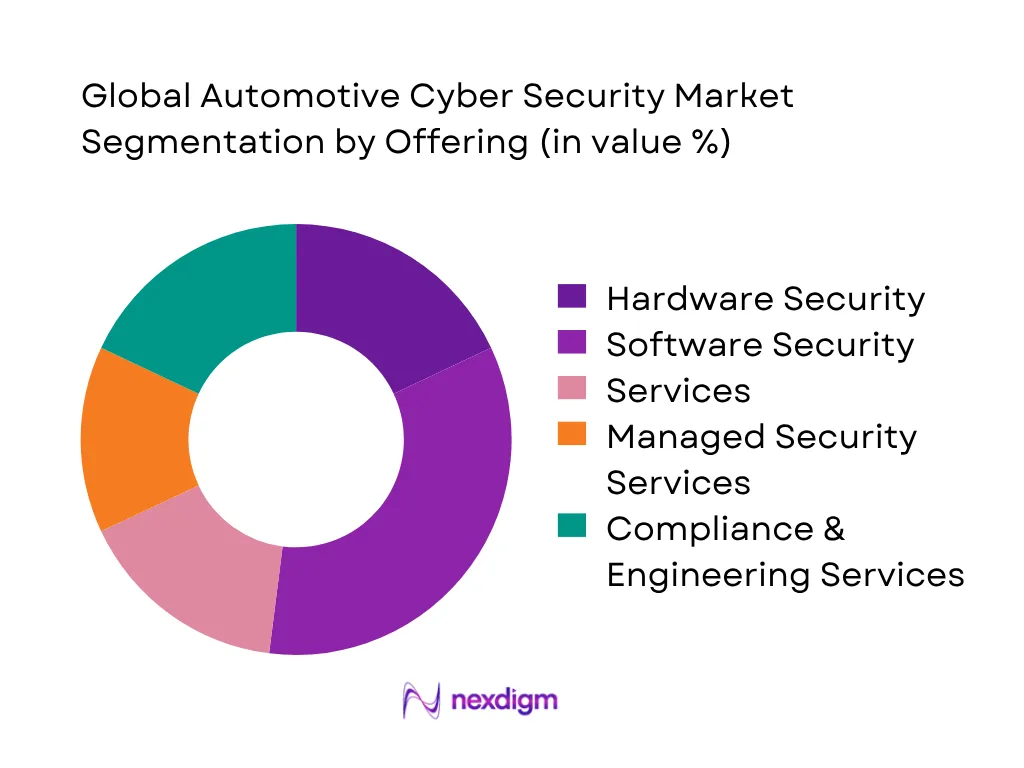
Software Security remains the dominant segment because automotive cyber security has shifted from isolated hardware-based control protection toward continuous software-driven defense across connected and software-defined vehicles. OEMs increasingly prioritize embedded protection layers, secure OTA management, intrusion detection, and cloud-linked threat analytics that can scale across multiple vehicle platforms and model programs. Software-based architectures also support faster updates, policy enforcement, and lifecycle threat visibility compared with static hardware controls. While services and compliance engineering are expanding, software retains strategic importance due to integration across infotainment, telematics, gateway controllers, and ADAS domains. Its dominance is further reinforced by the need for modular, updateable, and standards-aligned cyber resilience frameworks.
By Vehicle Architecture
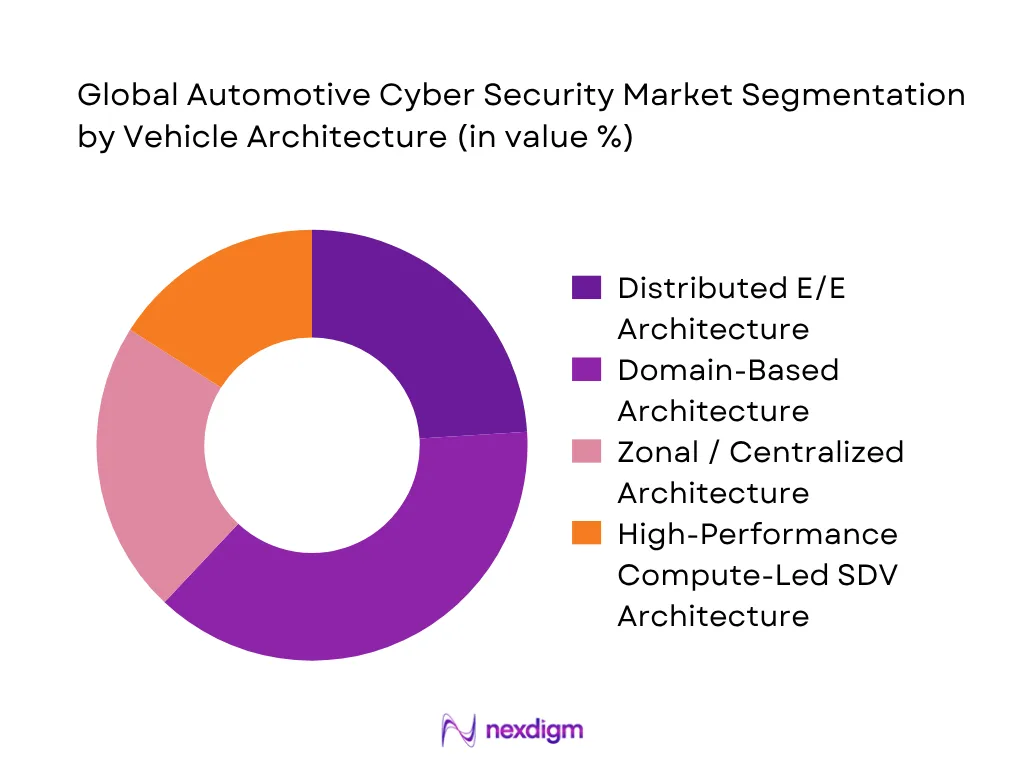
Domain-Based Architecture currently leads the market because it represents the most commercially active transition layer between legacy distributed electronics and fully centralized software-defined vehicle platforms. This architecture requires stronger cyber orchestration across connected domains such as infotainment, telematics, body electronics, and ADAS, creating significant demand for embedded and network-level security controls. OEMs and Tier suppliers are increasingly standardizing domain controllers to reduce complexity while improving cyber manageability. Compared with older distributed systems, domain-based layouts offer more efficient policy enforcement and monitoring. Although zonal and HPC-led architectures are expanding quickly, domain-based systems remain dominant due to broader deployment across current vehicle production programs and ongoing platform refresh cycles.
Competitive Landscape
The competitive environment is defined by a mix of automotive electronics leaders, embedded software specialists, and cyber-native vehicle security providers competing across design integration, compliance readiness, and lifecycle protection capabilities.
| Company Name | Establishment Year | Headquarters | Formulation Depth | Distribution Reach | Regulatory Readiness | Service Capability | Channel Strength | Pricing Flexibility |
| Robert Bosch GmbH | 1886 | Germany | ~ | ~ | ~ | ~ | ~ | ~ |
| Continental AG | 1871 | Germany | ~ | ~ | ~ | ~ | ~ | ~ |
| Aptiv PLC | 1994 | Ireland | ~ | ~ | ~ | ~ | ~ | ~ |
| Harman International | 1980 | United States | ~ | ~ | ~ | ~ | ~ | ~ |
| BlackBerry QNX | 1984 | Canada | ~ | ~ | ~ | ~ | ~ | ~ |
Global Automotive Cyber Security Market Analysis
Growth Drivers
Rise in Connected and Software-Defined Vehicles
The automotive cyber security market is being structurally driven by the rapid expansion of connected and software-defined vehicles, which materially increase the attack surface across telematics, infotainment, OTA, mobile app, and cloud interfaces. Global motor vehicle production reached 93.5 million units in 2023, while the broader digitalization of vehicles is accelerating in parallel with macroeconomic resilience in major auto markets such as the United States, China, Germany, and Japan. Electric car sales rose from 13.8 million in 2023 to 17 million in 2024, and vehicles sold with high software content increasingly rely on centralized compute, connected ECUs, remote diagnostics, and cloud-linked lifecycle management. This creates a direct and sustained requirement for embedded intrusion detection, secure boot, cryptographic key management, OTA hardening, API security, and fleet-wide threat monitoring—making cybersecurity a design-layer necessity rather than a post-production add-on.
Mandatory Compliance with UNECE R155 / R156 and ISO/SAE 21434
A major market driver is the compulsory compliance burden created by UNECE cybersecurity and software update regulations, which have transformed automotive cyber security from a discretionary engineering function into a homologation requirement. UNECE R155 and R156 became mandatory for all new vehicles produced from July 2024 in applicable markets, covering passenger cars, goods vehicles, trailers with ECUs, and certain automated vehicles. This requirement is reinforced by ISO/SAE 21434 across concept, development, production, operations, maintenance, and supplier governance. The compliance pressure is especially significant in export-oriented automotive economies: Germany exported over 3.1 million passenger cars in 2023, Japan exported over 4.4 million motor vehicles, and China became the world’s largest auto exporter with over 4 million car exports, making cybersecurity compliance essential for market access rather than optional product enhancement. As a result, OEMs and Tier-1s are investing in CSMS, SUMS, TARA, validation tooling, secure software development, and incident response processes across the full vehicle lifecycle.
Challenges
Fragmented Ownership Across IT / OT / Vehicle Engineering
One of the most persistent challenges in the automotive cyber security market is fragmented ownership of cyber risk across enterprise IT, manufacturing OT, embedded vehicle engineering, and aftersales software teams. Modern vehicles are no longer isolated mechanical products; they are connected cyber-physical systems with software dependencies extending into supplier codebases, cloud backends, mobile applications, and workshop tooling. This complexity is amplified by macro-scale industrial footprints: the global automotive industry produced 93.5 million vehicles in 2023, while EV stock reached around 40 million vehicles on the road the same year, each requiring coordinated lifecycle software governance. The challenge is particularly acute in large auto-producing economies where multi-tier supply ecosystems are dense and globally distributed. When cybersecurity responsibilities are split across product engineering, cloud operations, compliance, and functional safety teams, ownership gaps emerge around vulnerability remediation, incident escalation, secure update governance, and post-production monitoring. These organizational silos slow compliance readiness and create execution risk for cybersecurity programs.
Cybersecurity Validation Across Complex Supply Chains
Cybersecurity validation across automotive supply chains is a major bottleneck because modern vehicles integrate software, semiconductors, operating systems, middleware, telematics stacks, and cloud services from a wide range of global suppliers. This challenge is intensifying as electrification and digitalization expand simultaneously: global electric car sales increased from 13.8 million in 2023 to 17 million in 2024, while announced investments in EVs and batteries from 2022–2023 alone exceeded USD 470 billion, reflecting the rapid scaling of technology-heavy vehicle platforms. Each additional ECU, connectivity module, charging interface, and OTA dependency introduces new validation obligations across secure boot, cryptography, software bills of materials, interface hardening, and incident traceability. For OEMs, the difficulty is not only technical validation but also ensuring supplier continuity of evidence, auditability, and cybersecurity case documentation across the full chain of development and production. This makes supplier assurance and cyber validation one of the most resource-intensive barriers to deployment.
Opportunities
Cloud-Native Fleet Security and Vehicle XDR
A major future-facing opportunity in the automotive cyber security market is the scaling of cloud-native fleet security and vehicle extended detection and response (XDR), supported by the rapid expansion of connected vehicle fleets and remote software operations. Electric cars on the road reached around 40 million in 2023, and global EV sales climbed to 17 million in 2024, while public charging and telematics-linked vehicle ecosystems continue to expand. As OEMs move from vehicle-level protection to fleet-wide cyber visibility, the operational value of centralized telemetry, remote anomaly detection, incident correlation, and over-the-air remediation becomes significantly higher. This is particularly relevant in markets with advanced cloud and connected mobility ecosystems such as the United States, Europe, and China, where high volumes of connected vehicles generate continuous data streams that can be used for cyber analytics and fleet defense. The opportunity is therefore not only in embedded protection, but in off-board monitoring, threat intelligence, digital forensics, and software-defined post-production security operations.
Cybersecurity for EV Charging and Vehicle-to-Grid Interfaces
Cybersecurity for EV charging and vehicle-to-grid interfaces represents one of the clearest expansion opportunities for the automotive cyber security market because charging networks are becoming a critical external attack surface for connected vehicles. Public charging infrastructure grew 40% globally in 2023, and the United States increased its fast charger stock from 40,000 in 2023 to over 50,000 in 2024, while the European Union reached 71,000 fast chargers and over 77,000 ultra-fast chargers in 2024. At the same time, global electric car sales rose to 17 million in 2024, increasing the number of vehicles interacting with chargers, payment systems, roaming platforms, mobile apps, and energy management backends. This creates a strong need for authentication security, certificate management, encrypted communications, firmware integrity, charging session trust, and secure interoperability between vehicles and energy infrastructure. As EV ecosystems become more grid-connected and software-managed, cybersecurity is moving from vehicle perimeter defense to mobility-energy ecosystem protection.
Future Outlook
The global automotive cyber security market is expected to experience strong growth driven by the increasing adoption of software-defined vehicles, expansion of connected mobility ecosystems, and regulatory enforcement across key automotive markets. The evolution toward centralized and zonal architectures will further increase the attack surface, necessitating advanced cybersecurity solutions. Additionally, the rise of electric vehicles and vehicle-to-everything (V2X) communication will create new security challenges, encouraging OEMs to adopt proactive and continuous monitoring systems. The integration of artificial intelligence and machine learning for threat detection is expected to redefine cybersecurity capabilities. Furthermore, the shift toward cloud-native vehicle platforms and over-the-air updates will drive demand for scalable and real-time security solutions. As cybersecurity becomes a core component of vehicle design, investments in this domain will continue to rise significantly.
Major Players
- Robert Bosch GmbH
- Continental AG
- Aptiv PLC
- Harman International
- Elektrobit
- ETAS GmbH / ESCRYPT
- Synopsys, Inc.
- BlackBerry QNX
- VicOne
- PlaxidityX
- Karamba Security
- GuardKnox
- Upstream Security
- Cybellum
- Vector Informatik
Key Target Audience
- Automotive OEMs
- Tier-1 automotive system suppliers
- Semiconductor and automotive chipset vendors
- Fleet operators and mobility platform providers
- Electric vehicle charging infrastructure operators
- Managed security service providers for connected mobility
- Investments and venture capital firms
- Government and regulatory bodies including UNECE WP.29, NHTSA, ENISA, and national transport cybersecurity agencies
Research Methodology
Step 1: Identification of Key Variables
The research framework begins with identification of cyber security variables across connected vehicle architectures, embedded software stacks, telematics systems, OTA pipelines, and compliance workflows. Key parameters include vehicle connectivity depth, ECU exposure, software centralization, regulatory applicability, and deployment models across OEM and supplier ecosystems.
Step 2: Market Analysis and Construction
The market structure is constructed through segmentation by offering, architecture, deployment mode, vehicle class, and application area. Demand patterns are assessed through platform-level cyber adoption, connected vehicle deployment maturity, standards alignment, and cyber integration intensity across embedded and cloud-linked automotive environments.
Step 3: Hypothesis Validation and Expert Consultation
Initial assumptions are validated through expert consultation across automotive engineering, vehicle software, compliance, and cyber operations functions. Validation focuses on design-stage adoption trends, security integration bottlenecks, homologation readiness, fleet monitoring needs, and technology priorities across OEMs, Tier suppliers, and connected mobility operators.
Step 4: Research Synthesis and Final Output
Final outputs are synthesized by aligning segment-level adoption patterns, regulatory developments, platform transitions, and architecture-specific security requirements into a structured analytical narrative. The report is then refined into publication-ready insights covering demand drivers, buyer behavior, competitive structure, and future market evolution.

- Executive Summary
- Research Methodology (Market Definitions and Assumptions, Abbreviations, Research Framework, Bottom-Up Market Build, Top-Down Market Validation, Demand-Side Assessment, Supply-Side Assessment, Expert Interviews with OEMs/Tier-1s/Cyber Vendors, Cybersecurity Control Mapping, Forecasting Framework, Limitations and Analyst View)

- Definition and Scope
- Market Taxonomy and Boundary Conditions
- Evolution of Automotive Cyber Security Ecosystem
- Automotive Digital Attack Surface: Vehicle-to-Cloud Architecture View
- Cybersecurity Across Vehicle Lifecycle
- Regulatory and Standards Landscape

- Growth Drivers
Rise in Connected and Software-Defined Vehicles
Mandatory Compliance with UNECE R155 / R156 and ISO/SAE 21434
Expansion of OTA Update and Feature-on-Demand Ecosystems
Increased Integration of ADAS, V2X and Digital Cockpit Platforms
Rising OEM Exposure to Fleet-Scale Cyber Incidents - Challenges
Fragmented Ownership Across IT / OT / Vehicle Engineering
Cybersecurity Validation Across Complex Supply Chains
Security Overhead in Resource-Constrained ECUs
Lack of Standardized Threat Telemetry Across Fleets
Monetization Gap for Security-by-Design Investments - Opportunities
Cloud-Native Fleet Security and Vehicle XDR
Cybersecurity for EV Charging and Vehicle-to-Grid Interfaces
AI-Enabled Detection, Triage and Response
Post-Production Cyber Monitoring and Patch Orchestration
White Space in Emerging OEMs and New EV Brands - Trends
Shift from Point Solutions to Platformized Cybersecurity Stacks
Integration of Cybersecurity with Functional Safety and ASPICE
Movement from CAN-Centric Protection to Ethernet / SOA Security
Rise of Vehicle Security Operations Centers (VSOC)
Security-by-Architecture in Zonal / Centralized E/E Platforms - Use Case Mapping
Technology Benchmarking
Threat Landscape Analysis
Cyber Kill Chain for Connected Vehicles - PESTLE Analysis
- Porter’s Five Forces Analysis
- Market Attractiveness Matrix
- SWOT Analysis

- By Revenue, 2020–2025
- By Secured Vehicle Parc, 2020–2025
- By Protected ECU / Domain Controller Install Base, 2020–2025
- By Average Revenue per Protected Vehicle, 2020–2025

- By Offering (in Value %)
Hardware Security
Software Security
Services
Managed Security Services
Compliance & Engineering Services - By Security Layer (in Value %)
In-Vehicle Network Security
Endpoint / ECU / Domain Controller Security
Secure Gateway Security
Telematics / Connectivity Security
Cloud / Backend / Fleet Security
Mobile App / API / Digital Key Security
EV Charging Interface Security
V2X / C-V2X Security - By Solution Type (in Value %)
Intrusion Detection & Prevention System (IDPS)
Security Operations Center / VSOC
Threat Analysis & Risk Assessment (TARA)
Vulnerability Management & SBOM
Secure OTA / Update Security
PKI / Identity & Access Management - By Vehicle Architecture (in Value %)
Distributed E/E Architecture
Domain-Based Architecture
Zonal / Centralized Architecture
High-Performance Compute (HPC)-Led SDV Architecture - By Communication Interface (in Value %)
CAN / CAN-FD
LIN
Automotive Ethernet
FlexRay
Bluetooth / BLE
Wi-Fi
- By Application Area (in Value %)
Telematics Control Unit (TCU)
Infotainment / IVI
ADAS / Autonomous Driving Stack
Powertrain & Battery Management Systems
Body Control & Comfort Systems
Gateway / Domain Controller - By Vehicle Propulsion (in Value %)
Internal Combustion Engine (ICE)
Hybrid Electric Vehicle (HEV)
Plug-in Hybrid Electric Vehicle (PHEV)
Battery Electric Vehicle (BEV)
Fuel Cell Electric Vehicle (FCEV) - By Vehicle Class (in Value %)
Passenger Cars
Light Commercial Vehicles
Medium & Heavy Commercial Vehicles
Buses / Coaches
Off-Highway / Specialty Vehicles - By Deployment Mode (in Value %)
Embedded / On-Board Security
Edge + Cloud Hybrid Security
Cloud-Native / Off-Board Security
Managed / Outsourced Cyber Operations - By Customer Type (in Value %)
OEMs
Tier-1 Suppliers
Tier-2 / Semiconductor / ECU Vendors
Fleet Operators / Mobility Service Providers
Aftermarket / Retrofit Providers - By Sales Channel (in Value %)
Direct Enterprise Sales
OEM / Tier-1 Embedded Design Wins
Channel / Alliance / SI-Led Sales
Platform / Middleware-Led Bundling
MSSP / Managed Service Contracts
- By Region (in Value %)
North America
Europe
Asia-Pacific
Middle East & Africa
Latin America

- Market Share of Major Players
By In-Vehicle Security
By VSOC / Managed Security
By Compliance / Engineering Services - Cross Comparison Parameters (Protected Vehicle Parc, Number of OEM Programs Won, ECU / Domain Controller Coverage, VSOC / Fleet Monitoring Capability, UNECE R155 / ISO 21434 Compliance Depth, OTA Security Capability, Automotive Ethernet / SOME-IP Security Support, SDV / Zonal Architecture Readiness)
- Competitive Positioning Matrix
- Strategic Grouping of Competitors
- Pricing Benchmarking
- Design Win and Deployment Analysis
- Detailed Profiles of Major Companies
Robert Bosch GmbH
Continental AG
Aptiv PLC
Harman International
Elektrobit
ETAS GmbH / ESCRYPT
Synopsys, Inc.
BlackBerry QNX
VicOne
PlaxidityX
Karamba Security
GuardKnox
Upstream Security
Cybellum
Vector Informatik

- OEM Buying Behavior
- Tier-1 Supplier Cybersecurity Integration Needs
- Fleet / Mobility Operator Requirements
- Customer Pain Point Analysis
- Decision-Making Unit Mapping
- Procurement and Contracting Model

- By Revenue, 2026–2035
- By Secured Vehicle Parc, 2026–2035
- By Protected ECU / Domain Controller Install Base, 2026–2035
- By Average Revenue per Protected Vehicle, 2026–2035


 Request a Sample
 Ask for Customization
 Get a Quote
 Enquire Now