

 Download PDF
Market Overview
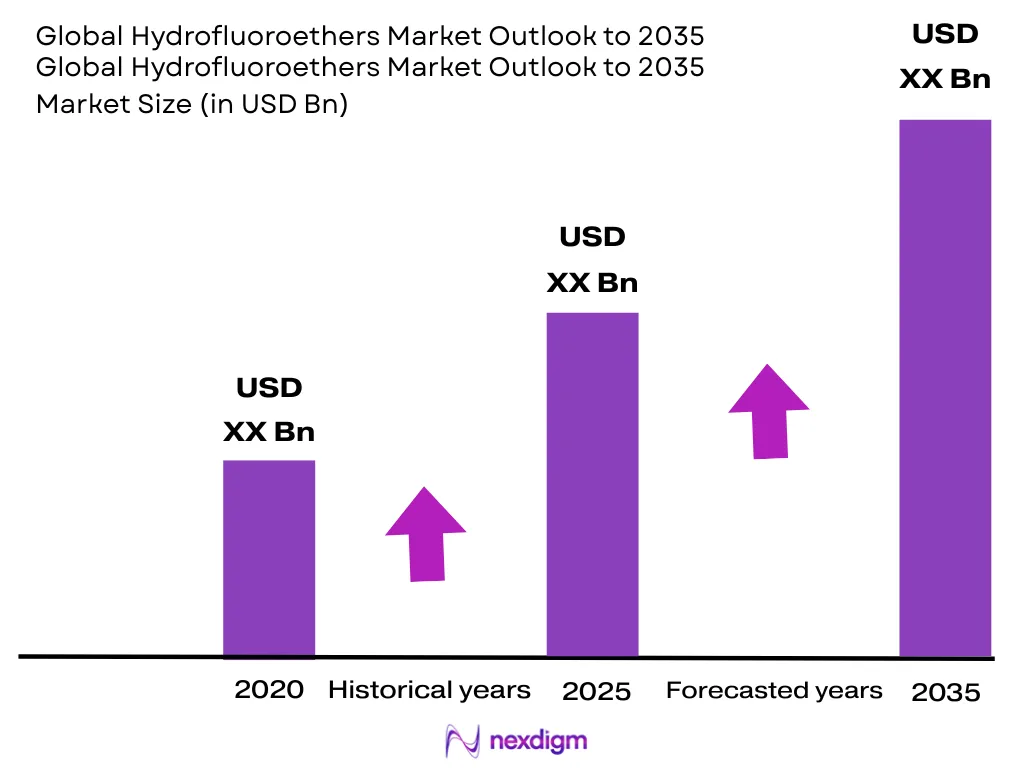
The Global Hydrofluoroethers (HFE) Market was valued at USD ~ Billion in 2024 and is anticipated to expand at a CAGR of ~% during 2026-2035. Hydrofluoroethers are non-flammable, chemically inert compounds with zero ozone depletion potential and comparatively low global warming potential, positioning them as third-generation replacements to chlorofluorocarbons (CFCs), hydrochlorofluorocarbons (HCFCs), and perfluorocarbons (PFCs) across precision cleaning, heat transfer, and specialty solvent applications. The market is primarily driven by increasing demand from semiconductor fabrication, electronics manufacturing, and data center cooling, which together account for the majority of global HFE consumption. A significant structural shift is underway following 3M’s December 2022 announcement to exit all per- and polyfluoroalkyl substance (PFAS) manufacturing, with production of its Novec and Fluorinert engineered fluid lines fully discontinued by the end of 2025, creating a substantial supply realignment that competing fluorochemical producers are moving to address.
Market Segmentation
By Product Type
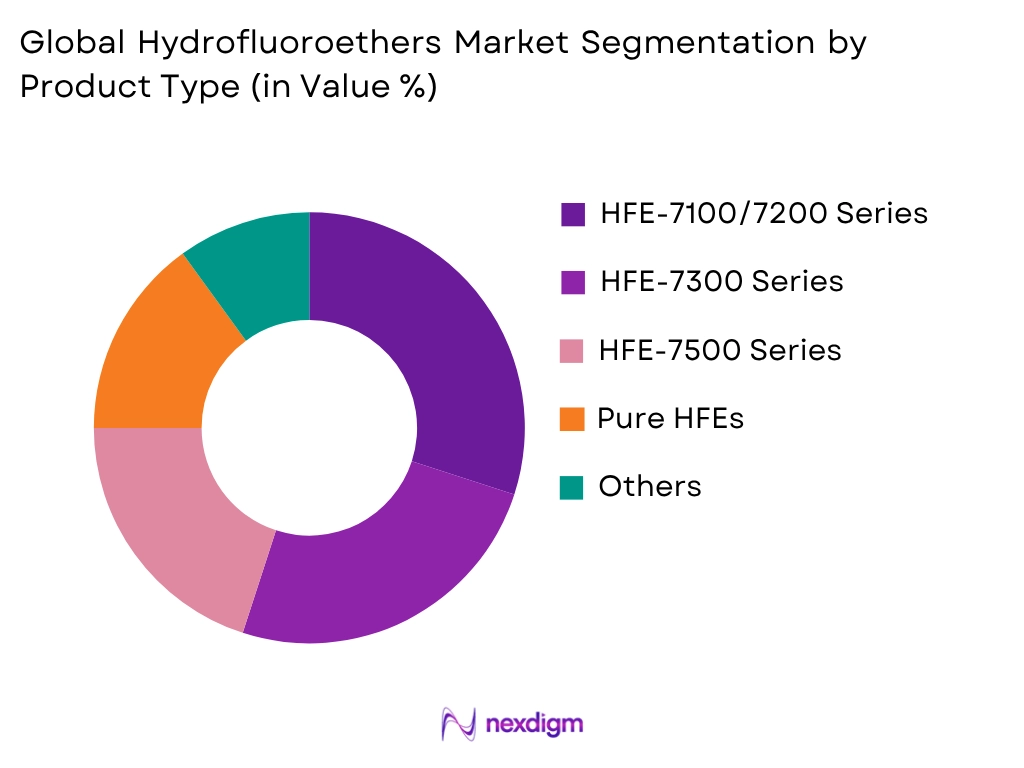
Among these, the HFE-7100/7200 Series holds the largest share of the Global Hydrofluoroethers Market, accounting for more than half of product-type revenue, owing to its widespread specification in precision cleaning and single-phase immersion cooling applications across semiconductor and electronics manufacturing. These grades are favored for their combination of low boiling point, high dielectric strength, and material compatibility with sensitive electronic components. Demand for HFE-7300 and HFE-7500 series fluids continues to expand within heat transfer and vapor degreasing applications requiring higher boiling points and thermal stability. Following the phase-out of 3M’s legacy Novec product lines, several fluorochemical producers, including AGC, Solvay, Chemours, and Daikin, have accelerated development of comparable HFE blends and co-solvent systems to maintain continuity of supply for qualified industrial and aerospace applications.
By Application
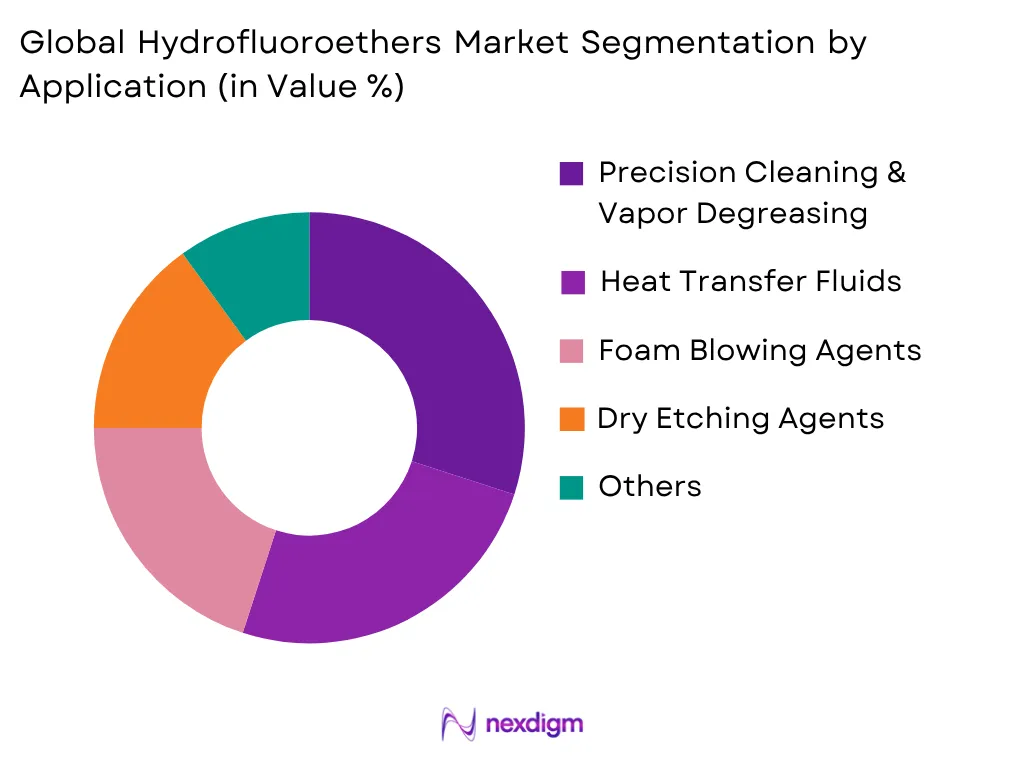
Precision Cleaning & Vapor Degreasing represents the leading application segment, driven by extensive use of HFE fluids in semiconductor wafer cleaning, printed circuit board manufacturing, and critical component degreasing across aerospace and medical device industries. Semiconductor manufacturing alone accounts for a substantial share of global HFE demand, given the fluids’ compatibility with sensitive microelectronic components and their ability to remove flux residues and particulate contamination without leaving damaging residues. Heat Transfer Fluids represent the second-largest application, supported by growing adoption of two-phase immersion cooling in high-density data centers and expanding semiconductor fabrication capacity worldwide. Additional applications, including foam blowing agents, dry etching agents, coatings and lubricants, and dielectric fluids, continue to expand as manufacturers seek non-flammable, low-toxicity alternatives to legacy ozone-depleting solvents.
Competitive Landscape
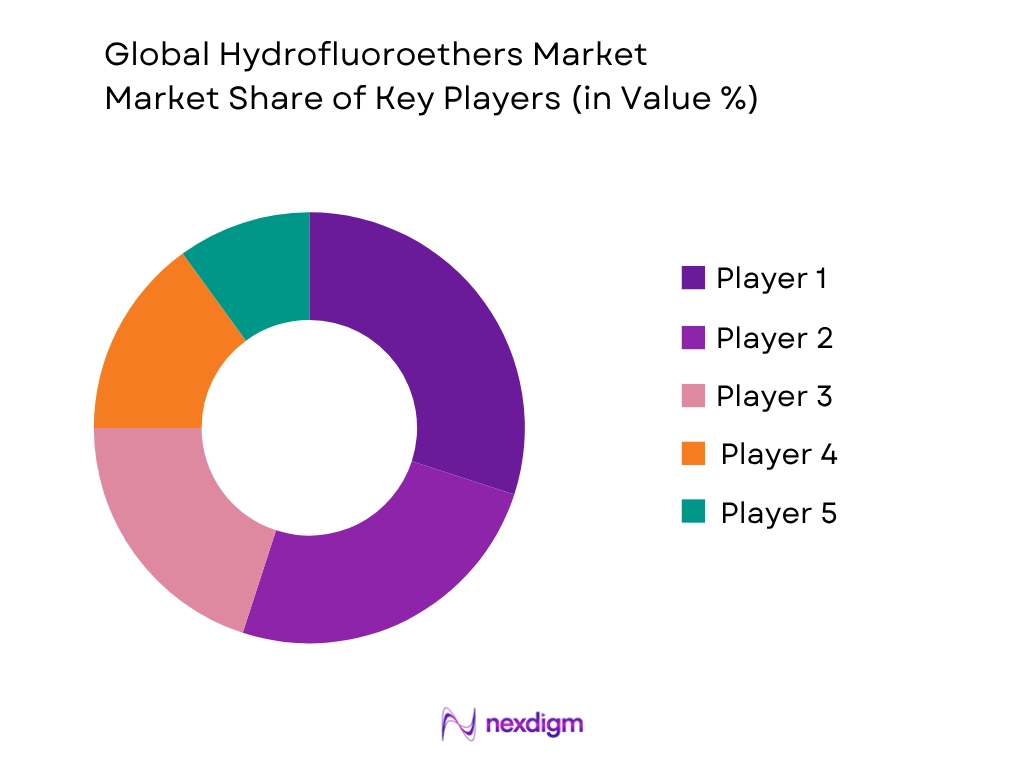
The Global Hydrofluoroethers Market is highly consolidated, with a small number of established fluorochemical producers historically accounting for the substantial majority of global production capacity. 3M was historically the dominant global producer through its Novec and Fluorinert engineered fluid brands; however, following the company’s exit from PFAS manufacturing, competitors including AGC, Solvay, Chemours, Daikin Industries, and several China-based specialty fluorochemical manufacturers are actively expanding capacity and qualifying replacement products for mission-critical applications in aerospace, semiconductor, and medical device manufacturing. Competition is primarily based on product purity, thermal and chemical stability, regulatory compliance, application-specific formulation expertise, and the ability to provide PFAS-free or low-global-warming-potential alternatives. Companies are increasingly investing in research and development to develop next-generation HFE formulations that meet tightening environmental regulations while preserving the performance characteristics required by precision cleaning and heat transfer applications.
| Company | Establishment Year | Headquarters | Primary Product Portfolio | Enzyme Portfolio
|
Manufacturing Presence | Major End-Use Industries | Key Strategic Focus | Certifications & Compliance |
| 3M | 1902 | ~ | ~ | ~ | ~ | ~ | ~ | ~ |
| AGC Inc. | 1907 | ~ | ~ | ~ | ~ | ~ | ~ | ~ |
| Solvay | 1863 | ~ | ~ | ~ | ~ | ~ | ~ | ~ |
| Chemours | 2015 | ~ | ~ | ~ | ~ | ~ | ~ | ~ |
| Daikin Industries | 1924 | ~ | ~ | ~ | ~ | ~ | ~ | ~ |
Global Confectionary Market Analysis
Growth Drivers
Rising Demand from Semiconductor and Electronics Manufacturing
The Global Hydrofluoroethers Market is experiencing sustained growth due to expanding semiconductor fabrication capacity and increasing precision cleaning requirements across the electronics industry. Industry estimates indicate that semiconductor manufacturing accounts for approximately 44% of global HFE consumption, followed by industrial and precision cleaning applications at approximately 38% and data center cooling at approximately 13%, reflecting the fluids’ critical role in wafer cleaning, flux removal, and component degreasing processes. Continued investment in new semiconductor fabrication facilities across the United States, Taiwan, South Korea, Japan, and China continues to expand the addressable market for high-purity HFE cleaning fluids. The fluids’ non-flammability, low toxicity, and material compatibility with sensitive microelectronic components make them difficult to substitute in critical cleaning steps, sustaining long-term demand even as the industry navigates evolving environmental regulations. Growth in printed circuit board manufacturing, aerospace component assembly, and medical device production further reinforces demand for high-purity precision cleaning solvents across multiple manufacturing sectors.
Regulatory Phase-Out of Ozone-Depleting and High-GWP Refrigerants
Regulatory phase-outs of ozone-depleting substances under the Montreal Protocol, together with the phasedown of high-global-warming-potential hydrofluorocarbons under the 2016 Kigali Amendment and the United States’ AIM Act, continue to drive adoption of hydrofluoroethers as replacement chemistries across refrigeration, foam blowing, and specialty solvent applications. HFEs offer zero ozone depletion potential and comparatively lower global warming potential than legacy CFC, HCFC, and PFC alternatives, positioning them favorably as regulators worldwide tighten restrictions on high-impact fluorinated chemicals. Data center operators and semiconductor manufacturers seeking to reduce the environmental footprint of cooling and cleaning operations continue to specify HFE-based fluids as part of broader sustainability commitments. As additional countries adopt Kigali Amendment obligations and expand domestic HFC phasedown schedules, demand for compliant, lower-impact fluorochemical alternatives such as HFEs is expected to continue expanding across both developed and emerging markets.
Market Challenges
Supply Chain Disruption Following 3M’s Exit from PFAS Manufacturing
3M’s December 2022 announcement to exit all per- and polyfluoroalkyl substance (PFAS) manufacturing, with production of its Novec and Fluorinert engineered fluid lines fully discontinued by the end of 2025, has created significant supply disruption across industries that historically relied on these fluids for precision cleaning, heat transfer, and fire suppression applications. Companies in aerospace, medical device manufacturing, and semiconductor production have faced shortages and escalating prices for remaining inventory while qualifying alternative fluids from competing suppliers such as AGC, Solvay, Chemours, Daikin, and Honeywell. Because many mission-critical applications require extensive requalification and validation testing before adopting a replacement chemistry, the transition away from legacy 3M products has extended lead times and increased costs for end users across multiple industries. This disruption has also accelerated interest in domestic and regional fluorochemical production capacity to reduce dependency on any single supplier for critical specialty fluids.
Evolving PFAS Regulatory Landscape
The Global Hydrofluoroethers Market continues to navigate an evolving and increasingly stringent regulatory landscape surrounding per- and polyfluoroalkyl substances. In February 2023, five European Economic Area authorities, coordinated through the European Chemicals Agency (ECHA), proposed a broad restriction on PFAS manufacturing, use, and market placement under the EU’s REACH regulation, one of the most extensive restriction proposals in the agency’s history. In the United States, the Environmental Protection Agency has classified certain PFAS compounds as hazardous substances, adding compliance complexity for manufacturers and downstream users. Although hydrofluoroethers are generally regarded as having a more favorable environmental and toxicological profile compared to legacy long-chain PFAS compounds, their classification within some regulatory frameworks as part of the broader PFAS family creates uncertainty for long-term market access, particularly in the European Union. Manufacturers must continuously monitor regulatory developments across multiple jurisdictions and invest in toxicological and environmental fate studies to support continued market authorization for their products.
Market Opportunities
Development of Next-Generation Low-GWP and PFAS-Free Alternatives
The regulatory pressure facing conventional PFAS-based fluids has created substantial commercial opportunity for fluorochemical producers investing in next-generation, lower-impact HFE formulations. Companies including Chemours and LG Chem have announced plans to commercialize next-generation hydrofluoroether and fluorinated fluid chemistries with global warming potential values below 10, reflecting the industry’s strategic pivot toward more sustainable product portfolios. Continued advances in fluorination chemistry, continuous flow synthesis, and catalytic process technologies are enabling producers to develop formulations that maintain the non-flammability, dielectric strength, and thermal stability required by precision cleaning and heat transfer applications while reducing environmental persistence. As regulatory frameworks in the European Union and United States continue to evolve, fluorochemical manufacturers that can demonstrate a credible pathway toward PFAS-free or ultra-low-GWP product lines are well positioned to capture market share from legacy suppliers exiting the category.
Expansion of Data Center Immersion Cooling and Semiconductor Fabrication Capacity
The rapid expansion of global data center capacity, driven by growing computational demand from artificial intelligence and cloud computing workloads, is creating significant new opportunities for HFE-based heat transfer fluids used in two-phase immersion cooling systems. As data center operators seek more energy-efficient thermal management solutions for high-density computing racks, demand for dielectric, non-flammable heat transfer fluids with strong thermal performance characteristics continues to expand. Simultaneously, continued investment in new semiconductor fabrication facilities across North America, Asia Pacific, and Europe is expanding the addressable market for high-purity precision cleaning fluids used in wafer processing. Fluorochemical producers that can scale production capacity, maintain electronics-grade purity standards, and provide reliable long-term supply agreements are well positioned to capitalize on these two structurally supported, multi-year growth trends across the semiconductor and digital infrastructure sectors.
Future Outlook
The Global Hydrofluoroethers Market is expected to witness sustained expansion over the forecast period, supported by continued semiconductor fabrication investment, growth in data center immersion cooling, and ongoing regulatory phase-outs of legacy ozone-depleting and high-global-warming-potential fluorochemicals. The market’s competitive structure is likely to continue evolving as producers complete the transition following 3M’s exit from PFAS manufacturing, with next-generation low-GWP and PFAS-free HFE formulations expected to play an increasingly central role in long-term product portfolios across precision cleaning, heat transfer, and specialty solvent applications.
Major Players
- 3M
- AGC Inc.
- Solvay
- Chemours
- Daikin Industries
- Honeywell International Inc.
- DuPont
- Merck KGaA
- Arkema
- Tianhe Chemical Group Limited
- Zhejiang Juhua Co., Ltd.
- Shandong Huaxia Shenzhou New Material Co., Ltd.
- Sicong Chemical (Shanghai) Co., Ltd.
- Sanming Hexaflu Chemicals Co., Ltd.
- Shanghai Yumu Chemical Co., Ltd.
Key Target Audience
- Hydrofluoroether and Fluorochemical Manufacturers
- Semiconductor & Electronics Manufacturers
- Aerospace & Defense Companies
- Data Center Operators & Cooling Solution Providers
- Pharmaceutical and Healthcare Companies
- Investment and Venture Capitalist Firms
- Government and Regulatory Bodies (US EPA, European Chemicals Agency (ECHA), Montreal Protocol Secretariat)
- Chemical Distributors and Industrial Raw Material Suppliers
Research Methodology
Step 1: Identification of Key Variables
The research process begins with identifying the complete ecosystem of the Global Hydrofluoroethers Market, including raw material suppliers, fluorochemical manufacturers, distributors, end-use industries, and regulatory authorities. Extensive secondary research is conducted using company annual reports, government publications, trade associations, customs statistics, industry journals, and proprietary databases to determine the variables influencing market demand, pricing, production, consumption, and technological developments.
Step 2: Market Analysis and Construction
Historical market information is collected and analyzed to estimate market size, production volumes, import-export activity, application-wise demand, and pricing trends. A combination of top-down and bottom-up approaches is used to estimate market revenues and validate segment-level performance. Consumption patterns across semiconductor manufacturing, precision cleaning, heat transfer, and specialty solvent applications are evaluated to establish an accurate representation of the industry.
Step 3: Hypothesis Validation and Expert Consultation
The preliminary findings are validated through Computer-Assisted Telephone Interviews (CATIs) and structured discussions with fluorochemical manufacturers, procurement managers, distributors, process engineers, regulatory experts, and senior executives operating within the global specialty chemicals industry. These interviews help verify market assumptions, competitive developments, technology adoption trends, pricing dynamics, and future investment opportunities while refining the overall market estimates.
Step 4: Research Synthesis and Final Output
The final stage integrates insights obtained from primary interviews with quantitative information collected through secondary sources. Data triangulation techniques are applied to reconcile differences between supply-side and demand-side estimates, ensuring robust market forecasting. The report is then reviewed through multiple quality assurance checkpoints to deliver a comprehensive analysis covering market size, segmentation, competitive landscape, future outlook, and strategic recommendations for industry stakeholders.

- Executive Summary
- Research Methodology (Market Definitions and Assumptions, Abbreviations, Market Sizing Approach, Top-Down Analysis, Bottom-Up Analysis, Demand-Side Assessment, Supply-Side Assessment, Primary Industry Interviews, Secondary Research Validation, Data Triangulation, Forecasting Framework, Limitations and Future Conclusions)

- Definition and Scope
- Market Evolution and Industry Genesis
- Timeline of Major Industry Developments
- Hydrofluoroethers Industry Value Chain Analysis
- Supply Chain Analysis

- Growth Drivers (Growing Semiconductor Fabrication Demand, Rising Adoption of Low-GWP Refrigerants, Expansion of Data Center Cooling, Increasing Precision Cleaning Applications, Regulatory Phase-Out of Ozone-Depleting Substances, Growth in Aerospace & Defense Applications)
- Market Challenges (High Production Costs, PFAS Regulatory Uncertainty, Raw Material Price Volatility, Supply Chain Disruption from 3M’s PFAS Exit, Limited Substitute Availability, Stringent Environmental Compliance)
- Market Opportunities (Development of Low-GWP HFE Alternatives, Expansion of Semiconductor Fabrication Capacity, Growth in Immersion Cooling Technologies, Emerging Pharmaceutical Applications, Next-Generation Fluorochemical R&D, Export-Oriented Specialty Chemical Manufacturing)
- Market Trends (Shift Toward PFAS-Free Alternatives, Growth in Two-Phase Immersion Cooling, Asian Manufacturer Market Share Gains, Next-Generation Low-GWP Product Development, Supply Chain Realignment, Multi-Functional Fluid Formulations)
- Government Regulations (EPA PFAS Regulations, REACH/ECHA PFAS Restriction Proposal, Montreal Protocol Compliance, Kigali Amendment / AIM Act HFC Phasedown, Import/Export Compliance, Occupational Exposure Standards)
- Import and Export Analysis (Trade Volume, Major Import Sources, Export Destinations, HS Code Analysis, Trade Balance)
- Raw Material Availability Analysis (Fluorspar, Hydrofluoric Acid, Chlorinated Precursors, Specialty Catalysts, Ether Feedstocks, Fluorinated Alcohols)
- Technology Landscape (Fluorination Technologies, Distillation & Purification Technologies, Continuous Flow Synthesis, Catalytic Process Technologies, Quality Control & Purity Testing Technologies)
- Sustainability Assessment (Low-GWP Product Development, Closed-Loop Manufacturing, Waste Fluorine Recovery, Reduced Emission Processing, Green Chemistry Initiatives)
- PESTLE Analysis
- SWOT Analysis
- Porter’s Five Forces Analysis
- Stakeholder Ecosystem
- Competition Ecosystem

- By Market Value (2020-2025)
- By Volume Consumption (2020-2025)
- By Average Selling Price (2020-2025)

- By Product Type (In Value %)
HFE-7100/7200 Series
HFE-7300 Series
HFE-7500 Series
Pure HFEs
HFE Blends
Co-Solvent Systems - By Application (In Value %)
Precision Cleaning & Vapor Degreasing
Heat Transfer Fluids
Foam Blowing Agents
Dry Etching Agents
Coatings & Lubricants
Refrigerants
Dielectric Fluids
Fire Suppression Agents
Aerosols & Propellants
Specialty Solvents - By Distribution Channel (In Value %)
Direct Sales to Industrial Manufacturers
Chemical Distributors
Industrial Gas & Specialty Chemical Suppliers
Online B2B Chemical Platforms
Specialty Fluid Suppliers - By End User (In Value %)
Semiconductor & Electronics Manufacturers
Aerospace & Defense Companies
Automotive Manufacturers
Pharmaceutical & Healthcare Companies
Data Center Operators
Industrial Manufacturing Companies
Research & Testing Laboratories - By Region (In Value %)
North America
Europe
Asia Pacific
Latin America
Middle East & Africa

- Market Share of Major Players (By Value, Volume, Product Type, Application Industry, End-Use Category)
- Cross Comparison Parameters (Product Portfolio Breadth, PFAS-Free Product Availability, Purity & Performance Standards, Application Technical Support Capability, Manufacturing Capacity, Regulatory Compliance & Certifications, Semiconductor & Aerospace Customer Base, Innovation & New Product Launch Frequency)
- SWOT Analysis of Major Players
- Pricing Analysis by Product Grade and Purity Level
- Production Capacity Analysis
- Manufacturing Footprint Analysis
- Distribution Network Analysis
- Innovation Benchmarking
- Detailed Profiles of Major Companies
3M
AGC Inc.
Solvay
Chemours
Daikin Industries
Honeywell International Inc.
DuPont
Merck KGaA
Arkema
Tianhe Chemical Group Limited
Zhejiang Juhua Co., Ltd.
Shandong Huaxia Shenzhou New Material Co., Ltd.
Sicong Chemical (Shanghai) Co., Ltd.
Sanming Hexaflu Chemicals Co., Ltd.
Shanghai Yumu Chemical Co., Ltd.

- Consumption Pattern Analysis (Industrial Usage, Batch Size, Product Category Penetration, Seasonal Demand, Reformulation Activity)
- Purchasing Criteria (Chemical Purity, Regulatory Compliance, Cost Efficiency, Thermal Stability, Non-Flammability, Global Warming Potential)
- Procurement and Supplier Selection Analysis
- PFAS-Free Adoption Assessment
- Premium vs Conventional Product Demand
- Product Attribute Preference Analysis (Dielectric Strength, Boiling Point Range, Solvency Power, Thermal Stability, Zero Ozone Depletion Potential, Low Global Warming Potential)
- Environmental & Regulatory Compliance Influence on Product Development
- Pain Point Analysis
- Decision-Making Process

- By Market Value (2026-2035)
- By Volume Consumption (2026-2035)
- By Average Selling Price (2026-2035)


 Request a Sample
 Ask for Customization
 Get a Quote
 Enquire Now