
 Download PDF
Market Overview
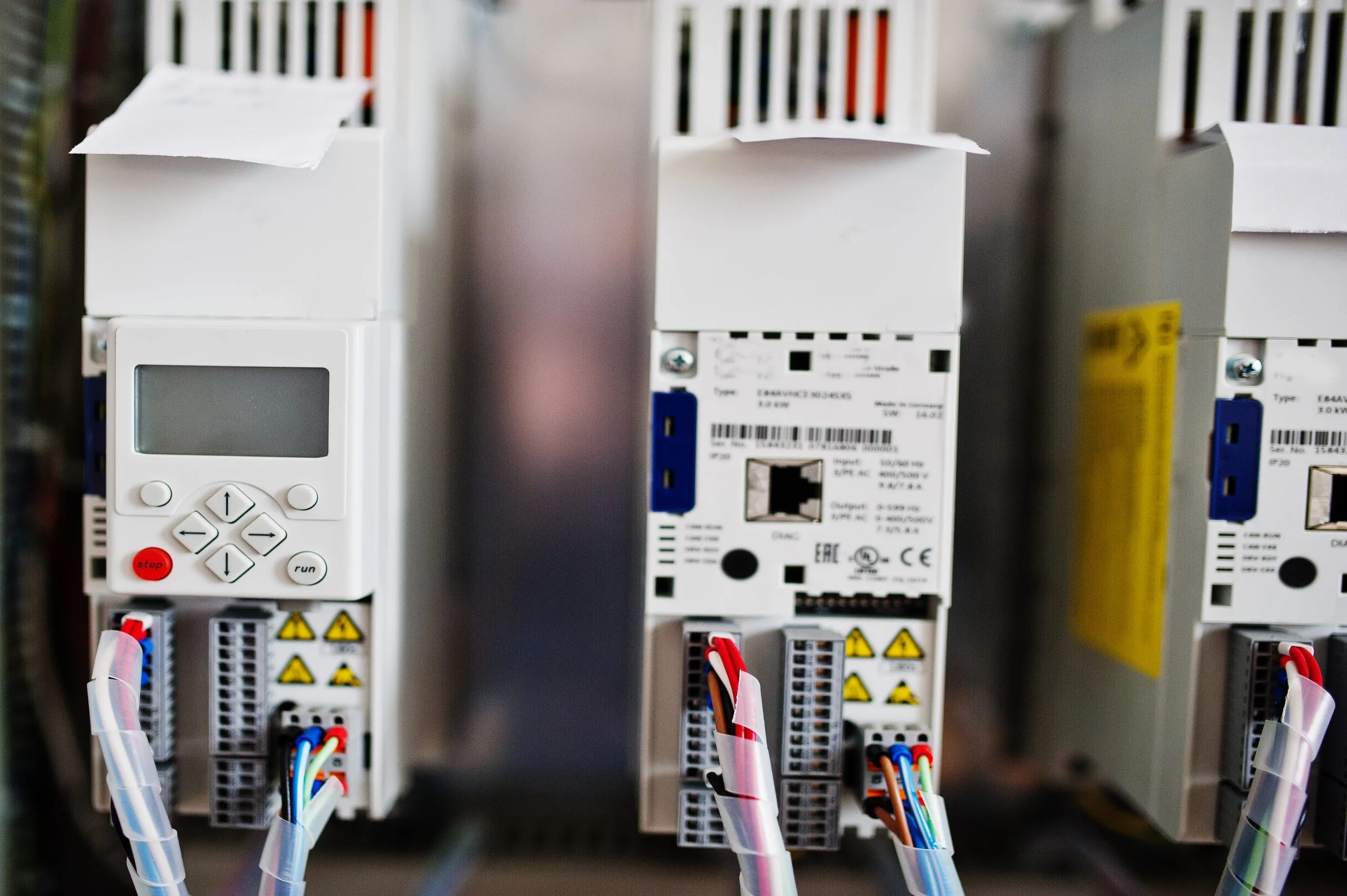
The India AC Motor Drives System Market is supported by rapid industrial automation expansion, increasing factory electrification, and rising deployment of energy-efficient motor control systems across material handling, machine tools, packaging machinery, textiles, pharmaceuticals, food processing, HVAC, electronics manufacturing, and semiconductor industries. India’s industrial automation ecosystem generated nearly USD ~ billion in industrial automation-related revenues, while industrial electricity consumption exceeded 490 billion kWh according to government energy statistics. Expansion of smart manufacturing initiatives, semiconductor investments, and automated warehousing infrastructure has accelerated deployment of variable frequency drives, servo drives, and intelligent motion-control systems across manufacturing facilities and industrial automation ecosystems.
Industrial clusters across Maharashtra, Tamil Nadu, Gujarat, Karnataka, Telangana, and Delhi NCR dominate the India AC Motor Drives System Market because of strong manufacturing activity, semiconductor investments, machine tool production, automotive manufacturing, and electronics assembly operations. Pune, Chennai, Bengaluru, Hyderabad, Ahmedabad, and Mumbai remain major automation adoption centers due to dense OEM ecosystems, industrial corridors, advanced logistics infrastructure, and increasing factory digitization initiatives. Southern and Western India continue attracting automation-intensive investments owing to expansion in semiconductor fabrication, industrial robotics deployment, packaging machinery production, and electronics manufacturing infrastructure supporting long-term demand for AC motor drives systems.
Market Segmentation
By Voltage Type
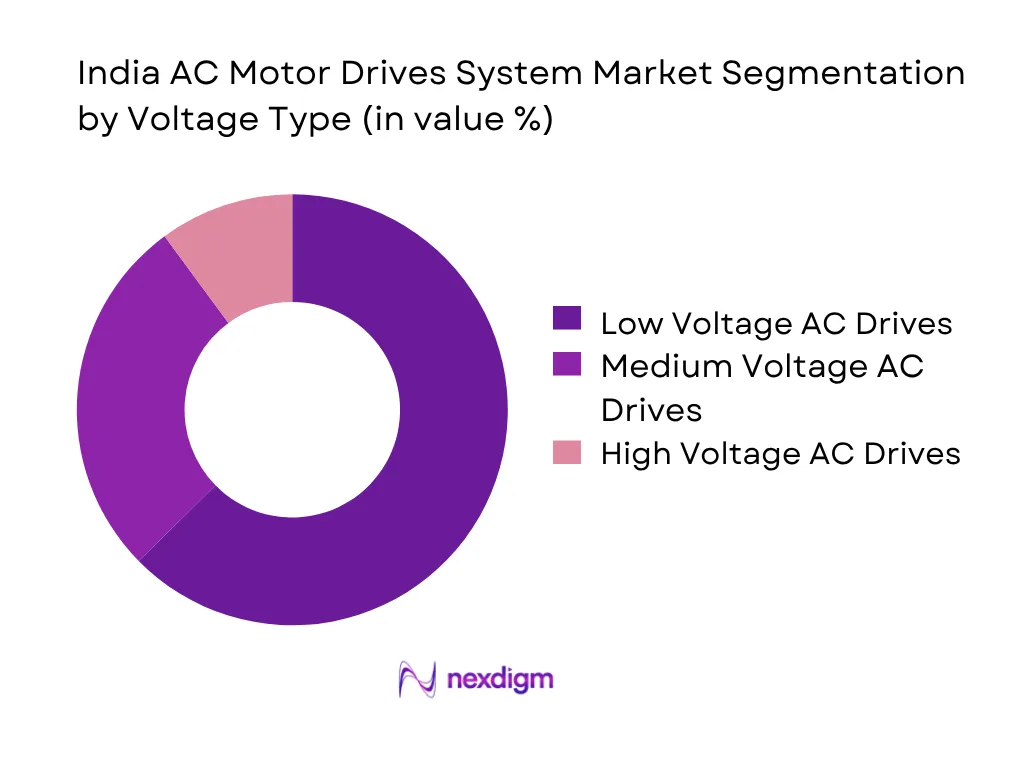
The India AC Motor Drives System Market is segmented by voltage type into low voltage AC drives, medium voltage AC drives, and high voltage AC drives. Low voltage AC drives dominate the India AC Motor Drives System Market because of their extensive deployment across material handling systems, packaging machinery, HVAC infrastructure, food processing facilities, plastics manufacturing units, and textile automation lines. These drives are widely preferred due to compact design architecture, lower installation complexity, energy optimization capability, and compatibility with smart factory communication systems. Rapid expansion of industrial automation among small and medium manufacturing facilities has accelerated adoption of low-voltage drive systems for pumps, conveyors, compressors, and fans. Their integration with programmable logic controllers and predictive maintenance systems further strengthens deployment across automation-intensive industries.
By End-Use Industry
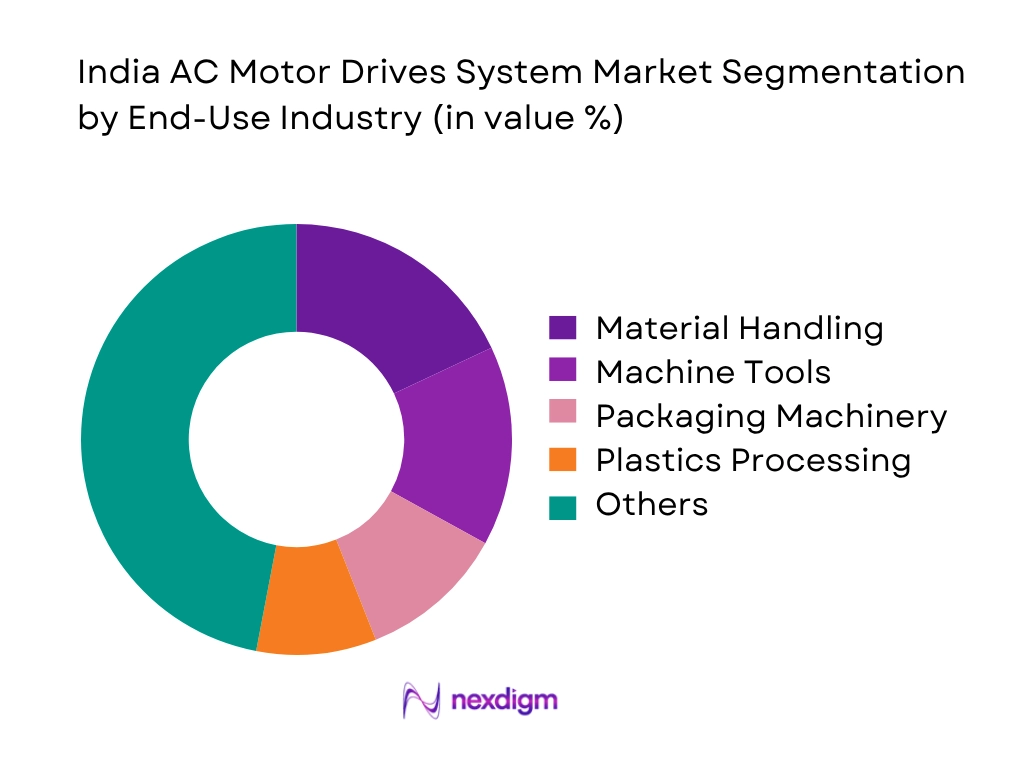
The India AC Motor Drives System Market is segmented by end-use industry into material handling, machine tools, packaging machinery, plastics processing, textile manufacturing, pharmaceuticals, food & beverage processing, HVAC systems, electronics & electrical manufacturing, semiconductor manufacturing, oil & gas, metals & mining, water & wastewater treatment, cement industry, and power generation. Material handling dominates the India AC Motor Drives System Market due to increasing deployment of automated warehouses, conveyor systems, logistics hubs, and smart intralogistics infrastructure. Growth in e-commerce fulfillment centers and industrial logistics automation has accelerated adoption of AC drives for conveyors, cranes, hoists, and robotic movement systems. Industries increasingly prefer intelligent motor drive systems to improve synchronization, reduce energy consumption, minimize maintenance downtime, and enhance operational precision across warehouse and logistics automation environments.
Competitive Landscape
The India AC Motor Drives System Market is moderately consolidated, with major industrial automation companies focusing on smart drive technologies, localization strategies, OEM partnerships, and expansion of industrial automation infrastructure. Market participants are increasingly investing in IIoT-enabled motor drives, predictive maintenance systems, industrial Ethernet integration, and high-efficiency motion control solutions to strengthen competitiveness across semiconductor manufacturing, machine tools, packaging machinery, material handling, and process industries. The market is also witnessing increasing investments in localized manufacturing and service infrastructure to reduce import dependency and improve supply chain resilience.
| Company | Establishment Year | Headquarters | Product Focus | OEM Partnerships | Industrial Vertical Presence | Smart Drive Capability | Localization Strength | Service Infrastructure | Strategic Focus |
| ABB | 1988 | Zurich, Switzerland | ~ | ~ | ~ | ~ | ~ | ~ | ~ |
| Siemens | 1847 | Munich, Germany | ~ | ~ | ~ | ~ | ~ | ~ | ~ |
| Schneider Electric | 1836 | Rueil-Malmaison, France | ~ | ~ | ~ | ~ | ~ | ~ | ~ |
| Mitsubishi Electric | 1921 | Tokyo, Japan | ~ | ~ | ~ | ~ | ~ | ~ | ~ |
| Delta Electronics | 1971 | Taipei, Taiwan | ~ | ~ | ~ | ~ | ~ | ~ | ~ |
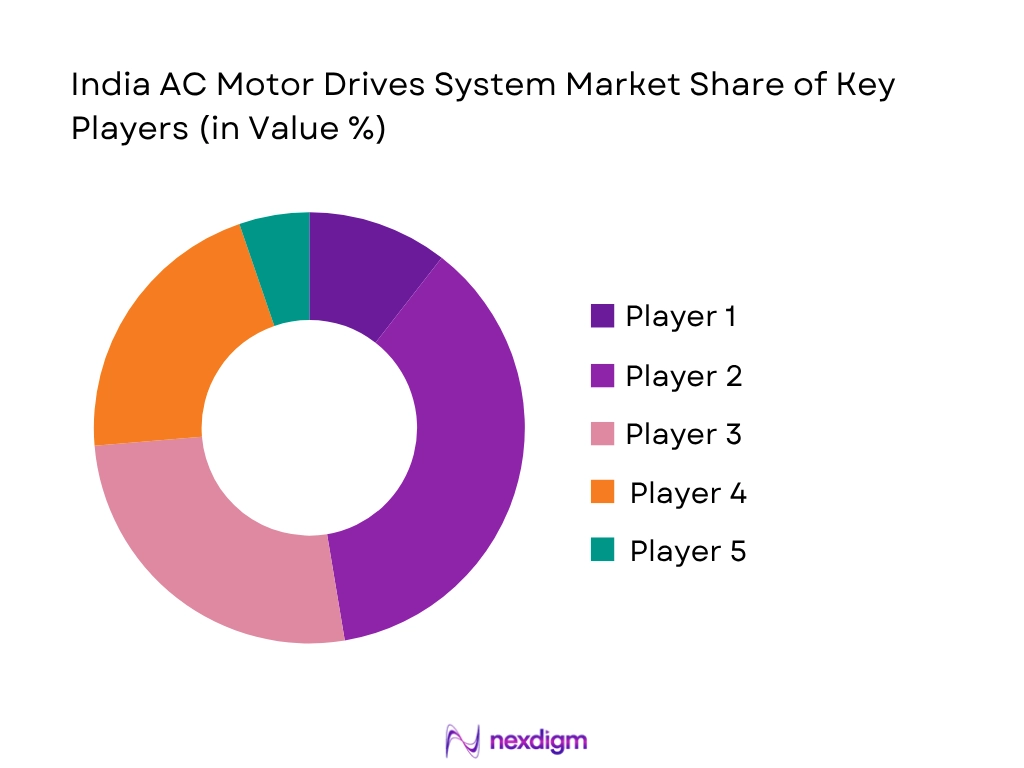
India AC Motor Drives System Market Analysis
Growth Drivers
Rising Industrial Automation Investments Across Manufacturing Industries
India’s manufacturing and industrial automation ecosystem is witnessing strong expansion, directly accelerating deployment of AC motor drives systems across material handling, machine tools, packaging machinery, plastics, pharmaceutical, HVAC, and electronics manufacturing industries. Manufacturing Gross Value Added exceeded INR 27 trillion during FY2024, supported by large-scale industrial automation investments and factory modernization programs. Semiconductor and electronics manufacturing projects worth more than INR 1.5 trillion under industrial manufacturing initiatives are increasing demand for precision motor control systems, servo drives, and variable frequency drives in cleanroom and automation-intensive production environments. Industrial electricity consumption exceeded 490 billion kWh according to national energy statistics, increasing deployment of AC drives to optimize motor efficiency and reduce industrial energy intensity across pumps, conveyors, compressors, robotics systems, and HVAC applications. Growth in industrial robotics installations across automotive, electronics, and machine tool manufacturing facilities is also strengthening adoption of intelligent motion-control systems integrated with advanced AC motor drive technologies.
Expansion of Energy-Efficiency Regulations and Industrial Electrification
Increasing focus on industrial energy efficiency and electrification is significantly accelerating adoption of AC motor drives systems across India. Electric motors account for nearly 70% of industrial electricity consumption according to global energy agencies, making variable frequency drives essential for reducing industrial power intensity and improving operational efficiency. Expansion of industrial energy-efficiency programs across cement, thermal power, textiles, metals, fertilizers, and process manufacturing sectors is supporting deployment of medium-voltage and low-voltage drive systems. India’s installed renewable energy capacity exceeded 190 GW during 2024, increasing industrial electrification and demand for intelligent energy management infrastructure. Growth in smart manufacturing and green industrial facilities is further strengthening demand for automation-integrated AC drives capable of predictive maintenance, real-time monitoring, harmonic reduction, and process optimization across industrial environments. Automated warehousing, smart logistics infrastructure, and green building projects are also contributing to increasing deployment of energy-efficient motor drive technologies.
Market Challenges
High Dependence on Imported Power Electronics and Semiconductor Components
The India AC Motor Drives System Market continues facing significant challenges due to dependence on imported semiconductors, insulated-gate bipolar transistors, microcontrollers, and advanced power electronics components used in variable frequency drives and servo systems. India imports more than 85% of its semiconductor requirements, exposing industrial automation manufacturers to supply chain disruptions, logistics risks, and foreign exchange volatility. Electronics imports exceeded USD 89 billion during FY2024, with a substantial share linked to industrial automation components and semiconductor devices. Advanced AC motor drive systems used in semiconductor fabs, packaging machinery, machine tools, robotics, and pharmaceutical automation require high-performance imported electronic architectures sourced largely from East Asia. Global semiconductor supply chain disruptions between 2022 and 2024 significantly affected industrial automation inventory cycles, lead times, and component availability, limiting domestic value addition for industrial automation manufacturers and OEMs.
Shortage of Skilled Industrial Automation Workforce
Shortage of skilled professionals capable of handling industrial automation systems, servo systems, PLC programming, industrial Ethernet communication, and smart drive integration remains a major challenge for the India AC Motor Drives System Market. India requires more than 30 million digitally skilled workers across manufacturing and automation-related industries over the coming years, while shortages continue across industrial robotics, automation engineering, and smart manufacturing operations. Industries increasingly deploying IIoT-enabled AC drives, predictive maintenance systems, industrial communication protocols, and robotics integration require highly specialized automation engineers and technicians. Electronics manufacturing, semiconductor facilities, packaging automation, and machine tool industries are facing increasing competition for technically skilled workforce across industrial corridors in Maharashtra, Tamil Nadu, Gujarat, and Karnataka. This workforce gap increases commissioning delays, maintenance inefficiencies, and operational downtime risks for advanced automation deployments.
Market Opportunities
Expansion of Semiconductor and Electronics Manufacturing Ecosystem
Rapid expansion of semiconductor and electronics manufacturing presents a major opportunity for AC motor drives system suppliers in India. Semiconductor and display manufacturing projects worth more than INR 1.5 trillion are increasing deployment of servo systems, precision motion-control systems, cleanroom HVAC automation, robotics integration, and intelligent motor drive infrastructure. Electronics production crossed USD 115 billion during FY2024, supported by growth in smartphones, consumer electronics, telecom equipment, and automotive electronics manufacturing. Semiconductor fabrication facilities and electronics assembly plants are highly automation-intensive environments requiring synchronized motor control systems across wafer handling, conveyor systems, robotics platforms, and precision manufacturing equipment. Increasing exports of electronic goods and expansion of localized electronics manufacturing ecosystems are expected to create strong downstream demand for advanced AC motor drive systems integrated with smart factory architectures.
Growth of Automated Warehousing and Material Handling Infrastructure
Expansion of warehousing, logistics automation, and industrial material handling infrastructure across India presents substantial opportunities for AC motor drive manufacturers. Investments exceeding USD 10 billion have been deployed across logistics infrastructure and industrial corridor development between 2022 and 2024, supported by e-commerce expansion and multimodal logistics modernization initiatives. Automated warehouses increasingly deploy conveyors, automated guided vehicles, pallet systems, cranes, and robotic sorting lines powered by variable frequency drives and servo motor systems. India’s warehousing stock exceeded 380 million square feet across major industrial cities, with strong growth observed in Pune, Bengaluru, Chennai, Hyderabad, and Delhi NCR. Expansion of logistics parks, freight corridors, food processing facilities, and industrial distribution centers is increasing deployment of automation-integrated motor drive systems for load synchronization, speed optimization, predictive maintenance, and energy-efficient warehouse operations.
Future Outlook
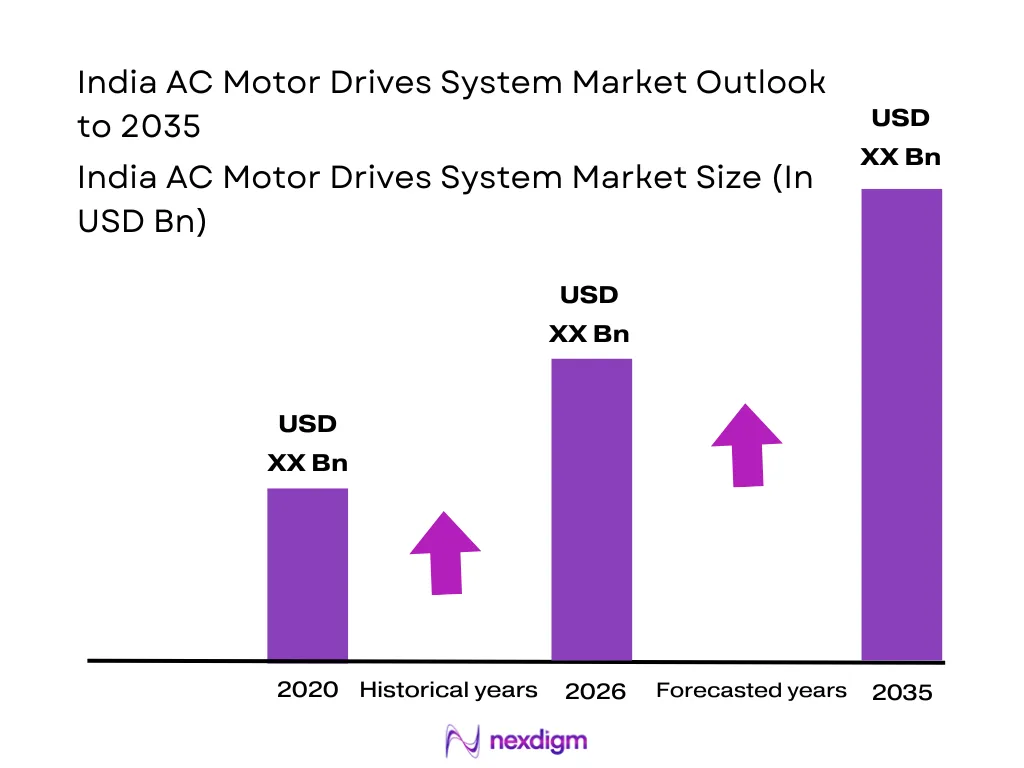
The India AC Motor Drives System Market is expected to witness substantial expansion over the coming years due to increasing factory automation, industrial electrification, semiconductor manufacturing investments, and smart manufacturing initiatives. Demand for intelligent motor control systems across material handling, packaging machinery, pharmaceuticals, food processing, electronics manufacturing, HVAC systems, and machine tools is expected to strengthen significantly. Manufacturers are increasingly focusing on IIoT-enabled smart drives, AI-based predictive maintenance systems, regenerative drive technologies, and industrial Ethernet integration to support evolving smart factory requirements. Expansion of localized manufacturing ecosystems, increasing automation adoption across Tier-II industrial clusters, and rising deployment of robotics and motion-control systems are expected to accelerate market demand further. Growth in warehouse automation, semiconductor fabrication facilities, electronics manufacturing infrastructure, and green industrial facilities is likely to strengthen deployment of energy-efficient AC motor drive systems integrated with advanced industrial automation architectures.
Major Players
- ABB
- Siemens
- Schneider Electric
- Danfoss
- Rockwell Automation
- Mitsubishi Electric
- Yaskawa Electric
- Fuji Electric
- Delta Electronics
- WEG
- Hitachi Industrial Equipment Systems
- CG Power and Industrial Solutions
- Bosch Rexroth
- Parker Hannifin
- Inovance Technology
Key Target Audience
- Industrial Automation Equipment Manufacturers
- OEM Machine Builders and Machine Tool Manufacturers
- Semiconductor Fabrication Facility Operators
- Food & Beverage Processing Plant Operators
- Material Handling and Warehouse Automation Companies
- Investments and Venture Capitalist Firms
- Government and Regulatory Bodies
- Industrial System Integrators and EPC Companies
Research Methodology
Step 1: Identification of Key Variables
The initial phase involved identifying major variables influencing the India AC Motor Drives System Market, including industrial automation penetration, factory electrification trends, semiconductor manufacturing expansion, machine builder ecosystems, and industrial energy-efficiency adoption. Extensive secondary research was conducted using industrial databases, manufacturing statistics, automation journals, trade publications, and government sources to understand market structure and ecosystem dynamics.
Step 2: Market Analysis and Construction
Historical market analysis was conducted using industrial automation deployment data, motor installation trends, industrial electricity consumption statistics, machine tool production, and warehouse automation investments. Revenue estimations were developed through bottom-up calculations based on deployment across manufacturing industries, logistics infrastructure, HVAC systems, semiconductor facilities, and process industries.
Step 3: Hypothesis Validation and Expert Consultation
Preliminary market findings were validated through interviews with automation vendors, OEM machine builders, industrial system integrators, plant managers, and industrial automation engineers. These consultations provided insights regarding procurement trends, localization levels, industrial communication protocols, predictive maintenance deployment, and future automation investment priorities.
Step 4: Research Synthesis and Final Output
The final stage involved integrating qualitative and quantitative findings to produce a consolidated market assessment. Cross-validation was conducted using trade statistics, industrial manufacturing disclosures, automation deployment analysis, and government industrial production data to ensure consistency and reliability of market estimates, segmentation analysis, and strategic opportunity mapping.

- Executive Summary
- Research Methodology (Market Definitions and Assumptions, Abbreviations, Research Framework, Bottom-Up Market Estimation, Top-Down Validation, Industrial Automation Mapping, OEM and Machine Builder Assessment, Factory Automation Penetration Analysis, Import-Export Dependency Assessment, Primary Interviews with Automation Vendors and OEMs, Forecasting Model, Limitations and Assumptions)

- Definition and Scope
- Evolution of Industrial Automation and Motion Control Systems in India
- Industry Ecosystem and Stakeholder Mapping
- Supply Chain and Value Chain Analysis
- Power Electronics and Semiconductor Dependency Landscape
- Manufacturing and Assembly Flow

- Growth Drivers
Rising Industrial Automation Investments Across Manufacturing Industries
Expansion of Energy-Efficiency Regulations and Industrial Electrification
Growth in Smart Manufacturing and Industry 4.0 Adoption
Expansion of Semiconductor and Electronics Manufacturing Facilities
Increasing Deployment of Automated Warehousing and Material Handling Systems - Market Challenges
High Dependence on Imported Power Electronics and Semiconductor Components
Shortage of Skilled Industrial Automation Workforce
Cybersecurity Risks in Connected Industrial Automation Systems
High Initial Capital Expenditure for Advanced Automation Infrastructure - Market Opportunities
Expansion of Semiconductor and Electronics Manufacturing Ecosystem
Growth of Automated Warehousing and Material Handling Infrastructure
Localization of Industrial Automation Manufacturing under Make in India
Expansion of Smart HVAC and Green Building Infrastructure
Growth in Retrofit Automation Projects Across Brownfield Manufacturing Facilities - Market Trends
Integration of IIoT-Enabled Smart Drives
Rise of Predictive Maintenance and AI-Based Diagnostics
Expansion of Ethernet-Based Industrial Communication Systems
Growth in Regenerative Drive Adoption
Increasing Deployment of Compact and Modular Drive Architectures
Expansion of Servo Drive Applications in Precision Manufacturing - Government Regulations
Bureau of Energy Efficiency Standards
Industrial Safety and EMC Compliance Regulations
Import Duty and Localization Policies
Industrial Automation and Smart Manufacturing Initiatives
Electronics Manufacturing and Semiconductor Policies - Pricing Analysis
- SWOT Analysis
- Porter’s Five Forces Analysis
- Competition Ecosystem

- By Value, 2020-2025
- By Shipment Volume, 2020-2025
- By Installed Base, 2020-2025
- By Hardware Revenue, 2020-2025
- By Software Revenue, 2020-2025

- By Voltage Type (in Value %)
Load Handling Capacity
Energy Optimization Efficiency
Industrial Duty Cycle
Motor Compatibility
Power Distribution Intensity - By Power Rating (in Value %)
Torque Requirement
Industrial Application Intensity
Variable Speed Penetration
Continuous Load Operations
Machine Capacity Utilization - By Drive Type (in Value %)
Speed Control Accuracy
Dynamic Motion Capability
Energy Recovery Efficiency
Precision Automation Integration
Industrial Communication Compatibility - By End-Use Industry (in Value %)
Automation Penetration
Factory Digitization Level
Energy Consumption Intensity
Production Throughput Dependency
Industrial Electrification Adoption - By Application (in Value %)
Pump Automation Intensity
Conveyor Automation Usage
HVAC Energy Optimization
Robotics Motion Precision
Compressor Load Management - By Communication Protocol (in Value %)
Industrial Ethernet Penetration
PLC Compatibility
IIoT Readiness
Real-Time Data Exchange
Smart Factory Connectivity - By Distribution Channel (in Value %)
OEM Dependency
Distributor Network Density
Service Reach Capability
System Integration Support
Industrial Procurement Preference - By Revenue Stream (in Value %)
Hardware Contribution
Software Integration Usage
Aftermarket Service Dependency
Retrofit Installation Demand
Maintenance Contract Penetration - By Region (in Value %)
North India
South India
West India
East India

- Market Share Analysis of Major Players on the Basis of Revenue, Shipment Volume, and Installed Base
- Cross Comparison Parameters (Voltage Portfolio Coverage, Power Rating Breadth, Industrial Vertical Penetration, Installed Base Strength, OEM Partnerships, Localization Capability, IIoT Integration Capability, Service Infrastructure Strength, Manufacturing Facilities, Automation Software Integration, Distribution Reach, Smart Factory Compatibility, Product Innovation Pipeline, Energy Efficiency Focus, Strategic Collaborations)
- Competitive Benchmarking Matrix
- SWOT Analysis of Major Players
- Pricing Analysis by Product Category and Power Rating
- Detailed Profiles of Major Companies
ABB
Siemens
Schneider Electric
Danfoss
Rockwell Automation
Mitsubishi Electric
Yaskawa Electric
Fuji Electric
Delta Electronics
WEG
Hitachi Industrial Equipment Systems
CG Power and Industrial Solutions
Bosch Rexroth
Parker Hannifin
Inovance Technology

- Industrial Automation Spending Analysis
- Factory Electrification and Energy Optimization Assessment
- OEM Procurement and Vendor Selection Parameters
- Machine Builder Partnership Analysis
- Operational Efficiency and Downtime Reduction Preferences
- Aftermarket Service and Maintenance Expectations

- By Value, 2026-2035
- By Shipment Volume, 2026-2035
- By Installed Base, 2026-2035
- By Hardware Revenue, 2026-2035
- By Software Revenue, 2026-2035


 Request a Sample
 Ask for Customization
 Get a Quote
 Enquire Now