
 Download PDF
Market Overview
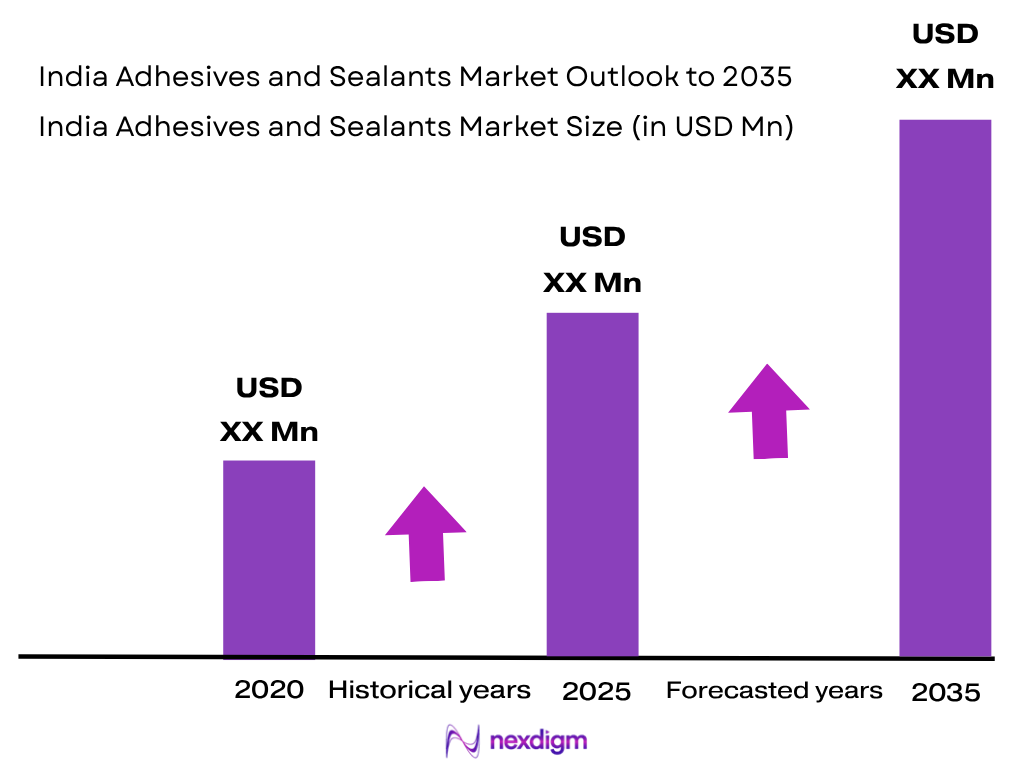
The India adhesives and sealants market is supported by the expansion of packaging, construction, automotive, woodworking, electronics and industrial manufacturing applications. The market recorded USD ~ million in revenue and 565.7 kilotons of consumption in 2024. Packaging is particularly important because adhesives are used for carton sealing, labeling, flexible packaging and lamination, while construction applications include flooring, roofing, glazing and joint sealing. The paper and packaging application accounted for 31.1% of market revenue under one established market definition.
Mumbai, Pune, Ahmedabad, Vadodara, Delhi-NCR, Bengaluru, Chennai and Hyderabad form important demand and manufacturing centers because they combine chemical supply, automotive production, construction activity, packaging conversion, electronics manufacturing and industrial distribution. Western India has a particularly developed chemical and manufacturing ecosystem, with Gujarat providing major chemical-production infrastructure and Maharashtra supporting automotive and packaging clusters. Southern India adds demand from automotive, electronics, aerospace, footwear and construction industries, while Delhi-NCR and surrounding industrial corridors support construction, consumer goods and manufacturing applications.
Market Segmentation
By Technology
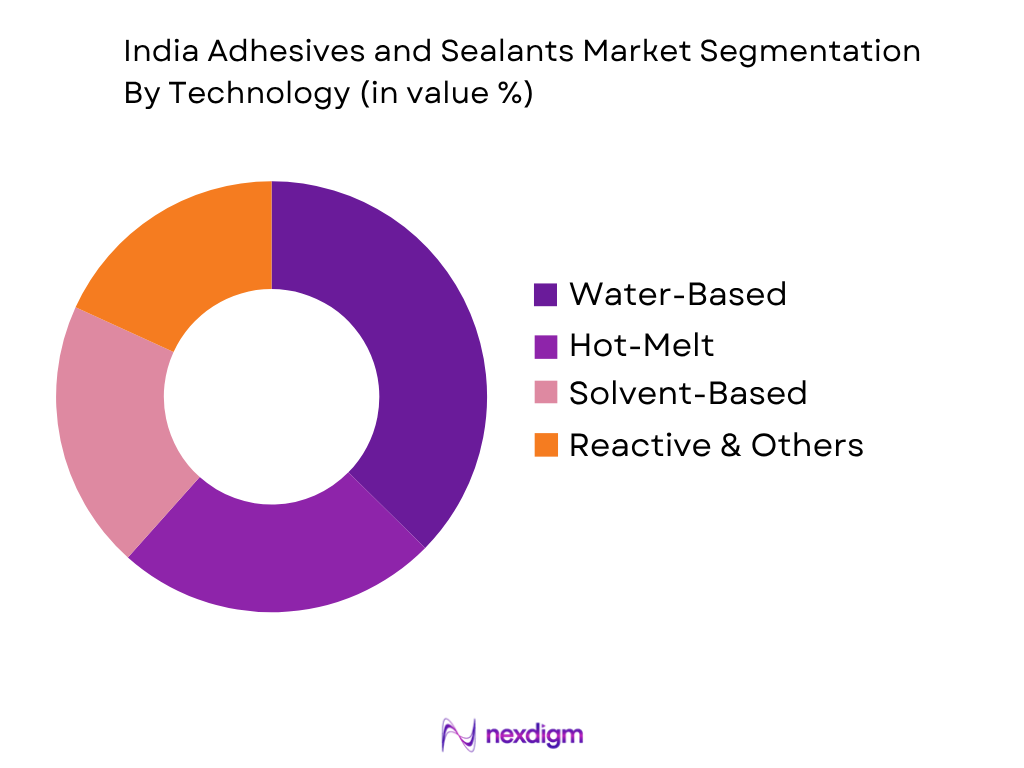
The India adhesives and sealants market is segmented by technology into water-based, solvent-based, hot-melt and reactive systems. Water-based technology represents the dominant reported technology segment, accounting for 37.9% of 2024 revenue under the Grand View Research market definition. Its position is associated with packaging, construction and woodworking applications where low-VOC characteristics, ease of application and compatibility with porous substrates are important. Water-based systems are particularly relevant for paper, board, wood and textile bonding. The shift toward lower-emission formulations also supports adoption as manufacturers seek to meet environmental and workplace requirements. Hot-melt technology is important in high-speed packaging, furniture and automated manufacturing because it provides rapid setting and solvent-free processing. Solvent-based systems continue to serve applications requiring strong resistance to heat and chemicals, while reactive systems are relevant to structural bonding and specialized industrial applications.
By Application
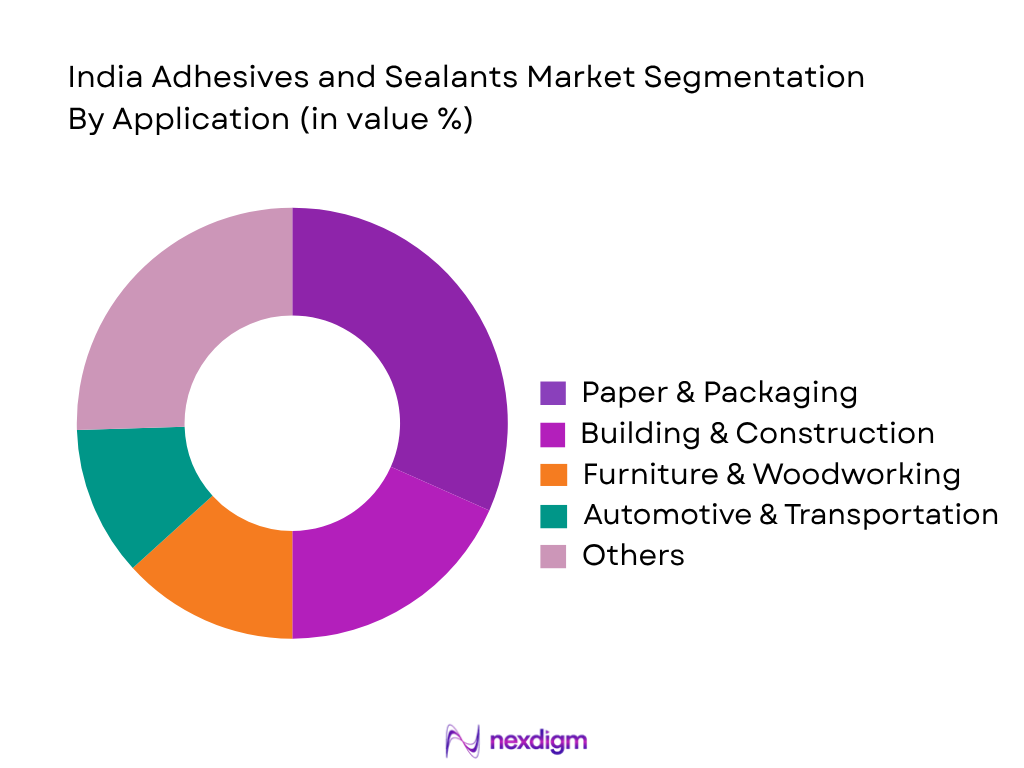
The India adhesives and sealants market is segmented across paper and packaging, building and construction, woodworking and joinery, transportation, footwear and leather, medical and healthcare, electronics and industrial applications. Paper and packaging represents the largest reported application segment, accounting for 31.1% of market revenue in 2024. Its position is supported by the extensive use of adhesives in corrugated boxes, cartons, labels, flexible packaging and laminating structures. The expansion of FMCG, food and beverage manufacturing and e-commerce increases requirements for packaging conversion and case sealing. Building and construction represents another major demand center because adhesives and sealants are used in flooring, tile installation, insulation, glazing, roofing and joint sealing. Transportation applications benefit from lightweight vehicle construction and the growing use of bonding in automotive assembly. Medical applications require specialized formulations with biocompatibility and sterilization resistance.
Competitive Landscape
The India adhesives and sealants market includes a combination of large domestic manufacturers, global chemical companies and specialized industrial adhesive suppliers. Pidilite Industries, Henkel, Sika, H.B. Fuller and 3M have significant presence across consumer, construction and industrial applications, while companies including Arkema/Bostik, Dow, BASF, MAPEI, Ashland and Anabond provide specialized technologies. Competition is shaped by formulation breadth, application engineering, distribution reach, brand strength, technical service and the ability to supply water-based, hot-melt, reactive and specialty bonding systems.
| Company | Established | Headquarters | India Market Focus | Key Technology | Major Applications | Distribution Capability | Product / Quality Focus |
| Pidilite Industries | 1959 | Mumbai, India | ~ | ~ | ~ | ~ | ~ |
| Henkel | 1876 | Düsseldorf, Germany | ~ | ~ | ~ | ~ | ~ |
| Sika | 1910 | Baar, Switzerland | ~ | ~ | ~ | ~ | ~ |
| H.B. Fuller | 1887 | St. Paul, USA | ~ | ~ | ~ | ~ | ~ |
| 3M | 1902 | St. Paul, USA | ~ | ~ | ~ | ~ | ~ |
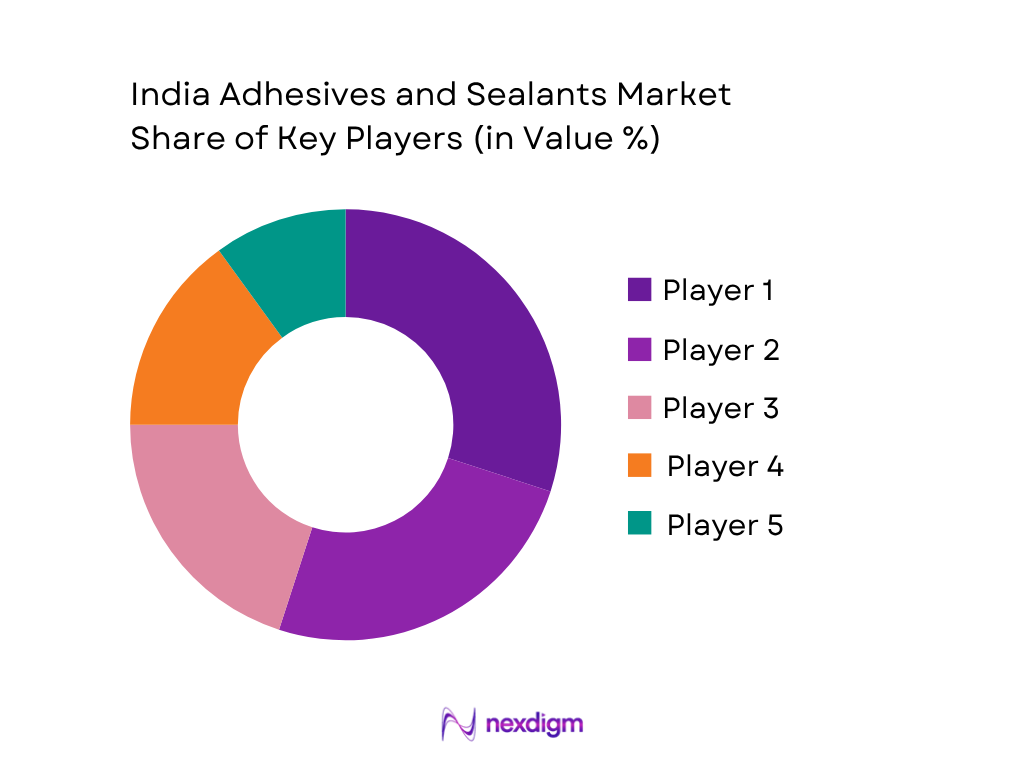
India Adhesives and Sealants Market Analysis
Growth Drivers
Expansion of Automotive Manufacturing
India’s expanding automotive production base is strengthening demand for structural adhesives, sealants, bonding compounds and specialty formulations used in vehicle assembly, interiors, glazing, electronics and lightweight components. India recorded 30,610,778 units of passenger vehicles, commercial vehicles, three-wheelers, two-wheelers and quadricycles produced during calendar 2024, according to industry production data. Passenger-vehicle production reached 6,014,691 units during FY2024-25, while two-wheeler production reached 23,883,857 units, demonstrating the scale of manufacturing activity relevant to adhesive-intensive vehicle applications. World Bank data records India’s 2024 GDP at USD 3.91 trillion, with real GDP growth of 6.5. The country’s industrial expansion is supporting additional vehicle assembly capacity, component manufacturing and supplier development. Adhesives are increasingly used where manufacturers require lightweight joining, vibration resistance, sealing and improved assembly efficiency. Applications extend across body components, windshields, interior assemblies, electronic modules, lighting systems and battery-related components. The shift toward electric and electronically integrated vehicles further increases the importance of specialized bonding and thermal-management materials. This creates opportunities for polyurethane, epoxy, acrylic, silicone, cyanoacrylate, hot-melt and anaerobic adhesive technologies. Rising vehicle production, increasing component complexity and continued manufacturing investment therefore provide a broad application base for India’s adhesives and sealants market.
Growth of Food Processing and Packaging Manufacturing
Expansion of India’s organized food-processing and packaging ecosystem is supporting recurring consumption of adhesives used in cartons, corrugated packaging, labels, flexible laminates, pouches and other converted packaging formats. Government data shows that the food-processing sector generated ₹2.24 lakh crore of GVA during 2023-24, while processed-food exports were valued at USD 10,881.8 million during the same period. The sector accounted for 12.41 of employment in India’s registered or organized manufacturing sector, demonstrating its industrial significance. India’s wider economy recorded USD 3.91 trillion of GDP and 6.5 real GDP growth in 2024, supporting expansion in consumer-oriented manufacturing. Packaging-intensive food categories require adhesives for primary, secondary and tertiary packaging, while converters increasingly need formulations compatible with high-speed automated production. Demand is developing across flexible packaging, folding cartons, corrugated cases, labels and multilayer structures. The expansion of organized retail and packaged-food distribution further increases the need for reliable packaging integrity during storage and transportation. Food-processing infrastructure and export-oriented production also require packaging systems capable of meeting demanding performance and safety specifications. These developments create opportunities for water-based, hot-melt, pressure-sensitive and specialty adhesive technologies designed for packaging substrates and high-throughput converting operations.
Market Challenges
Exposure to Raw-Material and Imported Chemical Supply Conditions
India’s adhesives and sealants manufacturers remain exposed to fluctuations in the availability and international supply conditions of petrochemical derivatives, polymers, solvents, resins, additives and specialty chemicals. Adhesive formulations frequently depend on multiple upstream chemical inputs, making production continuity sensitive to disruptions across international supply chains. World Bank data records India’s 2024 GDP at USD 3.91 trillion, real GDP growth of 6.5, and consumer-price inflation of 5.0, demonstrating a large but continuously evolving industrial economy. Currency movements can also influence the domestic procurement economics of imported specialty chemicals and intermediates. The challenge is particularly important for suppliers serving automotive, packaging, construction and industrial customers because these industries generally require consistent formulation performance and uninterrupted material availability. Manufacturers may consequently need diversified supplier bases, strategic inventories and alternative raw-material qualification programs. Local sourcing can reduce exposure to international logistics disruptions, but substituting imported specialty ingredients requires technical validation and customer approval. Differences in resin chemistry, viscosity, curing behavior and substrate compatibility can affect final-product performance. Larger producers may have greater flexibility to maintain inventories and qualify alternative suppliers, while smaller manufacturers can face greater working-capital and technical constraints. Strengthening domestic chemical supply chains and developing validated alternative formulations can therefore become important competitive priorities.
Regulatory and Environmental Compliance Pressure
Environmental and regulatory requirements are creating additional formulation and manufacturing challenges for India’s adhesives and sealants industry, particularly for products containing solvents, volatile organic compounds or chemicals requiring controlled handling, labeling and waste management. Manufacturers increasingly need to balance bonding performance with emission reduction, workplace safety and environmental requirements. India’s economic scale makes this transition significant: World Bank data records USD 3.91 trillion of GDP in 2024, while government infrastructure spending is supporting construction and industrial activity. The Union Budget allocated ₹11,11,111 crore in capital expenditure for FY2024-25, equivalent to 3.4 of GDP. Infrastructure expansion creates substantial demand for bonding and sealing products but also increases the importance of compliance with project specifications and applicable environmental requirements. Manufacturers may therefore need to expand water-based, reactive, hot-melt and other lower-emission product lines while maintaining mechanical strength, durability and substrate compatibility. Compliance can require additional testing, documentation, quality controls and customer approvals. Reformulation may also require investment in laboratory capabilities, process optimization and specialized technical personnel. Smaller producers can face relatively greater difficulty absorbing these requirements. At the same time, the transition creates opportunities for manufacturers with established low-emission technologies and strong technical support capabilities to address customers seeking compliant alternatives without compromising application performance.
Market Opportunities
Increasing Infrastructure and Construction Activity
India’s infrastructure investment pipeline creates opportunities for adhesives and sealants across flooring, roofing, insulation, glazing, façade systems, waterproofing, precast components, construction joints and specialty installation applications. The Union Budget allocated ₹11,11,111 crore in capital expenditure for FY2024-25, while the National Infrastructure Pipeline covered more than 9,766 projects across 37 infrastructure sub-sectors. These figures demonstrate the breadth of construction and infrastructure activity relevant to adhesive and sealant consumption. World Bank data records India’s 2024 GDP at USD 3.91 trillion and real GDP growth of 6.5, providing a substantial economic base for infrastructure development. As construction techniques become more specialized, adhesive and sealant systems can complement conventional mechanical fastening in applications requiring flexibility, waterproofing, vibration resistance or improved surface finishing. Opportunities span residential buildings, commercial properties, industrial facilities, transport infrastructure and public projects. Product requirements vary substantially by substrate and application, creating demand for polyurethane sealants, silicone sealants, epoxy systems, construction adhesives and specialty bonding solutions. Suppliers capable of providing application-specific formulations, technical assistance and reliable project supply can address increasingly complex construction requirements. The combination of infrastructure investment, expanding construction activity and increasing specification requirements creates scope for higher-value adhesive and sealant solutions.
Expansion of Value-Added Food and Processed-Food Applications
The development of value-added food manufacturing presents an opportunity for adhesives and sealants suppliers because processed foods require increasingly sophisticated packaging systems for protection, transportation, shelf-life management and product presentation. Government data records ₹2.24 lakh crore of GVA for India’s food-processing sector during 2023-24 and USD 10,881.8 million in processed-food exports. APEDA reported agri-food exports of USD 46.44 billion in FY2024, with processed food accounting for 23.4 of agri-food exports. These figures demonstrate the scale of agricultural value addition and export-oriented food manufacturing relevant to packaging-adhesive consumption. Opportunities extend across corrugated cases, folding cartons, flexible packaging, labels, laminates and specialty food-packaging structures. Adhesive suppliers can develop formulations compatible with higher converting speeds, improved bond integrity and recyclable or reduced-material packaging structures. Packaging manufacturers also require solutions that provide dependable adhesion across paper, films, foil and polymer substrates while meeting applicable food-contact requirements. India’s 6.5 real GDP growth in 2024 provides a broad economic foundation for continued consumer-goods and food-manufacturing activity. Suppliers with food-contact expertise, consistent quality systems and application-specific technical support can therefore participate in the development of higher-value packaging and processed-food manufacturing applications.
Future Outlook
The India adhesives and sealants market is positioned for continued expansion as packaging conversion, construction, automotive manufacturing, electronics, furniture and industrial production increase their use of engineered bonding systems. The technology mix is expected to shift toward lower-emission, water-based, hot-melt and reactive formulations where performance and environmental requirements support substitution. Automotive lightweighting and electric-vehicle production can increase demand for structural bonding and battery-related applications, while packaging continues to create volume demand. The market’s development will also depend on domestic specialty-chemical production, application engineering, regulatory compliance and the ability of manufacturers to localize higher-performance formulations.
Major Players
- Pidilite Industries Limited
- Henkel Adhesives Technologies India Private Limited
- Sika India Private Limited
- H.B. Fuller India Adhesives Private Limited
- 3M India Limited
- Arkema / Bostik India Private Limited
- Dow India
- BASF India Limited
- Ashland India Private Limited
- Jubilant Industries Limited
- Astral Adhesives
- Anabond Limited
- HP Adhesives Limited
- MAPEI India Private Limited
- Soudal India Private Limited
Key Target Audience
- Adhesive and sealant manufacturers
- Packaging converters and FMCG packaging companies
- Construction chemical and building-material manufacturers
- Automotive and EV manufacturers and component suppliers
- Electronics and electrical manufacturers
- Investments and venture capitalist firms
- Government and regulatory bodies (Bureau of Indian Standards, Central Pollution Control Board, Ministry of Chemicals and Fertilizers)
- Industrial chemical distributors and specialty-chemical suppliers
Research Methodology
Step 1: Identification of Key Variables
The initial phase involves constructing an ecosystem map covering raw-material suppliers, adhesive and sealant manufacturers, distributors, OEMs and major end-use industries. The research evaluates resin types, formulation technologies, application areas, production capacity, import dependence and distribution structures. Particular attention is given to packaging, construction, automotive, woodworking, footwear, electronics and healthcare applications.
Step 2: Market Analysis and Construction
Historical market data is compiled and analyzed across value, volume, technology, product type, application and geography. The analysis evaluates water-based, solvent-based, hot-melt and reactive systems alongside adhesive and sealant product categories. Demand indicators from packaging, construction, automotive, manufacturing and industrial production are incorporated to establish the market structure.
Step 3: Hypothesis Validation and Expert Consultation
Market hypotheses are validated through structured discussions with adhesive formulators, raw-material suppliers, distributors, packaging converters, construction-chemical manufacturers and industrial users. These consultations examine purchasing patterns, product specifications, technology adoption, application requirements and competitive positioning. The resulting insights are used to validate the quantitative market framework.
Step 4: Research Synthesis and Final Output
The final stage integrates secondary research, company disclosures, industry data and expert inputs into a consolidated India adhesives and sealants market model. Segment-level findings are cross-checked against reported company activity, application demand and available trade information. The output is then structured around market size, segmentation, competition, growth drivers, challenges and future opportunities.

- Executive Summary
- Research Methodology (Market Definition and Scope, India Adhesives and Sealants Market Classification, Adhesive and Sealant Product Mapping, Resin-Level Assessment, Technology-Level Assessment, Application-Level Demand Analysis, End-Use Industry Assessment, Production Capacity Mapping, Domestic Manufacturing Assessment, Import and Export Trade Analysis, Raw Material Supply Assessment, Demand-Side Assessment, Supply-Side Assessment, Top-Down Market Sizing, Bottom-Up Market Sizing, Primary Industry Interviews, Data Triangulation, Forecasting Framework, Market Share Validation, Limitations and Future Conclusions)

- Definition and Scope
- India Adhesives and Sealants Industry Evolution and Development of Domestic Adhesive Manufacturing, Formulation Technology and Industrial Application Infrastructure
- Adhesives and Sealants Value Chain Analysis
- Adhesives and Sealants Supply Chain Analysis
- Resin Manufacturers, Chemical Feedstock Suppliers, Adhesive Formulators, Sealant Manufacturers, Distributors, Industrial OEMs, Construction Material Manufacturers, Packaging Converters, End-Use Industries
- Adhesive Integration Across Packaging, Building and Construction, Automotive, Transportation, Woodworking and Joinery, Footwear and Leather, Electronics, Healthcare and Consumer Applications
- Sealant Integration Across Building and Construction, Automotive, Infrastructure, Electronics, Glass and Fenestration, Industrial Assembly and General Engineering Applications

- Growth Drivers (Expansion of Packaging and FMCG Manufacturing, Infrastructure and Construction Development, Automotive and EV Manufacturing Expansion, Growth of E-Commerce and Corrugated Packaging, Expansion of Electronics and Electrical Manufacturing, Furniture and Modular Construction Adoption, Rising Industrial Automation, Increasing Demand for High-Performance Bonding Systems)
- Market Challenges (Volatility in Petrochemical Feedstock Prices, Import Dependency for Specialty Chemicals and Monomers, Stringent VOC and Environmental Compliance Requirements, Fragmented Regional Manufacturing Base, Technology and Formulation Capability Gaps, Supply Chain Disruptions, Performance Limitations of Low-Cost Formulations, Skilled Application and Technical-Service Requirements)
- Market Opportunities (Water-Borne and Low-VOC Adhesive Expansion, High-Performance Automotive and EV Bonding, Electronics and Semiconductor Adhesive Applications, Sustainable Packaging Adhesives, Bio-Based Adhesive Formulations, Construction Sealant and Structural Bonding Expansion, Renewable Energy Adhesive Applications, Localization of Specialty Resin and Adhesive Production)
- Market Trends (Shift Toward Water-Borne Adhesives, Low-VOC Formulation Adoption, Hot-Melt Adhesive Expansion, Reactive Adhesive Technology Development, Silicone and MS Polymer Sealant Adoption, Lightweight Automotive Bonding, Sustainable Packaging Solutions, High-Performance Electronics Bonding, Bio-Based Adhesive Development, Digital and Automated Adhesive Dispensing)
- Government Regulations and Standards (Bureau of Indian Standards Adhesive Standards, Central Pollution Control Board VOC and Emission Requirements, Environmental Protection Regulations, Chemical Management Requirements, Bureau of Indian Standards Construction Standards, Automotive Component Standards, Packaging and Food-Contact Requirements, Hazardous Chemical Handling Regulations, Product Safety and Labeling Requirements)
- SWOT Analysis
- Porter’s Five Forces Analysis
- PESTLE Analysis
- Stakeholder Ecosystem
- Competition Ecosystem

- By Market Value (200-2025)
- By Market Volume (2020-2025)
- By Adhesives Consumption Volume (2020-2025)
- By Sealants Consumption Volume (2020-2025)
- By Domestic Production Volume (2020-2025)
- By Import Volume (2020-2025)
- By Export Volume (2020-2025)
- By Average Selling Price (2020-2025)

- By Adhesives Resin Type (In Value %)
Polyurethane Adhesives
Epoxy Adhesives
Acrylic Adhesives
Silicone Adhesives
Cyanoacrylate Adhesives
VAE / EVA Adhesives
Polyvinyl Acetate Adhesives
Other Adhesive Resins - By Adhesives Technology (In Value %)
Water-Borne Adhesives
Solvent-Borne Adhesives
Reactive Adhesives
Hot-Melt Adhesives
UV-Cured Adhesives
Pressure-Sensitive Adhesives - By Sealants Resin Type (In Value %)
Silicone Sealants
Polyurethane Sealants
Acrylic Sealants
Epoxy Sealants
Polysulfide Sealants
MS Polymer Sealants
Other Sealant Resins - By Application Type (In Value %)
Paper and Packaging
Building and Construction
Woodworking and Joinery
Automotive and Transportation
Footwear and Leather
Electronics and Electrical
Healthcare and Medical
General Industrial Assembly
Consumer and Household Applications - By End-Use Industry (In Value %)
Packaging Industry
Construction Industry
Automotive Industry
Furniture and Woodworking Industry
Footwear and Leather Industry
Electronics and Electrical Industry
Healthcare Industry
Aerospace and Defense Industry
Renewable Energy Industry
Industrial Manufacturing Industry - By Distribution Channel (In Value %)
Direct Industrial Sales
Authorized Distributors
Specialty Chemical Distributors
Construction Material Dealers
Hardware and Building Material Retailers
Modern Trade and Retail Chains
E-Commerce and Online Industrial Platforms
Dealer and Distributor Networks - By Region (In Value %)
West India
North India
South India
East India
Central India

- Market Share of Major Players (By India Revenue, Adhesives Sales Volume, Sealants Sales Volume, Resin Portfolio, Technology Portfolio, End-Use Industry Exposure, Production Capacity, Distribution Network Coverage, Regional Presence, Industrial Customer Coverage, Product Certification Coverage, R&D and Application-Laboratory Capability)
- Cross Comparison Parameters (Adhesives and Sealants Revenue, Adhesive Resin Portfolio Breadth, Sealant Resin Portfolio Breadth, Production and Formulation Capacity, Technology Portfolio Coverage, Packaging and Construction Application Coverage, Automotive and Electronics Application Capability, Distribution Network Reach)
- SWOT Analysis of Major Players
- Competitive Positioning Matrix
- Detailed Profiles of Major Companies
Pidilite Industries Limited
Henkel Adhesives Technologies India Private Limited
Sika India Private Limited
H.B. Fuller India Adhesives Private Limited
3M India Limited
Arkema / Bostik India Private Limited
Dow Chemical International Private Limited
BASF India Limited
Ashland India Private Limited
Jubilant Agri and Consumer Products Limited
Astral Adhesives
Anabond Limited
HP Adhesives Limited
MAPEI India Private Limited
Soudal India Private Limited

- Packaging Converter Adhesive Procurement Assessment
- Corrugated Box Manufacturer Adhesive Requirement Analysis
- Flexible Packaging Adhesive Application Assessment
- Building and Construction Adhesive Procurement Analysis
- Tile and Flooring Adhesive Requirement Assessment
- Automotive OEM Bonding and Sealant Requirement Analysis
- Automotive Component Manufacturer Adhesive Assessment
- EV Battery and Electronics Bonding Requirement Analysis
- Furniture and Woodworking Adhesive Procurement Assessment

- By Market Value (2026-2035)
- By Market Volume (2026-2035)
- By Adhesives Consumption Volume (2026-2035)
- By Sealants Consumption Volume (2026-2035)
- By Adhesives Resin Type (2026-2035)
- By Adhesives Technology (2026-2035)
- By Sealants Resin Type (2026-2035)
- By Application Type (2026-2035)
- By End-Use Industry (2026-2035)
- By Region (2026-2035)


 Request a Sample
 Ask for Customization
 Get a Quote
 Enquire Now