
 Download PDF
Market Overview
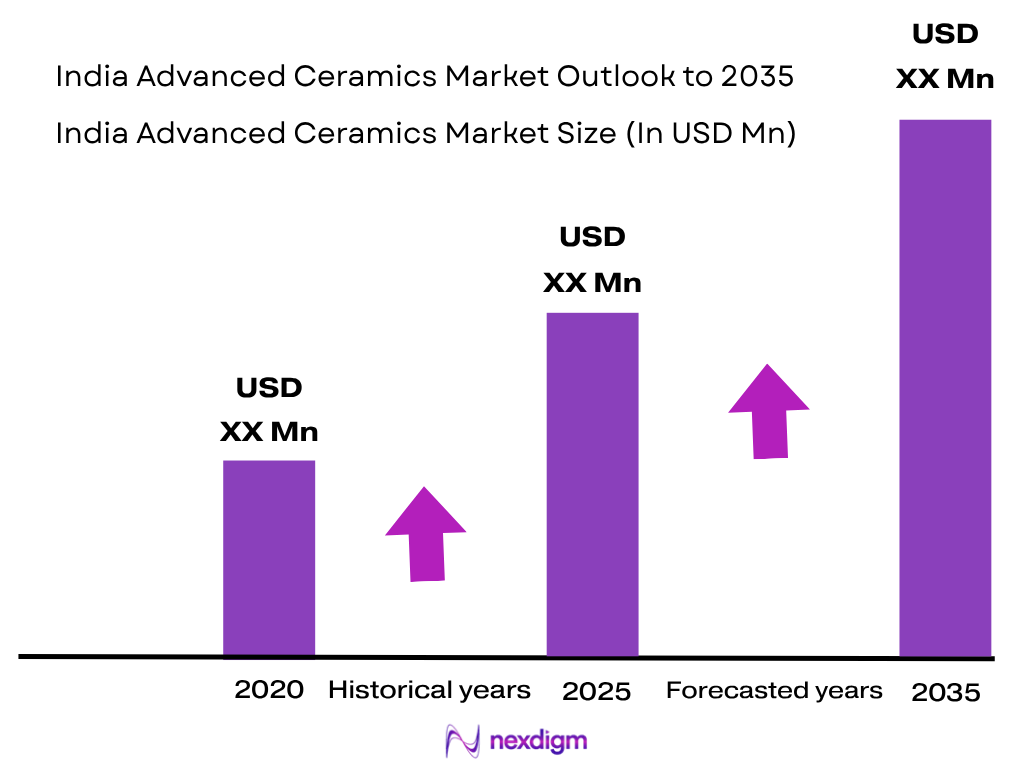
The India Advanced Ceramics Market is estimated at ~USD ~ billion in 2024, with the market supported by accelerating electronics manufacturing, semiconductor localization, automotive electrification, aerospace and defence manufacturing, medical-device production, and industrial automation. India’s electronics-goods production reached ₹9.52 lakh crore in FY2023-24, compared with ₹8.25 lakh crore in FY2022-23, creating a larger addressable base for ceramic substrates, insulators, packages, thermal-management components and precision ceramic parts. The report therefore uses a bottom-up assessment of material, product and application demand rather than treating conventional ceramics as advanced ceramics.
India’s advanced-ceramics demand is concentrated around Bengaluru, Chennai, Hyderabad, Pune, Mumbai-Pune, Ahmedabad-Sanand and the National Capital Region, reflecting the geographic concentration of electronics, automotive, aerospace, defence, medical-device and industrial manufacturing. Semiconductor activity is particularly relevant to Gujarat: government-approved semiconductor projects include facilities in Dholera and Sanand, while the broader approved projects cover automotive, EV, consumer electronics, telecom and power applications. Bengaluru also has an established materials-research and aerospace ecosystem, including active ceramic-development programs involving zirconia-based materials.
Market Segmentation
By Material Type
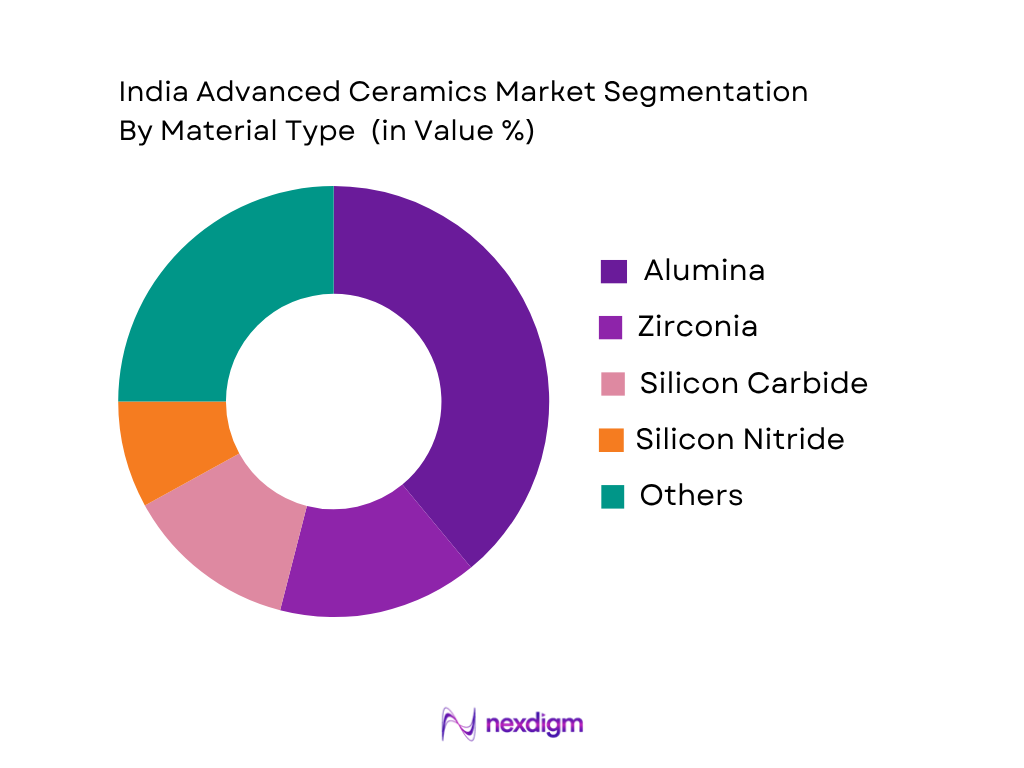
The India Advanced Ceramics Market is segmented by material type into alumina, zirconia, silicon carbide, silicon nitride, aluminum nitride, titanates, ferrites and other advanced ceramic materials. Alumina is expected to represent the dominant sub-segment, supported by its broad applicability across electrical insulation, electronic components, wear-resistant parts, industrial components, refractories and high-temperature applications. India already possesses established industrial familiarity with alumina products, while government technology-development work has specifically identified alumina ceramics for electronic and related high-technology applications as an area where imported products remain relevant. Zirconia is gaining importance where fracture toughness, wear resistance and biocompatibility are important, particularly in medical, dental and precision applications. Silicon carbide and silicon nitride are positioned toward higher-performance applications requiring thermal stability, mechanical strength and wear resistance. Aluminum nitride is particularly relevant to electronic thermal management because of its thermal conductivity and electrical insulation characteristics. Overall, material selection increasingly depends on the required combination of thermal, mechanical, electrical, chemical and dimensional performance rather than simply material availability.
By End-Use Industry
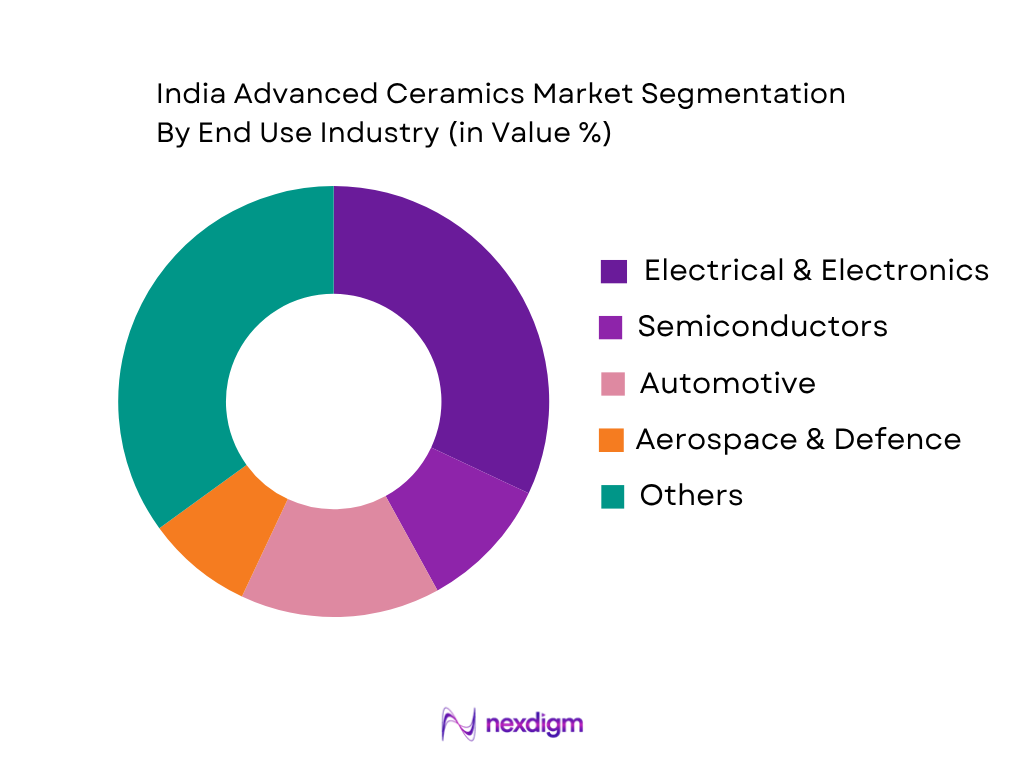
The India Advanced Ceramics Market is segmented by end-use industry into electrical and electronics, semiconductors, automotive, aerospace and defence, medical and healthcare, energy and power, telecommunications, industrial machinery, chemical processing, and environmental applications. Electrical and electronics is expected to remain the leading segment, because ceramic materials are integral to insulation, electronic substrates, packages, dielectric components, sensors, thermal-management systems and high-frequency applications. India’s electronics production reached ₹9.52 lakh crore in FY2023-24, up from ₹8.25 lakh crore in FY2022-23, while electronic-component production reached ₹86,929 crore in FY2023-24. Semiconductor localization provides an additional demand channel: government-backed projects include a 50,000-wafer-starts-per-month semiconductor fab and multiple packaging facilities, increasing the relevance of advanced ceramic substrates, packages, process components and thermal-management materials. Automotive is another significant application base, with India producing 50.61 lakh passenger vehicles and 23.884 million two-wheelers in FY2024-25. These end markets collectively broaden demand beyond conventional ceramic applications.
Competitive Landscape
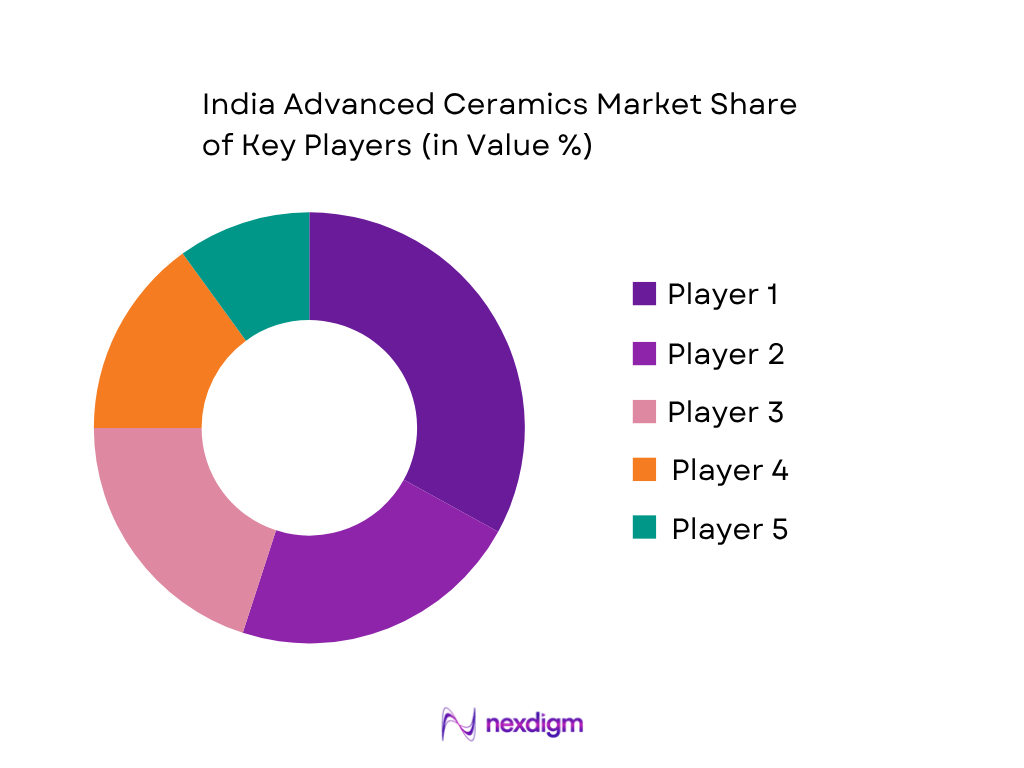
The India Advanced Ceramics Market combines established international advanced-material manufacturers with Indian ceramic, refractory, electronic-material and precision-component producers. Competition is increasingly shaped by material purity, processing precision, component qualification, application engineering, domestic manufacturing capability and technology localization. The competitive environment is also being influenced by semiconductor and electronics investment: the government has approved semiconductor projects covering fabrication, packaging and compound-semiconductor technologies, while the broader electronics ecosystem has expanded substantially.
| Company | Establishment | Headquarters | Key Material Focus | Product/Component Focus | Major Application Exposure | India Capability | Technology Positioning | Competitive Strength |
| CeramTec | 1903 | Plochingen, Germany | ~ | ~ | ~ | ~ | ~ | ~ |
| CoorsTek | 1910 | Golden, Colorado, USA | ~ | ~ | ~ | ~ | ~ | ~ |
| KYOCERA Corporation | 1959 | Kyoto, Japan | ~ | ~ | ~ | ~ | ~ | ~ |
| Morgan Advanced Materials | 1856 | Windsor, UK | ~ | ~ | ~ | ~ | ~ | ~ |
| CUMI | 1954 | Chennai, India | ~ | ~ | ~ | ~ | ~ | ~ |
India Advanced Ceramics Market Analysis
Growth Drivers
Electronics Manufacturing Expansion
India’s expanding electronics manufacturing base is strengthening the addressable demand for advanced ceramics used in substrates, insulators, semiconductor packaging, heat-management components, connectors and high-frequency applications. Government data shows electronics-goods production reached approximately ₹12 lakh crore in FY2024-25, while electronics exports reached approximately ₹3.3 lakh crore, demonstrating a substantially larger domestic manufacturing and export ecosystem. The semiconductor ecosystem is also becoming more fabrication-oriented: four semiconductor manufacturing units had been approved under the national programme during 2024, including a 50,000 wafer-starts-per-month fab in Gujarat and packaging facilities with capacities of 48 million units per day and 15.07 million units per day. These applications require ceramic materials such as alumina, aluminum nitride, silicon carbide and advanced ceramic packages for electrical insulation, thermal management and high-reliability operation. The subsequent approval of additional projects reinforces the manufacturing pipeline. Consequently, the growth of domestic electronics and semiconductor production provides a structural demand base for advanced ceramic components, particularly where conventional polymers and metals cannot provide the required dielectric strength, thermal conductivity, dimensional stability or high-temperature performance.
Semiconductor Manufacturing Development
India’s semiconductor manufacturing build-out is creating one of the strongest emerging demand channels for advanced ceramics because fabrication, assembly, testing and packaging require materials capable of maintaining performance under high temperatures, electrical loads and chemically demanding processes. Government data records ₹76,000 crore as the outlay of the Semicon India Programme, while projects approved during 2024 included a ₹91,000 crore semiconductor fab with planned capacity of 50,000 wafer starts per month, an Assam facility designed for 48 million units per day, and a specialized semiconductor facility with capacity of approximately 15 million units per day. A further project approved in September 2024 included capacity exceeding 6.33 million chips per day. Advanced ceramics are relevant across this ecosystem through wafer-processing components, ceramic packages, substrates, heater components, insulating parts and high-purity process hardware. The combination of semiconductor fabrication and outsourced assembly and testing also broadens the potential application base beyond conventional electronics. As domestic semiconductor operations become more integrated, demand can increasingly shift toward higher-purity alumina, aluminum nitride, silicon carbide and other engineered ceramic grades, creating opportunities for domestic material suppliers and precision component manufacturers.
Market Challenges
Dependence on Imported Ceramic Powders
India’s advanced ceramics ecosystem faces a structural challenge from dependence on internationally established suppliers for specialized powders, additives, binders and high-purity feedstocks. This constraint becomes more significant as domestic industries move toward semiconductor, medical, aerospace and high-temperature applications where material purity, particle-size distribution and formulation consistency directly influence component performance. The scale of India’s broader high-technology import dependence can be seen in medical devices: government data records medical-device imports of ₹1,34,701 crore in FY2023-24 compared with exports of ₹41,030 crore, indicating the continuing reliance of advanced manufacturing and healthcare systems on imported technology-intensive products. The government subsequently reported medical-device imports of ₹1,37,088 crore in FY2024-25, while exports reached ₹42,360 crore. Although these figures cover medical devices rather than ceramic powders specifically, they demonstrate the broader import-dependence environment in which advanced ceramic component manufacturing operates. For ceramic producers, imported powders and specialized inputs can lengthen qualification cycles, expose manufacturers to international logistics disruptions and restrict rapid customization for domestic semiconductor, aerospace and medical applications.
Limited Domestic Precision Processing Capability
Advanced ceramics require substantially tighter processing control than conventional ceramics because applications increasingly demand controlled porosity, surface finish, dimensional accuracy, thermal properties and electrical characteristics. India’s expanding high-technology manufacturing base increases the requirement for such capabilities, but qualification-intensive sectors can still face constraints in specialized machining, sintering, metallization, coating and inspection. The semiconductor programme illustrates the scale and technical complexity of the emerging ecosystem: projects approved under the national programme include a 50,000 wafer-starts-per-month fab, packaging capacity of 48 million units per day, and specialized-chip capacity of approximately 15 million units per day. These facilities create requirements for precision ceramic components that must meet demanding thermal, electrical and dimensional specifications. At the same time, defence manufacturing reached ₹1,26,887 crore in FY2023-24 and increased to ₹1,50,590 crore in FY2024-25, expanding another high-reliability application base for technical ceramics. The challenge is therefore not simply production capacity; it is the availability of qualified domestic processes capable of consistently producing semiconductor-, aerospace- and defence-grade components with repeatable properties and traceable quality.
Market Opportunities
Semiconductor Ceramic Components
India’s semiconductor expansion provides a clear opportunity to establish domestic production of ceramic substrates, packages, process components, insulators, thermal-management parts and precision ceramic fixtures. The opportunity is supported by concrete industrial commitments rather than future demand assumptions. The national semiconductor programme had approved projects involving approximately ₹1.6 lakh crore of investment by 2026, with 10 projects covering fabs and packaging facilities; commercial production had already commenced at 2 plants. Individual approved facilities include a 50,000 wafer-starts-per-month fab, an Assam packaging facility designed for 48 million units per day, and a specialized facility with capacity of approximately 15.07 million units per day. In 2024, the government also approved a semiconductor packaging project at Sanand with capacity exceeding 6.33 million chips per day. Such manufacturing infrastructure creates demand for materials offering electrical insulation, thermal conductivity, chemical resistance and dimensional stability. This makes alumina, aluminum nitride, silicon carbide and related high-purity ceramics strategically relevant. Domestic suppliers that can achieve semiconductor-grade purity, precision machining and reliable batch consistency can therefore participate in a growing local semiconductor supply chain while reducing dependence on imported ceramic components and specialized process materials.
Aerospace Ceramic Components
India’s accelerating indigenous aerospace and defence manufacturing creates an opportunity for advanced ceramics in thermal protection, electrical insulation, radomes, armour systems, engine-related components and high-temperature applications. Government data shows indigenous defence production reached ₹1,26,887 crore in FY2023-24, while FY2024-25 production subsequently reached ₹1,50,590 crore. Defence exports also reached ₹23,622 crore in FY2024-25, demonstrating increasing integration of Indian defence manufacturing with external markets. The aerospace opportunity is reinforced by the establishment of a private-sector C-295 aircraft final assembly line in Vadodara, with 56 aircraft planned under the programme, including 40 to be produced domestically. These developments increase the need for locally qualified materials capable of operating under high temperature, mechanical stress, electromagnetic exposure and demanding environmental conditions. Advanced ceramics can address applications where conventional metals or polymers face limitations in thermal stability, dielectric performance or wear resistance. Suppliers with domestic precision machining, controlled sintering, ceramic matrix composite capabilities and aerospace-grade testing can therefore target defence platforms, aircraft systems and high-temperature propulsion-related applications.
Future Outlook
The India Advanced Ceramics Market is positioned for structural expansion as advanced materials become increasingly important across semiconductor manufacturing, electronics, EV power electronics, aerospace, defence, healthcare and industrial automation. The strongest opportunity is expected to shift from conventional ceramic consumption toward application-specific, high-purity and precision-engineered components. Semiconductor localization is particularly important because government-approved projects are creating domestic demand for fabrication, packaging and associated materials. The development of domestic powder processing, precision machining and qualification capabilities should progressively strengthen India’s ability to participate in higher-value advanced-ceramic applications.
Major Players
- CeramTec
- CoorsTek
- KYOCERA Corporation
- Morgan Advanced Materials
- Saint-Gobain Performance Ceramics & Refractories
- 3M
- Murata Manufacturing
- AGC Inc.
- Niterra Co., Ltd.
- Corning Incorporated
- CUMI – Carborundum Universal
- Tata Advanced Materials
- Jyoti Ceramic
- Anoop Ceramics
- IFGL Refractories
Key Target Audience
- Advanced Ceramics Manufacturers and Component Producers
- Semiconductor and Electronic Component Manufacturers
- Automotive and EV Component Manufacturers
- Aerospace and Defence Manufacturers and Procurement Organizations
- Medical Device and Dental Component Manufacturers
- Industrial Machinery and High-Temperature Equipment Manufacturers
- Investments and Venture Capitalist Firms
- Government and Regulatory Bodies (Ministry of Electronics and Information Technology, India Semiconductor Mission, Department of Science and Technology, Department for Promotion of Industry and Internal Trade, Ministry of Defence)
Research Methodology
Step 1: Identification of Key Variables
The initial phase involves defining the India Advanced Ceramics Market ecosystem across raw-material suppliers, powder processors, ceramic manufacturers, precision-component producers and end users. Variables include material purity, product form, manufacturing process, application, production capability, imports, exports and end-use demand.
Step 2: Market Analysis and Construction
Historical market information is compiled through bottom-up assessment of material consumption, domestic production, imports, exports, application demand and company-level activity. Demand from electronics, semiconductors, automotive, aerospace, medical and industrial applications is separately evaluated to prevent conventional ceramics from being incorrectly included.
Step 3: Hypothesis Validation and Expert Consultation
Market hypotheses are validated through structured discussions with ceramic manufacturers, material suppliers, component producers, OEM procurement teams and application specialists. Particular attention is given to qualification requirements, imported components, material specifications, processing capabilities and customer adoption barriers.
Step 4: Research Synthesis and Final Output
The final stage triangulates company-level intelligence with government statistics, trade data, manufacturing indicators and application-level demand. The resulting model reconciles material-level consumption with product-level and end-use demand, enabling a consistent market valuation and segmentation framework.

- Executive Summary
- Research Methodology (Market Definitions and Scope, Advanced Ceramics Classification, Market Sizing Framework, Top-Down Market Estimation, Bottom-Up Market Estimation, Material-Level Demand Mapping, Application-Level Demand Assessment, Domestic Production Assessment, Import-Export Reconciliation, Supply-Side Capacity Mapping, Demand-Side Assessment, Primary Industry Interviews, Data Triangulation, Forecasting Framework, Assumptions and Limitations)

- Definition and Scope
- Advanced Ceramics Industry Evolution and Technology Development
- India Advanced Ceramics Ecosystem Mapping
- Advanced Ceramics Value Chain Analysis
- Advanced Ceramics Supply Chain Analysis
- Domestic Manufacturing vs Imported Advanced Ceramic Components

- Growth Drivers (Electronics Manufacturing Expansion, Semiconductor Manufacturing Development, Aerospace and Defence Localization, EV Power Electronics, Medical Device Manufacturing, Industrial Automation, Telecommunications Infrastructure, High-Temperature Industrial Applications)
- Market Challenges (Dependence on Imported Ceramic Powders, Limited Domestic Precision Processing Capability, High Technical Qualification Requirements, Imported Manufacturing Equipment, Technology Ownership Constraints, Skilled Workforce Gap, Long Qualification Cycles, Fragmented Domestic Manufacturing Base)
- Market Opportunities (Semiconductor Ceramic Components, EV and Power Electronics Substrates, Aerospace Ceramic Components, Advanced Bioceramics, Ceramic Matrix Composites, Ceramic Additive Manufacturing, High-Purity Alumina and Aluminum Nitride, Domestic Precision Machining, Defence Armour Ceramics)
- Market Trends (Miniaturization of Ceramic Components, High-Purity Materials, Ceramic Substrates for Power Electronics, Additive Manufacturing, Ceramic Matrix Composites, Advanced Bioceramics, Thermal Management Ceramics, Localized Semiconductor Supply Chains)
- Government Initiatives and Policy Environment (Semiconductor Mission, Electronics Component Manufacturing, Defence Indigenization, Aerospace Manufacturing, Medical Device Localization, R&D Incentives, Specialty Ceramics for Electronics)
- SWOT Analysis
- Porter’s Five Forces Analysis
- PESTLE Analysis

- By Market Value (2020-2025)
- By Production Volume (2020-2025)
- By Domestic Consumption Volume (2020-2025)
- By Domestic Production (2020-2025)
- By Imports (2020-2025)
- By Exports (2020-2025)
- By Average Realization (2020-2025)

- By Material Type (In Value %)
Alumina
Zirconia
Silicon Carbide
Silicon Nitride
Aluminum Nitride
Titanates
Ferrites
Zirconates
Other Advanced Ceramic Materials - By Product Form (In Value %)
Monolithic Ceramics
Ceramic Coatings
Ceramic Matrix Composites
Ceramic Powders
Ceramic Substrates
Ceramic Components
Ceramic Tubes and Rods
Ceramic Plates and Discs - By Product Category (In Value %)
Structural Ceramics
Electronic Ceramics
Electrical Ceramics
Bioceramics
Ceramic Matrix Composites
Ceramic Coatings
Refractory and High-Temperature Ceramics
Wear-Resistant Ceramics - By Manufacturing Process (In Value %)
Dry Pressing
Isostatic Pressing
Injection Moulding
Extrusion
Tape Casting
Slip Casting
Hot Pressing
Hot Isostatic Pressing
Spark Plasma Sintering
Additive Manufacturing - By End-Use Industry (In Value %)
Electrical and Electronics
Semiconductors
Automotive
Aerospace and Defence
Medical and Healthcare
Energy and Power
Telecommunications
Industrial Machinery
Chemical Processing
Environmental and Water Treatment - By Application (In Value %)
Electronic Substrates
Semiconductor Processing Components
Insulators and Dielectrics
Sensors and Actuators
Cutting and Wear Components
Engine and Turbine Components
Ballistic and Armour Components
Dental and Orthopedic Implants
Battery and Power Electronics Components
Heat Management Components

- Market Share of Major Players (By Material, Product Type, Application, End-Use Industry, Domestic Sales, Export Sales)
- Cross Comparison Parameters (Material Portfolio Breadth, Advanced Ceramic Production Capability, Powder-to-Component Integration, Precision Machining Capability, High-Purity Material Capability, Semiconductor Component Capability
- SWOT Analysis of Major Players
- Pricing and Cost Structure Analysis
- Detailed Profiles of Major Companies
CeramTec India
CoorsTek
KYOCERA Corporation
Morgan Advanced Materials
Saint-Gobain Performance Ceramics & Refractories
3M
Murata Manufacturing
AGC Inc.
Niterra Co., Ltd.
Corning Incorporated
CUMI – Carborundum Universal
Tata Advanced Materials
Jyoti Ceramic
Anoop Ceramics
IFGL Refractories

- Electronics and Semiconductor Demand Assessment
- Automotive Demand Assessment
- Aerospace and Defence Demand Assessment
- Medical and Healthcare Demand Assessment
- Energy and Power Demand Assessment
- Industrial Machinery Demand Assessment
- Telecommunications Demand Assessment
- End-User Procurement Assessment

- By Market Value (2026-2035)
- By Production Volume (2026-2035)
- By Domestic Consumption Volume (2026-2035)
- By Domestic Production (2026-2035)
- By Imports (2026-2035)
- By Exports (2026-2035)
- By Average Realization (2026-2035)


 Request a Sample
 Ask for Customization
 Get a Quote
 Enquire Now