
 Download PDF
 Download PDF
Market Overview
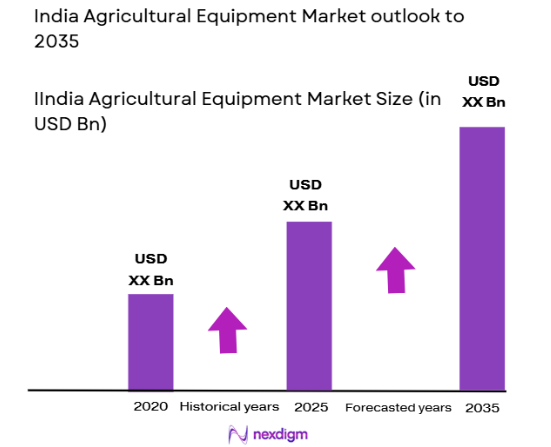
India agricultural equipment market reached USD ~ billion based on a recent historical assessment, supported by steady mechanization adoption across crop cultivation and post-harvest operations. Demand is driven by labor shortages, farm productivity requirements, and government-supported equipment financing and subsidy programs. Tractorization remains the core growth engine, while harvesting and precision implements expand usage intensity. Domestic manufacturing scale and dealer penetration further sustain equipment accessibility and replacement demand across diverse agro-climatic regions.
Northern and western agricultural belts including Punjab, Haryana, Uttar Pradesh, and Maharashtra dominate equipment adoption due to higher irrigation coverage, commercial crop intensity, and farm income levels. Southern states such as Karnataka and Tamil Nadu show strong mechanization linked to horticulture and plantation farming. Proximity to manufacturing clusters in Maharashtra, Gujarat, and Punjab supports distribution efficiency and service networks. These regions exhibit mature custom hiring ecosystems and cooperative procurement structures enabling sustained equipment utilization.
Market Segmentation
By Product Type
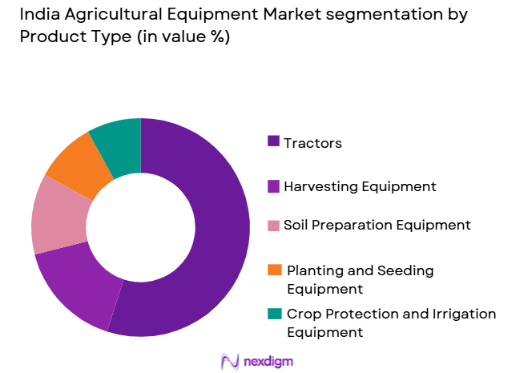
India Agricultural Equipment market is segmented by product type into tractors, harvesting equipment, soil preparation equipment, planting and seeding equipment, and crop protection and irrigation equipment. Recently, tractors have a dominant market share due to factors such as multi-purpose farm utility, extensive dealer financing availability, and strong domestic manufacturing presence. Tractors support ploughing, haulage, and mechanized operations across small and medium farms, improving asset utilization. Government subsidy structures and replacement demand cycles also favor tractors. High horsepower variants support commercial farming, while compact models suit fragmented landholdings, sustaining widespread adoption across agro-climatic zones.
By Power Output Range
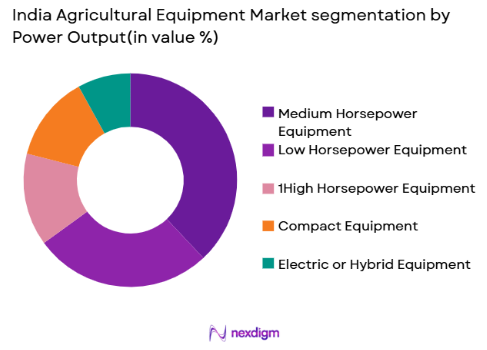
India Agricultural Equipment market is segmented by power output range into low horsepower equipment, medium horsepower equipment, high horsepower equipment, compact equipment, and electric or hybrid equipment. Recently, medium horsepower equipment has a dominant market share due to balanced cost-performance suitability for medium landholdings and diverse crop operations. These machines provide adequate traction, implement compatibility, and fuel efficiency for multi-season usage. Availability of financing schemes and aftermarket support enhances adoption. Medium horsepower equipment fits regional farm structures, enabling efficient ploughing, haulage, and mechanized cultivation without excessive capital burden for farmers.
Competitive Landscape
India agricultural equipment market is moderately consolidated, led by domestic manufacturers with extensive dealer networks and localized production capabilities. Large players influence technology adoption, financing access, and distribution scale, while regional firms compete in niche implements and specialized equipment. Strategic alliances, localization initiatives, and precision technology integration are strengthening competitive positioning across product categories.
| Company Name | Establishment Year | Headquarters | Technology Focus | Market Reach | Key Products | Revenue | Dealer Network Strength |
| Mahindra and Mahindra Farm Equipment | 1963 | Mumbai, India | ~ | ~ | ~ | ~ | ~ |
| TAFE Tractors and Farm Equipment | 1960 | Chennai, India | ~ | ~ | ~ | ~ | ~ |
| Escorts Kubota | 1944 | Faridabad, India | ~ | ~ | ~ | ~ | ~ |
| John Deere India | 1998 | Pune, India | ~ | ~ | ~ | ~ | ~ |
| CNH Industrial India | 1996 | Noida, India | ~ | ~ | ~ | ~ | ~ |
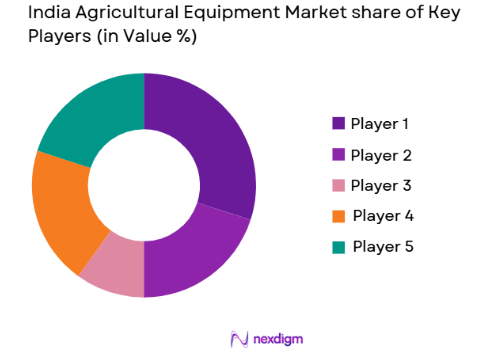
India Agricultural Equipment Market Analysis
Growth Drivers
Mechanization Demand from Labor Shortages and Productivity Pressure
Agricultural labor availability has steadily declined as rural workforce migration toward non-farm employment accelerates across developing regions. Farmers increasingly rely on machinery to maintain cultivation schedules, reduce dependency on seasonal labor, and stabilize operational costs. Mechanized operations improve field preparation speed, planting accuracy, and harvesting efficiency, enabling higher cropping intensity and yield consistency. Tractors and implements provide multi-functional capability across soil preparation, sowing, haulage, and residue management, increasing utilization rates. Labor substitution benefits are particularly significant in regions with rising wage levels and peak-season shortages. Mechanization also supports timely operations critical for climate-sensitive cropping cycles and water management. Commercial farming models further require scalable mechanized operations to manage larger cultivated areas efficiently. Productivity-linked government initiatives and farm mechanization schemes reinforce adoption by lowering acquisition barriers. Equipment rental and custom hiring centers extend mechanization access to smallholders lacking capital investment capacity. These combined factors structurally embed mechanization demand as a core growth engine across agricultural production systems.
Government Subsidy Programs and Rural Equipment Financing Expansion
Public agricultural modernization programs promote equipment adoption through capital subsidies, credit support, and mechanization incentives targeted at productivity improvement. Subsidy coverage reduces upfront acquisition cost, enabling farmers to transition from manual to mechanized operations. Rural financial institutions and specialized equipment financing schemes improve credit accessibility across small and medium farm segments. Interest subvention policies and priority sector lending norms encourage agricultural equipment purchases. State-level farm mechanization missions provide targeted incentives for tractors, harvesters, and precision implements. Financing availability also supports replacement demand cycles and technology upgrades among existing equipment users. Cooperative societies and farmer producer organizations facilitate group procurement and shared ownership models. Government-backed custom hiring centers enable community-level mechanization access without ownership burden. Policy alignment between agricultural productivity goals and mechanization adoption ensures sustained demand visibility. These institutional mechanisms collectively strengthen equipment affordability, distribution penetration, and long-term market expansion.
Market Challenges
Fragmented Landholdings Limiting Large Equipment Utilization
Agricultural land distribution is characterized by small and irregular farm plots, constraining efficient use of large mechanized equipment. Equipment maneuverability and operational efficiency decline in fragmented fields with boundary constraints and dispersed parcels. Farmers operating small holdings face difficulty achieving adequate utilization rates to justify capital investment in high-capacity machinery. Custom hiring services partially address access but cannot fully optimize logistics across scattered plots. Land fragmentation also reduces compatibility with high horsepower tractors and large harvesters designed for consolidated farming systems. Equipment manufacturers must adapt designs toward compact and modular formats, increasing development complexity. Economic returns from mechanization remain limited where scale economies cannot be realized. Infrastructure such as field roads and plot consolidation remains uneven, further constraining equipment movement. Fragmented land ownership structures also complicate cooperative mechanization initiatives. These structural land patterns represent a persistent constraint on large equipment penetration and productivity gains.
High Acquisition Cost and Financing Constraints for Smallholders
Agricultural equipment requires substantial upfront capital relative to average farm income levels, creating affordability barriers for small and marginal farmers. Even with subsidies, residual purchase cost and collateral requirements limit credit eligibility across low-income farm households. Seasonal income volatility and crop yield uncertainty elevate perceived repayment risk among lenders. Interest burden and repayment schedules may not align with agricultural cash flow cycles, discouraging equipment investment. Informal credit alternatives carry higher cost and financial risk. Smallholders also face additional expenses for maintenance, fuel, and operator training, increasing lifecycle ownership cost. Limited financial literacy and documentation capacity further constrain access to institutional financing. Equipment utilization may remain low on small farms, reducing economic justification for ownership. Custom hiring models provide partial mitigation but availability varies regionally. These financial barriers collectively slow mechanization diffusion across the largest farm segment.
Opportunities
Expansion of Precision and Smart Farming Equipment Adoption
Agricultural modernization increasingly emphasizes data-driven farm management using sensors, GPS guidance, and telematics-enabled machinery systems. Precision equipment enhances input efficiency, reduces waste, and improves yield consistency across diverse cropping conditions. Smart tractors and implements support automated steering, variable rate application, and real-time monitoring, improving operational accuracy. Integration with digital farm platforms enables predictive maintenance and performance optimization across equipment fleets. Government programs promoting climate-resilient and resource-efficient agriculture support precision technology uptake. Commercial farms and progressive farmers adopt advanced machinery to enhance profitability and sustainability compliance. Domestic manufacturers increasingly localize precision technology to reduce cost barriers. Service-based models and retrofit kits enable gradual adoption among existing equipment users. Digital agriculture ecosystems create demand for connected machinery capable of data integration. Precision farming equipment thus represents a high-value technology-driven growth avenue across mechanization markets.
Growth of Equipment Leasing and Custom Hiring Service Models
Agricultural equipment utilization remains seasonal, making ownership economically inefficient for many farmers with limited operational scale. Leasing and custom hiring services enable access to mechanization without capital investment burden, expanding equipment reach across smallholder segments. Shared machinery models improve asset utilization and operator efficiency through centralized management. Rural entrepreneurship initiatives and cooperative institutions increasingly operate equipment fleets for community use. Digital booking platforms enhance service accessibility, scheduling efficiency, and transparency in rental pricing. Government-supported hiring centers promote equitable mechanization access across regions with fragmented landholding patterns. Leasing models also facilitate technology diffusion by lowering adoption risk for new equipment categories. Manufacturers benefit from fleet sales and recurring service demand through rental operators. Financial institutions support leasing businesses with asset-backed financing structures. Expansion of organized equipment rental ecosystems therefore unlocks substantial latent demand across underserved farming segments.
Future Outlook
India agricultural equipment market is expected to expand steadily driven by continued mechanization, rural financing access, and precision technology integration. Growth will be supported by electric machinery development, smart farming adoption, and equipment leasing models. Policy incentives for farm modernization and domestic manufacturing will reinforce supply capacity. Rising commercial agriculture and productivity pressures will sustain long-term equipment demand across diverse farming systems.
Major Players
- Mahindra and Mahindra Farm Equipment
- TAFE Tractors and Farm Equipment
- Escorts Kubota
- John Deere India
- CNH Industrial India
- Sonalika International Tractors
- VST Tillers Tractors
- Action Construction Equipment
- SDF India
- Force Motors Agri Division
- Captain Tractors
- Preet Agro Industries
- Lemken India
- Kuhn India
- Shaktiman Agro Industries
Key Target Audience
- Agricultural equipment manufacturers
- Tractor and implementcomponent suppliers
- Agribusiness corporations
- Farm mechanization service providers
- Rural financial institutions
- Investments and venture capitalist firms
- Government and regulatory bodies
- Agricultural cooperatives
Research Methodology
Step 1: Identification of Key Variables
Key demand drivers, mechanization penetration levels, farm structure patterns, technology adoption trends, and policy incentives were identified to frame market boundaries and segmentation structure.
Step 2: Market Analysis and Construction
Historical production data, equipment sales volumes, and farm mechanization indicators were synthesized to construct market size and segment distribution across product and power categories.
Step 3: Hypothesis Validation and Expert Consultation
Industry experts, manufacturers, distributors, and agricultural economists validated assumptions regarding adoption drivers, pricing dynamics, and regional demand patterns influencing equipment utilization.
Step 4: Research Synthesis and Final Output
Validated insights were integrated into structured market models, competitive mapping, and demand forecasts to produce a consistent analytical representation of the agricultural equipment market.

- Executive Summary
- Research Methodology (Definitions, Scope, Industry Assumptions, Market Sizing Approach, Primary & Secondary Research Framework, Data Collection & Verification Protocol, Analytic Models & Forecast Methodology, Limitations & Research Validity Checks)

- Market Definition and Scope
- Value Chain & Stakeholder Ecosystem
- Regulatory / Certification Landscape
- Sector Dynamics Affecting Demand
- Strategic Initiatives & Infrastructure Growth

- Growth Drivers
Rising farm mechanization to address rural labor shortages
Expansion of government subsidy and farm modernization schemes
Increasing crop productivity requirements in high-value agriculture
Growth of custom hiring and equipment sharing models
Adoption of precision agriculture and digital farming technologies - Market Challenges
High upfront cost and financing constraints for small farmers
Fragmented landholdings limiting large equipment adoption
Inadequate rural service and maintenance infrastructure
Seasonal utilization reducing equipment ROI
Dependence on monsoon-driven farm income cycles - Market Opportunities
Expansion of low horsepower and compact equipment for small farms
Growth in autonomous and precision-enabled machinery adoption
Development of equipment leasing and pay-per-use models - Trends
Integration of GPS guidance and telematics in tractors
Shift toward electric and fuel-efficient farm machinery
Growth of smart implements compatible with precision systems
Localization of manufacturing under domestic production policies
Digital platforms for equipment rental and fleet management - Government Regulations & Defense Policy
Farm mechanization subsidy and credit support programs
Emission and safety standards for agricultural machinery
Domestic manufacturing incentives under industrial policy
SWOT Analysis
Stakeholder and Ecosystem Analysis
Porter’s Five Forces Analysis
Competition Intensity and Ecosystem Mapping

- By Market Value, 2020-2025
- By Installed Units, 2020-2025
- By Average System Price, 2020-2025
- By System Complexity Tier, 2020-2025

- By System Type (In Value%)
Tractors
Harvesting Equipment
Soil Preparation Equipment
Planting and Seeding Equipment
Crop Protection and Irrigation Equipment - By Platform Type (In Value%)
Self-Propelled Equipment
Tractor-Mounted Equipment
Trailed Equipment
Handheld and Smallholder Equipment
Autonomous and Smart Equipment - By Fitment Type (In Value%)
OEM Integrated Equipment
Aftermarket Attachments
Retrofit Precision Kits
Modular Implements
Custom-Built Farm Solutions - By EndUser Segment (In Value%)
Smallholder Farmers
Medium-Scale Commercial Farms
Large Agribusiness Enterprises
Custom Hiring Centers
Government and Cooperative Farms - By Procurement Channel (In Value%)
Direct Dealer Sales
Rural Distribution Networks
Government Subsidy Programs
Farmer Producer Organizations
Equipment Leasing and Rental Firms - By Material / Technology (in Value %)
Conventional Mechanical Systems
Hydraulic and Pneumatic Systems
Precision Farming Electronics
Electric and Hybrid Powertrain Systems
IoT and Telematics Enabled Systems

- Market structure and competitive positioning
- Market share snapshot of major players
- Cross Comparison Parameters (Horsepower Range, Equipment Portfolio Breadth, Precision Technology Integration, Dealer Network Reach, Localization Level, Pricing Tier Positioning, AfterSales Service Capability, Financing Support Options, Manufacturing Capacity, Export Presence)
- SWOT Analysis of Key Players
- Pricing & Procurement Analysis
- Key Players
Mahindra and Mahindra Farm Equipment
TAFE Tractors and Farm Equipment
Escorts Kubota
John Deere India
CNH Industrial India
Sonalika International Tractors
VST Tillers Tractors
Action Construction Equipment
SDF India
Force Motors Agri Division
Captain Tractors
Preet Agro Industries
Lemken India
Kuhn India
Shaktiman Agro Industries

- Smallholders prioritize affordability and multifunctional implements
- Commercial farms demand high horsepower and automation features
- Custom hiring centers focus on durability and utilization rates
- Cooperatives emphasize shared ownership and subsidy access

- Forecast Market Value, 2026-2035
- Forecast Installed Units, 2026-2035
- Price Forecast by System Tier, 2026-2035
- Future Demand by Platform, 2026-2035


 Request a Sample
 Ask for Customization
 Get a Quote
 Enquire Now