

 Download PDF
 Download PDF
Market Overview
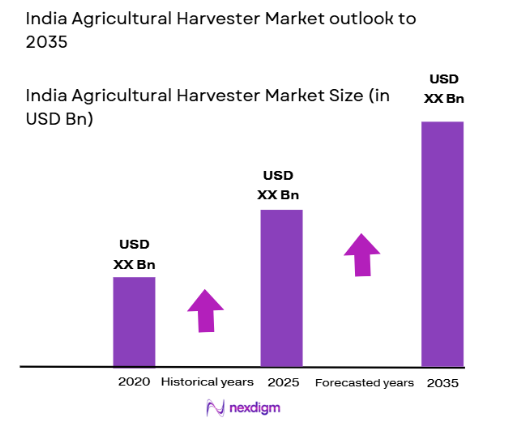
India Agricultural Harvester Market was valued at USD ~ billion based on a recent historical assessment supported by industry disclosures from leading manufacturers and agricultural machinery associations. The market is driven by mechanization incentives under central and state subsidy programs, increasing labor scarcity during peak harvest cycles, and rising adoption of multi-crop combine harvesters across major agrarian states. Expanding rural credit penetration through public and private sector banks has also accelerated equipment purchases in organized channels.
Punjab, Haryana, Uttar Pradesh, Madhya Pradesh, and Maharashtra dominate the India Agricultural Harvester Market due to extensive cereal and cash crop cultivation supported by irrigation infrastructure and strong procurement ecosystems. These regions benefit from higher farm incomes, custom hiring center penetration, and proximity to manufacturing hubs in northern and western India. Robust dealer networks and availability of aftersales service facilities further strengthen equipment deployment and operational continuity across these states.
Market Segmentation
By Product Type
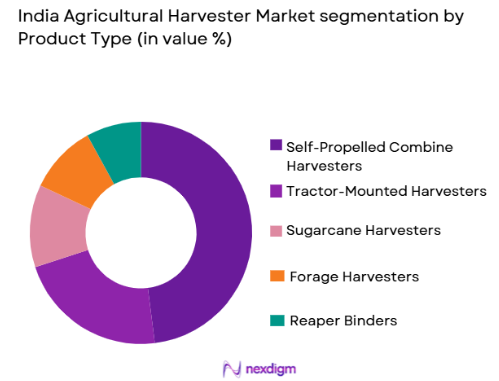
India Agricultural Harvester Market is segmented by product type into self-propelled combine harvesters, tractor-mounted harvesters, sugarcane harvesters, forage harvesters, and reaper binders. Recently, self-propelled combine harvesters have a dominant market share due to factors such as higher operational efficiency, ability to harvest, thresh, and clean grains in a single pass, and suitability for large-scale wheat and paddy cultivation. Strong brand presence of organized manufacturers, better financing access, and rising adoption among custom hiring centers have strengthened this segment’s leadership. Their compatibility with multi-crop headers and integration of telematics further enhance productivity and uptime, making them preferred across mechanized farming clusters in northern and central India.
By End User
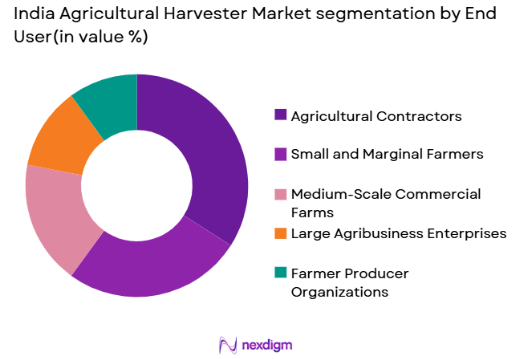
India Agricultural Harvester Market is segmented by end user into small and marginal farmers, medium-scale commercial farms, large agribusiness enterprises, farmer producer organizations, and agricultural contractors. Recently, agricultural contractors have a dominant market share due to demand patterns driven by fragmented land holdings and cost-sharing preferences. Custom hiring centers enable small farmers to access mechanized harvesting without heavy capital investment, improving equipment utilization rates. Increasing government support for mechanization clusters and cooperative-based procurement has strengthened contractor participation. Their operational scale allows better absorption of maintenance costs and optimized fleet management, resulting in sustained leadership within equipment deployment ecosystems.
Competitive Landscape
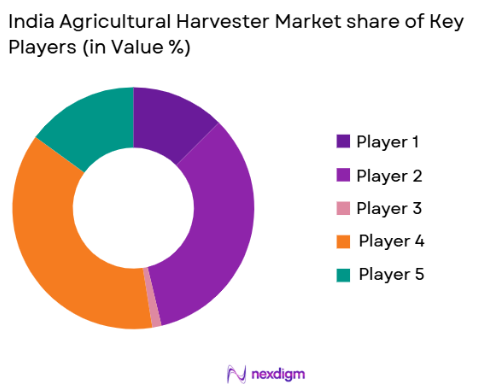
The India Agricultural Harvester Market is moderately consolidated, with domestic manufacturers and multinational agricultural equipment companies competing across price tiers and technology platforms. Leading firms benefit from strong dealer networks, localized manufacturing facilities, and diversified product portfolios. Consolidation has been driven by technology partnerships, engine compliance upgrades, and expansion of financing collaborations with rural banks and non-banking financial institutions.
| Company Name | Establishment Year | Headquarters | Technology Focus | Market Reach | Key Products | Revenue (USD Billion) | Engine Power Range |
| Mahindra and Mahindra Limited | 1945 | Mumbai, India | ~ | ~ | ~ | ~ | ~ |
| TAFE Motors and Tractors Limited | 1960 | Chennai, India | ~ | ~ | ~ | ~ | ~ |
| Escorts Kubota Limited | 1944 | Faridabad, India | ~ | ~ | ~ | ~ | ~ |
| John Deere India Pvt Ltd | 1837 | Pune, India | ~ | ~ | ~ | ~ | ~ |
| CNH Industrial India Pvt Ltd | 1999 | New Delhi, India | ~ | ~ | ~ | ~ | ~ |
India Agricultural Harvester Market Analysis
Growth Drivers
Government-Backed Farm Mechanization Subsidy Programs
Public investment under agricultural mechanization missions has significantly accelerated the adoption of harvesting equipment across major agrarian states. Central and state governments provide capital subsidies and financial incentives that reduce upfront acquisition costs for farmers and custom hiring centers. These initiatives improve affordability and encourage formal financing through rural banks and cooperative institutions. Structured subsidy disbursement mechanisms also promote purchases from organized manufacturers with certified equipment. The resulting increase in mechanized harvesting reduces post-harvest losses and enhances productivity in cereal and cash crop cultivation. Policy support further stimulates local manufacturing through production-linked incentives and localization mandates. Custom hiring centers supported by public funding enable shared access models in fragmented landholding regions. As rural incomes improve and crop procurement systems remain stable, subsidy-backed investments continue to reinforce steady equipment demand across agricultural clusters.
Rising Agricultural Labor Shortages During Peak Harvest Cycles
Structural shifts in rural employment patterns and migration toward urban sectors have reduced the availability of manual labor during peak harvesting seasons. Delays in harvesting directly impact crop quality and market realization, encouraging farmers to adopt mechanized alternatives for timely operations. Combine harvesters significantly reduce turnaround time compared to manual harvesting methods. Increasing wage costs in key agricultural states further enhance the economic viability of machine-based operations. Contractors operating fleets of harvesters can mobilize equipment rapidly across districts, ensuring efficient service delivery. Technological improvements such as multi-crop headers and fuel-efficient engines make equipment adaptable across cropping seasons. Financial institutions support machinery purchases through tailored agricultural credit products aligned with harvest cycles. As farm sizes consolidate in certain regions and productivity expectations rise, mechanized harvesting becomes an operational necessity rather than an optional investment.
Market Challenges
High Capital Investment and Financing Constraints for Smallholders
Agricultural harvesters involve substantial upfront capital expenditure, limiting direct ownership among small and marginal farmers. Even with subsidy support, residual costs remain significant relative to seasonal farm incomes. Credit appraisal processes in rural banking can delay equipment financing approvals. Smaller farmers often lack collateral security or formal income documentation required by lending institutions. Seasonal income variability increases perceived default risk for financiers. Dependence on contractors can create scheduling bottlenecks during peak harvest windows. Maintenance and spare parts costs add to lifecycle expenditure burdens. Limited financial literacy in remote areas further constrains optimal utilization of structured financing schemes.
Fragmented Land Holdings and Operational Constraints
A significant portion of agricultural land is divided into small and scattered plots, restricting the efficient deployment of large combine harvesters. Maneuverability challenges in irregular field layouts increase operational time and fuel consumption. Smaller fields reduce harvesting efficiency and increase per-acre service costs. Transportation of heavy machinery between dispersed plots raises logistical expenses. Inadequate rural road infrastructure in certain regions restricts mobility of high-capacity equipment. Terrain variability, including uneven soil conditions, can impact machine stability and performance. Seasonal weather unpredictability adds further uncertainty to harvesting schedules. These structural factors collectively constrain full-scale mechanization across certain agrarian belts.
Opportunities
Expansion of Custom Hiring Centers and Equipment Leasing Models
Organized custom hiring centers supported by cooperatives and agritech platforms present a scalable model for improving harvester penetration. Shared access reduces capital burden on individual farmers while maintaining equipment utilization efficiency. Leasing platforms integrated with digital booking systems enhance transparency in service pricing and availability. Fleet aggregation improves bargaining power with manufacturers and financiers. Data-driven scheduling optimizes deployment across districts during harvest peaks. Expansion of such centers into eastern and northeastern regions unlocks untapped mechanization potential. Collaboration with rural banks ensures structured repayment aligned with harvest revenues. As shared economy principles gain acceptance in agriculture, leasing models can significantly deepen market reach.
Integration of Precision Agriculture and Smart Telematics Systems
Adoption of telematics-enabled harvesters creates opportunities for predictive maintenance and real-time performance monitoring. GPS-guided harvesting improves field coverage efficiency and reduces grain loss. Data analytics supports yield mapping and crop assessment for better farm management decisions. Manufacturers offering connected platforms can differentiate through service-based revenue models. Remote diagnostics reduce downtime and enhance aftersales support efficiency. Integration with farm management software strengthens ecosystem interoperability. Digital dashboards provide actionable insights to contractors managing multi-machine fleets. Growing awareness of data-driven agriculture creates a pathway for premium technology adoption within mechanized harvesting solutions.
Future Outlook
Over the next five years, the India Agricultural Harvester Market is expected to witness steady expansion driven by sustained mechanization policies and rising rural financing penetration. Technological upgrades including telematics integration, fuel-efficient engines, and multi-crop adaptability will enhance productivity benchmarks. Regulatory emphasis on emission compliance and domestic manufacturing incentives will influence product development strategies. Demand-side growth will remain anchored in contractor-led deployment and cooperative farming models across major agrarian states.
Major Players
- Mahindra and Mahindra Limited
- TAFE Motors and Tractors Limited
- Escorts Kubota Limited
- John Deere India Private Limited
- CNH Industrial India Private Limited
- Preet Agro Industries Private Limited
- Sonalika International Tractors Limited
- Swaraj Tractors Limited
- CLAAS India Private Limited
- Kubota Agricultural Machinery India Private Limited
- New Holland Agriculture India
- Dasmesh Mechanical Works Private Limited
- Balkar Combines Private Limited
- Captain Tractors Private Limited
- VST Tillers Tractors Limited
Key Target Audience
- Agricultural Equipment Manufacturers
- Farm Equipment Dealers and Distributors
- Agribusiness Corporations
- Agricultural Contractors and Custom Hiring Centers
- Rural Financing Institutions
- Investments and Venture Capitalist Firms
- Government and Regulatory Bodies
- Cooperative Farming Organizations
Research Methodology
Step 1: Identification of Key Variables
The research identified production volumes, sales revenue, subsidy allocation, financing penetration, and regional deployment as core variables. Secondary data from government agriculture departments and industry associations were examined. Demand-side indicators were mapped across major agrarian states.
Step 2: Market Analysis and Construction
Data triangulation was conducted using manufacturer disclosures, trade data, and policy documentation. Revenue aggregation methods were applied to estimate total market size. Segmentation shares were derived through dealer interviews and shipment tracking.
Step 3: Hypothesis Validation and Expert Consultation
Industry experts, equipment distributors, and rural financing professionals were consulted to validate assumptions. Field-level operational insights were incorporated. Supply chain stakeholders reviewed technology adoption trends and regional performance patterns.
Step 4: Research Synthesis and Final Output
Quantitative and qualitative findings were consolidated into structured market models. Scenario analysis evaluated policy and demand impacts. Final outputs were peer-reviewed internally for data consistency and analytical coherence.

- Executive Summary
- Research Methodology (Definitions, Scope, Industry Assumptions, Market Sizing Approach, Primary & Secondary Research Framework, Data Collection & Verification Protocol, Analytic Models & Forecast Methodology, Limitations & Research Validity Checks)

- Market Definition and Scope
- Value Chain & Stakeholder Ecosystem
- Regulatory / Certification Landscape
- Sector Dynamics Affecting Demand
- Strategic Initiatives & Infrastructure Growth

- Growth Drivers
Rising farm mechanization supported by government subsidy programs
Increasing labor shortages in peak harvesting seasons
Expansion of commercial farming and contract farming models
Growing demand for multi crop harvesting efficiency
Improved rural financing access for farm equipment purchases - Market Challenges
High initial capital investment requirements
Fragmented land holdings limiting large harvester deployment
Seasonal demand variability impacting utilization rates
Limited technical service infrastructure in remote regions
Dependence on monsoon driven crop cycles - Market Opportunities
Expansion of custom hiring centers across rural clusters
Development of compact harvesters for small land parcels
Integration of precision agriculture technologies with harvesting equipment - Trends
Adoption of telematics for fleet monitoring and predictive maintenance
Shift toward fuel efficient and low emission engine platforms
Increasing demand for multi crop compatible headers
Growth of equipment leasing and pay per use models
Digital financing platforms for faster equipment approvals - Government Regulations & Defense Policy
Subsidy schemes under agricultural mechanization missions
Emission compliance norms for off highway diesel engines
Import duty policies influencing localization of harvester manufacturing
SWOT Analysis
Stakeholder and Ecosystem Analysis
Porter’s Five Forces Analysis
Competition Intensity and Ecosystem Mapping

- By Market Value, 2020-2025
- By Installed Units, 2020-2025
- By Average System Price, 2020-2025
- By System Complexity Tier, 2020-2025

- By System Type (In Value%)
Self-Propelled Combine Harvesters
Tractor-Mounted Harvesters
Sugarcane Harvesters
Forage Harvesters
Reaper Binders - By Platform Type (In Value%)
Wheeled Harvesters
Tracked Harvesters
Compact Harvesting Platforms
High Capacity Multi Crop Platforms
Hillside Specialized Platforms - By Fitment Type (In Value%)
OEM Factory Fitted Systems
Aftermarket Attachments
Modular Interchangeable Headers
Retrofit Harvesting Kits
Leased Equipment Configurations - By EndUser Segment (In Value%)
Small and Marginal Farmers
Medium Scale Commercial Farms
Large Agribusiness Enterprises
Farmer Producer Organizations
Agricultural Contractors and Custom Hiring Centers - By Procurement Channel (In Value%)
Direct Sales Through Dealers
Manufacturer Owned Retail Outlets
Government Subsidy Linked Procurement
Cooperative Society Purchases
Equipment Leasing and Rental Providers - By Material / Technology (in Value %)
Precision GPS Enabled Harvesters
Telematics Integrated Systems
Hybrid Fuel Efficient Engines
High Durability Alloy Components
Automation Enabled Smart Harvesting Systems

- Market structure and competitive positioning
- Market share snapshot of major players
- Cross Comparison Parameters (Engine Power Range, Cutting Width, Grain Tank Capacity, Fuel Efficiency, Telematics Integration, Header Compatibility, Terrain Adaptability, After Sales Network Strength, Price Range, Financing Options Availability)
- SWOT Analysis of Key Players
- Pricing & Procurement Analysis
- Key Players
Mahindra and Mahindra Limited
Tafe Motors and Tractors Limited
Escorts Kubota Limited
John Deere India Private Limited
CNH Industrial India Private Limited
Preet Agro Industries Private Limited
Sonalika International Tractors Limited
Swaraj Tractors Limited
CLAAS India Private Limited
Kubota Agricultural Machinery India Private Limited
New Holland Agriculture India
Dasmesh Mechanical Works Private Limited
Balkar Combines Private Limited
Captain Tractors Private Limited
VST Tillers Tractors Limited

- Small farmers prioritizing compact and affordable harvesting solutions
- Commercial farms focusing on high capacity and time efficient systems
- Custom hiring operators seeking durable equipment with high uptime
- Agribusiness firms investing in precision enabled harvesting fleets

- Forecast Market Value, 2026-2035
- Forecast Installed Units, 2026-2035
- Price Forecast by System Tier, 2026-2035
- Future Demand by Platform, 2026-2035


 Request a Sample
 Ask for Customization
 Get a Quote
 Enquire Now