
 Download PDF
 Download PDF
Market Overview
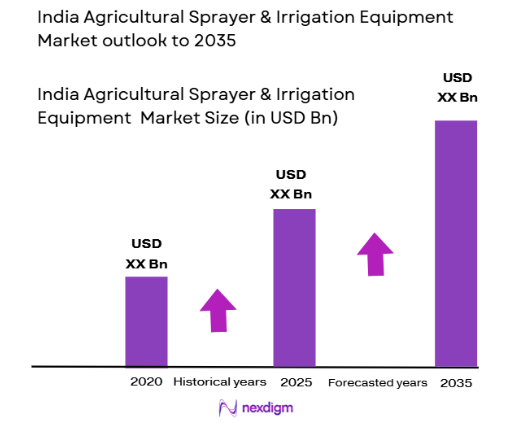
The India Agricultural Sprayer & Irrigation Equipment Market has witnessed substantial growth, driven by increased adoption of modern farming practices and the demand for efficient irrigation solutions. With a market size projected at USD ~ billion, it reflects the growing need for technology-driven agricultural solutions. The sector is primarily driven by government initiatives supporting agricultural mechanization and water conservation, and a strong focus on reducing water wastage in irrigation practices.
The market is dominated by India’s large agrarian economy, with significant contributions from states like Uttar Pradesh, Punjab, and Maharashtra, which are known for extensive crop cultivation. The dominance of these regions is attributed to the high agricultural output and government-backed subsidies promoting irrigation and sprayer equipment. These areas exhibit the highest adoption rates of automated irrigation systems and sprayers, driven by increasing demand for water-efficient solutions and advancements in irrigation technology.
Market Segmentation
By Product Type
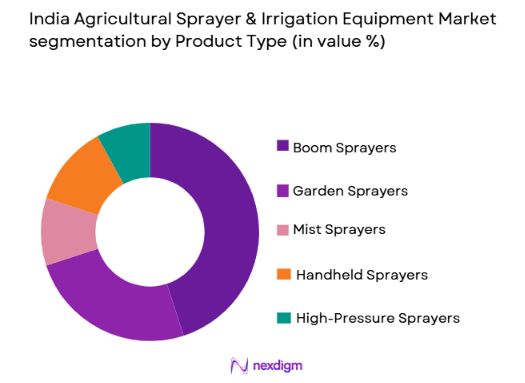
The India Agricultural Sprayer & Irrigation Equipment market is segmented by product type into boom sprayers, garden sprayers, mist sprayers, handheld sprayers, and high-pressure sprayers. Recently, boom sprayers have shown dominant market share due to their ability to cover large areas efficiently, which appeals to both large-scale farms and commercial agricultural operations. Their popularity is further driven by advancements in automated sprayer technologies, which reduce labor costs and increase productivity. Furthermore, the growing trend of precision farming has led to a higher preference for boom sprayers, as they ensure uniform spraying, minimizing waste and improving crop yields.
By Platform Type
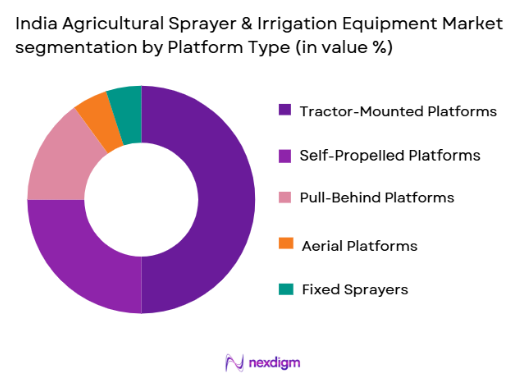
The India Agricultural Sprayer & Irrigation Equipment market is segmented by platform type into self-propelled platforms, tractor-mounted platforms, pull-behind platforms, aerial platforms, and fixed sprayers. Tractor-mounted platforms dominate due to their compatibility with existing agricultural equipment, providing farmers with an affordable solution to modernize their spraying systems. These platforms are versatile, easily attachable to existing tractors, and offer the advantage of large-area coverage with minimal labor. Tractor-mounted sprayers are highly favored in large farms, especially in states with high agricultural outputs like Punjab and Haryana.
Competitive Landscape
The competitive landscape in the India Agricultural Sprayer & Irrigation Equipment market is marked by a high level of consolidation, with key players dominating the market share. These players are actively engaging in mergers, acquisitions, and strategic partnerships to strengthen their presence. As the market grows, the influence of major players continues to increase, with companies focusing on product innovations, expanding their geographical presence, and responding to the increasing demand for water-efficient solutions.
| Company Name | Establishment Year | Headquarters | Technology Focus | Market Reach | Key Products | Revenue | Additional Market-Specific Parameter |
| Mahindra & Mahindra | 1945 | Mumbai, India | ~ | ~ | ~ | ~ | ~ |
| John Deere India | 1837 | Pune, India | ~ | ~ | ~ | ~ | ~ |
| Tata International | 1989 | Mumbai, India | ~ | ~ | ~ | ~ | ~ |
| Netafim | 1965 | Tel Aviv, Israel | ~ | ~ | ~ | ~ | ~ |
| Kirloskar Brothers | 1888 | Pune, India | ~ | ~ | ~ | ~ | ~ |
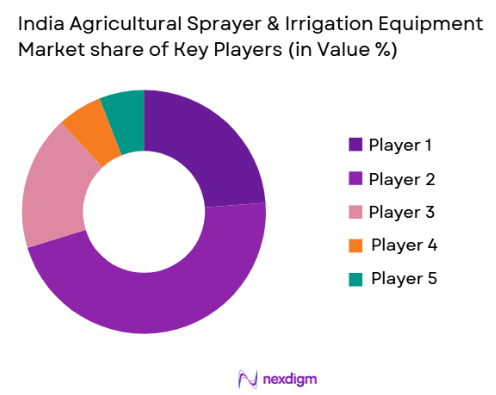
India Agricultural Sprayer & Irrigation Equipment Market Analysis
Growth Drivers
Rising Demand for Precision Farming
The increasing adoption of precision farming in India is one of the primary growth drivers for the agricultural sprayer and irrigation equipment market. As farmers seek to optimize crop yields and minimize water usage, precision farming techniques are gaining popularity. The demand for systems that integrate GPS, IoT, and sensor technologies has surged, as these technologies enable farmers to monitor and manage water usage more effectively. By utilizing precise data on soil moisture, weather patterns, and crop health, precision farming allows for more efficient use of fertilizers, pesticides, and irrigation systems. With the Indian government’s focus on supporting digital agriculture and water-efficient systems, this trend is expected to continue driving market growth. Precision farming systems enhance productivity, reduce environmental impact, and offer significant economic benefits for farmers, making them highly attractive in regions with water scarcity and limited arable land.
Government Initiatives for Agricultural Modernization
Government-backed initiatives such as subsidies for agricultural mechanization and water conservation are significant contributors to the market’s growth. Various state and central government programs are aimed at encouraging farmers to adopt modern irrigation systems and sprayers. The Pradhan Mantri Krishi Sinchayee Yojana (PMKSY) and other water conservation schemes have led to increased investments in irrigation infrastructure, including the promotion of drip irrigation and sprinkler systems. These initiatives support the transition from traditional flood irrigation methods to more efficient, modern alternatives. Farmers are being incentivized with financial assistance to install sprayers, irrigation equipment, and adopt water-efficient technologies. As a result, government policies are expected to continue fostering the demand for sprayers and irrigation equipment, ensuring the market remains on a growth trajectory in the coming years.
Market Challenges
High Initial Investment for Advanced Equipment
One of the key challenges hindering the widespread adoption of advanced sprayers and irrigation equipment in India is the high initial cost associated with these systems. While modern equipment offers significant advantages in terms of water efficiency and increased crop yields, the capital investment required for installation remains a barrier for small and medium-sized farmers. Many farmers in rural areas face financial constraints and lack access to affordable financing options, which limits their ability to invest in high-end irrigation systems. Although government subsidies are available, they often fall short of covering the full cost, leaving farmers to bear a significant portion of the financial burden. This challenge poses a significant obstacle to the growth of the market, particularly in regions where farming is more labor-intensive and capital is scarce.
Dependence on Monsoon for Irrigation
Despite the adoption of modern irrigation systems, the dependence on the monsoon for water supply continues to pose a significant challenge. In regions where rainfall is erratic or insufficient, the agricultural sector remains vulnerable to climatic variability. While irrigation systems, such as drip irrigation and sprinklers, are effective in reducing water usage, they are still highly dependent on the availability of water resources. In states with irregular rainfall patterns, the reliance on traditional water sources such as rivers and reservoirs can create an imbalance in water distribution, leading to inefficiencies in irrigation. Additionally, the lack of infrastructure in remote areas further exacerbates the challenge of delivering consistent water supply to crops, limiting the overall effectiveness of irrigation systems. This challenge underscores the need for better water management and storage solutions, especially in regions facing severe water scarcity.
Opportunities
Technological Integration with IoT & AI
The integration of the Internet of Things (IoT) and Artificial Intelligence (AI) in agricultural sprayers and irrigation systems presents a significant opportunity for market growth. IoT-enabled devices, such as smart sensors and controllers, allow farmers to remotely monitor and control irrigation systems, adjusting water usage based on real-time environmental data. AI-driven analytics can help optimize irrigation schedules, predict water requirements, and reduce water wastage. This technological advancement is particularly beneficial in water-scarce regions where efficient water management is crucial. The adoption of IoT and AI technologies enhances the effectiveness of irrigation systems, improves crop health, and ensures better yield. With the government promoting digital agriculture and smart farming practices, the demand for IoT and AI-enabled irrigation solutions is expected to increase, presenting a substantial opportunity for growth in the market.
Expansion of Drip Irrigation Technology
The growing awareness of the benefits of drip irrigation technology presents a significant market opportunity in India. Drip irrigation offers a water-efficient alternative to traditional irrigation systems, allowing water to be delivered directly to the plant roots. This method helps reduce water wastage, minimizes soil erosion, and increases crop yields. Given the increasing scarcity of water resources and the need for sustainable farming practices, drip irrigation is becoming an attractive option for farmers, especially in areas facing water shortages. The government’s push for water conservation and the availability of subsidies for drip irrigation systems further enhance the potential for market expansion. As farmers continue to prioritize water-efficient solutions, the demand for drip irrigation systems is expected to rise, offering significant growth opportunities for companies in the agricultural sprayer and irrigation equipment market.
Future Outlook
The India Agricultural Sprayer & Irrigation Equipment Market is expected to witness steady growth in the coming years, driven by continued advancements in irrigation technology, increased adoption of smart farming practices, and government-backed initiatives promoting water conservation. Technological developments such as IoT-enabled irrigation systems and AI-driven sprayers are likely to revolutionize the sector, making it more efficient and sustainable. With rising demand for precision farming, especially in water-scarce regions, the market is poised for substantial growth. Additionally, the growing focus on sustainability and resource conservation is expected to support the demand for water-efficient solutions, further accelerating market expansion.
Major Players
- Mahindra & Mahindra
- John Deere India
- Tata International
- Netafim
- Kirloskar Brothers
- Valmont Industries
- Rivulis Irrigation
- Jain Irrigation Systems
- BAF Agriculture
- Yanmar India
- Agrifac Machinery
- Kohler Co.
- CNH Industrial
- Rotech Pumps
- Buhler Industries
Key Target Audience
- Agricultural Equipment Manufacturers
- Government Agricultural Departments
- Irrigation System Providers
- Agricultural Tech Startups
- Large-scale Farms & Commercial Farmers
- Water Conservation Authorities
- Agricultural Research Institutes
- Financial Institutions & Investment Firms
Research Methodology
Step 1: Identification of Key Variables
This involves understanding the key factors driving the market, including agricultural trends, technological advancements, and regional demand for irrigation solutions.
Step 2: Market Analysis and Construction
Market data is gathered from industry reports, expert opinions, and primary surveys, followed by segmentation analysis to understand the different market components.
Step 3: Hypothesis Validation and Expert Consultation
A comprehensive review of existing hypotheses is conducted by consulting with market experts and stakeholders in the agricultural and irrigation sectors.
Step 4: Research Synthesis and Final Output
Final insights are synthesized from data analysis, with detailed market reports compiled, ensuring all variables and growth drivers are accurately reflected in the final document.

- Executive Summary
- Research Methodology (Definitions, Scope, Industry Assumptions, Market Sizing Approach, Primary & Secondary Research Framework, Data Collection & Verification Protocol, Analytic Models & Forecast Methodology, Limitations & Research Validity Checks)

- Market Definition and Scope
- Value Chain & Stakeholder Ecosystem
- Regulatory / Certification Landscape
- Sector Dynamics Affecting Demand
- Strategic Initiatives & Infrastructure Growth

- Growth Drivers
Rising Demand for Precision Farming
Government Subsidies for Irrigation Projects
Advancements in Automated Spraying Systems
Increase in Water Conservation Efforts
Expanding Greenhouse Agriculture - Market Challenges
High Initial Investment for Advanced Equipment
Lack of Awareness Among Small Farmers
Technological Integration Issues
Dependence on Monsoon for Irrigation
Maintenance & Spare Parts Accessibility - Market Opportunities
Growth in Smart Irrigation Systems
Expansion of Drip Irrigation Technology
Technological Integration with IoT & AI - Trends
Integration of Automation in Irrigation Systems
Rising Adoption of Solar-Powered Equipment
Growing Popularity of Precision Agriculture
Shift Toward Environmentally Friendly Spraying Solutions
Expansion of Online Sales Channels for Agricultural Equipment - Government Regulations & Defense Policy
Water Usage Regulations
Subsidy Programs for Farmers
Certification and Compliance Requirements - SWOT Analysis
- Stakeholder and Ecosystem Analysis
- Porter’s Five Forces Analysis
- Competition Intensity and Ecosystem Mapping

- By Market Value, 2020-2025
- By Installed Units, 2020-2025
- By Average System Price, 2020-2025
- By System Complexity Tier, 2020-2025

- By System Type (In Value%)
Boom Sprayers
Garden Sprayers
Mist Sprayers
Handheld Sprayers
High-Pressure Sprayers - By Platform Type (In Value%)
Self-Propelled Platforms
Tractor-Mounted Platforms
Pull-Behind Platforms
Aerial Platforms
Fixed Sprayers - By Fitment Type (In Value%)
Standalone Equipment
Integrated Equipment
Modular Equipment
Custom-Built Equipment
Retrofitted Systems - By EndUser Segment (In Value%)
Agricultural Farms
Horticulture & Orchards
Forestry Operations
Greenhouses & Nurseries
Government Irrigation Programs - By Procurement Channel (In Value%)
Direct Procurement
Government Tenders
Private Sector Procurement
Online Retail Platforms
Third-Party Distributors - By Material / Technology (In Value%)
Plastic Sprayers
Metal Sprayers
Electrically Operated Systems
Solar-Powered Sprayers
Hybrid Sprayers

- Market structure and competitive positioning
- Market share snapshot of major players
- Cross Comparison Parameters (System Type, Platform Type, Procurement Channel, End User Segment, Fitment Type, Material/Technology, Price, Performance, Distribution Reach, Product Differentiation)
- SWOT Analysis of Key Players
- Pricing & Procurement Analysis
- Key Players
Mahindra & Mahindra
Tata International Limited
John Deere India
Yanmar India
Bayer CropScience
Ravindra Agritech Limited
Kirloskar Brothers
Kubota Corporation
Valmont Industries
Irritec India Pvt Ltd
Netafim
John G. Graves Company
Meyer Industries
SAME Deutz-Fahr India Pvt. Ltd
Jacto India Pvt Ltd

- Adoption of Sprayers in Large-Scale Farms
- Government Initiatives Supporting Irrigation
- Rising Technological Investments by Private Players
- Awareness and Adoption Among Small Farmers

- Forecast Market Value, 2026-2035
- Forecast Installed Units, 2026-2035
- Price Forecast by System Tier, 2026-2035
- Future Demand by Platform, 2026-2035


 Request a Sample
 Ask for Customization
 Get a Quote
 Enquire Now