
 Download PDF
Market Overview
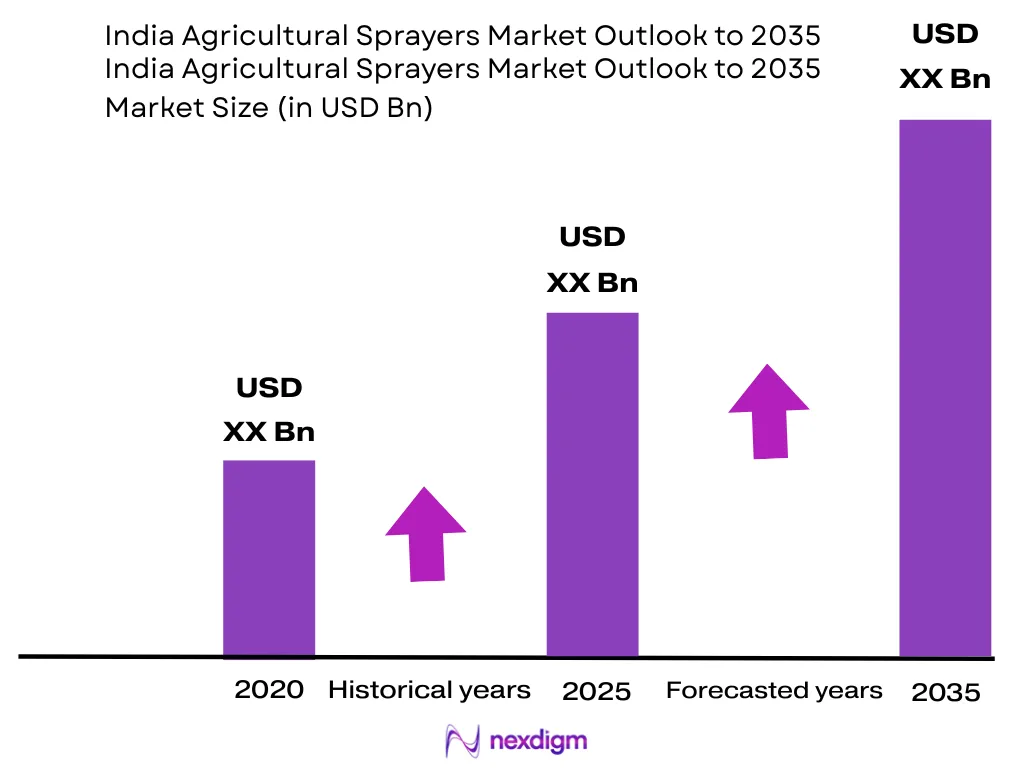
The India Agricultural Sprayers Market was valued at approximately USD ~ billion in 2024 based on a comprehensive assessment of agricultural machinery sales, crop protection equipment demand, and mechanisation trends across major farming regions. The market is primarily driven by India’s position as one of the world’s largest producers of rice, wheat, cotton, sugarcane, and horticultural crops. According to data published by the Ministry of Agriculture and Farmers Welfare (MoAFW) and the Directorate of Economics and Statistics, total foodgrain production exceeded 320 million metric tonnes, while total net sown area remained substantial across the Indo-Gangetic Plain, Deccan Plateau, and coastal agricultural regions. Rising adoption of crop protection chemicals, increasing government subsidy support for farm mechanisation, and growing awareness of precision agriculture technologies have accelerated demand for spraying equipment across smallholder and commercial farming segments.
Market Segmentation
By Sprayer Type
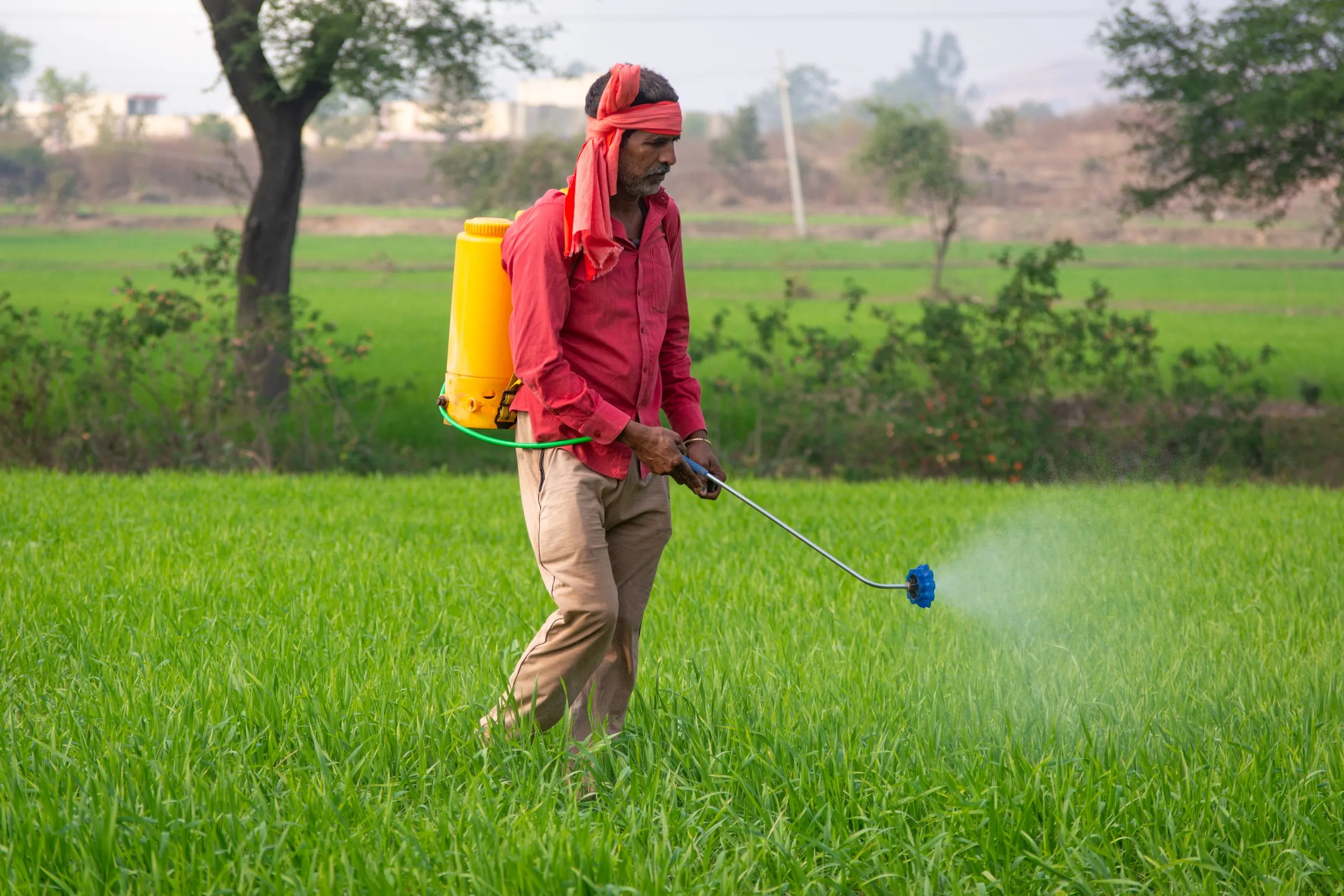
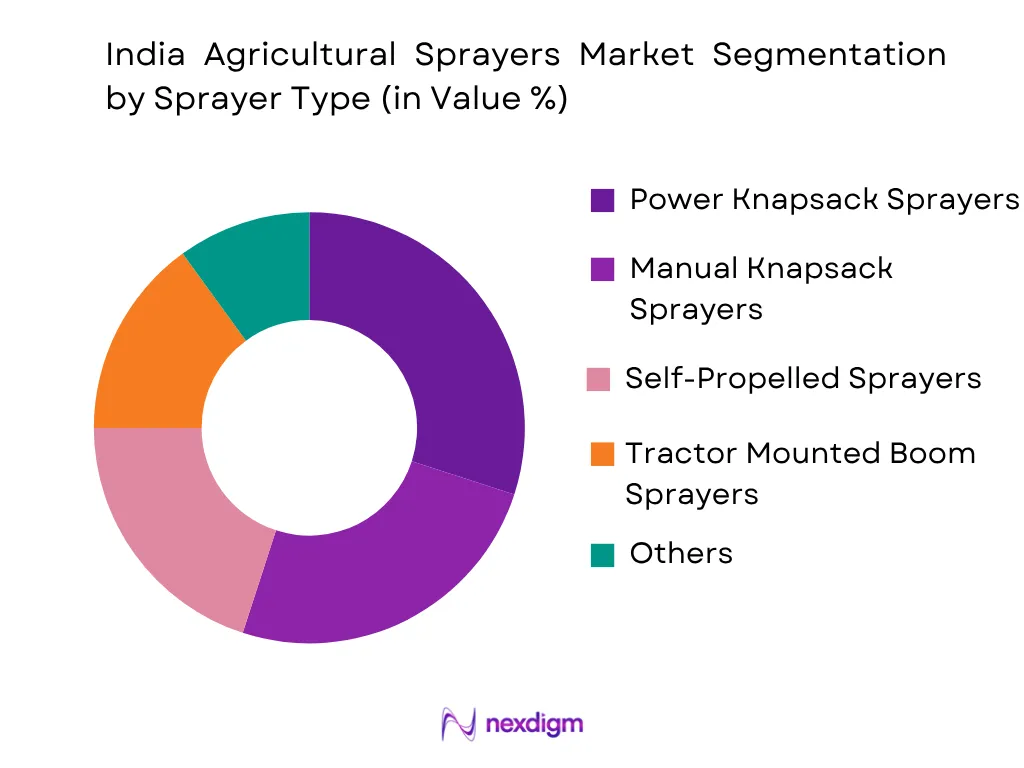
India Agricultural Sprayers Market is segmented by sprayer type into self-propelled sprayers, trailed sprayers, tractor-mounted boom sprayers, power knapsack sprayers, manual knapsack sprayers, UAV/drone sprayers, and backpack and portable sprayers. Power knapsack and manual knapsack sprayers dominate the market in terms of unit volumes, reflecting India’s predominantly smallholder farm structure where average landholding sizes remain below two hectares. These portable sprayers are affordable, easy to operate without specialised training, and well suited to the fragmented and irregular field shapes characteristic of Indian agriculture. However, tractor-mounted boom sprayers and self-propelled models are gaining traction among larger commercial farms, farmer producer organisations (FPOs), and custom hiring centres (CHCs) that operate across larger consolidated areas. Furthermore, rapidly growing UAV/drone sprayer adoption, supported by DGCA regulatory approvals and government subsidy programmes, is emerging as a transformative segment across paddy, cotton, and horticultural crop regions.
By Crop Type
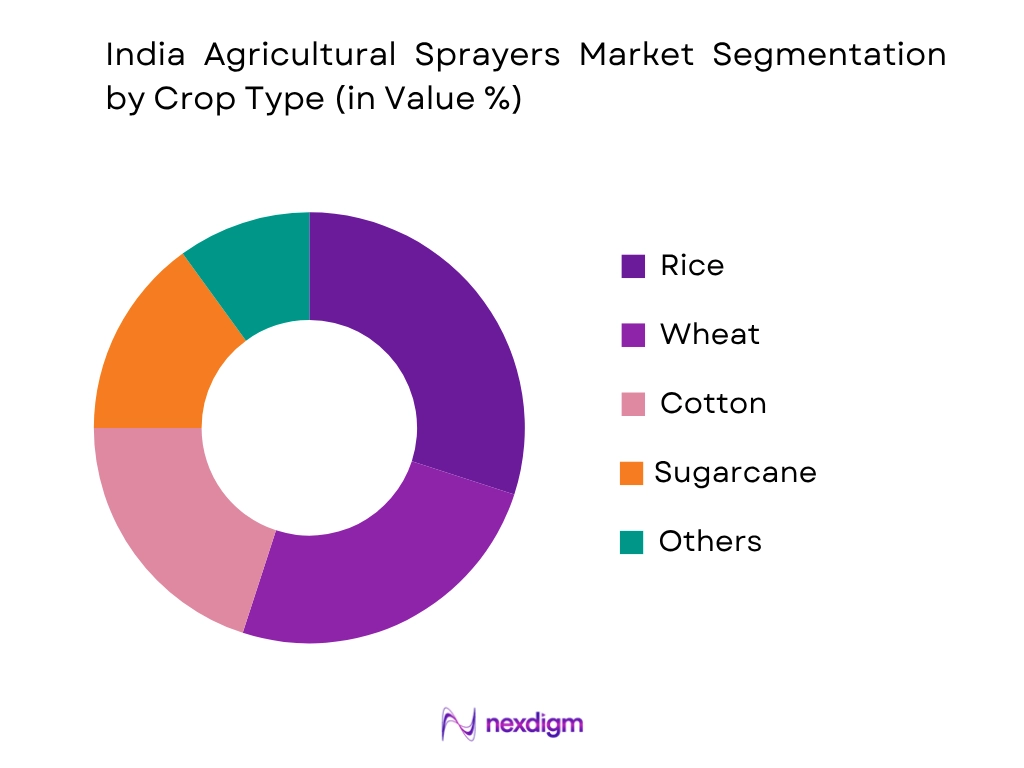
India Agricultural Sprayers Market is segmented by crop type into rice (paddy), wheat, cotton, sugarcane, fruits and vegetables (horticulture), pulses, oilseeds, and other field crops. Rice cultivation accounts for the largest market share owing to India’s status as the world’s largest rice exporter and one of its largest producers, with paddy grown across tens of millions of hectares during both kharif and rabi seasons. Rice cultivation demands frequent insecticide, fungicide, and fertiliser spray applications throughout the growing cycle, particularly in high-disease-pressure regions of West Bengal, Andhra Pradesh, Telangana, and Punjab. Additionally, the increasing focus on productivity improvement, pest management, and yield stabilisation in paddy cultivation has driven widespread adoption of power knapsack sprayers among smallholder farmers. Growing horticulture production including fruits, vegetables, and floriculture is further expanding sprayer demand, particularly for precision and orchard sprayer categories across Maharashtra, Karnataka, and Himachal Pradesh.
Competitive Landscape
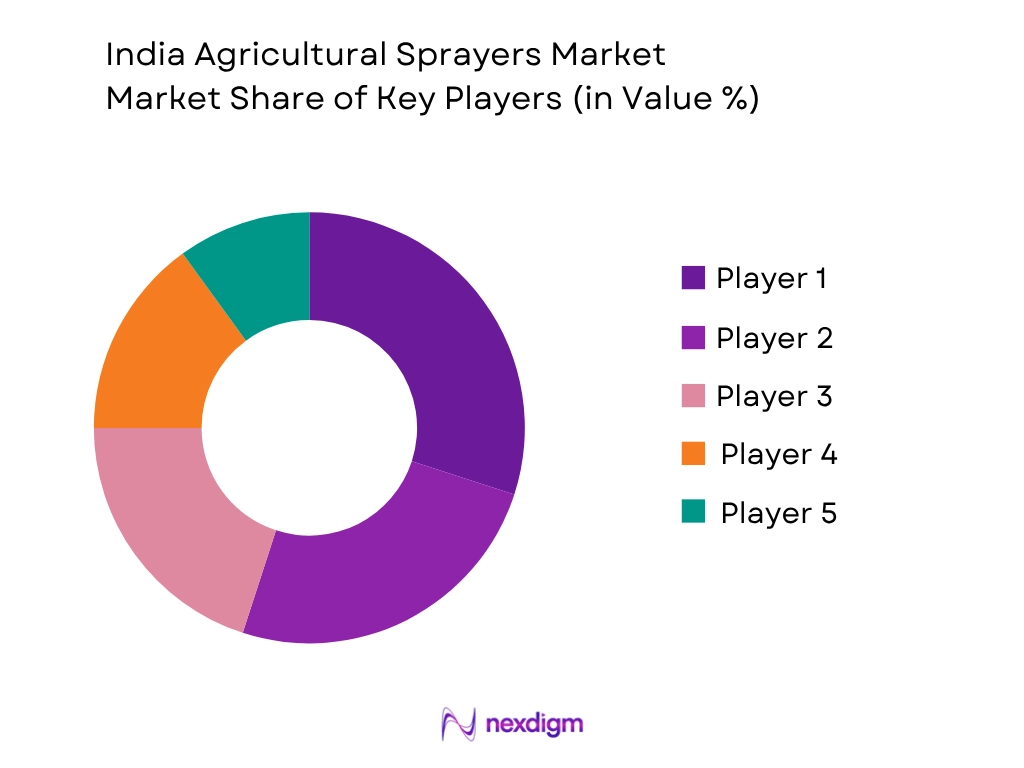
The India Agricultural Sprayers Market is characterised by the presence of both domestic manufacturers and international agricultural equipment companies. The competitive landscape is relatively fragmented at the lower end of the market, with numerous regional and local manufacturers supplying affordable knapsack and portable sprayers, while the premium and commercial segments are served by established domestic companies and global players with advanced technology offerings. Domestic manufacturers benefit from cost competitiveness, established distribution networks through agri-input retailers and cooperative societies, and familiarity with Indian crop and farm structures. International players leverage technological superiority and precision agriculture capabilities to address the growing demand from commercial farms, FPOs, and custom hiring centres.
| Company | Establishment Year | Headquarters | Product Portfolio | Precision Agriculture Integration
|
Tank Capacity Range | Dealer Network Strength | After-Sales Support | Innovation Capability |
| Mahindra & Mahindra | 1945 | ~ | ~ | ~ | ~ | ~ | ~ | ~ |
| Excel Crop Care (UPL) | 1964 | ~ | ~ | ~ | ~ | ~ | ~ | ~ |
| Aspee Agri Equipment | 1964 | ~ | ~ | ~ | ~ | ~ | ~ | ~ |
| Kirloskar Industries | 1888 | ~ | ~ | ~ | ~ | ~ | ~ | ~ |
| John Deere India | 1837 | ~ | ~ | ~ | ~ | ~ | ~ | ~ |
India Agricultural Sprayers Market Analysis
Growth Drivers
Expanding Cultivated Area and Rising Crop Protection Chemical Consumption
The India agricultural sprayers market is strongly supported by the country’s vast and expanding agricultural production base, which generates substantial and recurring demand for crop protection activities. According to the Ministry of Agriculture and Farmers Welfare and the Directorate of Economics and Statistics, India’s total foodgrain production exceeded 320 million metric tonnes in recent crop years, with net sown area covering approximately 140 million hectares across the country. Rice, wheat, cotton, and sugarcane collectively account for a dominant share of cultivated land, each requiring multiple spray applications for pest management, disease control, and foliar nutrition throughout the growing season. The Indo-Gangetic Plain states of Punjab, Haryana, and Uttar Pradesh represent the most intensive cereal-producing zones, generating consistent demand for tractor-mounted and power knapsack sprayers. Additionally, expanding horticultural production, which now covers over 27 million hectares, has created growing requirements for precision spraying equipment suited to orchards, vineyards, and vegetable crops. Increased awareness of integrated pest management and growing crop protection chemical consumption, which has risen steadily according to industry data, further amplifies sprayer utilisation frequency and creates sustained demand for equipment upgrades across farming communities.
Government Subsidy Schemes and Sub-Mission on Agricultural Mechanisation
Government support through subsidy programmes and mechanisation initiatives represents one of the most significant demand drivers for the India Agricultural Sprayers Market. The Sub-Mission on Agricultural Mechanisation (SMAM), implemented by the Ministry of Agriculture and Farmers Welfare, provides financial assistance of up to 50 percent of the cost of agricultural machinery and equipment, including sprayers, to individual farmers and up to 80 percent for demonstration purposes through Custom Hiring Centres and Farm Machinery Banks. According to government budgetary allocations, SMAM has channelled thousands of crore rupees toward agricultural mechanisation across multiple plan periods, enabling smallholder farmers to access equipment that would otherwise be financially inaccessible. Additionally, state government schemes in Maharashtra, Andhra Pradesh, Punjab, and Uttar Pradesh provide supplementary subsidies for power knapsack sprayers, drone sprayers, and tractor-mounted boom sprayers. The Pradhan Mantri Kisan Samman Nidhi (PM-KISAN) income support programme also strengthens farm household purchasing power, enabling incremental investment in crop protection equipment. The combination of central and state subsidy support creates a substantially favourable environment for sprayer adoption across both smallholder and commercial farming segments.
Market Challenges
Fragmented Landholding Structure and Smallholder Farm Economics
The India Agricultural Sprayers Market faces a fundamental structural challenge arising from the country’s highly fragmented landholding pattern. According to the Agriculture Census published by the Ministry of Agriculture and Farmers Welfare, approximately 86 percent of India’s farm holdings are classified as small and marginal, with average operational holding sizes below two hectares. This fragmentation severely limits the economic viability of investing in high-capacity or technologically advanced spraying equipment for individual farmers. The return on investment from a self-propelled sprayer or precision boom sprayer is difficult to justify across small, irregular, and often scattered plot holdings. As a result, the majority of Indian farmers continue to rely on low-cost manual and power knapsack sprayers, constraining overall market value realisation. Additionally, farm income volatility driven by commodity price fluctuations and monsoon dependency further limits discretionary capital expenditure on machinery among smallholder households. While Custom Hiring Centres and Farmer Producer Organisations are gradually addressing equipment access gaps, penetration remains uneven across states, particularly in rainfed and rain-shadow agricultural zones.
Irregular Monsoon Patterns and Climate-Related Agricultural Uncertainty
The India agricultural sprayers market remains highly vulnerable to monsoon variability and climate-related disruptions, which directly influence crop cultivation patterns, farm incomes, and equipment investment decisions. According to the India Meteorological Department (IMD), significant spatial and temporal variability in Southwest Monsoon distribution continues to affect agricultural productivity across major farming regions. Drought conditions in states such as Maharashtra, Karnataka, and Rajasthan periodically reduce kharif crop sowing, directly limiting the number of spray operations conducted per season. Conversely, excess rainfall and flooding events in eastern India can disrupt crop establishment and reduce the effectiveness of spray applications. Such weather-related uncertainties create year-to-year demand fluctuations for spraying equipment, as farmers facing crop losses or yield reductions defer machinery purchases and focus on input cost minimisation. Furthermore, the increasing frequency and severity of weather anomalies associated with climate change adds a structural dimension to agricultural uncertainty, potentially dampening long-term investment confidence among smallholder and semi-commercial farming segments. Managing this climatic risk remains an important consideration for manufacturers, distributors, and financiers operating within the Indian agricultural machinery sector.
Market Opportunities
Rapid Expansion of Agricultural Drone Sprayer Adoption
The adoption of UAV/drone sprayers presents one of the most significant growth opportunities for the India Agricultural Sprayers Market over the forecast period. The Directorate General of Civil Aviation (DGCA) has established a regulatory framework for agricultural drone operations through the Drone Rules 2021 and subsequent amendments, enabling commercial deployment of drone sprayers across major crop categories. The Ministry of Agriculture and Farmers Welfare has included agricultural drones as eligible equipment under the Sub-Mission on Agricultural Mechanisation, with subsidy support of up to 100 percent for demonstration activities conducted by agricultural institutions, Krishi Vigyan Kendras, and Farmer Producer Organisations. According to government data, thousands of agricultural drones have been deployed across paddy, cotton, and wheat-growing regions under Namo Drone Didi and related programmes, significantly expanding farmer familiarity with drone-based crop protection. Drone sprayers offer particular advantages in flooded paddy fields, hilly terrain, and dense crop canopies where conventional ground-based sprayers face operational limitations. The combination of regulatory support, subsidy incentives, and agronomic suitability positions drone spraying as a transformative growth segment within the Indian agricultural sprayers landscape.
Custom Hiring Centre Expansion and Farmer Producer Organisation Investments
The expansion of Custom Hiring Centres (CHCs) and Farmer Producer Organisations (FPOs) across India creates a compelling structural opportunity for the agricultural sprayers market, particularly for commercial-grade and precision spraying equipment. The government’s initiative to establish 10,000 FPOs under the Central Sector Scheme, combined with ongoing support for CHC infrastructure under SMAM, is progressively improving access to mechanised crop protection services among smallholder farming communities. CHCs enable farmers who cannot afford individual equipment ownership to access tractor-mounted boom sprayers, self-propelled sprayers, and drone spraying services on a per-acre hiring basis, significantly expanding effective sprayer utilisation across the country. According to Ministry of Agriculture records, thousands of CHCs have been established across major agricultural states, creating institutional procurement demand for advanced spraying equipment. Additionally, large agri-input companies and agricultural technology platforms are increasingly partnering with FPOs to deliver customised spraying services bundled with crop protection chemical supply, further stimulating demand for professional-grade equipment. This service-based agricultural mechanisation model represents a significant and growing channel for equipment manufacturers and distributors in the Indian market.
Future Outlook
The India Agricultural Sprayers Market is expected to experience robust growth over the forecast period, supported by expanding agricultural production, increasing government mechanisation support, and rising farmer awareness of crop protection best practices. Demand for advanced spraying systems is anticipated to accelerate as drone adoption scales rapidly, FPO and CHC ecosystems mature, and precision agriculture technologies become more affordable and accessible. Technological developments including battery-powered knapsack sprayers, AI-enabled spray optimisation, GPS-guided boom systems, and telematics integration are expected to progressively reshape the market landscape. Continued government investment in agricultural mechanisation, digital agriculture infrastructure, and farm income support programmes will further strengthen the enabling environment for sustained equipment adoption across India’s diverse and evolving agricultural regions.
Major Players
- Mahindra & Mahindra (Farm Equipment Sector)
- Excel Crop Care / Aspee Agri Equipment (UPL Group)
- Kirloskar Industries
- John Deere India
- CNH Industrial (Case IH India)
- AGCO Corporation (Massey Ferguson India)
- Fujifilm (Serimax) India
- Jacto India
- Tirth Agro Technology (STAR Agribusiness)
- Mottech Water Solutions India
- Indo Farm Equipment
- Krishiking
- DJI Agriculture (India Operations)
- Garuda Aerospace
- ideaForge Technology
Key Target Audience
- Agricultural Equipment Manufacturers
- Agricultural Machinery Distributors and Dealers
- Farmer Producer Organisations (FPOs) and Custom Hiring Centres
- Precision Agriculture Technology Providers
- Crop Protection Chemical Manufacturers
- Investments and Venture Capitalist Firms
- Government and Regulatory Bodies (Ministry of Agriculture and Farmers Welfare, DGCA, Central Insecticides Board and Registration Committee, NABARD, ICAR)
- Agricultural Equipment Rental and Leasing Companies
Research Methodology
Step 1: Identification of Key Variables
The initial phase involves constructing an ecosystem map encompassing all major stakeholders within the India Agricultural Sprayers Market. This process includes extensive secondary research through industry publications, government agricultural databases, manufacturer reports, trade associations, and agricultural machinery statistics. The objective is to identify critical market variables including equipment demand, crop acreage, mechanisation rates, technology adoption, subsidy utilisation, and purchasing behaviour across diverse farming segments.
Step 2: Market Analysis and Construction
Historical market data relating to agricultural machinery sales, crop production trends, farm equipment penetration, and spraying technology adoption are collected and analysed. Demand-side assessment focuses on farm-level purchasing patterns, custom hiring service utilisation, and crop protection requirements across smallholder and commercial farm segments. Supply-side analysis evaluates manufacturer revenues, dealer sales, production capacities, and distribution networks. Both approaches contribute to market size estimation and forecasting.
Step 3: Hypothesis Validation and Expert Consultation
Preliminary market findings and assumptions are validated through structured interviews with industry participants including agricultural equipment manufacturers, distributors, farm operators, agronomists, precision agriculture specialists, government programme administrators, and industry associations. These consultations provide practical insights regarding market trends, technological developments, subsidy programme effectiveness, and future demand outlook, thereby strengthening the reliability of the research findings.
Step 4: Research Synthesis and Final Output
The final stage involves triangulating information collected from primary interviews, secondary research sources, and proprietary databases. Market estimates are refined through cross-verification across multiple data points and stakeholder perspectives. Forecast models are developed using agricultural production outlooks, mechanisation programme targets, technology adoption rates, and investment patterns to generate comprehensive and reliable market intelligence.

- Executive Summary
- Research Methodology (Market Definitions and Assumptions, Abbreviations, Market Sizing Approach, Top-Down Analysis, Bottom-Up Analysis, Demand-Side Assessment, Supply-Side Assessment, Primary Industry Interviews, Distributor and Dealer Validation, Farm-Level Survey Assessment, Data Triangulation, Forecasting Framework, Limitations and Future Conclusions)

- Definition and Scope
- Industry Evolution and Market Genesis
- Timeline of Technological Advancements in Agricultural Spraying
- Agricultural Equipment Value Chain Analysis
- Agricultural Sprayer Supply Chain Analysis

- Growth Drivers (Expansion of Cultivated Crop Acreage, Growth in Crop Protection Chemical Usage, Rising Mechanisation Rate, Precision Agriculture Adoption, Government Subsidy Schemes for Farm Equipment)
- Market Challenges (Low Farm Mechanisation Among Smallholders, Fragmented Landholding Structure, Limited Access to Institutional Credit, High Equipment Maintenance Costs, Irregular Monsoon and Climatic Variability)
- Market Opportunities (Drone Sprayer Penetration, Biological Crop Input Application, Precision Farming Investments, Custom Hiring Centre Expansion, Sustainable Farming Practices)
- Market Trends (Battery-Powered Knapsack Sprayers, GPS-Guided Boom Sprayers, Telematics Integration, AI-Based Spray Optimisation, Low-Drift Nozzle Adoption)
- Government Regulations (Department of Agriculture and Farmers Welfare Machinery Standards, Central Insecticides Board and Registration Committee Approvals, BIS Certification Requirements, DGCA Drone Regulations, Sub-Mission on Agricultural Mechanisation Subsidy Guidelines)
- SWOT Analysis
- PESTLE Analysis
- Stakeholder Ecosystem
- Porter’s Five Forces Analysis
- Competition Ecosystem

- By Market Value (2020-2025)
- By Units Sold (2020-2025)
- By Average Selling Price (2020-2025)

- By Sprayer Type (In Value %)
Self-Propelled Sprayers
Trailed Sprayers
Mounted Sprayers
Tractor-Mounted Boom Sprayers
Power Knapsack Sprayers
Manual Knapsack Sprayers
Backpack and Portable Sprayers
UAV/Drone Sprayers - By Application (In Value %)
Herbicide Application
Fungicide Application
Insecticide Application
Foliar Fertiliser Application
Biological Inputs Application - By Crop Type (In Value %)
Rice (Paddy)
Wheat
Cotton
Sugarcane
Fruits and Vegetables (Horticulture)
Pulses
Oilseeds
Other Field Crops - By Distribution Channel (In Value %)
OEM Direct Sales
Agricultural Equipment Dealers
Agri-Input Retail Networks and Cooperative Societies
Government Procurement and Subsidy Channels
Online Agricultural Equipment Platforms - By Region (In Value %)
Punjab, Haryana, and Uttar Pradesh (Northern Plains)
Maharashtra and Madhya Pradesh (Central India)
Andhra Pradesh and Telangana (Southern India)
West Bengal and Odisha (Eastern India)
Gujarat and Rajasthan (Western India)

- Market Share of Major Players (By Value, Units Sold, Sprayer Type, Crop Segment, Region)
- Cross Comparison Parameters (Boom Width Portfolio, Tank Capacity Range, Field Coverage Efficiency (acres/hr), Precision Spraying Capability, Variable Rate Application Integration, Dealer Network Strength, After-Sales Service Reach, Spray Drift Reduction Technology)
- Competitive Positioning Matrix (Technology Leadership, Pricing Competitiveness, Brand Recognition, Regional Presence)
- SWOT Analysis of Major Players
- Pricing Analysis by Sprayer Category and Capacity
- Detailed Profiles of Major Companies
Mahindra & Mahindra (Farm Equipment Sector)
Excel Crop Care / Aspee Agri Equipment (UPL Group)
Kirloskar Industries
John Deere India
CNH Industrial (Case IH India)
AGCO Corporation (Massey Ferguson India)
Fujifilm (Serimax) India
Jacto India
Tirth Agro Technology (STAR Agribusiness)
Mottech Water Solutions India
Indo Farm Equipment
Krishiking
DJI Agriculture (India Operations)
Garuda Aerospace
ideaForge Technology

- Farm Equipment Ownership and Utilisation Analysis (Hours of Operation, Spraying Frequency, Fleet Age, Seasonal Utilisation Rate)
- Farm Mechanisation Assessment (Mechanisation Index, Equipment Density per Hectare, Technology Adoption Rate)
- Purchasing Power and Investment Capacity Analysis (Farm Income, Access to Kisan Credit Card and Institutional Finance, ROI Expectations, Capital Expenditure Trends)
- Crop Protection Spending Analysis (Chemical Input Spend, Application Cost per Hectare, Spray Frequency by Crop)
- Farmer Needs and Pain Point Assessment (Labour Availability, Input Efficiency, Downtime Reduction, Coverage Accuracy, Fuel Consumption)

- By Market Value (2026-2035)
- By Units Sold (2026-2035)
- By Average Selling Price (2026-2035)


 Request a Sample
 Ask for Customization
 Get a Quote
 Enquire Now