
 Download PDF
Market Overview
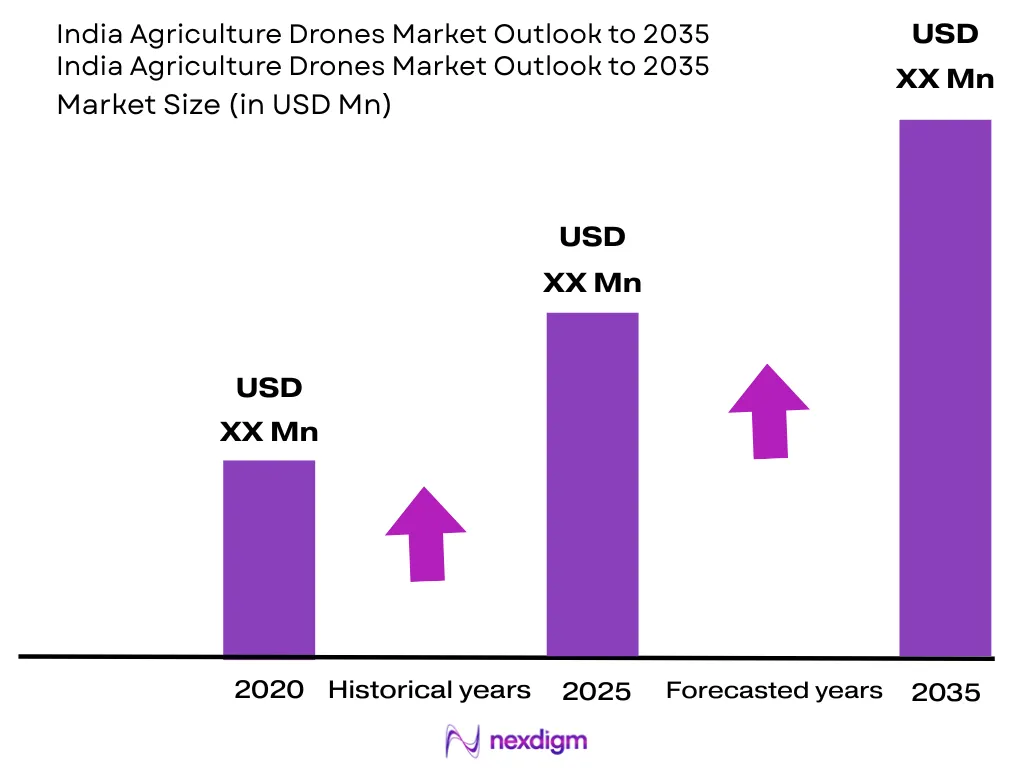
The India Agriculture Drones Market is valued at approximately USD ~ Million, supported by rapid agricultural mechanization and government-backed drone adoption initiatives. According to the Ministry of Agriculture & Farmers Welfare, India produced more than 330 million metric tonnes of food grains and over 350 million metric tonnes of horticulture produce, while agriculture supported nearly 146 million operational holdings. The Drone Didi Scheme, Sub-Mission on Agricultural Mechanization (SMAM), and increasing demand for precision spraying, crop monitoring, and field mapping are accelerating drone deployment across Indian farms.
Market Segmentation
By Drone Type
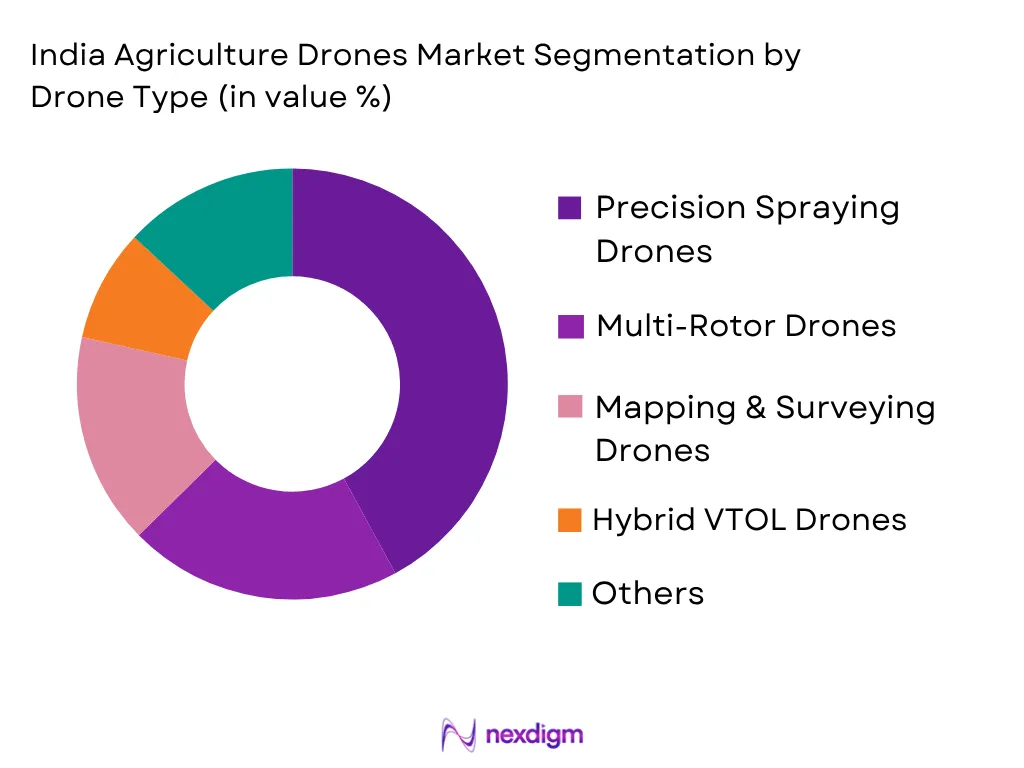
India Agriculture Drones Market is segmented by drone type into Spraying Drones, Mapping & Surveying Drones, Fixed-Wing Drones, Multi-Rotor Drones, Hybrid VTOL Drones, and AI-Enabled Autonomous Drones. Recently, Spraying Drones have held the dominant market share due to their direct impact on reducing labor dependency and improving operational efficiency. Indian agriculture faces seasonal labor shortages and increasing costs associated with manual pesticide application. Spraying drones enable faster and more uniform application of pesticides, fertilizers, and micronutrients while reducing chemical exposure for farm workers. Government subsidy programs and demonstration projects have further increased awareness regarding spraying drone benefits. Their ability to cover large agricultural areas within a shorter time frame compared to conventional methods has strengthened adoption among farmers cultivating paddy, cotton, sugarcane, wheat, and horticulture crops. As precision agriculture continues expanding across India, spraying drones remain the most commercially utilized segment within the market.
By Application
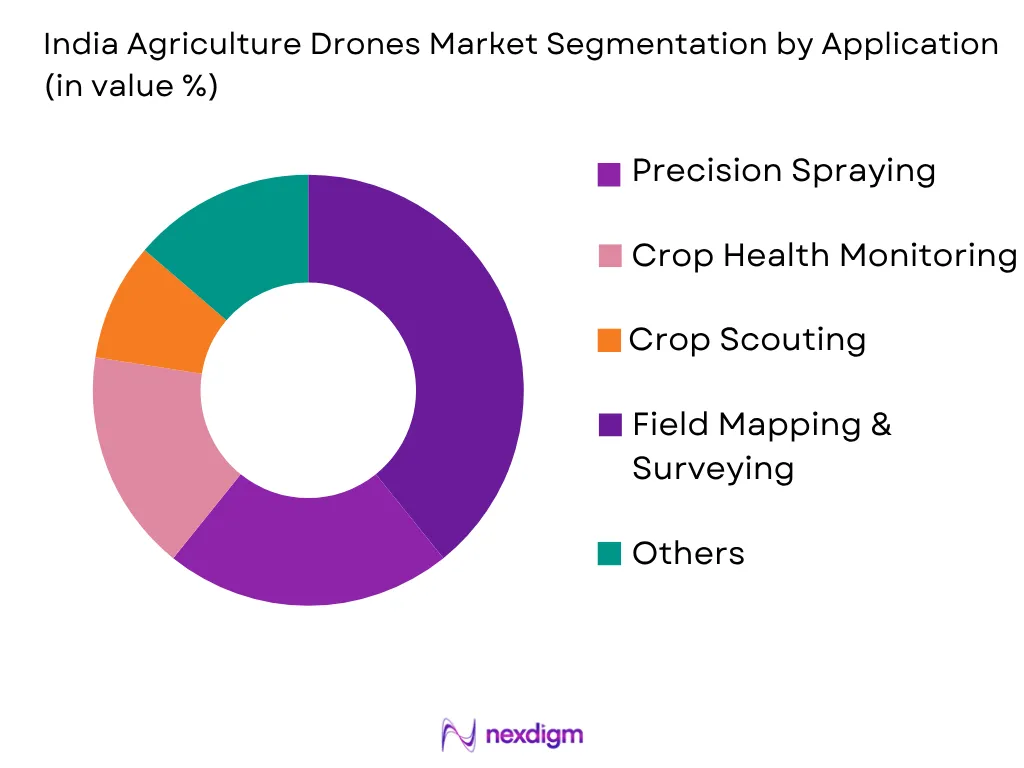
India Agriculture Drones Market is segmented by application into Precision Spraying, Crop Health Monitoring, Field Mapping & Surveying, Crop Scouting, Irrigation Monitoring, Seed Broadcasting, Fertilizer Application, Soil Analysis, Crop Damage Assessment, and Livestock Monitoring. Recently, Precision Spraying has emerged as the dominant application segment. The segment’s dominance is attributed to the immediate economic benefits delivered through optimized agrochemical usage and labor savings. Precision spraying drones enable targeted application of pesticides and fertilizers while reducing wastage and improving field coverage consistency. Farmers increasingly use drone spraying services for crops such as rice, cotton, sugarcane, maize, fruits, and vegetables. Government programs supporting drone deployment have focused heavily on spraying applications due to their measurable productivity benefits. Additionally, service providers offering Drone-as-a-Service solutions have made precision spraying accessible to small and medium-sized farmers who may not be able to purchase drones outright. This combination of affordability, efficiency, and productivity enhancement has supported the segment’s leadership position.
Competitive Landscape
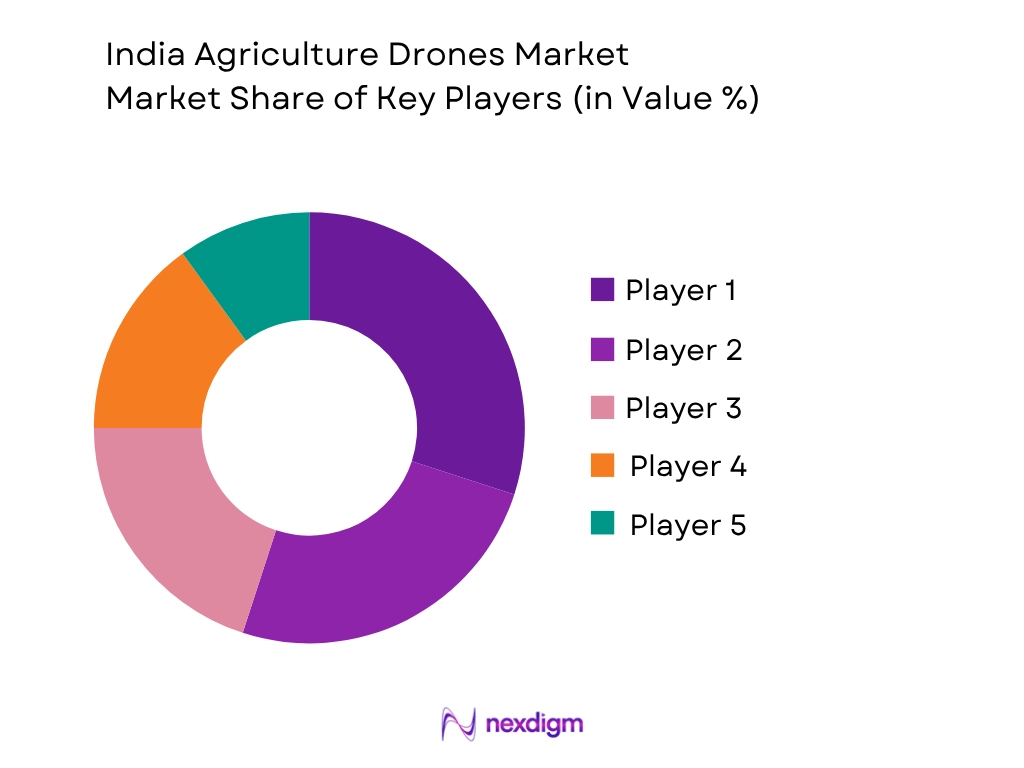
The India Agriculture Drones Market is moderately fragmented, with domestic drone manufacturers, agri-tech startups, and technology providers competing across spraying, mapping, and analytics applications. Government support for indigenous drone manufacturing under Make in India initiatives has strengthened local competition. Market participants are increasingly focusing on payload enhancement, battery efficiency, AI integration, and service network expansion to improve market positioning.
| Company | Establishment Year | Headquarters | Agriculture Drone Portfolio | Max Payload Capacity | Precision Spraying Capability | AI Analytics Integration | India Distribution Network | Precision Agriculture Solutions |
| Garuda Aerospace | 2015 | ~ | ~ | ~ | ~ | ~ | ~ | ~ |
| ideaForge Technology | 2007 | ~ | ~ | ~ | ~ | ~ | ~ | ~ |
| IoTechWorld Avigation | 2017 | ~ | ~ | ~ | ~ | ~ | ~ | ~ |
| General Aeronautics | 2018 | ~ | ~ | ~ | ~ | ~ | ~ | ~ |
| Marut Drones | 2019 | ~ | ~ | ~ | ~ | ~ | ~ | ~ |
India Agriculture Drones Market Analysis
Growth Drivers
Government Support for Agri-Drone Adoption and Agricultural Modernization
Government initiatives aimed at accelerating agricultural mechanization and precision farming are among the strongest growth drivers for the India Agriculture Drones Market. India possesses approximately 156 million hectares of arable land and more than 146 million operational agricultural holdings, according to the Ministry of Agriculture & Farmers Welfare. The agriculture sector contributes significantly to rural employment, supporting over 45% of the country’s workforce. To improve farm productivity and reduce dependence on manual operations, the Government of India has expanded support for drone deployment through initiatives such as the Drone Didi Scheme, Sub-Mission on Agricultural Mechanization, and Kisan Drone programs. More than 15,000 women self-help groups have been identified under the Drone Didi initiative for drone-based agricultural service delivery. Furthermore, India produced over 330 million metric tonnes of food grains and approximately 355 million metric tonnes of horticulture produce, creating substantial demand for efficient crop monitoring and input application technologies. Agricultural drones help improve pesticide spraying accuracy, fertilizer application efficiency, and field surveillance capabilities. The combination of large-scale agricultural activity, government incentives, and increasing focus on digital agriculture continues to accelerate adoption of agricultural drones across multiple farming regions.
Rising Demand for Precision Agriculture and Labor Optimization
The increasing need to improve agricultural productivity while addressing labor shortages is driving demand for agricultural drones across India. According to the Ministry of Statistics and Programme Implementation, agriculture remains one of India’s largest economic sectors, while the country’s population exceeded 1.43 billion people, increasing pressure on food production systems. India harvested more than 115 million tonnes of rice, over 110 million tonnes of wheat, and approximately 435 million tonnes of sugarcane, highlighting the scale of crop production activities. However, seasonal labor shortages and rising farm management complexity have encouraged farmers to adopt mechanized solutions. Agriculture drones enable rapid crop monitoring, precision spraying, crop scouting, and field mapping while significantly reducing manual intervention. Multi-rotor spraying drones can cover substantially larger areas compared to conventional manual spraying methods, improving operational efficiency during critical crop stages. Precision agriculture technologies also support optimized usage of pesticides, fertilizers, and water resources, helping farmers improve productivity while reducing wastage. As Indian agriculture continues transitioning toward data-driven farming practices, demand for drone-based farm management solutions is expected to strengthen significantly across major agricultural states.
Market Challenges
Fragmented Land Holdings and Limited Economies of Scale
One of the key challenges facing the India Agriculture Drones Market is the fragmented structure of agricultural land ownership. According to the Agriculture Census, India has more than 146 million operational holdings, with the average farm size remaining below 1.1 hectares. A large proportion of farmers operate on small and marginal landholdings, which can limit the economic viability of direct drone ownership. Unlike large commercial farms where drone utilization can be maximized across extensive cultivated areas, smaller farms may struggle to generate sufficient operational benefits to justify investments in advanced drone technologies. Furthermore, fragmented plots often create logistical challenges for drone deployment and mission planning. Although service-based business models and custom hiring centers are helping improve accessibility, many farmers continue relying on conventional farming practices due to cost considerations and limited awareness. The widespread presence of smallholder agriculture creates a structural challenge for market expansion, requiring manufacturers and service providers to develop flexible and affordable deployment models. Addressing land fragmentation constraints remains essential for achieving broader penetration of agricultural drone technologies across India’s farming ecosystem.
Limited Technical Expertise and Rural Infrastructure Constraints
The adoption of agricultural drones in India is also constrained by shortages of skilled operators and varying levels of rural technology readiness. Effective drone deployment requires expertise in flight operations, sensor management, data interpretation, crop analytics, and regulatory compliance. However, many agricultural regions continue to face limited access to technical training and digital agriculture resources. India’s rural population remains substantial, with hundreds of millions of people directly or indirectly dependent on agriculture for livelihoods. While smartphone adoption and internet connectivity continue improving, digital literacy levels vary significantly across farming communities. In addition, drone operations often require reliable access to charging infrastructure, maintenance services, software support, and trained pilots. Many agricultural drone users also require assistance in converting aerial imagery into actionable farm management decisions. The shortage of qualified drone operators and precision agriculture specialists can slow adoption rates and reduce utilization efficiency. Expanding training programs, strengthening service networks, and improving rural digital infrastructure will be critical to unlocking the full potential of agricultural drone technologies across India’s diverse agricultural landscape.
Market Opportunities
Expansion of Drone-as-a-Service and Custom Hiring Models
The rapid expansion of Drone-as-a-Service (DaaS) and custom hiring models presents a major opportunity for the India Agriculture Drones Market. Given the country’s more than 146 million agricultural holdings, many farmers prefer accessing advanced technologies through service providers rather than purchasing equipment outright. Custom hiring centers and drone service operators can distribute technology costs across multiple users, making precision agriculture solutions more affordable for small and marginal farmers. The Government of India has actively supported the establishment of custom hiring centers to improve access to agricultural mechanization technologies. Drone service providers offer crop spraying, field mapping, crop health monitoring, and precision agriculture analytics on a pay-per-use basis, reducing financial barriers for adoption. This model is particularly effective in states characterized by fragmented landholdings and diverse cropping patterns. As awareness regarding drone benefits continues increasing, service-based delivery models are expected to play a central role in expanding market penetration. The scalability and affordability of DaaS platforms position them as one of the most significant opportunities within the Indian agricultural drone ecosystem.
Integration of Artificial Intelligence and Precision Farm Analytics
The growing integration of artificial intelligence, machine learning, and advanced analytics technologies creates substantial opportunities for the India Agriculture Drones Market. India cultivates more than 156 million hectares of arable land and produces hundreds of millions of tonnes of agricultural commodities annually. Managing such large-scale agricultural operations requires timely and accurate information regarding crop conditions, pest infestations, nutrient deficiencies, irrigation requirements, and yield potential. Agriculture drones equipped with multispectral, thermal, and RGB imaging sensors generate large volumes of field-level data that can be transformed into actionable insights through AI-powered analytics platforms. These technologies enable predictive crop monitoring, early disease detection, precision input recommendations, and yield forecasting. The Indian government’s emphasis on digital agriculture, AgriStack development, and smart farming initiatives further supports adoption of data-driven agricultural solutions. As farmers increasingly seek tools that improve decision-making and resource efficiency, integrated drone analytics platforms will become an important component of precision agriculture ecosystems. This convergence of drones, artificial intelligence, and farm intelligence technologies represents a significant long-term growth opportunity for the market.
Future Outlook
The India Agriculture Drones Market is expected to witness strong growth over the coming decade due to increasing mechanization, precision agriculture adoption, and government support for drone-enabled farming. Expanding subsidy programs, custom hiring centers, and Drone-as-a-Service models are likely to improve accessibility for small and medium-sized farmers. Advances in artificial intelligence, automated flight planning, multispectral imaging, and data analytics are expected to expand application areas beyond spraying into farm intelligence and predictive agriculture. Continued emphasis on food security and productivity enhancement will support sustained market growth.
Major Players
- Garuda Aerospace
- ideaForge Technology
- IoTechWorld Avigation
- General Aeronautics
- Asteria Aerospace
- Dhaksha Unmanned Systems
- Paras Aerospace
- Marut Drones
- Aero360
- Thanos Technologies
- BharatRohan Airborne Innovations
- Skylark Drones
- TSAW Drones
- AgriFly Innovations
- DroneAcharya Aerial Innovations
Key Target Audience
- Agriculture Drone Manufacturers
- Agri-Tech Solution Providers
- Farmer Producer Organizations (FPOs)
- Agricultural Cooperatives
- Precision Agriculture Service Providers
- Agrochemical Companies
- Investments and Venture Capitalist Firms
- Government and Regulatory Bodies (Ministry of Agriculture & Farmers Welfare, DGCA, ICAR, Department of Agriculture & Farmers Welfare)
Research Methodology
Step 1: Identification of Key Variables
The initial phase involves constructing an ecosystem map covering all major stakeholders within the India Agriculture Drones Market. Extensive secondary research is conducted through government publications, agricultural databases, drone regulations, industry reports, and company disclosures. The objective is to identify key variables influencing adoption rates, investment trends, regulatory developments, and competitive positioning.
Step 2: Market Analysis and Construction
Historical data related to agricultural mechanization, drone deployment, precision agriculture adoption, and service provider activity is compiled and analyzed. Demand-side and supply-side assessments are conducted to estimate market performance across applications, crop types, and regions. Segment-level analysis is further validated through operational benchmarks and adoption patterns.
Step 3: Hypothesis Validation and Expert Consultation
Market hypotheses are developed and validated through computer-assisted telephone interviews (CATIs) with drone manufacturers, agricultural experts, agronomists, distributors, service providers, and government stakeholders. These consultations provide valuable insights into operational realities, adoption barriers, technology trends, and competitive dynamics.
Step 4: Research Synthesis and Final Output
The final phase involves integrating primary and secondary research findings through data triangulation techniques. Market estimates, segmentation structures, competitive assessments, and future outlook assumptions are verified and refined. This process ensures a comprehensive, reliable, and validated assessment of the India Agriculture Drones Market.

- Executive Summary
- Research Methodology (Market Definitions and Assumptions, Abbreviations, Market Sizing Approach, Top-Down Analysis, Bottom-Up Analysis, Demand-Side Assessment, Supply-Side Assessment, Precision Agriculture Ecosystem Analysis, Primary Industry Interviews, Data Triangulation, Forecasting Framework, Limitations and Future Conclusions)

- Definition and Scope
- Market Evolution and Industry Genesis
- Timeline of Major Industry Developments
- Agriculture Drone Industry Value Chain Analysis
- Supply Chain Analysis

- Growth Drivers (Drone Didi Scheme Expansion, Precision Farming Adoption, Labor Shortage in Agriculture, Government Subsidies for Agri-Drones, Increasing Mechanization of Farming)
- Market Challenges (High Initial Investment Requirements, Limited Farmer Awareness, Regulatory Compliance Requirements, Fragmented Land Holdings, Battery Endurance Constraints)
- Market Opportunities (Custom Hiring Center Expansion, AI-Based Farm Analytics, Precision Spraying Adoption, Drone-as-a-Service Growth, Smart Agriculture Programs)
- Market Trends (Autonomous Flight Planning, Precision Input Application, AI-Driven Crop Monitoring, Indigenous Drone Manufacturing, Integration with Digital Agriculture Platforms)
- Government Regulations (DGCA Drone Rules, Agriculture Ministry Agri-Drone Guidelines, PLI Scheme Support, Drone Certification Standards, NPNT Compliance Requirements)
- SWOT Analysis
- Porter’s Five Forces Analysis
- PESTLE Analysis
- Competitive Ecosystem

- By Market Value (2020-2025)
- By Volume (2020-2025)
- By Average Selling Price (2020-2025)

- By Drone Type (In Value %)
Spraying Drones
Mapping & Surveying Drones
Fixed-Wing Drones
Multi-Rotor Drones
Hybrid VTOL Drones
AI-Enabled Autonomous Drones - By Application (In Value %)
Crop Health Monitoring
Precision Spraying
Crop Scouting
Field Mapping & Surveying
Soil & Field Analysis
Irrigation Monitoring
Seed Broadcasting
Fertilizer Application
Crop Damage Assessment
Livestock Monitoring - By Crop Type (In Value %)
Cereals & Grains
Rice
Wheat
Sugarcane
Cotton
Fruits & Vegetables
Oilseeds & Pulses
Plantation Crops
Horticulture Crops
Tea & Coffee Plantations - By Region (In Value %)
North India
South India
East India
West India
Central India
Northeast India - By End User (In Value %)
Farmer Producer Organizations (FPOs)
Agricultural Cooperatives
Agri-Tech Service Providers
Custom Hiring Centers
Government Agriculture Departments
Research Farms and Demonstration Projects

- Market Share of Major Players (By Value, Units Sold, Application Segment, Region, Business Model)
- Cross Comparison Parameters (Payload Capacity Range, Precision Spraying Efficiency, Indigenous Manufacturing Capability, AI & Analytics Integration, Service Network Reach, Battery Endurance Performance, DGCA Certification Status, Drone-as-a-Service Capability)
- SWOT Analysis of Major Players
- Pricing Analysis by Payload Capacity and Application Type
- Detailed Profiles of Major Companies
Garuda Aerospace
ideaForge Technology
IoTechWorld Avigation
General Aeronautics
Asteria Aerospace
Dhaksha Unmanned Systems
Paras Aerospace
Marut Drones
Aero360
Thanos Technologies
BharatRohan Airborne Innovations
Skylark Drones
TSAW Drones
AgriFly Innovations
DroneAcharya Aerial Innovations

- Market Demand and Utilization Analysis (Flights per Acre, Spraying Frequency, Drone Utilization Rate, Seasonal Demand Trends)
- Farmer Adoption Assessment (Farm Size, Technology Readiness, Mechanization Level, Digital Literacy)
- Purchasing Power and Budget Allocation Analysis (Farm Expenditure, Mechanization Investments, Technology Spending Capacity)
- Regulatory Compliance Assessment (Drone Registration, Pilot Certification, Operational Permissions)
- Needs, Desires and Pain Point Analysis (Labor Availability, Input Cost Reduction, Yield Optimization, Farm Monitoring Efficiency)

- By Market Value (2026-2035)
- By Volume (2026-2035)
- By Average Selling Price (2026-2035)


 Request a Sample
 Ask for Customization
 Get a Quote
 Enquire Now