

 Download PDF
 Download PDF
Market Overview
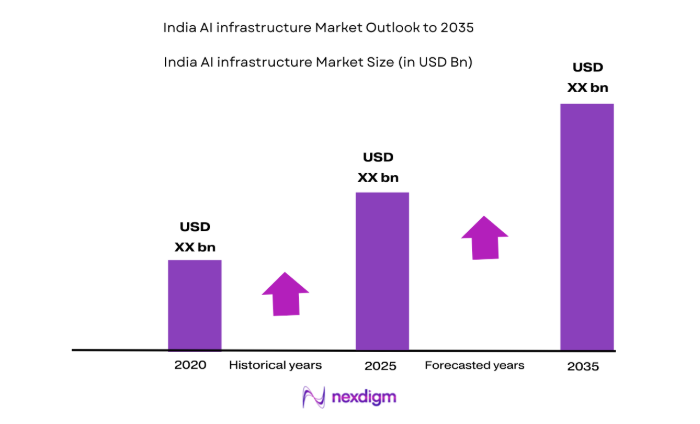
India AI infrastructure market reached approximately USD ~ billion based on a recent historical assessment, supported by rapid hyperscale data center investments, sovereign AI compute initiatives, and enterprise deployment of GPU-accelerated platforms. Demand is driven by large language model training workloads, cloud AI service expansion, and telecom edge modernization programs. Government incentives for semiconductor manufacturing and data center infrastructure, alongside rising enterprise AI adoption across finance, healthcare, and manufacturing sectors, further accelerate capital inflows into AI compute, storage, and high-performance networking systems.
Major metropolitan clusters such as Mumbai, Chennai, Hyderabad, and Delhi NCR dominate the India AI infrastructure market due to dense fiber connectivity, subsea cable landing stations, and concentration of hyperscale and colocation data centers. Mumbai leads through financial and cloud ecosystems, while Chennai benefits from international connectivity and land availability for large campuses. Hyderabad and Bengaluru attract enterprise AI deployments due to technology workforce depth and global capability centers, reinforcing regional infrastructure concentration and ecosystem maturity.
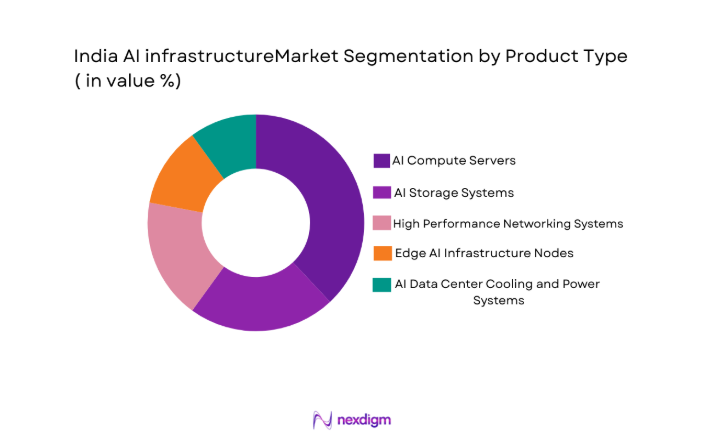
By Product Type
By Product Type: India AI infrastructure market is segmented by product type into AI compute servers, AI storage systems, high performance networking systems, edge AI infrastructure nodes, and AI data center cooling and power systems. Recently, AI compute servers has a dominant market share due to concentration of GPU and accelerator clusters required for AI model training, inference workloads, and hyperscale cloud deployments across enterprise and telecom environments.
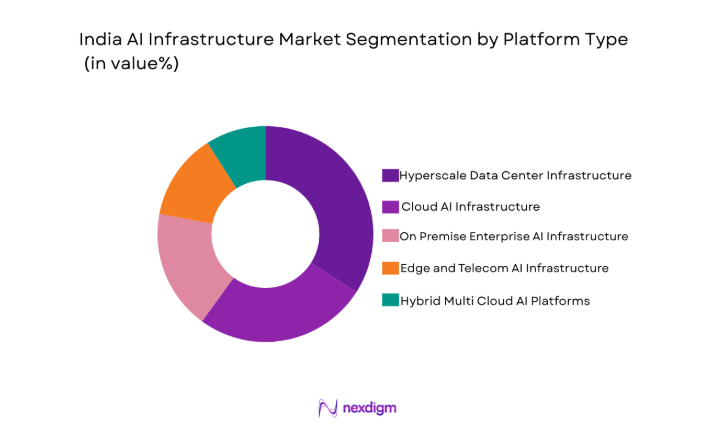
By Platform Type
By Platform Type: India AI infrastructure market is segmented by platform type into cloud AI infrastructure, on premise enterprise AI infrastructure, hyperscale data center infrastructure, edge and telecom AI infrastructure, and hybrid multi cloud AI platforms. Recently, hyperscale data center infrastructure has a dominant market share due to factors such as demand patterns, brand presence, infrastructure availability, or consumer preference.
Competitive Landscape
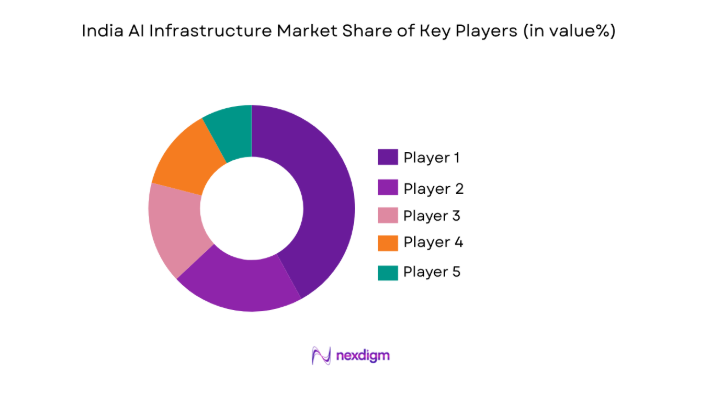
India AI infrastructure market shows moderate consolidation with large telecom operators, hyperscale cloud providers, and specialized data center firms controlling major deployments while enterprise integrators and GPU cloud startups expand niche segments. Strategic partnerships between global semiconductor vendors and domestic infrastructure providers shape technology adoption, while colocation operators scale multi-city campuses. Capital intensity and access to power and land create entry barriers, reinforcing dominance of established infrastructure players.
| Company Name | Establishment Year | Headquarters | Technology Focus | Market Reach | Key Products | Revenue | Data Center Capacity |
| Reliance Jio Platforms | 2007 | Mumbai, India | ~ | ~ | ~ | ~ | ~ |
| Tata Communications | 1986 | Mumbai, India | ~ | ~ | ~ | ~ | ~ |
| NTT Global Data Centers India | 1989 | Mumbai, India | ~ | ~ | ~ | ~ | ~ |
| ST Telemedia Global Data Centres India | 2004 | Singapore | ~ | ~ | ~ | ~ | ~ |
| Yotta Infrastructure | 2019 | Mumbai, India | ~ | ~ | ~ | ~ | ~ |
India AI Infrastructure Market Analysis
Growth Drivers
Hyperscale AI Compute Expansion and Sovereign Cloud Investments
India AI infrastructure market growth is strongly influenced by rapid hyperscale AI compute expansion and sovereign cloud investments driven by national digital sovereignty priorities and enterprise AI adoption acceleration. Large domestic conglomerates and global hyperscale providers are deploying multi-gigawatt data center campuses equipped with GPU-dense clusters optimized for artificial intelligence workloads including generative models, recommendation engines, and real-time analytics platforms. Sovereign cloud initiatives by government agencies and regulated sectors such as finance and public administration require domestically hosted AI infrastructure with secure compute and storage, significantly expanding demand for localized AI hardware deployment. Telecom operators integrating AI workloads into 5G edge sites also expand distributed compute requirements across metropolitan and industrial zones, creating additional infrastructure layers beyond centralized hyperscale campuses. Enterprises across banking, healthcare, retail, and manufacturing sectors are migrating from conventional analytics environments to AI-accelerated compute platforms to support automation, predictive modeling, and cognitive applications. This shift increases procurement of GPU servers, high-bandwidth networking fabrics, and AI-optimized storage architectures at enterprise and colocation facilities. Government semiconductor manufacturing incentives and data center infrastructure policies reduce capital barriers and attract foreign direct investment into AI infrastructure supply chains. The convergence of sovereign compute policies, hyperscale expansion strategies, and enterprise AI transformation programs creates sustained demand growth for high-performance AI infrastructure assets nationwide.
Enterprise AI Adoption Across Regulated and Digital Native Industries
India AI infrastructure market expansion is further driven by accelerating enterprise AI adoption across regulated industries and digital native sectors seeking scalable high-performance computing environments for advanced analytics and automation. Financial institutions deploy AI infrastructure for fraud detection, risk modeling, algorithmic trading, and customer intelligence systems that require high-throughput compute clusters and low-latency data processing architectures. Healthcare organizations adopt AI platforms for medical imaging analysis, genomics research, and hospital operations optimization, generating demand for secure high-density compute and compliant storage infrastructure within domestic data centers. Manufacturing enterprises implement AI-enabled predictive maintenance, quality inspection, and robotics control systems that rely on edge AI infrastructure integrated with plant automation networks. Retail and e-commerce platforms utilize recommendation engines, personalization algorithms, and logistics optimization models requiring scalable GPU cloud and AI training clusters hosted in hyperscale facilities. Digital native startups developing generative AI applications, conversational platforms, and autonomous systems create incremental demand for AI infrastructure as a service offerings from domestic providers. Government digital public infrastructure initiatives incorporating AI services for governance, agriculture advisory, and citizen platforms further expand compute requirements across public sector agencies. Workforce digitalization and data availability growth enable enterprises to operationalize AI at scale, reinforcing continuous investment in AI compute, storage, and networking capacity across sectors.
Market Challenges
Power Availability Constraints and Energy Intensity of AI Data Centers
India AI infrastructure market faces significant constraints from power availability limitations and high energy intensity of AI data centers that require uninterrupted high-capacity electricity supply and advanced cooling systems to sustain dense GPU clusters. AI workloads consume substantially higher power per rack compared with conventional computing, increasing electricity demand concentration in urban data center clusters already experiencing grid stress and transmission bottlenecks. Many metropolitan regions with strong connectivity and demand density also face land and power allocation challenges, delaying hyperscale campus approvals and limiting expansion pace for AI infrastructure operators. Renewable energy integration for data centers remains constrained by intermittency, storage limitations, and transmission infrastructure gaps, complicating sustainability targets and cost optimization for operators deploying energy-intensive AI clusters. High ambient temperatures in several Indian regions increase cooling loads and reduce operational efficiency of conventional air-cooled data centers, necessitating investment in liquid cooling technologies and advanced thermal management systems. Electricity pricing volatility and cross-subsidization policies raise operational costs for data center operators and AI infrastructure providers, affecting long-term investment predictability. Grid reliability and outage risks in certain zones require redundant power systems and backup generation capacity, increasing capital expenditure and operational complexity of AI infrastructure facilities. The combined effect of energy intensity, grid constraints, and cooling demands creates structural challenges for scaling AI infrastructure deployment at the pace required by national digital transformation initiatives.
Dependence on Imported Accelerators and Semiconductor Supply Chains
India AI infrastructure market also encounters challenges from heavy dependence on imported accelerators, GPUs, and semiconductor components that form the core of AI compute systems, exposing infrastructure deployment to global supply chain disruptions and pricing volatility. Advanced AI chips and high-bandwidth memory modules are largely manufactured in a limited number of global semiconductor hubs, making domestic infrastructure providers vulnerable to geopolitical trade restrictions, export controls, and allocation constraints affecting availability of high-performance accelerators. Import dependency increases procurement lead times and cost variability for AI servers and networking equipment, complicating capacity planning for hyperscale and enterprise infrastructure projects. Currency fluctuations and import duties further elevate acquisition costs of GPU clusters and specialized AI hardware, impacting capital expenditure efficiency and service pricing for AI infrastructure providers. Limited domestic semiconductor fabrication and packaging capabilities restrict localization of AI hardware manufacturing, preventing supply chain resilience and cost optimization in the near term. Global demand surges driven by generative AI adoption intensify competition for advanced chips, often prioritizing established hyperscale markets over emerging economies, thereby constraining timely deployment in India. Integration and maintenance of imported AI hardware also depend on specialized technical expertise and vendor support ecosystems that remain limited domestically. These factors collectively create structural supply chain risks that slow scaling of AI infrastructure capacity and increase dependence on external technology ecosystems.
Opportunities
Domestic Sovereign AI Cloud and National Compute Platforms
India AI infrastructure market presents substantial opportunity through development of domestic sovereign AI cloud and national compute platforms designed to provide secure, compliant, and scalable AI computing resources for government and regulated sectors. Sovereign AI infrastructure enables sensitive data processing within national jurisdiction, supporting public administration, defense analytics, financial supervision, and healthcare data initiatives that require strict data residency and security controls. Government-supported national compute programs and public cloud frameworks create anchor demand for domestic AI infrastructure providers to deploy large GPU clusters and high-performance storage systems across multiple regions. Domestic hyperscale and telecom operators can leverage sovereign AI platforms to offer AI-as-a-service solutions tailored to regulated industries, expanding service portfolios and utilization rates of AI infrastructure assets. Localization of AI compute environments also supports development of indigenous AI models trained on domestic datasets, enhancing technological self-reliance and reducing dependence on foreign cloud providers. Public procurement programs and digital public infrastructure initiatives incorporating AI capabilities provide long-term predictable demand for sovereign compute resources hosted within national data centers. Collaboration between government agencies, research institutions, and infrastructure providers can accelerate development of national AI supercomputing networks distributed across strategic locations. The emergence of sovereign AI cloud ecosystems thus represents a strategic growth avenue for domestic infrastructure expansion and technological autonomy.
Edge AI Infrastructure for Smart Cities and Industrial Automation
India AI infrastructure market holds major opportunity in deployment of edge AI infrastructure supporting smart city systems, industrial automation, and real-time analytics applications that require low-latency compute near data generation points. Smart urban infrastructure such as traffic management, surveillance analytics, environmental monitoring, and public safety platforms generate continuous data streams requiring localized AI processing nodes integrated with municipal networks and telecom edge facilities. Industrial sectors including manufacturing, energy, and logistics increasingly deploy AI-enabled robotics, predictive maintenance, and autonomous control systems that rely on edge compute clusters embedded within plants and operational sites. Expansion of 5G networks and private industrial connectivity enables distributed AI infrastructure deployment across transportation corridors, ports, and industrial zones, extending compute beyond centralized data centers. Telecom operators can monetize edge AI platforms by offering localized compute services for enterprises requiring real-time processing and data sovereignty at operational sites. Integration of edge AI with national digital infrastructure programs in agriculture, mobility, and urban governance expands demand for distributed compute nodes across rural and semi-urban regions. Advances in compact AI accelerators and ruggedized edge hardware enable cost-effective deployment in diverse environmental conditions. This distributed infrastructure paradigm complements hyperscale AI data centers and opens new revenue streams for infrastructure providers across sectors.
Future Outlook
India AI infrastructure market is expected to expand rapidly over the next five years supported by hyperscale campus construction, sovereign AI initiatives, and enterprise adoption of generative AI platforms. Advances in liquid cooling, accelerator efficiency, and edge computing architectures will improve scalability and energy performance. Government semiconductor and data center incentives will strengthen domestic supply chains. Rising AI workloads across public and private sectors will sustain investment momentum in compute, storage, and networking capacity nationwide.
Major Players
- Reliance Jio Platforms
- Tata Communications
- CtrlSDatacenters
- NTT Global Data Centers India
- ST Telemedia Global Data Centres India
- AdaniConneX
- Yotta Infrastructure
- Sify Technologies
- Netmagic Solutions
- HCLTech
- Wipro
- Tata Consultancy Services
- Amazon Web Services India
- Microsoft India
- Google Cloud India
Key Target Audience
- Hyperscale cloud providers
- Telecom operators
- Data center developers
- Enterprise IT infrastructure buyers
- Semiconductor and hardware vendors
- Investments and venture capitalist firms
- Government and regulatory bodies
- Colocation service providers
Research Methodology
Step 1: Identification of Key Variables
Key supply and demand variables including data center capacity, GPU deployments, enterprise AI adoption, and policy incentives were identified. Infrastructure segmentation across compute, storage, networking, and edge platforms defined analytical boundaries. Macroeconomic and technology indicators influencing AI infrastructure investment were mapped.
Step 2: Market Analysis and Construction
Market sizing integrated capital expenditure data from data center operators, hyperscale investments, and enterprise AI infrastructure spending. Segment allocation used deployment patterns across system types and platforms. Capacity additions, technology mix, and geographic distribution informed market structure modeling.
Step 3: Hypothesis Validation and Expert Consultation
Industry experts from data center operators, telecom providers, and AI hardware vendors validated adoption trends and deployment trajectories. Policy and regulatory assumptions were cross-checked with infrastructure and digital economy frameworks. Competitive positioning and technology evolution assumptions were refined.
Step 4: Research Synthesis and Final Output
Quantitative and qualitative insights were synthesized into market segmentation, competitive landscape, and growth analysis. Cross-verification ensured consistency across infrastructure categories and end-user sectors. Final outputs integrated strategic, technological, and economic perspectives of AI infrastructure development.

- Executive Summary
- Research Methodology (Definitions, Scope, Industry Assumptions, Market Sizing Approach, Primary & Secondary Research Framework, Data Collection & Verification Protocol, Analytic Models & Forecast Methodology, Limitations & Research Validity Checks)

- Market Definition and Scope
- Value Chain & Stakeholder Ecosystem
- Regulatory / Certification Landscape
- Sector Dynamics Affecting Demand
- Strategic Initiatives & Infrastructure Growth

- Growth Drivers
National AI mission and sovereign compute investments
Rapid hyperscale data center expansion in metro clusters
Enterprise AI adoption across BFSI healthcare and manufacturing
Telecom edge computing rollout with 5G networks
Government incentives for semiconductor and electronics manufacturing - Market Challenges
High capital intensity of GPU and accelerator hardware
Power availability and grid reliability constraints
Data localization and compliance complexities
Cooling and energy efficiency limitations in hot climates
Skilled workforce shortages in AI infrastructure engineering - Market Opportunities
Domestic AI cloud and sovereign compute platforms
Edge AI infrastructure for smart cities and Industry 4.0
Localization of AI hardware manufacturing and assembly - Trends
Shift toward liquid cooled high density AI racks
Rise of GPU cloud and AI infrastructure as a service
Integration of AI infrastructure with telecom edge sites
Adoption of custom accelerators by hyperscalers
Green AI data center design and renewable energy sourcing - Government Regulations & Defense Policy
National AI and data governance frameworks
Data center infrastructure policy and incentives
Semiconductor and electronics manufacturing schemes - SWOT Analysis
- Stakeholder and Ecosystem Analysis
- Porter’s Five Forces Analysis
- Competition Intensity and Ecosystem Mapping

- By Market Value, 2020-2025
- By Installed Units, 2020-2025
- By Average System Price, 2020-2025
- By System Complexity Tier, 2020-2025

- By System Type (In Value%)
AI Compute Servers
AI Storage Systems
High Performance Networking Systems
Edge AI Infrastructure Nodes
AI Data Center Cooling and Power Systems - By Platform Type (In Value%)
Cloud AI Infrastructure
On Premise Enterprise AI Infrastructure
Hyperscale Data Center Infrastructure
Edge and Telecom AI Infrastructure
Hybrid Multi Cloud AI Platforms - By Fitment Type (In Value%)
Greenfield AI Data Centers
Brownfield Data Center Upgrades
Modular AI Infrastructure Deployments
Colocation AI Installations
Embedded Edge AI Systems
By EndUser Segment (In Value%)
Hyperscale Cloud Providers
Telecom and Digital Service Providers
Government and Public Sector Agencies
Large Enterprises and GCCs
AI Native Startups and Research Institutions - By Procurement Channel (In Value%)
Direct OEM Procurement
System Integrator Contracts
Cloud Marketplace Procurement
Government Tender Procurement
Colocation and Managed Service Procurement - By Material / Technology (in Value %)
GPU Accelerated Computing
Custom AI ASIC and Accelerators
High Bandwidth Memory Systems
Liquid Cooling Technologies
Silicon Photonics Interconnects

- Market structure and competitive positioning
Market share snapshot of major players - Cross Comparison Parameters (Compute Capacity, Data Center Scale, Accelerator Portfolio, Cooling Technology, Network Throughput, Edge Presence, Service Model, Energy Efficiency, Localization Strategy)
- SWOT Analysis of Key Competitors
- Pricing & Procurement Analysis
- Key Players
Reliance Jio Platforms
Tata Communications
CtrlS Datacenters
NTT Global Data Centers India
ST Telemedia Global Data Centres India
AdaniConneX
Yotta Infrastructure
Sify Technologies
Netmagic Solutions
HCLTech
Wipro
Tata Consultancy Services
Amazon Web Services India
Microsoft India
Google Cloud India

- Hyperscalers driving largest scale AI compute deployments
- Telecom operators integrating edge AI with 5G networks
- Government demand for sovereign and secure AI infrastructure
- Enterprises adopting private and hybrid AI environments

- Forecast Market Value, 2026-2035
- Forecast Installed Units, 2026-2035
- Price Forecast by System Tier, 2026-2035
- Future Demand by Platform, 2026-2035


 Request a Sample
 Ask for Customization
 Get a Quote
 Enquire Now