

 Download PDF
Market Overview
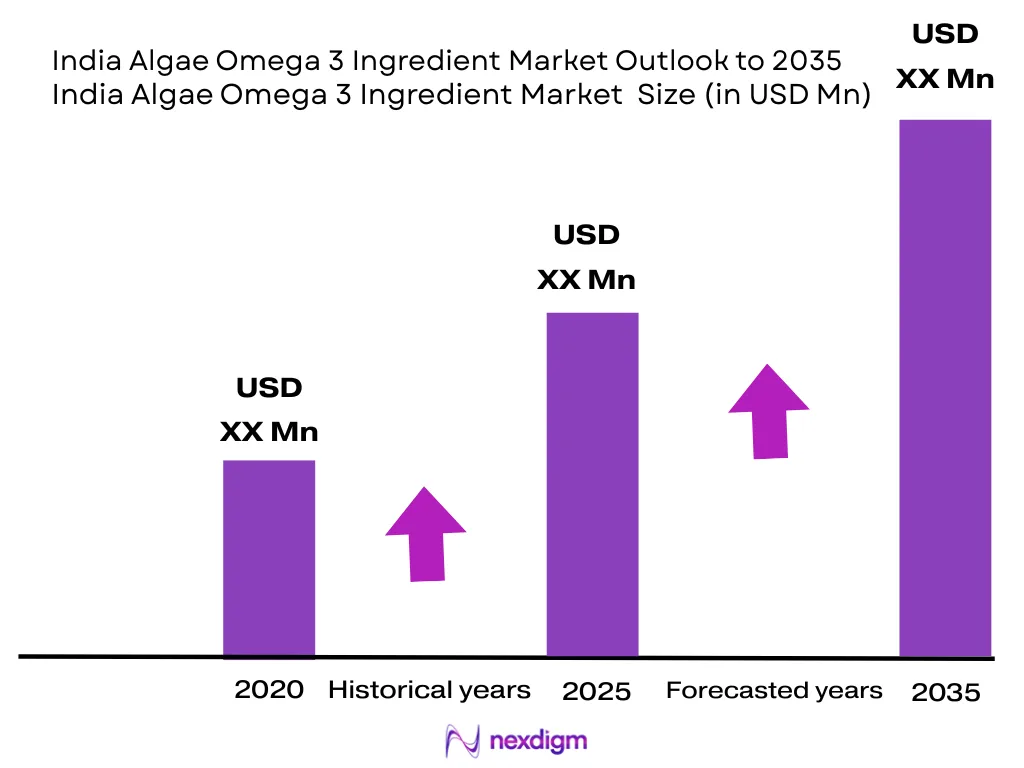
The India Algae Omega 3 Ingredient Market operates as an emerging plant-based sub-segment within India’s broader omega-3 ecosystem. The India omega-3 market is valued at USD ~ million, while the global algae omega-3 ingredient market is valued at USD ~ billion. Demand is driven by vegetarian omega-3 supplements, algal DHA capsules, fish-free EPA/DHA blends, prenatal DHA, pediatric nutrition, senior cognition products, functional foods, pet supplements and aquafeed fortification. The forecasted CAGR benchmark for algae omega-3 ingredients is 11.6% for 2026–203 Maharashtra, Gujarat, Karnataka, Delhi NCR, Telangana, Andhra Pradesh and Tamil Nadu dominate the India Algae Omega 3 Ingredient Market because they combine nutraceutical manufacturing, ingredient imports, softgel production, e-commerce supplement brands, pharmacy distribution, aquafeed demand and wellness-oriented urban consumers. Mumbai and Ahmedabad support ingredient import and contract manufacturing, Bengaluru supports digital health and supplement brands, Hyderabad and Andhra Pradesh support aquafeed demand, and Delhi NCR supports premium retail and pharmacy-led nutrition. These locations are commercially important because algae omega-3 ingredients are largely imported, technically validated and converted into finished supplements by specialized manufacturers.
Market Segmentation
By Type
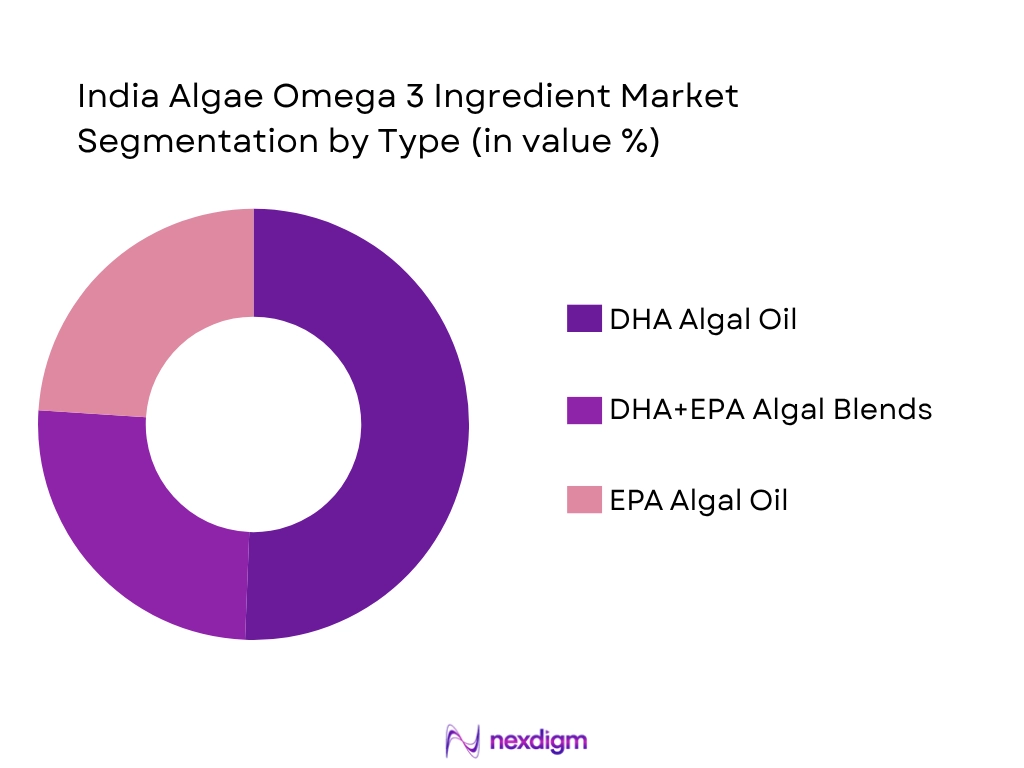
India Algae Omega 3 Ingredient Market is segmented by type into DHA algal oil, DHA+EPA algal blends, EPA algal oil and microencapsulated algal omega-3 powders. Recently, DHA algal oil has a dominant market share in India under the segmentation type, due to its strong fit with vegetarian prenatal supplements, pediatric DHA drops, brain-health products, eye-health formulations and infant-oriented nutritional products. DHA is also easier to commercialize than EPA-only algae oil because high-DHA algal strains such as Schizochytrium and Aurantiochytrium have a more established ingredient supply base. Indian brands also prefer DHA-led positioning because vegetarian consumers often reject fish oil softgels, creating a clear white space for algae-based capsules, gummies and liquids. DHA+EPA blends are expanding as fish-oil-equivalent alternatives, but DHA remains dominant because maternal and cognitive health claims are easier to communicate in consumer-facing products.
By Application
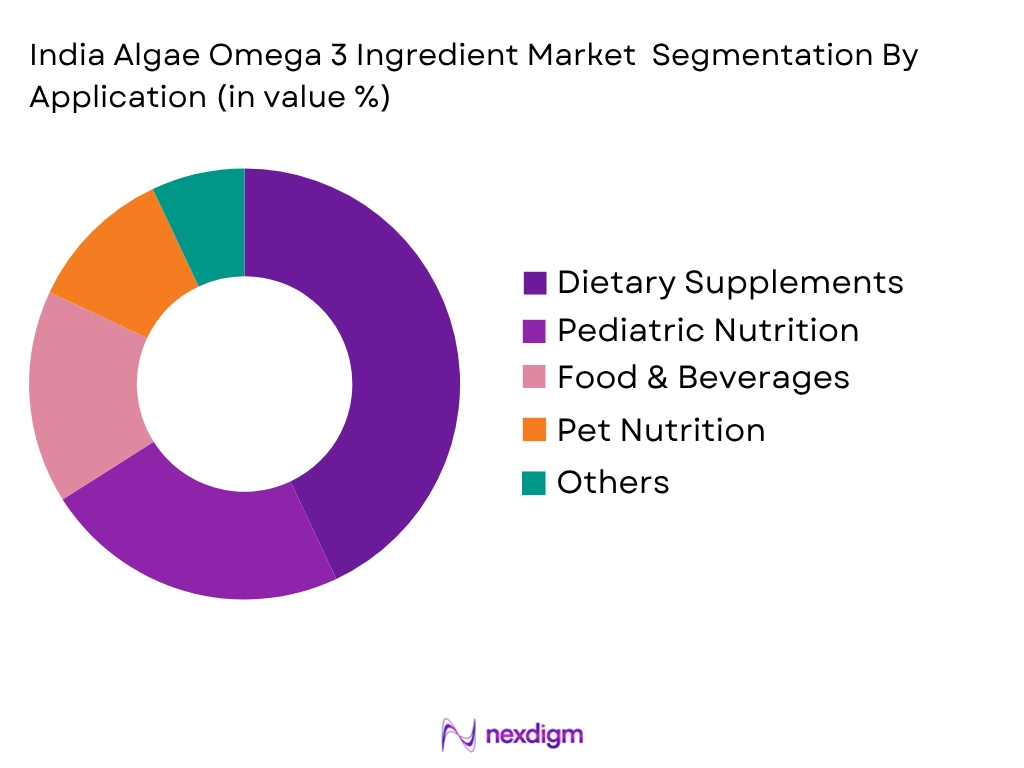
India Algae Omega 3 Ingredient Market is segmented by application into dietary supplements and nutraceuticals, prenatal/maternal/pediatric nutrition, functional food and beverages, pet nutrition, and aquafeed and animal nutrition. Recently, dietary supplements and nutraceuticals have a dominant market share in India under the segmentation application, due to the rapid commercialization of capsules, vegetarian softgels, gummies, drops and e-commerce health products. Supplements are easier to formulate than beverages and fortified foods because dosage, active DHA/EPA declaration, packaging, sensory masking and shelf-life control are more manageable. Nutraceutical brands also benefit from India’s large vegetarian consumer base, where fish-free omega-3 has a stronger label proposition than conventional fish oil. Prenatal and pediatric nutrition remain high-value applications, but qualification requirements, safety documentation, stability testing and regulatory compliance increase commercialization timelines. Aquafeed and pet nutrition are emerging as future white-space applications.
Competitive Landscape
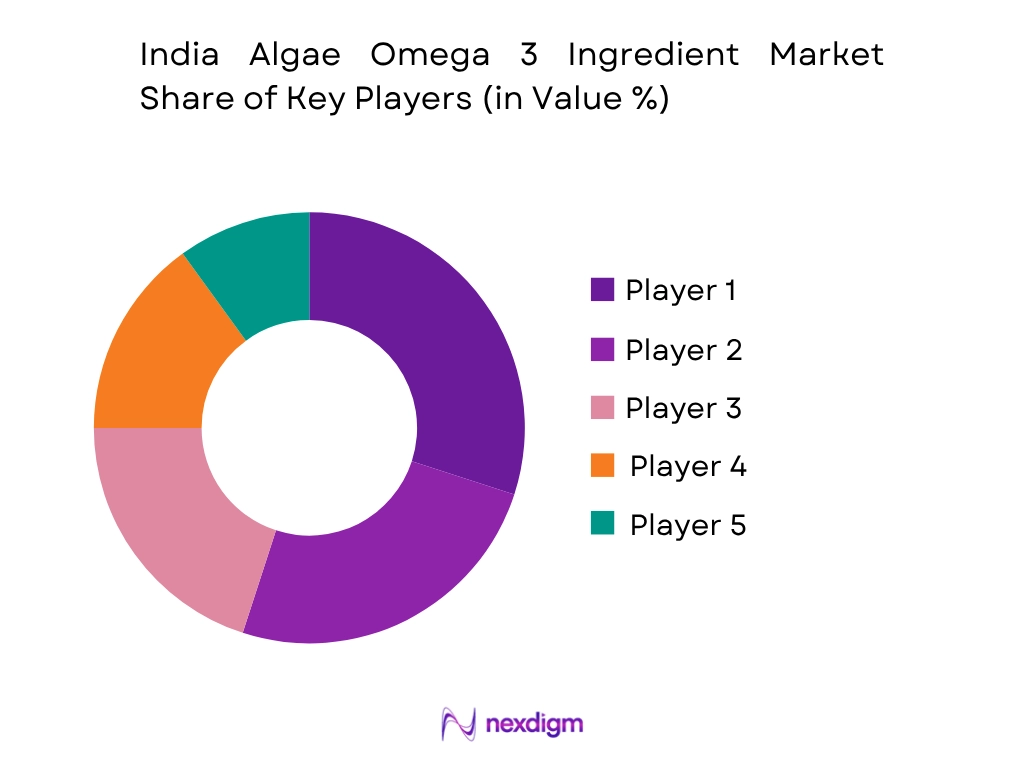
The India Algae Omega 3 Ingredient Market is import-led and supplier-concentrated, with global ingredient companies supplying DHA/EPA oils, powders and blends through Indian importers, distributors and contract manufacturers. dsm-firmenich, Corbion, BASF, Fermentalg and DIC Corporation hold strategic relevance because they provide branded algal DHA/EPA ingredients, regulatory documentation, technical support and formulation compatibility across supplements, infant nutrition, foods, pet nutrition and aquafeed. Competition is shaped by DHA/EPA potency, vegetarian positioning, FSSAI documentation readiness, oxidative stability, sensory performance, softgel compatibility, microencapsulation capability and availability through Indian B2B channels.
| Company | Establishment Year | Headquarters | Core Ingredient Focus | Production / Technology Platform | Key Applications | India Commercial Route | Regulatory / Quality Strength | Market-Specific Differentiator |
| dsm-firmenich | 2023 | Kaiseraugst, Switzerland / Maastricht, Netherlands | ~ | ~ | ~ | ~ | ~ | ~ |
| Corbion | 1919 | Amsterdam, Netherlands | ~ | ~ | ~ | ~ | ~ | ~ |
| BASF | 1865 | Ludwigshafen, Germany | ~ | ~ | ~ | ~ | ~ | ~ |
| Fermentalg | 2009 | Libourne, France | ~ | ~ | ~ | ~ | ~ | ~ |
| DIC Corporation | 1908 | Tokyo, Japan | ~ | ~ | ~ | ~ | ~ | ~ |
India Algae Omega 3 Ingredient Market Analysis
Growth Drivers
Large consumer economy supports vegetarian DHA/EPA supplement demand
India Algae Omega 3 Ingredient Market is supported by a large consumer base for vegetarian nutraceuticals, prenatal DHA, pediatric drops, cognition supplements and fish-free EPA/DHA products. The World Bank reports India’s population at 1.45 billion, GDP at USD 3.91 trillion, and GDP per capita at USD 2,694.7. These macro indicators support a large downstream base for capsules, gummies, drops and fortified nutrition products. FSSAI also regulates health supplements and nutraceuticals under dedicated standards, creating a formal route for algae-derived DHA/EPA ingredient commercialization in compliant supplement formats.
Maternal, pediatric and senior nutrition create stable DHA application demand
India Algae Omega 3 Ingredient Market benefits from DHA’s application in maternal nutrition, pediatric development, eye-health and healthy-aging formulations. World Bank data shows life expectancy at 72 years, while India’s population aged 65 and above reached 103,691,375 people, creating a large base for senior cognition and eye-health products. India also had 357,277,020 people aged 0–14, supporting pediatric DHA drops, gummies and fortified nutrition formats. Algal DHA is market-specific here because it offers a fish-free source aligned with vegetarian capsule, powder and liquid-drop positioning.
Market Challenges
Regulatory classification increases launch complexity for novel algae-based ingredients
India Algae Omega 3 Ingredient Market faces commercialization complexity because nutraceutical, supplement, functional food and novel food products must follow FSSAI classification, labelling and claims rules. PIB states that FSSAI specified standards for nutraceutical products under the Food Safety and Standards Regulations, 2016, while FSSAI’s updated health supplement and nutraceutical framework includes product categories such as health supplements, nutraceuticals, food for special dietary use, food for special medical purpose, and prebiotic/probiotic foods. In a USD 3.91 trillion economy with 1.45 billion consumers, incorrect category selection can delay algae DHA/EPA launches.
Labelling and vegan/vegetarian claim scrutiny raise compliance burden
India Algae Omega 3 Ingredient Market faces claim and label scrutiny because algae-derived DHA/EPA products are often sold through vegetarian, vegan, fish-free and clean-label positioning. FSSAI’s Labelling and Display requirements mandate pre-packaged food labelling and specify vegetarian/non-vegetarian logo dimensions, including 3 mm, 4 mm, 6 mm and 8 mm circle sizes depending on display-panel area. FSSAI’s Vegan Food Regulations, 2022, require approved vegan foods to carry the specified logo after approval. This creates extra documentation pressure for imported algal oil, capsules, gummies and powders.
Market Opportunities
Aquafeed growth creates a route for algae DHA substitution
India Algae Omega 3 Ingredient Market has an opportunity in aquafeed because algal DHA can support fish-oil replacement, broodstock nutrition, shrimp feed, carp feed and omega-3 enrichment. PIB reported India’s fish production at 184.02 lakh tonnes in 2023–24, and a later official release reported 197.75 lakh tonnes in 2024–25. Inland and aquaculture fish production added 77.71 lakh tonnes during the referenced decade. This creates a practical ingredient opportunity for algae-derived DHA/EPA in feed trials where consistent lipid quality and marine-resource reduction are important.
Ingredient innovation pipeline supports future algae-based nutrition formats
India Algae Omega 3 Ingredient Market has an opportunity in new algae-derived formats because FSSAI’s non-specified food ingredient route shows continuing applications for specialty ingredients. FSSAI’s official status list recorded Algae Protein Powder under process with file number 124/Std/PA/FSSAI/2024, received on 21.12.2024, from an applicant in Mumbai. While this is not an omega-3 oil approval, it demonstrates active regulatory engagement around algae-based food ingredients. Combined with India’s USD 3.91 trillion GDP and 1.45 billion consumer base, this supports future microencapsulated DHA powders, gummies, capsules and fortified nutrition formats.
Future Outlook
Over the next decade, the India Algae Omega 3 Ingredient Market is expected to grow steadily as vegetarian supplements, prenatal DHA, pediatric nutrition, senior cognition products, pet wellness and aquafeed applications expand. The market will benefit from India’s large vegetarian consumer base, rising e-commerce nutraceutical sales, pharmacy-led wellness channels and growing preference for fish-free, non-burping, contaminant-controlled omega-3 products.
The strongest growth pockets will be high-DHA vegetarian capsules, DHA+EPA blends, children’s gummies, microencapsulated powders, prenatal DHA sachets, pet oils and shrimp-feed or fish-feed lipid enrichment. FSSAI compliance will remain central because omega-3 products must meet health supplement, nutraceutical, labelling, claims and food-category requirements. Companies with FSSAI-ready dossiers, stable oils, vegetarian capsule compatibility, importer partnerships and strong technical support will be better positioned.
Major Players
- dsm-firmenich
- Corbion
- BASF
- Fermentalg
- DIC Corporation
- Qualitas Health / iwi
- SourceOne Global Partners
- Mara Renewables Corporation
- Algarithm Ingredients
- Nuseed Nutritional
- Evonik Health Care
- Polaris
- KD Pharma Group
- Croda International
- ADM
Key Target Audience
- Nutraceutical and dietary supplement manufacturers
- Vegetarian softgel, capsule, gummy and powder contract manufacturers
- Prenatal, maternal and pediatric nutrition product manufacturers
- Functional food and beverage manufacturers
- Pet nutrition and veterinary supplement companies
- Aquafeed and animal nutrition manufacturers
- Investments and venture capitalist firms
- Government and regulatory bodies — Food Safety and Standards Authority of India, Ministry of Health and Family Welfare, Ministry of Food Processing Industries, Department of Animal Husbandry and Dairying, Marine Products Export Development Authority, Central Drugs Standard Control Organisation
Research Methodology
Step 1: Identification of Key Variables
The initial phase involves constructing an ecosystem map for the India Algae Omega 3 Ingredient Market, covering algal oil producers, specialty ingredient importers, nutraceutical distributors, supplement manufacturers, vegetarian softgel producers, pediatric nutrition companies, pet nutrition brands and aquafeed formulators. Key variables include DHA/EPA concentration, product form, application type, FSSAI pathway, import dependency, formulation route and channel demand.
Step 2: Market Analysis and Construction
In this phase, historical and current data are compiled from India omega-3 market benchmarks, global algae omega-3 ingredient benchmarks, FSSAI regulations, global supplier portfolios, import-led specialty ingredient channels and application-level adoption. The market is constructed using top-down omega-3 demand and bottom-up formulation mapping across capsules, softgels, powders, gummies, pet oils and aquafeed.
Step 3: Hypothesis Validation and Expert Consultation
Market hypotheses are validated through interviews with ingredient importers, nutraceutical brands, contract manufacturers, regulatory specialists, pet nutrition formulators, aquafeed buyers, pharmacy private-label teams and supplement distributors. These discussions validate DHA dominance, supplement-led adoption, microencapsulation demand, fish-oil substitution barriers, buyer qualification cycles and FSSAI documentation requirements.
Step 4: Research Synthesis and Final Output
The final phase triangulates desk research, regulatory sources, supplier portfolios, expert interviews and application-level assumptions. The output delivers a validated view of India Algae Omega 3 Ingredient Market, including market size context, segmentation, competitive landscape, future outlook, key target audience and methodology for business decision-making.

- Executive Summary
- Research Methodology (Market definitions and assumptions, ingredient inclusion criteria, algal oil versus fish oil exclusion logic, vegetarian DHA/EPA scope, active DHA/EPA content mapping, FSSAI regulatory validation, B2B ingredient route-to-market, nutraceutical manufacturer procurement, contract manufacturing triangulation, infant nutrition application mapping, pet nutrition and aquafeed application mapping, import dependency assessment, distributor interviews, primary research approach, limitations and future conclusions)

- Definition and Scope
- Market Genesis and Evolution
- Timeline of Major Regulatory and Ingredient Developments
- Business Cycle and Commercialization Pathway
- Supply Chain and Value Chain Analysis

- Growth Drivers (Vegetarian supplement demand, nutraceutical consumption, prenatal DHA adoption, senior brain-health positioning, pharmacy retail penetration, e-commerce supplement growth, contaminant concerns in fish oil, sustainability claims, pet wellness premiumization, aquaculture feed modernization)
- Market Challenges (Imported ingredient dependence, exchange-rate volatility, high production cost, FSSAI compliance complexity, limited domestic algae omega-3 scale, sensory masking, oxidation stability, fish oil price competition, limited consumer awareness of algae omega-3, formulation compatibility issues)
- Opportunities (Premium vegetarian omega-3 supplements, high-DHA prenatal formulas, EPA+DHA fish-oil alternatives, pharmacy private labels, microencapsulated powders, gummies, functional beverages, pet supplements, aquafeed lipid replacement, local ingredient distribution partnerships)
- Market Trends (Vegetarian DHA/EPA, fish-free supplements, contaminant-controlled claims, non-GMO positioning, high-potency capsules, gummies and chewables, pharmacy private labels, premium prenatal DHA, e-commerce wellness, pet humanization, aquafeed sustainability, microencapsulated omega-3 powders)
- SWOT Analysis
- PESTLE Analysis
- Porter’s Five Forces

- By Value (2020-2025)
- By Volume (2020-2025)
- By Active DHA/EPA Content (2020-2025)

- By Fatty Acid Type (In Value %)
DHA-Only Algal Oil
EPA-Only Algal Oil
DHA+EPA Algal Blends
High-DHA Specialty Ingredients
Balanced EPA Algal Ingredients - By Product Form (In Value %)
Refined Algal Oil
Microencapsulated Powder
Water-Dispersible Emulsions
Beadlets and Encapsulated Actives
Algae Biomass and Concentrates - By Distribution Channel (In Value %)
Direct Supplier-to-Manufacturer Sales
Specialty Ingredient Importers
Nutraceutical Ingredient Distributors
Contract Manufacturer Procurement
Pharmacy and E-Commerce Private-Label Procurement - By Region (In Value %)
Maharashra
Gujarat
Karnataka
Telangana and Andhra Pradesh
Delhi NCR and North India

- Market Share of Major Players on the Basis of Value and Volume (Ingredient sales value, algal oil volume, active DHA/EPA tonnage, supplement customer contracts, application mix, imported supply contribution)
- Cross Comparison Parameters (DHA/EPA concentration, FSSAI documentation readiness, production technology, source organism, Indian importer/distributor network, product-form capability, oxidative stability and sensory performance, sustainability and traceability credentials)
- SWOT Analysis of Major Players
- Pricing Analysis by Ingredient SKU
- Detailed Profiles of Major Companies
dsm-firmenich
Corbion
BASF
Fermentalg
DIC Corporation
Qualitas Health / iwi
SourceOne Global Partners
Mara Renewables Corporation
Algarithm Ingredients
Nuseed Nutritional
Evonik Health Care
Polaris
KD Pharma Group
ADM

- Nutraceutical Brand Demand and Utilization
- Contract Manufacturer and Softgel Producer Requirements
- Prenatal, Pediatric and Maternal Nutrition Buyer Needs
- Functional Food and Beverage Formulator Needs
- Pet Nutrition and Veterinary Channel Demand

- By Value (2026-2035)
- By Volume (2026-2035)
- By Active DHA/EPA Content (2026-2035)


 Request a Sample
 Ask for Customization
 Get a Quote
 Enquire Now