
 Download PDF
Market Overview
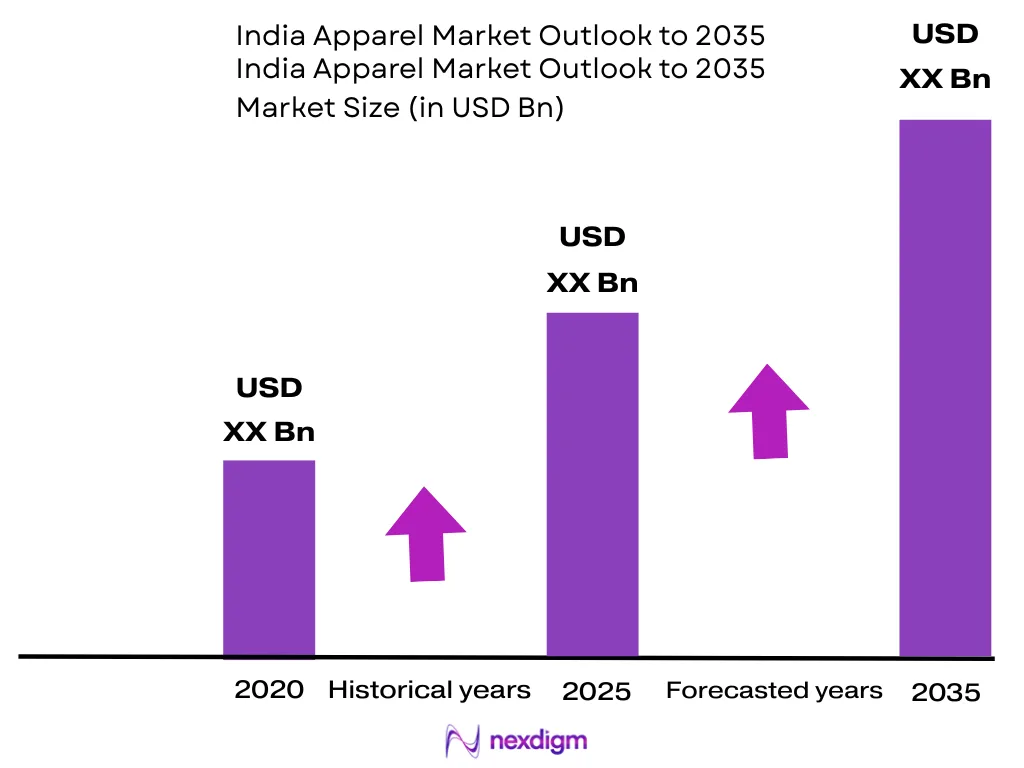
The India apparel market was valued at approximately USD ~ Billion in 2024 and is supported by one of the world’s largest textile and garment ecosystems. According to the Ministry of Textiles and India Brand Equity Foundation (IBEF), India’s textile and apparel sector contributed around USD ~ billion to the economy during FY 2022-23, while textile exports exceeded USD ~ billion. Growth is driven by rising disposable incomes, increasing urbanization, expansion of organized retail, rapid penetration of e-commerce platforms, and growing consumer demand for branded and fashion-oriented apparel across both metropolitan and emerging cities.
Market Segmentation
By Product Type
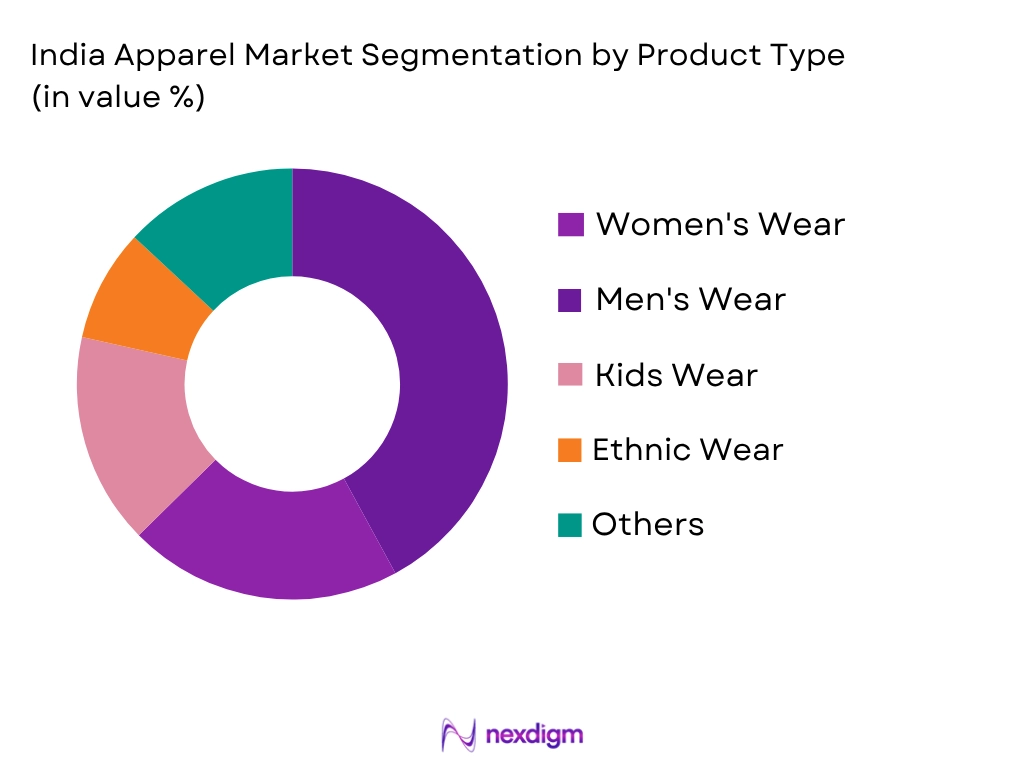
The India apparel market is segmented into women’s wear, men’s wear, kids wear, ethnic wear, sportswear & activewear, and innerwear & loungewear. Women’s wear holds the dominant market position due to the extensive variety of products available across ethnic, western, fusion, casual, formal, and occasion-based categories. The segment benefits from higher purchase frequency compared to other apparel categories, supported by changing fashion trends, increasing workforce participation among women, and growing disposable incomes. The rapid expansion of organized retail chains and online fashion platforms has further enhanced accessibility to premium and affordable fashion options. In addition, seasonal collections, festive purchases, influencer-led fashion marketing, and rising demand for sustainable and designer apparel continue to strengthen the leadership position of women’s wear in India’s apparel industry.
By Distribution Channel
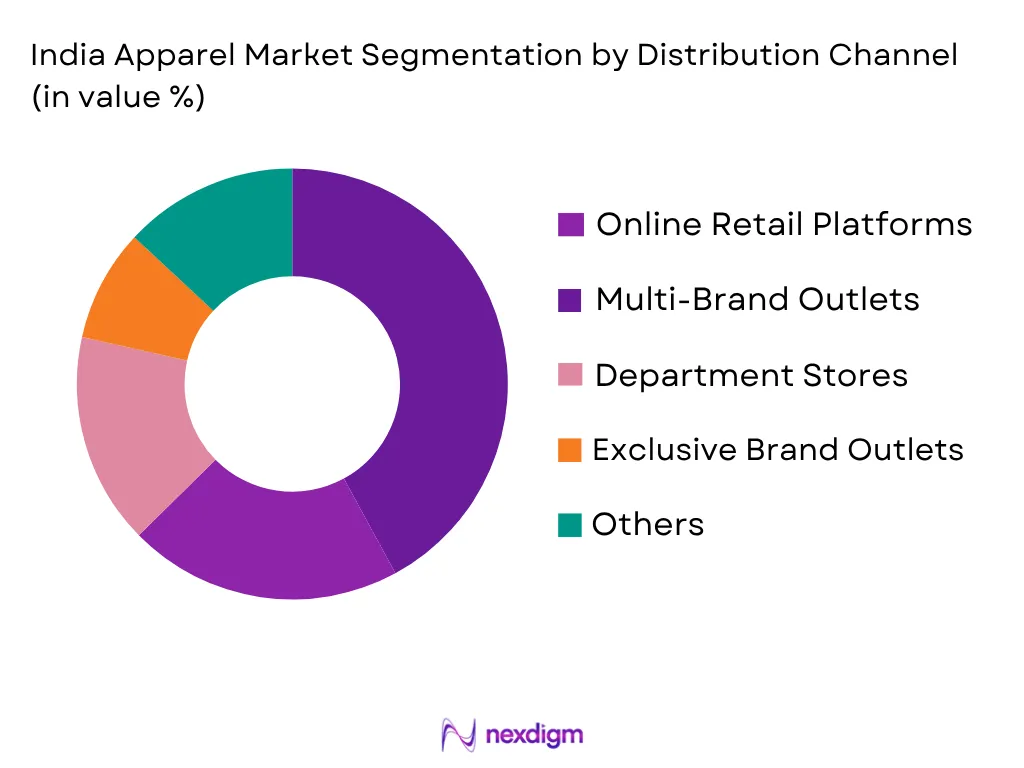
The India apparel market is segmented into exclusive brand outlets, multi-brand outlets, department stores, online retail platforms, hypermarkets & supermarkets, and direct-to-consumer platforms. Online retail platforms have emerged as the dominant distribution channel due to increasing smartphone penetration, affordable internet connectivity, and growing consumer preference for convenience. Platforms such as Myntra, AJIO, Amazon Fashion, and Flipkart provide extensive product assortments, competitive pricing, personalized recommendations, and easy return policies. The channel also benefits from widespread adoption in Tier-II and Tier-III cities where access to organized retail stores remains relatively limited. Frequent promotional campaigns, quick delivery services, digital payment adoption, and social media-driven fashion discovery further contribute to the strong performance of online apparel sales. As consumers increasingly prioritize convenience and product variety, online retail continues to gain prominence across all demographic groups.
Competitive Landscape
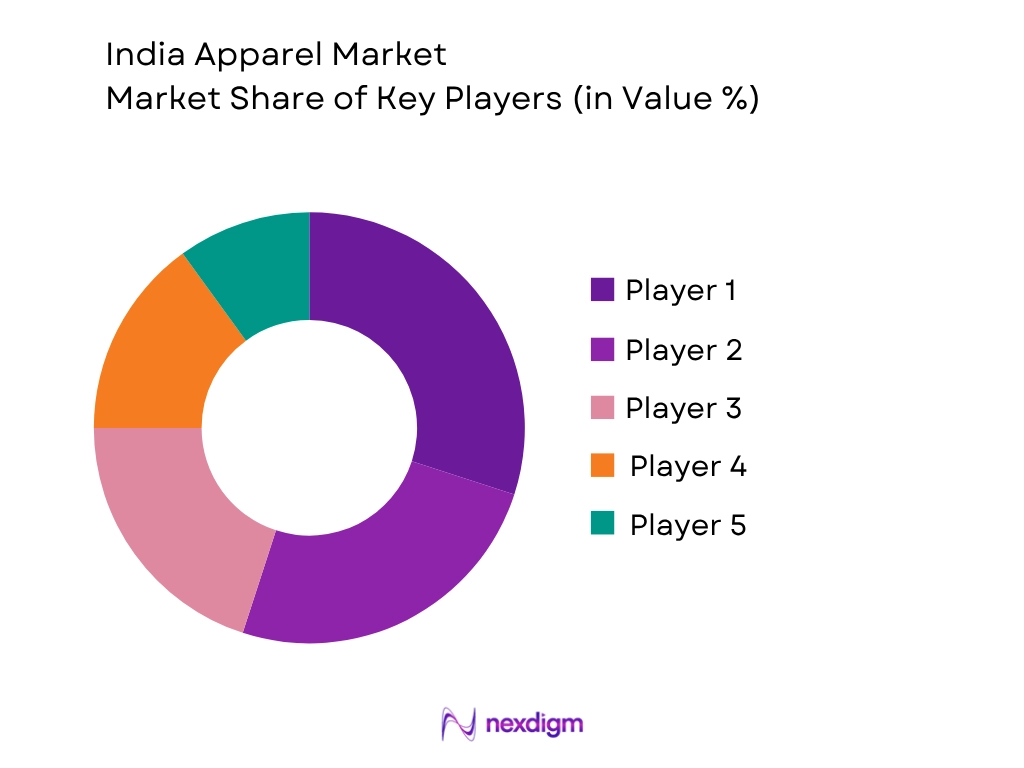
The India apparel market is characterized by the presence of several established domestic and international brands competing across premium, mass-market, ethnic wear, fast-fashion, and sportswear categories. The market remains moderately fragmented, with large organized retailers expanding aggressively through omnichannel strategies while regional and unorganized players continue to maintain strong positions in local markets. Leading companies leverage extensive store networks, strong sourcing capabilities, diversified product portfolios, digital commerce platforms, and brand recognition to strengthen their market positions.
| Company | Establishment Year | Headquarters | Primary Segment | Store Network | Online Presence | Manufacturing Model | Distribution Strength | Key Brands Focus |
| Aditya Birla Fashion & Retail Ltd. | 2007 | ~ | ~ | ~ | ~ | ~ | ~ | ~ |
| Reliance Retail (AJIO) | 2006 | ~ | ~ | ~ | ~ | ~ | ~ | ~ |
| Trent Ltd. (Westside) | 1998 | ~ | ~ | ~ | ~ | ~ | ~ | ~ |
| Arvind Limited | 1931 | ~ | ~ | ~ | ~ | ~ | ~ | ~ |
| Raymond Lifestyle | 1925 | ~ | ~ | ~ | ~ | ~ | ~ | ~ |
India Apparel Market Analysis
Growth Drivers
Rising Disposable Income and Expanding Consumer Expenditure
India’s apparel market is being significantly driven by rising household incomes and increasing consumer spending capacity. According to the International Monetary Fund (IMF), India’s nominal GDP reached approximately USD 3.9 trillion in 2024, making it one of the world’s largest consumer economies. The World Bank reported India’s population at over 1.43 billion, creating a vast consumer base for apparel purchases. Data from the Ministry of Statistics and Programme Implementation (MOSPI) indicates that private final consumption expenditure exceeded INR 190 trillion in FY 2024-25, reflecting strong consumer spending across discretionary categories including apparel and fashion. Furthermore, the Reserve Bank of India reported urban consumption demand remained resilient due to rising employment opportunities and wage growth in services and manufacturing sectors. The Periodic Labour Force Survey showed urban worker participation increasing across several states, supporting higher spending on branded and premium apparel products. The expansion of organized retail infrastructure is further strengthening demand, with the Department for Promotion of Industry and Internal Trade reporting continued investments into retail and consumer sectors. Additionally, India’s middle-income population continues to expand, resulting in increased purchases of casual wear, ethnic wear, sportswear, and occasion-based apparel. These macroeconomic developments directly support sustained demand for apparel products across metropolitan, Tier-II, and Tier-III markets throughout India.
Rapid Urbanization and Expansion of Organized Retail
Urbanization remains one of the strongest growth drivers for the India apparel market. According to the World Bank, more than 520 million people reside in urban areas across India, while the United Nations estimates that urban populations continue to expand through migration and natural growth. The Ministry of Housing and Urban Affairs reported ongoing development initiatives across more than 100 smart cities, creating new commercial hubs and retail ecosystems. India’s retail sector has experienced substantial infrastructure growth, with the Department for Promotion of Industry and Internal Trade reporting cumulative FDI inflows into trading and retail-related activities exceeding USD 4 billion during recent reporting periods. Large metropolitan regions such as Delhi NCR, Mumbai, Bengaluru, Hyderabad, Chennai, and Pune continue to witness the expansion of shopping malls, lifestyle centers, and organized retail stores. According to MOSPI, household consumption expenditure in urban areas remains significantly higher than rural spending levels, enabling greater adoption of branded apparel. Increased workforce participation, particularly among younger consumers and women, has accelerated demand for workwear, casual fashion, and premium apparel products. Growing internet penetration exceeding 950 million telecom subscribers according to TRAI also supports omnichannel retailing and digital apparel purchases, creating stronger market accessibility and accelerating apparel consumption nationwide.
Market Challenges
Dependence on Imported Synthetic Fibers and Raw Material Volatility
The India apparel industry continues to face challenges arising from dependence on imported synthetic fibers and fluctuations in global raw material markets. According to the Ministry of Commerce and Industry, India imported man-made fibers, synthetic yarns, and textile raw materials worth several billion dollars during recent trade cycles. Polyester and specialty synthetic fibers used in activewear, performance apparel, and fashion garments remain partially dependent on international supply chains. The World Bank reported continuing volatility in crude oil and petrochemical markets, directly affecting synthetic fiber production costs globally. Additionally, India’s textile value chain remains exposed to fluctuations in cotton availability due to climatic variations. The Ministry of Agriculture and Farmers Welfare noted varying cotton production levels across major producing states including Gujarat, Maharashtra, and Telangana. Since apparel manufacturers operate on thin margins in highly competitive retail environments, changes in raw material prices can influence sourcing decisions, inventory planning, and production schedules. Export-oriented apparel manufacturers also face uncertainty from global logistics disruptions and currency fluctuations. These challenges create operational complexity for apparel producers attempting to maintain competitive pricing while meeting consumer expectations regarding product quality, design innovation, and delivery timelines across domestic and export markets.
Fragmented Manufacturing Structure and Labor Productivity Constraints
India’s apparel manufacturing ecosystem remains highly fragmented, creating operational and scalability challenges. According to the Ministry of Textiles, India has thousands of garment manufacturing units ranging from micro-enterprises to large export-oriented facilities, with a substantial share of production occurring within small and medium enterprises. The Annual Survey of Industries indicates that a significant portion of textile and apparel establishments operate with limited automation and relatively low production scale. While India possesses one of the world’s largest labor forces, the Periodic Labour Force Survey reported that workforce skill development remains uneven across regions and manufacturing clusters. Apparel production hubs such as Tiruppur, Ludhiana, Surat, Bengaluru, Noida, and Gurugram continue to face periodic labor availability challenges due to migration patterns and competition from other industries. According to the Ministry of Skill Development and Entrepreneurship, continuous reskilling is required to support modern apparel manufacturing technologies, automated cutting systems, digital pattern making, and advanced supply chain management tools. Furthermore, infrastructure disparities between leading manufacturing clusters and emerging regions contribute to differences in productivity and operational efficiency. These structural issues can limit economies of scale, impact production consistency, and reduce the ability of manufacturers to respond rapidly to changing consumer fashion trends.
Market Opportunities
Growth of Sustainable and Eco-Friendly Apparel Manufacturing
Sustainability initiatives are creating substantial opportunities for the India apparel market. According to the Ministry of Textiles, India has emerged as one of the world’s largest producers of natural fibers including cotton, jute, and silk, providing a strong foundation for sustainable apparel development. The Textile Exchange and government-supported sustainability initiatives have encouraged the adoption of environmentally responsible production processes across textile and apparel value chains. India produced more than 35 million bales of cotton according to agricultural statistics, enabling increased utilization of natural fiber-based apparel products. The Ministry of New and Renewable Energy also reported growing renewable energy adoption across manufacturing sectors, supporting cleaner production facilities. Furthermore, the Bureau of Indian Standards and export-focused compliance requirements are encouraging manufacturers to improve environmental practices, wastewater treatment, and resource efficiency. International buyers increasingly prioritize sustainable sourcing, creating opportunities for Indian apparel exporters to strengthen global competitiveness. Rising consumer awareness regarding eco-friendly products within metropolitan markets is also supporting demand for organic cotton apparel, recycled textiles, and responsibly manufactured garments. These developments position sustainability as a major long-term growth avenue for apparel brands, textile manufacturers, and export-oriented garment producers operating in India.
Expansion of Tier-II and Tier-III Consumer Markets Through Digital Commerce
The rapid expansion of digital infrastructure across India presents a significant opportunity for apparel market growth. According to the Telecom Regulatory Authority of India, India has more than 950 million internet subscribers, creating one of the largest digital consumer ecosystems globally. The Ministry of Electronics and Information Technology continues to support digital inclusion initiatives, improving connectivity across smaller cities and rural regions. Data from the National Payments Corporation of India indicates that digital payment transactions reached billions of monthly transactions through UPI, simplifying online purchasing behavior for consumers nationwide. Tier-II and Tier-III cities are increasingly becoming important apparel consumption centers due to rising incomes, improving logistics networks, and greater exposure to fashion trends through social media platforms. The Department for Promotion of Industry and Internal Trade has also highlighted increasing investments in warehousing, fulfillment centers, and logistics infrastructure that improve product accessibility beyond metropolitan areas. E-commerce platforms and direct-to-consumer apparel brands can now efficiently serve consumers in previously underpenetrated regions. This broader digital reach enables apparel companies to expand customer acquisition, diversify revenue streams, strengthen brand awareness, and capitalize on the growing purchasing power emerging across India’s smaller urban centers.
Future Outlook
The India apparel market is expected to witness sustained growth over the forecast period, supported by rising disposable incomes, increasing urbanization, expanding middle-class population, and growing adoption of branded fashion products. Continued investments in organized retail infrastructure and digital commerce platforms are likely to enhance accessibility across Tier-II and Tier-III cities. Additionally, increasing consumer awareness regarding sustainable fashion, advancements in supply chain digitization, and the emergence of direct-to-consumer apparel brands are expected to reshape the competitive landscape. The growing influence of social media, influencer marketing, and personalized shopping experiences will further contribute to market expansion and product innovation.
Major Players
- Reliance Retail (AJIO)
- Aditya Birla Fashion & Retail Limited
- Arvind Limited
- Trent Limited (Westside)
- Raymond Lifestyle
- V-Mart Retail
- Shoppers Stop
- Lifestyle International
- Fabindia
- BIBA Fashion
- Vedant Fashions (Manyavar)
- H&M India
- Zara India
- Uniqlo India
- Puma India
Key Target Audience
- Apparel Manufacturers
- Fashion Brand Owners
- Textile and Garment Exporters
- Retail Chain Operators
- E-Commerce Fashion Platforms
- Investments and Venture Capitalist Firms
- Government and Regulatory Bodies (Ministry of Textiles, Ministry of Commerce and Industry, Directorate General of Foreign Trade, Bureau of Indian Standards)
- Apparel Raw Material and Fabric Suppliers
Research Methodology
Step 1: Identification of Key Variables
The initial phase involves constructing an ecosystem map encompassing all major stakeholders within the India Apparel Market. Extensive secondary research is conducted through industry publications, company annual reports, trade associations, government databases, and proprietary sources. The objective is to identify key variables influencing apparel demand, production, distribution, pricing, and consumer purchasing behavior.
Step 2: Market Analysis and Construction
Historical market data is compiled and analyzed to understand industry performance, consumption trends, retail expansion, manufacturing output, and trade dynamics. Both organized and unorganized market structures are assessed to estimate overall revenue generation. Additional analysis includes evaluating apparel consumption patterns, retail penetration, and e-commerce contribution.
Step 3: Hypothesis Validation and Expert Consultation
Preliminary market assumptions and estimates are validated through structured interviews with apparel manufacturers, fashion retailers, distributors, textile producers, and industry experts. These consultations provide operational insights regarding sourcing strategies, inventory management, pricing trends, consumer preferences, and future growth opportunities within the market.
Step 4: Research Synthesis and Final Output
The final stage involves triangulating information obtained from secondary sources, industry interviews, and company-level insights. Bottom-up and top-down approaches are utilized to validate market size estimates and segment-level analysis. The resulting findings are synthesized into a comprehensive market assessment, ensuring accuracy, reliability, and strategic relevance for stakeholders.

- Executive Summary
- Research Methodology (Market Definitions and Assumptions, Abbreviations, Market Sizing Approach, Top-Down Analysis, Bottom-Up Analysis, Demand-Side Assessment, Supply-Side Assessment, Primary Industry Interviews, Trade Data Analysis, Retail Audit Assessment, Consumer Survey Framework, Data Triangulation, Forecasting Framework, Limitations and Future Conclusions)

- Definition and Scope
- Market Evolution and Industry Genesis
- Timeline of Major Industry Developments
- Apparel Industry Ecosystem
- Textile-to-Apparel Value Chain Analysis

- Growth Drivers (Rising Disposable Income, Expansion of Organized Retail, Growing Fashion Consciousness, Increasing Urbanization, Rapid E-Commerce Adoption, Rising Female Workforce Participation, Youth Population Expansion, Premiumization Trends)
- Market Challenges (Counterfeit Apparel Penetration, High Inventory Carrying Costs, Seasonal Demand Volatility, Dependence on Imported Synthetic Fibers, Fragmented Manufacturing Base, Supply Chain Inefficiencies)
- Market Opportunities (Sustainable Fashion Growth, Tier-II and Tier-III Market Expansion, D2C Brand Proliferation, Technical Apparel Adoption, Athleisure Penetration, Apparel Rental Platforms, AI-Driven Personalization)
- Market Trends (Fast Fashion Expansion, Premium Ethnic Wear Demand, Omnichannel Retailing, Sustainable Fabrics Adoption, Gender-Neutral Fashion, Smart Apparel Development, Influencer-Led Fashion Commerce, Quick Commerce Fashion Deliveries)
- Government Regulations (PLI Scheme for Textiles, BIS Quality Standards, GST Structure, Labeling and Packaging Compliance, Labor Regulations, Sustainability and ESG Compliance Requirements)
- Trade and Export Competitiveness Analysis
- Raw Material Price Trend Analysis
- Manufacturing Capacity Assessment
- SWOT Analysis
- Porter’s Five Forces Analysis
- PESTLE Analysis
- Stakeholder Ecosystem
- Competition Ecosystem

- By Market Value (2020-2025)
- By Volume Consumption (2020-2025)
- By Average Selling Price (2020-2025)

- By Product Category (In Value %)
Men’s Wear
Women’s Wear
Kids Wear
Infant Wear
Unisex Apparel - By Apparel Type (In Value %)
Ethnic Wear
Western Wear
Innerwear and Loungewear
Sportswear and Activewear
Casual Wear
Formal Wear
Denim Wear
Winter Wear - By Distribution Channel (In Value %)
Exclusive Brand Outlets (EBOs)
Multi-Brand Outlets (MBOs)
Department Stores
Hypermarkets and Supermarkets
Factory Outlets
Online Marketplaces
Direct-to-Consumer (D2C) Platforms
Social Commerce Platforms - By Fabric Type (In Value %)
Cotton Apparel
Polyester Apparel
Blended Fabric Apparel
Woolen Apparel
Silk Apparel
Linen Apparel
Sustainable and Recycled Fabric Apparel - By Region (In Value %)
North India
South India
East India
West India
Central India

- Market Share of Major Players (By Value, Volume, Product Category, Distribution Channel, Consumer Segment)
- Cross Comparison Parameters (Product Portfolio Breadth, Average Selling Price Positioning, Store Network Reach, E-Commerce Contribution, SKU Depth, Manufacturing Capacity Utilization, Sustainable Apparel Portfolio Share, Inventory Turnover Efficiency)
- SWOT Analysis of Major Players
- Pricing Analysis by Product Category and SKU
- Detailed Profiles of Major Companies
Reliance Retail (AJIO)
Aditya Birla Fashion and Retail Limited
Arvind Limited
Trent Limited (Westside)
Raymond Lifestyle
V-Mart Retail
Shoppers Stop
Lifestyle International
Fabindia
BIBA Fashion
Manyavar (Vedant Fashions)
H&M India
Zara India
Uniqlo India
Puma India

- Apparel Consumption Behavior Assessment (Purchase Frequency, Wardrobe Replacement Rate, Occasion-Based Spending, Fashion Sensitivity, Brand Affinity)
- Demographic Consumption Trends (Age Group, Gender, Income Group, Occupation, Family Structure)
- Urban vs Rural Consumption Analysis
- Apparel Spending Pattern Analysis
- Premium vs Mass Market Demand Analysis

By Market Value (2026-2035)
By Volume Consumption (2026-2035)
By Average Selling Price (2026-2035)


 Request a Sample
 Ask for Customization
 Get a Quote
 Enquire Now