
 Download PDF
Market Overview
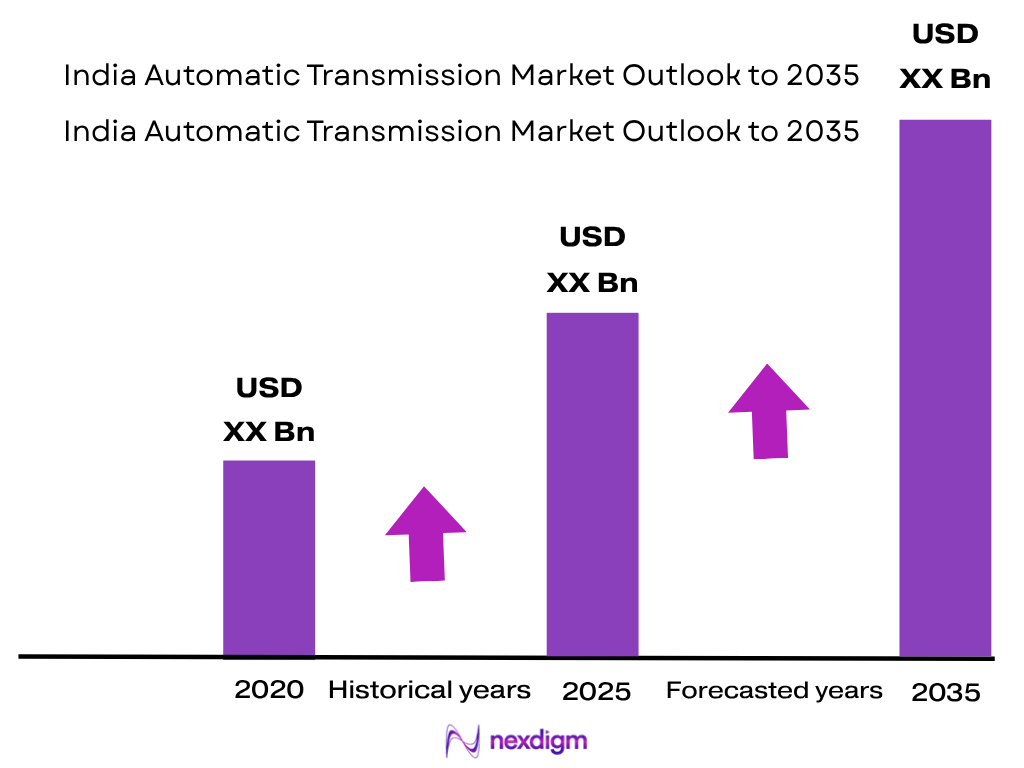
The India Automatic Transmission Market is valued at approximately ~USD XX billion, based on historical transmission fitment and vehicle-production analysis. Demand is supported by passenger-vehicle sales increasing from approximately 4.1 million units in the preceding annual cycle to 4,274,793 units in the latest calendar cycle. Rising utility-vehicle demand, urban congestion and increasing availability of AMT, torque-converter AT, CVT and DCT options across mass-market vehicles are accelerating the transition from manual to automatic powertrains.
Pune-Chakan, Chennai-Oragadam, Gurugram-Manesar-Rohtak and Bengaluru-Bidadi dominate India’s automatic-transmission ecosystem because these clusters combine passenger-vehicle assembly, transmission manufacturing, component suppliers and powertrain engineering. Passenger-vehicle production increased from 4,901,840 units in the preceding financial cycle to 5,061,164 units in the latest cycle. Chakan hosts India’s first localized DCT assembly facility with capacity of approximately 200,000 units annually, while Bidadi houses hybrid-transmission and electrified powertrain manufacturing, strengthening localization of advanced automatic architectures.
Market Segmentation
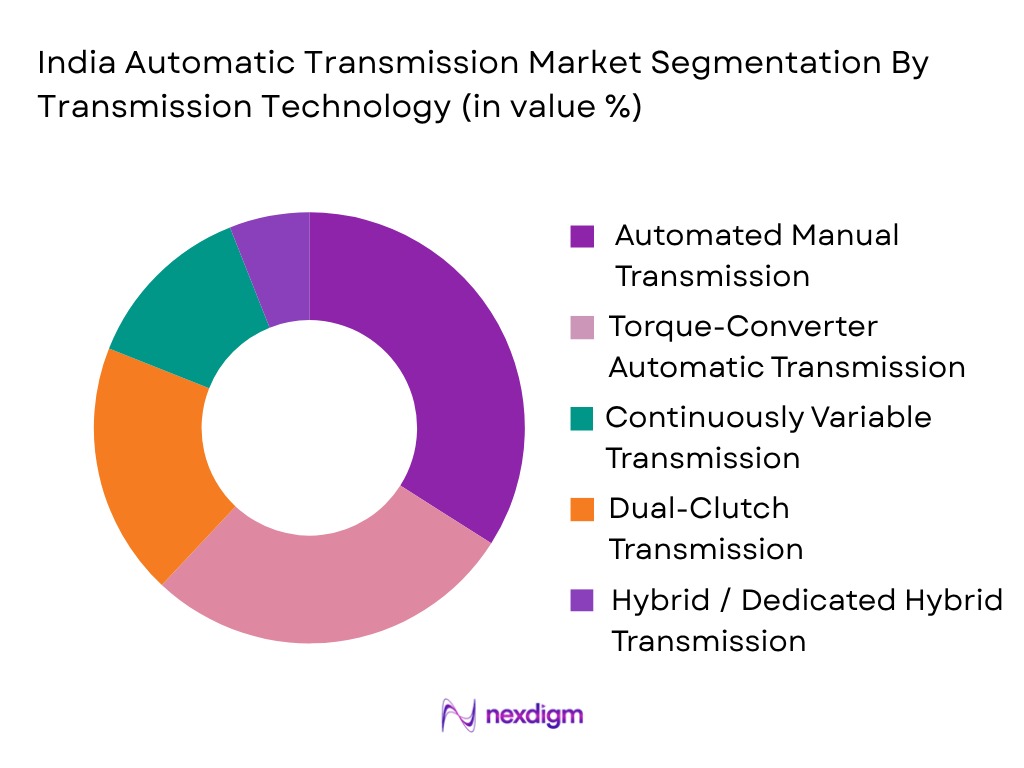
By Transmission Technology
The India Automatic Transmission Market is segmented into Automated Manual Transmission, Torque-Converter Automatic Transmission, Continuously Variable Transmission, Dual-Clutch Transmission and Hybrid/Dedicated Hybrid Transmission. Automated Manual Transmission holds the dominant position because it enables manufacturers to offer two-pedal convenience while retaining much of the underlying manual gearbox architecture. AMT is particularly relevant to India’s hatchback, entry-level sedan and compact-SUV segments, where vehicle affordability, fuel efficiency and manufacturing localization remain important purchase considerations. Domestic manufacturers have deployed AMT extensively across high-volume vehicle platforms, creating a substantial installed base. Torque-converter automatics have strengthened their position in compact and mid-size SUVs because of smoother low-speed operation and suitability for higher-torque engines, while DCTs are increasingly associated with turbo-petrol vehicles. CVTs remain established across selected petrol sedans and SUVs. Hybrid transmissions are developing into an important technology category as locally manufactured electrified powertrain components become available.
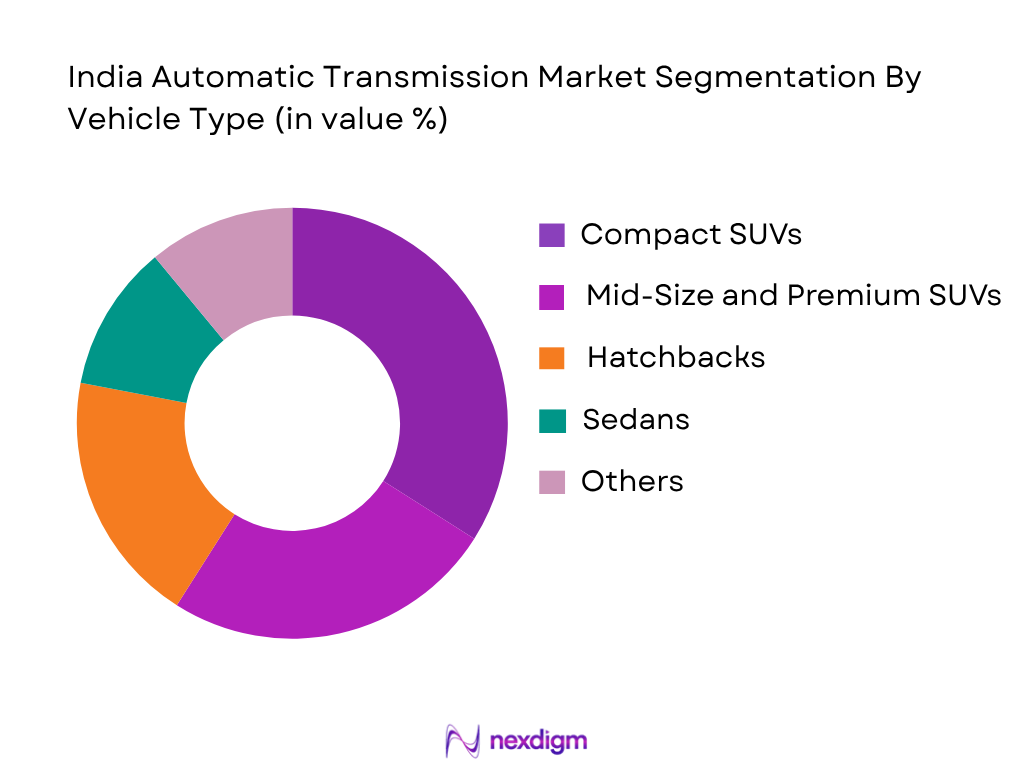
By Vehicle Type
The India Automatic Transmission Market is segmented into hatchbacks, sedans, compact SUVs, mid-size and premium SUVs, MPVs and commercial vehicles. SUVs constitute the dominant automatic-transmission application because Indian passenger-vehicle demand has shifted substantially toward utility vehicles. Utility vehicles now form the core volume category of passenger-vehicle demand, supported by compact SUVs offering AMT, torque-converter AT, CVT and DCT choices across increasingly broad price bands. The segment is particularly favorable for automatic transmissions because heavier vehicles, turbocharged engines and urban usage increase demand for smoother launch characteristics, greater torque handling and convenient stop-and-go operation. Compact SUVs support high-volume AMT and torque-converter adoption, while mid-size SUVs support higher-value 6-speed AT and 7-speed DCT architectures. Strong-hybrid SUVs are additionally expanding the use of e-CVT and power-split systems. Hatchbacks remain important because localized AMT systems make automatic driving accessible to more price-sensitive customers.
Competitive Landscape
The India Automatic Transmission Market combines global transmission specialists, localized joint ventures, component manufacturers and vertically integrated vehicle OEMs. AISIN, ZF, TACO Punch Powertrain, Hyundai Transys and Schaeffler represent important participants across automatic transmissions, DCTs, CVTs, hybrid systems and transmission components. Competition is increasingly defined by localization, OEM platform fitments, torque coverage, mechatronics capability, hybrid readiness and the ability to manufacture sophisticated transmission components at Indian automotive-industry cost structures.
| Major Player | Establishment Year | Headquarters | Key Transmission Capability | India Manufacturing / Engineering Position | Vehicle Application Focus | Localization Capability | Hybrid / Electrified Readiness | Mechatronics / Controls Capability |
| AISIN Corporation | 1965 | Kariya, Japan | ~ | ~ | ~ | ~ | ~ | ~ |
| ZF Friedrichshafen AG | 1915 | Friedrichshafen, Germany | ~ | ~ | ~ | ~ | ~ | ~ |
| TACO Punch Powertrain | 2023 | Pune, India | ~ | ~ | ~ | ~ | ~ | ~ |
| Hyundai Transys | 1999 | Seosan, South Korea | ~ | ~ | ~ | ~ | ~ | ~ |
| Schaeffler | 1946 | Herzogenaurach, Germany | ~ | ~ | ~ | ~ |
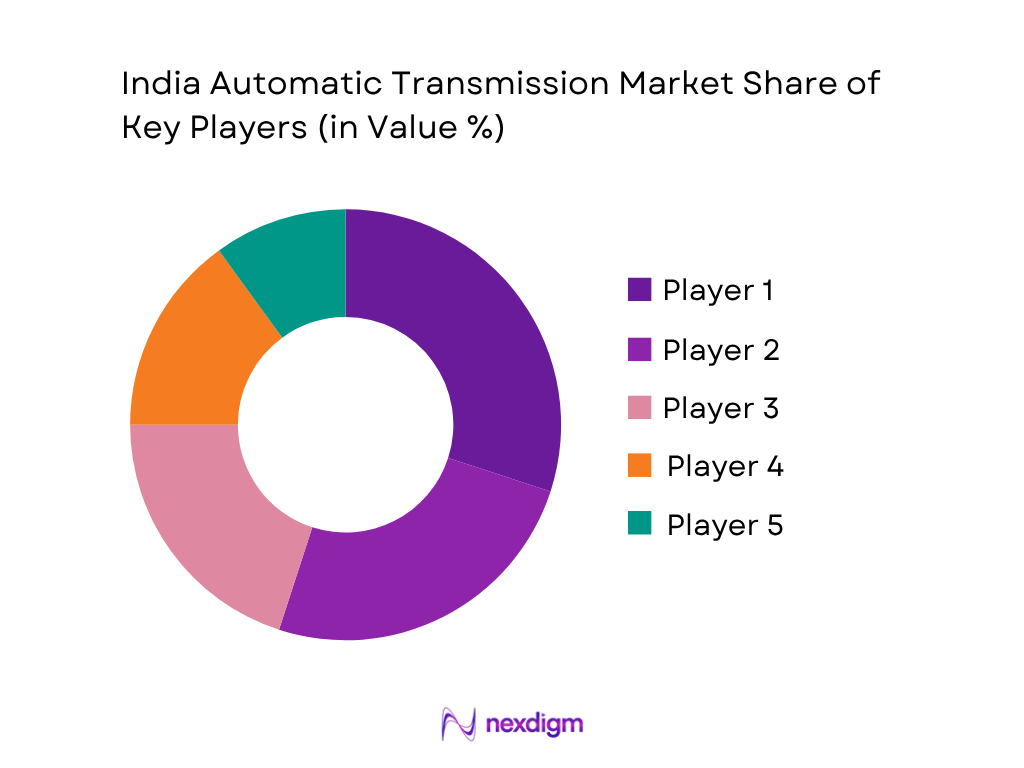
India Automatic Transmission Market Analysis
Growth Drivers
Rising Utility Vehicle Production and Automatic Transmission Fitment
The India Automatic Transmission Market is being driven by the rapid expansion of utility vehicles, a segment that increasingly uses torque-converter automatic, DCT, CVT and AMT systems. SIAM recorded 3,155,312 utility vehicles produced in FY2024–25, compared with 2,777,051 units in FY2023–24, while domestic utility-vehicle sales increased from 2,520,691 units to 2,797,229 units. Total passenger-vehicle production simultaneously increased from 4,901,840 units to 5,061,164 units, providing a larger addressable production base for automatic-transmission fitment. The trend continued during calendar 2025, when passenger-vehicle production reached 5.38 million units and domestic sales reached 4.49 million units, according to the Ministry of Heavy Industries using SIAM data. Utility vehicles are particularly important for automatic transmissions because higher vehicle mass, turbocharged engines, urban stop-start conditions and customer expectations for driving convenience support 6-speed torque-converter AT, 7-speed DCT, CVT and advanced AMT installations. The broader economic environment is supportive: World Bank data place India’s 2024 GDP at USD 3,909.89 billion and GDP per capita at USD 2,694.7, reinforcing the expanding economic base supporting passenger-vehicle ownership and technology upgrades.
Expansion of Domestic Advanced Transmission Manufacturing and Localization
Localization of sophisticated transmission systems is becoming a major growth driver for the India Automatic Transmission Market because domestic assembly reduces dependence on complete imported units and makes advanced gearboxes more accessible to Indian vehicle programs. TACO Punch Powertrain operates India’s first localized dual-clutch transmission assembly facility at Chakan, covering 2,510 square metres with annual capacity of approximately 200,000 DCT units, supported by robotic assembly, laser welding and automated testing. Government policy is reinforcing the broader localization environment. The Ministry of Heavy Industries reported that the Production Linked Incentive scheme for automobiles and auto components had generated cumulative investment of ₹44,326 crore and 67,820 jobs by March 2026. As of July 2026, 18 applicants had received Domestic Value Addition certificates covering 154 products and variants, demonstrating increasing localization of advanced automotive technology. The same program had generated ₹52,414 crore of incremental sales and disbursed ₹2,386.36 crore in incentives. These investments strengthen the supplier ecosystem for transmission electronics, clutches, hydraulic systems, gears, control units and electrified drivetrains. India’s 2024 GDP of USD 3,909.89 billion, according to the World Bank, provides the macroeconomic scale necessary to sustain deeper automotive manufacturing investment and automatic-transmission localization.
Market Challenges
Battery-Electric Vehicle Adoption Reducing Conventional Transmission Content
Battery-electric vehicle adoption represents a structural challenge for the India Automatic Transmission Market because most pure-electric passenger vehicles eliminate conventional multi-speed AMT, CVT, DCT and torque-converter transmission architectures in favor of single-speed reduction systems. Ministry of Road Transport and Highways data reported through the Ministry of Heavy Industries show that 1,950,490 electric vehicles were registered during calendar 2024, within total vehicle registrations of 26,207,453 units. The transition continued under government-supported advanced automotive manufacturing programs: by the end of 2025, PLI incentives had covered 79,540 electric four-wheelers, alongside 1,042,172 electric two-wheelers, 238,385 electric three-wheelers and 1,391 electric buses. Passenger-vehicle production nevertheless remained substantial at 5,061,164 units in FY2024–25, indicating that conventional and electrified powertrains will coexist, but transmission suppliers face an increasingly fragmented technology environment. Manufacturers dependent primarily on planetary automatic gearboxes, CVT pulley systems or conventional DCT hardware must therefore diversify toward hybrid transaxles, reduction gears, e-axles and electric-drive components. World Bank data show India generated USD 3,909.89 billion of GDP in 2024, meaning changes in drivetrain technology are occurring across a large and expanding automotive economy capable of influencing component investment decisions at significant scale.
Complex Localization Requirements for Mechatronics and Advanced Transmission Components
The India Automatic Transmission Market faces a significant localization challenge because modern AT, CVT and DCT systems depend on precision gears, valve bodies, solenoids, electronic control units, hydraulic modules, sensors, clutch packs and embedded software that require tighter manufacturing tolerances than conventional manual transmissions. The Ministry of Heavy Industries reported that the PLI-Auto framework requires eligible advanced automotive products to achieve at least 50 units of domestic value for every 100 units of product value, illustrating the depth of localization expected from suppliers. By July 2026, only 18 applicants had secured Domestic Value Addition certification for 154 products and variants, despite the broader PLI program generating ₹44,326 crore in cumulative automotive and component investment and 67,820 jobs. Earlier implementation data showed cumulative automotive PLI investment of ₹25,219 crore through December 2024, with ₹15,230 crore in incremental sales and 38,186 jobs, indicating that localization is progressing but requires sustained manufacturing and engineering investment. The challenge is particularly acute for DCT mechatronics, CVT belts and pulleys, torque converters, hydraulic controls and transmission software. India’s World Bank-reported USD 3,909.89 billion GDP in 2024 provides a substantial manufacturing base, but automatic-transmission localization still requires specialized tooling, validation, calibration and supplier-development capabilities.
Market Opportunities
Hybrid Transmission and Electrified Transaxle Localization
Hybridization creates a substantial growth opportunity for the India Automatic Transmission Market because strong-hybrid vehicles continue to require sophisticated transmission systems, including hybrid transaxles, power-split planetary gearsets, integrated electric motors, reduction gearing and electronically controlled clutch systems. Government localization data already provide evidence of an emerging supply base. The Ministry of Heavy Industries reported in December 2025 that Toyota Kirloskar Auto Parts received Domestic Value Addition certification for 2 trans-axle variants under the PLI-Auto Component Champion framework, while Tata AutoComp Systems received certification for 1 dual-clutch transmission variant. Across the scheme, 37 component variants had received certification among Component Champion applicants by the end of 2025. The wider advanced automotive manufacturing ecosystem had attracted ₹35,657 crore in cumulative investment by September 2025, generated ₹32,879 crore in determined incremental sales, and created 48,974 jobs. These current manufacturing indicators establish a base from which localized hybrid transmission components, electric oil pumps, mechatronics, reduction systems and control electronics can expand as Indian OEMs broaden electrified passenger-vehicle portfolios. World Bank data place India’s 2024 GDP at USD 3,909.89 billion and population at approximately 1.45 billion, providing a large domestic economic and mobility base for future hybrid powertrain localization.
Advanced Automatic Transmission Demand from the Expanding Utility Vehicle Base
The continuing expansion of India’s utility-vehicle base creates a strong opportunity for higher-value automatic transmission technologies, particularly 6-speed torque-converter systems, 7-speed DCTs, CVTs and hybrid transmission architectures. SIAM reported domestic utility-vehicle sales of 2,797,229 units in FY2024–25, compared with 2,520,691 units in FY2023–24, while utility-vehicle production increased from 2,777,051 units to 3,155,312 units. At the same time, passenger-car sales declined from 1,548,947 units to 1,353,287 units, highlighting the industry’s shift toward vehicle categories that generally require broader torque capability, stronger thermal performance and more sophisticated drivetrain calibration. Total passenger-vehicle production reached 5,061,164 units, and calendar 2025 production subsequently reached 5.38 million units, establishing a large addressable production base for transmission suppliers. Local manufacturing is also deepening: India’s first localized DCT assembly operation has approximately 200,000 units of annual production capacity, demonstrating that advanced automatic architectures can increasingly be sourced domestically. The opportunity therefore extends beyond complete transmissions to clutch modules, actuators, hydraulic controls, torque converters, transmission control units and thermal-management components. World Bank data recorded India’s 2024 GDP at USD 3,909.89 billion, supporting continued expansion of the automotive manufacturing ecosystem.
Future Outlook
The India Automatic Transmission Market is expected to expand at an indicative ~X.X% CAGR during 2026–2035, supported by the continued migration from manual gearboxes toward AMT, torque-converter AT, CVT, DCT and hybrid transmission systems. Growth will increasingly be shaped by utility vehicles, urban driving requirements, localization of transmission manufacturing and the development of hybrid powertrains. AMT will continue to provide an important gateway to automatic-transmission ownership in entry-level hatchbacks, compact sedans and affordable SUVs. Its ability to use an automated clutch and shift actuator with a fundamentally manual transmission architecture supports localization and broad deployment across high-volume vehicle platforms. Further improvements in actuator response, creep functionality, shift calibration and electronic control can improve drivability while retaining AMT’s suitability for cost-sensitive applications.
Torque-converter automatic transmissions are positioned for deeper penetration in compact, mid-size and premium SUVs. Their smooth low-speed behavior, torque multiplication and ability to handle higher engine output make them well suited to India’s expanding utility-vehicle segment. Increasing localization should become particularly important as suppliers seek to reduce dependence on imported complete transmission assemblies and align production with domestic OEM volumes.
Major Players
- AISIN Automotive Haryana Private Limited / AISIN Corporation
- ZF India Private Limited
- TACO Punch Powertrain Private Limited
- Hyundai Transys India
- Magna Powertrain India
- Schaeffler India Limited
- Valeo India Private Limited
- BorgWarner India
- JATCO Ltd.
- Bosch Limited
- Continental Automotive India
- Tata AutoComp Systems Limited
- Maruti Suzuki India Limited / Suzuki Motor Corporation
- Hyundai Motor India Limited
- Tata Motors Limited
Key Target Audience
- Automotive OEMs and Passenger Vehicle Manufacturers
- Automatic Transmission and Powertrain System Manufacturers
- Transmission Component, Mechatronics and Electronic Control Suppliers
- Automotive Aftermarket and Transmission Remanufacturing Companies
- Automotive Component Distributors and Powertrain Suppliers
- Passenger Vehicle, Utility Vehicle and Commercial Fleet Operators
- Investments and Venture Capitalist Firms
- Government and Regulatory Bodies (Ministry of Road Transport and Highways, Ministry of Heavy Industries, Ministry of Commerce and Industry, Automotive Research Association of India, Bureau of Indian Standards)
Research Methodology
Step 1: Identification of Key Variables
The initial phase involves constructing an ecosystem map encompassing vehicle OEMs, automatic-transmission manufacturers, Tier-1 powertrain suppliers, transmission component manufacturers, electronics suppliers, distributors and aftermarket participants. Extensive desk research identifies critical variables including transmission architecture, vehicle fitment, torque capacity, gear count, propulsion type, localization level, domestic production, imports and OEM sourcing relationships influencing the India Automatic Transmission Market.
Step 2: Market Analysis and Construction
Historical market construction applies top-down and bottom-up methodologies to passenger-vehicle production, domestic sales, transmission fitment and vehicle-platform data. AMT, torque-converter AT, CVT, DCT and hybrid transmission installations are mapped across hatchbacks, sedans, SUVs and MPVs. Supply-side assessment incorporates domestic transmission assembly, imported units, localized components and supplier capacities to establish a consistent market framework.
Step 3: Hypothesis Validation and Expert Consultation
Market hypotheses are validated through computer-assisted telephone interviews with transmission manufacturers, vehicle OEMs, Tier-1 component suppliers, powertrain engineers, distributors and transmission service specialists. These consultations assess technology adoption, localization, OEM sourcing, vehicle-platform cycles, torque requirements, transmission reliability, hybridization, mechatronics content and supplier-selection criteria. Primary findings are compared with secondary evidence to refine assumptions and remove inconsistencies.
Step 4: Research Synthesis and Final Output
The final phase triangulates vehicle-level demand, transmission fitment and supplier-level production information. Bottom-up transmission volumes are reconciled against passenger-vehicle production, OEM sourcing, domestic manufacturing, imports and aftermarket requirements. This process generates the final segmentation, competitive landscape, localization assessment, technology benchmarking and long-term outlook for AMT, torque-converter AT, CVT, DCT and hybrid automatic-transmission architectures in India.

- Executive Summary
- Research Methodology (Market Definition and Scope, India Automatic Transmission Taxonomy, AMT Classification, Torque-Converter Automatic Transmission Mapping, Continuously Variable Transmission Mapping, Dual-Clutch Transmission Mapping, Hybrid Transmission Architecture Assessment, Vehicle Platform Fitment Analysis, OEM Sourcing Assessment, Transmission Localization Assessment, Torque Capacity Mapping, Gear-Speed Configuration Assessment, Powertrain Compatibility Assessment, Domestic Production Assessment, Import-Export Assessment, Market Sizing Framework)

- Definition and Scope
- India Automatic Transmission Industry Evolution and Technology Development
- Automatic Transmission Manufacturing and Assembly Process
- Automatic Transmission Value Chain Analysis
- India Automatic Transmission Supply Chain Analysis
- Transmission Component, Mechatronics and Control-System Ecosystem Analysis
- India Automatic Transmission Import Dependency and Localization Assessment
- OEM Transmission Platform Architecture and Powertrain Integration Framework

- Growth Drivers (Rising Automatic Transmission Adoption in Passenger Vehicles, Utility Vehicle Sales Expansion, Increasing Urban Stop-and-Go Driving, Growing AMT Penetration in Entry-Level Vehicles, Torque-Converter Automatic Adoption in SUVs, DCT Adoption in Turbocharged Vehicles, Hybrid Transmission Expansion, Localization of Automatic Transmission Production)
- Market Challenges (Imported AT and CVT Dependency, High Localization Complexity, Automatic Transmission Cost Premium, Heat Management in Indian Driving Conditions, DCT Reliability Perception, Mechatronics Repair Complexity, OEM-Specific Transmission Architectures, Limited Independent Remanufacturing Capability)
- Market Opportunities (Localized Torque-Converter AT Manufacturing, Localized CVT Production, Compact DCT Manufacturing, Strong-Hybrid Transmission Systems, Affordable Automatic Transmissions for Compact SUVs, AMT Technology Upgradation, Hybridized DCT Systems, Transmission Control Software and Electronics Localization)
- Market Trends (Shift from AMT toward Torque-Converter AT and DCT in Higher Segments, CVT Adoption in Petrol Vehicles, Strong-Hybrid e-CVT Expansion, 6-Speed Automatic Penetration, 7-Speed DCT Adoption, Paddle-Shift Integration, Shift-by-Wire Systems, Drive-Mode-Based Transmission Calibration)
- Regulatory and Standards Landscape (Bharat Stage Emission Standards, Corporate Average Fuel Economy Requirements, Automotive Industry Standards, Central Motor Vehicle Rules, Vehicle Type Approval Requirements, On-Board Diagnostics Requirements, Fuel Efficiency Requirements, Automotive Component Homologation Requirements)
- SWOT Analysis
- Porter’s Five Forces Analysis
- PESTLE Analysis
- Stakeholder Ecosystem
- Competition Ecosystem

- By Market Value (2020-2025)
- By Automatic Transmission Unit Volume (2020-2025)
- By Domestic Production Volume (2020-2025)
- By Import Volume (2020-2025)
- By Export Volume (2020-2025)
- By OEM Fitment Volume (2020-2025)
- By Passenger Vehicle Automatic Transmission Volume (2020-2025)
- By Utility Vehicle Automatic Transmission Volume (2020-2025)
- By Replacement and Remanufactured Transmission Volume (2020-2025)

- By Transmission Technology (In Value %)
Automated Manual Transmission
Torque-Converter Automatic Transmission
Continuously Variable Transmission
Dual-Clutch Transmission
Intelligent Variable Transmission
Dedicated Hybrid Transmission
Hybrid e-CVT / Power-Split Transmission
Electrified Dual-Clutch Transmission
Other Advanced Automatic Transmission Architectures - By Vehicle Type (In Value %)
Hatchbacks
Sedans
Compact SUVs
Mid-Size SUVs
Premium SUVs
MPVs
Pickup and Utility Vehicles
Light Commercial Vehicles
Medium Commercial Vehicles
Heavy Commercial Vehicles
Buses and Coaches
Premium and Luxury Passenger Vehicles - By Propulsion Type (In Value %)
Gasoline ICE Vehicles
Diesel ICE Vehicles
Strong Hybrid Vehicles
Plug-In Hybrid Vehicles
Mild Hybrid Vehicles
CNG-Compatible Automatic Vehicles
Alternative-Fuel Vehicles
Range-Extended Electrified Vehicles - By Number of Forward Speeds (In Value %)
5-Speed AMT
6-Speed AMT
6-Speed Torque-Converter Automatic
7-Speed Dual-Clutch Transmission
8-Speed Automatic Transmission
9-Speed Automatic Transmission
10-Speed and Higher Automatic Transmission
Continuously Variable Ratio Systems
Power-Split Hybrid Transmission Systems - By Sales Channel (In Value %)
OEM Captive Transmission Supply
Tier-1 Supplier-to-OEM
Imported Completely Built Transmission Units
Localized Transmission Assembly
Domestic Transmission Manufacturing
Authorized Replacement Channel
Independent Automotive Aftermarket
Transmission Rebuilders and Remanufacturers
Dealer Service Networks
Fleet Maintenance Channels - By Region (In Value %)
North India
West India
South India
East India
Delhi NCR Automotive Cluster
Pune–Chakan Automotive Cluster
Chennai–Sriperumbudur–Oragadam Automotive Cluster
Gurugram–Manesar–Rohtak Automotive Cluster
Sanand–Ahmedabad Automotive Cluster
Bengaluru–Hosur Automotive Cluster
Sambhajinagar Automotive Cluster

- Market Share of Major Players (By Revenue, Transmission Volume, Transmission Technology, Vehicle Segment, OEM Customer, Localization Level, Manufacturing Footprint, Powertrain Type)
- Cross Comparison Parameters (Automatic Transmission Architecture and Technology Breadth, India Manufacturing and Localization Footprint, Passenger Vehicle and Utility Vehicle OEM Fitment Coverage, Torque Range and Gear-Speed Capability, AMT-CVT-DCT-Torque Converter Portfolio Strength, Hybrid and Electrified Transmission Readiness, Transmission Control Software and Mechatronics Capability, Aftermarket Service and Local Engineering Support)
- SWOT Analysis of Major Players
- Competitive Positioning Matrix
- Transmission Technology and Product Portfolio Benchmarking
- Localization and Manufacturing Footprint Benchmarking
- Market Entry Strategy Assessment
- Detailed Profiles of Major Companies
AISIN Automotive Haryana Private Limited / AISIN Corporation
ZF India Private Limited
TACO Punch Powertrain Private Limited
Hyundai Transys India
Magna Powertrain India
Schaeffler India Limited
Valeo India Private Limited
BorgWarner India
JATCO Ltd.
Bosch Limited
Continental Automotive India
Tata AutoComp Systems Limited
Maruti Suzuki India Limited / Suzuki Motor Corporation
Hyundai Motor India Limited
Tata Motors Limited

- Buyer Segmentation
- OEM Procurement Behaviour
- Supplier Selection Criteria
- Buyer Pain Points
- Technology Adoption Assessment
- Replacement and Repurchase Behaviour

- By Market Value (2026-2035)
- By Automatic Transmission Unit Volume (2026-2035)
- By Domestic Production Volume (2026-2035)
- By Import Volume (2026-2035)
- By Export Volume (2026-2035)
- By OEM Fitment Volume (2026-2035)
- By Passenger Vehicle Automatic Transmission Volume (2026-2035)
- By Utility Vehicle Automatic Transmission Volume (2026-2035)
- By Replacement and Remanufactured Transmission Volume (2026-2035)


 Request a Sample
 Ask for Customization
 Get a Quote
 Enquire Now