

 Download PDF
Market Overview
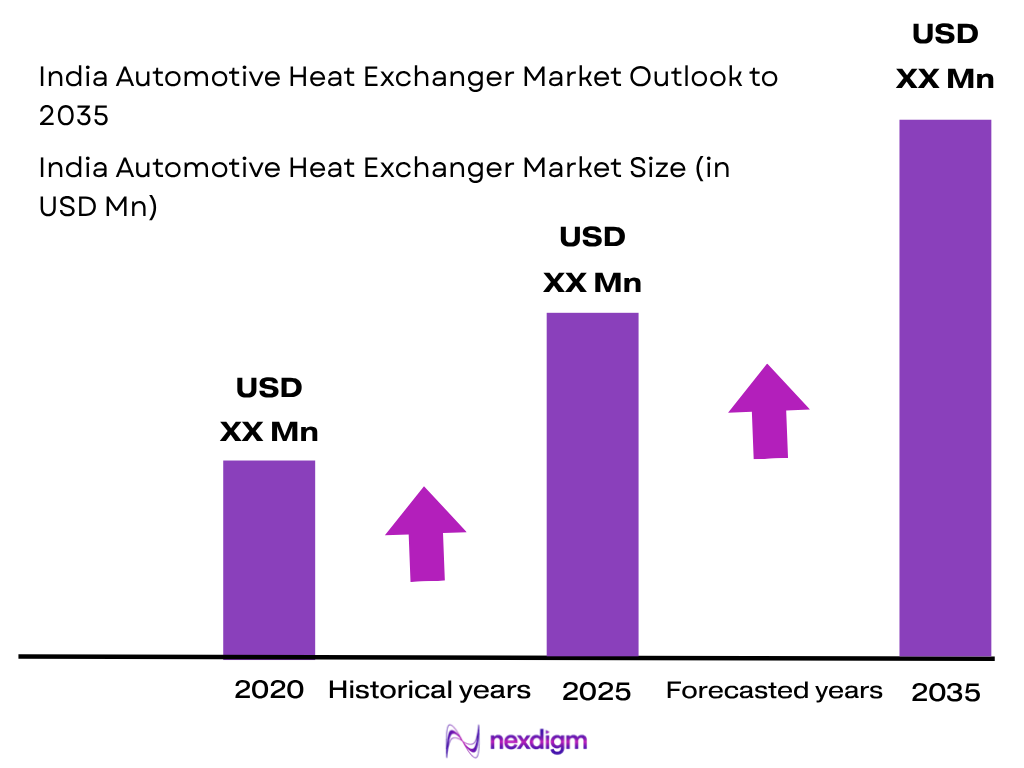
The India Automotive Heat Exchanger Market is valued at ~USD XX billion in 2024 and is projected to expand at a CAGR of ~XX% during 2026-2035. The market growth is supported by increasing vehicle production, rising demand for efficient engine cooling systems, stricter emission standards, and growing adoption of electric vehicle thermal management systems. Heat exchangers such as radiators, condensers, oil coolers, and intercoolers are becoming increasingly important due to higher thermal loads in modern vehicles. The transition toward lightweight aluminium-based systems and advanced cooling architectures is further supporting market expansion.
India’s automotive heat exchanger demand is concentrated across major automobile manufacturing clusters including Tamil Nadu, Maharashtra, Haryana, Gujarat, Karnataka, and Uttar Pradesh. Chennai and Pune dominate due to their large OEM ecosystem and presence of Tier-1 component suppliers, while Gurugram-Manesar benefits from passenger vehicle manufacturing concentration. Gujarat has emerged as a major EV and automotive manufacturing hub due to new vehicle assembly investments. These regions support heat exchanger demand through proximity to vehicle manufacturers, component suppliers, aluminium processing facilities, and established automotive supply chains.
Market Segmentation
By Heat Exchanger Type
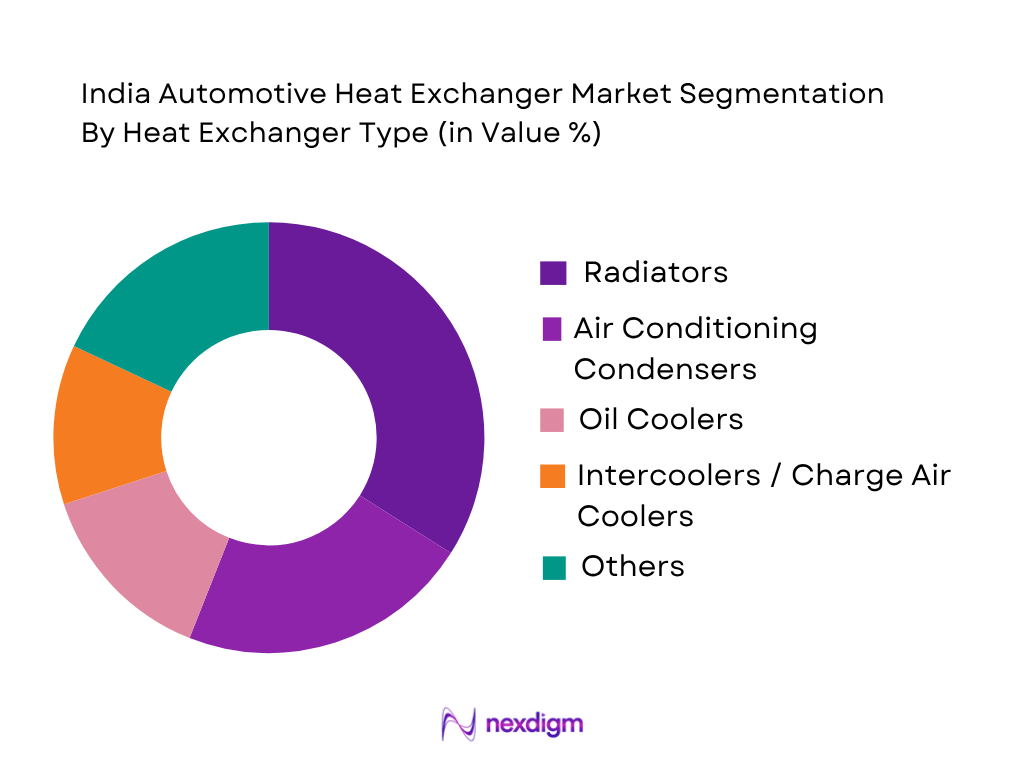
Radiators dominate the India Automotive Heat Exchanger Market by heat exchanger type due to their essential role in engine cooling systems across passenger vehicles, commercial vehicles, and heavy-duty transportation applications. Radiators are installed across almost all internal combustion engine vehicles and remain a high-volume component because of India’s large ICE vehicle base. Passenger cars, trucks, buses, and agricultural equipment require radiator systems for maintaining optimal engine operating temperatures under varying climatic conditions. Increasing vehicle ownership, rising commercial transportation activity, and replacement demand from the existing vehicle fleet continue to support radiator demand. However, battery cooling heat exchangers and advanced thermal modules are expected to gain importance with increasing electric vehicle penetration.
By Vehicle Type
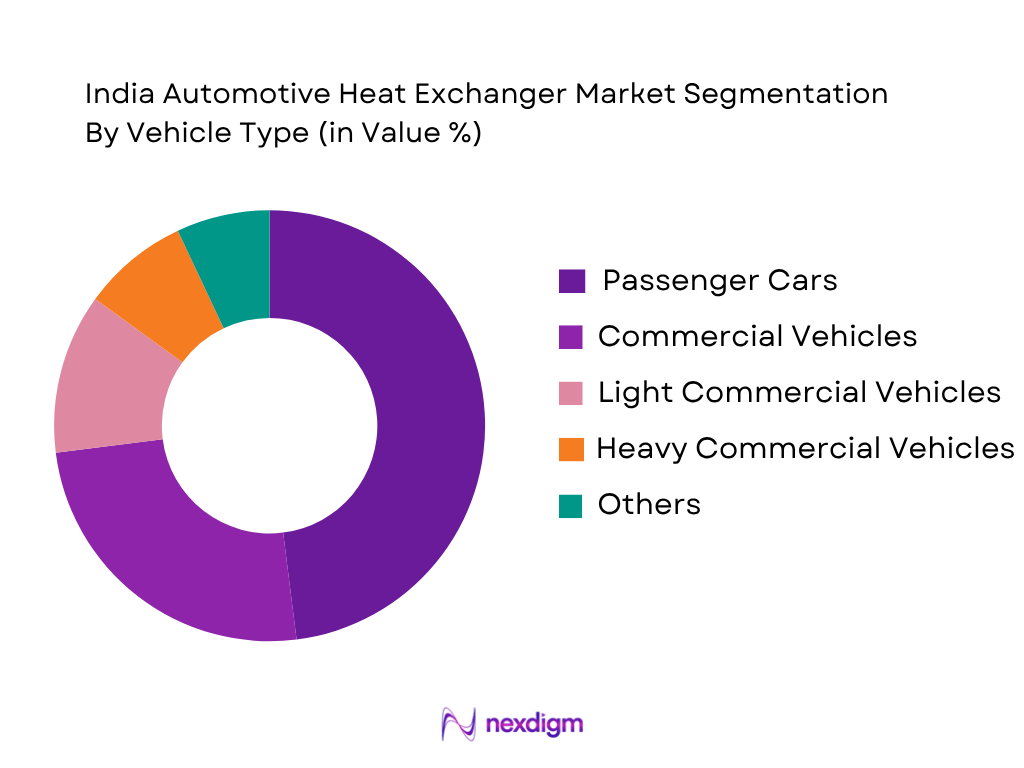
Passenger cars represent the leading vehicle segment in the India Automotive Heat Exchanger Market due to high production volumes and widespread adoption of thermal management components across compact cars, sedans, SUVs, and premium vehicles. Passenger vehicle manufacturers increasingly require lightweight and compact heat exchanger solutions to improve fuel efficiency and comply with emission regulations. Commercial vehicles also represent a significant demand category because heavy-duty engines generate higher thermal loads and require advanced cooling systems. The increasing penetration of electric vehicles is creating new opportunities for battery cooling systems, chillers, and integrated thermal management modules. EV manufacturers require specialized heat exchangers to regulate battery temperature, improve charging performance, and enhance vehicle range.
Competitive Landscape
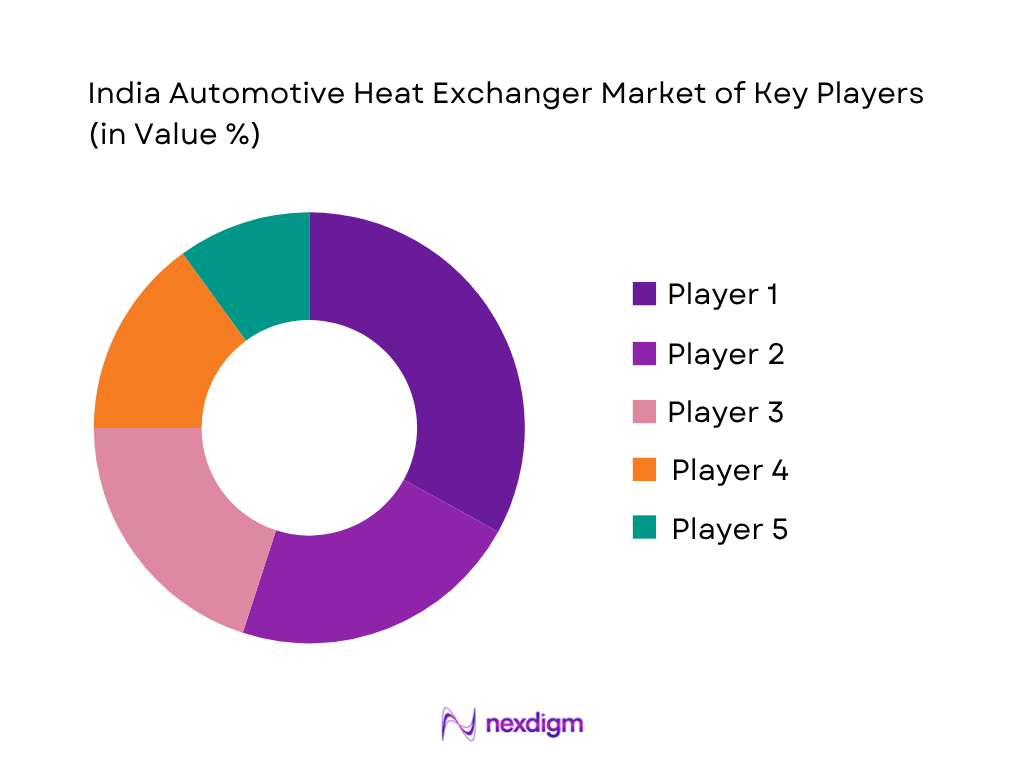
The India Automotive Heat Exchanger Market is characterized by the presence of global Tier-1 thermal management suppliers and domestic component manufacturers supplying radiators, condensers, intercoolers, oil coolers, HVAC heat exchangers, and EV battery thermal management systems. The competitive environment is driven by OEM partnerships, lightweight aluminum heat exchanger development, localization of component manufacturing, and increasing demand for advanced thermal solutions for electric vehicles. Major global suppliers such as Denso Corporation, Valeo SA, MAHLE GmbH, Modine Manufacturing, and Hanon Systems compete alongside domestic suppliers including Subros Limited and Tata AutoComp Systems.
The shift toward electric mobility has increased competition in battery cooling systems, integrated thermal modules, and heat pump technologies, while conventional engine cooling systems continue to represent a major demand area due to India’s large internal combustion engine vehicle base.
| Company | Establishment Year | Headquarters | Product Portfolio | OEM Partnerships | EV Thermal Management Capability | Manufacturing Footprint | R&D Capability | Aftermarket Presence |
| Denso Corporation | 1949 | Kariya, Japan | ~ | ~ | ~ | ~ | ~ | ~ |
| Valeo SA | 1923 | Paris, France | ~ | ~ | ~ | ~ | ~ | ~ |
| MAHLE GmbH | 1920 | Stuttgart, Germany | ~ | ~ | ~ | ~ | ~ | ~ |
| Modine Manufacturing Company | 1916 | Racine, USA | ~ | ~ | ~ | ~ | ~ | ~ |
| Hanon Systems | 1986 | Daejeon, South Korea | ~ | ~ | ~ | ~ | ~ | ~ |
India Automotive Heat Exchanger Market Analysis
Growth Drivers
Increasing Vehicle Production
The expansion of India’s automotive manufacturing ecosystem is strengthening demand for automotive heat exchangers across passenger vehicles, commercial vehicles, and two-wheelers. India produced approximately 28.43 million vehicles across all categories in the financial year 2023-24, according to the Society of Indian Automobile Manufacturers (SIAM), creating sustained requirements for radiators, condensers, oil coolers, intercoolers, and HVAC heat exchangers. The country’s manufacturing sector contributed around 17% to GDP, supported by industrial investments and vehicle localization initiatives, according to World Bank economic indicators. Rising vehicle assembly capacity in manufacturing hubs such as Maharashtra, Tamil Nadu, Gujarat, and Haryana is increasing demand for locally produced thermal components. Automotive heat exchanger manufacturers are expanding production capabilities to support higher vehicle volumes and stricter emission requirements. The increasing adoption of advanced engines, turbocharged powertrains, automatic transmissions, and commercial vehicles is further increasing thermal management complexity. Additionally, government initiatives supporting domestic automotive manufacturing are encouraging suppliers to develop localized heat exchanger production capabilities and reduce dependence on imported components.
Electric Vehicle Adoption
The rapid transition toward electric mobility is creating new demand for advanced automotive heat exchanger technologies, particularly battery cooling systems, power electronics cooling modules, and integrated thermal management solutions. India recorded electric vehicle registrations exceeding 1.6 million units in 2024, according to the Ministry of Road Transport and Highways (MoRTH) Vahan portal, reflecting increasing electrification across two-wheelers, three-wheelers, passenger vehicles, and commercial vehicles. The Government of India has allocated continued support under electric mobility programs to accelerate EV manufacturing and charging infrastructure development. India’s electricity generation capacity exceeded 450 GW in 2024, according to the Ministry of Power, supporting the broader electrification ecosystem required for EV adoption. Electric vehicles require precise temperature regulation to maintain battery efficiency, safety, and operating life, increasing demand for battery cooling plates, refrigerant-based cooling systems, and compact thermal modules. Automotive suppliers are investing in EV-specific thermal technologies as manufacturers introduce more electric vehicle platforms across passenger and commercial segments.
Market Challenges
Raw Material Price Volatility
Automotive heat exchanger manufacturing is significantly influenced by fluctuations in aluminum, copper, and steel prices, as these materials represent essential inputs for radiators, condensers, and cooling modules. India consumed approximately 4.1 million tonnes of aluminum in 2023-24, according to data from the Ministry of Mines, with automotive applications representing an important demand segment due to aluminum’s lightweight and thermal conductivity advantages. Global commodity market fluctuations, energy costs, and supply chain disruptions continue to affect material availability and production planning for component manufacturers. The automotive sector also depends on specialized aluminum alloys and precision-engineered materials for lightweight heat exchanger production. According to World Bank commodity indicators, industrial metal prices remained sensitive to global manufacturing activity and energy market conditions during 2024. Heat exchanger suppliers face challenges in maintaining consistent margins while meeting OEM requirements for cost efficiency, durability, and weight reduction. Increasing adoption of aluminum-intensive EV thermal systems may further increase exposure to raw material supply risks.
High Manufacturing Precision Requirements
Automotive heat exchanger production requires advanced manufacturing capabilities, including brazing technology, leak testing, thermal simulation, and precision assembly processes. Increasing vehicle complexity has raised performance requirements for cooling systems, particularly in turbocharged engines, hybrid powertrains, and electric vehicle battery thermal management applications. India’s automotive component industry employed more than 1.5 million direct workers in 2023-24, according to Automotive Component Manufacturers Association of India (ACMA), highlighting the scale of technical expertise required for component manufacturing. Heat exchanger suppliers must maintain strict quality standards to meet OEM reliability requirements, as failures can impact engine performance, battery safety, and vehicle efficiency. Advanced EV thermal systems require expertise in coolant management, refrigerant circuits, and electronic control integration. The development of such technologies requires investments in testing facilities, engineering capabilities, and manufacturing automation. Smaller suppliers face difficulties competing with global Tier-1 manufacturers due to the need for specialized equipment, skilled workforce availability, and continuous technology upgrades.
Market Opportunities
EV Battery Cooling Systems
The growth of electric mobility is creating significant opportunities for manufacturers developing battery thermal management solutions, including liquid cooling plates, cooling modules, and integrated thermal control systems. India registered more than 1.6 million electric vehicles in 2024 according to the Ministry of Road Transport and Highways, increasing the requirement for efficient battery temperature management solutions. Battery performance is highly dependent on maintaining optimal operating temperatures, particularly in India’s diverse climatic conditions ranging from extreme heat in northern and western regions to humid coastal environments. The National Electric Mobility Mission and ongoing government support for EV manufacturing are encouraging domestic development of EV components. Battery cooling systems are becoming increasingly important for passenger EVs, electric buses, and commercial electric vehicles where extended operating range and battery durability are critical factors. Heat exchanger manufacturers with capabilities in lightweight aluminum structures, coolant-based systems, and integrated thermal modules are positioned to support India’s growing EV ecosystem.
Advanced Thermal Management Solutions
Increasing vehicle electrification, emission regulations, and demand for improved energy efficiency are creating opportunities for advanced thermal management solutions beyond conventional radiators and condensers. India’s automotive industry produced more than 4.2 million passenger vehicles in 2023-24, according to SIAM, increasing demand for efficient HVAC systems, engine cooling modules, and integrated thermal solutions. Modern vehicles require coordinated management of multiple thermal systems, including battery packs, motors, power electronics, cabins, and conventional powertrain components. The adoption of hybrid vehicles and electric platforms is accelerating demand for compact and intelligent thermal management technologies. India’s manufacturing sector received continued industrial investment support through government initiatives focused on strengthening domestic production capabilities. Advanced heat exchanger technologies using lightweight aluminum materials, optimized airflow designs, and electronic thermal controls can help manufacturers meet efficiency requirements. Suppliers developing integrated thermal modules and smart cooling solutions can benefit from increasing collaboration with OEMs seeking localized component solutions.
Future Outlook
The India Automotive Heat Exchanger Market is expected to experience structural transformation due to increasing vehicle electrification, stricter emission regulations, and rising demand for efficient thermal management systems. Future growth will be supported by higher adoption of EV battery cooling solutions, integrated thermal modules, lightweight aluminum heat exchangers, and advanced HVAC systems.
Passenger vehicles and commercial vehicles will continue generating demand for conventional heat exchangers, while electric vehicles will create new opportunities for battery cooling plates, coolant systems, and thermal control technologies. Domestic manufacturing expansion, localization initiatives, and partnerships between OEMs and Tier-1 suppliers are expected to strengthen India’s automotive thermal component ecosystem.
Major Players
- Denso Corporation
- Valeo SA
- MAHLE GmbH
- Modine Manufacturing Company
- Hanon Systems
- Subros Limited
- Tata AutoComp Systems Limited
- Sanden Holdings Corporation
- Banco Products (India) Limited
- Nippon Light Metal Holdings Co. Ltd.
- T.RAD Co. Ltd.
- Dana Incorporated
- Marelli Corporation
- AKG Group
- Climetal S.L.
Key Target Audience
- Automotive Original Equipment Manufacturers (OEMs)
- Automotive Tier-1 and Tier-2 Component Manufacturers
- Electric Vehicle Manufacturers and EV Platform Developers
- Automotive Thermal Management System Suppliers
- Battery Pack Manufacturers and Energy Storage Companies
- Investments and Venture Capitalist Firms (Automotive Technology Investors, Mobility-Focused Investment Funds)
- Government and Regulatory Bodies (Ministry of Heavy Industries, Automotive Research Association of India, Bureau of Indian Standards)
- Automotive Aftermarket Distributors and Replacement Component Suppliers
Research Methodology
Step 1: Identification of Key Variables
The initial stage involves defining the India Automotive Heat Exchanger Market ecosystem by identifying key stakeholders, including automotive OEMs, Tier-1 suppliers, thermal management manufacturers, aftermarket distributors, and EV technology providers. Secondary research is conducted using industry databases, government automotive statistics, company reports, and technical publications to identify major market variables.
Step 2: Market Analysis and Construction
Historical market assessment is performed by analyzing vehicle production trends, automotive component demand, heat exchanger application adoption, and technology transitions across ICE and electric vehicles. The analysis evaluates demand contribution from passenger vehicles, commercial vehicles, EV platforms, and aftermarket replacement requirements to construct a comprehensive market framework.
Step 3: Hypothesis Validation and Expert Consultation
Market assumptions are validated through discussions with automotive component manufacturers, thermal system suppliers, OEM professionals, and industry specialists. These consultations provide insights into procurement patterns, OEM supplier relationships, technology adoption, localization trends, and future thermal management requirements.
Step 4: Research Synthesis and Final Output
The final phase integrates quantitative and qualitative findings from supply-side and demand-side analysis. Data collected from manufacturers, industry participants, and automotive ecosystem stakeholders is triangulated to develop an accurate assessment of market structure, competitive positioning, technological trends, and future opportunities.

- Executive Summary
- Research Methodology (Market Definition and Scope, Automotive Heat Exchanger Ecosystem Mapping, Primary and Secondary Research Framework, Market Sizing Methodology, Top-Down Analysis, Bottom-Up Analysis, OEM Demand Assessment, Component Supplier Assessment, Vehicle Production Data Analysis, Aftermarket Evaluation, Demand-Side and Supply-Side Analysis, Industry Expert Interviews, Data Triangulation, Forecasting Framework, Research Limitations)

- Definition and Scope
- Market Evolution and Technological Development Timeline
- Automotive Heat Exchanger Industry Structure
- Automotive Thermal Management System Ecosystem
- Automotive Heat Exchanger Value Chain Analysis
- Raw Material Supply Chain Analysis

- Growth Drivers (Increasing Vehicle Production, Electric Vehicle Adoption, Rising Thermal Management Requirements, Automotive Manufacturing Expansion, Commercial Vehicle Demand Growth)
- Market Challenges (Raw Material Price Volatility, High Manufacturing Precision Requirements, Import Dependency for Advanced Components, Increasing Competition Among Suppliers, Technology Transition Challenges)
- Market Opportunities (EV Battery Cooling Systems, Advanced Thermal Management Solutions, Lightweight Aluminium Heat Exchangers, Hybrid Vehicle Growth, Localized Component Manufacturing)
- Market Trends (Electric Vehicle Thermal Management Integration, Compact Heat Exchanger Development, Lightweight Component Adoption, Advanced Brazing Technologies, Smart Thermal Control Systems, Integrated Cooling Modules)
- Government Regulations and Industry Standards (Bureau of Indian Standards Automotive Regulations, Automotive Industry Standards, Vehicle Emission Norms, Electric Vehicle Policies, FAME Scheme Impact, Automotive Component Localization Policies)
- SWOT Analysis
- Porter’s Five Forces Analysis
- PESTLE Analysis

- By Market Value (2020-2025)
- By Volume Production (2020-2025)
- By Vehicle Heat Exchanger Installation Volume (2020-2025)
- By Average Selling Price (2020-2025)
- By OEM Supply Revenue (2020-2025)
- By Aftermarket Replacement Demand (2020-2025)

- By Heat Exchanger Type (In Value %)
Engine Radiators
Air Conditioning Condensers
Oil Coolers
Charge Air Coolers / Intercoolers
Battery Thermal Management Heat Exchangers
EGR Coolers
Transmission Oil Coolers
HVAC Heat Exchangers
Fuel Coolers
Power Electronics Cooling Heat Exchangers - By Vehicle Type (In Value %)
Passenger Cars
Commercial Vehicles
Light Commercial Vehicles
Heavy Commercial Vehicles
Two-Wheelers
Three-Wheelers
Electric Vehicles - By Propulsion Type (In Value %)
Internal Combustion Engine Vehicles
Petrol Vehicles
Diesel Vehicles
Compressed Natural Gas Vehicles
Hybrid Electric Vehicles
Battery Electric Vehicles - By Material Type (In Value %)
Aluminium Heat Exchangers
Copper-Brass Heat Exchangers
Stainless Steel Heat Exchangers
Composite Material Heat Exchangers - By Sales Channel (In Value %)
OEM Supply
Tier-1 Supplier Network
Aftermarket Replacement
Authorized Service Centers
Independent Repair Workshops - By Application Area (In Value %)
Engine Cooling Systems
Electric Vehicle Battery Cooling
Powertrain Thermal Management
Cabin Climate Control
Emission Control Systems - By Region (In Value %)
North India
South India
West India
East India

- Market Share Analysis of Major Players (By Revenue, Vehicle Segment, Heat Exchanger Type, OEM Supply, Aftermarket Presence)
- Cross Comparison Parameters (Automotive Heat Exchanger Product Portfolio Breadth, OEM Customer Base, Manufacturing Capacity, EV Thermal Management Capability, Aluminium Brazing Technology Expertise, Vehicle Segment Coverage, Localization Level, R&D and Product Innovation Capability)
- SWOT Analysis of Major Players
- Detailed Profiles of Major Companies
Domestic and International Heat Exchanger Manufacturers
Valeo
Denso
MAHLE
Sanden Holdings Corporation
Modine Manufacturing Company
T.RAD Co., Ltd.
Dana Incorporated
Behr-Hella Thermocontrol
Pranav Vikas
Banco Products
Radiant Heat Exchangers
Subros Limited
Varroc Engineering
Motherson Group
Sandhar Technologies

- OEM Demand Assessment
- Vehicle Manufacturer Preference Analysis
- EV Thermal Management Requirement Analysis
- Aftermarket Demand Analysis
- Commercial Vehicle Usage Analysis

- By Market Value (2026-2035)
- By Volume Production (2026-2035)
- By Vehicle Heat Exchanger Installation Volume (2026-2035)
- By Average Selling Price (2026-2035)
- By OEM Supply Revenue (2026-2035)
- By Aftermarket Replacement Demand (2026-2035)


 Request a Sample
 Ask for Customization
 Get a Quote
 Enquire Now