
 Download PDF
Market Overview
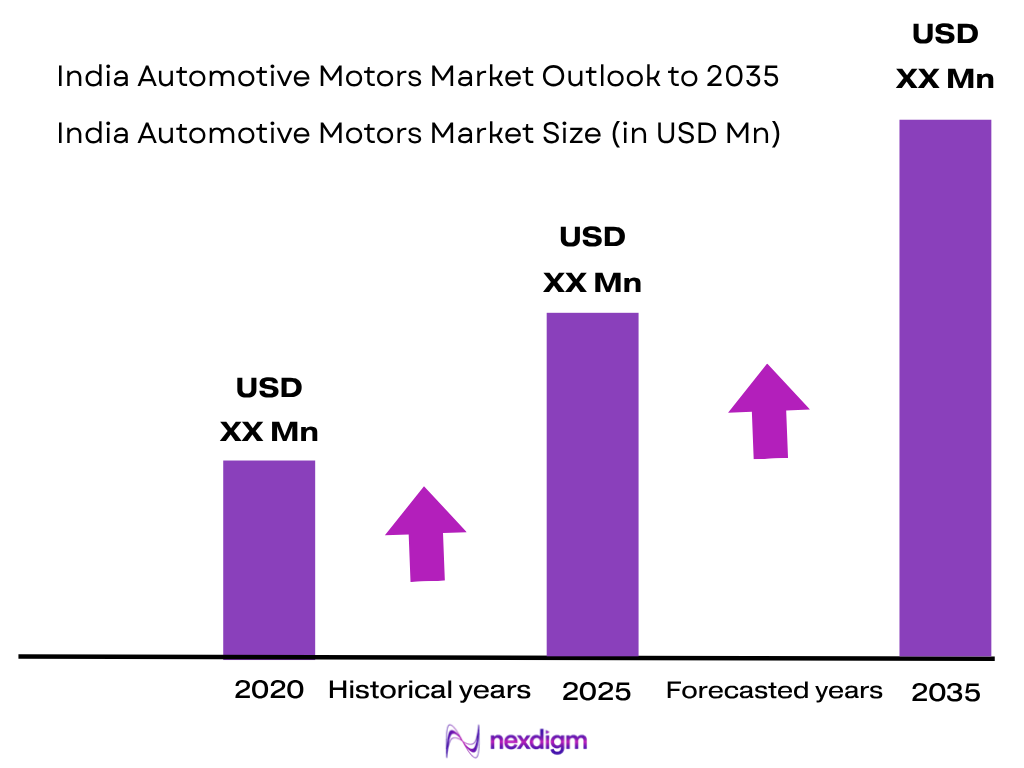
The India Automotive Motors Market is valued at ~USD ~ billion in 2024, with the 2026–2035 CAGR estimated at ~%. The market is supported by the scale of vehicle manufacturing and increasing motor content per vehicle as electrification expands. SIAM reports that India produced 30.61 million vehicles in 2024, compared with 28.44 million in 2023, while calendar-year domestic sales reached 25.07 million vehicles, reinforcing the underlying addressable base for starter motors, alternators, traction motors, EPS motors, HVAC motors, pumps and other electric actuators.
India’s automotive motor demand is concentrated around major vehicle and component manufacturing clusters including Chennai–Sriperumbudur, Pune, Gurugram–Manesar, Sanand–Ahmedabad, Bengaluru, Hosur, Hyderabad and the NCR region. Their dominance is driven by dense concentrations of OEM assembly plants, Tier-1 suppliers, component manufacturers, engineering centres and logistics infrastructure. The scale of the national ecosystem is reflected in SIAM’s 5.06 million passenger vehicles, 1.03 million commercial vehicles, 10.50 million three-wheelers and 23.88 million two-wheelers produced in FY2024–25.
Market Segmentation
By Motor Type
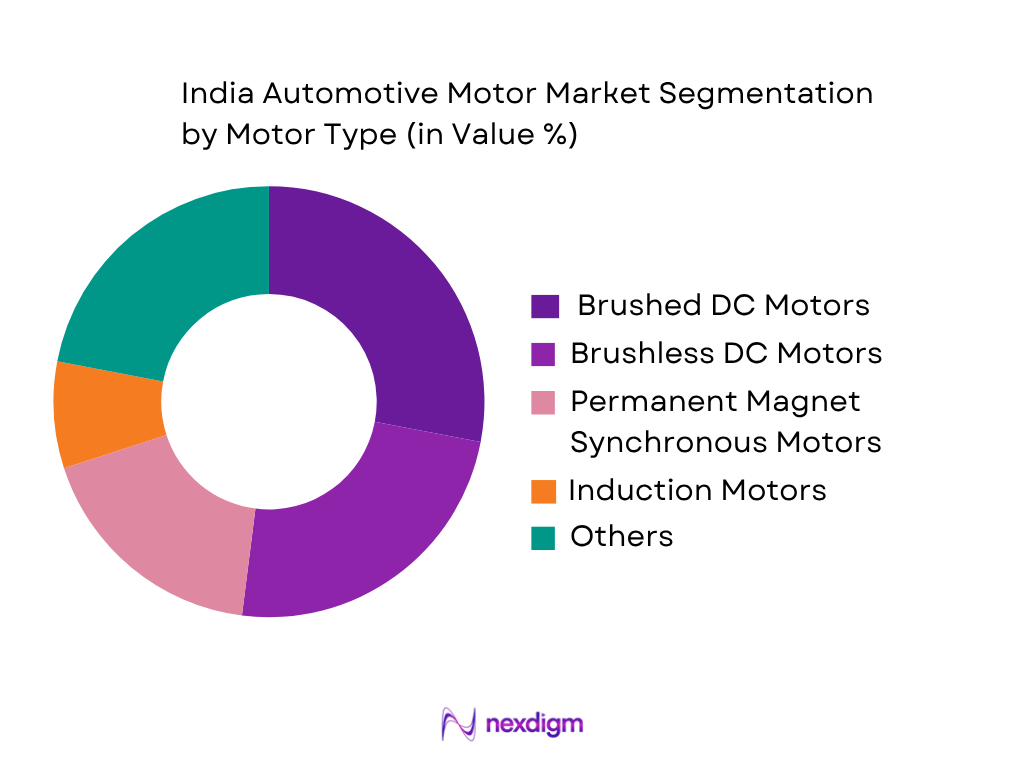
The India Automotive Motors Market is segmented by motor type into Brushed DC Motors, Brushless DC Motors, Permanent Magnet Synchronous Motors, Induction Motors, Stepper Motors, Switched Reluctance Motors, Starter Motors, Alternators and Axial-Flux Motors. Brushed DC and BLDC motors maintain strong application breadth because they serve a wide range of automotive functions, from windows, wipers and HVAC blowers to pumps and actuators, while BLDC and PMSM technologies gain importance in electrified powertrains. Increasing EV adoption is progressively shifting demand toward electronically controlled, high-efficiency motor architectures. Government data recorded 1.95 million EV registrations in calendar 2024, demonstrating the expanding installed base relevant to traction and auxiliary motor demand.
By Vehicle Type
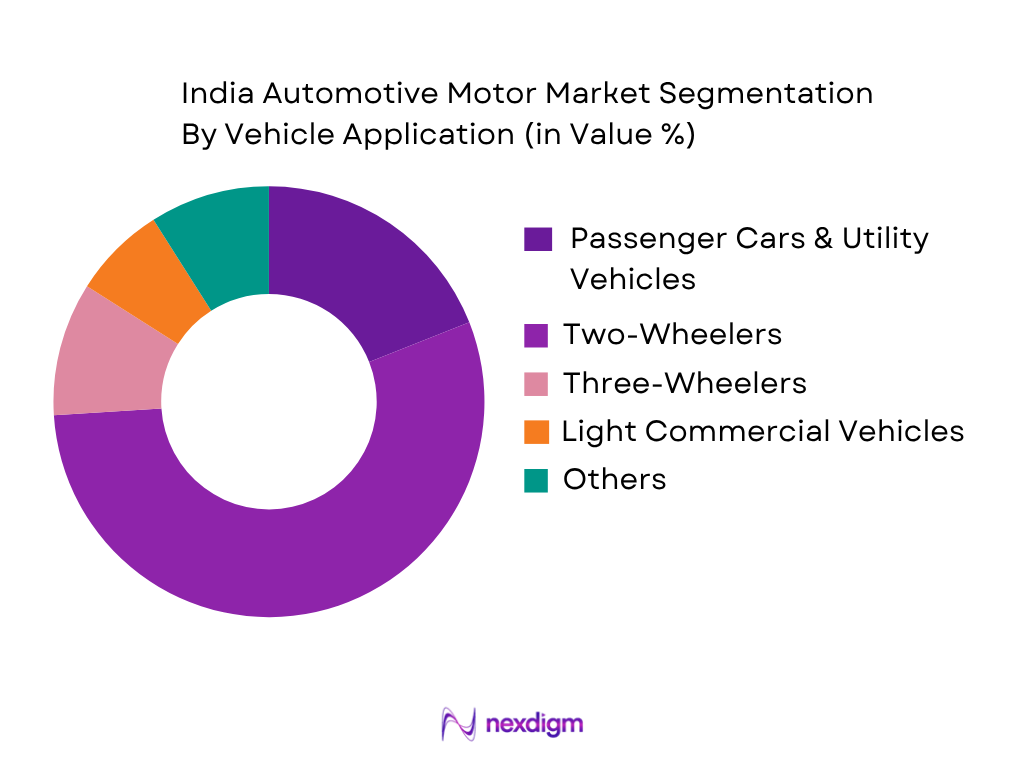
The India Automotive Motors Market is segmented by vehicle type into Passenger Cars, SUVs and Utility Vehicles, Two-Wheelers, Three-Wheelers, Light Commercial Vehicles, Medium and Heavy Commercial Vehicles, Buses and Electric Commercial Vehicles. Two-wheelers represent the largest underlying vehicle-volume opportunity because India produced 23.88 million two-wheelers in FY2024–25, while passenger vehicles reached 5.06 million units and commercial vehicles exceeded 1.03 million units. The high production base generates demand not only for propulsion motors in electric vehicles but also for numerous auxiliary motors, including cooling, HVAC, pumps, steering and actuation systems.
Competitive Landscape
The India Automotive Motors Market comprises global automotive component groups, specialist motor manufacturers, diversified Tier-1 suppliers and domestic automotive-component companies. Competition is increasingly shaped by OEM qualification, motor efficiency, power density, thermal performance, localization and the ability to supply both conventional and electrified vehicle platforms. Companies with established Indian manufacturing and engineering operations have an advantage because OEM programmes require validated products, production consistency and localized technical support. The broader component ecosystem generated INR 6.14 lakh crore in FY2024, according to ACMA, providing a substantial industrial base for motor and related component suppliers.
| Major Player | Established | Headquarters | India Manufacturing Footprint | EV Motor Capability | Key Applications | OEM/Tier-1 Integration | Technology Focus |
| Bosch | 1886 | Gerlingen, Germany | ~ | ~ | ~ | ~ | ~ |
| DENSO | 1949 | Kariya, Japan | ~ | ~ | ~ | ~ | ~ |
| Valeo | 1923 | Paris, France | ~ | ~ | ~ | ~ | ~ |
| Nidec | 1973 | Kyoto, Japan | ~ | ~ | ~ | ~ | ~ |
| Lucas TVS | 1961 | Chennai, India | ~ | ~ | ~ | ~ | ~ |
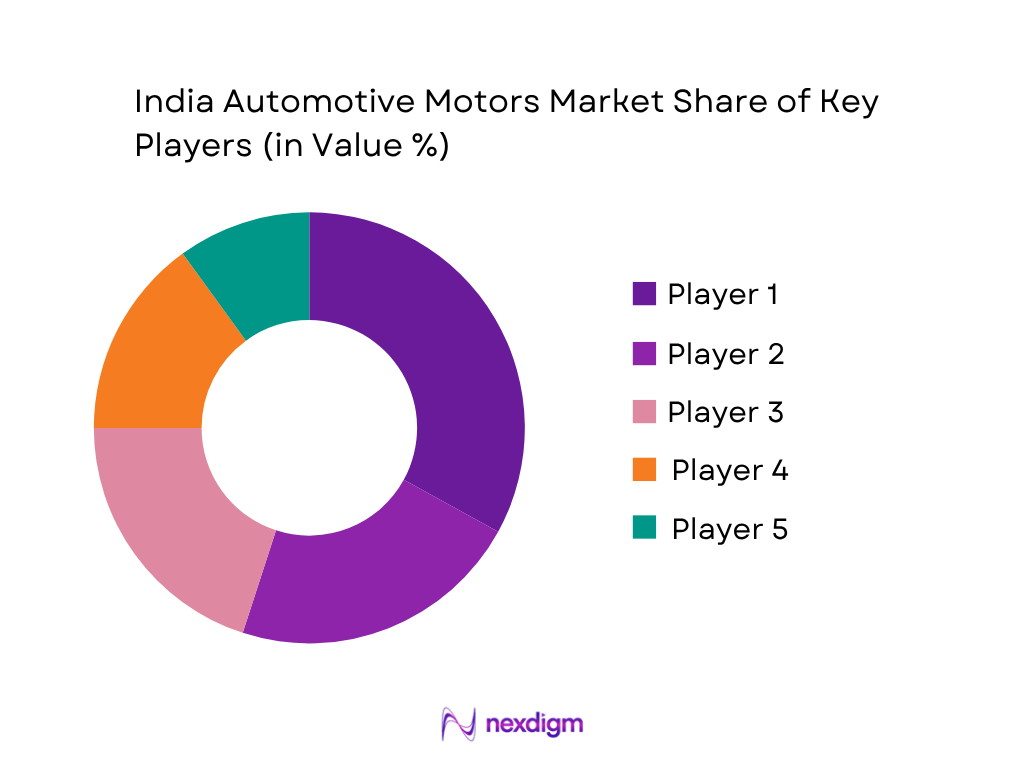
India Automotive Motors Market Analysis
Growth Drivers
EV Penetration and Rising Vehicle Production
India’s automotive motor demand is being strengthened by the simultaneous expansion of vehicle production and the electrification of vehicle architectures. SIAM recorded 306,10,778 vehicles produced in calendar 2024, comprising 42,74,793 passenger vehicles, 9,51,991 commercial vehicles, 7,28,670 three-wheelers and 1,95,43,093 two-wheelers sold domestically. The production base continued expanding into FY2024-25, when total automobile production reached 3,10,36,476 units, including 50,61,164 passenger vehicles, 10,34,947 commercial vehicles, 10,50,020 three-wheelers and 2,38,83,857 two-wheelers. This scale directly enlarges the addressable installed base for starter motors, alternators, cooling fans, pumps, HVAC motors, window regulators, wiper motors, EPS motors and traction systems. Electrification adds another layer because electric vehicles replace mechanically driven auxiliaries with electrically actuated systems and require high-performance traction motors. The PM E-DRIVE dashboard recorded 27,33,332 eligible EV registrations as of August 28, 2026, including 24,88,519 electric two-wheelers, 2,37,258 L5 electric three-wheelers and 194 electric trucks within the programme’s reported categories. The same dashboard reported 30,68,468 litres of daily fuel savings and 37,59,765 kg of daily CO₂ reduction, indicating the operational scale already associated with supported electrification. India’s macroeconomic environment also supports automotive investment: the IMF reported 6.5% real GDP growth in FY2024-25, 7.2% private-consumption growth, and 7.1% investment growth, providing a relatively strong demand and capital-formation environment for automotive manufacturing. The combination of high vehicle volumes and increasingly motor-intensive electrical architectures creates demand across both conventional and electrified powertrains. For motor suppliers, this expands opportunities beyond unit growth because a single vehicle can incorporate multiple auxiliary motors alongside traction or starter-generation systems. Two-wheelers remain particularly important because India produced 2,38,83,857 units in FY2024-25, while passenger-vehicle production reached 50,61,164 units. The resulting scale supports higher volumes for compact BLDC, DC and electronically controlled motors, while passenger and commercial vehicles increasingly require EPS, thermal-management and actuator motors. The market therefore benefits from two simultaneous demand mechanisms: more vehicles being produced and a greater number of electrically actuated functions being incorporated into each vehicle.
Increasing Motor Content per Vehicle, Hybridization, EPS and ADAS Adoption
The structural increase in electrical functionality per vehicle is creating a second growth engine for India’s automotive motors industry. SIAM’s FY2024-25 data show 50,61,164 passenger vehicles and 10,34,947 commercial vehicles produced, while domestic sales reached 43,01,848 passenger vehicles and 9,58,679 commercial vehicles. Utility vehicles alone accounted for 27,97,000 domestic sales, demonstrating the scale of vehicle platforms in which electronically controlled steering, thermal management, powered closures, seat adjustment, HVAC actuation and other motor-driven functions can be deployed. In electric and hybrid architectures, motor content rises further through traction systems, electric coolant pumps, battery thermal-management equipment, compressors and electrically assisted accessories. India’s electrification policy is also generating measurable deployment: the PM E-DRIVE dashboard showed 24,05,237 registered electric two-wheelers and 2,41,921 registered L5 electric three-wheelers within its reported programme records as of the latest available 2026 dashboard data. These volumes create a practical installed base for compact traction motors, pumps, fans, steering systems and electronic actuators. At the macro level, the IMF reported 6.5% real GDP growth in FY2024-25, alongside 7.2% private-consumption growth and 7.1% investment growth. Such conditions support continued vehicle replacement, feature upgrades and manufacturing investment. The motor opportunity is therefore shifting from simply supplying one or two rotating machines per vehicle toward providing multiple electronically controlled motor systems. EPS is particularly relevant because electric assistance converts steering support into an electronically controlled motor function and creates demand for compact, high-torque and high-efficiency units. ADAS adds additional actuation requirements through systems associated with braking, steering, sensor positioning, camera cleaning, grille shutters and other electronically controlled functions. Thermal-management electrification is equally important because EV and hybrid platforms require active management of battery, inverter, motor and cabin temperatures. Consequently, suppliers capable of integrating motors with controllers, sensors, gearing and diagnostics can capture more value per vehicle than suppliers focused solely on conventional motor assemblies. India’s passenger-vehicle production base of 5,061,164 units and two-wheeler production base of 23,883,857 units in FY2024-25 provide substantial volume platforms for this transition. The industry’s export base further expands the opportunity: SIAM recorded 7,70,364 passenger-vehicle exports and 41,98,403 two-wheeler exports in FY2024-25, indicating that India-based motor and component manufacturing increasingly serves both domestic vehicle programmes and international platforms.
Market Challenges
Rare-Earth Magnet Exposure, Electrical-Steel Availability and Copper Price Volatility
Automotive motor manufacturers in India face increasing material and engineering complexity as demand shifts toward compact, high-efficiency BLDC and permanent-magnet synchronous motor systems. These technologies require carefully engineered magnetic circuits, electrical steel, copper windings, insulation systems and, in many applications, permanent magnets containing rare-earth elements. The challenge is amplified because the automotive sector is operating at very large volumes: SIAM recorded 3,10,36,476 vehicles produced in FY2024-25, including 2,38,83,857 two-wheelers, 5,061,164 passenger vehicles, 1,034,947 commercial vehicles and 1,050,020 three-wheelers. Even small changes in material availability, specification or procurement lead time can therefore affect substantial production programmes. Copper exposure is particularly relevant because motor windings are fundamental to traction motors, EPS systems, pumps, fans and other auxiliary motors. Electrical steel is similarly critical for stators and rotors because material losses directly influence motor efficiency and thermal performance. Rare-earth dependency becomes more strategically important as vehicle electrification increases the use of permanent-magnet architectures. India’s EV deployment is already substantial: the PM E-DRIVE dashboard reported 24,88,519 electric two-wheelers and 2,37,258 L5 electric three-wheelers in its cumulative programme records, illustrating the scale of electric platforms requiring specialized motor systems. At the same time, the IMF reported 6.5% real GDP growth in FY2024-25, with 7.1% investment growth, indicating an environment in which manufacturers are investing while simultaneously managing input-security requirements. The challenge is not limited to procurement. Motor manufacturers must maintain electromagnetic performance while potentially qualifying alternative magnetic materials, steel grades, winding configurations or motor topologies. Substitution can require redesign, validation, durability testing and OEM approval, particularly for traction and steering applications where failure carries significant safety and warranty consequences. Higher motor efficiency requirements can also increase material sensitivity because thinner electrical steel, tighter magnetic tolerances and optimized copper utilization become important to achieving performance targets. As India moves toward greater localization, suppliers are therefore required to establish resilient sourcing for magnets, electrical steel, copper, bearings, insulation and electronic components while maintaining cost discipline. The scale of the vehicle industry makes supply continuity a strategic issue rather than a narrow purchasing concern, particularly where a single motor component can affect vehicle production schedules.
Semiconductor Dependency, OEM Cost Pressure, Motor Miniaturization and Thermal Constraints
Automotive motor systems are becoming increasingly dependent on electronics, particularly as BLDC, PMSM, EPS, electric pumps and intelligent actuators replace simpler mechanically controlled systems. This creates exposure to semiconductors, power electronics, sensors, microcontrollers and control modules in addition to the conventional motor supply chain. India’s vehicle manufacturing scale magnifies the operational implications: SIAM reported 50,61,164 passenger vehicles, 10,34,947 commercial vehicles, 10,50,020 three-wheelers and 2,38,83,857 two-wheelers produced during FY2024-25. Meanwhile, EV deployment recorded through PM E-DRIVE reached 29,40,093 total eligible sales in the dashboard’s cumulative programme records, including 24,05,237 electric two-wheelers, 2,41,921 L5 electric three-wheelers and 113 electric trucks as reflected in the latest reported dashboard fields. Electrification therefore increases the requirement for motors that operate together with inverters, controllers and vehicle networks. Miniaturization adds another engineering constraint because suppliers must package higher torque density into smaller housings without compromising insulation, bearing life, electromagnetic performance or thermal dissipation. Thermal management is especially demanding in India because motors can operate under high ambient temperatures, traffic congestion and extended duty cycles. EPS motors, cooling fans, electric pumps and traction motors may encounter repeated transient loads, requiring accurate thermal modeling and robust materials. OEM procurement practices create an additional challenge because vehicle manufacturers seek lower system costs while simultaneously demanding higher efficiency, reliability, functional safety and warranty performance. The macroeconomic backdrop is supportive but does not remove these pressures. The IMF recorded 6.5% real GDP growth in FY2024-25, 7.2% private-consumption growth and 7.1% investment growth, meaning suppliers are operating in a growing industrial environment where customers can simultaneously pursue expansion and cost optimization. Motor manufacturers therefore need to achieve scale efficiencies while investing in automation, testing, electronic integration and localization. Localization requirements can further increase engineering costs when suppliers must develop domestic sources for magnets, electrical steel, bearings, sensors, power electronics and precision components. For smaller suppliers, the combination of certification, tooling, testing, cybersecurity-related electronics and OEM validation can lengthen programme-development cycles. The resulting competitive environment favors companies capable of offering complete motor-plus-controller solutions, localized supply chains, predictive-quality systems and application engineering rather than manufacturers competing only on motor unit price.
Market Opportunities
EV Traction Motors, E-Axles, BLDC Motors and PMSM
India’s accelerating vehicle electrification creates a clear opportunity for suppliers of traction motors and integrated electric-drive systems, supported by the country’s large underlying vehicle manufacturing ecosystem. SIAM recorded 3,10,36,476 vehicles produced in FY2024-25, including 2,38,83,857 two-wheelers, 5,061,164 passenger vehicles, 1,034,947 commercial vehicles and 1,050,020 three-wheelers. This provides a large manufacturing platform from which electric-drive penetration can expand across different vehicle categories. The current EV base provides evidence of active demand rather than relying on future forecasts. PM E-DRIVE records show 24,05,237 electric two-wheelers and 2,41,921 L5 electric three-wheelers registered within the programme’s cumulative dashboard data, while the programme also records 113 electric trucks in the latest displayed registration field. This creates opportunities for differentiated motor architectures ranging from compact BLDC systems for high-volume two-wheelers to higher-output PMSM and integrated e-axle systems for passenger and commercial vehicles. E-axles can combine traction motors, reduction gearing, differential functions and power-electronics integration, potentially reducing packaging complexity and assembly steps for vehicle manufacturers. PMSM technology is particularly suited to applications requiring high power density, controllability and efficiency, while BLDC architectures remain attractive for smaller electric vehicles and auxiliary applications where compact packaging and electronic commutation are valuable. India’s macroeconomic conditions provide a supportive industrial foundation: the IMF recorded 6.5% real GDP growth in FY2024-25, 7.2% growth in private consumption and 7.1% growth in investment. These indicators support continued vehicle demand and industrial capacity formation without requiring future market estimates to justify the opportunity. The opportunity also extends to localized motor manufacturing. As EV volumes increase, Indian suppliers can develop domestic capabilities in stator winding, rotor balancing, magnet assembly, motor housing, thermal management and end-of-line testing. Suppliers with integrated electromagnetic design and power-electronics capabilities can move upward from component supply into complete drive units. Export potential is another current foundation: SIAM recorded 7,70,364 passenger-vehicle exports and 41,98,403 two-wheeler exports in FY2024-25. A stronger domestic motor ecosystem can therefore serve both India-produced vehicles and export-oriented platforms. The strategic opportunity is consequently not limited to replacing conventional motors with electric traction units; it includes developing scalable motor families that cover two-wheelers, three-wheelers, passenger vehicles and commercial vehicles while sharing common electromagnetic, control and manufacturing technologies.
Electric Pumps, EPS Motors, ADAS Actuators and High-Efficiency Auxiliary Motors
Beyond traction systems, the expansion of vehicle electrification creates an opportunity across the broader population of electrically driven auxiliary systems. India’s vehicle production scale provides the immediate industrial base: FY2024-25 production reached 5,061,164 passenger vehicles, 10,34,947 commercial vehicles, 10,50,020 three-wheelers and 2,38,83,857 two-wheelers. The increasing number of electrical functions within these platforms creates opportunities for electric coolant pumps, oil pumps, HVAC blowers, cooling fans, compressor motors, window and seat motors, wiper systems, power tailgate actuators and electronically controlled steering motors. EPS is particularly attractive because it requires compact, responsive and highly reliable motors capable of delivering controlled assistance while meeting stringent durability requirements. ADAS adoption adds further actuator opportunities because electronically controlled vehicles require increasingly sophisticated steering, braking, thermal and sensor-support functions. The opportunity is reinforced by India’s active electrification base: PM E-DRIVE data show 24,05,237 registered electric two-wheelers and 2,41,921 registered L5 electric three-wheelers in the programme’s cumulative records, alongside 113 electric trucks in the latest displayed figures. EVs require multiple electrically driven thermal-management components because battery packs, inverters and traction motors operate within controlled temperature ranges. Consequently, the expansion of traction electrification can generate secondary motor demand even where the traction motor itself is supplied by another company. High-efficiency auxiliary motors also have an important role in conventional and hybrid vehicles because reducing parasitic electrical consumption can improve fuel efficiency and vehicle energy management. India’s industrial environment supports investment in these technologies. The IMF reported 6.5% real GDP growth in FY2024-25, 7.2% private-consumption growth and 7.1% investment growth, while SIAM recorded 7,70,364 passenger-vehicle exports and 41,98,403 two-wheeler exports during the same fiscal year. This creates a pathway for Indian motor suppliers to develop products that meet both domestic OEM specifications and international platform requirements. The strongest opportunity is therefore likely to sit with suppliers capable of providing complete, application-engineered systems rather than standalone motors. Integration of motor, controller, sensor, gearing and thermal-management functions can improve packaging and enable predictive diagnostics. Suppliers that combine localized manufacturing with electromagnetic simulation, automated winding, balancing, end-of-line testing and electronic controls can address increasingly demanding OEM requirements while supporting the industry’s transition toward higher electrical content per vehicle.
Future Outlook
Over the coming decade, the India Automotive Motors Market is expected to undergo a structural transition from predominantly ICE-related motor applications toward a broader portfolio of traction and electrically driven auxiliary systems. Growth will be supported by rising vehicle production, increasing EV penetration, hybridization, EPS adoption, thermal-management requirements and greater electronic content per vehicle. The transition will also encourage higher power density, motor–inverter integration, advanced cooling, software-controlled motors and greater localization of critical components.
The market is expected to see particularly strong strategic interest in PMSM, BLDC, integrated e-axles, electric pumps, EPS motors, battery thermal-management motors, high-speed traction motors and rare-earth-efficient motor architectures. SIAM data already demonstrates the scale of the vehicle base: total automobile production reached 31.04 million units in FY2024–25, while EV penetration has been rising across passenger vehicles, commercial vehicles, three-wheelers and two-wheelers.
Major Players
- Bosch
- DENSO
- Valeo
- Nidec Corporation
- Mitsubishi Electric
- Hitachi Astemo
- Marelli
- BorgWarner
- ZF Friedrichshafen
- MAHLE
- Johnson Electric
- Mabuchi Motor
- Lucas TVS
- Sona Comstar
- Uno Minda
Key Target Audience
- Automotive OEMs and Vehicle Manufacturers
- Tier-1 Automotive Component Manufacturers
- Automotive Motor and Powertrain Suppliers
- EV Powertrain and E-Axle Manufacturers
- Investments and Venture Capitalist Firms (Automotive Technology Investors, EV Mobility Funds, Industrial Venture Capital Firms)
- Government and Regulatory Bodies (Ministry of Heavy Industries, Ministry of Road Transport and Highways, Department for Promotion of Industry and Internal Trade, Automotive Research Association of India)
- Automotive Aftermarket Distributors and Motor Replacement Specialists
- Automotive Electrical and Electronic Component Manufacturers
Research Methodology
Step 1: Identification of Key Variables
The initial stage involves mapping India’s automotive motor ecosystem across OEMs, Tier-1 suppliers, motor manufacturers, EV powertrain companies, component suppliers and aftermarket participants. Variables include vehicle production, motors per vehicle, motor technology, application, power rating, voltage architecture and powertrain mix. Secondary research is used to establish the industry’s structural baseline.
Step 2: Market Analysis and Construction
Historical automotive production and sales data are combined with vehicle-level motor-fitment analysis to construct the addressable motor pool. The assessment distinguishes between propulsion motors and auxiliary motors, including starter motors, alternators, EPS, HVAC, pumps, cooling systems and ADAS-related actuators. SIAM production statistics and government EV-registration data are used to validate vehicle-volume assumptions.
Step 3: Bottom-Up Motor Demand Assessment
Motor demand is reconstructed from vehicle production, motor installation rates and the number of motors fitted to individual vehicle platforms. The analysis evaluates motor content by passenger vehicle, two-wheeler, three-wheeler, commercial vehicle and bus applications. EV platforms are separately assessed based on traction-motor architecture, auxiliary electrification and thermal-management requirements.
Step 4: Supply-Side and Competitive Assessment
The supply side is evaluated through manufacturer capabilities, Indian production facilities, OEM relationships, technology platforms, localization levels and product portfolios. Competitive benchmarking considers BLDC, PMSM, induction, brushed DC and emerging motor technologies alongside manufacturing scale and engineering capabilities.
Step 5: Primary Industry Validation
Market hypotheses are validated through discussions with automotive OEM procurement teams, Tier-1 engineering professionals, motor manufacturers, EV powertrain specialists, distributors and aftermarket participants. Interviews focus on qualification requirements, localization, technology selection, motor pricing structures, sourcing strategies and upcoming platform requirements.
Step 6: Data Triangulation and Forecasting
Bottom-up vehicle-level calculations are reconciled with top-down automotive-component and vehicle-production indicators. Government EV-registration information and industry production statistics provide additional validation points. Scenario-based forecasting then evaluates the effects of EV adoption, hybridization, vehicle production, motor-content expansion and localization.

- Executive Summary
- Research Methodology (Market Definition, Automotive Motor Taxonomy, Scope Boundaries, Revenue Pool Construction, Unit-Volume Assessment, Motor Content Analysis, Top-Down Market Sizing, Bottom-Up Market Reconstruction, OEM Production Mapping, Motor Fitment Analysis, Primary Interviews, Supply-Side Validation, Demand-Side Validation, Import–Export Cross-Checks, Data Triangulation, Forecasting Framework, Scenario Analysis, Sensitivity Testing, Assumptions and Limitations)

- Definition and Scope
- Automotive Motors Industry Evolution
- India Automotive Manufacturing Ecosystem
- Automotive Motor Value Chain
- Automotive Motor Supply Chain
- OEM–Tier-1–Motor Supplier Ecosystem

- Growth Drivers (EV Penetration, Rising Vehicle Production, Increasing Motor Content per Vehicle, Hybridization, EPS Adoption, ADAS Penetration, Thermal-Management Electrification, Premium Vehicle Feature Adoption)
- Market Challenges (Rare-Earth Magnet Exposure, Electrical-Steel Availability, Copper Price Volatility, Semiconductor Dependency, OEM Cost Pressure, Motor Miniaturization, Thermal Constraints, Localization Requirements)
- Market Opportunities (EV Traction Motors, E-Axles, BLDC Motors, PMSM, Axial-Flux Motors, Electric Pumps, EPS Motors, ADAS Actuators, High-Efficiency Auxiliary Motors)
- Technology Trends (Hairpin Windings, High-Speed Motors, Integrated Inverter-Motor Systems, Sensorless Control, Advanced Cooling, Higher Power Density, Motor–Controller Integration)
- Government and Regulatory Environment (PM E-DRIVE, ZEV Transition, FAME Legacy Programs, Automotive Mission Plan, Production-Linked Incentives, Auto PLI, Component Localization, EV Manufacturing Policies)
- Porter’s Five Forces Analysis
- PESTLE Analysis
- SWOT Analysis

- By Market Value (2020-2025)
- By Motor Unit Volume (2020-2025)
- By Average Motor Selling Price (2020-2025)
- By Motor Content per Vehicle (2020-2025)
- By Vehicle Production (2020-2025)
- By OEM Procurement(2020-2025)

- By Motor Type (in value %)
Brushed DC Motors
Brushless DC Motors
Permanent-Magnet Synchronous Motors
Induction Motors
Stepper Motors
Switched Reluctance Motors
Axial-Flux Motors
Starter Motors
Alternators
Integrated Motor-Actuator Systems - By Vehicle Powertrain (in value %)
Internal Combustion Engine Vehicles
Mild Hybrid Electric Vehicles
Hybrid Electric Vehicles
Plug-in Hybrid Electric Vehicles
Battery Electric Vehicles
Fuel Cell Electric Vehicles - By Vehicle Type (in value %)
Passenger Cars
SUVs and Utility Vehicles
Two-Wheelers
Three-Wheelers
Light Commercial Vehicles
Medium Commercial Vehicles
Heavy Commercial Vehicles
Buses - By Motor Application (in value %)
Traction Motors
Starter Motors
Alternators
Electric Power Steering Motors
HVAC Blower Motors
Electric Compressor Motors
Cooling Fan Motors
Electric Water Pump Motors
Electric Oil Pump Motors - By Functional Category (in value %)
Powertrain Motors
Chassis and Steering Motors
Thermal Management Motors
Body and Exterior Motors
Interior and Comfort Motors
Safety and ADAS Motors
Auxiliary and Utility Motors - By Motor Power Output (in value %)
Below 100 W
100–500 W
501 W–1 kW
1–5 kW
5–20 kW
21–100 kW
Above 100 kW

- Market Share of Major Players (By Revenue, Unit Volume, Motor Type, Application, Vehicle Type, Powertrain, OEM Supply, Aftermarket)
- Cross Comparison Parameters (Automotive Motor Portfolio Breadth, EV Traction Motor Capability, Maximum Motor Power Density, Motor Efficiency Range, OEM and Tier-1 Customer Coverage, India Manufacturing Footprint, Motor–Inverter Integration Capability, Localization and Component Sourcing Depth)
- Detailed Profiles of Major Companies
Robert Bosch GmbH
DENSO Corporation
Valeo SE
Nidec Corporation
Mitsubishi Electric Corporation
Hitachi Astemo, Ltd.
Marelli Holdings Co., Ltd.
BorgWarner Inc.
ZF Friedrichshafen AG
MAHLE GmbH
Johnson Electric Holdings Limited
Mabuchi Motor Co., Ltd.
Lucas TVS Limited
Sona Comstar
Uno Minda Limited

- OEM Motor Procurement Behavior
- Vehicle-Level Motor Demand
- Powertrain-Specific Motor Adoption
- Passenger Vehicle Motor Requirements
- Two-Wheeler Motor Requirements

- By Market Value (2026-2035)
- By Motor Unit Volume (2026-2035)
- By Average Motor Selling Price (2026-2035)
- By Motor Content per Vehicle (2026-2035)
- By Vehicle Production (2026-2035)
- By OEM Procurement(2026-2035)


 Request a Sample
 Ask for Customization
 Get a Quote
 Enquire Now