
 Download PDF
Market Overview
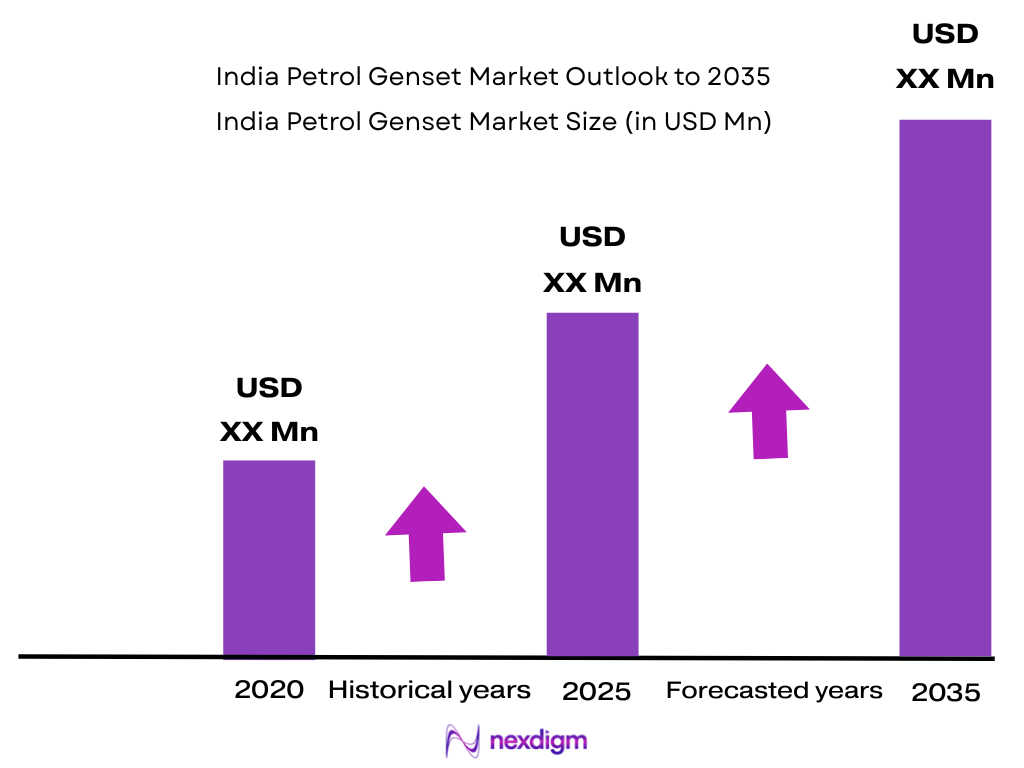
The India Petrol Genset Market is valued at approximately ~ million, supported by rising requirements for compact backup and mobile electricity across households, shops, workshops, construction sites and temporary commercial operations. India’s construction GVA increased from approximately INR 20.28 lakh crore to INR 22.21 lakh crore at current prices across the latest comparable official periods, while World Bank data places national GDP at about USD 3.96 trillion in its latest dataset. Portable petrol generators benefit from this economic activity because they offer relatively compact backup for lower-load applications. Delhi NCR, Mumbai, Bengaluru, Hyderabad, Chennai, Pune, Ahmedabad and major Tier-II industrial centres form important petrol-genset demand clusters because they concentrate construction, small businesses, workshops, residential properties and temporary power applications. Maharashtra, Gujarat, Karnataka, Tamil Nadu, Telangana, Uttar Pradesh and the National Capital Region are particularly relevant due to their dense commercial and construction ecosystems. India’s construction sector generated approximately INR 22.21 lakh crore of current-price GVA in the latest comparable official period, reinforcing portable-power requirements around expanding building and infrastructure activity.
Market Segmentation
By Power Rating
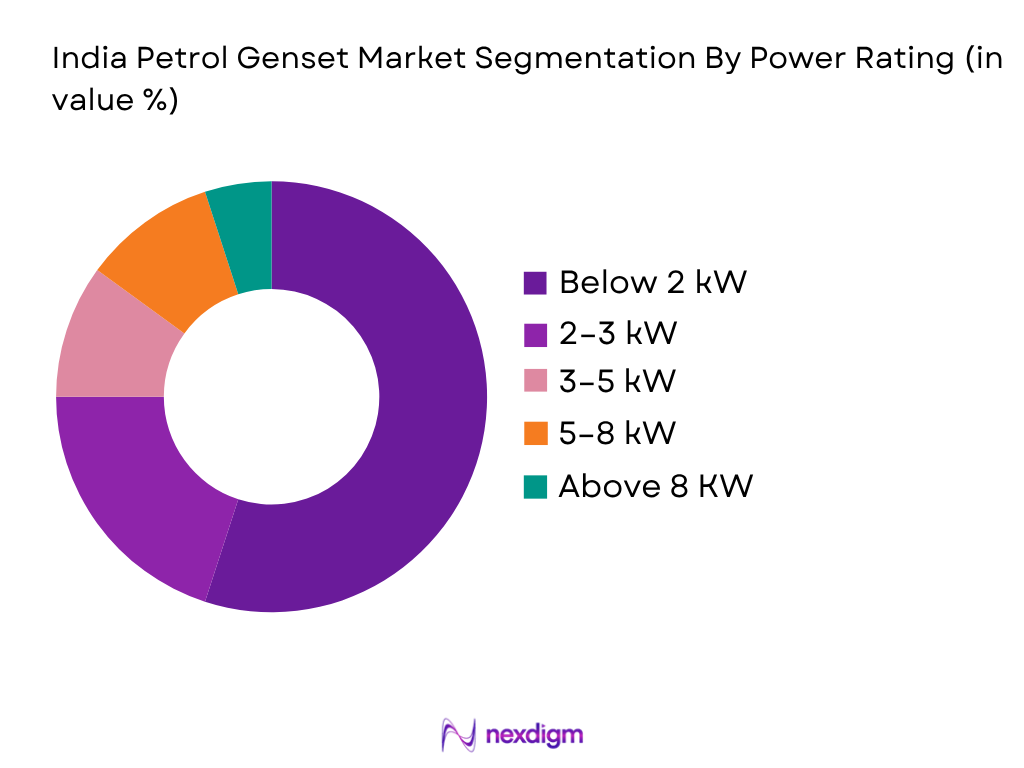
The India Petrol Genset Market is segmented into below 2 kW, 2–3 kW, 3–5 kW, 5–8 kW and above 8 kW units. The 2–5 kW category holds the dominant market position because this range balances portability with sufficient output for household essentials, retail outlets, workshops, outdoor commercial operations and smaller construction applications. Current products illustrate this positioning: Kirloskar markets a 5 kW petrol inverter generator, while Honda India Power Products maintains a portfolio of portable generators aimed at backup applications. In this range, buyers can operate lights, fans, refrigerators, tools, pumps and selected electronic equipment without moving into significantly heavier stationary generating equipment. The category also benefits from increasing inverter-generator availability, which allows stable power for laptops, electronic controls and modern appliances. Petrol engines are particularly suited to intermittent, low-to-medium load applications where compact dimensions, quick starting and portability matter more than prolonged heavy-duty operation.
By Application
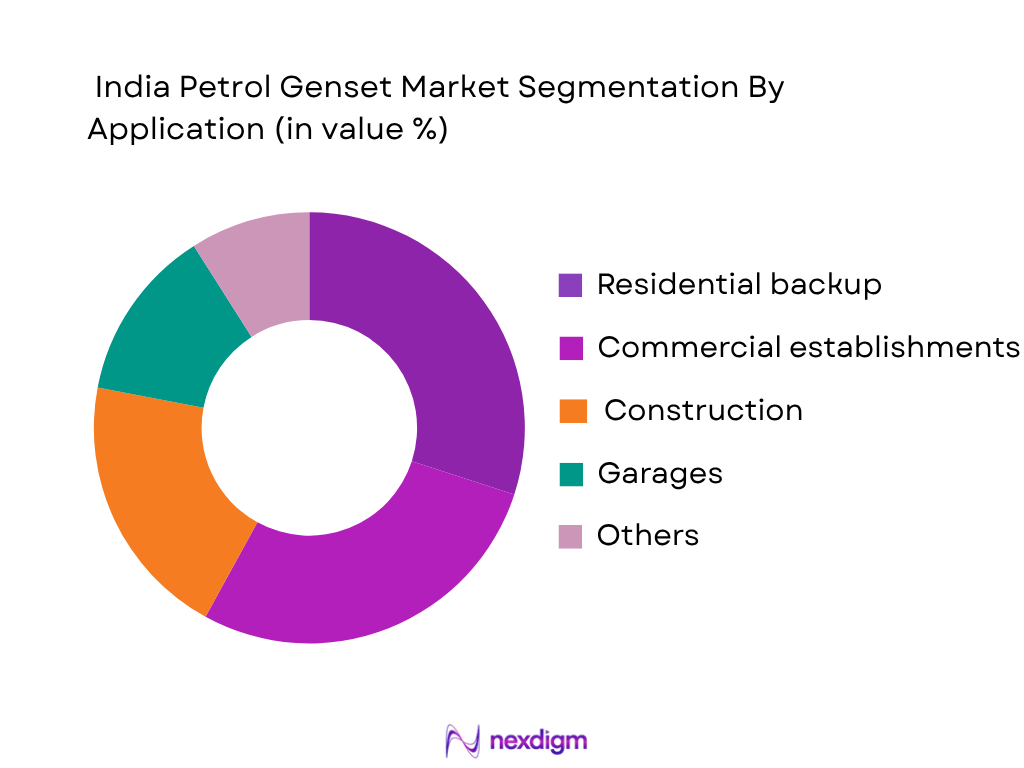
The India Petrol Genset Market is segmented into residential backup, small commercial establishments, construction and contracting, automotive workshops, outdoor and event applications, and agricultural or rural mobile-power use. Residential and small-commercial backup applications collectively represent the most important demand pool because petrol gensets are generally most competitive where required loads are moderate and operating hours are intermittent. Honda India Power Products positions portable generators as compact backup equipment, while Kirloskar identifies homes, small businesses and rental applications among the target uses for petrol gensets. Petrol units can be moved between locations, stored when grid power is stable and deployed during local interruptions or where temporary electrical connections are unavailable. Smaller retail establishments, pharmacies, workshops and offices can use them to maintain essential lighting, refrigeration, computers or selected equipment. Construction contractors also value portability for operating tools before permanent electrical infrastructure becomes available.
Competitive Landscape
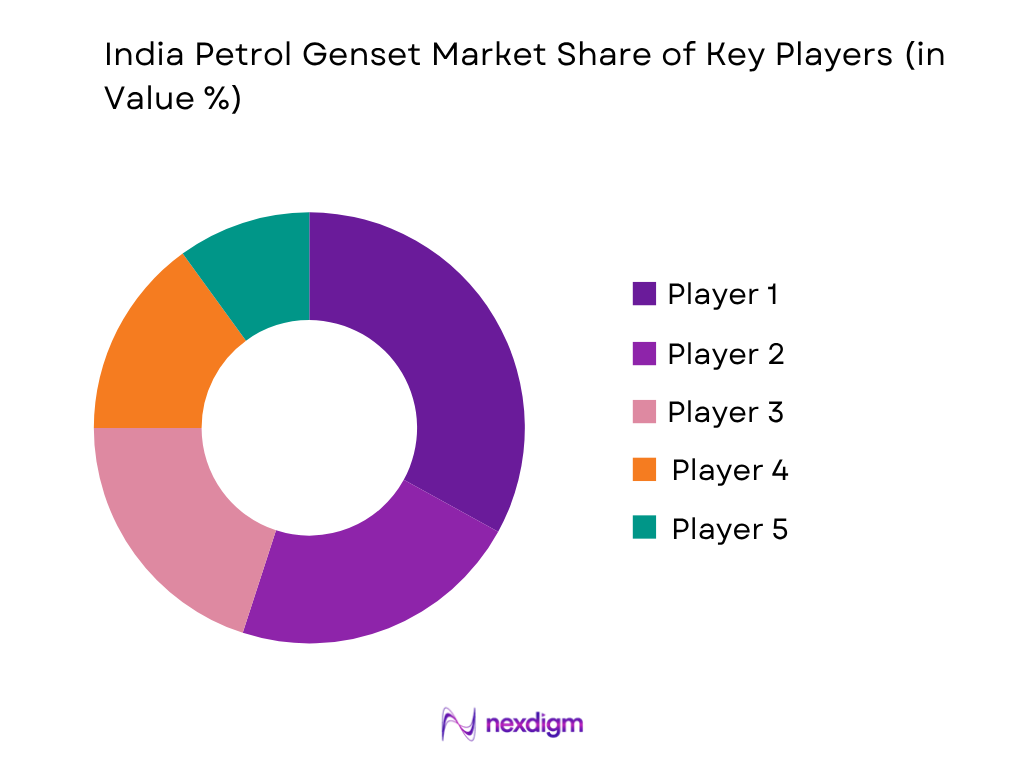
The India Petrol Genset Market combines established domestic power-equipment manufacturers, Japanese portable-generator brands, specialist generator assemblers and imported inverter-generator suppliers. Honda India Power Products maintains a strong position in compact portable gensets, while Kirloskar has expanded its generator portfolio into petrol-powered inverter units alongside its much broader power-generation business. Specialist Indian companies such as Himalayan Power Machines address 3 kVA, 5.5 kVA and higher portable petrol applications, while Elemax and Senci products contribute to the inverter and premium portable category through Indian distribution networks.
| Player | Establishment Year | Headquarters | Petrol Genset Presence | Typical Power Focus | Inverter Technology | Portable Range | Target Applications | Distribution Model |
| Honda India Power Products | 1985 | Greater Noida, India | ~ | ~ | ~ | ~ | ~ | ~ |
| Kirloskar Oil Engines | 1946 | Pune, India | ~ | ~ | ~ | ~ | ~ | ~ |
| Himalayan Power Machines | 2013 | Dehradun, India | ~ | ~ | ~ | ~ | ~ | ~ |
| Elemax | 1950s | Japan | ~ | ~ | ~ | ~ | ~ | ~ |
| Senci | 1990s | China | ~ | ~ | ~ | ~ | ~ | ~ |
India Petrol Genset Market Analysis
Growth Drivers
Rising Demand for Portable Backup Power Across Households and Small Businesses
India’s petrol genset market is supported by sustained demand for compact backup electricity among households, roadside businesses, workshops, retail outlets, mobile service operations and small commercial establishments. The Central Electricity Authority recorded an all-India peak electricity demand of 249,854 MW in May 2024, while the Ministry of Power reported total electricity generation of 1,829.698 billion units during FY 2024-25. These figures show the scale of electricity consumption being supported by the national grid, but local distribution interruptions, maintenance shutdowns, voltage instability and weather-related failures continue to create demand for portable emergency generation at the end-user level. Petrol gensets are particularly suitable for lower-capacity backup applications because they are compact, relatively easy to transport and can power lighting, refrigeration, tools, communication devices and small electrical loads without requiring permanent installation. Kirloskar Oil Engines, for example, continues to market petrol gensets specifically for homes, small businesses and rental applications, highlighting the active commercial relevance of this category. The macroeconomic environment provides a broad demand base: World Bank data places India’s GDP at approximately USD 4.17 trillion in 2024 and about USD 3.96 trillion in 2025 under its latest reported series, while GDP per capita reached approximately USD 2,702.5 in 2025. The country’s growing economic activity translates into a large universe of small workshops, shops, construction contractors and service enterprises requiring dependable temporary power. Petrol availability also supports the category. Petroleum Planning and Analysis Cell data recorded 3.1 million tonnes of motor-spirit consumption in January 2024 alone, compared with 2.8 million tonnes in the corresponding prior period, demonstrating the depth of the national petrol distribution network. Petrol gensets therefore benefit from easy refuelling access through a fuel ecosystem designed primarily around road transport. The segment is especially relevant below the heavy industrial generator range, where purchasers prioritize mobility, compact footprints and intermittent backup rather than continuous high-load operation. As electricity consumption increases and appliances become more essential to business continuity, even short local outages can interrupt payment systems, refrigeration, lighting, repair equipment and communications. This makes portable petrol gensets a practical contingency asset despite the substantial improvement in India’s overall electricity-supply position. Supporting sources include the Central Electricity Authority, Ministry of Power, Petroleum Planning and Analysis Cell and World Bank.
Construction, Infrastructure and Mobile Worksite Power Requirements
Construction and infrastructure activity represents a second major growth driver because petrol gensets provide portable electricity for low- and medium-load tools at sites where permanent grid connections are unavailable, incomplete or inconvenient. India’s construction sector remains a substantial component of economic activity. Ministry of Statistics and Programme Implementation data for the second quarter of FY 2025-26 placed construction among the major secondary-sector contributors, with real construction activity expanding materially and supporting overall GDP of ₹48.63 lakh crore at constant prices during the quarter. During the first half of FY 2025-26, real GDP reached ₹96.52 lakh crore, compared with ₹89.35 lakh crore in the corresponding FY 2024-25 period. These absolute economic values indicate the continuing scale of investment, building and infrastructure work generating demand for temporary electricity. Petrol gensets are especially relevant to smaller contractors, maintenance teams, roadside engineering crews, event infrastructure providers and equipment-rental operators that do not require the output or weight of large diesel systems. Portable units can support drills, cutters, pumps, lighting towers, welding auxiliaries, battery chargers and site offices, allowing contractors to move power between locations instead of installing permanent electrical connections at every stage of a project. Petroleum supply infrastructure further supports this use case. The Petroleum Planning and Analysis Cell recorded aggregate petroleum-product consumption of 20.04 million tonnes in January 2024, compared with 18.51 million tonnes in January 2023, while petrol alone accounted for 3.1 million tonnes during the month. This nationwide availability lowers the logistical barrier to operating petrol-powered equipment in urban and peri-urban construction environments. Electricity demand data reinforces the broader infrastructure context: power requirement reached 133,696 million units in January 2024, against 127,054 million units a year earlier, according to Central Electricity Authority data reproduced by PPAC. Although the grid supplied 133,188 million units, temporary construction locations may still be outside established distribution infrastructure or may require mobility that grid connections cannot offer. Compact petrol gensets therefore solve a different problem from large standby generators: they provide movable point-of-use electricity. The opportunity is strongest in residential construction, highway maintenance, temporary commercial developments, automotive workshops and rental fleets where output requirements are typically below the heavy-duty generator segment. As contractors increasingly use electronically controlled tools, portable compressors and precision equipment, stable voltage delivery and inverter technology are becoming more important product-selection parameters. This creates room for manufacturers to differentiate through automatic voltage regulation, inverter output, lower noise, improved fuel efficiency and portability. Supporting sources include the Ministry of Statistics and Programme Implementation, Central Electricity Authority, Petroleum Planning and Analysis Cell and World Bank.
Market Challenges
Tightening Emission and Noise Compliance Requirements for Petrol Gensets
Environmental and noise compliance constitutes a significant challenge for the India automotive petrol genset market because small internal-combustion generators operate close to homes, shops, construction sites and public spaces, creating regulatory scrutiny around carbon monoxide, hydrocarbons, nitrogen oxides and acoustic emissions. The Central Pollution Control Board maintains specific emission and noise standards for petrol- and kerosene-driven generator sets, separate from its requirements for diesel, CNG and LPG equipment. The CPCB generator-set regulatory portal was updated in July 2026 and continues to list dedicated petrol-generator emission and noise requirements alongside certification and conformity documentation. Manufacturers therefore cannot compete solely on engine output and portability; they must engineer combustion systems, mufflers, acoustic enclosures, catalytic treatment where applicable and quality-control processes capable of demonstrating regulatory conformity. The challenge becomes more important as India’s electricity and fuel consumption expand. Central Electricity Authority data shows national peak demand reaching 249,854 MW in May 2024, while electricity generation rose to 1,829.698 billion units during FY 2024-25. At the same time, petrol consumption reached 3.1 million tonnes in January 2024, according to the Petroleum Planning and Analysis Cell. These volumes demonstrate the size of the energy system within which small petrol engines operate and help explain the regulatory emphasis on controlling distributed combustion sources. India’s macroeconomic scale further increases enforcement relevance: World Bank data places GDP at around USD 4.17 trillion in 2024, meaning millions of small commercial and construction activities operate within a rapidly expanding economy. Petrol genset suppliers must consequently balance low equipment weight and competitive engine performance against stricter environmental expectations. Noise is particularly important because portable generators are frequently used close to people rather than in isolated utility compounds. Additional sound attenuation increases product weight and can reduce the portability that differentiates petrol gensets from larger equipment. Emissions controls can similarly increase engineering complexity and require more precise carburetion, electronic fuel management or improved after-treatment. Manufacturers must also maintain certification records and product consistency across production batches, making compliance a continuing engineering and quality-management responsibility rather than a one-time design requirement. The challenge is amplified for smaller brands and importers that may lack domestic certification infrastructure. As regulatory authorities continue updating generator-set standards, models built around older engine platforms can face shortened product cycles. Suppliers with established testing capabilities and India-specific engine calibration are therefore likely to be better positioned than low-cost unorganized producers. Supporting sources include the Central Pollution Control Board, Central Electricity Authority, Ministry of Power, PPAC and World Bank.
Improving Grid Reliability Reduces Dependence on Routine Backup Generation
A structurally improving national power-supply position presents a challenge to petrol genset demand because generators are increasingly shifting from routine power substitutes toward contingency and mobile-power products. Ministry of Power data shows that India successfully met a record peak demand of approximately 250,000 MW during FY 2024-25, while the reported peak shortage during the year to December was extremely small. Central Electricity Authority and Ministry of Power data also show electricity generation increasing from 1,739.091 billion units during FY 2023-24 to 1,829.698 billion units during FY 2024-25, strengthening the volume of electricity available from formal grid infrastructure. In January 2024 alone, national electricity requirement stood at 133,696 million units, while 133,188 million units were supplied, leaving an absolute gap of roughly 508 million units. The important market implication is that petrol genset manufacturers can no longer rely on broad nationwide electricity deficits as the principal demand narrative. Instead, product demand depends increasingly on localized distribution failures, construction sites, disaster resilience, remote applications and mobility. This is particularly relevant because grid capacity continues expanding: the Ministry of Power reported India added 34 GW of generation capacity during FY 2024-25, including 29.5 GW of renewable capacity. As more generation, transmission and distribution infrastructure becomes available, urban households and formal businesses face fewer situations requiring daily generator operation. This reduces annual runtime and replacement intensity for traditional backup units. India’s macroeconomic development reinforces the shift. World Bank data places GDP at about USD 4.17 trillion in 2024, while greater economic formalization encourages businesses to use centralized grid supply, rooftop solar, batteries and professionally engineered backup systems rather than small portable generators for long-duration operation. Battery energy storage also competes with petrol gensets in applications requiring silent, indoor-compatible or zero-tailpipe-emission backup. Petrol gensets retain an advantage for long runtime and rapid refuelling but lose competitiveness where users need only short-duration backup for electronics. The strategic challenge is therefore market repositioning. Manufacturers must focus on emergency resilience, mobile work, construction, recreation, agricultural portability and hybrid battery-generator systems rather than treating unreliable electricity supply as a universal growth engine. Product specifications may also need to change: lower noise, electric start, automatic transfer capability, inverter output and battery integration become more commercially valuable as consumers use generators less frequently but expect higher convenience when outages occur. Supporting sources include the Ministry of Power, Central Electricity Authority, PPAC and World Bank.
Market Opportunities
Inverter-Based, Low-Noise and Electronics-Safe Petrol Gensets
Technological upgrading creates a significant growth opportunity because India’s petrol genset market can increasingly shift from basic constant-speed machines toward inverter-equipped, lower-noise and electronically controlled portable generators. The opportunity is supported by the expanding amount of sensitive electrical equipment used by Indian households, workshops, service businesses and construction operators. National electricity generation reached 1,829.698 billion units during FY 2024-25, compared with 1,739.091 billion units during FY 2023-24, illustrating how deeply electricity-dependent economic activity has become. India’s economy also reached approximately USD 4.17 trillion in 2024 according to the World Bank, while real GDP in the first half of FY 2025-26 reached ₹96.52 lakh crore, based on Ministry of Statistics and Programme Implementation data. This expanding economic base supports greater use of laptops, electronic payment terminals, computerized workshop tools, telecom equipment, refrigeration controls and digitally managed appliances, all of which benefit from stable power quality. Traditional low-cost generators can exhibit voltage and frequency variations when loads fluctuate, whereas inverter gensets can regulate output more precisely and operate engines at variable speeds. This allows manufacturers to differentiate around cleaner electrical output, reduced noise and improved fuel utilization instead of competing only on rated wattage. The opportunity is particularly relevant to mobile service vans, automotive workshops, food trucks, outdoor commercial events, premium residential backup and contractors using electronic equipment. Petrol supply availability supports mobile applications: PPAC reported 3.1 million tonnes of petrol consumption during January 2024, showing that fuel access is widespread across the country. Generator manufacturers can combine this existing fuel infrastructure with improved electronics to create products positioned between basic open-frame generators and battery-only portable power stations. Product development opportunities include digital displays, overload protection, automatic low-oil shutdown, remote start, carbon-monoxide sensing, parallel operation and integrated battery charging. Lower acoustic output is also becoming commercially important because CPCB maintains specific noise regulations for generator sets. In dense residential and commercial environments, quieter products can extend the number of permissible or practical operating locations. Automotive-sector distribution networks provide another route to growth: engine, power-equipment and workshop brands can sell generators through dealers already familiar with small combustion engines and service parts. Unlike speculative long-term market forecasts, the opportunity is grounded in current electricity dependence, fuel availability and regulatory requirements. Manufacturers that deliver improved power quality and safer combustion performance can therefore capture replacement demand from older portable units while competing more effectively against emerging battery power stations. Supporting sources include the Ministry of Power, MoSPI, Petroleum Planning and Analysis Cell, Central Pollution Control Board and World Bank.
Portable Power for Construction, Rural Enterprise and Hybrid Resilience Applications
A second major opportunity lies in repositioning petrol gensets as flexible mobile-power assets for construction, rural enterprise, roadside services and hybrid resilience systems rather than purely as household outage equipment. India’s power system is becoming more reliable, but economic activity is simultaneously expanding into thousands of temporary and decentralized locations where permanent electricity connections are impractical. Peak national electricity demand reached 249,854 MW in May 2024, while the government added 34 GW of generation capacity during FY 2024-25. These numbers indicate rapid electrification and economic activity but do not eliminate temporary power requirements at construction sites, agricultural service locations, road projects or mobile businesses. MoSPI data reinforces the opportunity: real GDP reached ₹96.52 lakh crore during the first half of FY 2025-26, including strong activity across construction, manufacturing, trade and service sectors. Portable petrol generators are well suited to users who need several hours of electricity at changing locations but cannot justify transporting larger diesel equipment. The category can support cutting tools, pumps, lighting, small compressors, charging equipment, workshop machinery and communication devices. Fuel accessibility remains an important competitive advantage. PPAC recorded total petroleum-product consumption of 20.04 million tonnes in January 2024, including 3.1 million tonnes of petrol, reflecting an extensive national fuel-distribution system. Manufacturers can therefore serve rural and semi-urban areas without requiring entirely new refuelling infrastructure. The more differentiated opportunity is hybridization. Petrol gensets can be paired with portable battery storage or solar charging systems, allowing batteries to supply low loads silently while the generator operates periodically to recharge them or handle peak loads. This architecture reduces unnecessary engine runtime and can address emerging expectations around noise and emissions without eliminating the long-duration resilience offered by liquid fuel. It also gives manufacturers a route to participate in the energy-storage transition rather than competing directly against batteries. Rental companies represent another attractive channel because a single portable generator can serve construction sites, events, maintenance teams and emergency-response activities over its operating life. Rural enterprises such as repair workshops, small processing facilities and mobile vendors also benefit from equipment that can be transported without specialized vehicles. The opportunity is therefore strongest for compact products engineered around portability, multiple sockets, inverter output, rugged frames and simple servicing. Manufacturers able to combine petrol engines, battery interfaces and digital monitoring can create a higher-value category suited to India’s improving but increasingly decentralized energy economy. Supporting sources include the Ministry of Power, Central Electricity Authority, Ministry of Statistics and Programme Implementation, Petroleum Planning and Analysis Cell and World Bank.
Future Outlook
The India Petrol Genset Market is expected to expand at approximately ~ CAGR during 2026–2035, with growth increasingly concentrated in compact inverter-based and low-noise products rather than conventional open-frame machines. Demand will be supported by continued construction, small-business activity, mobile service operations and requirements for flexible backup power. India’s construction ecosystem remains a significant underlying demand driver, while household and commercial buyers increasingly need stable electricity for electronically controlled appliances and equipment. The technology mix is expected to shift toward electronic inverter controls, improved fuel management, lower acoustic output and more compact enclosures. Kirloskar’s current 5 kW inverter petrol platform already demonstrates this transition by targeting sensitive electronics such as laptops, refrigerators and air conditioners. Regulation will simultaneously reshape product engineering. The Central Pollution Control Board maintains dedicated generator-set notifications covering emissions and conformity requirements, meaning manufacturers must increasingly treat emission performance, certification and labelling as central product-development requirements rather than optional attributes.
Major Players
- Honda India Power Products
- Kirloskar Oil Engines
- Himalayan Power Machines
- Elemax
- Senci
- Greaves Cotton
- Rehlko Power Systems
- Mahindra Powerol
- Cummins India
- Perfect House
- Saimax Marine and Engineering
- Voltking Generator
- KOEL Green
- Osprey Power Systems
- Powerica
Key Target Audience
- Petrol genset manufacturers and portable power-equipment producers
- Generator distributors, dealers and rental-power operators
- Residential backup-power equipment suppliers
- Construction contractors and infrastructure companies
- Automotive workshops, service garages and mobile repair operators
- Small commercial establishments and organised retail operators
- Investments and venture capitalist firms
- Government and regulatory bodies (Central Pollution Control Board, Ministry of Environment, Forest and Climate Change, Ministry of Power, Central Electricity Authority, Bureau of Indian Standards)
Research Methodology
Step 1: Identification of Key Variables
The initial phase involves constructing an ecosystem map for the India Automotive Petrol Genset Market covering generator manufacturers, engine suppliers, importers, distributors, dealers, construction contractors, residential buyers, small businesses and rental operators. Core variables include kW/kVA capacity, engine displacement, petrol consumption, operating hours, starting system, alternator configuration, inverter technology, noise characteristics, mobility and emission certification.
Step 2: Market Analysis and Construction
Historical demand is constructed by mapping shipments and installed usage across residential, commercial, construction, automotive-workshop and mobile-power applications. The bottom-up framework analyses power-rating bands, average generator replacement cycles, portable versus stationary configurations, inverter penetration and fuel architecture. Supporting economic variables include construction activity, household electricity usage, commercial establishments and infrastructure development.
Step 3: Hypothesis Validation and Expert Consultation
Market hypotheses are validated through CATIs and structured interviews with genset dealers, portable-power manufacturers, rental companies, electrical contractors, hardware distributors and construction companies. Interviews assess preferred kVA ratings, petrol consumption, operating hours, noise requirements, electric-start adoption, after-sales expectations, spare-parts availability and customer migration toward inverter or dual-fuel equipment.
Step 4: Research Synthesis and Final Output
Demand-side estimates are reconciled with manufacturer product portfolios and channel availability. Honda’s portable-generator range, Kirloskar’s petrol and inverter platforms, Himalayan Power Machines’ 3 kVA–8 kVA petrol offerings and imported inverter systems provide supply-side benchmarks. Government emission requirements and macroeconomic indicators are integrated into the final market-development and forecast framework.

- Executive Summary
- Research Methodology (Market Definition and Scope, Petrol Genset Classification, Abbreviations, Market Sizing Approach, Top-Down Assessment, Bottom-Up Unit Assessment, Power Rating Mapping, Application-Level Demand Assessment, Residential Demand Assessment, Commercial Demand Assessment, Construction Demand Assessment, Dealer Interviews, Equipment Rental Interviews, Electrical Contractor Interviews, Retail Channel Assessment, Import Mapping, Domestic Manufacturing Assessment, Product SKU Mapping, Data Triangulation, Forecasting Framework, Limitations and Future Conclusions)

- Definition and Scope
- Industry Evolution and Genesis
- Evolution of Portable Petrol Generator Adoption
- Development of Low-kVA Backup Power Ecosystem
- Evolution of Inverter Generator Technology

- Growth Drivers (Residential Backup Requirements, Small Business Power Continuity, Construction-Site Electricity Demand, Equipment Portability, Petrol Availability)
- Market Challenges (Fuel Consumption, Emissions Compliance, Noise Limits, Grid Improvement, Battery Substitution)
- Market Opportunities (Inverter Technology, Low-Noise Products, Compact Designs, Smart Controls, Rental Applications)
- Market Trends (Inverter Technology, Portability, Acoustic Improvement, Electronics Protection, Hybrid Power)
- Government Regulations (Emission Standards, Noise Requirements, Product Safety, Fuel Handling, Electrical Standards)
- SWOT Analysis
- Porter’s Five Forces Analysis
- PESTLE Analysis

- By Market Value (2020-2025)
- By Unit Sales Volume (2020-2025)
- By Installed Petrol Genset Base (2020-2025)

- By Power Rating (In Value %)
Below 1 kVA
1–2 kVA
2–3 kVA
3–5 kVA
5–7.5 kVA
7.5–10 kVA - By Generator Technology (In Value %)
Conventional Petrol Generator
Inverter Petrol Generator
Digital Inverter Generator
AVR-Controlled Petrol Generator
Parallel-Capable Inverter Generator - By Application (In Value %)
Residential Backup Power
Small Retail Shops
Small Offices
Clinics and Pharmacies
Restaurants and Food Outlets - By Region (In Value %)
North India
South India
West India
East India
Central India
Northeast India

- Market Share of Major Players (By Value, Unit Volume, Power Rating, Application, Distribution Channel)
- Cross Comparison Parameters (Petrol Genset kVA Range, Inverter and Low-THD Technology Capability, Fuel Tank Capacity and Runtime, Fuel Consumption Efficiency, Noise and Acoustic Performance, Portability and Dry Weight, Dealer–Service–Spare Parts Network, Emission and Safety Compliance Capability)
- SWOT Analysis of Major Players
- Detailed Profiles of Major Companies
Honda India Power Products
Kirloskar Oil Engines – Kirloskar Green
Greaves Cotton / Greaves Power
Mahindra Powerol
Elemax / Sawafuji Electric
Senci Power
Pramac / Generac
Yamaha Motor Power Products
Himalayan Power Machines
Kohler Power
Cummins India
Cooper Corporation
Jakson Group
Sudhir Power
Ashok Leyland Power Solutions

- Residential Consumers
- Small Business Owners
- Construction Contractors
- Electrical Contractors
- Rental Fleet Operators

- By Market Value (2026-2035)
- By Unit Sales Volume (2026-2035)
- By Installed Petrol Genset Base (2026-2035)


 Request a Sample
 Ask for Customization
 Get a Quote
 Enquire Now