
 Download PDF
Market Overview
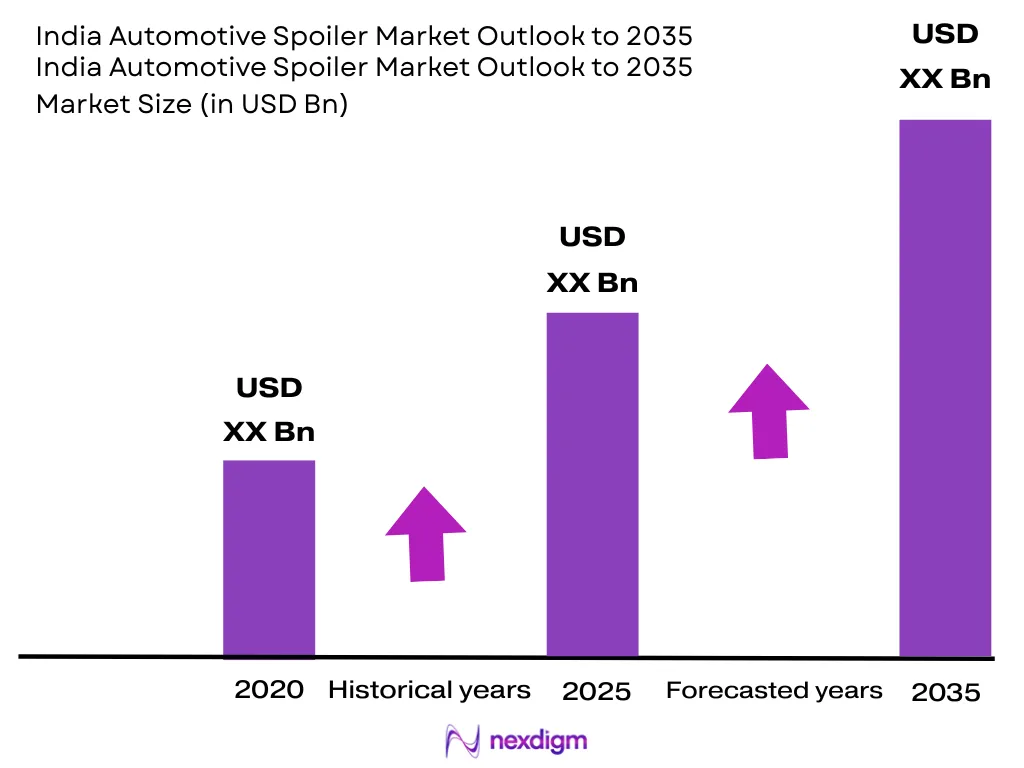
The India Automotive Spoiler Market was valued at USD ~ Billion in 2024 and is anticipated to expand at a CAGR of ~% during 2026–2035. The market is primarily driven by rising passenger vehicle production, growing consumer interest in vehicle customization, and increasing demand for aerodynamic efficiency in electric vehicles seeking to maximize battery range. India’s broader rear spoiler market was valued at approximately USD ~ billion in 2025 and is projected to reach USD ~ billion by 2032, growing at a CAGR of 8.1%, positioning India among the fastest-growing markets within the Asia-Pacific region, which itself commands the largest global revenue share of the rear spoiler market. Automotive OEMs operating in India are increasingly integrating spoilers as standard or optional features in premium and mid-range vehicles, while a fast-expanding base of car enthusiasts is driving robust aftermarket demand for aesthetic and performance-oriented spoiler upgrades across both passenger cars and two-wheelers.
Market Segmentation
By Material
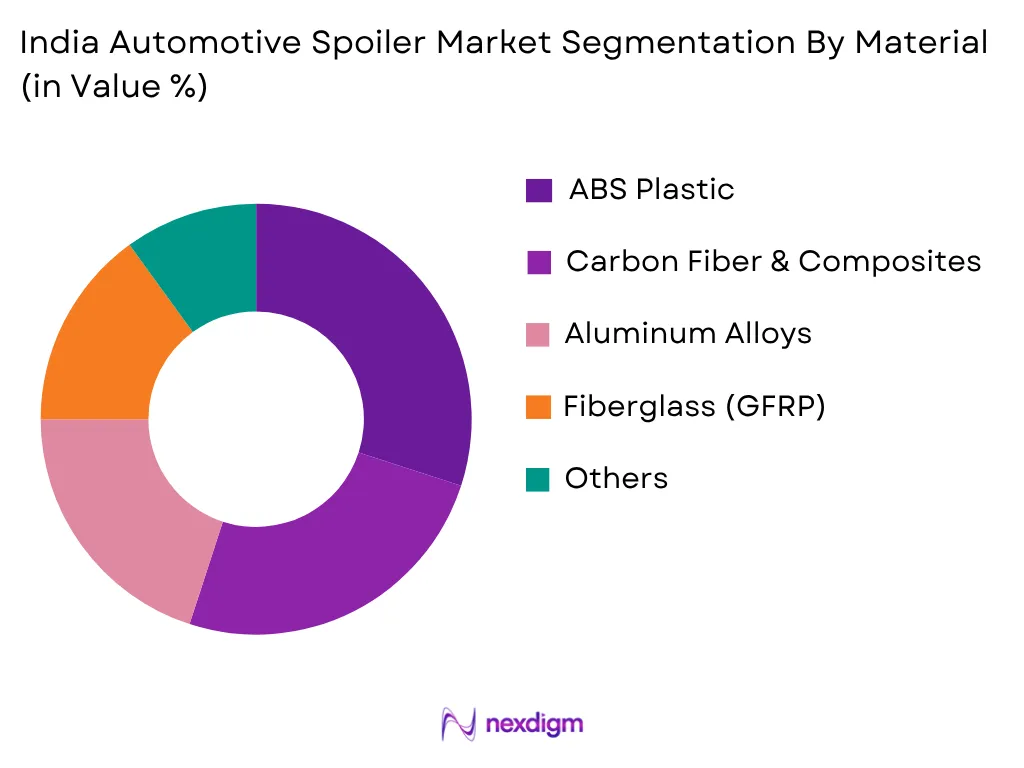
ABS Plastic remains the most widely used material in the India Automotive Spoiler Market, valued for its cost efficiency, ease of injection molding, and suitability for high-volume passenger car and two-wheeler applications. However, Carbon Fiber & Composites and Fiberglass (GFRP) are gaining share as manufacturers focus on material innovation to enhance durability and design flexibility, with lightweight materials increasingly viewed as a key trend driving advancements in product design and vehicle performance. Aluminum Alloys hold a meaningful share particularly in OEM applications for premium vehicles, where the balance of structural strength and weight reduction supports both aerodynamic and fuel efficiency goals. As India’s electric vehicle segment expands, demand for lightweight composite spoilers is expected to accelerate further, since minimizing component weight directly supports the extended driving range that EV manufacturers and consumers increasingly prioritize.
By Vehicle Type
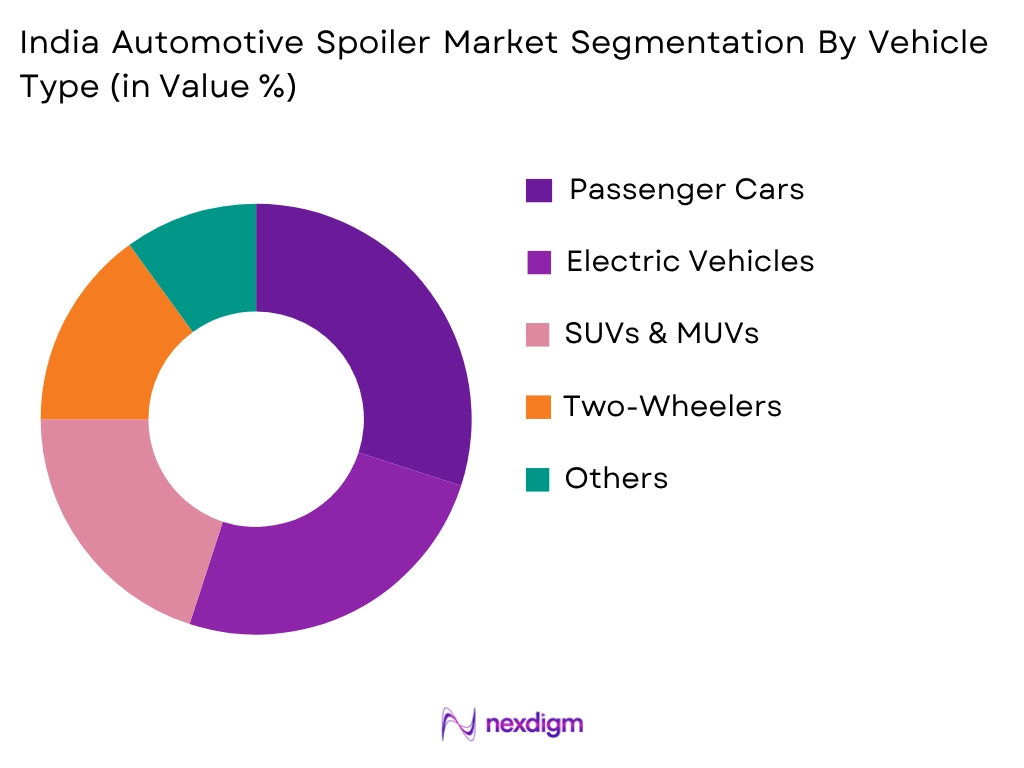
Passenger Cars represent the largest vehicle segment in the India Automotive Spoiler Market, reflecting the country’s large and growing passenger vehicle production base and the increasing integration of spoilers as standard or optional features across premium and mid-range models. Electric Vehicles represent the fastest-growing segment, as EV manufacturers in India design specialized spoilers to optimize airflow and energy efficiency; because electric vehicles require optimized aerodynamics to maximize battery efficiency and driving range, rear spoilers play a critical role in reducing air drag and improving overall vehicle performance, a design consideration that is becoming increasingly central as India’s EV market continues to expand steadily. SUVs & MUVs and Two-Wheelers also contribute meaningfully to overall demand, supported by India’s strong SUV sales growth and a large two-wheeler aftermarket accessory culture, while Commercial Vehicles represent a smaller but stable niche focused primarily on functional aerodynamic and fuel-efficiency applications.
Competitive Landscape
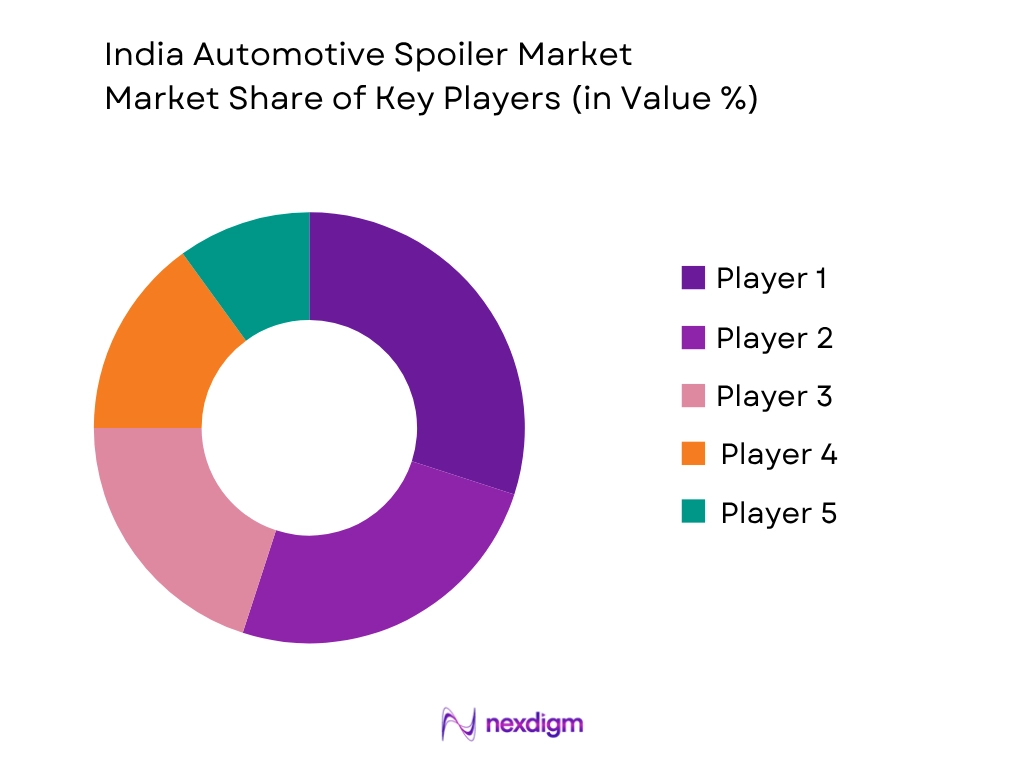
The India Automotive Spoiler Market is characterized by a mix of large domestic auto component conglomerates, established global exterior systems suppliers, and a highly fragmented base of unbranded aftermarket manufacturers. Samvardhana Motherson International, India’s largest automotive components group, supplies exterior plastic modules including spoilers and bumper systems to major domestic and international OEMs from its extensive manufacturing network, while UNO Minda and Varroc Engineering represent additional homegrown auto component majors with exterior systems and plastics manufacturing capabilities serving India’s passenger vehicle and two-wheeler industries. Global exterior systems specialists such as Plastic Omnium and Magna International, both of which command significant global market share in automotive spoiler systems through extensive manufacturing capabilities and strong OEM relationships, operate manufacturing facilities in India to serve both domestic automakers and export programs. Beyond these established players, India’s aftermarket segment remains highly fragmented, with numerous small-scale manufacturers listed on platforms such as IndiaMART offering low-cost, unbranded spoiler products, creating pricing pressure and quality inconsistency that branded OEM-grade suppliers must navigate when competing for aftermarket consumer demand.
| Company | Establishment Year | Headquarters | Primary Product Portfolio | Automotive Spoiler Portfolio
|
Manufacturing Presence | Major End-Use Industries | Key Strategic Focus | Certifications & Compliance |
| Samvardhana Motherson International | 1975 | ~ | ~ | ~ | ~ | ~ | ~ | ~ |
| UNO Minda Limited | 1958 | ~ | ~ | ~ | ~ | ~ | ~ | ~ |
| Varroc Engineering | 1988 | ~ | ~ | ~ | ~ | ~ | ~ | ~ |
| Plastic Omnium | 1946 | ~ | ~ | ~ | ~ | ~ | ~ | ~ |
| Magna International | 1957 | ~ | ~ | ~ | ~ | ~ | ~ | ~ |
India Automotive Spoiler Market Analysis
Growth Drivers
Rising Vehicle Production and EV Aerodynamic Optimization Demand
The India Automotive Spoiler Market is benefiting from sustained growth in vehicle production and an increasing emphasis on aerodynamic efficiency as India’s electric vehicle segment expands. India’s broader rear spoiler market was valued at approximately USD 3.1 billion in 2025 and is projected to grow at a CAGR of 8.1% to reach USD 5.4 billion by 2032, with growth attributed to increasing vehicle production, rising demand for improved aerodynamics, and growing interest in vehicle customization. Electric vehicles require optimized aerodynamics to maximize battery efficiency and driving range, and automotive companies in India are increasingly designing specialized spoilers for electric vehicles that focus on improving airflow and energy efficiency; as India’s EV market continues to expand steadily, this design consideration is becoming an increasingly significant driver of spoiler demand across both OEM and aftermarket channels.
Growing Vehicle Customization Culture and OEM Integration
Rising consumer interest in customizing vehicles for aesthetic and performance purposes continues to drive robust aftermarket demand across India’s passenger car and two-wheeler segments, with the aftermarket segment offering car enthusiasts a wide variety of spoiler options catering to both appearance and functional performance preferences. Simultaneously, automotive OEMs operating in India are increasingly integrating spoilers as standard or optional features in premium and mid-range vehicles, reflecting broader industry recognition that aerodynamic components have become an expected feature rather than a purely aftermarket customization. Advancements in lightweight materials such as carbon fiber and composites continue to improve product performance and durability, further supporting adoption across both OEM and aftermarket channels as manufacturers focus on material innovation to enhance design flexibility.
Market Challenges
Low Consumer Awareness Limiting Adoption Beyond Premium Segments
A significant restraint facing the India Automotive Spoiler Market, particularly in the active and electromechanical spoiler category, stems from limited consumer awareness and relatively low aftermarket adoption outside luxury and performance vehicle segments. While active rear spoilers are increasingly integrated into premium and high-performance vehicles, many mainstream car buyers in India remain unaware of the aerodynamic and efficiency benefits these components offer, restricting demand outside of the luxury and sports car categories and narrowing the addressable market for manufacturers seeking to expand active spoiler adoption into India’s large mass-market vehicle segment.
Price Sensitivity and Fragmented Unorganized Aftermarket Competition
India’s automotive spoiler aftermarket is characterized by intense price competition from a highly fragmented base of small-scale, unbranded manufacturers, with basic spoiler sets available on B2B marketplaces such as IndiaMART for as little as a few hundred rupees. This price sensitivity creates a challenging environment for branded, OEM-grade aftermarket suppliers seeking to differentiate on material quality, fitment precision, and aerodynamic performance, since many price-conscious Indian consumers prioritize upfront cost over these attributes. Quality and safety inconsistency among unbranded aftermarket products, combined with limited standardized aftermarket installation practices, further complicates efforts to build consumer trust in premium spoiler offerings across India’s price-sensitive mass market.
Market Opportunities
Growth in EV-Specific Aerodynamic and Active Spoiler Design
India’s steadily expanding electric vehicle market presents a substantial opportunity for spoiler manufacturers to develop specialized aerodynamic solutions optimized for battery efficiency and driving range. Active spoilers, which are increasingly integrated with advanced driver-assistance systems (ADAS) to enhance high-speed stability and reduce accident risk, represent a particularly promising growth avenue as India’s premium and EV vehicle segments expand and as safety-conscious OEMs recognize the dual aerodynamic and safety benefits these systems provide. Manufacturers that can develop cost-effective active spoiler systems suited to India’s price-sensitive but rapidly premiumizing vehicle market stand to capture significant OEM integration opportunities as electrification accelerates.
Expansion of Lightweight Composite and Carbon Fiber Manufacturing
Rising adoption of lightweight materials such as carbon fiber and composites, which offer a balance of performance and cost-effectiveness relative to traditional materials, presents a significant opportunity for India’s growing base of domestic auto component manufacturers to scale up advanced materials capability. As global automakers and Tier-1 suppliers increasingly seek to diversify manufacturing beyond China, India’s expanding auto component manufacturing base, supported by the government’s Production-Linked Incentive scheme for the automotive sector, is well positioned to capture greater investment in domestic composite and lightweight material production capacity, strengthening India’s position within global automotive exterior component supply chains over the coming decade.
Future Outlook
The India Automotive Spoiler Market is expected to witness sustained expansion over the forecast period, supported by continued growth in passenger vehicle and electric vehicle production, rising OEM integration of spoilers as standard features in premium and mid-range vehicles, and growing consumer interest in vehicle customization and performance upgrades. Advancements in lightweight composite materials and active spoiler technology, combined with India’s expanding domestic auto component manufacturing base under the Production-Linked Incentive scheme, will further accelerate market growth. The market is also likely to benefit from India’s position as one of the fastest-growing markets within the Asia-Pacific region, as rising vehicle ownership, expanding EV adoption, and a growing middle-class appetite for vehicle customization continue to widen the addressable market for both OEM and aftermarket spoiler solutions.
Major Players
- Samvardhana Motherson International (SMIL)
- UNO Minda Limited
- Varroc Engineering
- Plastic Omnium
- Magna International
- Sandhar Technologies
- Rico Auto Industries
- SMP Automotive (Motherson Group)
- SRG Global
- Rehau Group
- INOAC Corporation
- Polytec Group
- Gestamp Automoción
- A.P. Plasman
- Neel Metal Products
Key Target Audience
- Automotive Spoiler Manufacturers and Suppliers
- Passenger Vehicle and Two-Wheeler OEMs
- Electric Vehicle Manufacturers
- Aftermarket Accessory Retailers and Distributors
- Automotive Design and Engineering Firms
- Investment and Venture Capitalist Firms
- Government and Regulatory Bodies (Automotive Research Association of India – ARAI, Bureau of Indian Standards – BIS, Ministry of Road Transport and Highways)
- Raw Material and Composite Suppliers
Research Methodology
Step 1: Identification of Key Variables
The research process begins with identifying the complete ecosystem of the India Automotive Spoiler Market, including raw material and composite suppliers, component manufacturers, OEM and aftermarket distribution channels, and regulatory authorities. Extensive secondary research is conducted using company reports, government publications, trade associations, customs statistics, industry journals, and proprietary databases to determine the variables influencing market demand, pricing, production, consumption, and technological developments.
Step 2: Market Analysis and Construction
Historical market information is collected and analyzed to estimate market size, production volumes, application-wise demand, and pricing trends. A combination of top-down and bottom-up approaches is used to estimate market revenues and validate segment-level performance. Consumption patterns across passenger cars, SUVs, two-wheelers, commercial vehicles, and electric vehicles are evaluated to establish an accurate representation of the industry.
Step 3: Hypothesis Validation and Expert Consultation
The preliminary findings are validated through Computer-Assisted Telephone Interviews (CATIs) and structured discussions with component distributors, procurement managers, design engineers, regulatory experts, and senior executives operating within the Indian automotive industry. These interviews help verify market assumptions, competitive developments, technology adoption trends, pricing dynamics, and future investment opportunities while refining the overall market estimates.
Step 4: Research Synthesis and Final Output
The final stage integrates insights obtained from primary interviews with quantitative information collected through secondary sources. Data triangulation techniques are applied to reconcile differences between supply-side and demand-side estimates, ensuring robust market forecasting. The report is then reviewed through multiple quality assurance checkpoints to deliver a comprehensive analysis covering market size, segmentation, competitive landscape, future outlook, and strategic recommendations for industry stakeholders.

- Executive Summary
- Research Methodology (Market Definitions and Assumptions, Abbreviations, Market Sizing Approach, Top-Down Analysis, Bottom-Up Analysis, Demand-Side Assessment, Supply-Side Assessment, Primary Industry Interviews, Secondary Research Validation, Data Triangulation, Forecasting Framework, Limitations and Future Conclusions)

- Definition and Scope
- Market Evolution and Industry Genesis
- Timeline of Major Industry Developments
- Automotive Spoiler Industry Value Chain Analysis
- Supply Chain Analysis

- Growth Drivers (Rising Vehicle Production and Sales, EV Aerodynamic Optimization Demand, Growing Vehicle Customization Culture, OEM Integration in Premium and Mid-Range Vehicles, Advancements in Lightweight Materials, Expansion of Domestic Auto Component Manufacturing)
- Market Challenges (Low Consumer Awareness Beyond Premium Segments, Price Sensitivity and Unorganized Aftermarket Competition, Quality and Safety Inconsistency in Unbranded Products, Raw Material Cost Volatility, Regulatory Compliance Complexity, Limited Aftermarket Installation Standards)
- Market Opportunities (Growth in EV-Specific Aerodynamic Spoiler Design, Expansion of Lightweight Composite and Carbon Fiber Adoption, Integration with ADAS Safety Systems, Production-Linked Incentive Scheme Localization, Premium and Sports Vehicle Segment Growth, Active Spoiler Technology Adoption)
- Market Trends (Shift Toward Active and Retractable Spoiler Systems, Rising Carbon Fiber and Composite Material Adoption, EV-Optimized Aerodynamic Design, Integration with Advanced Driver-Assistance Systems, Growing Online Aftermarket Sales Channels, Customization-Driven Product Diversification)
- Government Regulations (AIS (Automotive Industry Standards) Compliance Requirements, ARAI Type Approval and Testing, Bureau of Indian Standards (BIS) Component Standards, Central Motor Vehicle Rules (CMVR), Ministry of Road Transport and Highways Regulations, Production-Linked Incentive (PLI) Scheme for Auto Components)
- Import and Export Analysis (Trade Volume, Major Import Sources, Export Destinations, HS Code Analysis, Trade Balance)
- Raw Material Availability Analysis (ABS Resin and Polymer Feedstocks, Carbon Fiber and Composite Materials, Aluminum Alloy Feedstocks, Domestic Petrochemical Supply Chain Access, Import Dependency for Advanced Composites)
- Technology Landscape (Injection Molding Technology, Active/Electromechanical Spoiler Systems, Carbon Fiber Layup and Composite Manufacturing, Aerodynamic Simulation and CFD Design Tools, Additive Manufacturing for Prototyping)
- Sustainability Assessment (Lightweighting for Fuel and Energy Efficiency, Recyclable Polymer Adoption, Carbon Footprint Reduction in Manufacturing, End-of-Life Component Recyclability, Circular Economy Alignment)
- PESTLE Analysis
- SWOT Analysis
- Porter’s Five Forces Analysis
- Stakeholder Ecosystem
- Competition Ecosystem

- By Market Value (2020-2025)
- By Volume (2020-2025)
- By Average Selling Price (2020-2025)

- By Material (In Value %)
ABS Plastic
Carbon Fiber & Composites
Fiberglass (GFRP)
Aluminum Alloys
Polyurethane - By Product Type (In Value %)
Lip Spoilers
Wing Spoilers
Active/Retractable Spoilers
Roof Spoilers
Ducktail Spoilers - By Vehicle Type (In Value %)
Passenger Cars
SUVs & MUVs
Two-Wheelers
Commercial Vehicles
Electric Vehicles - By End User (In Value %)
Passenger Vehicle Manufacturers
Two-Wheeler Manufacturers
Electric Vehicle Manufacturers
Aftermarket Accessory Retailers
Commercial Fleet Operators - By Region (In Value %)
North India
South India
West India
East India

- Market Share of Major Players (By Value, Volume, Material Type, Vehicle Segment, Sales Channel)
- Cross Comparison Parameters (Material Portfolio Breadth, OEM Relationship Strength, Aftermarket Distribution Network, Active Spoiler Technology Capability, Manufacturing Capacity, Regulatory Compliance & Certifications, Customer Base, Innovation & New Product Launch Frequency)
- SWOT Analysis of Major Players
- Pricing Analysis by Product Category and Vehicle Segment
- Production Capacity Analysis
- Manufacturing Footprint Analysis
- Distribution Network Analysis
- Innovation Benchmarking
- Detailed Profiles of Major Companie
Samvardhana Motherson International (SMIL)
UNO Minda Limited
Varroc Engineering
Plastic Omnium
Magna International
Sandhar Technologies
Rico Auto Industries
SMP Automotive (Motherson Group)
SRG Global
Rehau Group
INOAC Corporation
Polytec Group
Gestamp Automoción
A.P. Plasman
Neel Metal Products

- Consumption Pattern Analysis (OEM Fitment Rate, Aftermarket Installation Volume, Application Penetration by Vehicle Segment, Seasonal Demand, Customization Activity)
- Purchasing Criteria (Aerodynamic Performance, Material Durability, Cost Efficiency, Fitment Accuracy, Aesthetic Appeal, Regulatory Compliance)
- Procurement and Supplier Selection Analysis
- Premium vs Standard-Grade Spoiler Demand Assessment
- EV vs Internal Combustion Vehicle Adoption Comparison
- Product Attribute Preference Analysis (Weight Reduction, Aerodynamic Efficiency, Material Finish, Color Matching, Fitment Precision, Impact Resistance)
- Sustainability & ESG Influence on Procurement Decisions
- Pain Point Analysis
- Decision-Making Process

- By Market Value (2026-2035)
- By Volume (2026-2035)
- By Average Selling Price (2026-2035)


 Request a Sample
 Ask for Customization
 Get a Quote
 Enquire Now