
 Download PDF
Market Overview
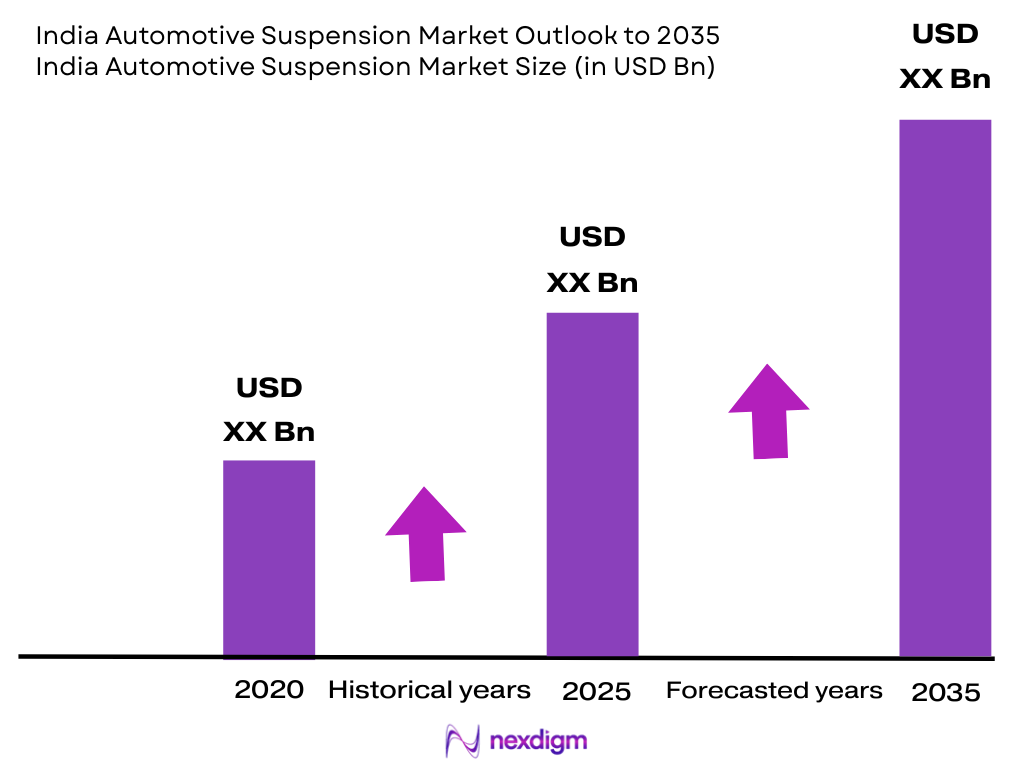
The India Automotive Suspension Market is valued at approximately USD ~ billion, compared with USD ~ billion in the preceding annual benchmark. India manufactured more than 28 million vehicles across major categories in the earlier benchmark and 31.03 million vehicles in the subsequent benchmark, substantially expanding the addressable OE suspension base. Demand is driven by passenger vehicles, SUVs, motorcycles, scooters and commercial vehicles requiring shock absorbers, struts, forks, springs, linkages and increasingly electronic ride-control systems. Pune–Chakan, Chennai–Oragadam, Gurugram–Manesar, Hosur, Sanand and Bengaluru dominate the India Automotive Suspension Market because they combine vehicle assembly, Tier-1 component manufacturing, engineering centres and EV investment. India’s automotive-component ecosystem includes more than 830 ACMA member companies, while ZF alone operates 17 manufacturing facilities and 12 engineering centres in India. These clusters enable close OEM proximity, just-in-time suspension supply, ride-development capability and efficient aftermarket distribution across passenger, two-wheeler and commercial vehicle applications.
India’s suspension market is unusually diverse because the country combines one of the world’s largest two-wheeler industries with a rapidly expanding passenger-vehicle and SUV sector, substantial commercial-vehicle production and accelerating electrification. SIAM reported domestic sales of 4,301,848 passenger vehicles, 956,671 commercial vehicles, 741,420 three-wheelers and 19,607,332 two-wheelers in the latest completed financial period. This creates very different suspension requirements, ranging from telescopic motorcycle forks and mono-shocks to MacPherson struts, multi-link SUV systems, leaf springs and heavy commercial air suspension.
Market Segmentation
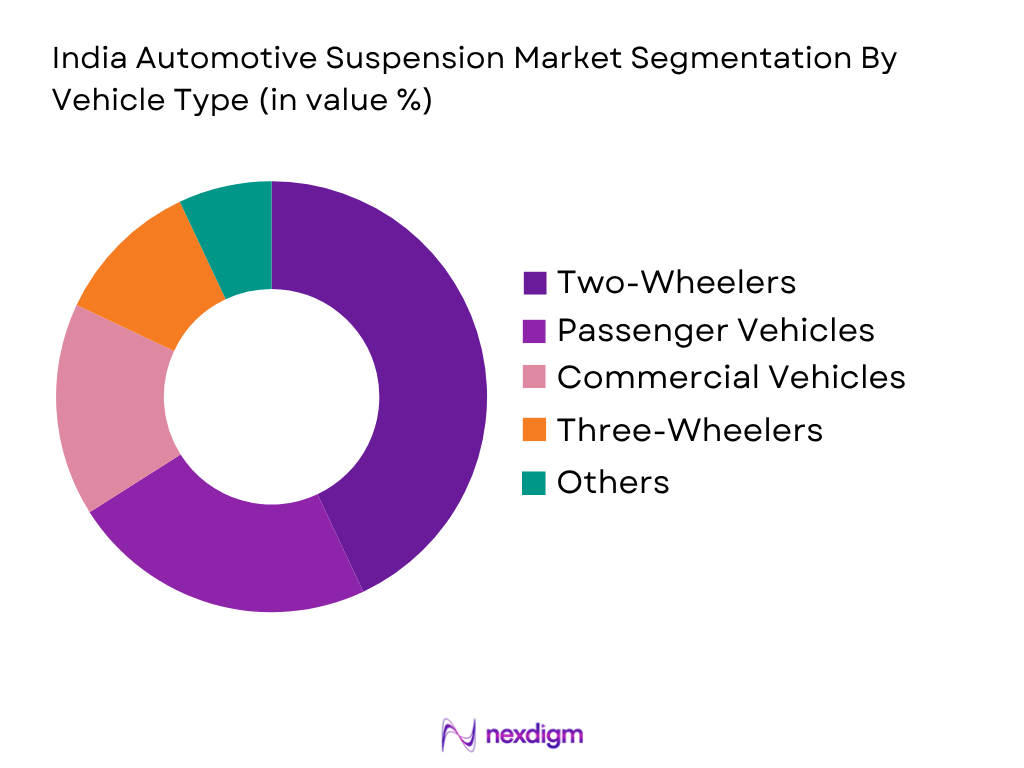
By Vehicle Type
The India Automotive Suspension Market is segmented into two-wheelers, passenger vehicles, commercial vehicles, three-wheelers and buses/other specialty vehicles. Two-wheelers dominate the market by unit volume because India sold more than 19.6 million motorcycles and scooters in the latest completed financial period, far exceeding other vehicle categories. Each motorcycle typically incorporates a front fork and one or two rear damping units, creating very high suspension-unit demand. Suppliers such as Endurance have dedicated front-fork and shock-absorber operations, while premiumisation is expanding upside-down forks, mono-shocks and gas-charged systems beyond traditional high-performance motorcycles. Passenger vehicles contribute greater value per vehicle because cars and SUVs use multiple dampers, springs, control arms and increasingly multi-link or electronically controlled systems. Commercial vehicles contribute lower units but significantly heavier-duty suspension content.
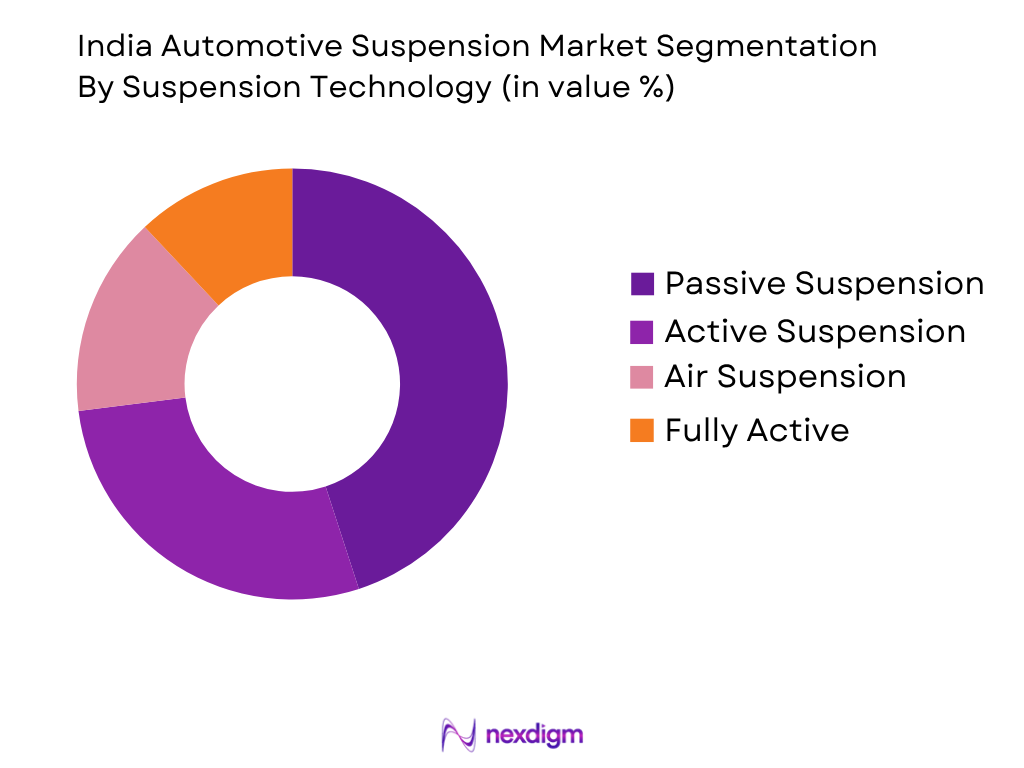
By Suspension Technology
The India Automotive Suspension Market is segmented into passive suspension, semi-active/electronically controlled suspension, air suspension, and fully active suspension. Passive suspension remains dominant because the majority of mass-market motorcycles, scooters, hatchbacks, compact SUVs and commercial vehicles continue to use conventional hydraulic dampers, coil springs or leaf springs. These systems offer established durability, strong localisation and competitive manufacturing economics. However, the technology mix is beginning to change. Tenneco’s CVSAe electronic suspension is available on Mahindra’s BE 6 and XEV 9e, while Endurance has identified electronic suspension for motorcycles above 200 cc within its product-development roadmap. Air suspension also has established relevance in buses, premium vehicles and selected commercial applications. The premiumisation of SUVs and motorcycles is therefore gradually increasing electronic and adjustable suspension content per vehicle.
Competitive Landscape
The India Automotive Suspension Market combines large domestic suppliers with global chassis technology companies. Gabriel India, Endurance Technologies, ZF India, Tenneco/Monroe and KYB represent important participants across passenger vehicles, two-wheelers, commercial vehicles and aftermarket applications. Competition is based on OEM platform wins, manufacturing proximity, ride and handling development, damping technology, localised production, aftermarket penetration and increasing capability in electronic suspension. India’s auto-component industry itself generated approximately INR 6.14 lakh crore in turnover in the earlier benchmark, underlining the depth of the wider component ecosystem supporting suspension localisation.
| Major Player | Establishment Year | Headquarters | Key Suspension Products | Vehicle Coverage | India Manufacturing / R&D Position | Electronic Suspension Capability | Aftermarket Position | Key Competitive Strength |
| Gabriel India Limited | 1961 | Pune, Maharashtra | ~ | ~ | ~ | ~ | ~ | ~ |
| Endurance Technologies | 1985 | Chhatrapati Sambhajinagar, Maharashtra | ~ | ~ | ~ | ~ | ~ | ~ |
| ZF India | Global ZF founded 1915 | India HQ: Chakan, Pune | ~ | ~ | ~ | ~ | ~ | ~ |
| Tenneco / Monroe | 1999 Tenneco structure | Northville, USA | ~ | ~ | ~ | ~ | ~ | ~ |
| KYB | 1919 | Tokyo, Japan | ~ | ~ | ~ | ~ | ~ | ~ |
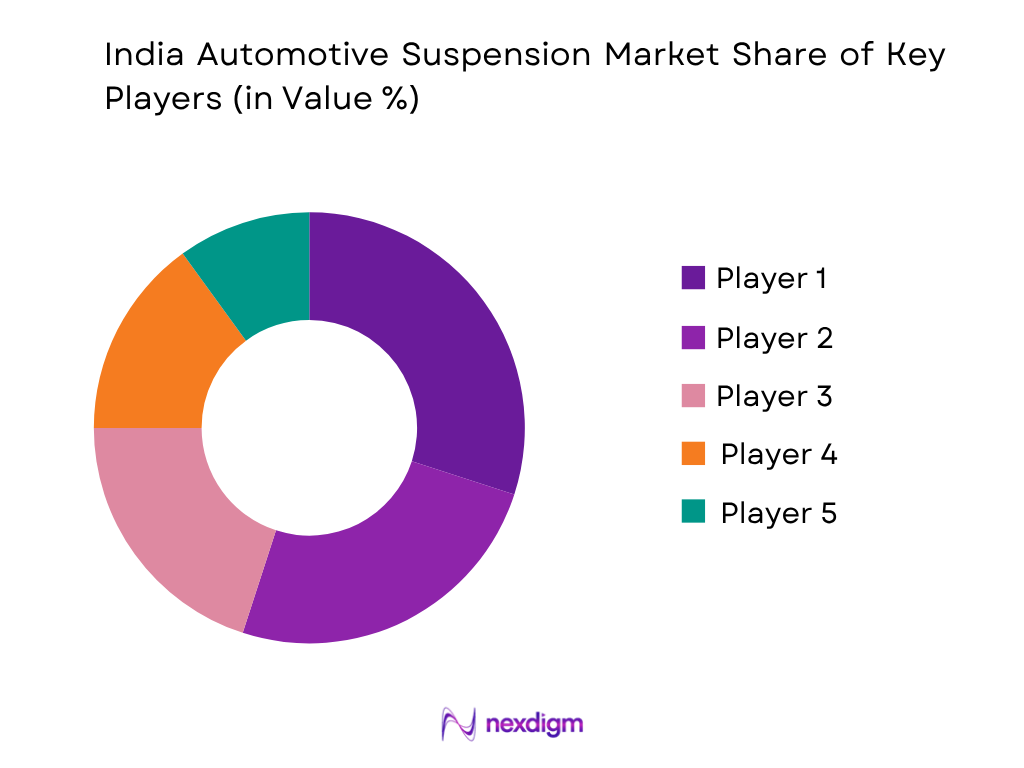
India Automotive Suspension Market Analysis
Growth Drivers
Large Vehicle Production Base and Shift Toward Utility Vehicles
India’s automotive production scale is a fundamental growth driver for suspension components because every vehicle produced requires multiple load-bearing, damping and ride-control elements. Ministry of Heavy Industries data based on SIAM show that during January–December 2025 India produced 5.38 million passenger vehicles, 1.11 million commercial vehicles, 1.22 million three-wheelers and 25.50 million two-wheelers, representing more than 33 million vehicles across these categories. This follows approximately 28 million vehicles produced during FY2023-24, illustrating the continuing expansion of the addressable OE base. The suspension implication is particularly strong in passenger vehicles and utility vehicles, where each platform requires combinations of struts, shock absorbers, coil springs, control arms, stabiliser systems, bushings and increasingly sophisticated independent rear architectures. SUVs and higher-riding utility vehicles demand greater wheel travel, stronger spring rates and improved roll and pitch control compared with small hatchbacks because of higher curb weight, ground clearance and passenger/load requirements. India’s very large two-wheeler manufacturing base adds another volume layer: 25.50 million two-wheelers were produced during calendar 2025, creating demand for tens of millions of telescopic forks, upside-down forks, mono-shocks and twin-shock assemblies. Commercial vehicles add comparatively lower unit volumes but significantly higher component loading, including parabolic leaf springs, multi-leaf assemblies, heavy-duty dampers and air suspension on selected buses and trucks. The broader industrial base also supports domestic suspension manufacturing; the Ministry of Heavy Industries reports that the automotive value chain supports approximately 30 million jobs, including 4.2 million direct jobs and 26.5 million indirect jobs, giving component manufacturers access to a substantial manufacturing and service ecosystem. India’s macroeconomic environment reinforces this volume-driven demand. The IMF’s October 2024 World Economic Outlook placed calendar-year real GDP growth at approximately 7.3% for 2024, while the latest World Bank series places Indian GDP near USD 3.96 trillion in 2025. Rapid economic expansion supports freight movement, personal mobility, vehicle replacement and rising ownership of higher-content SUVs and motorcycles. For suspension suppliers, this creates multiple simultaneous demand pools: high-volume commuter two-wheelers, increasingly sophisticated SUVs, commercial vehicles exposed to heavy operating cycles and recurring replacement demand. The strategic advantage lies with suppliers that can manufacture high volumes of conventional suspension while simultaneously developing more advanced products for premium segments.
EV Expansion, Vehicle Premiumisation and Advanced Automotive Localisation
Electrification and premiumisation are increasing the technological content required from India’s suspension suppliers. Press Information Bureau data show that India had already registered 4.4 million electric vehicles by August 2024, including approximately 950,000 new EV registrations during the first eight months of that year. Government-supported electrification accelerated further: by December 2025, the Ministry of Heavy Industries reported incentives for 1,361,488 vehicles under the PLI-Auto framework, comprising 1,042,172 electric two-wheelers, 238,385 electric three-wheelers, 79,540 electric four-wheelers and 1,391 electric buses. Separately, more than 2,136,305 electric vehicles had been sold under PM E-DRIVE by the end of 2025. These vehicles create suspension requirements that differ from conventional platforms. Battery packs add mass, alter axle loads and place greater emphasis on spring-rate optimisation, damper control, wheel-load management and bushing durability. Electric cars and SUVs also have quieter drivetrains, making road-impact harshness, damper friction and suspension noise more noticeable inside the cabin, which increases demand for higher-quality ride-control systems. Premiumisation in motorcycles has a similar effect, with larger motorcycles increasingly moving from basic telescopic forks and twin shocks toward upside-down forks, gas-charged dampers, mono-shocks and adjustable systems. Government localisation policies strengthen the opportunity for Indian suspension manufacturers to move into these higher-value technologies. As of September 2025, cumulative investment under the PLI-Auto Scheme had reached INR 35,657 crore, while 48,974 jobs had been generated. By December 2025, 8 Champion OEM applicants had received domestic-value-addition certification covering 94 variants, while 10 Component Champion applicants had certification for 37 variants. The PLI architecture requires qualifying advanced automotive technology products to achieve at least 50% domestic value addition, encouraging localisation of sophisticated vehicle components instead of relying solely on imports. PM E-DRIVE carries an outlay of INR 10,900 crore, while the electric passenger-car manufacturing scheme requires approved global manufacturers to commit at least INR 4,150 crore of investment. Suspension suppliers can benefit from this manufacturing migration through localised electronic dampers, lightweight control arms, air-suspension components, high-performance motorcycle forks and EV-specific chassis tuning. The IMF and World Bank continue to show India as one of the fastest-growing large economies, providing an industrial environment supportive of capital investment and premium vehicle demand. Growth for suspension companies therefore increasingly depends not only on more vehicles but on greater technology content per vehicle.
Market Challenges
OEM Cost Pressure and Difficulty Localising Advanced Suspension Technologies
Cost pressure represents a structural challenge for India’s suspension industry because suppliers must satisfy highly price-sensitive vehicle manufacturers while simultaneously investing in advanced materials, electronic controls and validation capabilities. India’s annual production base exceeds 33 million vehicles across passenger vehicles, commercial vehicles, three-wheelers and two-wheelers according to Ministry of Heavy Industries data for calendar 2025. Large volumes create purchasing leverage for OEMs, which routinely expect component suppliers to reduce weight, improve ride quality, extend component life and increase localisation while maintaining tight cost targets. This challenge becomes more pronounced as suspension systems migrate beyond conventional hydraulic dampers. Semi-active dampers require electronically controlled valves, sensors, ECUs, wiring and vehicle-level software calibration; air suspension adds compressors, valve blocks, reservoirs and height sensors; lightweight chassis designs may replace low-cost stamped steel with forged or cast aluminium components. The government’s PLI-Auto programme illustrates both the opportunity and the qualification barrier. Although cumulative investment had reached INR 35,657 crore by September 2025, only 37 advanced-technology variants from 10 Component Champion applicants had received domestic-value-addition certification by December 2025. Qualifying products must achieve at least 50% domestic value addition, meaning advanced suspension suppliers cannot simply import a complete electronic damper or chassis system and market it as locally manufactured. They must develop or localise valves, control electronics, software integration, machining, structural components and testing capability. Testing requirements themselves are becoming more sophisticated as EVs and premium SUVs demand validation for higher mass, thermal loading, ride comfort, NVH and software functionality. At the same time, India remains a market where basic passive suspension dominates high-volume motorcycles, hatchbacks and commercial vehicles, which limits the price premium that suppliers can recover immediately from advanced R&D investments. The challenge is therefore one of technology economics: companies must spend ahead of demand while continuing to compete aggressively on conventional components. India’s macroeconomic growth provides a positive backdrop, with the IMF recording approximately 7.3% real GDP growth for calendar 2024, but rapid growth does not eliminate cost sensitivity among vehicle buyers. Suspension suppliers with insufficient scale may struggle to amortise electronic-suspension development across enough platforms, while companies lacking local engineering capability risk exclusion from OEM programmes that require domestic content. The most defensible response is modular technology development—common valves, sensors, controllers and damper architectures that can be tuned across several passenger vehicle, SUV and EV platforms—combined with deeper domestic sourcing.
Extreme Product Diversity and Aftermarket Service Complexity
India’s suspension market is difficult to serve efficiently because the national vehicle ecosystem spans motorcycles, scooters, three-wheelers, compact cars, SUVs, buses and heavy trucks, each requiring fundamentally different suspension architectures and replacement parts. Ministry of Heavy Industries data show that calendar 2025 production included 25.50 million two-wheelers, 5.38 million passenger vehicles, 1.22 million three-wheelers and 1.11 million commercial vehicles. This product diversity creates enormous SKU complexity for suspension manufacturers, distributors and repair networks. A commuter motorcycle may require conventional telescopic fork internals and twin rear shocks, while a premium motorcycle may use an inverted fork and mono-shock. A hatchback may use MacPherson struts and torsion-beam rear suspension, whereas an SUV can use double wishbones or multi-link systems, and a heavy truck may require parabolic leaf springs, torque rods and cab dampers. Electrification adds further variants because battery-powered two-wheelers, three-wheelers, passenger cars and buses require different load calibrations from equivalent ICE platforms. Government data show that by the end of 2025 PLI-related incentives had covered 1,042,172 electric two-wheelers, 238,385 electric three-wheelers, 79,540 electric four-wheelers and 1,391 electric buses, adding new chassis variants to an already fragmented market. For aftermarket suppliers, maintaining correct fitment across thousands of models and model years becomes a major inventory and distribution challenge. The problem becomes more technical as electronic damping and air suspension appear on premium vehicles. Workshops that traditionally diagnose a worn shock through leakage, noise or poor rebound increasingly need diagnostic tools for electronic valves, ride-height sensors and suspension ECUs. Incorrect installation can also affect wheel alignment, ride height, tyre wear and vehicle stability. Geographic complexity adds another operational burden because suspension demand extends from metropolitan dealer networks to small-town and rural workshops serving motorcycles, utility vehicles and commercial fleets. The Indian automotive industry supports around 30 million direct and indirect jobs, demonstrating the scale of the service ecosystem, but skill levels and access to specialised chassis diagnostics vary substantially across locations. World Bank data place India’s population at well above 1.4 billion people, while access to electricity reached 99.9 people out of every 100 people in 2024, reflecting the rapidly expanding infrastructure base supporting mobility and workshop activity. The market challenge is therefore not lack of demand but efficiently supplying the correct product, technical information and installation support across a vast and heterogeneous vehicle fleet. Companies with strong digital fitment databases, regional warehouses and mechanic-training programmes are better positioned to reduce returns, incorrect installations and counterfeit substitution.
Market Opportunities
Localisation of Electronic, EV-Specific and Premium Suspension Systems
India’s automotive transition creates a major opportunity for suspension manufacturers to localise technologies that historically remained concentrated in imported premium vehicles. Current government data already show a substantial EV production ecosystem rather than merely a future aspiration. Under PLI-Auto, cumulative investment reached INR 35,657 crore by September 2025, generating 48,974 jobs and INR 32,879 crore of determined sales. By the end of 2025, qualifying incentive volumes included more than 1.36 million electric vehicles, while PM E-DRIVE had supported sales exceeding 2.13 million EVs. Advanced automotive manufacturing is being reinforced through a PLI-Auto budget of INR 25,938 crore and PM E-DRIVE outlay of INR 10,900 crore. These present-day investments create an expanding customer base for suspension technologies specifically designed around heavier battery vehicles and higher chassis-control requirements. EV-specific opportunity areas include higher-load coil springs, adaptive dampers, lightweight forged-aluminium control arms, hollow stabiliser bars, advanced bushings and electronically managed ride-height systems. Semi-active dampers are particularly attractive because they can provide a measurable improvement in ride comfort and body control without the complexity of fully active suspension. Their control valves can vary damping using information from wheel movement, body acceleration, steering and braking, allowing manufacturers to offer comfort and sport characteristics through software calibration. The opportunity is no longer theoretical in India: premium domestically developed electric SUVs have begun adopting electronically controlled suspension architectures, proving that Indian vehicle platforms can support higher-content chassis technologies. Two-wheelers provide another localisation pathway. With 25.50 million two-wheelers produced during calendar 2025, even modest penetration of upside-down forks, gas-charged dampers and adjustable mono-shocks can translate into substantial component volume. India’s localisation rules strengthen the business case for domestic manufacturing; advanced automotive products qualifying for PLI incentives must achieve 50% domestic value addition, encouraging local machining, assembly, electronics integration and testing. The country’s macroeconomic position also remains supportive. The World Bank places GDP at approximately USD 3.96 trillion in 2025, while the IMF continues to project India among the fastest-growing major economies. Suspension suppliers should therefore view localisation as a route to both domestic OEM business and exports. Manufacturers capable of combining India’s cost base with advanced damping engineering can serve locally built EVs and SUVs while potentially supplying global vehicle platforms from Indian factories.
Organised Replacement Market, Commercial-Vehicle Durability and Two-Wheeler Upgrade Demand
India’s exceptionally large flow of new vehicles is continuously adding to the future installed base requiring suspension maintenance, creating a long-duration opportunity for organised aftermarket companies. Calendar 2025 production reached 5.38 million passenger vehicles, 25.50 million two-wheelers, 1.11 million commercial vehicles and 1.22 million three-wheelers, while domestic sales included 4.49 million passenger vehicles, 20.50 million two-wheelers, 1.03 million commercial vehicles and 790,000 three-wheelers. Every annual production cohort eventually generates replacement requirements for shocks, struts, fork seals, fork tubes, bushings, ball joints, control arms, coil springs, leaf springs and stabiliser links. The opportunity is particularly broad in two-wheelers because the population of motorcycles and scooters entering service is several times larger than the annual passenger-vehicle market. Front forks require periodic seal, oil and internal-component service, while rear shocks can deteriorate under high mileage, passenger loads and poor road inputs. Commercial vehicles offer a different but valuable replacement pool: 1.03 million commercial vehicles were sold during calendar 2025, supporting demand for high-durability dampers, leaf springs, torque rods, bushings and increasingly air-suspension components on selected buses and heavy trucks. High utilisation means commercial-vehicle suspension is subjected to repeated loading cycles, giving fleet operators strong incentives to replace worn components that affect tyre life, stability and cargo protection. Organised suppliers can differentiate from low-quality unbranded products through validated fatigue life, corrosion resistance, correct damping curves and consistent dimensional tolerances. Digital distribution provides another pathway for expansion because fitment data can connect specific vehicle models with correct suspension SKUs, reducing reliance on informal visual matching. Mechanic training and diagnostic support can further shift customers toward branded parts as electronic dampers and EV-specific suspension components begin entering the replacement cycle. India’s broader economic scale provides a supportive environment: the World Bank reports GDP near USD 3.96 trillion in 2025, while IMF data show a population approaching 1.48 billion people in 2026, supporting continued mobility demand across metropolitan, tier-two, tier-three and rural markets. Government industrial policy also reinforces domestic parts availability: PLI-Auto has already attracted INR 35,657 crore of cumulative investment, improving the manufacturing ecosystem from which aftermarket products can eventually be sourced. The strongest opportunity for suspension manufacturers therefore combines broad SKU coverage with premium product tiers—OE-equivalent replacement for mass-market vehicles, heavy-duty suspension for commercial fleets, and performance or adjustable suspension for premium motorcycles and SUVs.
Future Outlook
The India Automotive Suspension Market is expected to expand at approximately ~ CAGR during 2026–2035, supported by rising vehicle production, SUV penetration, two-wheeler premiumisation, commercial mobility, electrification and gradual migration toward electronically controlled ride systems. Vehicle production provides a substantial volume foundation. Total Indian production across passenger vehicles, commercial vehicles, three-wheelers, two-wheelers and quadricycles reached 31.03 million units in the latest completed financial period and increased further to 34.71 million units in the following period. Suspension manufacturers can therefore benefit from rising OE requirements even before accounting for replacement demand.
Electrification should change suspension specifications rather than eliminate demand. Government support includes the PLI scheme focused on zero-emission vehicles and the Scheme to Promote Manufacturing of Electric Passenger Cars in India, which requires approved participants to invest at least INR 4,150 crore while meeting domestic-value-addition conditions. Electric vehicles tend to require revised spring rates, damper tuning and lightweight components because battery packs alter mass and axle loading. Premiumisation will be equally important. Higher-specification motorcycles increasingly use upside-down forks, mono-shocks and adjustable suspension, while SUVs are creating opportunities for multi-link systems, electronic damping and air suspension. Endurance’s latest development roadmap includes larger suspension R&D capability, while Monroe’s CVSAe already demonstrates production-level electronic suspension adoption in India. The aftermarket should remain structurally important because India’s large installed fleet experiences demanding operating conditions involving high payloads, uneven road surfaces, dust, heat and urban congestion. Shocks, bushings, ball joints, forks and springs therefore generate recurring replacement demand independent of new vehicle manufacturing.
Major Players
- Gabriel India Limited
- ZF Group / ZF India
- Endurance Technologies Limited
- Marelli Motherson Auto Suspension Parts
- KYB Motorcycle Suspension India
- Tenneco / Monroe India
- Hitachi Astemo India
- HL Mando / Mando Automotive India
- ZF Rane Automotive India
- JAMNA Auto Industries Limited
- Hendrickson India
- WABCO / ZF Commercial Vehicle Solutions India
- Brakes India / TVS Group
- BWI Group India
- Sogefi Group
Key Target Audience
- Passenger Vehicle and SUV Manufacturers
- Two-Wheeler and Premium Motorcycle Manufacturers
- Commercial Vehicle and Bus Manufacturers
- Suspension, Shock Absorber, Front Fork and Chassis Component Manufacturers
- Automotive Aftermarket Distributors and Spare Parts Networks
- Fleet Operators and Vehicle Service Networks
- Investments and Venture Capitalist Firms
- Government and Regulatory Bodies (Ministry of Heavy Industries, Ministry of Road Transport and Highways, Automotive Research Association of India, Bureau of Indian Standards, Department for Promotion of Industry and Internal Trade)
Research Methodology
Step 1: Identification of Key Variables
The initial phase constructs an ecosystem map covering passenger-vehicle, two-wheeler, three-wheeler and commercial-vehicle OEMs; suspension Tier-1 suppliers; spring and damper manufacturers; distributors; workshops and EV manufacturers. Critical variables include vehicle production, suspension units per vehicle, technology mix, OEM fitment, replacement frequency, component localisation and average content per vehicle. Secondary research incorporates SIAM, Ministry of Heavy Industries, ACMA and supplier disclosures to define the demand universe. Separate frameworks are created for passenger vehicles, motorcycles and commercial vehicles because their suspension architectures differ materially.
Step 2: Market Analysis and Construction
The top-down approach assesses the Indian auto-component and suspension ecosystem before isolating suspension-system revenues. The bottom-up methodology maps vehicle production by category against shocks, forks, springs, control arms and other suspension components required per vehicle. OE and aftermarket demand are calculated independently. Passive suspension, electronic damping, air suspension and premium motorcycle technologies are also modelled separately to account for differences in technology content and pricing.
Step 3: Hypothesis Validation and Expert Consultation
Market hypotheses are validated through computer-assisted telephone interviews with suspension manufacturers, vehicle OEM sourcing teams, chassis engineers, distributors, workshops and fleet operators. Interviews evaluate platform wins, installed capacity, product mix, replacement cycles, price positioning and technological migration. Supplier findings are cross-checked with end-user and distribution-channel insights. Particular emphasis is placed on SUV suspension, premium motorcycle forks, EV-specific ride-control requirements and commercial-vehicle replacement demand.
Step 4: Research Synthesis and Final Output
Primary findings are triangulated with SIAM production data, government EV schemes, ACMA industry statistics and supplier disclosures. The final model estimates demand by vehicle category, suspension technology, component type, propulsion system and channel. Forecasting incorporates vehicle production, SUV penetration, EV localisation, two-wheeler premiumisation, commercial mobility and aftermarket replacement. Scenario analysis tests faster electronic-suspension adoption, stronger EV growth and changes in vehicle-production cycles.

- Executive Summary
- Research Methodology (Market Definitions and Assumptions, Automotive Suspension Market Boundary, Abbreviations, Top-Down Market Sizing, Bottom-Up Vehicle Platform Mapping, Vehicle Production Assessment, Vehicle Parc Assessment, Suspension Content per Vehicle, OE Fitment Analysis, Shock Absorber Replacement Modelling, Two-Wheeler Front Fork Assessment, Commercial Vehicle Suspension Assessment, Demand-Side Interviews, Supply-Side Interviews, OEM and Tier-1 Interviews, Aftermarket Distributor Interviews, Garage and Workshop Interviews, Product Benchmarking, Data Triangulation, Forecasting Framework, Scenario Analysis, Limitations and Future Conclusions)

- Definition and Scope
- Market Evolution and Industry Genesis
- Evolution of Ride-Control Technology in India
- India Automotive Manufacturing Ecosystem
- Passenger Vehicle Suspension Ecosystem

- Growth Drivers (SUV Demand, Two-Wheeler Production, Commercial Vehicle Utilisation, EV Vehicle Mass, Rough-Road Requirements, Premiumisation, Replacement Demand)
- Market Challenges (OEM Cost Pressure, Raw Material Cost, Electronic Complexity, Ride-Durability Trade-Off, Aftermarket Fragmentation, Counterfeit Parts, Skilled Installation)
- Market Opportunities (EV Suspension, Semi-Active Damping, Premium Motorcycles, SUV Aftermarket, Commercial Air Suspension, Localisation, Lightweight Components, Diagnostics)
- Market Trends (Mono-Shock Adoption, USD Forks, Gas-Charged Dampers, Electronic Damping, Air Suspension, Lightweighting, Modular Chassis, Sensorisation)
- SWOT Analysis
- Porter’s Five Forces Analysis
- PESTLE Analysis

- By Market Value (2020-2025)
- By Suspension System Units (2020-2025)
- By Shock Absorber and Strut Units (2020-2025)

- By Suspension Technology (In Value %)
Passive Suspension Systems
Semi-Active Suspension Systems
Fully Active Suspension Systems
Air Suspension Systems
Adaptive Air Suspension Systems - By Vehicle Type (In Value %)
Hatchbacks
Sedans
Compact SUVs
Mid-Size SUVs - By Sales Channel (In Value %)
Original Equipment Manufacturers
Original Equipment Service Parts
Independent Aftermarket Distributors
Automotive Parts Retailers - By Region (In Value %)
North India
West India
South India
East India
Central India

- Market Share of Major Players by Market Value
- Cross Comparison Parameters (Suspension Technology Portfolio Breadth, India OEM Platform Wins, Passenger Vehicle–Two-Wheeler–Commercial Vehicle Coverage, Shock Absorber–Strut–Front Fork Manufacturing Capacity, India Manufacturing and R&D Footprint, EV and High-Mass Vehicle Suspension Capability, Aftermarket SKU Breadth and Distributor Reach, Electronic Suspension–Sensor–Chassis Control Capability)
- SWOT Analysis of Major Players
- Detailed Profiles of Major Companies
Gabriel India Limited
ZF Group / ZF India
Endurance Technologies Limited
Marelli Motherson Auto Suspension Parts Private Limited
KYB Motorcycle Suspension India Private Limited
Tenneco / Monroe India
Hitachi Astemo India
Mando Automotive India / HL Mando
Rane Group / ZF Rane Automotive India
Sona BLW Precision Forgings / Sona Comstar Chassis-Adjacent Systems
JAMNA Auto Industries Limited
WABCO / ZF Commercial Vehicle Solutions India
Brakes India / TVS Group Chassis Systems
Hendrickson India
BWI Group India

- Ride Comfort Preference
- Ground-Clearance Requirement
- Pothole and Rough-Road Performance
- SUV Body-Control Requirement
- Commercial Load Requirement

- By Market Value (2026-2035)
- By Suspension System Units (2026-2035)
- By Shock Absorber and Strut Units (2026-2035)


 Request a Sample
 Ask for Customization
 Get a Quote
 Enquire Now