

 Download PDF
 Download PDF
Market Overview
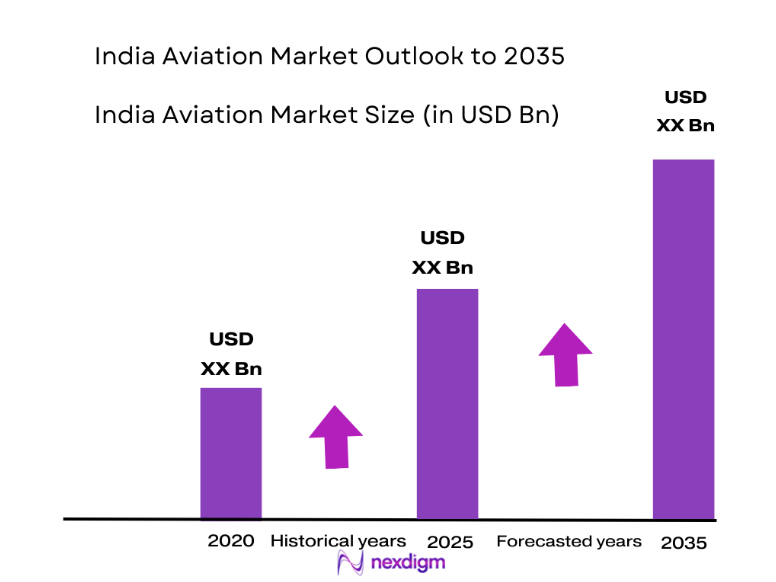
The India Aviation Market is expected to see significant growth, with a market size based on a recent historical assessment reaching USD ~ billion. This growth is driven by factors such as an increasing middle-class population, rising air traffic, and government initiatives to enhance infrastructure. The market is further bolstered by advancements in aviation technologies, making air travel more accessible to a broader segment of the population. The growing demand for both commercial and private aviation is contributing to this dynamic expansion, and infrastructure development in airports and airstrips is expected to keep pace with the demand.
India is home to major cities like Delhi, Mumbai, and Bangalore, which are key drivers of the aviation market. These cities dominate due to their strategic locations, infrastructure capabilities, and economic significance. The national capital, Delhi, serves as a hub for both domestic and international travel, while Mumbai, the financial capital, supports the growing demand for business travel. Additionally, Bengaluru’s burgeoning tech industry and its proximity to several international destinations make it a key player in the aviation sector. Together, these cities attract investments and foster demand across various aviation segments.
Market Segmentation
By Product Type
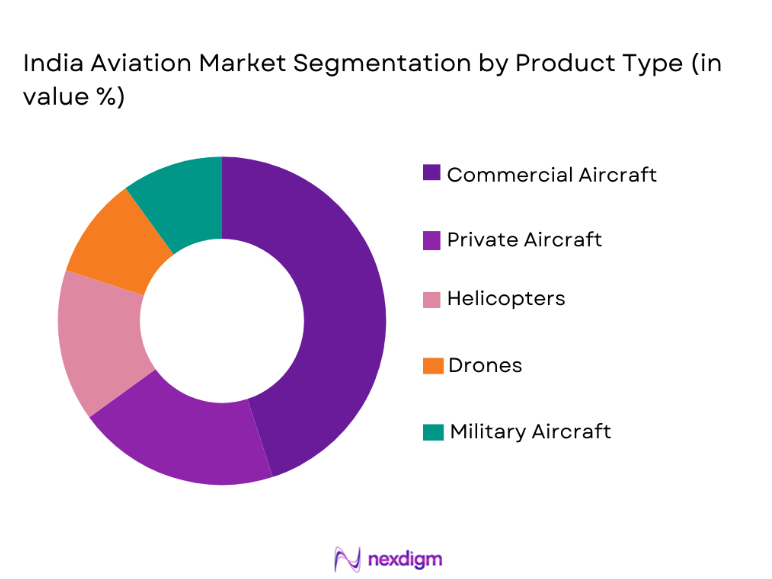
The India Aviation Market is segmented by product type into commercial aircraft, private aircraft, helicopters, drones, and military aircraft. Among these, commercial aircraft has a dominant market share, driven by the rising middle class and increased urbanization in India. The growing demand for domestic and international flights has led to an expansion in both low-cost and full-service carriers, making commercial aviation the key driver. Airlines are investing in larger fleets and upgrading older models, contributing to the sector’s dominance. This segment’s leadership is also supported by government incentives and partnerships that encourage the expansion of aviation infrastructure.
By Platform Type
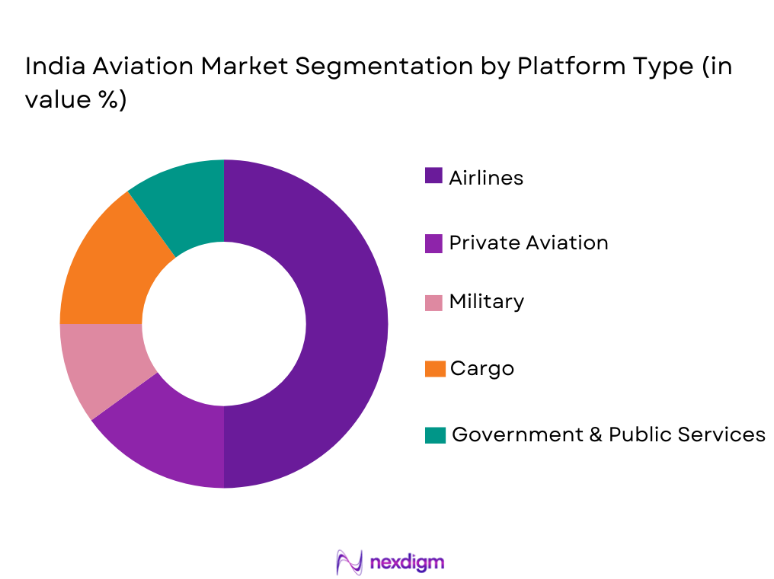
The India Aviation Market is segmented by platform type into airlines, private aviation, military, cargo, and government & public services. Among these, airlines dominate the market, driven by the explosive growth in domestic air travel. The increasing number of budget airlines, along with the expansion of major carriers, has made air travel more accessible, particularly in tier 2 and tier 3 cities. Additionally, the government’s push to enhance airport infrastructure and increase air connectivity has further reinforced the dominance of the airline sector. The rise in disposable income and the changing attitudes towards air travel have also contributed to the airline segment’s dominance.
Competitive Landscape
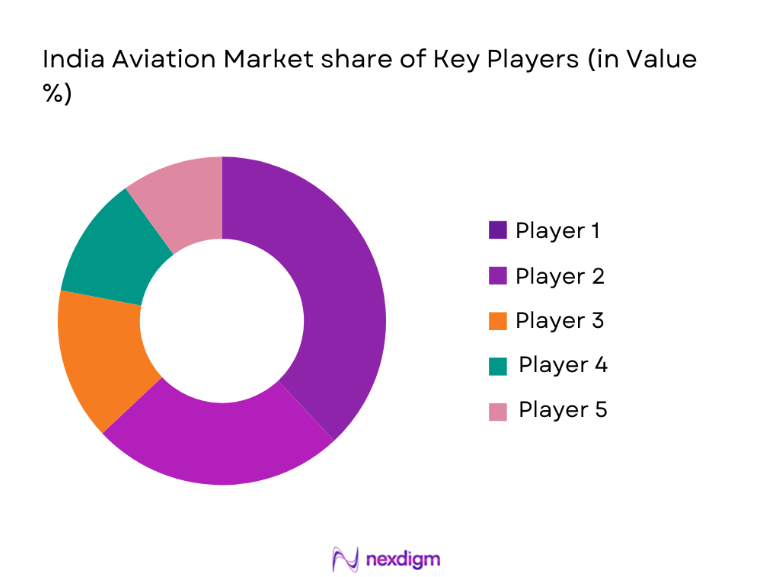
The competitive landscape of the India Aviation Market is characterized by significant consolidation, with both domestic and international players vying for market share. Major players, particularly large airlines, are expanding their fleet sizes and enhancing their service offerings to cater to the growing demand. The market also sees strategic partnerships, with airlines collaborating on codeshare agreements and infrastructure development. Moreover, government support through initiatives such as the UDAN scheme plays a critical role in encouraging new entrants and enhancing competition.
| Company Name | Establishment Year | Headquarters | Technology Focus | Market Reach | Key Products | Revenue | Additional Parameter |
| IndiGo | 2006 | Gurgaon, India | ~ | ~ | ~ | ~ | ~ |
| Air India | 1932 | New Delhi, India | ~ | ~ | ~ | ~ | ~ |
| SpiceJet | 2005 | Gurgaon, India | ~ | ~ | ~ | ~ | ~ |
| GoAir | 2005 | Mumbai, India | ~ | ~ | ~ | ~ | ~ |
| Boeing | 1916 | Chicago, USA | ~ | ~ | ~ | ~ | ~ |
India Aviation Market Analysis
Growth Drivers
Increasing Domestic Air Travel
The surge in domestic air travel in India is a key growth driver for the aviation sector. With a rapidly expanding middle class and rising disposable incomes, more people are opting for air travel, driving demand for both low-cost carriers and premium airlines. Furthermore, the government’s initiatives to improve regional connectivity through the UDAN (Ude Desh ka Aam Naagrik) scheme have made flying more accessible to people in Tier 2 and Tier 3 cities. This growth is supported by the expansion of airport infrastructure, both in terms of capacity and number of terminals, enabling airlines to serve new routes and destinations. Additionally, the growing preference for air travel due to its speed and convenience compared to rail or road transport further fuels the demand. The low-cost carrier (LCC) model has also played a significant role in democratizing air travel in India, making it more affordable for a larger segment of the population. Furthermore, the trend of urbanization and the expansion of business hubs in smaller cities are also contributing to the increase in domestic air traffic. This trend is expected to continue over the next few years, with passenger traffic set to rise significantly, further strengthening the market’s growth.
Government Investment in Aviation Infrastructure
The Indian government’s focus on developing and modernizing aviation infrastructure has been a major growth driver for the market. Initiatives like the UDAN scheme, which seeks to increase regional connectivity by subsidizing airfares, have played a critical role in increasing demand for domestic flights. The government is also heavily investing in expanding airport capacity, with the construction of new airports and terminals across the country. This is particularly evident in cities like Mumbai, New Delhi, Bengaluru, and Hyderabad, where new terminals are being built to handle increasing passenger volumes. Additionally, the Airports Authority of India (AAI) has been working on upgrading existing airports to improve the passenger experience and increase operational efficiency. These investments are aimed at making air travel more accessible to a broader population while also facilitating the growth of the aviation market. The government’s proactive stance in easing regulatory barriers and encouraging private investments in the aviation sector has provided a conducive environment for the market’s expansion, positioning India as one of the largest aviation markets in the world.
Market Challenges
High Operational Costs
Despite the rapid growth of the Indian aviation market, high operational costs remain one of the significant challenges facing airlines and aviation service providers. Fuel costs, which constitute a substantial portion of an airline’s operational expenditure, have been subject to fluctuations in global oil prices, impacting profitability. Additionally, airport fees, air navigation charges, and maintenance costs continue to rise, putting pressure on both full-service and low-cost carriers. Airlines are forced to adopt cost-cutting measures, which could negatively affect service quality and operational efficiency. Furthermore, India’s infrastructure, while improving, still faces challenges such as congestion and delays, which further increase operational costs. Airlines also need to manage the costs associated with fleet modernization, which requires large investments in new aircraft, training, and maintenance. The rising costs in the sector are expected to remain a challenge, particularly with the growth in air traffic and the need for expanded infrastructure. These challenges require strategic adjustments from airlines, including optimizing routes, investing in fuel-efficient aircraft, and leveraging new technologies to improve operational efficiency.
Regulatory Hurdles
Regulatory hurdles remain a significant challenge for the Indian aviation market. While the government has introduced initiatives such as the UDAN scheme to boost air travel, the regulatory environment is still complex and often seen as a barrier to growth. There are stringent regulations on safety, security, and environmental standards that airlines must comply with, which adds to the overall cost of operations. Moreover, the licensing and approval process for new routes, as well as for foreign investments, can be time-consuming and bureaucratically challenging. Foreign airlines also face restrictions on ownership stakes in Indian carriers, limiting potential investments from international stakeholders. Additionally, the aviation industry in India faces challenges related to airspace congestion, especially in major metropolitan areas, which can lead to delays and operational inefficiencies. While efforts are being made to streamline these regulations, they continue to pose a challenge to the seamless expansion of the sector.
Opportunities
Growth in Air Cargo Sector
The Indian air cargo market presents a significant opportunity for growth within the broader aviation sector. As e-commerce continues to expand, the demand for fast and efficient cargo services has surged. The Indian government’s initiatives to improve logistics infrastructure and facilitate international trade also contribute to the growing demand for air cargo services. The development of dedicated cargo terminals at major airports and the modernization of logistics facilities further enhances the sector’s growth prospects. Additionally, the expansion of cold chain logistics for perishable goods and pharmaceuticals is also boosting demand for air freight services. With the growth of digital platforms, the need for rapid delivery of goods has made air cargo an essential part of India’s supply chain ecosystem. This sector is poised for growth, with both domestic and international carriers looking to increase their cargo services to meet the rising demand. With ongoing investments in infrastructure and technology, the Indian air cargo sector is expected to see substantial growth, providing new avenues for revenue generation for airlines and logistics companies.
Technological Advancements in Aircraft
The adoption of new technologies in aircraft design and operations presents another significant opportunity for the India Aviation Market. With rising concerns over fuel costs and environmental impact, airlines are increasingly turning to more fuel-efficient and eco-friendly aircraft. Manufacturers like Boeing and Airbus are developing new models with advanced materials and more efficient engines, which can help reduce fuel consumption and lower carbon emissions. Additionally, the rise of electric and hybrid-electric aircraft is expected to transform the aviation sector, particularly for short regional flights. These technologies offer significant cost savings in the long term and align with global efforts to reduce aviation’s environmental footprint. Airlines in India are already showing interest in incorporating these technologies into their fleets as part of their sustainability strategies. The adoption of digital technologies, such as artificial intelligence, predictive maintenance, and data analytics, is also enabling airlines to optimize operations and enhance customer experience. These advancements open up new opportunities for the Indian aviation sector to modernize its fleet and improve operational efficiency, making the market more competitive on a global scale.
Future Outlook
The India Aviation Market is poised for continued expansion over the next five years, driven by growth in domestic travel, technological advancements, and government support. Key factors influencing the market include the ongoing development of airport infrastructure, the adoption of fuel-efficient and eco-friendly aircraft, and the rise of new airline services catering to underserved regions. Furthermore, air cargo services are expected to see increased demand as e-commerce continues to grow, and technological advancements like autonomous aircraft and digital innovations will likely transform the industry.
Major Players
- IndiGo
- Air India
- SpiceJet
- GoAir
- Jet Airways
- Airbus
- Boeing
- Bombardier
- Hindustan Aeronautics
- Tata Advanced Systems
- Embraer
- Lockheed Martin
- General Electric
- Safran
- Honeywell
Key Target Audience
- Investments and venture capitalist firms
- Government and regulatory bodies
- Airlines
- Airport authorities
- Aviation manufacturers
- Aviation service providers
- Logistic companies
- Aircraft leasing companies
Research Methodology
Step 1: Identification of Key Variables
Key variables affecting the aviation market are identified, including passenger demand, government policies, technological advancements, and market size. These are prioritized based on their potential impact.
Step 2: Market Analysis and Construction
Market analysis is conducted by evaluating historical trends, current market conditions, and projections for future growth. Various primary and secondary data sources are used to assess these factors.
Step 3: Hypothesis Validation and Expert Consultation
Expert consultation is employed to validate hypotheses and incorporate industry insights. Interviews and surveys with key stakeholders, including industry professionals and government agencies, help refine the analysis.
Step 4: Research Synthesis and Final Output
The research findings are synthesized into the final report, providing actionable insights on market dynamics, challenges, and opportunities. The output is reviewed for accuracy and relevance before publication.

- Executive Summary
- Research Methodology (Definitions, Scope, Industry Assumptions, Market Sizing Approach, Primary & Secondary Research Framework, Data Collection & Verification Protocol, Analytic Models & Forecast Methodology, Limitations & Research Validity Checks)

- Market Definition and Scope
- Value Chain & Stakeholder Ecosystem
- Regulatory / Certification Landscape
- Sector Dynamics Affecting Demand
- Strategic Initiatives & Infrastructure Growth

- Growth Drivers
Growing middle-class population
Increase in air traffic and tourism
Government investment in aviation infrastructure
Expansion of airports and new terminal development
Adoption of eco-friendly aviation technologies - Market Challenges
High operational and maintenance costs
Limited skilled workforce in the aviation sector
Stringent regulatory environment
Geopolitical tensions affecting international routes
Challenges in infrastructure scalability - Market Opportunities
Emerging demand for regional aircraft
Growth of air cargo services
Technological innovations in aviation fuel efficiency - Trends
Rise in low-cost carriers
Growth of unmanned aerial systems
Increase in aviation fuel price volatility
Shift towards electric aircraft
Development of hybrid and green technologies - Government Regulations & Defense Policy
Regulations on emissions and environmental standards
Aerospace security and safety protocols
Defense contracts for military aviation - SWOT Analysis
- Stakeholder and Ecosystem Analysis
- Porter’s Five Forces Analysis
- Competition Intensity and Ecosystem Mapping

- By Market Value, 2020-2025
- By Installed Units, 2020-2025
- By Average System Price, 2020-2025
- By System Complexity Tier, 2020-2025

- By System Type (In Value%)
Commercial Aircraft
Private Aircraft
Helicopters
Drones
Military Aircraft - By Platform Type (In Value%)
Airlines
Private Aviation
Military
Cargo
Government & Public Services - By Fitment Type (In Value%)
OEM Aircraft
Aftermarket Aircraft
Upgraded Aircraft
Custom-Built Aircraft
Converted Aircraft - By EndUser Segment (In Value%)
Commercial Aviation
Private Aviation
Military Aviation
Cargo Operators
Government Agencies - By Procurement Channel (In Value%)
Direct Purchases
Leasing
OEM Partnerships
Government Contracts
Secondary Market - By Material / Technology (in Value%)
Composite Materials
Metal Alloys
Autonomous Systems
Powertrain Systems
Avionics & Navigation Systems

- Market structure and competitive positioning
- Market share snapshot of major players
- CrossComparison Parameters (Technology Adoption, Operational Efficiency, Cost Competitiveness, Fleet Size, Customer Service, Market Presence, Regulatory Compliance, Innovation, Strategic Partnerships, Sustainability)
- SWOT Analysis of Key Players
- Pricing & Procurement Analysis
- Key Players
IndiGo
Air India
SpiceJet
GoAir
Jet Airways
Airbus
Boeing
Bombardier
Hindustan Aeronautics
Tata Advanced Systems
Embraer
Lockheed Martin
General Electric
Safran
Honeywell

- Growth in domestic travel
- Increasing foreign investments in aviation
- Rising demand for luxury private aviation services
- Military and defense sector modernization

- Forecast Market Value, 2026-2035
- Forecast Installed Units, 2026-2035
- Price Forecast by System Tier, 2026-2035
- Future Demand by Platform, 2026-2035


 Request a Sample
 Ask for Customization
 Get a Quote
 Enquire Now