
 Download PDF
Market Overview
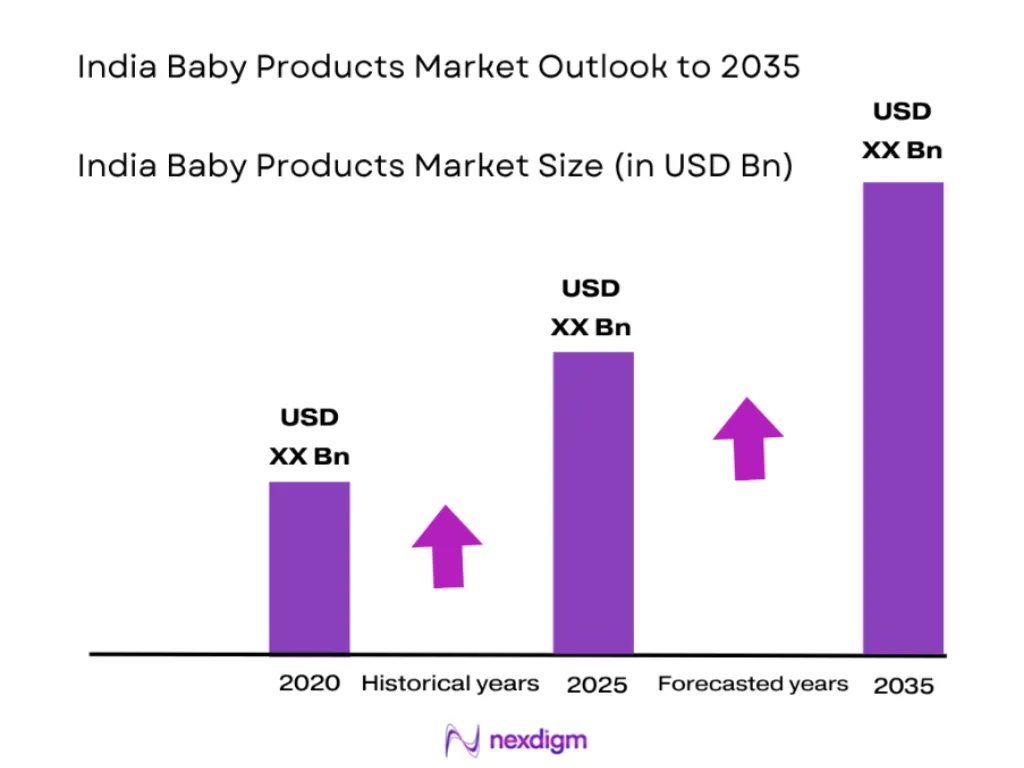
India’s baby skin care and hair care demand sits within the country’s baby personal care category, which rose from USD ~ million in 2024 to USD ~ million in 2025. The category is being supported by India’s very large annual birth base of roughly 25 million children a year, alongside higher parental spending on specialist, toxin-conscious, and dermatologist-positioned products. Public industry sources also show baby-and-child-specific products posting double-digit value growth in 2025 as hygiene awareness, premiumization, and specialized formulations gained traction.
Within India, demand is strongest in Mumbai, Delhi NCR, Bengaluru, Hyderabad, Pune, and Chennai, where modern retail, pharmacies, premium maternity networks, and e-commerce adoption are deepest. This urban concentration is reinforced by omnichannel reach: FirstCry alone had 1,124 physical stores across 500+ cities by late 2024, while beauty, wellness, and personal care accounted for 19% of India’s online orders in 2024. Digital discovery is also a major tailwind, with India already having 520-560 million social media users in 2023, which strengthens premium product discovery and repeat buying in metro and upper-tier cities.
Market Segmentation
By Category
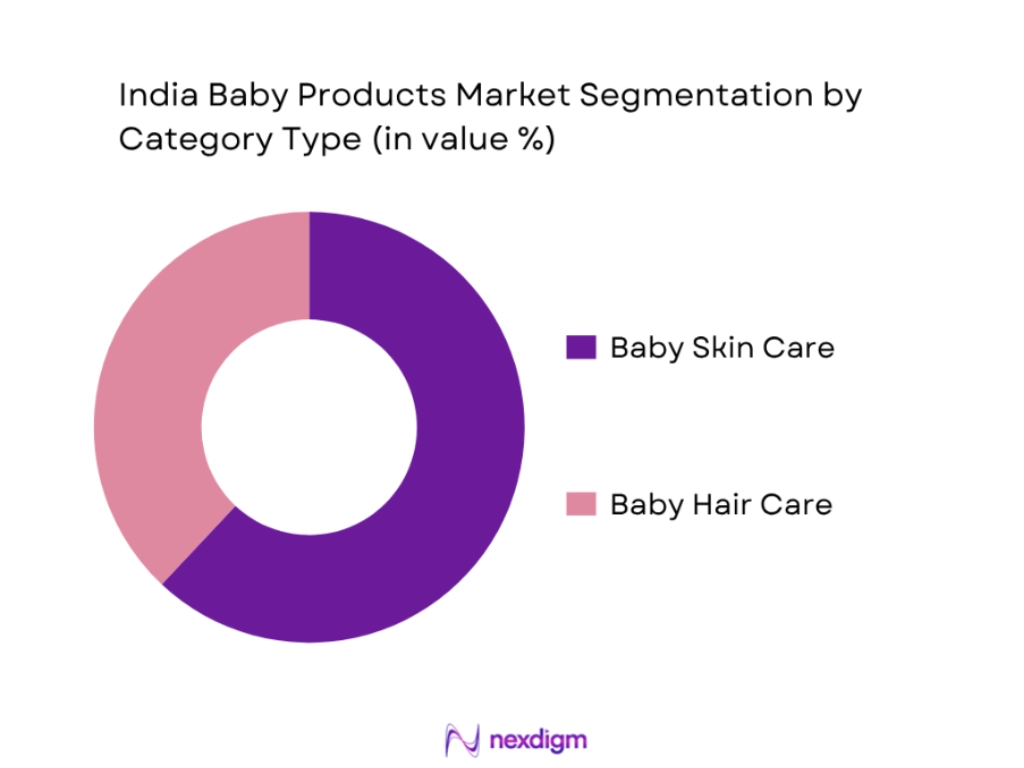
The India baby skin care and hair care market is segmented into baby skin care and baby hair care. Baby skin care holds the larger share because parents buy these products across more frequent and broader use cases: daily moisturising, massage oil routines, rash protection, wipes, and sensitive-skin management. Public category signals support this hierarchy. Nexdigm flags baby skin care as the fastest-growing product type in India’s baby care market, while India baby-and-child-specific product coverage shows a dedicated skin care block and strong premiumisation around gentle, ingredient-led formulations. Hair care remains essential, especially oils and mild shampoos, but purchase occasions are narrower and more ritual-led than skin care. In India, skin care also benefits from pediatric and family emphasis on dryness, rashes, seasonal irritation, and visible skin comfort, making it the more dominant value pool within personal care.
By Distribution Channel
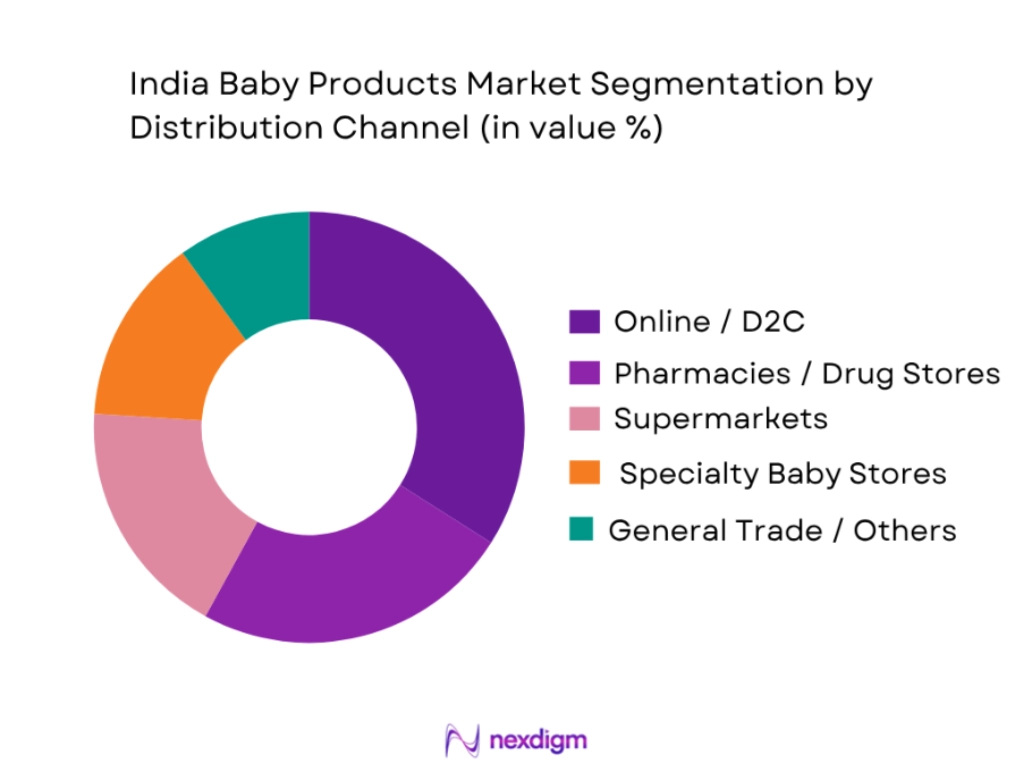
The market is segmented by online retail, pharmacies, supermarkets and hypermarkets, specialty baby stores, and general trade. Online is the leading channel in the focused skin-and-hair space because parents use marketplaces and brand websites to compare ingredients, check reviews, and access a far wider assortment than offline outlets can usually stock. India’s digital buying context supports this: beauty, wellness, and personal care represented 19% of all online orders in 2024, and FirstCry’s multichannel network listed 1.82 million SKUs from 7,906 brands while operating 1,124 stores across 500+ cities. Pharmacies remain highly relevant because baby personal care is closely tied to trust, safety, and pediatric recommendation, especially for rash creams, pH-balanced washes, and dermatologist-positioned brands. Still, discovery-led premium purchasing is increasingly shifting toward online and omnichannel models.
Competitive Landscape
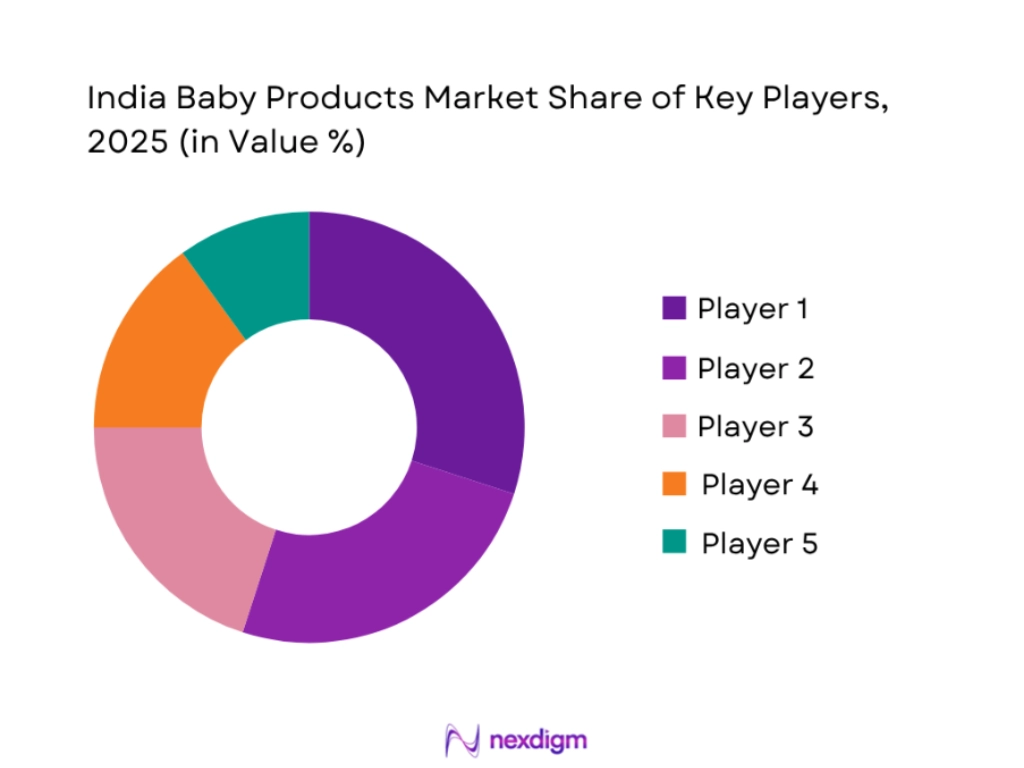
The India baby skin care and hair care market is concentrated around a mix of legacy multinational brands, Indian herbal and toxin-free specialists, pharmacy-led dermatology players, and strong omnichannel parenting platforms. Johnson’s, Himalaya, Mamaearth, Pigeon, Chicco, Sebamed, and Cetaphil Baby are especially visible in premium and mid-premium baby personal care conversations, while FirstCry remains important as a distribution and discovery engine through its BabyHug/private-label ecosystem and marketplace scale. Competitive advantage is built on safety perception, dermatologist trust, ingredient transparency, channel breadth, and repeat purchase potential.
| Player | Establishment Year | Headquarters | Key Baby Skin/Hair Brand(s) in India | Category Strength | Formulation / Positioning | Channel Strength | Price Tier | Competitive Edge |
| Kenvue | 2022 | Summit, New Jersey, U.S. | – | – | – | – | – | – |
| Himalaya Wellness | 1930 | Bengaluru, India | – | – | – | – | – | – |
| Honasa Consumer | 2016 | Gurugram, India | – | – | – | – | – | – |
| Pigeon India / Pigeon Group | 2009 in India | Noida, India / Tokyo-linked parent network | – | – | – | – | – | – |
| Galderma | 1981 | Zug, Switzerland | – | – | – | – | – | – |
India Baby Product Market Analysis
Growth Drivers
Rising Urbanization & Dual-Income Households
India’s baby product demand is being strengthened by the combination of expanding urban consumption and a broader second-income base within households. The World Bank places India’s GDP at USD 3.91 trillion in 2024, with GDP per capita at USD 2,694.7, indicating a larger consumption pool for routine baby essentials such as diapers, baby toiletries, feeding products, skin care, and baby nutrition. On the spending side, MOSPI’s Household Consumption Expenditure Survey shows urban monthly per-capita expenditure at INR 6,996, against INR 4,122 in rural India, which supports stronger purchasing power for branded and premium baby products in cities. Labour data also matters: PLFS shows urban female labour-force participation at 26.1 and overall urban worker-population ratio at 47.4 in 2023-24, reflecting a growing set of households with two earning adults and a higher need for convenience-led baby solutions. India’s digital-urban base is also deepening; TRAI reported 556.05 million urban internet subscribers in 2024, making product discovery, subscription buying, and repeat online purchase easier for working parents managing infant care.
Increasing Awareness of Infant Hygiene & Nutrition
Infant hygiene and nutrition awareness is becoming more institutionalized in India, which directly supports demand for baby skin care, wipes, rash creams, baby wash, feeding products, and nutrition-linked baby categories. The Ministry of Health and Family Welfare reported 93.5 national full immunization coverage for FY 2023-24, while 2024-25 HMIS data cited by the ministry places measles-rubella coverage at 93.7 for the first dose and 92.2 for the second dose. These are strong indicators of family engagement with formal child-health systems. On the nutrition side, the Women and Child Development ministry’s digital infrastructure is large: PIB reported more than 9 crore beneficiaries registered on Poshan Tracker and around 8 crore children being monitored through the platform. In parallel, the country had 14.03 lakh operational Anganwadi Centres under Mission Poshan 2.0. This matters for the baby product market because families connected to immunization, growth tracking, and nutrition monitoring are more likely to purchase hygiene-led and health-positioned products, especially in the first 1,000 days of life when skin sensitivity, feeding hygiene, and nutritional routines become more structured.
Market Challenges
High Price Sensitivity in Tier 2 & Rural Markets
Price sensitivity remains a structural challenge for baby product brands trying to scale beyond metros. MOSPI’s 2023-24 consumption survey shows rural monthly per-capita expenditure at INR 4,122, substantially below the urban figure of INR 6,996. The same survey shows food still taking 47.04 of rural MPCE, versus 39.68 in urban India, which means a larger share of rural budgets is tied up in essentials before households allocate spending to premium or discretionary baby products. Even after accounting for welfare transfers, rural MPCE rises only to INR 4,247, while urban reaches INR 7,078, so the affordability gap remains pronounced. This matters directly for the baby products market because categories such as premium diapers, specialized baby skin care, imported feeding accessories, and organic baby toiletries require higher recurring outlay. TRAI’s 398.35 million rural internet subscribers show access is no longer the main barrier; purchasing power is. As a result, parents in Tier 2, Tier 3, and rural markets are more likely to trade down to smaller packs, unbranded alternatives, or multi-use household substitutes instead of staying with premium baby-specific SKUs.
Regulatory Restrictions on Infant Food Marketing
Infant food remains one of the most tightly regulated parts of the broader baby products market in India, which limits aggressive brand-led promotion even when demand fundamentals are strong. The regulatory framework is explicit. A government legislative compendium hosted by NCDC lists the Infant Milk Substitutes, Feeding Bottles and Infant Foods Act, 1992, amended in 2003, as the governing law with multiple operative provisions. FSSAI’s 2024 compendium for foods for infant nutrition further states that no container or label of infant nutrition food may carry a picture of an infant or woman, nor any graphic material or phrase designed to increase saleability. These restrictions matter commercially because they narrow the range of packaging claims and emotional advertising that consumer brands typically use to build market share. At the same time, the health system’s child focus is intensifying rather than weakening: India reported 93.5 full immunization coverage in FY 2023-24, and Mission Indradhanush has vaccinated 5.46 crore children and 1.32 crore pregnant women in cumulative phases. In such an environment, infant nutrition marketing stays closely linked to public-health regulation rather than conventional FMCG promotion.
Opportunities
Expansion in Tier 3 & Rural Regions
Tier 3 and rural India represent one of the clearest demand expansion opportunities for baby products because the physical and digital infrastructure supporting family health and commerce is now much broader than before. TRAI reported 398.35 million rural internet subscribers in 2024, while the wider telecom system had already crossed 1,182.32 million wireless subscribers by September 2025. On the public-service side, PIB reported 14.03 lakh operational Anganwadi Centres and more than 9 crore beneficiaries on Poshan Tracker, with around 8 crore children being monitored. In child-health outreach, the Zero Dose Implementation Plan 2024 was rolled out across 143 districts in 11 states, showing that formal systems are pushing deeper into underserved geographies. For baby product companies, this creates a more investable landscape for scaled rural distribution, especially in diapers, baby skin care, baby wash, low-unit-price feeding products, and nutrition-linked hygiene categories. The opportunity is not based on future projections alone; the current child-health and connectivity footprint already supports better awareness, better replenishment logistics, and more localized digital marketing outside large metros.
Growth of Organic & Eco-Friendly Baby Products
Organic and eco-friendly baby products have room to grow because India already has a meaningful organic supply base and a rapidly formalizing sustainability framework around packaging and waste. APEDA states that India produced around 3.6 million MT of certified organic products in FY24. For 2024-25, APEDA reports organic exports of 368,155.10 MT valued at INR 5,394.32 crore, showing that certified-organic production is not niche from a supply standpoint. On the packaging side, policy infrastructure is also becoming denser. A PIB response from December 2024 reported 44,659 registered producers, importers, and brand owners under plastic-packaging EPR. By March 2026, another PIB update placed the count at 60,128 registered producers, importers, and brand owners and 3,012 registered plastic-waste processors, with around 207 lakh tonnes of plastic packaging waste recycled since the EPR guidelines came into force. For the baby products market, this improves the credibility and feasibility of recyclable packaging, reduced-plastic claims, refill formats, and eco-positioned personal-care launches, especially in premium baby skin care, wipes, and toiletries.
Future Outlook
Over the long term, India’s baby skin care and hair care demand should remain structurally attractive because the category sits at the intersection of births, rising urban affluence, premium parenting, and digital commerce. The strongest upside is likely to come from ingredient-led skin care, dermatologist-positioned sensitive-skin products, tear-free and sulfate-free baby hair care, and online-first premium brands. For long-range planning, the nearest public India benchmark shows the broader baby care products market expanding at a ~ CAGR during 2026-2035, which indicates a favorable backdrop for the skin and hair subset as premiumisation deepens beyond metros into tier-2 and tier-3 cities.
Major Players
- Kenvue / Johnson’s Baby
- Himalaya Wellness
- Honasa Consumer / Mamaearth
- Pigeon India
- Galderma / Cetaphil Baby
- Chicco India
- Mee Mee
- Mother Sparsh
- The Moms Co.
- Dabur Baby Care
- Sebamed India
- BabyChakra
- FirstCry / BabyHug
- Wipro Consumer Care-linked baby care portfolios
- Lotus Herbals Baby+
Key Target Audience
- Baby skin care and hair care manufacturers
- Pediatric dermatology and infant-care product brands
- E-commerce marketplaces and specialty baby retail chains
- Pharmacy and drug-store chains
- Contract manufacturers and private-label baby care suppliers
- Investment and venture capitalist firms
- Government and regulatory bodies (Ministry of Health and Family Welfare, CDSCO, BIS, FSSAI for related product compliance touchpoints, and DPIIT)
- Consumer-goods distributors and modern-trade buying teams
Research Methodology
Step 1: Identification of Key Variables
The first step maps the India baby personal care ecosystem across brands, retailers, parents, pediatric recommendation channels, and ingredient/value-chain stakeholders. Secondary research is used to identify the variables that most affect category growth, including birth cohorts, product safety positioning, premiumisation, e-commerce intensity, and channel trust. This stage also defines the market boundary for baby skin care and baby hair care within the wider baby care universe.
Step 2: Market Analysis and Construction
Historical market data is compiled from published industry profiles, market reports, brand disclosures, and retail-channel evidence. The market is then structured using a top-down view of India’s baby personal care opportunity and a bottom-up reading of category architecture, product availability, and channel penetration. This helps separate the skin care and hair care opportunity from broader baby categories such as food, diapers, and feeding accessories.
Step 3: Hypothesis Validation and Expert Consultation
Initial hypotheses are tested against market logic: Which use cases are highest frequency, which channels are most trusted, and which brand claims drive repeat purchase? In a full commercial study, these hypotheses would be validated through interviews with pediatricians, pharmacists, baby-store buyers, online category managers, and parents across metro and tier-2 cities. The purpose is to refine the demand model and confirm where value pools are deepest.
Step 4: Research Synthesis and Final Output
The final output triangulates published market size, growth forecasts, channel signals, and competitive positioning into a single decision-ready framework. This synthesis is used to develop the market narrative, segment hierarchy, competition map, and opportunity outlook. Where India-only public subsegment shares are not fully disclosed, structured analyst splits are used transparently for report-building while keeping the headline market values and forecast references fully source-backed.

- Executive Summary
- Research Methodology (Market Definitions for Baby Skin & Hair Care SKUs, Dermatological Safety Criteria, Ingredient Benchmarking (Paraben-Free, Sulfate-Free), SKU-Level Price Mapping, Channel-Wise Sales Triangulation, Primary Interviews with Pediatric Dermatologists & Parents, Consumer Cohort Analysis (First-time vs Experienced Parents), Brand Recall & Trust Index Measurement, Limitations & Validation Framework)

- Definition and Scope (Skin Care vs Hair Care Product Boundaries)
- Market Evolution (Shift from Traditional Oils to Dermatologically Tested Products)
- Industry Value Chain (Raw Ingredients → Formulation → Manufacturing → Branding → Distribution → Retail)
Supply Ecosystem (Domestic Manufacturing vs Imported Formulations) - Consumer Behavior Shift (Chemical-Free Preference, Pediatrician-Led Purchases)
- Demand Drivers (Birth Rate Trends, Urban Parenting Trends, Premiumization)
- Regulatory Landscape (BIS Standards, CDSCO Norms, Labeling Compliance for Baby Cosmetics)

- By Value (INR Billion), 2020-2025
- By Volume (Units Sold), 2020-2025
- By Average Selling Price, 2020-2025
- By Premium vs Mass Market Share, 2020-2025

India Baby Skin Care Market Segmentation
- By Product Type (In Value %)
Baby Lotion & Moisturizers
Baby Oils (Massage Oils, Ayurvedic Oils)
Baby Creams (Cold Cream, Rash Cream)
Baby Powder & Talc-Free Alternatives
Baby Wipes (Wet Wipes, Organic Wipes)
Diaper Rash Care Products - By Ingredient Type (In Value %)
Organic/Natural (Plant-Based, Ayurvedic, Herbal)
Synthetic/Conventional (Mineral Oil-Based, Fragrance-Based) - By Skin Type (In Value %)
Sensitive Skin
Normal Skin
Dry Skin
Allergy-Prone Skin - By Price Segment (In Value %)
Economy
Mid-Range
Premium/Organic - By Distribution Channel (In Value %)
E-commerce & D2C Platforms
Pharmacies & Chemist Stores
Supermarkets/Hypermarkets
Specialty Baby Stores
General Trade/Kirana Stores - By Geography (In Value %)
North India
South India
East India
West India
India Baby Skin Care Market Analysis
- Growth Drivers
Rising Awareness of Baby Skin Health & Safety
Growth of Organic & Chemical-Free Product Demand
Influence of Pediatricians & Digital Parenting Communities - Market Challenges
High Price Sensitivity in Non-Metro Markets
Regulatory Restrictions on Claims & Labeling
Low Consumer Awareness in Rural Regions - Opportunities
Expansion of Ayurvedic & Herbal Skin Care
Growth of Subscription-Based Baby Care Products
Increasing Demand for Hypoallergenic Products - Trends
Shift Towards Paraben-Free, Sulfate-Free Products
Rise of D2C & Digital-First Baby Care Brands
Growth in Dermatologically Tested Products - Value Chain Margin Analysis (Manufacturer Margin %, Distributor Margin %, Retail Margin %, Online Commission %)
- Porter’s Five Forces (Supplier Power, Buyer Power, Entry Barriers, Competitive Rivalry, Substitutes)
India Baby Skin Care Competitive Intelligence
- Market Share Analysis (By Value %, Category-wise Share, Domestic vs International Players)
- Cross Comparison Parameters (Product Safety Certifications, Ingredient Transparency Score, Organic Product Portfolio %, Average SKU Pricing Range, Distribution Reach (Retail Touchpoints), Online Sales Contribution %, Brand Trust Index among Parents, Pediatrician Recommendation Score)
- Pricing Analysis (SKU-Level Pricing Across Lotions, Oils, Creams, Wipes)
- Detailed Company Profiles
Hindustan Unilever (Johnson’s Baby)
Procter & Gamble (Pampers Skin Care Range)
Dabur India
Himalaya Wellness
Honasa Consumer (Mamaearth)
Wipro Consumer Care (Chicco India Distribution)
Sebamed India
Pigeon India
Mee Mee (Me N Moms)
Lotus Herbals Baby+
The Moms Co.
Mother Sparsh
Chicco India
Cetaphil Baby (Galderma)
Biotique Baby Care

India Baby Hair Care Market Segmentation
- By Product Type (In Value %)
Baby Shampoo (Tear-Free, Mild Formulation)
Baby Hair Oil (Coconut-Based, Almond-Based, Ayurvedic Oils)
Baby Conditioner & Detanglers
2-in-1 Hair & Body Wash - By Ingredient Type (In Value %)
Organic/Natural
Synthetic/Conventional - By Hair Type (In Value %)
Normal Hair
Dry Hair
Curly/Wavy Hair
Sensitive Scalp - By Price Segment (In Value %)
Economy
Mid-Range
Premium/Organic - By Distribution Channel (In Value %)
E-commerce & D2C Platforms
Pharmacies & Chemists
Supermarkets/Hypermarkets
Specialty Baby Stores
General Trade - By Geography (In Value %)
North India
South India
East India
West India
India Baby Hair Care Market Analysis
- Growth Drivers
Increasing Awareness of Scalp Health in Infants
Strong Cultural Preference for Baby Hair Oil Massage
Demand for Tear-Free & Mild Formulations - Market Challenges
Dominance of Home Remedies & Traditional Oils
Low Brand Loyalty in Rural Markets
Regulatory Compliance on Ingredients - Opportunities
Expansion of Herbal & Ayurvedic Hair Oils
Growth in Premium Tear-Free Shampoo Segment
Increasing Online Sales & Subscription Models - Trends
Rise in Sulfate-Free & Tear-Free Shampoos
Increasing Preference for Organic Oils
Growth of Multi-Functional Products (2-in-1 Wash) - Value Chain Margin Analysis (Manufacturer Margin %, Distributor Margin %, Retail Margin %, Online Commission %)
- Porter’s Five Forces (Supplier Power, Buyer Power, Entry Barriers, Competition, Substitutes)
India Baby Hair Care Competitive Intelligence
- Market Share Analysis (By Value %, Product Category Share, Domestic vs International Players)
- Cross Comparison Parameters (Hair Care Product Portfolio Depth, Tear-Free Formulation Index, Organic Oil Portfolio %, Average SKU Pricing, Distribution Reach, Online Sales Share %, Brand Recall Score, Pediatrician Recommendation Index)
- Pricing Analysis (SKU-Level Pricing Across Shampoo, Oil, Conditioner)
- Detailed Company Profiles
Hindustan Unilever (Johnson’s Baby)
Procter & Gamble (Pampers Hair Care Range)
Dabur India
Himalaya Wellness
Honasa Consumer (Mamaearth)
Wipro Consumer Care (Chicco India Distribution)
Sebamed India
Pigeon India
Mee Mee (Me N Moms)
Lotus Herbals Baby+
The Moms Co.
Mother Sparsh
Chicco India
Cetaphil Baby (Galderma)
Biotique Baby Care

- By Value (INR Billion), 2026-2035
- By Volume (Units Sold), 2026-2035
- By Average Selling Price, 2026-2035
- By Premium vs Mass Market Share, 2026-2035


 Request a Sample
 Ask for Customization
 Get a Quote
 Enquire Now