

 Download PDF
 Download PDF
Market Overview
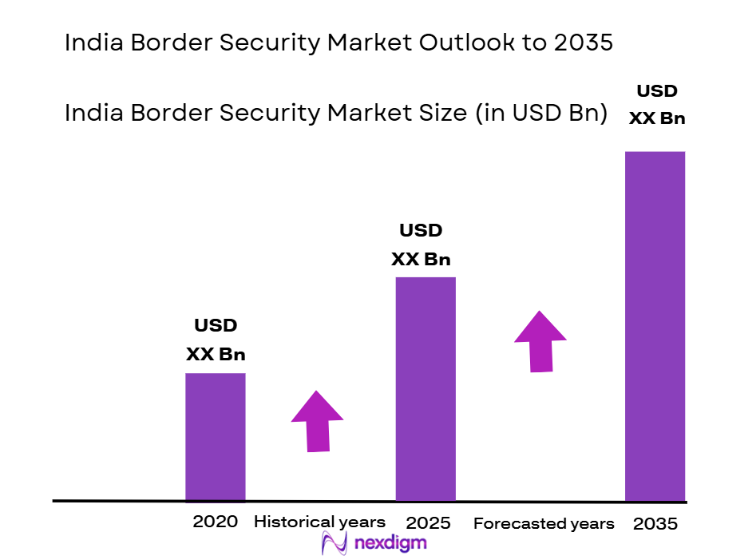
The India Border Security Market is valued at approximately USD ~ billion in 2025, with a robust growth trajectory. The market is primarily driven by India’s growing defense and homeland security budgets, with significant investments in border surveillance systems, UAV technologies, and border fencing initiatives. The strategic focus on enhancing border security infrastructure, increasing incidences of cross-border threats, and ongoing modernization of forces like BSF, ITBP, and Assam Rifles fuel the demand for advanced security systems. Furthermore, the “Make in India” initiative is boosting domestic manufacturing of defense technologies, making India a self-reliant force in securing its borders.
India is the dominant player in the Asia-Pacific region regarding border security infrastructure. The market is mainly concentrated in cities near India’s international borders, including Jammu, Srinagar, Amritsar, and Ahmedabad, all of which face significant security challenges from neighboring countries. The government’s prioritization of securing both land and maritime borders in states like Jammu & Kashmir, Punjab, Gujarat, and Rajasthan enhances the demand for border security solutions. Moreover, the presence of key defense manufacturing hubs such as Hyderabad, Bengaluru, and New Delhi further strengthens the market.
Market Segmentation
By Technology Platform
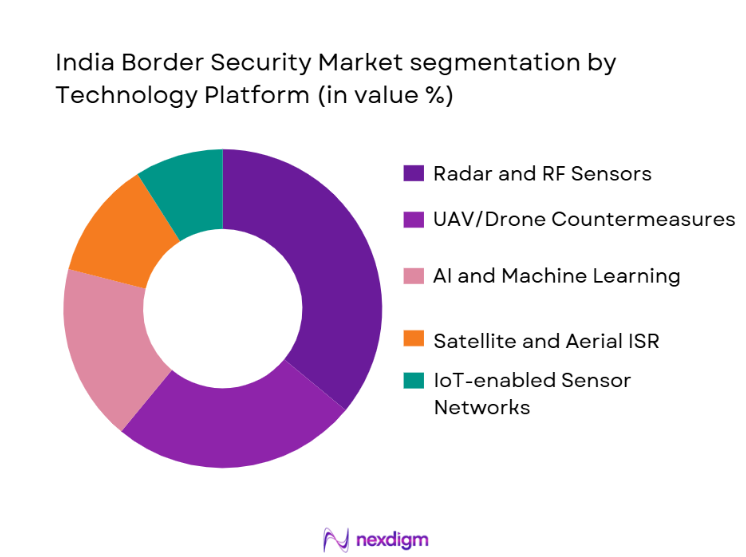
The India Border Security market is segmented by technology platform into radar and RF sensors, UAV/Drone countermeasures, AI & machine learning-based analytics, satellite and aerial ISR, and IoT-enabled sensor networks. Among these, radar and RF sensors hold the dominant market share, primarily due to their critical role in long-range detection and surveillance. These technologies are particularly essential in monitoring vast and challenging terrains such as India’s border with Pakistan and China. The advanced radar systems provide real-time data, ensuring the border forces can track unauthorized movements, preventing infiltration and smuggling activities. Additionally, the robustness and reliability of radar-based systems in harsh environmental conditions, such as extreme temperatures and rugged terrains, contribute to their dominant position in the market.
By Solution Type
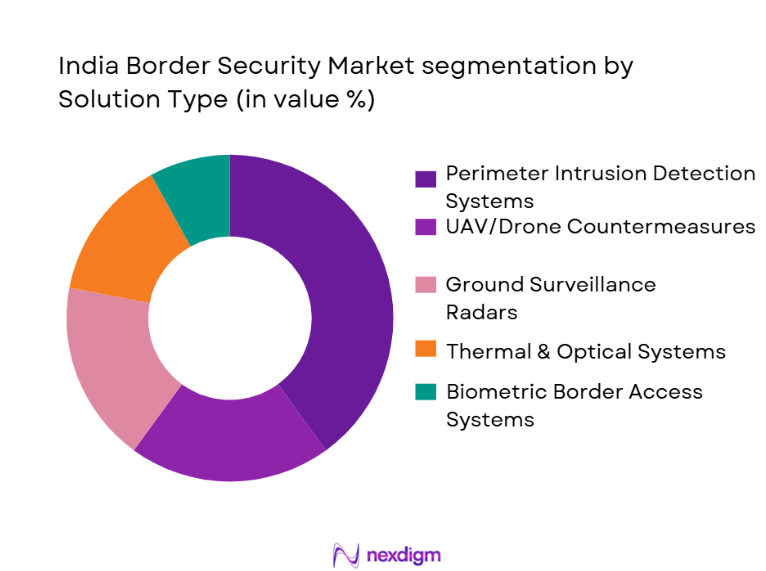
India’s Border Security market is also segmented by solution type, which includes perimeter intrusion detection systems (PIDS), UAV/Drone countermeasures, ground surveillance radars, thermal & optical systems, and biometric border access systems. The perimeter intrusion detection systems (PIDS) segment is the largest, driven by the large-scale fencing projects on India’s western and eastern borders. The demand for PIDS is increasing as they provide real-time detection and an immediate response mechanism to unauthorized border crossings. These systems are essential for maintaining tight security across thousands of kilometers of border, ensuring quick alerts to border security forces. Their proven track record in preventing infiltration activities makes them a highly preferred solution, especially in high-risk zones.
Competitive Landscape
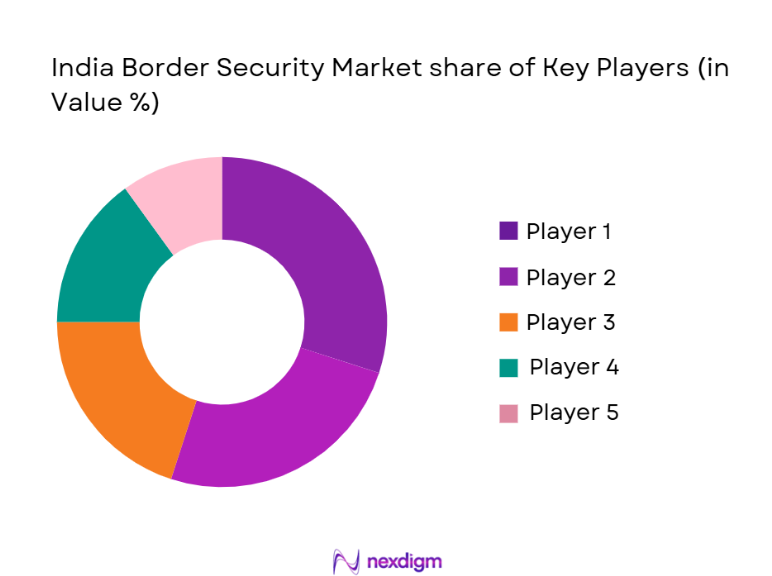
The India Border Security Market is dominated by a few key players, both domestic and international, who provide a diverse range of technologies and solutions to enhance border security. Key players include companies like Bharat Electronics Limited (BEL), L&T Defence, and international players such as Lockheed Martin, Thales, and Elbit Systems. These companies offer a mix of radar, sensor, UAV, and integrated surveillance solutions, contributing to the market’s growth. The consolidation of key players is indicative of the market’s reliance on advanced technology and innovation, with firms investing heavily in research and development to cater to India’s unique border security needs.
| Company | Establishment Year | Headquarters | Technology Focus | Product Portfolio | Strategic Partnership |
| Bharat Electronics Limited | 1954 | ~ | ~ | ~ | ~ |
| L&T Defence | 1997 | ~ | ~ | ~ | ~ |
| Lockheed Martin | 1996 | ~ | ~ | ~ | ~ |
| Thales Group | 1999 | ~ | ~ | ~ | ~ |
| Elbit Systems | 1966 | ~ | ~ | ~ | ~ |
India Border Security Market Analysis
Growth Drivers
Government Investment in Border Security Infrastructure
India’s increasing defense budget allocation toward modernizing border security infrastructure, including the deployment of advanced surveillance systems, UAVs, and smart fencing technologies, has been a key growth driver for the market. The government’s strategic focus on securing its land and maritime borders fosters consistent demand for cutting-edge security solutions.
Rising Border Threats and Cross-Border Incidents
Escalating border tensions, especially with neighboring countries like Pakistan and China, and the growing threat from insurgent activities and cross-border smuggling, have significantly heightened the need for robust security solutions. This urgency for enhanced border surveillance and protection drives technological innovation and adoption within the market.
Market Challenges
High Cost of Advanced Security Technologies
The high cost of implementing sophisticated border security solutions, such as UAVs, advanced radar systems, and biometric technologies, poses a significant challenge. Budget constraints at various levels of government and the complexity of integrating these systems into existing infrastructure can limit the market’s overall growth.
Regulatory and Compliance Barriers
The market faces hurdles related to procurement processes, compliance with defense standards, and the slow-moving regulatory framework. Delays in government approval processes and complex defense procurement norms can create roadblocks in the timely deployment of necessary border security technologies.
Opportunities
Expansion of Indigenous Manufacturing Capabilities
The “Make in India” initiative presents significant opportunities for domestic defense companies to develop and supply advanced border security solutions. Encouraging local manufacturing of surveillance systems, drones, and sensors not only reduces dependence on imports but also boosts the growth of the domestic defense sector.
Adoption of AI and Machine Learning for Threat Detection
The integration of AI and machine learning technologies in border security systems offers immense potential. These technologies enhance threat prediction and real-time decision-making, enabling more effective surveillance and rapid responses. As AI-driven systems become more accessible and affordable, they are poised to drive future growth in the market.
Future Outlook
Over the next five years, the India Border Security Market is expected to witness steady growth driven by continuous government support, the expanding need for modern border surveillance systems, and increasing technological adoption in defense operations. The adoption of AI and machine learning for threat prediction and real-time decision-making is expected to transform the market landscape. In addition, the government’s “Make in India” initiative is likely to encourage domestic manufacturing of critical border security equipment, reducing reliance on foreign imports and fostering innovation in this space.
Major Players in the India Border Security Market
- Bharat Electronics Limited (BEL)
- L&T Defence
- Lockheed Martin
- Thales Group
- Elbit Systems
- BAE Systems
- Saab Group
- Raytheon Technologies
- Northrop Grumman Corporation
- Rheinmetall Defence
- General Dynamics Mission Systems
- Honeywell International
- Airbus Group
- Harris Corporation
- Leonardo S.p.A.
Key Target Audience
- Government & Regulatory Bodies
- Defense Contractors
- Border Security Solution Providers
- System Integrators in the Defense Sector
- Investments and Venture Capitalist Firms
- Border Infrastructure Developers
- Military & Defense Equipment Buyers
- Public-Private Partnerships (PPP) Initiators in Border Security
Research Methodology
Step 1: Identification of Key Variables
The initial phase involves gathering data from government agencies, defense contractors, and border security technology providers to identify the critical variables affecting the market, such as procurement cycles, technology adoption rates, and regulatory influences. This will be achieved through desk research and interviews with industry leaders.
Step 2: Market Analysis and Construction
In this phase, historical data from credible sources such as government budgets and defense ministry reports will be analyzed. The analysis will also include an assessment of key technologies used for border surveillance, like UAVs, radars, and C4ISR platforms, along with the market’s pricing trends.
Step 3: Hypothesis Validation and Expert Consultation
Market hypotheses will be validated through interviews with experts, including defense industry veterans, security solution providers, and government officials. These consultations will help refine our understanding of the operational challenges and growth opportunities in the market.
Step 4: Research Synthesis and Final Output
The final phase will involve a synthesis of the collected data, including cross-referencing findings from secondary research and expert consultations. This will provide a comprehensive and accurate picture of the India Border Security Market, including future trends, competitive landscape, and opportunities for growth.

- Executive Summary
- Research Methodology (Market Definitions & Assumptions, India Border Security Definitions, Abbreviations, Research Design & Data Sources, India Primary & Secondary Data Integration, Government Procurement Cycle Mapping, Intelligence Interviews, Limitations & Validation)

- Market Genesis & Evolution
- Border Security Force Architecture
- India Border Security Policy & Doctrine
- Strategic Border Threat Landscape
- National Border Security Ecosystem

- Driving Forces
India Budget Priorities
Modernization Drives
Smart Borders
CrossBorder Crime Data - Market Restraints
Compliance
Rough Terrain Deployments
Cost of Advanced Tech - Opportunities
CounterDrone Tech
AI/ML Adoption
Indigenous Manufacturing
Export Potential - Key Market Trends
Automation
ISR Integration
Predictive Analytics
Sensor Fusion - Government Regulation & Security Standards
MHA/MoD
IT Tech import norms - Industry Value Chain & Procurement Landscape
India Border Security Supply Chain Mapping
Vendor Qualification & Licensing Norms
Tendering & Contracting Process
AfterSales & Maintenance Lifecycle
Indigenous Manufacturing & ‘Make in India’ Contribution

- By Value 2020–2025
- By Volume 2020-2025
- By Deployment Spend 2020-2025
- By Procurement Spend 2020-2025
- Border Security Market CAGR & Growth Trend 2020-2025

- By Domain (In Value%)
Land Surveillance
Coastal Surveillance
HighAltitude Border Surveillance
Airborne
Cyber Border Defense - By Solution Type (In Value%)
Perimeter Intrusion Detection Systems (PIDS)
UAV/Drone Countermeasures
Ground Surveillance Radars
Thermal & Optical Systems
Biometric Border Access Control
Automated Border Control Systems (ABC)
C4ISR Platforms - By Technology Platform (In Value%)
Radar & RF Sensors
Artificial Intelligence & Machine Learning Analytics
Satellite & Aerial ISR
Machine LearningBased Threat Prediction
Internet of Things (IoT) Enabled Sensor Networks - By End User (In Value%)
Central Armed Police Forces
Defence Forces
State Agencies
Private Border Infrastructure Operators
Critical Infrastructure Segments - By Procurement Model (In Value%)
Government Tenders
Foreign Military Sales
Imports
PublicPrivate Partnerships (PPP)
Domestic R&D & MakeinIndia Programs

- CrossComparison Parameters (Company Overview, India Business Units, Government Certifications, Product Portfolio Breadth, R&D Investment, Field Deployments, Strategic Partnerships, Pricing & Contract Terms)
- SWOT of Key Players
- Major Players
Bharat Electronics Limited (BEL)
Tata Advanced Systems
L&T Defence
HCL & Tech Mahindra
Jacobs/Thales
Lockheed Martin
Raytheon/RTX Corp
Elbit Systems
Saab
Siemens
Honeywell
CP Plus/Genetec
Bosch Security Systems
Rafael Advanced Defense Systems
Anduril Industries

- Border Threat Profiles – Western, Northern, Eastern & Coastal Frontiers
- Force Deployment Dynamics
- Budget Allocations & Prioritization by Force
- Pain Points & Technology Gaps
- Adoption Roadmap for NextGen Security Tech

- Value & Growth Trajectory 2026-2035
- Domain & Solution Demand 2026-2035
- Domestic vs Import Procurement 2026-2035


 Request a Sample
 Ask for Customization
 Get a Quote
 Enquire Now