

 Download PDF
Market Overview
The India Building Automation System Market is estimated at ~USD XX billion, with the market supported by expanding commercial construction, rising energy-management requirements, data-centre development, and increasing adoption of connected HVAC and building controls. The building sector accounts for more than 30% of India’s electricity consumption, while commercial floor space is being added at approximately 300,000 sq. ft. per day, creating a substantial installed-base opportunity for automation, monitoring and optimization systems.
Bengaluru, Delhi NCR, Mumbai, Hyderabad, Chennai and Pune represent the principal demand centres for the India Building Automation System Market because they combine large commercial building inventories, technology-intensive facilities, data centres, industrial activity and institutional construction. India’s top 7 office markets had approximately 853.7 million sq. ft. of Grade A office stock as of December 2024, covering Bengaluru, Chennai, Delhi NCR, Hyderabad, Kolkata, Mumbai and Pune. The concentration of high-quality office assets supports sophisticated HVAC, energy-management and integrated BMS deployments.
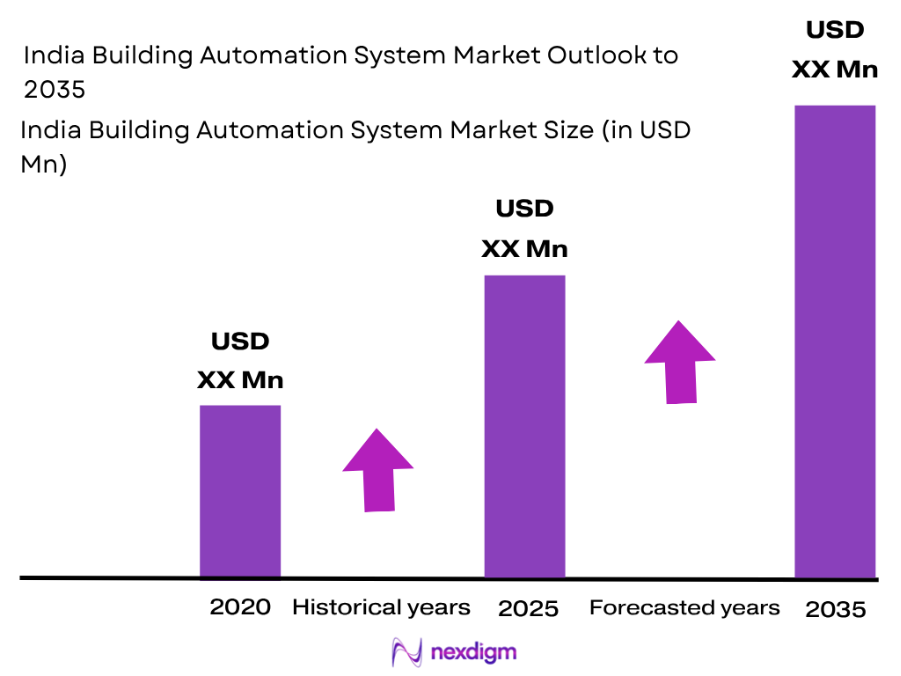
Market Segmentation
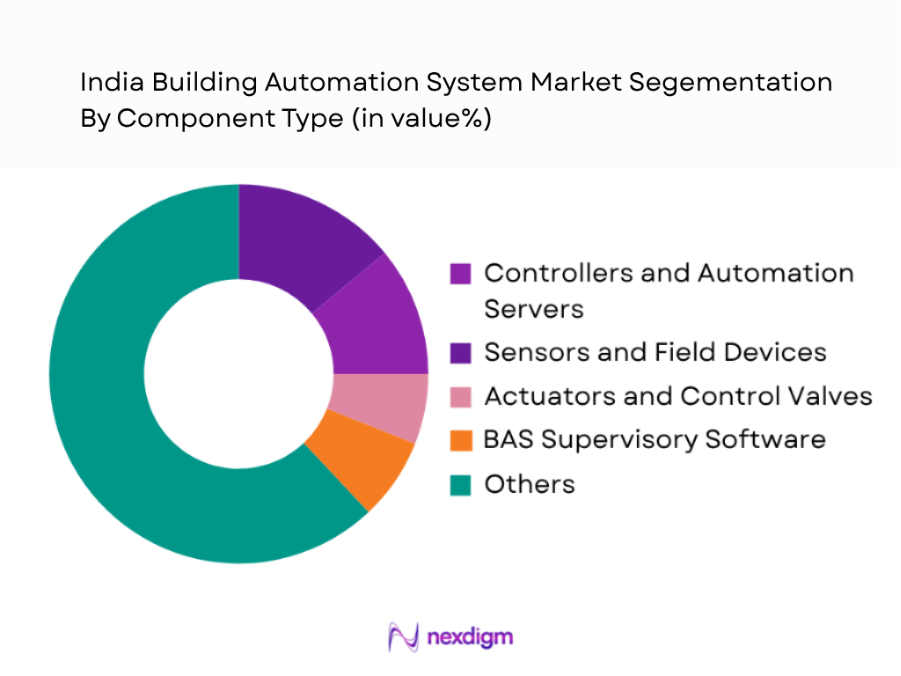
By Component
The India Building Automation System Market is segmented by component into BAS controllers and automation servers, programmable automation controllers, sensors and field devices, smart meters, actuators and control valves, variable frequency drives, communication gateways, supervisory software, energy-management software, cloud-based BAS platforms, IoT and edge devices, system integration, installation and lifecycle services. BAS controllers and automation servers represent the leading component category because they form the central control layer connecting HVAC equipment, sensors, lighting, meters and other building subsystems. Their importance increases as facilities move from isolated equipment controls toward integrated building management. BEE identifies HVAC, lighting and electrical appliances as important contributors to building electricity consumption, while its commercial-building energy work highlights the need for accurate energy data, benchmarking and energy-saving technologies. BEE’s 2023–24 energy scenario also assessed 290 commercial buildings through its star-rating programme, reinforcing the importance of measurable building performance.
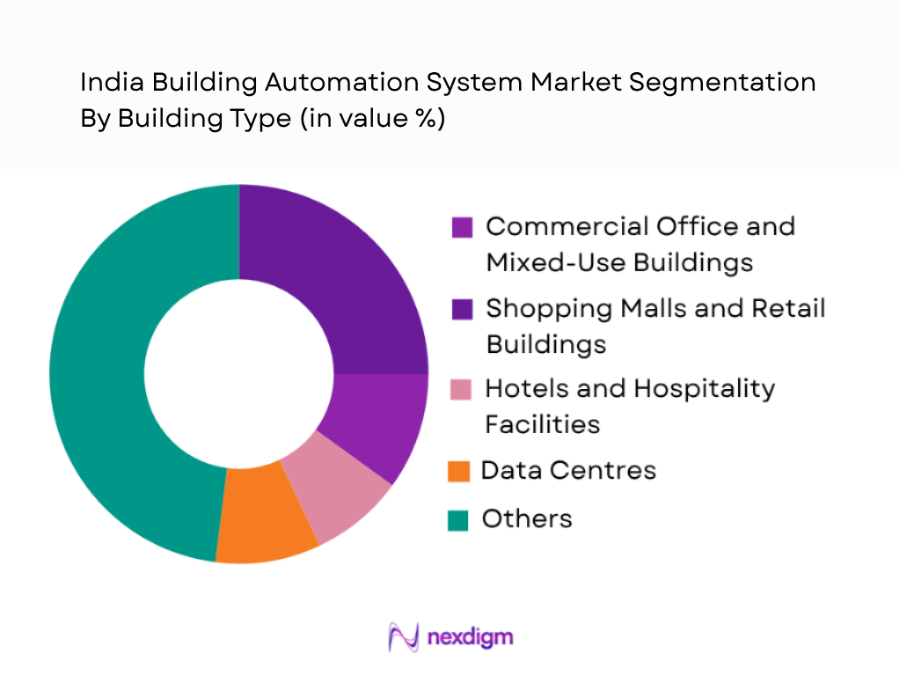
By Building Type
The India Building Automation System Market is segmented by building type into commercial office buildings, shopping malls and retail buildings, hotels and hospitality facilities, residential and high-rise buildings, industrial and manufacturing facilities, warehouses and logistics facilities, data centres, hospitals and healthcare facilities, educational institutions, government buildings, airports and transportation facilities, and mixed-use developments. Commercial office buildings represent the leading application because India’s major office markets contain extensive Grade A building inventories requiring centralized HVAC controls, energy monitoring, access integration, lighting automation and centralized facility management. The leading seven office markets reached approximately 853.7 million sq. ft. of Grade A stock by December 2024. In parallel, IGBC reported more than 13,720 green and net-zero building projects covering over 13.76 billion sq. ft. by July 2024, strengthening the case for automated energy monitoring and building-performance management.
Competitive Landscape
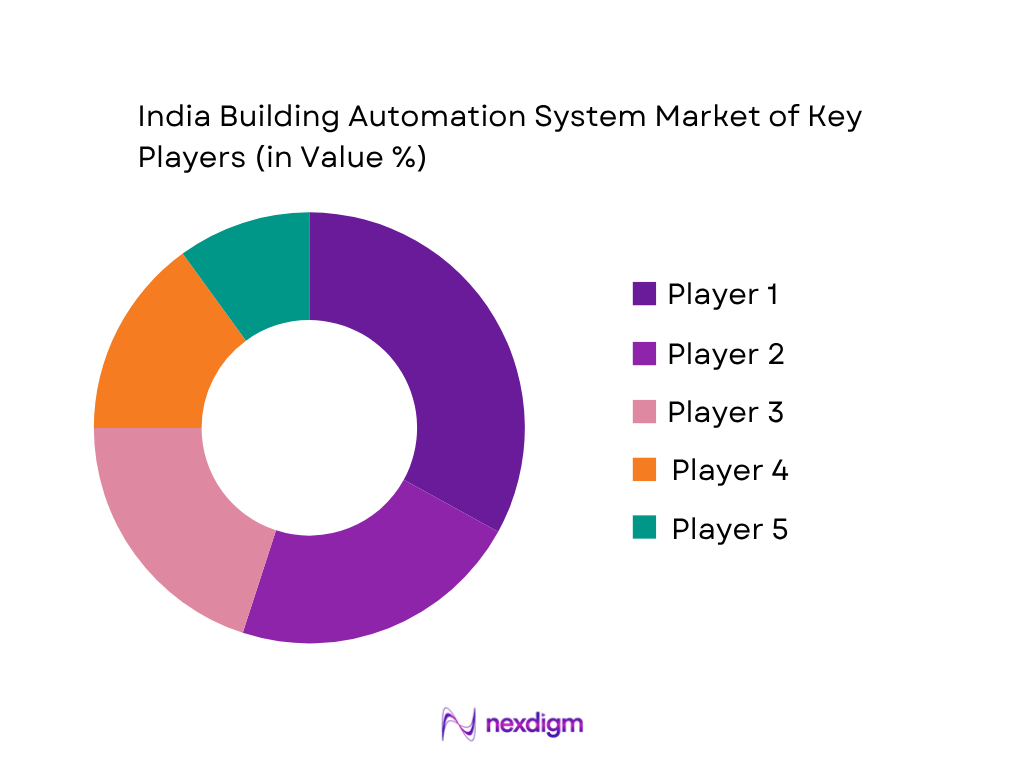
The India Building Automation System Market is characterized by multinational building-technology companies, HVAC specialists, electrical automation providers and domestic engineering organizations. Major participants compete through BAS hardware portfolios, HVAC controls, energy-management platforms, IoT connectivity, cloud services, analytics, system integration and lifecycle support. The competitive environment is increasingly influenced by interoperability, cybersecurity, retrofit capability and the ability to integrate multiple building systems rather than by standalone control hardware alone.
| Company | Establishment | Headquarters | BAS Portfolio | HVAC Automation | Cloud / IoT Capability | Energy Management | System Integration | India Market Capability |
| Honeywell | 1906 | Charlotte, USA | ~ | ~ | ~ | ~ | ~ | ~ |
| Siemens | 1847 | Munich, Germany | ~ | ~ | ~ | ~ | ~ | ~ |
| Johnson Controls | 1885 | Cork, Ireland | ~ | ~ | ~ | ~ | ~ | ~ |
| Schneider Electric | 1836 | Rueil-Malmaison, France | ~ | ~ | ~ | ~ | ~ | ~ |
| Trane Technologies | 1913 | Dublin, Ireland | ~ | ~ | ~ | ~ | ~ | ~ |
India Building Automation System Market Analysis
Growth Drivers
Commercial Real Estate Development, HVAC Energy Optimization and Smart Building Adoption
India’s expanding commercial building base is creating a larger addressable environment for building automation systems, particularly for HVAC controls, energy monitoring, occupancy-based controls and centralized facility management. The Bureau of Energy Efficiency states that India is adding around 300,000 sq. ft. of commercial floor space every day, while the building sector accounts for more than 30% of total electricity consumption. BEE also identifies HVAC and lighting as major building electricity end uses, strengthening the operational rationale for automated controls. The World Bank reported that India’s urban population stood at around 480 million in 2020 and is projected to reach 951 million by 2050, indicating continued long-term urban infrastructure requirements. BEE’s ECBC applies to commercial buildings with connected loads of 100 kW or more or contract demand of 120 kVA or more, directly creating a regulatory framework around efficient mechanical, electrical and HVAC systems. BEE also reports 290 commercial buildings assessed under its star-rating programme, providing an established performance-monitoring ecosystem. These conditions support greater deployment of integrated BAS platforms that can coordinate chillers, air-handling units, variable-speed drives, lighting, meters and sensors while providing building operators with centralized energy-performance information.
Data Centre Expansion, Industrial Automation and Building Electrification
India’s rapid expansion of digitally intensive infrastructure is creating a strong application base for sophisticated building automation systems. Government information reported in 2026 indicates that national data-centre capacity increased from approximately 375 MW in 2020 to around 1,500 MW in 2025, while approximately 38,231 GPUs had been onboarded through 14 empanelled service providers and data centres under the national AI compute framework. These facilities require continuous environmental monitoring, precision cooling, electrical supervision, redundancy management and automated alarms, making BAS integration increasingly important. The wider infrastructure environment also supports demand: India’s Economic Survey recorded ₹13.0 lakh crore of outstanding infrastructure credit in March 2024, including ₹6.4 lakh crore for power and ₹3.2 lakh crore for roads. Renewable-energy development adds another layer of building-electrification complexity, with India reaching 209.44 GW of renewable-energy installed capacity by December 2024 and adding 28.64 GW during that year. This expansion increases the relevance of systems capable of coordinating distributed energy resources, electrical loads, storage, HVAC and demand-management functions. Industrial facilities, data centres and large commercial buildings therefore provide increasingly sophisticated use cases for BAS platforms beyond conventional temperature control.
Market Challenges
Legacy BAS Infrastructure, Proprietary Control Systems and Interoperability Constraints
A major challenge for the India Building Automation System Market is the technical complexity involved in integrating modern BAS platforms with existing building equipment and legacy control infrastructure. Many established commercial and industrial properties contain HVAC systems, meters, controllers and field devices installed at different stages and using different communication protocols. BEE identifies commercial buildings as an important area for energy-performance assessment and notes that accurate building-energy data is required to identify inefficiencies and design effective energy-efficiency interventions. Its commercial-building programme covers systems including HVAC, lighting and electrical infrastructure, demonstrating the breadth of equipment that may need to be coordinated. ECBC also applies across 5 climatic zones, requiring building mechanical and electrical strategies to respond to substantially different operating conditions. Retrofit projects therefore require detailed assessment of existing chillers, air-handling units, pumps, sensors, actuators, meters and control panels before automation can be deployed. Integration becomes more complicated where proprietary controllers restrict access to operating data or where equipment lacks modern communication interfaces. Building owners may consequently face engineering requirements extending beyond BAS installation into controls replacement, gateway deployment, network redesign and commissioning. These technical dependencies can lengthen project execution and make retrofit automation considerably more complex than new-build BAS deployment.
Cybersecurity Risks, Skilled BAS Requirements and Building Data Management Complexity
Increasing connectivity is simultaneously expanding the functionality and cybersecurity exposure of the India Building Automation System Market. Modern BAS environments increasingly connect HVAC controllers, sensors, meters, access systems, lighting controls, cloud platforms and enterprise networks, creating additional points through which unauthorized access or operational disruption could occur. The challenge is particularly significant for data centres, healthcare facilities, industrial plants and government buildings where uninterrupted environmental and electrical control is operationally critical. BEE’s commercial-building programme evaluates energy performance across 290 surveyed office and BPO buildings, illustrating the volume of operational data required to assess building efficiency and establish performance benchmarks. At the national level, BEE maintains energy-audit information covering multiple distribution companies, including BESCOM, BRPL, BYPL, MSEDCL and TANGEDCO, demonstrating the increasingly data-intensive nature of energy management. BAS projects therefore require personnel capable of handling controls engineering, networking, cybersecurity, HVAC optimization, data analytics and commissioning rather than only conventional electrical installation. Smaller building owners may also struggle to maintain specialized teams after deployment. As BAS systems evolve toward cloud connectivity, AI analytics and remote facility management, organizations must establish access controls, data governance, network segmentation, backup procedures and lifecycle cybersecurity practices alongside physical automation infrastructure.
Market Opportunities
Data Centre BAS, AI-Enabled Energy Optimization and Predictive HVAC Maintenance
The expanding Indian digital infrastructure ecosystem creates a substantial opportunity for advanced BAS applications focused on precision cooling, energy optimization and predictive maintenance. Government information indicates that India’s data-centre capacity reached around 1,500 MW in 2025, compared with approximately 375 MW in 2020, while the national AI compute initiative had onboarded 38,231 GPUs through 14 empanelled service providers and data centres. Such facilities require continuous monitoring of temperature, humidity, power quality, cooling performance and equipment status, creating opportunities for BAS platforms that combine conventional controls with analytics and predictive algorithms. The opportunity extends to commercial buildings because BEE reports that the building sector consumes more than 30% of India’s electricity, while approximately 300,000 sq. ft. of commercial floor space is being added every day. This creates an expanding installed base in which AI-enabled BAS can identify abnormal HVAC operation, optimize chiller sequencing, adjust ventilation according to occupancy and support predictive maintenance. BEE’s ECBC framework specifically addresses mechanical systems and HVAC equipment, while its commercial-building star-rating programme provides a foundation for performance-based energy management. As building operators seek measurable efficiency improvements, BAS providers can increasingly position analytics, automated fault detection, digital commissioning and predictive maintenance as integrated services rather than standalone control solutions.
Commercial Building Retrofits, Grid-Interactive Buildings and Building Electrification Controls
India’s transition toward more connected and energy-efficient buildings creates opportunities for BAS providers to modernize existing commercial assets while integrating new electrical technologies. BEE states that 40% of the building stock expected to exist in the next 20 years has yet to be built, while India’s urban population is projected by the World Bank to reach 951 million by 2050. This combination creates opportunities in both new construction and modernization of existing properties. Renewable-energy deployment further strengthens the case for integrated building controls: India had 209.44 GW of renewable-energy installed capacity by December 2024, with 28.64 GW added during that year. BAS platforms can increasingly coordinate rooftop solar, batteries, HVAC loads, EV charging, lighting and other electrical equipment, allowing building operators to manage consumption more dynamically. BEE’s ECBC framework applies to commercial buildings with connected loads of 100 kW or more or contract demand of 120 kVA or more, while its energy-efficiency programmes emphasize mechanical, electrical and renewable-energy integration. These conditions create an opportunity for retrofit-oriented BAS solutions that combine energy monitoring, automated HVAC control, occupancy analytics, demand management and distributed-energy coordination. Multi-site facility operators can further use centralized cloud platforms to compare performance and manage geographically distributed building portfolios.
Future Outlook
Over the next decade, the India Building Automation System Market is expected to benefit from continued commercial development, expansion of data centres, industrial modernization and increasing attention to building energy performance. BEE states that buildings account for more than 30% of India’s electricity consumption, creating a strong operational rationale for HVAC optimization and automated energy monitoring. Bureau of Energy Efficiency The market should progressively move toward cloud-connected BAS, AI-supported analytics, predictive maintenance, digital twins and integrated energy-management platforms. The availability of 13.76 billion sq. ft. of green and net-zero projects under IGBC systems also indicates a substantial ecosystem for performance-oriented building technologies.
Major Players
- Honeywell
- Siemens
- Johnson Controls
- Schneider Electric
- Trane Technologies
- Carrier
- ABB
- Delta Controls
- Distech Controls
- Bosch Building Technologies
- Mitsubishi Electric
- Azbil Corporation
- Legrand
- Larsen & Toubro
- KMC Controls
Key Target Audience
- Commercial Real Estate Developers and Building Owners
- Data Centre Operators and Infrastructure Developers
- Facility Management Companies
- HVAC Equipment Manufacturers and System Integrators
- Industrial and Manufacturing Facility Operators
- Investments and Venture Capitalist Firms
- Government and Regulatory Bodies (Bureau of Energy Efficiency, Ministry of Power, Ministry of Housing and Urban Affairs, Central Public Works Department)
- Smart Building Technology, IoT and Building Controls Providers
Research Methodology
Step 1: Identification of Key Variables
The initial phase involves constructing an ecosystem map covering BAS manufacturers, HVAC equipment suppliers, system integrators, facility managers, building owners, developers and technology providers. The study identifies controllers, sensors, actuators, BMS software, energy-management platforms and connected building technologies as core market variables. Building type, deployment model, application and regional concentration are also established as key analytical dimensions.
Step 2: Market Analysis and Construction
Historical market information is compiled across hardware, software, integration, installation and lifecycle services. The analysis evaluates commercial buildings, industrial facilities, data centres, healthcare assets, government buildings and other major application areas. Building-energy consumption, commercial floor-space development and green-building activity are incorporated to establish demand-side relationships and validate the underlying market structure.
Step 3: Hypothesis Validation and Expert Consultation
Market hypotheses are developed around BAS adoption, HVAC automation, energy monitoring, retrofit activity, IoT connectivity and cloud-based building management. These hypotheses are validated through discussions with BAS manufacturers, HVAC specialists, system integrators, facility-management organizations, developers and building operators. Expert inputs are used to verify deployment patterns, product adoption and integration requirements.
Step 4: Research Synthesis and Final Output
The final phase integrates secondary research, industry interviews, company-level analysis and building-sector indicators into a consolidated market framework. Bottom-up estimates are cross-checked against demand-side and supply-side indicators to improve consistency. Competitive benchmarking evaluates product portfolios, HVAC capabilities, software functionality, IoT integration, energy management and system-integration strength across major market participants.

- Executive Summary
- Research Methodology (Market Definitions and Assumptions, India BAS Market Classification, Building Automation Scope, BMS and IBMS Scope, HVAC Controls Mapping, Lighting Automation Mapping, Fire and Life-Safety Integration Mapping, Security and Access-Control Integration Mapping, Energy Management System Mapping, IoT and Edge-Device Assessment, Sensor and Actuator Mapping, BACnet and Modbus Protocol Assessment, Cloud-Based BAS Assessment, AI and Analytics Assessment, Smart Building Project Mapping, Green Building and Energy-Code Assessment, New-Build Assessment, Retrofit Assessment, Top-Down Market Sizing, Bottom-Up Market Sizing, Demand-Side Assessment, Supply-Side Assessment, Primary Industry Interviews, Building Stock Assessment, Commercial Construction Pipeline Assessment, Data-Centre Project Pipeline Assessment, Data Triangulation, Forecasting Framework)

- Definition and Scope
- India Building Automation Industry Evolution and Development of Building Management Systems, Integrated Building Management Systems, Direct Digital Controls, HVAC Automation, Chiller Plant Automation, Variable Air Volume Controls, Variable Frequency Drive Integration, Lighting Automation, Smart Metering, Energy Management Systems, Occupancy-Based Controls, Indoor Air Quality Monitoring, IoT Building Platforms, Cloud-Based BMS, AI-Enabled Building Analytics, Digital Twins, Predictive Maintenance and Grid-Interactive Building Controls
- Building Automation System Value Chain Analysis
- Building Automation System Supply Chain Analysis
- BAS Controllers and Automation Servers, Sensors and Field Devices, Actuators and Control Valves, HVAC Equipment and Controls, Smart Meters, Variable Frequency Drives, Communication Gateways, BMS Software Platforms, Energy Management Software, IoT Platforms, Cloud Infrastructure Providers, System Integrators, MEP Contractors, Facility Management Companies, Building Owners, Real Estate Developers, Data Centre Operators, Industrial Facility Operators, Government Buildings, State Public Works Departments, DISCOMs, Energy Service Companies

- Growth Drivers (Commercial Real Estate Development, HVAC Energy Optimization, Smart Building Adoption, Data Centre Expansion, Industrial Automation, Green Building Development, Energy Conservation Building Code Adoption, Building Electrification, Facility Management Digitization, IoT Sensor Deployment, Chiller Optimization, Occupancy-Based Controls)
- Market Challenges (Legacy BAS Infrastructure, Proprietary Control Systems, Interoperability Constraints, Protocol Compatibility Issues, Skilled BAS Engineer Requirements, Cybersecurity Risks, Retrofit Installation Complexity, Fragmented Controls Ecosystem, Long Equipment Replacement Cycles, Existing HVAC Integration Constraints, Building Data Management Complexity, Limited Automation Budgets)
- Market Opportunities (Data Centre BAS, Cloud-Based Building Automation, AI-Enabled Energy Optimization, Predictive HVAC Maintenance, Smart Chiller Controls, Commercial Building Retrofits, Industrial Facility Automation, Indoor Air Quality Monitoring, Occupancy Analytics, Grid-Interactive Buildings, Demand Response Integration, Digital Twin-Based Building Management, Multi-Site Facility Management, Building Electrification Controls, EV Charging and Building Energy Management)
- Market Trends (Integrated Building Management Systems, Smart HVAC Controls, IoT-Connected Buildings, Cloud-Based BMS, AI Building Analytics, Predictive Maintenance, Digital Twin Adoption, Occupancy-Based Automation, Energy Monitoring, Open-Protocol BAS, Cybersecurity Integration, Indoor Air Quality Monitoring, Automated Chiller Optimization, Building Electrification, Distributed Energy Integration)
- Government Regulations and Standards (Energy Conservation and Sustainable Building Code 2024, Energy Conservation Building Code 2017, Energy Conservation Act, National Building Code of India 2016, Eco-Niwas Samhita, Bureau of Energy Efficiency Building Energy Standards, State Energy Conservation Regulations, Building Energy Performance Requirements, HVAC Efficiency Requirements, Electrical Safety Requirements, Fire and Life-Safety Requirements, Data and Cybersecurity Requirements)
- SWOT Analysis
- Porter’s Five Forces Analysis
- PESTLE Analysis
- Stakeholder Ecosystem

- By Market Value (2020-2025)
- By BAS Hardware Revenue (2020-2025)
- By BAS Software Revenue (2020-2025)
- By System Integration Revenue (2020-2025)
- By Installation and Commissioning Revenue (2020-2025)
- By Maintenance and Lifecycle Services Revenue (2020-2025)

- By Component (In Value %)
BAS Controllers and Automation Servers
Programmable Automation Controllers
Direct Digital Controllers
Sensors and Field Devices
Smart Meters and Energy Monitoring Devices
Actuators and Control Valves
Variable Frequency Drives
Communication Gateways
BAS Supervisory Software
Energy Management Software
Building Analytics Software
Cloud-Based BAS Platforms
IoT and Edge Devices
System Integration and Engineering
Installation and Commissioning
Maintenance and Lifecycle Services - By Building Type (In Value %)
Commercial Office Buildings
Shopping Malls and Retail Buildings
Hotels and Hospitality Facilities
Residential and High-Rise Buildings
Industrial and Manufacturing Facilities
Warehouses and Logistics Facilities
Data Centres
Hospitals and Healthcare Facilities
Educational Institutions
Government and Public Buildings
Airports and Transportation Facilities
Mixed-Use Developments - By Application System (In Value %)
HVAC Automation
Chiller Plant Management
Air Handling Unit Controls
Variable Air Volume Controls
Lighting Automation
Energy Monitoring and Management
Occupancy and Space Management
Indoor Air Quality Monitoring
Fire and Life-Safety System Integration
Access Control and Security Integration
Elevator and Vertical Transportation Integration
Power Monitoring and Electrical Automation
Water Management and Pump Controls
Renewable Energy and Building Integration
EV Charging and Building Energy Management - By Deployment Model (In Value %)
New Construction BAS
Building Retrofit and Modernization
Expansion and System Upgrades
Centralized Building Management
Integrated Building Management
Cloud-Based Building Automation
On-Premise Building Automation
Hybrid BAS Deployment - By Region (In Value %)
North India
South India
West India
East India
Central India
Northeast India

- Market Share of Major Players (By India Revenue, BAS Hardware Revenue, BAS Software Revenue, Controller Portfolio, HVAC Automation Capability, Energy Management Capability, IoT and Cloud Capability, System Integration Capability, Data Centre BAS Capability, Commercial Building Coverage, Industrial Building Coverage, Geographic Coverage, Retrofit Capability, Engineering Capability)
- Cross Comparison Parameters (BAS Product Portfolio Breadth, HVAC and Chiller Automation Capability, BMS Software Functionality, Energy Management Capability, IoT and Cloud Integration, Open-Protocol Compatibility, AI and Analytics Capability, System Integration and Retrofit Capability)
- SWOT Analysis of Major Players
- Major Companies
Honeywell
Siemens
Johnson Controls
Schneider Electric
Trane Technologies
Carrier
ABB
Delta Controls
Distech Controls
Bosch Building Technologies
Mitsubishi Electric
Azbil Corporation
Legrand
Larsen & Toubro
KMC Controls

- Commercial Real Estate Developer BAS Requirement Assessment
- Building Owner Automation Requirement Assessment
- Facility Management Company Procurement Assessment
- MEP Contractor BAS Integration Assessment
- BAS System Integrator Requirement Analysis
- Data Centre Operator BAS Requirement Assessment
- Industrial and Manufacturing Facility BAS Assessment

- By Market Value (2026-2035)
- By BAS Hardware Revenue (2026-2035)
- By BAS Software Revenue (2026-2035)
- By System Integration Revenue (2026-2035)
- By Installation and Commissioning Revenue (2026-2035)
- By Maintenance and Lifecycle Services Revenue (2026-2035)


 Request a Sample
 Ask for Customization
 Get a Quote
 Enquire Now
