

 Download PDF
Market Overview
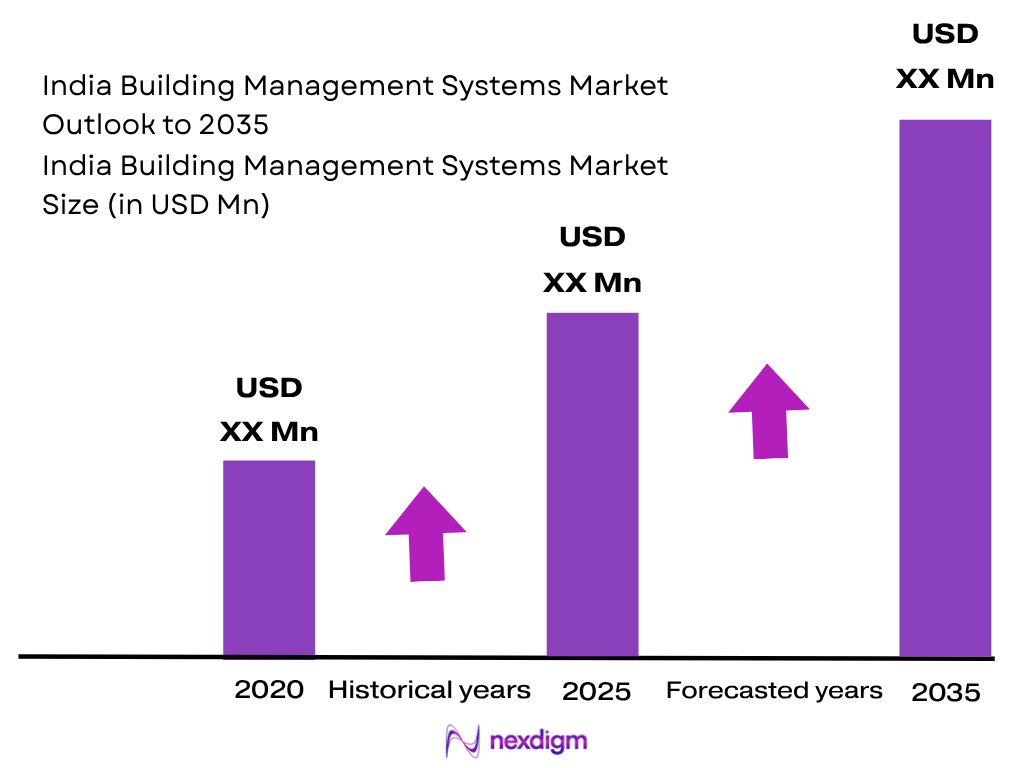
The India Building Management Systems Market is valued at USD 442.98 million, based on the referenced market definition covering building-management products and services. Demand is reinforced by rapid expansion of automation-intensive commercial real estate: gross office absorption increased from 61.6 million sq. ft. to 79.0 million sq. ft. across two consecutive annual periods. Grade-A offices, GCC facilities, hospitals, hotels and technology campuses increasingly require centralized HVAC control, energy monitoring, alarms, metering and integrated building operations.
Bengaluru, Mumbai, Hyderabad, Delhi-NCR, Chennai and Pune form the core demand centres for the India Building Management Systems Market because of their concentration of Grade-A offices, technology parks, data centres, hospitals and large mixed-use developments. India’s data-centre capacity expanded from 853 MW to about 1,255 MW across the referenced periods. Mumbai benefits from submarine-cable connectivity and BFSI demand, while Bengaluru and Hyderabad benefit from technology and GCC development and Chennai from cable connectivity and hyperscale infrastructure.
Market Segmentation
By System Type
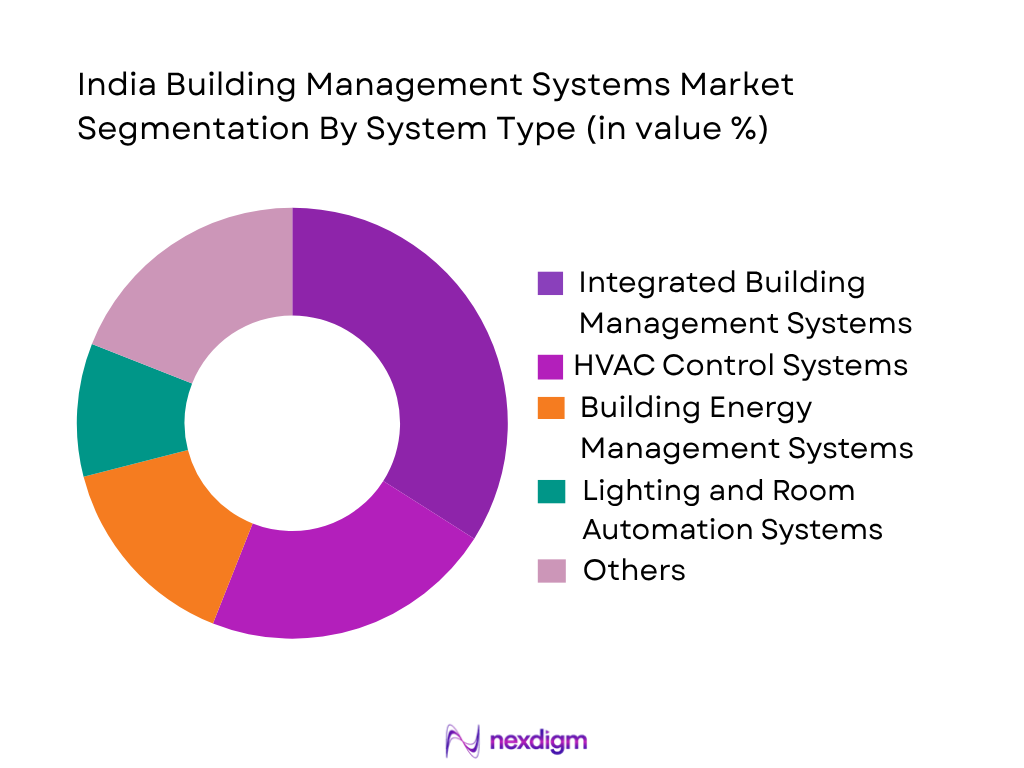
The India Building Management Systems Market is segmented into integrated building management systems, HVAC control systems, building energy management systems, lighting management, room automation, security-integrated platforms and cloud-based BMS solutions. Integrated Building Management Systems hold the dominant share because large commercial properties increasingly require centralized control of HVAC, lighting, energy metering, fire alarms, access systems and electrical infrastructure through a unified supervisory platform. India’s expanding stock of high-quality offices and mission-critical facilities strengthens this requirement. Gross office leasing across the top six cities reached 29.4 million square feet during the first half of 2024, compared with 24.8 million square feet in the corresponding preceding period. In addition, India had more than 130 operational data centres and over 1,180 MW of IT-load capacity. Such facilities require coordinated control, alarm management, cooling optimization, power monitoring and redundancy supervision, favouring integrated systems over standalone controllers.
By Application
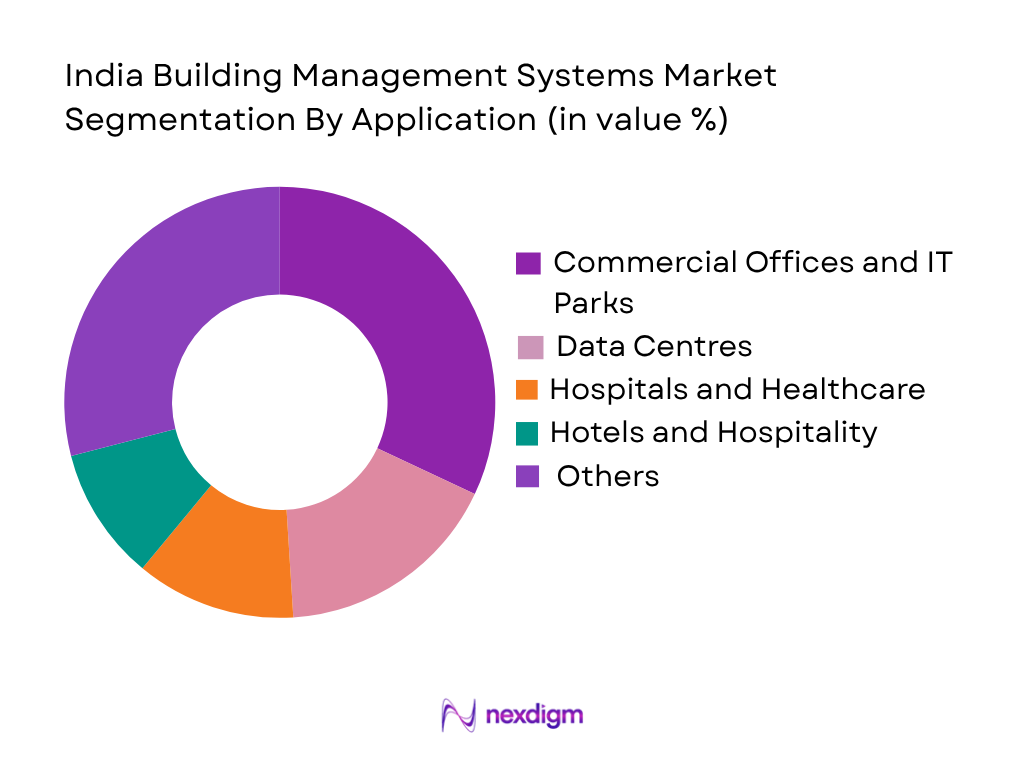
The India Building Management Systems Market is segmented into commercial offices, data centres, hospitals, hotels, airports and transport infrastructure, retail, industrial facilities and institutional buildings. Commercial offices represent the dominant application because India’s Grade-A office market continues expanding across Bengaluru, Delhi-NCR, Hyderabad, Mumbai, Pune and Chennai. Office leasing reached 15.8 million square feet in the April–June period, versus 14.6 million square feet in the corresponding preceding period. Bengaluru alone recorded 4.8 million square feet, Mumbai 3.5 million, and Hyderabad 2.6 million. Modern offices increasingly deploy BMS for chiller optimization, tenant metering, occupancy-based HVAC, lighting control, air-quality monitoring and centralized facility operations. Energy efficiency regulation reinforces this requirement: the Bureau of Energy Efficiency’s Energy Conservation and Sustainable Building Code 2024 specifically applies to commercial and office buildings, increasing the relevance of automated monitoring and control for high-performance developments.
Competitive Landscape
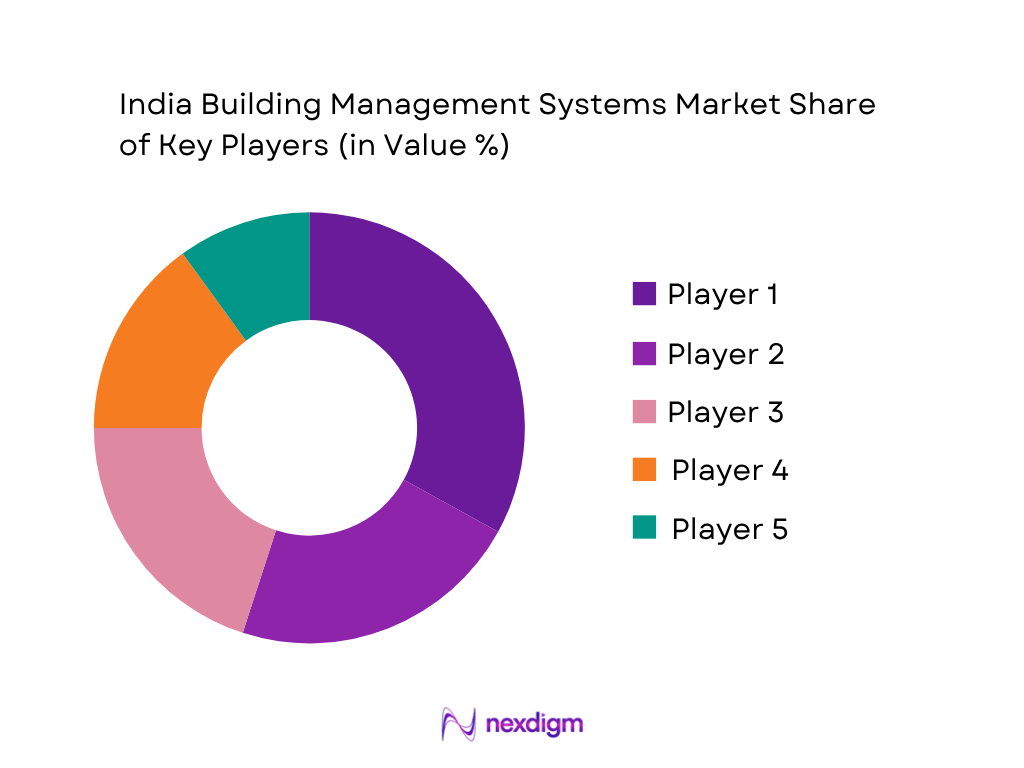
The India Building Management Systems Market has a competitive structure led by multinational automation companies with established controls portfolios, software platforms and system-integrator networks. Honeywell, Siemens, Schneider Electric, Johnson Controls and ABB compete through integrated hardware-software ecosystems, open-protocol interoperability, energy management capabilities and lifecycle services. Competition is gradually shifting beyond controller pricing toward cloud connectivity, analytics, cybersecurity, predictive maintenance, digital twins and multi-building portfolio management. Honeywell and Schneider Electric, for example, actively market cloud-enabled and integrated building-management platforms in India.
| Major Player | Establishment Year | Headquarters | Flagship BMS Platform | DDC / Field Control Capability | Protocol & Integration Capability | Cloud / Analytics Capability | Key Building Verticals | Lifecycle & Service Capability |
| Honeywell | 1906 | Charlotte, United States | ~ | ~ | ~ | ~ | ~ | ~ |
| Siemens | 1847 | Munich / Berlin, Germany | ~ | ~ | ~ | ~ | ~ | ~ |
| Schneider Electric | 1836 | Rueil-Malmaison, France | ~ | ~ | ~ | ~ | ~ | ~ |
| Johnson Controls | 1885 | Cork, Ireland | ~ | ~ | ~ | ~ | ~ | ~ |
| ABB | 1988 | Zurich, Switzerland | ~ | ~ | ~ | ~ | ~ | ~ |
India Building Management Systems Market Analysis
Growth Drivers
Expansion of Data Centres and Mission-Critical Digital Infrastructure
India’s rapidly expanding data-centre footprint is creating direct demand for Building Management Systems capable of coordinating cooling, power, environmental monitoring, alarms and equipment uptime. The Ministry of Electronics and Information Technology reported installed data-centre capacity of about 1,280 MW as of June 2025, supported by approximately 130 privately operated data centres and 49 data centres operated by central and state government agencies. By August 2026, installed capacity had increased further to about 1,575 MW, with major clusters in Mumbai, Navi Mumbai, Chennai, Hyderabad, Bengaluru, Delhi NCR and Gujarat. These facilities require dense networks of temperature, humidity, differential-pressure, power and water sensors combined with automated cooling and alarm-management platforms. India’s wider economic scale also supports investment in such infrastructure: World Bank data place national GDP at approximately USD 3.91 trillion in 2024, with GDP per capita at USD 2,694.7. For BMS vendors, this combination of large economic activity and high-density mission-critical infrastructure supports demand for redundant controllers, chiller optimization, centralized supervisory platforms, remote monitoring and integration with electrical and data-centre infrastructure.
Building Energy Regulation and Rising Power-System Complexity
Energy-efficiency regulation is strengthening the role of Building Management Systems in large commercial facilities because building controls are increasingly embedded in compliance requirements rather than treated as optional automation. The Bureau of Energy Efficiency’s Energy Conservation and Sustainable Building Code framework applies to commercial buildings with a connected load of 100 kW or more or contract demand of 120 kVA or more, placing large offices, hotels, hospitals, malls and institutional complexes directly within the addressable control environment. The code covers HVAC systems, lighting, electrical systems and renewable-energy integration, all of which rely on monitoring, sequencing and automated controls. At the national level, the Ministry of Power reported total installed electricity capacity of approximately 509,700 MW by November 2025, while India met peak demand of about 242,490 MW during FY2025-26. These operating conditions increase the value of demand management, chiller sequencing, smart metering and automated load control at building level. World Bank data also show India’s 2024 economy at approximately USD 3.91 trillion, giving the construction and infrastructure ecosystem the scale required for broader adoption of digitally managed buildings.
Market Challenges
Integration Complexity Across Legacy and Multi-Vendor Building Systems
One of the central challenges for the India Building Management Systems Market is integrating new digital platforms with large installed bases of HVAC equipment, electrical infrastructure, fire systems, meters and proprietary controllers. This issue becomes more pronounced as buildings become operationally complex. Government data show India already had approximately 130 privately operated data centres and 49 government-operated data centres as of June 2025, while national installed data-centre capacity reached around 1,575 MW in 2026. Such facilities combine chillers, cooling towers, pumps, UPS equipment, electrical switchgear, environmental sensors and multiple supervisory systems, requiring reliable protocol translation and centralized alarm management. India’s government cloud ecosystem adds another layer of complexity: the Ministry of Electronics and Information Technology reported that 2,170 ministries and departments had applications hosted on MeghRaj and that 26 cloud service providers had been empanelled for government cloud requirements in 2025. As BMS platforms become increasingly connected to cloud infrastructure, facility operators must manage interoperability, network architecture, system availability and cybersecurity simultaneously. This makes engineering quality, open-protocol capability and experienced system integration critical barriers to scalable implementation.
Uneven Automation Readiness Across India’s Building Stock
Building automation adoption is constrained by the large gap between sophisticated new commercial assets and smaller or older buildings that were not originally designed for integrated controls. The Bureau of Energy Efficiency applies its principal commercial-building energy code to facilities with connected electrical load of at least 100 kW or contract demand of at least 120 kVA. This threshold focuses regulatory attention on larger facilities, while substantial numbers of smaller properties operate outside the same compliance envelope and may lack standardized metering, control networks or centralized HVAC architecture. Retrofitting such buildings can require new sensors, gateways, communications infrastructure and control panels before higher-level BMS software can generate meaningful operational benefits. The broader economic context also matters: World Bank data put India’s GDP per capita at USD 2,694.7 in 2024, despite the overall economy reaching about USD 3.91 trillion. This combination reflects a very large economy with substantial variation in capital availability and building quality. Consequently, BMS penetration can be strong in data centres, Grade-A offices and large hospitals while remaining fragmented across smaller commercial facilities, creating a challenge for vendors seeking standardized national deployment models.
Market Opportunities
Data-Centre Cooling, Power and Environmental Automation
India’s data-centre build-out creates one of the strongest forward opportunities for Building Management Systems because every additional facility requires continuous coordination of mechanical cooling, electrical supply, environmental conditions and alarm workflows. Government information shows installed capacity at approximately 1,280 MW in June 2025, distributed across around 130 privately operated data centres and 49 government-operated facilities. Capacity reached about 1,575 MW by August 2026, with deployment concentrated in Mumbai, Navi Mumbai, Chennai, Hyderabad, Bengaluru, Delhi NCR and Gujarat while additional locations emerge elsewhere. The IndiaAI ecosystem is adding another layer of high-density computing demand: the Ministry of Electronics and Information Technology reported that common national compute capacity had crossed 34,000 GPUs in May 2025, and another government update cited 38,231 GPUs onboarded through 14 empanelled service providers and data centres in 2026. These installations intensify cooling loads and increase the importance of precise temperature, humidity, flow and differential-pressure control. Current infrastructure therefore creates a sizeable future runway for advanced BMS platforms integrating liquid-cooling supervision, chiller optimization, electrical monitoring, alarm analytics and remote operations.
Energy-Efficiency Retrofits and Cloud-Based Building Operations
Existing commercial properties represent a significant growth opportunity as owners increasingly connect legacy equipment to centralized energy and facility-management platforms. The Bureau of Energy Efficiency’s building-code framework sets minimum requirements for large commercial properties beginning at 100 kW connected load or 120 kVA contract demand, covering HVAC, lighting, electrical systems and renewable-energy integration. This creates a technically defined pool of buildings where automated monitoring, scheduling, sub-metering and equipment optimization have direct regulatory and operating relevance. India’s electrical system further reinforces the need for active demand management: total installed power capacity reached approximately 509,700 MW in November 2025, while peak electricity demand met during FY2025-26 reached approximately 242,490 MW. Cloud infrastructure is simultaneously becoming more accessible to building operators. Government data indicate that 2,170 ministries and departments were using MeghRaj cloud infrastructure, supported by 26 empanelled cloud service providers in 2025. These current conditions support future adoption of retrofit gateways, wireless sensors, cloud BMS platforms, centralized command centres, automated fault detection and portfolio-level energy dashboards across offices, hospitals, hotels, malls and institutional properties.
Future Outlook
The India Building Management Systems Market is expected to expand at a forecast CAGR of approximately ~XX.X% during 2026–2035, supported by commercial construction, data centres, building-energy regulation and modernization of legacy automation infrastructure. Cloud platforms, wireless field devices, open protocols and AI-enabled HVAC optimization should increase the addressable opportunity beyond conventional BMS installations. Growth will progressively shift toward software, recurring services and portfolio-level optimization rather than remaining dependent solely on greenfield hardware projects.
Data centres will be among the most important high-value applications because they require continuous control of cooling equipment, environmental conditions, electrical infrastructure, alarms and utility systems. India’s rapid data-centre expansion provides a particularly favourable demand environment for high-availability BMS architectures. JLL has highlighted substantial capacity additions and real-estate requirements associated with India’s data-centre expansion, while CBRE has reported strong ongoing capacity development.
Major Players
- Honeywell Automation India Limited
- Siemens Limited
- Schneider Electric India Private Limited
- Johnson Controls India Private Limited
- ABB India Limited
- Delta Electronics India Private Limited
- Carrier India
- Trane Technologies India
- Azbil India Private Limited
- 75F India
- Beckhoff Automation Private Limited
- CAREL ACR Systems India Private Limited
- Legrand India Private Limited
- Crestron Electronics India Private Limited
- Acuity Brands / Distech Controls
Key Target Audience
- Building Management System OEMs and Building Automation Technology Providers
- BMS System Integrators and Control Panel Manufacturers
- Commercial Real Estate Developers and Institutional Property Owners
- Data Centre Developers and Operators
- HVAC, MEP and EPC Contractors
- Facility Management Companies and Energy Service Companies
- Investments and Venture Capitalist Firms
- Government and Regulatory Bodies (Bureau of Energy Efficiency, Ministry of Power, Central Public Works Department, Bureau of Indian Standards, State Designated Agencies)
Research Methodology
Step 1: Identification of Key Variables
The initial phase involves creating a detailed ecosystem map of the India Building Management Systems Market, covering OEMs, DDC and PLC suppliers, sensor manufacturers, HVAC companies, system integrators, developers, MEP contractors and facility managers. Secondary research is used to define variables such as building automation penetration, control-point density, project type, controller architecture, application mix, building floor area and average BMS project value.
Step 2: Market Analysis and Construction
Historical market development is analysed using both top-down and bottom-up approaches. The top-down model reviews commercial construction, office supply, data-centre capacity, healthcare and hospitality development and BMS penetration, while the bottom-up model evaluates installed controllers, sensors, software licences, control points, project values, system integration expenditure and lifecycle-service revenues across relevant building categories.
Step 3: Hypothesis Validation and Expert Consultation
Initial market hypotheses are validated through computer-assisted telephone interviews and structured discussions with BMS manufacturers, system integrators, MEP consultants, HVAC contractors, developers, facility managers and building-energy specialists. These consultations validate project pricing, controller mix, system architecture, protocol preferences, retrofit activity, customer procurement behaviour, competitive positioning and differences between greenfield and brownfield BMS deployments.
Step 4: Research Synthesis and Final Output
The final stage triangulates primary findings with company product portfolios, building-code requirements, construction indicators, project pipelines and secondary industry sources. Top-down market outputs are reconciled with control-point and project-level bottom-up estimates. The validated framework is then used to develop market segmentation, competitive benchmarking, future growth scenarios and strategic recommendations for participants in the India Building Management Systems Market.

- Executive Summary
- Research Methodology (Market Definitions and Assumptions, India Building Management Systems Market Classification, Building Automation Scope, Integrated Building Management System Mapping, HVAC Automation Assessment, Lighting Control Assessment, Building Energy Management Assessment, Fire and Life-Safety Integration Assessment, Access Control Integration Assessment, Electrical and Power Monitoring Assessment, Water and Utility Monitoring Assessment, Indoor Air Quality Monitoring Assessment, Direct Digital Controller Assessment, PLC-Based Building Control Assessment, Sensors and Actuators Assessment, Supervisory Controller Assessment, BMS Head-End Software Assessment, Cloud BMS Assessment)

- Definition and Scope
- India Building Automation Industry Evolution and Development of Conventional Building Management Systems, Direct Digital Control Systems, Integrated Building Management Systems, HVAC Automation, Building Energy Management Systems, Lighting Automation, Fire and Life-Safety Integration, Access Control Integration, Electrical Monitoring, Smart Metering, IoT-Enabled Building Automation, Cloud-Based BMS, AI-Enabled Building Optimization, Digital Twin Platforms, Wireless Building Automation, Predictive Maintenance Platforms, Smart Building Command Centres, Portfolio-Level Building Management Platforms
- Building Management Systems Value Chain Analysis
- Building Management Systems Supply Chain Analysis
- Sensor Manufacturers, Thermostat and Environmental Sensor Suppliers, DDC Controller Manufacturers, PLC Suppliers, Supervisory Controller Providers, Valves and Damper Actuator Suppliers, Variable Frequency Drive Suppliers, Smart Meter Providers, Gateways and Protocol Converter Suppliers, BMS Software Developers, Cloud Platform Providers, Building Analytics Providers, HVAC OEMs, Electrical Automation Providers, Security System Providers, Fire Detection System Providers, System Integrators, Panel Builders, MEP Consultants, EPC Contractors, Facility Management Companies, Real Estate Developers, Data Centre Operators, Commercial Property Owners, Green Building Consultants, BMS Service and Maintenance Providers

- Growth Drivers (Grade-A Commercial Real Estate Expansion, Data Centre Capacity Addition, IT and Technology Campus Development, Healthcare Infrastructure Growth, Airport Modernization, Hospitality Development, Industrial and Manufacturing Expansion, Rising Electricity Costs, Building Energy-Efficiency Requirements, ECBC and ECSBC Adoption, Corporate Decarbonization Targets, Green Building Certification)
- Market Challenges (High Initial BMS Installation Cost, Long Retrofit Payback Perception, Legacy Proprietary Systems, Multi-Vendor Integration Complexity, Shortage of Skilled BMS Commissioning Engineers, Cybersecurity Risks, Fragmented System Integrator Ecosystem, Price-Based Tendering, Sensor Calibration Requirements, Interoperability Challenges, Building Owner Awareness Gaps, Maintenance Contract Price Pressure)
- Market Opportunities (Legacy BMS Modernization, Cloud-Based BMS, AI-Driven HVAC Optimization, Data Centre BMS, Chiller Plant Optimization, Building Energy Management Systems, Portfolio-Level Remote Operations, Wireless Retrofit Controls, Open-Protocol BACnet Migration, Digital Twin Integration, Predictive Maintenance)
- Market Trends (BACnet/IP Adoption, Cloud BMS Migration, Edge Computing, Wireless Sensors, AI and Machine Learning Optimization, Digital Twin-Based Building Operations, Fault Detection and Diagnostics, Continuous Commissioning, Occupancy-Based HVAC Control, Demand-Controlled Ventilation, Integrated Energy Dashboards, Smart Meter Integration)
- Government Regulations and Standards (Energy Conservation Act Requirements, Energy Conservation Building Code, Energy Conservation and Sustainable Building Code, National Building Code Building Automation Provisions, National Building Code Building Services Requirements, BEE Commercial Building Energy Efficiency Requirements, Automatic Lighting Control Requirements, HVAC Control Requirements)
- SWOT Analysis
- Porter’s Five Forces Analysis
- PESTLE Analysis
- Stakeholder Ecosystem
- Building Automation Project Ecosystem

- By Market Value (2020-2025)
- By Hardware Market Value (2020-2025)
- By Software Market Value (2020-2025)
- By Services Market Value (2020-2025)
- By BMS Controllers Installed (2020-2025)
- By Sensors and Field Devices Installed (2020-2025)
- By BMS Monitoring and Control Points (2020-2025)
- By Buildings Connected to BMS Platforms (2020-2025)
- By Integrated BMS Project Value (2020-2025)
- By Greenfield BMS Project Value (2020-2025)
- By Retrofit and Modernization Project Value (2020-2025)
- By Commercial Building BMS Value (2020-2025)
- By Data Centre BMS Value (2020-2025)
- By Industrial Building BMS Value (2020-2025)
- By Healthcare BMS Value (2020-2025)
- By Hospitality BMS Value (2020-2025)

- By Offering Type (In Value %)
BMS Control Hardware
Building Management Software
Engineering and Design Services
Installation and Commissioning Services
Annual Maintenance Services
Managed Building Services
Cloud and Software Subscription Services
System Upgrade and Modernization Services - By Building System Managed (In Value %)
HVAC and Chiller Plant Controls
Lighting Control Systems
Electrical and Power Monitoring
Building Energy Management
Fire and Life-Safety Monitoring
Access Control Systems
Security and CCTV Integration
Elevator and Escalator Monitoring
Water Supply and Pump Monitoring
Sewage and Effluent Treatment Monitoring
Indoor Air Quality Monitoring
Parking Management Integration
Renewable Energy and Solar Integration
EV Charging and Building Load Integration - By Connectivity Technology (In Value %)
Wired Building Automation
Ethernet and IP-Based Controls
RS-485 Field Networks
Wi-Fi-Based Building Controls
Zigbee-Based Controls
Bluetooth Low Energy Controls
LoRa and LPWAN Building Sensors
Other Wireless Building Automation Technologies
Hybrid Wired-Wireless BMS - By Project Type (In Value %)
Greenfield Building Automation
Brownfield BMS Retrofit
Legacy BMS Modernization
BMS Controller Replacement
BMS Software Upgrade
Open-Protocol Migration
Energy-Efficiency Retrofit
Multi-Building BMS Integration
Smart Building Transformation - By Building Type (In Value %)
Grade-A Office Buildings
IT and Technology Parks
Business Parks
Retail and Shopping Centres
Hotels and Hospitality Properties
Hospitals and Healthcare Facilities
Data Centres
Airports and Transportation Facilities
Educational Campuses
Government and Institutional Buildings
Industrial and Manufacturing Facilities
Pharmaceutical and Life Sciences Facilities
Warehouses and Logistics Facilities
Mixed-Use Developments
Premium Residential and High-Rise Buildings - By Customer Type (In Value %)
Real Estate Developers
Corporate Occupiers
Commercial Property Owners
Data Centre Operators
Industrial Enterprises
Healthcare Operators
Hospitality Companies
Retail Chains
Government Agencies
Airport and Transport Authorities
Educational Institutions
Facility Management Companies - By Region (In Value %)
North India
South India
West India
East India
Central India
Delhi NCR
Mumbai Metropolitan Region
Bengaluru
Hyderabad
Chennai
Pune
Kolkata
Ahmedabad
Rest of India

- Market Share of Major Players (By India BMS Revenue, Hardware Revenue, Software Revenue, Services Revenue, Installed BMS Base, Controller Installations, Monitored and Controlled Points, HVAC Automation Capability, Energy Management Capability, Integrated BMS Capability, Cloud BMS Capability, Data Centre Project Portfolio, Commercial Building Project Portfolio, System Integrator Network, Geographic Coverage, Annual Maintenance Base)
- Cross Comparison Parameters (BMS Hardware and Controller Portfolio Breadth, Open-Protocol BACnet Modbus and KNX Integration Capability, Installed BMS Control Point and Building Base in India, HVAC and Chiller Plant Optimization Capability, Cloud AI Analytics and Digital Twin Capability, System Integrator and Service Network Reach, Data Centre and Mission-Critical BMS Execution Capability, BMS Modernization Cybersecurity and Lifecycle Service Capability)
- SWOT Analysis of Major Players
- Competitive Positioning Matrix
- Major Companies
Honeywell Automation India Limited
Siemens Limited
Schneider Electric India Private Limited
Johnson Controls India Private Limited
ABB India Limited
Delta Electronics India Private Limited
Carrier India
Trane Technologies India
Azbil India Private Limited
75F India
Beckhoff Automation Private Limited
CAREL ACR Systems India Private Limited
Legrand India Private Limited
Crestron Electronics India Private Limited
Acuity Brands / Distech Controls

- Real Estate Developer BMS Requirement Assessment
- Commercial Building Owner BMS Requirement Assessment
- Facility Manager Requirement Assessment
- MEP Consultant Specification Assessment
- System Integrator Requirement Assessment
- Data Centre BMS Requirement Assessment
- Hospital BMS Requirement Assessment
- Hotel BMS Requirement Assessment
- Industrial Facility BMS Requirement Assessment
- Retail and Shopping Centre BMS Requirement Assessment
- Airport and Transportation BMS Requirement Assessment
- Premium Residential BMS Requirement Assessment

- By Market Value (2026-2035)
- By Hardware Market Value (2026-2035)
- By Software Market Value (2026-2035)
- By Services Market Value (2026-2035)
- By BMS Controllers Installed (2026-2035)
- By Sensors and Field Devices Installed (2026-2035)
- By BMS Monitoring and Control Points (2026-2035)
- By Buildings Connected to BMS Platforms (2026-2035)
- By Integrated BMS Project Value (2026-2035)
- By Greenfield BMS Project Value (2026-2035)
- By Retrofit and Modernization Project Value (2026-2035)
- By Cloud BMS Market Value (2026-2035)
- By Building Energy Management Market Value (2026-2035)
- By Commercial Building BMS Value (2026-2035)
- By Data Centre BMS Value (2026-2035)


 Request a Sample
 Ask for Customization
 Get a Quote
 Enquire Now
