
 Download PDF
Market Overview
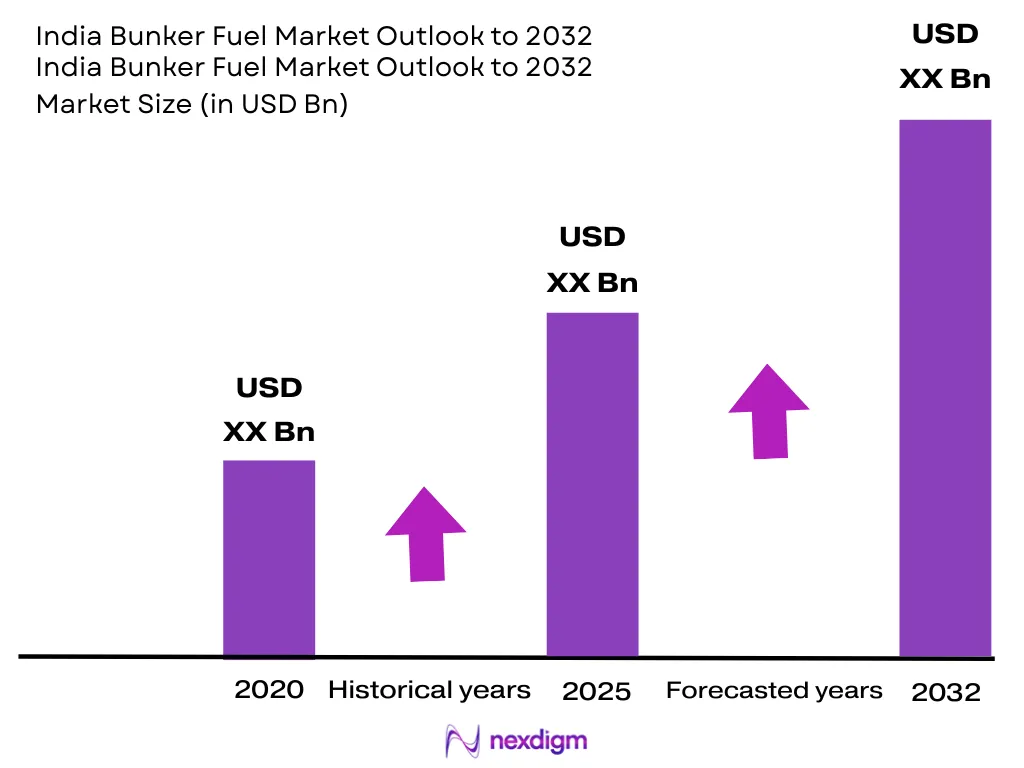
The India Bunker Fuel Market is valued at USD ~ Billion in 2024 and is projected to expand at a CAGR of ~% during the forecast period. The market is primarily supported by increasing maritime trade, rising cargo movement through Indian ports, refinery expansion, and the country’s strategic location along major East-West shipping routes. According to the Ministry of Ports, Shipping and Waterways, India’s major ports handled approximately 819 million tonnes of cargo during FY2023-24, compared with around 795 million tonnes in FY2022-23, reflecting continuous growth in maritime logistics. Simultaneously, bunkering activity witnessed significant acceleration, with 6,765 bunkering and ship-to-ship (STS) calls recorded during the first seven months of 2024 compared to 4,113 calls during the corresponding period of 2023, supported by shipping route diversions and favorable domestic fuel availability. These developments continue to strengthen India’s position as an emerging regional bunkering destination.
Market Segmentation
By Fuel Type
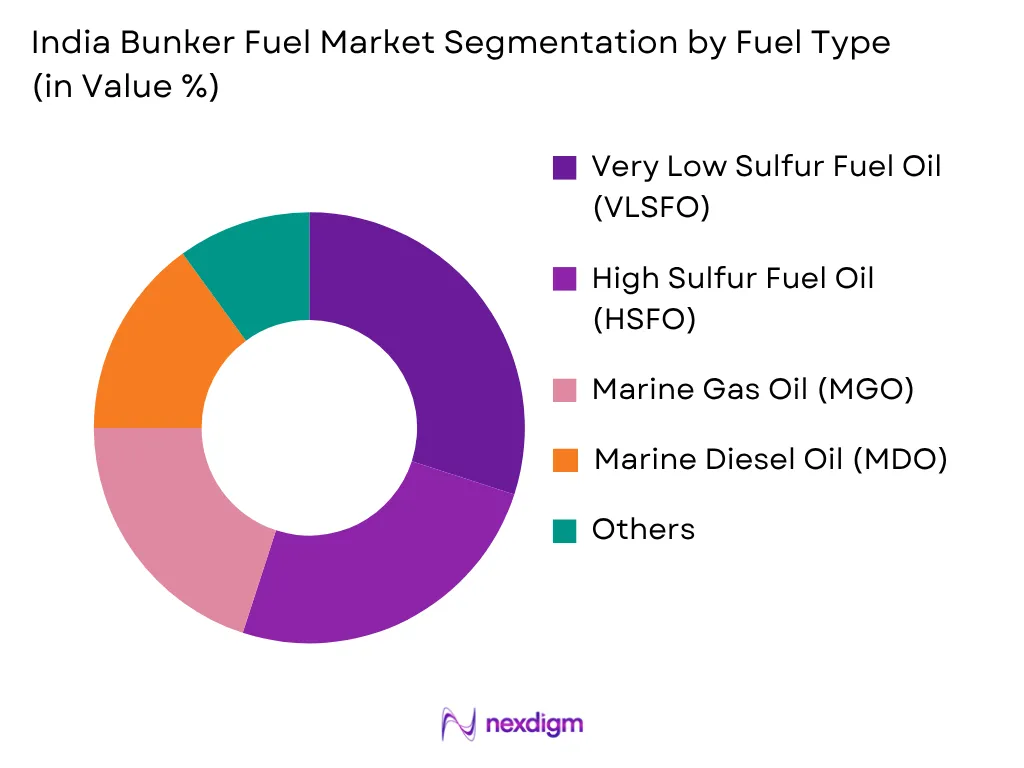
India Bunker Fuel Market is segmented by fuel type into Very Low Sulfur Fuel Oil (VLSFO), High Sulfur Fuel Oil (HSFO), Marine Gas Oil (MGO), Marine Diesel Oil (MDO), LNG bunkering fuel, and biofuel blends. Among these, Very Low Sulfur Fuel Oil (VLSFO) accounts for the largest market share owing to widespread compliance with the International Maritime Organization’s IMO 2020 sulfur regulations. The majority of international merchant vessels operating through Indian waters have shifted toward VLSFO because it offers regulatory compliance without requiring expensive exhaust gas scrubbers. Major refiners including Indian Oil Corporation, Bharat Petroleum, Hindustan Petroleum, Reliance Industries and Nayara Energy have significantly expanded domestic production of compliant marine fuels, improving supply consistency across major ports. The growing number of international container ships, crude tankers and bulk carriers calling at western and eastern Indian ports further reinforces demand for VLSFO, making it the preferred bunker fuel across commercial shipping operations.
By Vessel Type
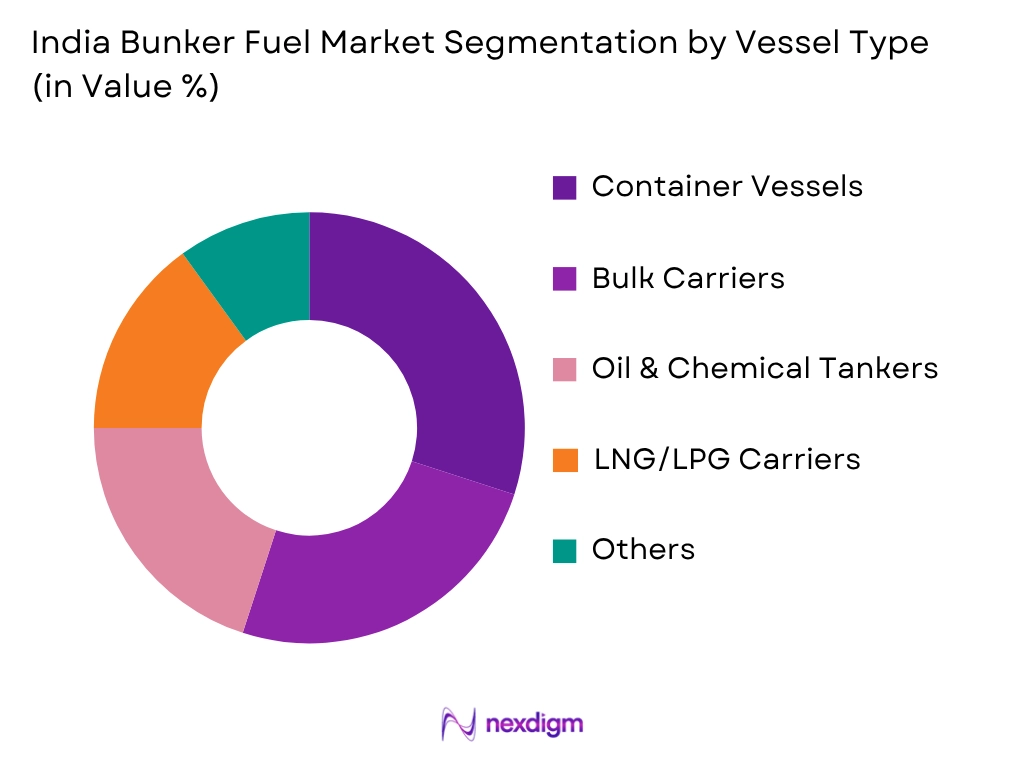
India Bunker Fuel Market is segmented by vessel type into container vessels, bulk carriers, oil and chemical tankers, LNG/LPG carriers, offshore support vessels, coastal vessels and passenger vessels. Container vessels dominate bunker fuel consumption because India continues to witness rapid expansion in containerized trade through ports such as Jawaharlal Nehru Port, Mundra, Chennai and Visakhapatnam. Growth in exports of engineering goods, pharmaceuticals, electronics, textiles and consumer products has substantially increased container traffic. Large international shipping companies operating scheduled liner services require reliable fuel availability and shorter turnaround times, encouraging regular bunkering at Indian ports. The increasing development of transshipment infrastructure, deeper draft facilities and improved port efficiency under the Sagarmala Programme further support container vessel traffic, enabling this segment to maintain the largest share of bunker fuel demand across the country.
Competitive Landscape
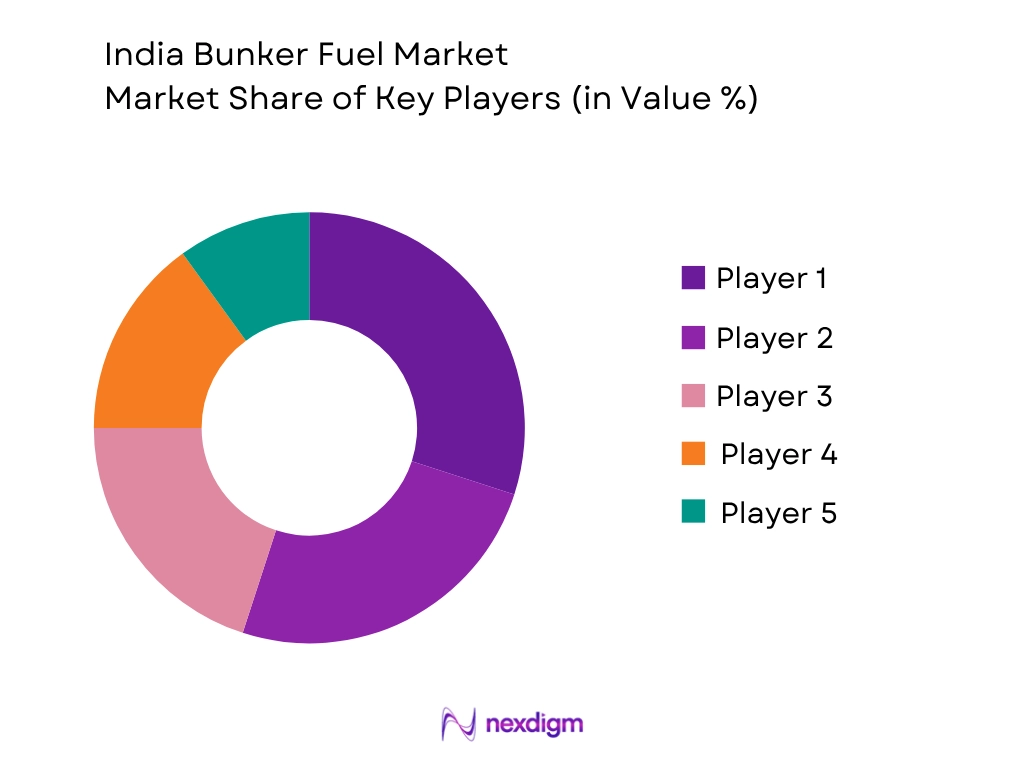
The India Bunker Fuel Market is moderately consolidated with a combination of integrated oil companies, domestic refiners and international marine fuel suppliers. Indian public sector oil companies continue to dominate physical bunker supply due to their extensive refinery networks and nationwide storage infrastructure. Private refiners and global bunker suppliers are increasingly strengthening their presence through strategic partnerships, digital bunker procurement platforms and expanded operations at high-traffic ports. Competition is primarily based on fuel availability, pricing, delivery reliability, marine fuel quality, storage capacity and compliance with international fuel standards.
| Company | Establishment Year | Headquarters | Fuel Portfolio | Major Bunkering Ports
|
Refinery Integration | Bunker Delivery Mode | Marine Fuel Grades | Storage & Terminal Network |
| Indian Oil Corporation | 1959 | ~ | ~ | ~ | ~ | ~ | ~ | ~ |
| Bharat Petroleum | 1952 | ~ | ~ | ~ | ~ | ~ | ~ | ~ |
| Hindustan Petroleum | 1974 | ~ | ~ | ~ | ~ | ~ | ~ | ~ |
| Reliance Industries | 1966 | ~ | ~ | ~ | ~ | ~ | ~ | ~ |
| Nayara Energy | 1989 | ~ | ~ | ~ | ~ | ~ | ~ | ~ |
India Bunker Fuel Market Analysis
Growth Drivers
Expansion of Maritime Trade and Cargo Throughput
India’s growing maritime trade has become one of the strongest drivers for bunker fuel demand, as increasing cargo volumes directly translate into higher vessel traffic and refueling requirements at Indian ports. During FY2023-24, India’s ports handled 1,540 million metric tonnes (MMT) of cargo, increasing from 1,434.19 MMT in the previous fiscal year. Of this, the country’s 12 major ports handled 819.23 MMT, compared with 784.31 MMT a year earlier. Petroleum, Oil and Lubricants (POL), which represent one of the largest cargo categories requiring extensive tanker movement, accounted for 218.10 million tonnes at major ports during FY2023-24. Container traffic also continued to expand, reaching 181.26 million tonnes at major ports, reflecting stronger international trade flows. India possesses a coastline of approximately 11,098 km, supported by 12 major ports and more than 200 non-major ports, enabling extensive marine logistics and fueling infrastructure. The continued growth in merchandise exports, crude oil imports, LNG shipments and containerized cargo has increased the frequency of vessel arrivals requiring marine fuel replenishment. Greater utilization of western ports such as Mundra, Kandla and Mumbai, together with eastern ports including Paradip and Visakhapatnam, has further strengthened bunker fuel consumption by accommodating larger international vessels and improving turnaround efficiency. Continuous investment in port modernization and maritime logistics under national infrastructure initiatives further supports long-term bunker fuel demand as larger cargo volumes create sustained marine fuel requirements.
Rising Bunkering Activity Supported by Domestic Refining Capacity
India’s bunkering industry has experienced substantial operational growth owing to increased international shipping activity, competitive marine fuel availability and strong domestic refining capacity. During the first seven months of 2024, Indian ports recorded 6,765 bunkering and ship-to-ship (STS) calls, compared with 4,113 calls during the corresponding period of the previous year. Mumbai alone registered a 53% increase in bunkering and STS operations as longer international shipping routes increased demand for marine fuel supplies. The increase was further supported by uninterrupted availability of bunker fuels from domestic refineries operated by Indian Oil Corporation, Bharat Petroleum, Hindustan Petroleum, Reliance Industries and Nayara Energy. India is among the world’s largest refining nations with refining complexes strategically located near major ports including Jamnagar, Vadinar, Kochi, Chennai and Paradip, allowing efficient supply of Very Low Sulfur Fuel Oil (VLSFO), High Sulfur Fuel Oil (HSFO) and Marine Gas Oil (MGO). The diversion of vessels around the Cape of Good Hope due to disruptions in the Red Sea significantly extended voyage distances, encouraging additional refueling stops at Indian ports. Stable refinery operations, improved marine fuel logistics and enhanced port infrastructure have collectively strengthened India’s competitiveness as an emerging regional bunkering destination while increasing bunker fuel demand across both commercial shipping and tanker operations.
Market Challenges
Competition from Established Global Bunkering Hubs
Despite rapid progress, India continues to face intense competition from established international bunkering hubs that possess larger storage infrastructure, deeper supplier networks and greater operational scale. Singapore, the world’s largest bunkering hub, recorded 54.92 million metric tonnes of marine fuel sales during 2024 while handling 41.12 million TEUs of container throughput and 3.11 billion gross tonnes of vessel arrivals. Such infrastructure enables global shipping companies to secure marine fuels through highly efficient supply chains with extensive fuel grade availability. Although India’s ports continue expanding bunkering capabilities, many international shipping operators still schedule primary refueling at established global hubs because of wider product availability, sophisticated bunker trading platforms and larger physical supplier ecosystems. Indian ports must also compete with regional bunkering centers such as Fujairah and Colombo, particularly for vessels operating on Asia-Europe shipping routes. Building internationally competitive storage capacity, expanding bunker barges, improving digital bunker procurement systems and enhancing delivery flexibility remain important challenges for India as it seeks to capture a larger share of international marine fuel demand while competing against mature global bunkering ecosystems.
Dependence on Global Shipping Routes and Geopolitical Disruptions
The India bunker fuel market remains highly influenced by international shipping patterns and geopolitical developments that affect vessel routing and marine fuel demand. The Red Sea security crisis demonstrated how geopolitical events can rapidly alter bunker consumption patterns by forcing ships to adopt significantly longer voyages around southern Africa. Although this temporarily increased bunkering demand at Indian ports, prolonged geopolitical uncertainty also creates volatility in shipping schedules, tanker deployment and fuel inventory management. India’s maritime sector additionally depends on continuous imports of crude oil for refinery operations, making bunker fuel supply indirectly sensitive to disruptions in global energy logistics. Petroleum, Oil and Lubricants remained the largest commodity handled at India’s major ports with approximately 254.5 million tonnes handled during FY2024-25, highlighting the close relationship between marine fuel availability and petroleum logistics. Maintaining uninterrupted bunker fuel supplies therefore requires resilient refinery operations, reliable crude imports and efficient port logistics despite evolving geopolitical risks. Operational disruptions caused by adverse weather conditions during the southwest monsoon further affect barge movements and offshore bunker deliveries at several western ports, creating seasonal logistical challenges for physical marine fuel suppliers.
Market Opportunities
Expansion of Green Marine Fuel Infrastructure
India’s transition toward cleaner maritime fuels presents a significant long-term opportunity for the bunker fuel market as ports and energy companies expand infrastructure for LNG, biofuels and green hydrogen-based marine fuels. The maritime sector carries nearly 95% of India’s external trade by volume, making decarbonization initiatives increasingly important for future bunker demand. Under the National Green Hydrogen Mission, the Government of India has approved an outlay of INR 19,744 crore to accelerate green hydrogen production and associated infrastructure. Three major ports—Deendayal (Kandla), Paradip and V.O. Chidambaranar (Tuticorin)—have been identified for development as Green Hydrogen Hubs, creating future opportunities for alternative marine fuel bunkering. Indian ports are simultaneously investing in LNG bunkering facilities, renewable energy integration and shore-power infrastructure to support cleaner vessel operations. The government has also targeted cleaner fuel adoption across port ecosystems by promoting LNG for port craft and logistics vehicles while expanding electrification of cargo-handling equipment. As global shipowners increasingly invest in dual-fuel vessels capable of operating on LNG, methanol and biofuels, India’s early investment in alternative bunkering infrastructure positions domestic ports to capture growing demand from environmentally compliant shipping fleets. These developments create opportunities for bunker suppliers to diversify product portfolios beyond conventional fuel oil while strengthening India’s competitiveness as a regional marine fuel hub.
Port Modernization and Strategic Maritime Corridor Development
Large-scale investments in port modernization and maritime logistics continue to create favorable conditions for sustained growth in India’s bunker fuel industry. The Sagarmala Programme encompasses more than 800 projects across port modernization, port connectivity enhancement, coastal economic zones and logistics infrastructure, significantly improving cargo movement efficiency and vessel turnaround times. Increasing private investment in commercial ports, expansion of container terminals and development of deep-draft berths enable accommodation of larger international vessels that require higher bunker fuel volumes during port calls. India’s western coastline, particularly Gujarat, continues to strengthen its role through integrated refinery-port ecosystems that provide uninterrupted marine fuel availability. The expansion of dedicated freight corridors, multimodal logistics parks and coastal shipping services further enhances cargo movement between ports, increasing marine traffic requiring bunker services. In addition, changing global shipping patterns following disruptions in traditional trade routes have encouraged several international shipping companies to increase operational dependence on Indian ports for refueling and logistics support. Simultaneously, government initiatives to improve ease of doing business at ports through digitalization, single-window clearance systems and operational efficiency improvements reduce vessel turnaround times, making Indian bunkering locations increasingly attractive for international shipping operators. Together, these structural developments create substantial opportunities for bunker suppliers, storage operators and marine fuel logistics providers to expand capacity and strengthen India’s position within the regional bunkering network.
Future Outlook
The India Bunker Fuel Market is expected to witness sustained expansion over the coming decade as maritime trade volumes continue to increase alongside government investment in port modernization and logistics infrastructure. The development of deep-water ports, expansion of coastal shipping, increasing refinery capacity and India’s growing role in global supply chains are expected to support bunker fuel demand. Adoption of cleaner marine fuels, digital bunkering solutions and alternative fuels such as LNG and biofuel blends will gradually reshape the competitive landscape. Strategic initiatives under Sagarmala and Maritime India Vision 2030 are likely to further strengthen India’s position as a preferred regional bunkering hub.
Major Players
- Indian Oil Corporation (IOC)
- Bharat Petroleum Corporation Limited (BPCL)
- Hindustan Petroleum Corporation Limited (HPCL)
- Reliance Industries Limited
- Nayara Energy
- Mangalore Refinery & Petrochemicals Limited (MRPL)
- Adani Bunkering Private Limited
- Shell India Markets Pvt. Ltd.
- TotalEnergies Marketing India Pvt. Ltd.
- ExxonMobil Marine Fuels
- Peninsula Petroleum
- Bunker One
- Monjasa
- Integr8 Fuels
- Seven Ocean Bunkering
Key Target Audience
- Shipping Companies and Fleet Operators
- Port Authorities and Terminal Operators
- Marine Fuel Suppliers and Physical Bunker Operators
- Oil Refining and Petroleum Companies
- Ship Management and Maritime Logistics Companies
- Investments and Venture Capitalist Firms
- Government and Regulatory Bodies (Ministry of Ports, Shipping and Waterways, Directorate General of Shipping, Petroleum and Natural Gas Regulatory Board (PNGRB), Indian Ports Association)
- Marine Infrastructure Developers and Port EPC Companies
Research Methodology
Step 1: Identification of Key Variables
The research process begins with developing an ecosystem map of the India Bunker Fuel Market by identifying all major stakeholders including refinery operators, bunker suppliers, shipping companies, port authorities, storage terminal operators and marine logistics providers. Extensive secondary research is conducted using government publications, port statistics, shipping databases, refinery reports and proprietary industry databases to identify the critical variables influencing market demand and supply.
Step 2: Market Analysis and Construction
Historical market information is compiled through analysis of bunker fuel consumption, vessel traffic, cargo throughput, refinery production, marine fuel pricing and port-wise bunkering activities. Both demand-side and supply-side analyses are performed to estimate market revenues, fuel consumption patterns and operational capacity. Bottom-up calculations are validated against macroeconomic indicators including international trade, coastal shipping growth and refinery output.
Step 3: Hypothesis Validation and Expert Consultation
The preliminary market estimates are validated through Computer Assisted Telephone Interviews (CATI) and structured discussions with senior executives from oil marketing companies, bunker suppliers, shipping operators, marine fuel traders, port authorities and maritime consultants. These expert interactions provide operational insights into pricing mechanisms, procurement strategies, regulatory developments and future investment trends, enabling refinement of market assumptions.
Step 4: Research Synthesis and Final Output
The final stage integrates insights obtained from primary interviews with findings from secondary research to develop a comprehensive assessment of the India Bunker Fuel Market. Multiple validation techniques including data triangulation, bottom-up market estimation and top-down verification are applied to ensure consistency and accuracy. The finalized report presents detailed market sizing, competitive benchmarking, segmentation analysis, strategic recommendations and long-term market forecasts.

- Executive Summary
- Research Methodology (Market Definitions and Assumptions, Abbreviations, Market Sizing Approach, Top-Down Analysis, Bottom-Up Analysis, Demand-Side Assessment, Supply-Side Assessment, Primary Interviews with Bunker Suppliers, Ship Owners & Port Authorities, Data Triangulation, Forecasting Framework, Limitations and Future Conclusions)

- Definition and Scope
- Industry Evolution and Market Genesis
- Timeline of Major Industry Developments
- India Maritime Trade and Bunkering Ecosystem
- Marine Fuel Supply Chain Analysis

- Growth Drivers (Rising Cargo Throughput, Expansion of Port Infrastructure, IMO 2020 Compliance, Growth in Coastal Shipping, Increasing Refinery Capacity, Sagarmala Programme, Growing International Trade, Emerging LNG Bunkering Infrastructure)
- Market Challenges (Bunker Price Volatility, Limited LNG Bunkering Infrastructure, High Port Charges, Supply Chain Disruptions, Refinery Maintenance Shutdowns, Geopolitical Risks, Environmental Compliance Costs, Competition from Global Bunkering Hubs)
- Market Opportunities (Green Shipping Transition, Biofuel Blended Marine Fuels, LNG Bunkering Expansion, Digital Bunkering Platforms, Growth of Transshipment Ports, Offshore Energy Projects, Cruise Shipping Growth, Strategic Port Modernization)
- Market Trends (Rapid VLSFO Adoption, Digital Fuel Procurement, Fuel Quality Monitoring, Carbon Intensity Compliance, Alternative Marine Fuel Trials, AI-Based Voyage Optimization, Increasing West Coast Bunkering Activity, Multi-Fuel Storage Infrastructure)
- Government Regulations (IMO MARPOL Annex VI Compliance, Sulfur Emission Standards, DG Shipping Guidelines, Port Authority Regulations, Customs & GST Framework, Petroleum Storage Regulations, Fuel Quality Standards, Environmental Emission Compliance)
- PESTLE Analysis
- SWOT Analysis
- Porter’s Five Forces Analysis
- Stakeholder Ecosystem
- Competition Ecosystem

- By Market Value (2020-2025)
- By Volume Consumption (2020-2025)
- By Average Bunker Price (2020-2025)

- By Fuel Type (In Value %)
Very Low Sulfur Fuel Oil (VLSFO)
High Sulfur Fuel Oil (HSFO)
Marine Gas Oil (MGO)
Low Sulfur Marine Gas Oil (LSMGO)
Marine Diesel Oil (MDO)
LNG Bunkering Fuel
Biofuel Blends & Alternative Marine Fuels - By Vessel Type (In Value %)
Container Vessels
Bulk Carriers
Crude Oil Tankers
Product Tankers
LNG/LPG Carriers
General Cargo Ships
Offshore Support Vessels
Coastal Vessels
Passenger & Cruise Ships
Naval & Defense Vessels - By Delivery Mode (In Value %)
Barge-to-Ship
Truck-to-Ship
Pipeline-to-Ship
Terminal-to-Ship - By Port Type (In Value %)
Major Government Ports
Private Commercial Ports
Container Ports
Bulk Cargo Ports
Offshore Terminals - By End User (In Value %)
International Shipping Lines
Coastal Shipping Operators
Oil & Gas Offshore Operators
Fishing Fleet Operators
Port Service Operators
Naval & Government Agencies

- Market Share of Major Players (By Value, Volume, Fuel Type, Port Presence, Delivery Mode)
- Cross Comparison Parameters (Physical Supply Network, Number of Bunkering Ports Served, Marine Fuel Storage Capacity, Marine Fuel Portfolio (VLSFO/HSFO/MGO/LNG), Barge Fleet Strength, Refinery Integration, Average Fuel Availability Rate, IMO-Compliant Fuel Capability)
- SWOT Analysis of Major Players
- Marine Fuel Pricing Analysis (Port-wise Bunker Premium, Fuel Grade-wise Pricing, Spot vs Contract Pricing, Supplier Margin Analysis)
- Port-wise Competitive Positioning
- Detailed Profiles of Major Companies
Indian Oil Corporation (IOC)
Bharat Petroleum Corporation Limited (BPCL)
Hindustan Petroleum Corporation Limited (HPCL)
Mangalore Refinery & Petrochemicals Limited (MRPL)
Reliance Industries Limited
Nayara Energy
Adani Bunkering Private Limited
Shell India Markets Pvt. Ltd.
TotalEnergies Marketing India Pvt. Ltd.
ExxonMobil Marine Fuels
Peninsula Petroleum
Bunker One
Monjasa
Seven Ocean Bunkering
Integr8 Fuels

- Marine Fuel Consumption Analysis (Average Bunker Consumption per Vessel Category, Fuel Mix, Voyage Patterns, Refueling Frequency)
- Procurement Behaviour Analysis (Spot Procurement, Contract Procurement, Supplier Selection Criteria, Price Sensitivity)
- Fleet Composition Analysis (Domestic Fleet, International Fleet, Coastal Fleet, Offshore Fleet)
- Fuel Purchasing Decision Factors (Price, Availability, Fuel Quality, Delivery Reliability, Credit Terms, Port Convenience)
- Customer Pain Point Analysis
- Sustainability Adoption Assessment (Low Sulfur Fuel Adoption, LNG Readiness, Carbon Reduction Initiatives)
- Purchase Decision-Making Process

- By Market Value (2026-2032)
- By Volume Consumption (2026-2032)
- By Average Bunker Price (2026-2032)


 Request a Sample
 Ask for Customization
 Get a Quote
 Enquire Now